REVIEW 3 major objections 5 minor 1 cited by
Casual3DHDR: Deblurring High Dynamic Range 3D Gaussian Splatting from Casually Captured Videos
T0 review · 3 major / 5 minor · reviewed 2026-08-16 · deepseek-v4-flash
Pith's one-line read Casual3DHDR claims that a handheld auto-exposure video, with unknown exposure times and motion blur, is sufficient input to reconstruct a high-dynamic-range 3D scene by jointly optimizing exposure, camera trajectory, and the camera…
desk verdict Casual3DHDR is a real step forward for HDR 3D reconstruction from casual video, but the exposure-time identifiability evidence is thinner than the central claim warrants. read the letter →
The pith
A machine-rendered reading of the paper's core claim, the machinery that carries it, and where it could break.
The reading
What carries the argument
The load-bearing object is the unified physical image-formation model $\mathbf{B}(x,y) = F\left(\int \mathbf{H}(x,y,P(t))\, dt\right)$, with $P(t)$ supplied by a cumulative SE(3) B-spline, a smooth curve through control knots that yields a camera pose at any timestamp. The spline makes camera motion during exposure differentiable, so blur is rendered as the average of virtual sharp views. Exposure time is the coupling variable: it determines how many virtual views the integral averages over and scales the accumulated irradiance before the camera response function maps it to pixel values. A per-channel MLP tone mapper plus an image-varying white-balance vector plays the role of $F$. Jointly optimizing all of these makes the blur width and brightness level mutually consistent, which is how the method separates scene radiance from camera state.
What would settle it
Run the method on a synthetic sequence with known ground-truth exposures, camera response curve, and HDR radiance, then compare the recovered HDR radiance and exposure times against ground truth in absolute units, not just rank correlation. A decisive test is to construct two different ground-truth camera-response/exposure combinations that produce nearly identical LDR frames and check whether optimization converges to the true combination or to an appearance-equivalent one.
Extended reading notes
Core claim
The central claim is that motion blur and exposure variation are not separate nuisances but two readings of the same physical quantity: the exposure interval. Along a continuous-time SE(3) B-spline trajectory, each observed low-dynamic-range frame is modeled as $\mathbf{B} = F\left(\int \mathbf{H}(x, y, P(t))\, dt\right)$, where $\mathbf{H}$ is the HDR radiance field, the integral averages over camera motion during the shutter interval to produce blur, and $F$ is a camera response function with white balance and per-channel tone mapping to produce brightness. Because exposure time controls both the width of the blur kernel and the total accumulated light, optimizing it couples deblurring with HDR reconstruction. The method learns the 3D HDR scene, the trajectory, the per-frame exposure times, and the camera response function jointly, and reports that this recovers usable exposure times, sharp frames, re-exposable HDR renders, and accurate poses even when exposure times are initialized randomly.
Load-bearing premise
The method assumes that, given only low-dynamic-range frames, the exposure times and camera response curve can be recovered as physical quantities even though the tone-mapping network and white-balance terms are also free to change; if those flexible components absorb the brightness differences, the optimized exposure times and HDR radiance might fit the images without being the true physical values.
Editorial extensions
If this is right
- A consumer camera's video mode, with auto-exposure on, becomes a sufficient input for 3D HDR reconstruction, with no exposure metadata, no RAW capture, and no tripod required.
- The same reconstruction yields sharp images at any chosen exposure, so deblurring and HDR exposure editing are derived outputs of one optimization rather than separate tasks.
- Because poses, exposure times, and the camera response curve are optimized together instead of in a separate preprocessing step, scenes where feature-based pose estimation fails under brightness changes and blur can still be reconstructed.
- Randomly initialized exposure times converge to values that track the true exposure times, so the pipeline can run without a calibration step.
- The continuous trajectory representation also provides camera poses at arbitrary timestamps, enabling high frame-rate novel-view rendering from low frame-rate input video.
Reading between the lines
- Editorial inference: If exposure recovery is only up to a global scale, as the appendix's correlation-based evaluation suggests, then the recovered HDR radiance is also known only up to an unknown multiplier; relative re-exposure editing survives, but absolute radiometric comparison across scenes does not.
- Editorial inference: Adding an explicit prior that keeps the learned tone-mapping curve smooth and monotone, or including a single calibration frame with known shutter speed, would likely convert the current correlation-level exposure recovery into absolute exposure calibration; that is a testable next step.
- Editorial inference: The same coupling of blur width and brightness through one timing parameter transfers naturally to rolling-shutter readout, event-camera capture, or mixed flash/no-flash video, where the timing parameter plays an analogous role.
Signed reviews
Editorial analysis
A structured set of objections, weighed in public.
Referee Report
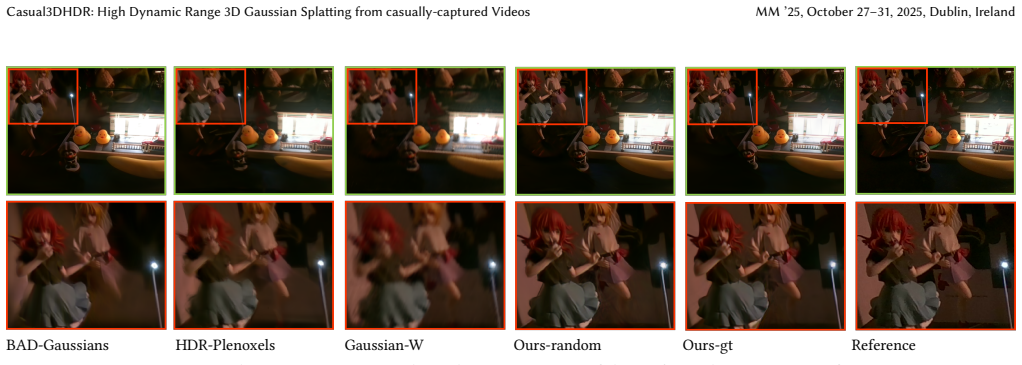
Summary. The paper proposes Casual3DHDR, a one-stage method for reconstructing 3D high dynamic range (HDR) scenes from casually captured auto-exposure videos that contain motion blur, brightness variation, and unknown, varying exposure times. The method represents camera motion with a cumulative SE(3) B-spline continuous-time trajectory, models motion blur as an average over virtual sharp frames during the exposure interval, and jointly optimizes the 3D Gaussian splatting scene, the trajectory, per-frame exposure times, and an implicit camera response function (CRF) composed of per-image white balance and per-channel tone-mapping MLPs. The loss combines an exposure-normalized reconstruction term with a D-SSIM term. Experiments on synthetic Blender scenes and real RealSense/Pixel/ScanNet sequences compare novel view synthesis, deblurring, and pose accuracy against HDR-NeRF, HDR-Plenoxels, Gaussian-W, BAD-Gaussians, and gsplat baselines, with ablations on trajectory initialization and on each model component.
Significance. If the central claim holds, the paper offers a practical advance: consumer-grade AE videos, with unknown exposure times and motion blur, would become sufficient input for HDR 3D scene reconstruction without calibrated exposure settings. The synthetic experiments cover the full blur-and-exposure setting and the proposed components are individually ablated, which is a strength. The dataset release is also a useful contribution. The NVS evaluation on held-out views against external baselines is not circular. However, the validation of the load-bearing exposure-time recovery is weak: only rank correlations on two real sequences are provided, and the flexible CRF/white-balance model may absorb the brightness signal that should constrain exposure times. I therefore regard the result as promising but not yet fully established.
major comments (3)
- [§3.3–3.4 and Appendix A.1] The paper does not establish that exposure times are identifiable from the proposed loss. The forward model in Eqs. (7)–(9) contains per-image white-balance gains (Eq. 10) and flexible per-channel tone-mapping MLPs, while the loss in Eq. (12) removes the absolute brightness scale by normalizing each image by its mean pixel value. There is a global scale ambiguity between the HDR radiance H and Δt, and more seriously, the white-balance and CRF components can absorb frame-to-frame brightness variations that should constrain Δt. The only quantitative validation, Table 8, reports rank correlations on two real sequences; rank metrics are invariant to monotonic transformations, and the correlations are computed on the same videos used for optimization, so they do not demonstrate absolute or predictive accuracy. Because recovery of unknown, varying exposure times is a central contribution, please report absolute or relative exposure-time error on the synthetic Blender scenes where ground-truth exposure times are known, and provide either an identifiability argument or an ablation that constrains the CRF/white-balance model to isolate the exposure-time signal.
- [§4.4 and Tables 2/10] The real-world NVS evaluation uses only manually selected sharp frames: the text states "we used 5 to 10 sharp images per sequence for evaluation." This protocol does not exercise the severe motion blur that is the motivating condition of the paper, and a method that fails on blurry frames could still score well on this sharp subset. Please evaluate on all captured frames, report sharp-frame and blurry-frame results separately, and specify the exact selection protocol and per-sequence numbers of selected frames.
- [Tables 1–8] No error bars or significance tests are reported; all comparisons are single runs despite stochastic components in training, including MCMC-based densification in gsplat and random exposure-time initialization (Sec. 4.2). For claims such as those in Table 5, where ATE differences between methods are fractions of a centimeter, the absence of variance estimates makes the claimed superiority impossible to assess. Please report mean±std over multiple seeds or runs, and where appropriate, paired significance tests.
minor comments (5)
- [Appendix A.1] The sentence "the results show that we can estimate exposure times :" is incomplete and should be finished or removed; also, Figure 9 plots estimates that are scaled uniformly, so the figure cannot be read as evidence of absolute accuracy.
- [§4.2, §4.3, §2.1, §6] Several typos remain, for example "Sythetic" (Sec. 4.2), "server motion blur" (Sec. 4.3), "image domian translation" (Sec. 2.1), and "Acknowldement" (Section 6).
- [§2.3] The citation [34] is used for NeRF, but [34] is NeRF-W; the correct NeRF reference appears to be [36], so the citation should be corrected.
- [Appendix A.2/A.3] Table 9 duplicates the BAD-Gaussians rows of Table 3, and Table 10 repeats the real-dataset rows of Table 2; the supplementary material should refer to the main tables instead of duplicating them.
- [§3.3 and §4.2] The CRF module is described only as per-channel MLPs; please specify the architecture details, including number of layers, hidden size, activation function, and initialization, in the implementation section.
Circularity Check
No significant circularity: held-out novel-view, deblur, and pose evaluations give the central claims independent content.
full rationale
The derivation chain is a forward physical imaging model (Eqs. 7-10: irradiance integration over a continuous SE(3) trajectory, then a learned CRF with per-image white balance) whose parameters—3D Gaussians, spline control knots, exposure times, and CRF—are optimized against the per-frame reconstruction loss (Eqs. 11-12). The central claims are not equivalent to the inputs by construction. Novel-view synthesis is evaluated on held-out views against independent baselines (Tables 1-2, 10); pose recovery is evaluated against Vicon ground truth with ATE (Table 5); deblurring is compared against synthetic sharp ground truth and with the external BRISQUE metric on ScanNet (Tables 3-4, 9). The main caveat is Appendix A.1: exposure-time 'estimation' is validated only by rank correlations on the training videos, and Eq. 12's mean normalization plus per-image white balance weakens the brightness constraint on exposure times. That is an identifiability and validation weakness, not a circular reduction: no predicted quantity is defined as, or statistically forced to be, a fitted input, and the authors explicitly acknowledge the constant-scale ambiguity. Self-citations to BAD-NeRF and BAD-Gaussians are prior published baselines and are used as starting points, not as uniqueness arguments or as substitutes for the held-out evaluation. Therefore no load-bearing circular step is present.
Assumptions & free parameters
free parameters (6)
- Per-frame exposure time Δt =
optimized, initialized randomly
- Per-channel tone-mapping MLP weights =
learned
- White balance gains wb_r, wb_g, wb_b =
learned
- Exposure-normalized loss weight λexp =
0.25
- Number of virtual camera poses N =
10
- Spline control knot ratio =
3.0
assumptions (6)
- domain assumption A blurry LDR frame equals the camera response function applied to the time integral of scene irradiance over the exposure interval (Eq. 7).
- domain assumption Camera motion during exposure is captured by a continuous SE(3) B-spline with uniformly spaced control knots and is discretized by averaging N virtual sharp frames (Eqs. 5-8).
- ad hoc to paper The camera response function decomposes into image-varying white balance followed by a per-channel tone-mapping MLP (Eqs. 9-10).
- domain assumption Exposure times are identifiable from the video up to a global scale given the shared scene and CRF.
- domain assumption Scene radiance is static during capture; brightness changes come only from exposure time, white balance, and tone mapping.
- standard math Cumulative SE(3) B-spline interpolation formulas (Eqs. 5-6) are correct as given by the cited literature.
Cite this review
Pith. "Pith review of Casual3DHDR: Deblurring High Dynamic Range 3D Gaussian Splatting from Casually Captured Videos." pith.science (2026). https://pith.science/paper/IPPGOUR5
@misc{pith2026250417728,
  author       = {Pith},
  title        = {Pith review of: Casual3DHDR: Deblurring High Dynamic Range 3D Gaussian Splatting from Casually Captured Videos},
  year         = {2026},
  howpublished = {\url{https://pith.science/paper/IPPGOUR5}},
  note         = {Machine review of arXiv:2504.17728}
}
read the original abstract
Photo-realistic novel view synthesis from multi-view images, such as neural radiance field (NeRF) and 3D Gaussian Splatting (3DGS), has gained significant attention for its superior performance. However, most existing methods rely on low dynamic range (LDR) images, limiting their ability to capture detailed scenes in high-contrast environments. While some prior works address high dynamic range (HDR) scene reconstruction, they typically require multi-view sharp images with varying exposure times captured at fixed camera positions, which is time-consuming and impractical. To make data acquisition more flexible, we propose \textbf{Casual3DHDR}, a robust one-stage method that reconstructs 3D HDR scenes from casually-captured auto-exposure (AE) videos, even under severe motion blur and unknown, varying exposure times. Our approach integrates a continuous-time camera trajectory into a unified physical imaging model, jointly optimizing exposure times, camera trajectory, and the camera response function (CRF). Extensive experiments on synthetic and real-world datasets demonstrate that \textbf{Casual3DHDR} outperforms existing methods in robustness and rendering quality. Our source code and dataset will be available at https://lingzhezhao.github.io/CasualHDRSplat/
Figures


Figures from the paper (11 more)


Forward citations
Cited by 1 Pith paper
-
A Hybrid Neural-Microfacet BRDF Model for Real-Time Rendering
A hybrid BRDF model, combining a GGX analytical term with a tiny learned residual and gating network, fits measured materials more accurately than fully neural models at equal memory cost.
Reference graph
Works this paper leans on
-
[1]
Jyrki Alakuijala, Ruud Van Asseldonk, Sami Boukortt, Martin Bruse, Iulia-Maria Coms,a, Moritz Firsching, Thomas Fischbacher, Evgenii Kliuchnikov, Sebastian Gomez, Robert Obryk, et al. 2019. JPEG XL next-generation image compression architecture and coding tools. In Applications of digital image processing XLII , Vol. 11137. SPIE, 112–124
work page 2019
-
[2]
Gwangtak Bae, Changwoon Choi, Hyeongjun Heo, Sang Min Kim, and Young Min Kim. 2024. I2-SLAM: Inverting Imaging Process for Robust Photorealistic Dense SLAM. In ECCV. Springer, 72–89
work page 2024
-
[3]
Adam Bry, Charles Richter, Abraham Bachrach, and Nicholas Roy. 2015. Aggres- sive flight of fixed-wing and quadrotor aircraft in dense indoor environments. 34, 7 (2015), 969–1002
work page 2015
-
[4]
Yuanhao Cai, Zihao Xiao, Yixun Liang, Minghan Qin, Yulun Zhang, Xi- aokang Yang, Yaoyao Liu, and Alan Yuille. 2024. HDR-GS: Efficient High Dynamic Range Novel View Synthesis at 1000x Speed via Gaussian Splatting. arXiv:2405.15125 [cs.CV] https://arxiv.org/abs/2405.15125
work page Pith review arXiv 2024
-
[5]
Wenbo Chen and Ligang Liu. 2024. Deblur-GS: 3D Gaussian Splatting from Camera Motion Blurred Images. Proceedings of the ACM on Computer Graphics and Interactive Techniques 7, 1 (2024), 1–15
work page 2024
-
[6]
Sunghyun Cho and Seungyong Lee. 2009. Fast motion deblurring. In ACM SIGGRAPH Asia 2009 papers . 1–8
work page 2009
-
[7]
Chang, Manolis Savva, Maciej Halber, Thomas Funkhouser, and Matthias Nießner
Angela Dai, Angel X. Chang, Manolis Savva, Maciej Halber, Thomas Funkhouser, and Matthias Nießner. 2017. ScanNet: Richly-annotated 3D Reconstructions of Indoor Scenes. In Proc. Computer Vision and Pattern Recognition (CVPR), IEEE
2017
-
[8]
Yang Fu, Sifei Liu, Amey Kulkarni, Jan Kautz, Alexei A. Efros, and Xiaolong Wang. 2024. COLMAP-Free 3D Gaussian Splatting. InProceedings of the IEEE/CVF Conference on Computer Vision and Pattern Recognition (CVPR) . 20796–20805
work page 2024
Show all 75 references
-
[9]
Paul Furgale, Timothy D Barfoot, and Gabe Sibley. 2012. Continuous-time batch estimation using temporal basis functions. IEEE, 2088–2095
2012
-
[10]
Patrick Geneva, Kevin Eckenhoff, Woosik Lee, Yulin Yang, and Guoquan Huang
-
[11]
Yulia Gryaditskaya, Tania Pouli, Erik Reinhard, Karol Myszkowski, and Hans- Peter Seidel. 2015. Motion Aware Exposure Bracketing for HDR Video. Computer Graphics Forum (Proc. EGSR) (2015). https://doi.org/10.1111/cgf.12684
2015 doi
-
[12]
Miska M Hannuksela, Jani Lainema, and Vinod K Malamal Vadakital. 2015. The high efficiency image file format standard [standards in a nutshell]. IEEE Signal Processing Magazine 32, 4 (2015), 150–156
2015
-
[13]
Xin Huang, Qi Zhang, Ying Feng, Hongdong Li, and Qing Wang. 2024. LTM- NeRF: Embedding 3D Local Tone Mapping in HDR Neural Radiance Field. IEEE Transactions on Pattern Analysis and Machine Intelligence (2024)
2024
-
[14]
Xin Huang, Qi Zhang, Ying Feng, Hongdong Li, Xuan Wang, and Qing Wang
-
[15]
ITU-R. 2018. BT.2100 : Image parameter values for high dynamic range tele- vision for use in production and international programme exchange. ITU-R Recommendations (2018). https://www.itu.int/rec/R-REC-BT.2100-2-201807-I/
2018
-
[16]
Xin Jin, Pengyi Jiao, Zheng-Peng Duan, Xingchao Yang, Chun-Le Guo, Bo Ren, and Chong-Yi Li. 2024. Lighting Every Darkness with 3DGS: Fast Training and Real-Time Rendering for HDR View Synthesis. In arxiv preprint
2024
-
[17]
Kim Jun-Seong, Kim Yu-Ji, Moon Ye-Bin, and Tae-Hyun Oh. 2022. HDR-Plenoxels: Self-Calibrating High Dynamic Range Radiance Fields. In ECCV
2022
-
[18]
Bernhard Kerbl, Georgios Kopanas, Thomas Leimkühler, and George Drettakis
-
[19]
Shakiba Kheradmand, Daniel Rebain, Gopal Sharma, Weiwei Sun, Jeff Tseng, Hossam Isack, Abhishek Kar, Andrea Tagliasacchi, and Kwang Moo Yi. 2024. 3D Gaussian Splatting as Markov Chain Monte Carlo.arXiv preprint arXiv:2404.09591 (2024)
2024 arXiv
-
[20]
Dilip Krishnan and Rob Fergus. 2009. Fast Image Deconvolution using Hyper- Laplacian Priors. In Advances in Neural Information Processing Systems , Y. Bengio, D. Schuurmans, J. Lafferty, C. Williams, and A. Culotta (Eds.), Vol. 22. Cur- ran Associates, Inc. https://proceedings...
2009
-
[21]
Dogyoon Lee, Minhyeok Lee, Chajin Shin, and Sangyoun Lee. 2023. DP-NeRF: Deblurred neural radiance field with physical scene priors. In Proceedings of the IEEE/CVF Conference on Computer Vision and Pattern Recognition . 12386–12396
2023
-
[22]
Dongwoo Lee, Jeongtaek Oh, Jaesung Rim, Sunghyun Cho, and Kyoung Mu Lee
-
[23]
Junghe Lee, Donghyeong Kim, Dogyoon Lee, Suhwan Cho, and Sangyoun Lee
-
[24]
Jungho Lee, Dogyoon Lee, Minhyeok Lee, Donghyung Kim, and Sangyoun Lee
-
[25]
Moyang Li, Peng Wang, Lingzhe Zhao, Bangyan Liao, and Peidong Liu. 2024. USB-NeRF: Unrolling Shutter Bundle Adjusted Neural Radiance Fields. In ICLR
2024
-
[26]
ExBluRF: Efficient Radiance Fields for Extreme Motion Blurred Images. In ICCV. 17639–17648
-
[27]
Zhan Li, Zhang Chen, Zhong Li, and Yi Xu. 2024. Spacetime Gaussian Feature Splatting for Real-Time Dynamic View Synthesis. In Proceedings of the IEEE/CVF Conference on Computer Vision and Pattern Recognition (CVPR) . 8508–8520
2024
-
[28]
Zhengqi Li, Qianqian Wang, Forrester Cole, Richard Tucker, and Noah Snavely
-
[29]
Youtian Lin, Zuozhuo Dai, Siyu Zhu, and Yao Yao. 2024. Gaussian-flow: 4d reconstruction with dynamic 3d gaussian particle. In Proceedings of the IEEE/CVF Conference on Computer Vision and Pattern Recognition . 21136–21145
2024
-
[30]
arXiv preprint arXiv:2403.07547 (2024)
SMURF: Continuous Dynamics for Motion-Deblurring Radiance Fields. arXiv preprint arXiv:2403.07547 (2024)
2024 arXiv
-
[31]
Yu-Lun Liu, Wei-Sheng Lai, Yu-Sheng Chen, Yi-Lung Kao, Ming-Hsuan Yang, Yung-Yu Chuang, and Jia-Bin Huang. 2020. Single-image HDR reconstruction by learning to reverse the camera pipeline. In Proceedings of the IEEE/CVF conference on computer vision and pattern recognition . 1651–1660
2020
-
[32]
Wenpu Li, Pian Wan, Peng Wang, Jinhang Li, Yi Zhou, and Peidong Liu. 2024. BeNeRF: Neural Radiance Fields from a Single Blurry Image and Event Stream. In ECCV
2024
-
[33]
Li Ma, Xiaoyu Li, Jing Liao, Qi Zhang, Xuan Wang, Jue Wang, and Pedro V. Sander
-
[34]
Ricardo Martin-Brualla, Noha Radwan, Mehdi S. M. Sajjadi, Jonathan T. Barron, Alexey Dosovitskiy, and Daniel Duckworth. 2021. NeRF in the Wild: Neural Radiance Fields for Unconstrained Photo Collections. In CVPR
2021
-
[35]
2023 IEEE/CVF Con- ference on Computer Vision and Pattern Recognition (CVPR) (2022), 4273–4284
DynIBaR: Neural Dynamic Image-Based Rendering. 2023 IEEE/CVF Con- ference on Computer Vision and Pattern Recognition (CVPR) (2022), 4273–4284. https://api.semanticscholar.org/CorpusID:253734533
2022
-
[36]
Srinivasan, Matthew Tancik, Jonathan T
Ben Mildenhall, Pratul P. Srinivasan, Matthew Tancik, Jonathan T. Barron, Ravi Ramamoorthi, and Ren Ng. 2020. NeRF: Representing Scenes as Neural Radiance Fields for View Synthesis. In ECCV
2020
-
[37]
Lahav Lipson, Zachary Teed, and Jia Deng. 2024. Deep Patch Visual SLAM. In European Conference on Computer Vision
2024
-
[38]
Elias Mueggler, Guillermo Gallego, Henri Rebecq, and Davide Scaramuzza. 2018. Continuous-time visual-inertial odometry for event cameras. 34, 6 (2018), 1425– 1440
2018
-
[39]
Steven Lovegrove, Alonso Patron-Perez, and Gabe Sibley. 2013. Spline Fusion: A continuous-time representation for visual-inertial fusion with application to rolling shutter cameras.. In BMVC
2013
-
[40]
Jeongtaek Oh, Jaeyoung Chung, Dongwoo Lee, and Kyoung Mu Lee. 2024. DeblurGS: Gaussian Splatting for Camera Motion Blur. arXiv preprint arXiv:2404.11358 (2024)
2024 arXiv
-
[41]
Cheng Peng and Rama Chellappa. 2022. PDRF: Progressively Deblurring Radiance Field for Fast and Robust Scene Reconstruction from Blurry Images. In AAAI Conference on Artificial Intelligence. https://api.semanticscholar.org/CorpusID: 251622408
2022
-
[42]
Yunshan Qi, Lin Zhu, Yifan Zhao, Nan Bao, and Jia Li. 2024. Deblurring Neural Radiance Fields with Event-driven Bundle Adjustment. arXiv preprint arXiv:2406.14360 (2024)
2024 arXiv
-
[43]
Srinivasan, and Jonathan T
Ben Mildenhall, Peter Hedman, Ricardo Martin-Brualla, Pratul P. Srinivasan, and Jonathan T. Barron. 2022. NeRF in the Dark: High Dynamic Range View Synthesis from Noisy Raw Images. CVPR (2022)
2022
-
[44]
Joern Rehder, Janosch Nikolic, Thomas Schneider, Timo Hinzmann, and Roland Siegwart. 2016. Extending kalibr: Calibrating the extrinsics of multiple IMUs and of individual axes. IEEE, 4304–4311
2016
-
[45]
Anish Mittal, Anush Krishna Moorthy, and Alan Conrad Bovik. 2012. No- reference image quality assessment in the spatial domain. IEEE Transactions on image processing 21, 12 (2012), 4695–4708
2012
-
[46]
Meng-Li Shih, Jia-Bin Huang, Changil Kim, Rajvi Shah, Johannes Kopf, and Chen Gao. 2024. Modeling Ambient Scene Dynamics for Free-view Synthesis. In ACM SIGGRAPH 2024 Conference Papers (Denver, CO, USA) (SIGGRAPH ’24). Association for Computing Machinery, New York, NY, USA, Ar...
2024
-
[47]
Thomas Müller, Alex Evans, Christoph Schied, and Alexander Keller. 2022. Instant Neural Graphics Primitives with a Multiresolution Hash Encoding. ACM Trans. Graph. 41, 4, Article 102 (July 2022), 15 pages. https://doi.org/10.1145/3528223. 3530127
2022 doi
-
[48]
Huiqiang Sun, Xingyi Li, Liao Shen, Xinyi Ye, Ke Xian, and Zhiguo Cao. 2024. DyBluRF: Dynamic Neural Radiance Fields from Blurry Monocular Video. 2024 IEEE/CVF Conference on Computer Vision and Pattern Recognition (CVPR) (2024), 7517–7527. https://api.semanticscholar.org/Corpu...
2024
-
[49]
Wei Zhi Tang, Daniel Rebain, Kostantinos G Derpanis, and Kwang Moo Yi. 2024. LSE-NeRF: Learning Sensor Modeling Errors for Deblured Neural Radiance Fields with RGB-Event Stereo. arXiv preprint arXiv:2409.06104 (2024). MM ’25, October 27–31, 2025, Dublin, Ireland Shucheng Gong et al
2024 arXiv
-
[50]
Fu-Jen Tsai, Yan-Tsung Peng, Yen-Yu Lin, Chung-Chi Tsai, and Chia-Wen Lin
-
[51]
Kaihuai Qin. 1998. General Matrix Representations for B-Splines. In Sixth Pacific Conference on Computer Graphics and Applications
1998
-
[52]
Chao Wang, Krzysztof Wolski, Bernhard Kerbl, Ana Serrano, Mojtaba Bemana, Hans-Peter Seidel, Karol Myszkowski, and Thomas Leimkühler. 2024. Cinematic Gaussians: Real-Time HDR Radiance Fields with Depth of Field. arXiv preprint arXiv:2406.07329 (2024)
2024 arXiv
-
[53]
Paul-Edouard Sarlin, Cesar Cadena, Roland Siegwart, and Marcin Dymczyk. 2019. From Coarse to Fine: Robust Hierarchical Localization at Large Scale. In CVPR
2019
-
[54]
Qianqian Wang, Vickie Ye, Hang Gao, Jake Austin, Zhengqi Li, and Angjoo Kanazawa. 2024. Shape of Motion: 4D Reconstruction from a Single Video. arXiv preprint arXiv:2407.13764 (2024)
2024
-
[55]
Yuanhang Su and C-C Jay Kuo. 2015. Fast and robust camera’s auto exposure control using convex or concave model. In 2015 IEEE International Conference on Consumer Electronics (ICCE). IEEE, 13–14
2015
-
[56]
Bovik, H.R
Zhou Wang, A.C. Bovik, H.R. Sheikh, and E.P. Simoncelli. 2004. Image quality assessment: from error visibility to structural similarity. IEEE Transactions on Image Processing 13, 4 (2004), 600–612. https://doi.org/10.1109/TIP.2003.819861
2004
-
[57]
Jiahao Wu, Lu Xiao, Rui Peng, Kaiqiang Xiong, and Ronggang Wang. 2024. HDRGS: High Dynamic Range Gaussian Splatting. arXiv:2408.06543 [cs.CV] https://arxiv.org/abs/2408.06543
2024 arXiv
-
[58]
Vickie Ye, Ruilong Li, Justin Kerr, Matias Turkulainen, Brent Yi, Zhuoyang Pan, Otto Seiskari, Jianbo Ye, Jeffrey Hu, Matthew Tancik, and Angjoo Kanazawa
-
[59]
Stripformer: Strip Transformer for Fast Image Deblurring. In ECCV
-
[60]
Chaoyang Wang, Ben Eckart, Simon Lucey, and Orazio Gallo. 2021. Neural Trajec- tory Fields for Dynamic Novel View Synthesis. ArXiv Preprint. arXiv:2105.05994
2021 arXiv
-
[61]
Dongbin Zhang, Chuming Wang, Weitao Wang, Peihao Li, Minghan Qin, and Hao- qian Wang. 2024. Gaussian in the Wild: 3D Gaussian Splatting for Unconstrained Image Collections. arXiv preprint arXiv:2403.15704 (2024)
2024 arXiv
-
[62]
Peng Wang, Lingzhe Zhao, Ruijie Ma, and Peidong Liu. 2023. BAD-NeRF: Bundle Adjusted Deblur Neural Radiance Fields. In CVPR. 4170–4179
2023
-
[63]
Lingzhe Zhao, Peng Wang, and Peidong Liu. 2024. BAD-Gaussians: Bundle Adjusted Deblur Gaussian Splatting. In ECCV
2024
-
[64]
Yuehao Wang, Chaoyi Wang, Bingchen Gong, and Tianfan Xue. 2024. Bilateral Guided Radiance Field Processing. ACM Transactions on Graphics (TOG) 43, 4 (2024), 1–13
2024
-
[68]
arXiv preprint arXiv:2409.06765 (2024)
gsplat: An Open-Source Library for Gaussian Splatting. arXiv preprint arXiv:2409.06765 (2024). arXiv:2409.06765 [cs.CV] https://arxiv.org/abs/2409. 06765
2024 arXiv
-
[69]
Wangbo Yu, Chaoran Feng, Jiye Tang, Xu Jia, Li Yuan, and Yonghong Tian. 2024. EvaGaussians: Event Stream Assisted Gaussian Splatting from Blurry Images. arXiv preprint arXiv:2405.20224 (2024)
2024 arXiv
-
[70]
Syed Waqas Zamir, Aditya Arora, Salman Khan, Munawar Hayat, Fahad Shahbaz Khan, Ming-Hsuan Yang, and Ling Shao. 2021. Multi-Stage Progressive Image Restoration. In CVPR
2021
-
[72]
Efros, Eli Shechtman, and Oliver Wang
Richard Zhang, Phillip Isola, Alexei A. Efros, Eli Shechtman, and Oliver Wang
-
[75]
Boyu Zhou, Fei Gao, Luqi Wang, Chuhao Liu, and Shaojie Shen. 2019. Robust and efficient quadrotor trajectory generation for fast autonomous flight. 4, 4 (2019), 3529–3536
2019
-
[2018]
arXiv:1801.03924 [cs.CV] https://arxiv.org/abs/1801.03924
The Unreasonable Effectiveness of Deep Features as a Perceptual Metric. arXiv:1801.03924 [cs.CV] https://arxiv.org/abs/1801.03924
-
[2020]
IEEE, 4666–4672
OpenVINS: A Research Platform for Visual-Inertial Estimation. IEEE, 4666–4672
-
[2021]
arXiv preprint arXiv:2111.14292 (2021)
Deblur-NeRF: Neural Radiance Fields from Blurry Images. arXiv preprint arXiv:2111.14292 (2021)
2021 arXiv
-
[2022]
HDR-NeRF: High Dynamic Range Neural Radiance Fields. In CVPR. 18398– 18408
-
[2023]
ACM TOG 42, 4 (July 2023)
3D Gaussian Splatting for Real-Time Radiance Field Rendering. ACM TOG 42, 4 (July 2023). https://repo-sam.inria.fr/fungraph/3d-gaussian-splatting/
2023
-
[2024]
arXiv preprint arXiv:2407.03923 (2024)
CRiM-GS: Continuous Rigid Motion-Aware Gaussian Splatting from Motion Blur Images. arXiv preprint arXiv:2407.03923 (2024)
2024 arXiv
Reviewed August 16, 2026 · model on record in the stance chip above.
Discussion (0). Continue with ORCID to comment.