REVIEW 2 major objections 6 minor 1 cited by
Fermi Unassociated Sources in the MeerKAT Absorption Line Survey
T0 review · 2 major / 6 minor · reviewed 2026-08-11 · deepseek-v4-flash
Pith's one-line read Deep MeerKAT images find nine pulsar candidates inside Fermi's unassociated gamma-ray sources, four of them prime follow-up targets.
desk verdict A clear and honest candidate list from MALS DR1, but without a background estimate the Fermi association claim rests on unquantified ground. read the letter →
The pith
A machine-rendered reading of the paper's core claim, the machinery that carries it, and where it could break.
The reading
What carries the argument
The machinery is an image-based selection ladder. MALS provides in-band spectral indices measured between two frequency windows centered near 1006 MHz and 1381 MHz, so a source can be tagged as steep-spectrum with $\alpha < -1.4$ without combining data from different telescopes and epochs. The catalog's compactness criterion (peak-to-total flux ratio less than 1.2) removes resolved galaxies, and the surviving sources are then run through a radio/optical/infrared classification flowchart that assigns each as a radio galaxy, a Tier 2 pulsar candidate, or a Tier 1 pulsar candidate based on detections in RACS-low1, WISE, PanSTARRS, or DECaLS.
What would settle it
Compute the expected number of MALS compact sources with $\alpha < -1.4$ inside the combined area of the 74 Fermi error ellipses using the survey's source density and the measured spectral-index distribution; if the expected background is comparable to 50, the candidate list is likely dominated by chance coincidences. A targeted pulsation search of the four Tier 1 positions that finds no periodic signals would also falsify the claim that these are Fermi's pulsar counterparts.
Extended reading notes
Core claim
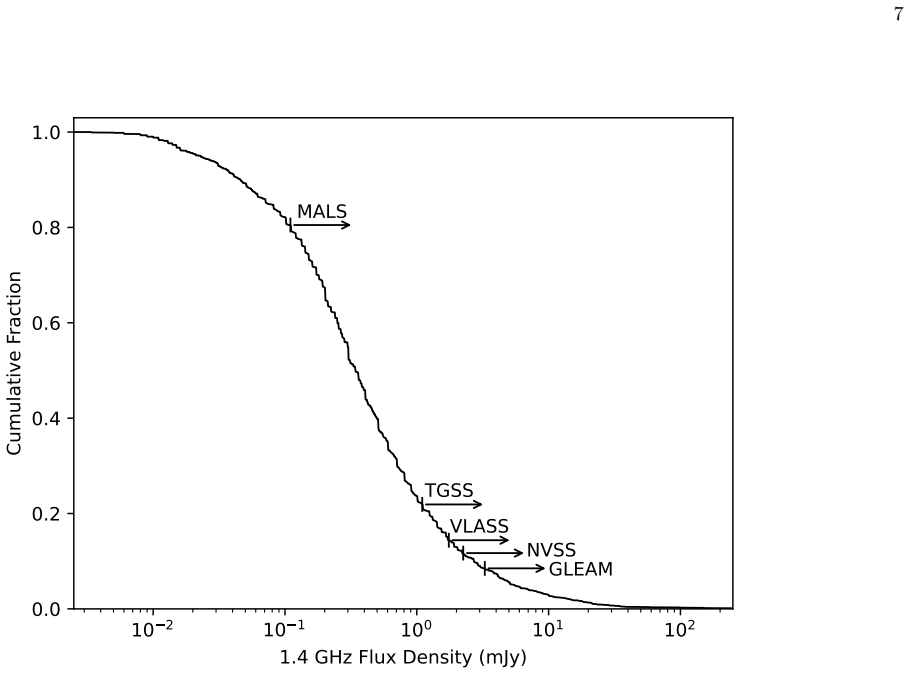
The central discovery is that image-based selection using MALS DR1 yields a manageable set of 50 compact steep-spectrum radio sources (in-band spectral index below -1.4) inside the 95 percent confidence ellipses of Fermi unassociated sources, and that combining this with optical and infrared color classification leaves nine pulsar candidates, four of them Tier 1, that are worthy of follow-up pulsation searches. The same sensitivity calculation shows that MALS should detect about 80 percent of the known pulsar population at 1.4 GHz, compared with 7 to 21 percent for earlier surveys such as NVSS and TGSS. The authors are careful to present these as candidates rather than detections: two of the four Tier 1 objects sit near Fermi sources with possible blazar associations, and confirmation requires detecting periodic pulsations.
Load-bearing premise
The candidates are treated as likely counterparts rather than chance alignments, yet the paper does not estimate how many compact steep-spectrum sources should randomly fall inside the 74 Fermi error ellipses; with MALS's source density of roughly 210 per square degree, background radio galaxies could plausibly account for many or all of the 50 selected sources.
Editorial extensions
If this is right
- The four Tier 1 candidates, toward 4FGL J0041.3-0048, J0634.6-3046c, J1245.4-0701, and J1334.8-3856, should be the first targets for pulsation searches; if they are pulsars, their radio-versus-gamma-ray flux ratios suggest they are likely millisecond pulsars.
- The 41 radio galaxy candidates, being compact and steep-spectrum, are plausible high-redshift radio galaxy candidates and can feed searches for distant AGN.
- Because MALS can image 80 percent of known pulsars, future wide-area surveys with MeerKAT, ASKAP, or the Square Kilometre Array can find pulsar candidates by imaging first and folding data later, rather than searching blindly.
- Measuring spectral indices within a single survey removes false candidates caused by variability between different telescopes and epochs, a known contaminant in earlier image-based pulsar searches.
- Future MALS data releases with wider bandwidths and full Stokes vectors can extend this method to polarization-based selection, which has a lower false-positive rate than total intensity alone.
Reading between the lines
- The paper does not compute how many compact, steep-spectrum sources should fall inside the 74 Fermi error ellipses by chance; using the stated MALS source density of roughly 210 per square degree, a reader can estimate the background count and judge whether 50 candidates represents a real excess over unrelated radio-loud galaxies.
- The same selection applied to the full MALS footprint, rather than only Fermi ellipses, could produce a large uniform catalog of compact steep-spectrum sources, which would sharpen both pulsar candidate searches and high-redshift radio galaxy studies.
- A stronger association test than source counts would compare each Fermi source's gamma-ray flux with its candidate's radio flux against the known correlation for millisecond pulsars, a check the paper only begins with a visual plot.
- The 80 percent sensitivity figure is derived from known pulsars with published 1.4 GHz flux densities; the true recovery rate on the sky may differ for pulsars that are scattered, variable, or have steeper spectra than assumed.
Editorial analysis
A structured set of objections, weighed in public.
Referee Report
Summary. The paper presents an image-based search for compact, steep-spectrum radio sources within the error ellipses of Fermi-LAT unassociated gamma-ray sources, using the MeerKAT Absorption Line Survey (MALS) Data Release 1. The selection pipeline filters MALS compact sources with in-band spectral index alpha < -1.4 inside 4FGL-DR4 unassociated-source ellipses, yielding 50 unique sources. These are classified using WISE, Pan-STARRS, DECaLS, and additional radio surveys into 4 Tier 1 pulsar candidates, 5 Tier 2 pulsar candidates, and 41 radio galaxy candidates. The paper also argues that MALS's sensitivity would allow detection of 80% of the known pulsar population, and it discusses the promise of future image-based pulsar searches.
Significance. If the nine pulsar candidates are genuinely associated with the Fermi sources, the paper provides a valuable, prioritized target list for pulsation follow-up and demonstrates the power of MALS-class surveys for this purpose. The crossmatch logic is described clearly and the candidate tables are internally consistent, and the 80% pulsar-detectability estimate is an instructive sensitivity comparison. However, the central association claim currently rests on an unquantified assumption that the selected compact steep-spectrum sources are more numerous inside Fermi ellipses than expected from the radio-loud AGN background. The paper itself acknowledges AGN contamination but does not compute the expected chance coincidence rate, leaving the main scientific conclusion unsupported as written.
major comments (2)
- [Section 2.3 and Section 5] The central association claim is not supported by a background estimate. The paper reports 1,090 compact MALS sources inside 74 Fermi error ellipses, then reduces to 50 unique sources with alpha < -1.4, and later states that MALS has a source density of approximately 210 sources/deg^2 at 1380.9 MHz and that most sources are AGN or star-forming galaxies. The paper never computes how many compact steep-spectrum AGN are expected to fall inside the Fermi ellipses by chance. Using the numbers in the paper, 74 ellipses times 210 sources/deg^2 times the observed fraction of compact sources with alpha < -1.4 (roughly 50/1090, or about 4.6%) yields an expected count of order 50, i.e., the entire candidate sample could be chance coincidences. A control-field count, an offset-ellipse analysis, or a quantitative background model is required before the nine pulsar candidates can be claimed as likely associations with the Fermi sources. This is the load-bearing issue for the paper's main conclusion.
- [Section 2.4 and Figure 1] The Tier 1 / Tier 2 classification depends on a subjective visual judgment ('Is the detection convincing?') for whether a WISE, Pan-STARRS, or DECaLS detection is real, and no quantitative criteria or reproducibility check is provided. The final count of nine pulsar candidates depends directly on this step. The paper should either define explicit detection thresholds (e.g., SNR, positional offset, PSF consistency) or demonstrate that independent classifiers reach the same categorization, and it should provide cutouts for all nine candidates so that readers can assess the classification.
minor comments (6)
- [Table 3 and Section 2.4] Section 2.4 states there are five Tier 2 candidates, and Table 4 lists five T2 sources, but Table 3 lists only two Tier 2 candidates. The tables need to be reconciled.
- [Tables 2-4] Spectral indices are quoted without uncertainties, even though the MALS catalog provides spectral index uncertainties. Because the alpha < -1.4 selection is central, including uncertainties would allow readers to assess how many candidates are robustly steep.
- [Table 4] The row for MALS J063518.93-304016.7 contains an apparent stray '2' before the spectral index value, reading '10.27 2 -2.76'; this should be corrected.
- [Section 3] The text refers to '4FGL J2052.3-2707' but the source in the tables is '4FGL J0252.3-2707'; the source name should be consistent.
- [Section 2.2] The sentence 'There are 56 known pulsars that lie within the MALS pointings, of which there are 1.4 GHz mean flux densities published for only 26' is grammatically awkward and should be rewritten, e.g., 'of which only 26 have published 1.4 GHz mean flux densities.'
- [Figure 3 and Section 5] The figure caption contains 'to do so' where 'To do so' is meant, and the text contains 'MW A' with an extra space; these should be fixed for clarity.
Circularity Check
No circularity: the candidate search is an independent cross-match of MALS DR1 with Fermi 4FGL-DR4 and external surveys, and the 80% sensitivity estimate is an explicit, non-predictive sensitivity calculation rather than a fitted prediction.
full rationale
The paper's central products are (1) a list of 50 compact steep-spectrum MALS sources inside Fermi unassociated error ellipses, and (2) an estimate that MALS can detect 80% of the known pulsar population. Both are derived from public catalogs and external surveys rather than from the conclusion being tested. The selection in Section 2.3 applies a spectral-index threshold (alpha < -1.4) to compact MALS sources; the classification in Section 2.4 uses WISE, PanSTARRS, DECaLS, VLASS, TGSS, and RACS data. The 80% figure is a cumulative histogram of 2374 ATNF pulsar flux densities compared with survey rms noise scaled to 1.4 GHz, and the paper explicitly labels it 'not predictive.' The only self-citations are to MALS DR1 (Deka et al. 2024) and MALS design papers; these are data provenance rather than load-bearing arguments, and the crossmatch does not depend on any fitted parameter from the paper's own candidate list. The absence of a background or control-field estimate for chance AGN coincidences is a real robustness limitation, but it is not circularity: the candidates are not defined in terms of the Fermi association, and no fitted quantity is renamed as a prediction.
Assumptions & free parameters
free parameters (3)
- Spectral index threshold =
-1.4
- Compactness threshold =
peak/total < 1.2
- SNR detection threshold =
5
assumptions (6)
- domain assumption Fermi 4FGL-DR4 error ellipses accurately localize unassociated gamma-ray sources.
- domain assumption MALS DR1 catalog positions, flux densities, and in-band spectral indices are reliable.
- domain assumption Pulsars typically have spectral indices steeper than -1.4.
- domain assumption Non-detection in WISE, PanSTARRS, DECaLS, and RACS implies that a compact steep-spectrum source is unlikely to be a galaxy.
- domain assumption Known pulsar 1.4 GHz flux densities in the ATNF catalog are representative of the full pulsar population.
- domain assumption Spectral index scaling with -1.4 applies to all pulsars in the sensitivity comparison.
Cite this review
Pith. "Pith review of Fermi Unassociated Sources in the MeerKAT Absorption Line Survey." pith.science (2026). https://pith.science/paper/IPS7ZOBV
@misc{pith2026241212470,
  author       = {Pith},
  title        = {Pith review of: Fermi Unassociated Sources in the MeerKAT Absorption Line Survey},
  year         = {2026},
  howpublished = {\url{https://pith.science/paper/IPS7ZOBV}},
  note         = {Machine review of arXiv:2412.12470}
}
read the original abstract
Over 2000 Gamma ray sources identified by the Large Area Telescope (LAT) on NASA's Fermi Gamma-ray Space Telescope are considered unassociated, meaning that they have no known counterparts in any other frequency regime. We have carried out an image-based search for steep spectrum radio sources, with in-band spectral index less than -1.4, within the error regions of Fermi unassociated sources using 1 to 1.4 GHz radio data from the MeerKAT Absorption Line Survey (MALS) Data Release. MALS DR1 with a median rms noise of 22 to 25 microJy and 735,649 sources is a significant advance over past image-based searches with improvements in sensitivity, resolution and bandwidth. Steep spectrum candidates were identified using a combination of in-band spectral indices from MALS and existing radio surveys. We developed an optical and infrared source classification scheme in order to distinguish between galactic pulsars and radio galaxies. In total, we identify nine pulsar candidates towards six Fermi sources that are worthy of follow-up for pulsation searches. We also report 41 steep spectrum radio galaxy candidates that may be of interest in searches for high-redshift radio galaxies. We show that MALS due to its excellent continuum sensitivity can detect 80 percent of the known pulsar population. This exhibits the promise of identifying exotic pulsar candidates with future image-based surveys with the Square Kilometre and its precursors.
Figures


Figures from the paper (2 more)


Forward citations
Cited by 1 Pith paper
-
Search for spatial coincidences between galaxy mergers and Fermi-LAT 4FGL-DR4 sources
Twenty-one galaxy mergers show statistically significant spatial coincidences with Fermi-LAT gamma-ray sources, including five unidentified gamma-ray objects.
Reference graph
Works this paper leans on
-
[1]
2022, ApJS, 260, 53, doi: 10.3847/1538-4365/ac6751
Abdollahi, S., Acero, F., Baldini, L., et al. 2022, ApJS, 260, 53, doi: 10.3847/1538-4365/ac6751
-
[2]
2013, ApJ, 779, 133, doi: 10.1088/0004-637X/779/2/133 Astropy Collaboration, Robitaille, T
Acero, F., Donato, D., Ojha, R., et al. 2013, ApJ, 779, 133, doi: 10.1088/0004-637X/779/2/133 Astropy Collaboration, Robitaille, T. P., Tollerud, E. J., et al. 2013, A&A, 558, A33, doi: 10.1051/0004-6361/201322068 Astropy Collaboration, Price-Whelan, A. M., Sip˝ ocz, B. M., et al. 2018, AJ, 156, 123, doi: 10.3847/1538-3881/aabc4f
-
[3]
Atwood, W., Abdo, A. A., Ackermann, M., et al. 2009, The Astrophysical Journal, 697, 1071
work page 2009
-
[4]
Goss, W. M. 1982, Nature, 300, 615, doi: 10.1038/300615a0
doi:10.1038/300615a0 1982
-
[5]
2023, arXiv preprint arXiv:2307.12546
Ballet, J., Bruel, P., Burnett, T., Lott, B., et al. 2023, arXiv preprint arXiv:2307.12546
arXiv 2023
-
[6]
Bates, S. D., Lorimer, D. R., & Verbiest, J. P. 2013, Monthly Notices of the Royal Astronomical Society, 431, 1352
work page 2013
-
[7]
Benaglia, P., Ishwara-Chandra, C. H., Paredes, J. M., et al. 2021, ApJS, 252, 17, doi: 10.3847/1538-4365/abc891
-
[8]
N., Kondapally, R., Williams, W
Best, P. N., Kondapally, R., Williams, W. L., et al. 2023, MNRAS, 523, 1729, doi: 10.1093/mnras/stad1308
Show all 53 references
-
[9]
K., & Taylor, G
Bruzewski, S., Schinzel, F. K., & Taylor, G. B. 2023, ApJ, 943, 51, doi: 10.3847/1538-4357/acaa33
2023 doi
-
[10]
K., Taylor, G
Bruzewski, S., Schinzel, F. K., Taylor, G. B., & Petrov, L. 2021, ApJ, 914, 42, doi: 10.3847/1538-4357/abf73b
2021 doi
-
[11]
C., Magnier, E., Metcalfe, N., et al
Chambers, K. C., Magnier, E., Metcalfe, N., et al. 2016, arXiv preprint arXiv:1612.05560
2016 arXiv
-
[12]
2017, Astronomy & Astrophysics, 598, A17
Chang, Y.-L., Arsioli, B., Giommi, P., & Padovani, P. 2017, Astronomy & Astrophysics, 598, A17
2017
-
[13]
J., Cotton, W
Condon, J. J., Cotton, W. D., Greisen, E. W., et al. 1998, AJ, 115, 1693, doi: 10.1086/300337 13
1998 doi
-
[14]
E., et al
Dai, S., Johnston, S., Bell, M. E., et al. 2016, MNRAS, 462, 3115, doi: 10.1093/mnras/stw1871 De Breuck, C., van Breugel, W., R¨ ottgering, H. J. A., &
2016 doi
-
[15]
2000, A&AS, 143, 303, doi: 10.1051/aas:2000181 De Gasperin, F., Intema, H., & Frail, D
Miley, G. 2000, A&AS, 143, 303, doi: 10.1051/aas:2000181 De Gasperin, F., Intema, H., & Frail, D. 2018, Monthly Notices of the Royal Astronomical Society, 474, 5008 de Gasperin, F., Edler, H. W., Williams, W. L., et al. 2023, A&A, 673, A165, doi: 10.1051/0004-6361/202245389
2000 doi
-
[16]
P., Gupta, N., Jagannathan, P., et al
Deka, P. P., Gupta, N., Jagannathan, P., et al. 2024, ApJS, 270, 33, doi: 10.3847/1538-4365/acf7b9
2024 doi
-
[17]
J., Taylor, J
Dewey, R. J., Taylor, J. H., Weisberg, J. M., & Stokes, G. H. 1985, ApJL, 294, L25, doi: 10.1086/184502
1985 doi
-
[18]
J., Lang, D., et al
Dey, A., Schlegel, D. J., Lang, D., et al. 2019, The Astronomical Journal, 157, 168
2019
-
[19]
W., Thomson, A
Duchesne, S. W., Thomson, A. J. M., Pritchard, J., et al. 2023, PASA, 40, e034, doi: 10.1017/pasa.2023.31
2023 doi
-
[20]
Duncan, K. J. 2022, Monthly Notices of the Royal Astronomical Society, 512, 3662
2022
-
[21]
2016, Monthly Notices of the Royal Astronomical Society, 461, 1062
Frail, D., Mooley, K., Jagannathan, P., & Intema, H. 2016, Monthly Notices of the Royal Astronomical Society, 461, 1062
2016
-
[22]
A., Ray, P
Frail, D. A., Ray, P. S., Mooley, K. P., et al. 2018, MNRAS, 475, 942, doi: 10.1093/mnras/stx3281
2018 doi
-
[23]
2017, arXiv preprint arXiv:1708.07371
Gupta, N., Srianand, R., Baan, W., et al. 2017, arXiv preprint arXiv:1708.07371
2017 arXiv
-
[24]
2021, ApJ, 907, 11, doi: 10.3847/1538-4357/abcb85
Gupta, N., Jagannathan, P., Srianand, R., et al. 2021, ApJ, 907, 11, doi: 10.3847/1538-4357/abcb85
2021 doi
-
[25]
2022, The Astrophysical Journal, 929, 108
Gupta, N., Shukla, G., Srianand, R., et al. 2022, The Astrophysical Journal, 929, 108
2022
-
[26]
L., McConnell, D., Thomson, A., et al
Hale, C. L., McConnell, D., Thomson, A., et al. 2021, arXiv preprint arXiv:2109.00956
2021 arXiv
-
[27]
P., Strader, J., & Li, M
Halpern, J. P., Strader, J., & Li, M. 2017, ApJ, 844, 150, doi: 10.3847/1538-4357/aa7cff
2017 doi
-
[28]
2023, MNRAS, 525, L76, doi: 10.1093/mnrasl/slad094
Heywood, I. 2023, MNRAS, 525, L76, doi: 10.1093/mnrasl/slad094
2023 doi
-
[29]
Hunter, J. D. 2007, Computing in Science & Engineering, 9, 90, doi: 10.1109/MCSE.2007.55
2007 doi
-
[30]
R., Hancock, P
Hurley-Walker, N., Callingham, J. R., Hancock, P. J., et al. 2017, MNRAS, 464, 1146, doi: 10.1093/mnras/stw2337
2017 doi
-
[31]
J., Duchesne, S
Hurley-Walker, N., Galvin, T. J., Duchesne, S. W., et al. 2022, PASA, 39, e035, doi: 10.1017/pasa.2022.17
2022 doi
-
[32]
D., Frail, D
Hyman, S. D., Frail, D. A., Deneva, J. S., et al. 2021, MNRAS, 507, 3888, doi: 10.1093/mnras/stab1979
2021 doi
-
[33]
T., Jagannathan, P., Mooley, K
Intema, H. T., Jagannathan, P., Mooley, K. P., & Frail, D. A. 2017, A&A, 598, A78, doi: 10.1051/0004-6361/201628536
2017 doi
-
[34]
2016, in MeerKAT Science: On the Pathway to the SKA, 1, doi: 10.22323/1.277.0001
Jonas, J., & MeerKAT Team. 2016, in MeerKAT Science: On the Pathway to the SKA, 1, doi: 10.22323/1.277.0001
2016 doi
-
[35]
A., Chandler, C
Lacy, M., Baum, S. A., Chandler, C. J., et al. 2020, PASP, 132, 035001, doi: 10.1088/1538-3873/ab63eb
2020 doi
-
[36]
2011, The Astrophysical Journal, 731, 53
Mainzer, A., Bauer, J., Grav, T., et al. 2011, The Astrophysical Journal, 731, 53
2011
-
[37]
N., Hobbs, G
Manchester, R. N., Hobbs, G. B., Teoh, A., & Hobbs, M. 2005, The Astronomical Journal, 129, 1993
2005
-
[38]
J., et al
Mateos, S., Alonso-Herrero, A., Carrera, F. J., et al. 2012, Monthly Notices of the Royal Astronomical Society, 426, 3271
2012
-
[39]
2020, Publications of the Astronomical Society of Australia, 37, e048
McConnell, D., Hale, C., Lenc, E., et al. 2020, Publications of the Astronomical Society of Australia, 37, e048
2020
-
[40]
2007, in Astronomical Society of the Pacific Conference Series, Vol
Golap, K. 2007, in Astronomical Society of the Pacific Conference Series, Vol. 376, Astronomical Data Analysis Software and Systems XVI, ed. R. A. Shaw, F. Hill, & D. J. Bell, 127
2007
-
[41]
G., Frail, D
Navarro, J., de Bruyn, A. G., Frail, D. A., Kulkarni, S. R., & Lyne, A. G. 1995, ApJL, 455, L55, doi: 10.1086/309816
1995 doi
-
[42]
S., Nieder, L., Clark, C
Ray, P. S., Nieder, L., Clark, C. J., et al. 2022, ApJ, 927, 216, doi: 10.3847/1538-4357/ac49ef
2022 doi
-
[43]
Saxena, A., Jagannathan, P., R¨ ottgering, H. J. A., et al. 2018, MNRAS, 475, 5041, doi: 10.1093/mnras/sty152
2018 doi
-
[44]
K., Petrov, L., Taylor, G
Schinzel, F. K., Petrov, L., Taylor, G. B., & Edwards, P. G. 2017, ApJ, 838, 139, doi: 10.3847/1538-4357/aa6439
2017 doi
-
[45]
Sett, S., Bhat, N. D. R., Sokolowski, M., & Lenc, E. 2023, PASA, 40, e003, doi: 10.1017/pasa.2022.59
2023 doi
-
[46]
A., Bruel, P., Clark, C
Smith, D. A., Bruel, P., Clark, C. J., et al. 2023, The Third Fermi Large Area Telescope Catalog of Gamma-ray Pulsars. https://arxiv.org/abs/2307.11132
2023 arXiv
-
[47]
G., O’Sullivan, S
Sobey, C., Bassa, C. G., O’Sullivan, S. P., et al. 2022, A&A, 661, A87, doi: 10.1051/0004-6361/202142636
2022 doi
-
[48]
Taylor, M. B. 2005, in Astronomical data analysis software and systems XIV, Vol. 347, 29
2005
-
[49]
D., Kl¨ ockner, H
Wagenveld, J. D., Kl¨ ockner, H. R., Gupta, N., et al. 2024, A&A, 690, A163, doi: 10.1051/0004-6361/202450291
2024 doi
-
[50]
L., et al
Wang, Y., Murphy, T., Kaplan, D. L., et al. 2022a, ApJ, 930, 38, doi: 10.3847/1538-4357/ac61dc
-
[51]
L., et al
Wang, Z., Murphy, T., Kaplan, D. L., et al. 2022b, MNRAS, 516, 5972, doi: 10.1093/mnras/stac2542
-
[52]
Waskom, M. L. 2021, Journal of Open Source Software, 6, 3021, doi: 10.21105/joss.03021
2021 doi
-
[53]
L., Eisenhardt, P
Wright, E. L., Eisenhardt, P. R., Mainzer, A. K., et al. 2010, The Astronomical Journal, 140, 1868
2010
Reviewed August 11, 2026 · model on record in the stance chip above.
Discussion (0). Continue with ORCID to comment.