Weak focusing low emittance storage ring with large 6d dynamic aperture based on canted cosine theta magnet technology
Pith reviewed 2026-05-25 17:10 UTC · model grok-4.3
The pith
A weak-focusing 3 GeV storage ring reaches 50 pm emittance with large 6D dynamic aperture using canted cosine theta magnets.
A machine-rendered reading of the paper's core claim, the machinery that carries it, and where it could break.
Core claim
The authors establish that by employing a weak focusing lattice with low chromaticity per cell, slicing it into many short elementary periodic cells with small bending angles, and superimposing focusing gradient and chromaticity compensating sextupole components over the dipole field using superconducting canted cosine theta magnets, it is possible to achieve a storage ring model with 50 pm horizontal emittance at 3 GeV beam energy, 400-500 m circumference, and large 6D dynamic aperture.
What carries the argument
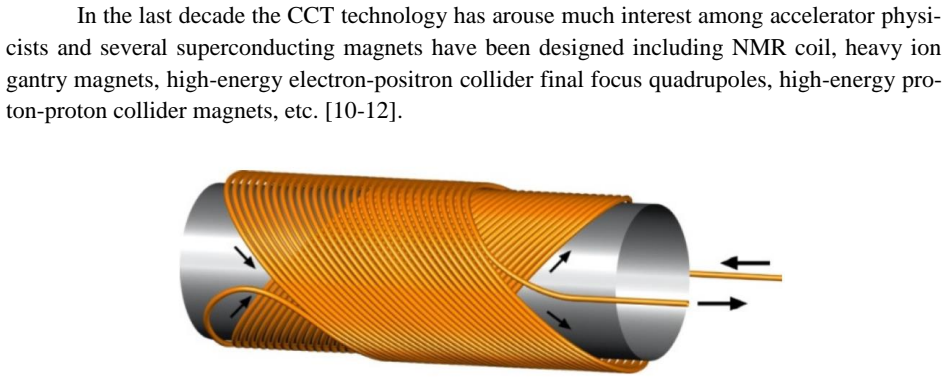
Canted cosine theta (CCT) magnet technology that superimposes the required quadrupole and sextupole field components onto the dipole field in superconducting windings.
If this is right
- The lattice avoids huge natural chromaticity that would otherwise restrict the dynamic aperture.
- Emittance growth from weak focusing is offset by the large number of short cells.
- The design keeps the overall circumference practical while delivering low emittance.
- Large 6D dynamic aperture is preserved due to the low chromaticity approach.
Where Pith is reading between the lines
- If CCT magnets can deliver the required field precision, this could enable more compact low-emittance rings for synchrotron light sources.
- Similar field superposition techniques might apply to other accelerator designs facing chromaticity challenges.
- Further work could explore scaling the approach to higher energies or different beam types.
Load-bearing premise
The superconducting canted cosine theta magnets can be fabricated and operated to produce the precise combined dipole, quadrupole, and sextupole fields required without unacceptable errors or mechanical issues.
What would settle it
Fabrication and testing of a CCT magnet prototype that fails to achieve the simultaneous field components with the needed accuracy for stable lattice operation, or beam dynamics simulations showing insufficient dynamic aperture.
Figures




read the original abstract
We developed a low emittance electron storage ring with large 6D dynamic aperture. Contrary to the traditional approach using strong focusing magnetic cells with optimized (and large) horizontal phase advance, which yields huge natural chromaticity, we employed a relatively weak focusing lattice with low chromaticity per cell and, consequently, wide on- and off-momentum dynamic aperture. Inevitable for weak focusing emittance growth, we compensated by slicing the lattice into many short, with small bending angle, elementary periodic cells. To reduce the size, we superimposed focusing gradient and chromaticity compensating sextupole components over the dipole field utilizing superconducting magnets based on the Canted Cosine Theta (CCT) winding technology. The result is a model lattice with 50 pm horizontal emittance at 3 GeV beam energy, with 400-500 m circumference and large 6D aperture.
Editorial analysis
A structured set of objections, weighed in public.
Referee Report
Summary. The manuscript presents a conceptual design for a weak-focusing low-emittance electron storage ring at 3 GeV. It uses many short periodic cells with small bending angles to mitigate emittance growth from weak focusing, low chromaticity per cell for wide dynamic aperture, and superconducting Canted Cosine Theta (CCT) magnets to superimpose the required dipole, quadrupole, and sextupole components. The result is stated to be a model lattice achieving 50 pm horizontal emittance with 400-500 m circumference and large 6D dynamic aperture.
Significance. If the lattice functions, tracking, and magnet realization can be shown to deliver the stated performance, the approach would provide a viable alternative to strong-focusing lattices by avoiding large natural chromaticities while still reaching low emittance through cell multiplicity; this could influence designs for compact light sources where chromaticity correction and aperture are limiting.
major comments (2)
- [Abstract] Abstract: the central claim that the model lattice achieves 50 pm emittance and large 6D aperture rests on the unverified assumption that CCT magnets can deliver the precise superimposed multipole fields without errors; no lattice functions, tracking results, or error budgets are provided to substantiate this.
- [Abstract] Abstract: the compensation of weak-focusing emittance growth by many short cells is asserted but no quantitative cell parameters, phase advances, or resulting emittance formula are given, leaving the 50 pm figure unsupported.
Simulated Author's Rebuttal
Thank you for the review. We address the major comments on our conceptual design paper point by point.
read point-by-point responses
-
Referee: [Abstract] Abstract: the central claim that the model lattice achieves 50 pm emittance and large 6D aperture rests on the unverified assumption that CCT magnets can deliver the precise superimposed multipole fields without errors; no lattice functions, tracking results, or error budgets are provided to substantiate this.
Authors: The manuscript presents a conceptual design for an ideal lattice. The stated performance is calculated assuming perfect CCT magnets delivering exact superimposed fields, with no magnet errors included. Lattice functions are described in the body; however, no tracking with errors or error budgets are provided, as these require detailed engineering studies beyond the conceptual scope. We will revise the abstract and text to explicitly state that results apply to the ideal model lattice. revision: yes
-
Referee: [Abstract] Abstract: the compensation of weak-focusing emittance growth by many short cells is asserted but no quantitative cell parameters, phase advances, or resulting emittance formula are given, leaving the 50 pm figure unsupported.
Authors: The full manuscript provides cell parameters (short length, small bend angle per cell, low phase advance), the number of cells for the target circumference, and the emittance derived from standard radiation integrals for the weak-focusing case, where cell multiplicity reduces the per-cell contribution. The abstract summarizes the outcome; we will add a brief reference to the scaling approach in the abstract. revision: partial
Circularity Check
Design study of lattice model is self-contained with no circular reductions
full rationale
The paper presents a conceptual design for a storage ring lattice employing weak focusing cells with superimposed dipole, quadrupole, and sextupole fields realized via CCT magnets. The abstract and description outline a model achieving 50 pm emittance at 3 GeV without any equations or steps that define a quantity in terms of itself, rename a fitted parameter as a prediction, or rely on self-citations for uniqueness or ansatz. The central result is a constructed lattice model whose properties follow from standard accelerator physics applied to the chosen parameters; no load-bearing claim reduces to its own inputs by construction. This is the expected outcome for a design study.
Axiom & Free-Parameter Ledger
Reference graph
Works this paper leans on
-
[1]
L.S. Nadolski, Methods and tools to simulate, optimize and analyze nonlinear dynamics in low emittance storage rings, Beam Dynamics Newsletter 57, April 2012, 85-93
work page 2012
-
[2]
The double-helix dipole – a novel approach to accelera- tor magnet design, IEEE Trans
C.L Goodzeit, M.J.Ball, R.B.Meinke. The double-helix dipole – a novel approach to accelera- tor magnet design, IEEE Trans. Appl. Supercon., 2003, 13(2), 1365-1368. S.Caspi, D.R.Dieterich, P.Ferracin et al. Design, fabrication and test of a superconducting dipole magnet based on tilted solenoids, IEEE Trans. Appl. Supercon., 2007, 17(2), 2266-2269
work page 2003
-
[3]
Complex bend: strong focusing magnet for low emittance synchrotrons, Phys
G.Wang, T.Shaftan, V.Smaluk et al. Complex bend: strong focusing magnet for low emittance synchrotrons, Phys. Rev. Accel. and Beams 21, 100703 (2018)
work page 2018
-
[4]
Yu.Cai, Singularity and stability in a periodic system of particle accelerators, Phys. Rev. Accel. and Beams 21, 054002 (2018)
work page 2018
-
[5]
D.Einfeld and H.Ghasem, The South-East-European Initiative, 7th Low Emittance Ring Work- shop, CERN 15-17 January 2018
work page 2018
-
[6]
D.I.Meyer and R.Flasck, A new configuration for the dipole magnet for use in high -energy physics application, NIM A 80.2 (1970), pp.339-341
work page 1970
-
[7]
C.L.Goodzeit, M.J.Ball and R.B.Meinke, The double-helix dipole – a novel approach to accel- erator magnet design, IEEE Trans. Appl. Supercond. 13.2 (2003), pp.1365-1378
work page 2003
-
[8]
New concepts in transverse field magnet design
A.V.Gavrilin et al. New concepts in transverse field magnet design. IEEE Trans. Appl. Super- cond. 13.2 (2003), pp.1213-1216
work page 2003
-
[9]
Iwata, S.Suzuki, K.Noda, et al
Y. Iwata, S.Suzuki, K.Noda, et al. Development of curved combined-function superconduct- ing magnets for a heavy -ion rotating gantry. IEEE Trans. Appl. Supercon., 2014, Vol.24(3): 4400505
work page 2014
-
[10]
Doubl e helix dipole design applied to magnetic resonance: a novel NMR coil
J.Alonso, A.Soleilhavoup, A.Wong, et al. Doubl e helix dipole design applied to magnetic resonance: a novel NMR coil. Journal of Magnetic Resonance, 2013, 235, 32-41
work page 2013
-
[11]
E. Paoloni et al. Advances in the design of the SuperB final doublet. Proc.of IPAC2011, San Sebastian, Spain, 2454
-
[12]
The FCC-ee Interaction Region Magnet Design
M. Koratzinos et al. The FCC -ee interaction region magnet design. https://arxiv.org/abs/ 1607.05446. 16
work page internal anchor Pith review Pith/arXiv arXiv
-
[13]
L.N.Brouwer. Canted -cosine theta superconducting accelerator magnets for high -energy physics and ion beam cancer therapy. PhD dissertation, University of California, Berkley, 2015
work page 2015
-
[14]
S. Caspi et al. A superconducting magnet mandrel with minimum symmetry laminations for proton therapy. NIM A 719 (2013) 44-49
work page 2013
-
[15]
A review and prospects for Nb3Sn superconductor development
Xu Xingchen. A review and prospects for Nb 3Sn superconductor development, Fermi Na- tional Accelerator Laboratory, Batavia, Illinois, https://arxiv.org/pdf/1706.10253
work page internal anchor Pith review Pith/arXiv arXiv
-
[16]
J.A. Parrell, Y.Z. Zhang, M.B. Field, P.Cisek and S. Hong. High field Nb3Sn conductor de- velopment at Oxford Superconducting Technology IEEE Tr ans. Appl. Supercond. 13 3470 -3, 2003
work page 2003
-
[17]
J.A.Parrell, M.B. Field, Y.Z. Zhang and S. Hong. Nb3Sn Conductor Development for Fusion and Particle Accelerator AIP Conf. Proc. 711 369-75, 2004
work page 2004
-
[18]
R.H. Helm and H. Wiedemann, Emittance in a FODO -cell lattice. SLAC -PEP-NOTE-303, May 1979
work page 1979
-
[19]
Y.Cai, Symplectic maps and chromatic optics in particle accelerators. NIM A 797 (2015) 172- 181. 17 ATTACHMENT We present well-known expressions for the FODO cell parameters (see, for instance [19], [20], etc.) for both arbitrary and small cell betatron phase advance ( 𝜇𝑥 = 𝜇𝑦 = 𝜇). The cell is shown schematically in Fig.2.1; the quadrupoles and sextupole...
work page 2015
-
[20]
𝜙3 A1.1 𝛽𝑚𝑎𝑥 𝑚𝑖𝑛 𝐿 ±2 ±1 + sin(𝜇/2) sin 𝜇 A2 2 𝜇 ± 1 + 𝜇 3 A2.1 𝜂𝑚𝑎𝑥 𝑚𝑖𝑛 𝐿𝜙 2 ± sin(𝜇/2) 1 − cos 𝜇 A3 1 3 ± 1 𝜇 + 4 𝜇2 ± 𝜇 24 A3.1 (𝐾1𝐿)𝐹 𝐷 ± 2 𝐿 sin 𝜇 2 A4 ± 𝜇 𝐿 A4.1 𝜉𝑥,𝑦 − 1 𝜋 tan 𝜇 2 A5 − 𝜇 2𝜋 A5.1 𝐿2𝜙(𝐾2𝐿)𝐹 𝐷 4[sin(𝜇/2)]3 ±2 + sin(𝜇/2) A6 ± 𝜇3 4 − 𝜇4 16 A6.1 𝜇𝑥′′ −2 tan (𝜇
-
[21]
3 + cos 𝜇 7 + cos 𝜇 A7 − 𝜇 2 − 𝜇3 96 A7.1 𝜇𝑦′′ −2 tan (𝜇
-
[22]
𝐿, 𝜙 and 𝜇/2 relate to the half- cell
−5 + cos 𝜇 7 + cos 𝜇 A8 𝜇 2 + 13𝜇3 96 A8.1 𝜇𝑥′′′ −6𝜇𝑥 ′′ A9 −6𝜇𝑥 ′′ A9.1 𝜇𝑦′′′ −6𝜇𝑦 ′′ A10 −6𝜇𝑦 ′′ A10.1 According to the notation in Fig.2.1 the cell starts with half of defocusing point-like quad- rupole (and the defocusing sextupole locates at the same azimuth). 𝐿, 𝜙 and 𝜇/2 relate to the half- cell. In A7-A10 prime denotes derivative with respect to t...
discussion (0)
Sign in with ORCID, Apple, or X to comment. Anyone can read and Pith papers without signing in.