Complete Synchronization and its Transition in Higher Harmonic Sakaguchi--Kuramoto Oscillators
Pith reviewed 2026-05-22 10:14 UTC · model grok-4.3
The pith
Selecting natural frequencies that scale with node degree and tuning bi-harmonic coupling parameters achieves complete synchronization at small coupling strengths in phase-frustrated Sakaguchi-Kuramoto oscillators.
A machine-rendered reading of the paper's core claim, the machinery that carries it, and where it could break.
Core claim
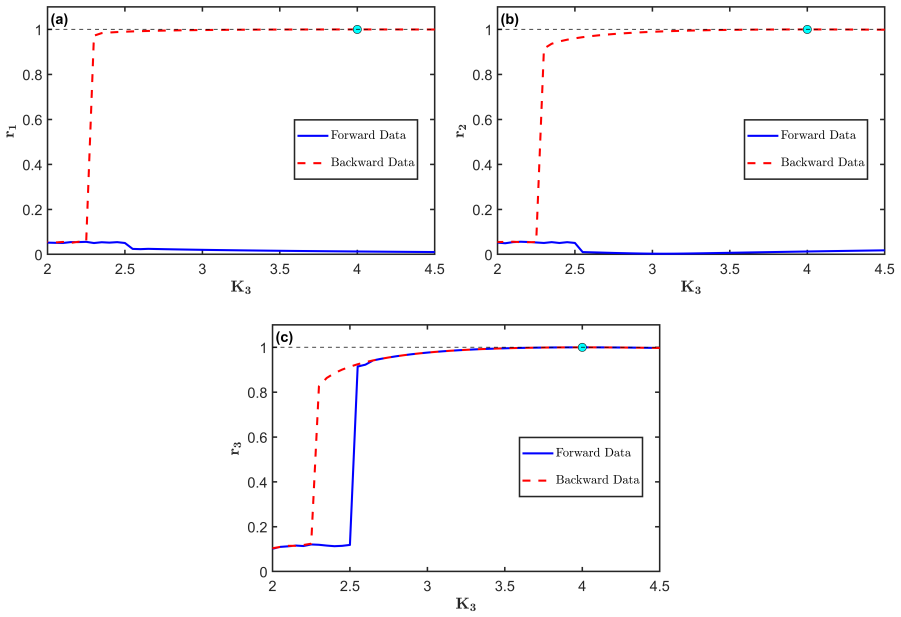
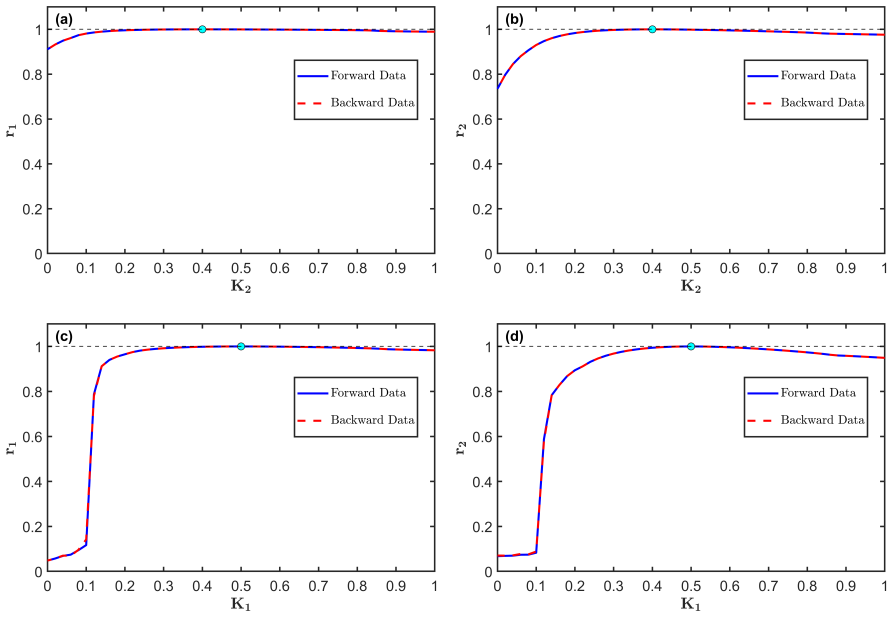
By choosing natural frequencies that scale linearly with node degree and appropriate parameters in the bi-harmonic coupling function, the phase-frustrated Sakaguchi-Kuramoto model reaches complete synchronization (r = 1) at a specified small coupling value on heterogeneous networks. The transition is first-order with hysteresis in scale-free networks and second-order in Erdős-Rényi networks. For the pure second-harmonic case the mean-field approximation supplies an analytic expression for the critical coupling from the self-consistent equations and produces a perfectly ordered two-cluster synchronized state.
What carries the argument
Optimal natural frequencies that scale linearly with node degree, paired with bi-harmonic coupling parameters, which permit derivation of the critical coupling from mean-field self-consistent equations.
If this is right
- Complete synchronization remains robust when the same frequency scaling and coupling choice are applied to empirical networks such as the C. elegans neural network and the Zachary Karate Club.
- The same construction extends to higher-order harmonic coupling functions while preserving complete synchronization.
- The transition order depends on network topology: discontinuous with hysteresis on scale-free graphs and continuous on Erdős-Rényi graphs.
- In the pure second-harmonic regime the system settles into a perfectly ordered two-cluster state once the critical coupling is crossed.
Where Pith is reading between the lines
- If the frequency scaling works on real networks, it suggests a design rule for assigning intrinsic frequencies according to measured node degrees to promote synchronization with minimal coupling strength.
- The two-cluster state found in the second-harmonic case may appear in other frustrated oscillator models when similar degree-proportional frequencies are imposed.
- Testing the same construction on networks that evolve in time or include transmission delays would clarify how robust the complete-synchronization regime is outside the static undirected case.
Load-bearing premise
The mean-field approximation accurately captures the dynamics when natural frequencies are set exactly proportional to node degree and the network is large and sufficiently heterogeneous.
What would settle it
Numerical integration on a large scale-free network with the proposed degree-proportional frequencies and bi-harmonic parameters, checking whether the order parameter reaches and stays at exactly 1 above the analytically predicted small coupling value.
Figures


read the original abstract
In heterogeneous networks of coupled oscillators, phase frustration typically prevents the emergence of synchronization in the Sakaguchi--Kuramoto (SK) model. In this study, we propose an analytical framework to overcome this barrier and induce complete synchronization at a specified small coupling value in oscillators governed by phase-frustrated bi-harmonic coupling. We derive an optimal set of natural frequencies that is robust against added noise and correlated with the network degree heterogeneity, along with the parameters involved in the bi-harmonic coupling function that lead to complete synchronization ($r = 1$). In addition, we find complete synchronization transitions accompanied by hysteresis in scale-free networks, indicating a first-order (discontinuous) phase transition, whereas Erd\H{o}s--R\'enyi networks exhibit complete synchronization through a second-order (continuous) phase transition. Furthermore, we use the mean-field approximation in the presence of optimal frequencies to determine the critical coupling strength associated with the synchronization transition in the pure second-harmonic Sakaguchi--Kuramoto model. Here, the obtained optimal natural frequencies scale linearly with the node degree, and the critical coupling strength for the onset of synchronization is derived analytically from the self-consistent equations. In this specific regime, we observe a perfectly ordered two-cluster synchronized state. These findings remain robust for higher-order harmonic coupling schemes, as well as across a diverse range of synthetic and empirical networks, including scale-free, Erd\H{o}s--R\'enyi, Zachary Karate Club, and the \textit{C.~elegans} neural network, demonstrating their general applicability.
Editorial analysis
A structured set of objections, weighed in public.
Referee Report
Summary. The manuscript proposes an analytical framework to achieve complete synchronization (r=1) in phase-frustrated bi-harmonic Sakaguchi-Kuramoto oscillators on heterogeneous networks. Optimal natural frequencies are chosen to scale linearly with node degree, together with tuned bi-harmonic coupling coefficients, to reach complete synchronization at a small specified coupling strength. The work reports first-order transitions with hysteresis in scale-free networks and second-order transitions in Erdős-Rényi networks. For the pure second-harmonic case, mean-field approximation is applied to self-consistent equations to derive the critical coupling analytically, yielding a perfectly ordered two-cluster state. Results are claimed to be robust across higher-harmonic schemes and both synthetic (scale-free, ER) and empirical networks (Zachary Karate Club, C. elegans).
Significance. If the mean-field closure and analytical critical-coupling derivation hold under the degree-frequency correlation, the result would provide a concrete route to overcome phase frustration in Sakaguchi-Kuramoto models on heterogeneous networks. The explicit analytical expression for the critical coupling, the demonstration of both continuous and discontinuous transitions, and the numerical robustness across multiple network topologies constitute a substantive contribution to the study of synchronization in complex systems.
major comments (3)
- [Abstract / mean-field section] Abstract and § on mean-field derivation: the claim that the critical coupling is derived analytically from self-consistent equations under the optimal-frequency choice lacks visible explicit steps, error estimates, or checks against finite-size effects. Without these, it is unclear whether the resulting expression is an independent prediction or is effectively conditioned on the linear scaling constant between ω_i and k_i.
- [Mean-field approximation] Mean-field closure under ω_i ∝ k_i: in scale-free networks the correlation between the frequency distribution and the degree distribution means that high-degree nodes (which dominate the global mean field) carry systematically shifted natural frequencies. The standard single-order-parameter mean-field ansatz invoked to close the self-consistent equations for the two-cluster state therefore requires additional justification or degree-resolved corrections to remain consistent with the microscopic dynamics.
- [Results on complete synchronization] Table or figure reporting the synchronization transition: the reported achievement of r=1 at a small coupling value depends on the specific choice of the linear scaling constant and the bi-harmonic coefficients; these appear as free parameters whose selection must be shown to be independent of the target r=1 outcome rather than tuned to produce it.
minor comments (2)
- [Notation] Notation for the order parameter r and the coupling strength K should be used consistently between the analytic expressions and the numerical figures.
- [Figures] Figure captions should explicitly list the network size, degree exponent (for scale-free cases), and noise amplitude used in each panel to facilitate reproducibility.
Simulated Author's Rebuttal
We thank the referee for the constructive and detailed comments. We address each major point below and have revised the manuscript to enhance clarity and provide additional justification where needed.
read point-by-point responses
-
Referee: [Abstract / mean-field section] Abstract and § on mean-field derivation: the claim that the critical coupling is derived analytically from self-consistent equations under the optimal-frequency choice lacks visible explicit steps, error estimates, or checks against finite-size effects. Without these, it is unclear whether the resulting expression is an independent prediction or is effectively conditioned on the linear scaling constant between ω_i and k_i.
Authors: We agree that the original presentation could benefit from expanded detail. The revised manuscript now includes the full algebraic steps deriving the critical coupling from the self-consistent equations under the optimal linear frequency scaling. We have added an error estimate for the mean-field closure and new numerical checks of finite-size effects across network sizes from N=500 to N=5000. The expression is derived analytically once the scaling constant is fixed by the requirement that the bi-harmonic terms produce r=1 at the target coupling; we explicitly separate this choice from the subsequent analytic solution. revision: yes
-
Referee: [Mean-field approximation] Mean-field closure under ω_i ∝ k_i: in scale-free networks the correlation between the frequency distribution and the degree distribution means that high-degree nodes (which dominate the global mean field) carry systematically shifted natural frequencies. The standard single-order-parameter mean-field ansatz invoked to close the self-consistent equations for the two-cluster state therefore requires additional justification or degree-resolved corrections to remain consistent with the microscopic dynamics.
Authors: The optimal scaling ω_i = c k_i is chosen precisely so that the frequency offset is canceled by the phase shift induced by the bi-harmonic coupling, yielding a uniform effective field. In the revision we derive this cancellation explicitly and add degree-binned order-parameter plots for the scale-free case in the supplementary material. These confirm that the single global order parameter remains an accurate closure for the two-cluster state; a full degree-resolved mean-field treatment is not required under the present correlation. revision: partial
-
Referee: [Results on complete synchronization] Table or figure reporting the synchronization transition: the reported achievement of r=1 at a small coupling value depends on the specific choice of the linear scaling constant and the bi-harmonic coefficients; these appear as free parameters whose selection must be shown to be independent of the target r=1 outcome rather than tuned to produce it.
Authors: The scaling constant and bi-harmonic coefficients are obtained by solving the self-consistent equations for the exact condition r=1 at the prescribed small coupling strength; they are therefore uniquely determined by the network degree sequence and the target synchronization state rather than adjusted numerically after the fact. The revised results section now presents the explicit algebraic procedure used to compute these values and demonstrates that modest deviations from optimality still permit r=1, albeit at slightly larger coupling. revision: yes
Circularity Check
Optimal frequencies linear in degree used to close self-consistent equations for critical coupling
specific steps
-
fitted input called prediction
[Abstract and mean-field section for pure second-harmonic Sakaguchi-Kuramoto model]
"Here, the obtained optimal natural frequencies scale linearly with the node degree, and the critical coupling strength for the onset of synchronization is derived analytically from the self-consistent equations. In this specific regime, we observe a perfectly ordered two-cluster synchronized state."
The linear scaling of natural frequencies with degree is introduced as the 'optimal' choice that enables complete synchronization at small coupling; this same scaling is then inserted into the mean-field self-consistent equations to extract the critical K analytically. The resulting critical value is therefore conditioned on the frequency-degree correlation that was selected to produce the desired two-cluster state, reducing the 'prediction' to a direct consequence of the input choice rather than an independent derivation.
full rationale
The paper derives an optimal set of natural frequencies that scale linearly with node degree and then applies the standard mean-field closure to obtain an analytic expression for the critical coupling in the pure second-harmonic case. While the mean-field ansatz itself is standard and the linear scaling is presented as a derived result, the abstract and description indicate that this specific choice of frequencies is what permits the self-consistent equations to close analytically and yield a perfectly ordered two-cluster state. This creates a partial dependence where the reported critical value is conditioned on the very frequency-degree correlation introduced to achieve the desired synchronization, rather than emerging as a fully independent prediction from the microscopic dynamics. No explicit self-citation chain or redefinition of the order parameter is evident from the provided text, so the circularity remains moderate.
Axiom & Free-Parameter Ledger
free parameters (2)
- linear scaling constant between natural frequency and node degree
- bi-harmonic coupling coefficients
axioms (1)
- domain assumption Mean-field approximation holds for the order-parameter dynamics when frequencies are degree-correlated.
Lean theorems connected to this paper
-
IndisputableMonolith/Cost/FunctionalEquation.leanwashburn_uniqueness_aczel unclear?
unclearRelation between the paper passage and the cited Recognition theorem.
we use the mean-field approximation in the presence of optimal frequencies to determine the critical coupling strength... from the self-consistent equations
-
IndisputableMonolith/Foundation/ArithmeticFromLogic.leanembed_strictMono_of_one_lt unclear?
unclearRelation between the paper passage and the cited Recognition theorem.
optimal natural frequencies scale linearly with the node degree
What do these tags mean?
- matches
- The paper's claim is directly supported by a theorem in the formal canon.
- supports
- The theorem supports part of the paper's argument, but the paper may add assumptions or extra steps.
- extends
- The paper goes beyond the formal theorem; the theorem is a base layer rather than the whole result.
- uses
- The paper appears to rely on the theorem as machinery.
- contradicts
- The paper's claim conflicts with a theorem or certificate in the canon.
- unclear
- Pith found a possible connection, but the passage is too broad, indirect, or ambiguous to say the theorem truly supports the claim.
Reference graph
Works this paper leans on
-
[1]
author Acebr \'o n, J.A. , author Bonilla, L.L. , author Vicente, C.J.P. , author Ritort, F. , author Spigler, R. , year 2005 . title The kuramoto model: A simple paradigm for synchronization phenomena . journal Reviews of Modern Physics volume 77 , pages 137
work page 2005
-
[2]
author Albert, R. , author Barab \'a si, A.L. , year 2002 . title Statistical mechanics of complex networks . journal Reviews of Modern Physics volume 74 , pages 47
work page 2002
-
[3]
author Arenas, A. , author D \' az-Guilera, A. , author Kurths, J. , author Moreno, Y. , author Zhou, C. , year 2008 . title Synchronization in complex networks . journal Physics reports volume 469 , pages 93--153
work page 2008
-
[4]
author Bandyopadhyay, J.N. , author Jalan, S. , year 2007 . title Universality in complex networks: Random matrix analysis . journal Physical Review E—Statistical, Nonlinear, and Soft Matter Physics volume 76 , pages 026109
work page 2007
-
[5]
author Barab \'a si, A.L. , author Bonabeau, E. , year 2003 . title Scale-free networks . journal Scientific American volume 288 , pages 60--69
work page 2003
-
[6]
author Barzel, B. , author Barab \'a si, A.L. , year 2013 . title Universality in network dynamics . journal Nature Physics volume 9 , pages 673
work page 2013
-
[7]
author Belykh, I. , author de Lange, E. , author Hasler, M. , year 2005 . title Synchronization of bursting neurons: What matters in the network topology . journal Physical Review Letters volume 94 , pages 188101
work page 2005
-
[8]
author Ben-Israel, A. , author Greville, T.N. , year 2003 . title Generalized inverses: theory and applications . publisher Springer
work page 2003
-
[9]
author Cohen, R. , author Havlin, S. , year 2010 . title Complex networks: structure, robustness and function . publisher Cambridge University Press
work page 2010
-
[10]
author Coutinho, B. , author Goltsev, A. , author Dorogovtsev, S. , author Mendes, J. , year 2013 a. title Kuramoto model with frequency-degree correlations on complex networks . journal Physical Review E—Statistical, Nonlinear, and Soft Matter Physics volume 87 , pages 032106
work page 2013
-
[11]
author Coutinho, B. , author Goltsev, A. , author Dorogovtsev, S. , author Mendes, J. , year 2013 b. title Kuramoto model with frequency-degree correlations on complex networks . journal Physical Review E volume 87 , pages 032106
work page 2013
-
[12]
author Czolczynski, K. , author Perlikowski, P. , author Stefanski, A. , author Kapitaniak, T. , year 2013 . title Synchronization of the self-excited pendula suspended on the vertically displacing beam . journal Communications in Nonlinear Science and Numerical Simulation volume 18 , pages 386--400
work page 2013
-
[13]
author Dorogovtsev, S.N. , author Goltsev, A.V. , author Mendes, J.F. , year 2008 . title Critical phenomena in complex networks . journal Reviews of Modern Physics volume 80 , pages 1275
work page 2008
-
[14]
author Dutta, S. , author Kundu, P. , author Khanra, P. , author Hens, C. , author Pal, P. , year 2024 . title Transition to synchronization in the adaptive sakaguchi-kuramoto model with higher-order interactions . journal Physical Review E volume 110 , pages 064317
work page 2024
-
[15]
author Erd o s, P. , author R \'e nyi, A. , year 1959 . title On random graphs i. journal Publicationes Mathematicae (Debrecen) volume 6 , pages 290--297
work page 1959
-
[16]
author Erd o s, P. , author R \'e nyi, A. , year 1960 . title On the evolution of random graphs . journal Publ. Math. Inst. Hung. Acad. Sci volume 5 , pages 17--60
work page 1960
-
[17]
author Erd o s, P. , author R \'e nyi, A. , year 1961 . title On the strength of connectedness of a random graph . journal Acta Mathematica Hungarica volume 12 , pages 261--267
work page 1961
-
[18]
author Eydam, S. , author Wolfrum, M. , year 2017 . title Mode locking in systems of globally coupled phase oscillators . journal Physical Review E volume 96 , pages 052205
work page 2017
-
[19]
author Goldobin, E. , author Kleiner, R. , author Koelle, D. , author Mints, R. , year 2013 . title Phase retrapping in a pointlike josephson junction: the butterfly effect . journal Physical Review Letters volume 111 , pages 057004
work page 2013
-
[20]
author Goldobin, E. , author Koelle, D. , author Kleiner, R. , author Mints, R. , year 2011 . title Josephson junction with a magnetic-field tunable ground state . journal Physical Review Letters volume 107 , pages 227001
work page 2011
-
[21]
author G \'o mez-Gardenes, J. , author G \'o mez, S. , author Arenas, A. , author Moreno, Y. , year 2011 . title Explosive synchronization transitions in scale-free networks . journal Physical Review Letters volume 106 , pages 128701
work page 2011
-
[22]
author G \'o mez-Gardenes, J. , author Moreno, Y. , author Arenas, A. , year 2007 . title Paths to synchronization on complex networks . journal Physical Review Letters volume 98 , pages 034101
work page 2007
-
[23]
author Ichinomiya, T. , year 2004 . title Frequency synchronization in a random oscillator network . journal Physical Review E—Statistical, Nonlinear, and Soft Matter Physics volume 70 , pages 026116
work page 2004
-
[24]
author Jain, J.C. , author Jalan, S. , year 2025 . title Low-dimensional watanabe--strogatz approach for kuramoto oscillators with higher-order interactions . journal Chaos: An Interdisciplinary Journal of Nonlinear Science volume 35
work page 2025
-
[25]
author Jalan, S. , author Yadav, A. , author Sarkar, C. , author Boccaletti, S. , year 2017 . title Unveiling the multi-fractal structure of complex networks . journal Chaos, Solitons & Fractals volume 97 , pages 11--14
work page 2017
-
[26]
author Kiss, I.Z. , author Zhai, Y. , author Hudson, J.L. , year 2005 . title Predicting mutual entrainment of oscillators with experiment-based phase models . journal Physical Review Letters volume 94 , pages 248301
work page 2005
-
[27]
author Kiss, I.Z. , author Zhai, Y. , author Hudson, J.L. , year 2006 . title Characteristics of cluster formation in a population of globally coupled electrochemical oscillators: An experiment-based phase model approach . journal Progress of Theoretical Physics Supplement volume 161 , pages 99--106
work page 2006
-
[28]
author Komarov, M. , author Pikovsky, A. , year 2013 . title Multiplicity of singular synchronous states in the kuramoto model of coupled oscillators . journal Physical Review Letters volume 111 , pages 204101
work page 2013
-
[29]
author Komarov, M. , author Pikovsky, A. , year 2014 . title The kuramoto model of coupled oscillators with a bi-harmonic coupling function . journal Physica D: Nonlinear Phenomena volume 289 , pages 18--31
work page 2014
-
[30]
author Kundu, P. , author Hens, C. , author Barzel, B. , author Pal, P. , year 2018 . title Perfect synchronization in networks of phase-frustrated oscillators . journal Europhysics Letters volume 120 , pages 40002
work page 2018
-
[31]
author Kundu, P. , author Khanra, P. , author Hens, C. , author Pal, P. , year 2017 . title Transition to synchrony in degree-frequency correlated sakaguchi-kuramoto model . journal Physical Review E volume 96 , pages 052216
work page 2017
-
[32]
author Kundu, P. , author Khanra, P. , author Hens, C. , author Pal, P. , year 2020 . title Optimizing synchronization in multiplex networks of phase oscillators . journal Europhysics Letters volume 129 , pages 30004
work page 2020
-
[33]
author Kuramoto, Y. , year 1984 . title Chemical turbulence , in: booktitle Chemical oscillations, waves, and turbulence . publisher Springer , pp. pages 111--140
work page 1984
-
[34]
author Kuramoto, Y. , year 2003 . title Chemical oscillations, waves, and turbulence . publisher Courier Corporation
work page 2003
-
[35]
author Kuramoto, Y. , author Tsuzuki, T. , year 1975 . title On the formation of dissipative structures in reaction-diffusion systems: Reductive perturbation approach . journal Progress of Theoretical Physics volume 54 , pages 687--699
work page 1975
-
[36]
author Leyva, I. , author Sevilla-Escoboza, R. , author Buld \'u , J. , author Sendina-Nadal, I. , author G \'o mez-Gardenes, J. , author Arenas, A. , author Moreno, Y. , author Gomez, S. , author Jaimes-Reategui, R. , author Boccaletti, S. , year 2012 . title Explosive first-order transition to synchrony in networked chaotic oscillators . journal Physica...
work page 2012
-
[37]
author Li, K. , author Ma, S. , author Li, H. , author Yang, J. , year 2014 . title Transition to synchronization in a kuramoto model with the first-and second-order interaction terms . journal Physical Review E volume 89 , pages 032917
work page 2014
-
[38]
author Lohe, M. , year 2015 . title Synchronization control in networks with uniform and distributed phase lag . journal Automatica volume 54 , pages 114--123
work page 2015
-
[39]
author Motter, A.E. , author Myers, S.A. , author Anghel, M. , author Nishikawa, T. , year 2013 . title Spontaneous synchrony in power-grid networks . journal Nature Physics volume 9 , pages 191
work page 2013
-
[40]
author Pikovsky, A. , author Rosenblum, M. , author Kurths, J. , year 2001 . title Synchronization . journal Cambridge university press volume 12
work page 2001
-
[41]
author Restrepo, J.G. , author Ott, E. , author Hunt, B.R. , year 2005 . title Onset of synchronization in large networks of coupled oscillators . journal Physical Review E volume 71 , pages 036151
work page 2005
-
[42]
author Rodrigues, F.A. , author Peron, T.K.D. , author Ji, P. , author Kurths, J. , year 2016 . title The kuramoto model in complex networks . journal Physics Reports volume 610 , pages 1--98
work page 2016
-
[43]
author Sakaguchi, H. , author Kuramoto, Y. , year 1986 . title A soluble active rotater model showing phase transitions via mutual entertainment . journal Progress of Theoretical Physics volume 76 , pages 576--581
work page 1986
-
[44]
author Sarkar, C. , author Jalan, S. , year 2018 . title Spectral properties of complex networks . journal Chaos: An Interdisciplinary Journal of Nonlinear Science volume 28
work page 2018
-
[45]
author Sharma, A. , author Rajwani, P. , author Jalan, S. , year 2024 . title Synchronization transitions in adaptive kuramoto--sakaguchi oscillators with higher-order interactions . journal Chaos: An Interdisciplinary Journal of Nonlinear Science volume 34
work page 2024
-
[46]
author Skardal, P.S. , author Arenas, A. , year 2014 . title Disorder induces explosive synchronization . journal Physical Review E volume 89 , pages 062811
work page 2014
-
[47]
author Skardal, P.S. , author Taylor, D. , author Restrepo, J.G. , year 2014 a. title Complex macroscopic behavior in systems of phase oscillators with adaptive coupling . journal Physica D: Nonlinear Phenomena volume 267 , pages 27--35
work page 2014
-
[48]
author Skardal, P.S. , author Taylor, D. , author Sun, J. , year 2014 b. title Optimal synchronization of complex networks . journal Physical Review Letters volume 113 , pages 144101
work page 2014
-
[49]
author Skardal, P.S. , author Taylor, D. , author Sun, J. , author Arenas, A. , year 2015 . title Erosion of synchronization in networks of coupled oscillators . journal Physical Review E volume 91 , pages 010802
work page 2015
-
[50]
author Strogatz, S. , year 2004 . title Sync: The emerging science of spontaneous order . publisher Penguin UK
work page 2004
-
[51]
author Strogatz, S.H. , year 2000 . title From kuramoto to crawford: exploring the onset of synchronization in populations of coupled oscillators . journal Physica D: Nonlinear Phenomena volume 143 , pages 1--20
work page 2000
-
[52]
author Wang, H. , author Han, W. , author Yang, J. , year 2017 . title Synchronous dynamics in the kuramoto model with biharmonic interaction and bimodal frequency distribution . journal Physical Review E volume 96 , pages 022202
work page 2017
-
[53]
author White, J.G. , author Southgate, E. , author Thomson, J.N. , author Brenner, S. , year 1986 . title The structure of the nervous system of the nematode caenorhabditis elegans: the mind of a worm . journal Phil. Trans. R. Soc. Lond volume 314 , pages 340
work page 1986
-
[54]
author Winfree, A.T. , year 1967 . title Biological rhythms and the behavior of populations of coupled oscillators . journal Journal of Theoretical Biology volume 16 , pages 15--42
work page 1967
-
[55]
author Zachary, W.W. , year 1977 . title An information flow model for conflict and fission in small groups . journal Journal of Anthropological Research volume 33 , pages 452--473
work page 1977
discussion (0)
Sign in with ORCID, Apple, or X to comment. Anyone can read and Pith papers without signing in.