REVIEW 5 major objections 5 minor 61 references
DPO Kernels: A Semantically-Aware, Kernel-Enhanced, and Divergence-Rich Paradigm for Direct Preference Optimization
T0 review · 5 major / 5 minor · reviewed 2026-08-10 · deepseek-v4-flash
Pith's one-line read This paper claims that DPO-Kernels—superimposing kernel maps on the DPO preference ratio, adding an embedding term, and swapping KL for alternative divergences—improves alignment, with a hierarchical kernel mixture giving the best…
desk verdict The central objective is misstated as DPO, so the kernelized losses optimize a surrogate, not DPO; the empirical breadth cannot rescue that. read the letter →
The pith
A machine-rendered reading of the paper's core claim, the machinery that carries it, and where it could break.
The reading
What carries the argument
The load-bearing object is the Hierarchical Mixture of Kernels (HMK), a two-level learnable kernel mixture $K(x,x') = \tau_1(\lambda_1 K_{\mathrm{RBF}}+\lambda_2 K_{\mathrm{Poly}})+\tau_2(\lambda_3 K_{\mathrm{Spectral}}+\lambda_4 K_{\mathrm{Maha}})$ that balances local kernels (RBF, polynomial) against global kernels (spectral, Mahalanobis). Around it sits the kernelized hybrid loss, which applies $\kappa$ to the policy log-ratio and to an embedding-similarity log-ratio, and a generic divergence $D$ that keeps the policy near a reference distribution. This machinery is what the paper credits for capturing local and global dependencies, preventing kernel collapse through softmax weights and entropy regularization, and producing the reported alignment gains.
What would settle it
Derive the optimal policy for the stated objective with, say, Jensen-Shannon divergence in place of KL: if the minimizer does not retain the DPO form $\pi^*(y|x) \propto \pi_{\mathrm{ref}}(y|x)\exp(r(x,y)/\alpha)$, the substituted divergences do not optimize the preference-alignment problem the paper claims.
Extended reading notes
Core claim
The paper's central claim is that DPO is not stuck with a single contrastive form: the preference signal $\log \frac{\pi(y_+|x)}{\pi(y_-|x)}$ can be passed through kernel functions $\kappa$—polynomial, RBF, Mahalanobis, spectral—and combined with an embedding-based semantic term $\gamma \log \frac{e_{y_+|x}}{e_{y_-|x}}$, while the KL regularizer is replaced by Jensen-Shannon, Hellinger, Rényi, Bhattacharyya, Wasserstein, or f-divergences. On these terms, the paper reports that the kernelized objectives improve over vanilla DPO across 12 datasets covering factuality, reasoning, truthfulness, safety, and instruction following, with the Hierarchical Mixture of Kernels (HMK) as the best performer. The paper further claims, using the Weighted Alpha metric from Heavy-Tailed Self-Regularization, that the gains do not come at the price of overfitting: the aligned models remain within acceptable generalization bounds.
Load-bearing premise
The framework assumes the DPO objective is simply the contrastive log-ratio plus a KL penalty, and that replacing KL with any other divergence in that formula still defines a valid preference-optimization objective.
Editorial extensions
If this is right
- If the claims hold, DPO becomes a tunable family rather than a fixed objective: practitioners could pick kernel and divergence per task using the proposed data-driven metrics.
- HMK would be the recommended variant when alignment quality matters most, at a 3-4x computational cost over vanilla DPO on the reported setup.
- Divergences such as Wasserstein and Bhattacharyya would offer better generalization behavior than KL in DPO-style alignment, according to the HT-SR analysis.
- The kernelized variants would preserve the language model's general capabilities while improving preference alignment, since the Weighted Alpha analysis shows only mild overfitting drift.
Reading between the lines
- The kernels are applied to scalar log-ratios rather than to full response distributions, so the 'richer feature space' is in practice a nonlinear rescaling of a one-dimensional preference signal; comparing against simpler scalar reweightings would clarify where the gains come from.
- The paper introduces selection metrics but does not validate that metric-chosen kernel-divergence pairs outperform or match an oracle grid search; that validation is a direct next experiment.
- The divergence substitutions are written by analogy with KL rather than derived from the DPO/Bradley-Terry link; if the closed-form optimum changes under non-KL divergences, the kernelized objectives may be solving a different alignment problem.
- Because the hybrid loss already mixes embeddings with probabilities, the same construction is portable to multimodal preference alignment, where semantic embeddings exist for images or video as well as text.
Editorial analysis
A structured set of objections, weighed in public.
Referee Report
Summary. The paper proposes DPO-Kernels, a set of extensions to Direct Preference Optimization (DPO) in which the preference loss is wrapped in polynomial, RBF, spectral, or Mahalanobis kernels; an embedding-based hybrid loss is added; and the KL regularizer is replaced by one of six alternative divergences. It also introduces heuristic metrics for kernel/divergence selection and a Hierarchical Mixture of Kernels (HMK) claimed to avoid kernel collapse. The empirical section reports F1 heatmaps across 12 datasets and claims state-of-the-art generalization in factuality, safety, reasoning, and instruction following.
Significance. At face value, the proposed toolbox could be useful for alignment research: the paper covers a wide design space (4 kernels x 7 divergences), is candid about computational overhead and limitations, and provides extensive appendix derivations. However, the central mathematical premise is not DPO as defined in the literature: Section 1 drops the logistic link and the reference policy from the contrastive term, and Section 4 replaces the KL regularizer with other divergences without re-deriving the preference-optimization objective. The reported gains, if reproducible, would therefore support an unstated surrogate loss rather than DPO-Kernels. The HMK non-collapse theorem in Appendix H.18 is a direct consequence of softmax parameterization plus an assumed entropy regularizer, not a substantive stability guarantee. Because these issues are load-bearing for the paper's central claim, the contribution as presented cannot be accepted.
major comments (5)
- [Section 1, Eq. (1)] Equation (1) states the DPO objective as max_pi E[log(pi(y+|x)/pi(y-|x))] - alpha KL(pi || pi_ref). This is not the DPO objective of Rafailov et al.; the actual DPO loss is -E[log sigma(beta log(pi(y+|x)/pi_ref(y+|x)) - beta log(pi(y-|x)/pi_ref(y-|x)))], with the KL regularizer folded in analytically and the reference policy present inside the ratio. Every subsequent kernelized and hybrid objective in Sections 2-3 and Table 1 builds on this incorrect starting point, so the paper's losses are not DPO losses.
- [Section 4, Table 2] For each alternative divergence, the paper simply writes 'The DPO objective with ... becomes max_pi L_KCL - alpha E[D(pi || pi_ref)]'. No optimal policy or implied preference probability is derived for Jensen-Shannon, Hellinger, Renyi, Bhattacharyya, Wasserstein, or f-divergence. The DPO derivation depends on the KL regularizer being conjugate to the softmax reward parameterization; replacing it changes the optimization problem and breaks the equivalence between reward modeling and preference classification. Thus the divergence variants are substitutions, not derivations, and the 'divergence-rich' contribution is not established.
- [Appendix H.18-H.19] The theorem 'HMK Avoids Kernel Collapse' concludes that lambda_i(t) > 0 and tau_i(t) > 0 for all t. The proof's first step is that softmax parameterization gives exp(theta_i) > 0, which makes positivity true by construction; the entropy regularizer is assumed in the theorem but does not appear in the HMK objective of Section 6.1. The theorem therefore does not address kernel collapse in the usual sense of one kernel dominating the mixture; it only restates a property of the chosen normalization. The claim that HMK 'theoretically prevents kernel collapse' is circular and should be removed or replaced by an analysis of the actual optimization dynamics.
- [Section 5.1-5.2] The 'data-driven selection' framework depends on thresholds epsilon_1..epsilon_5 for kernels and epsilon_1..epsilon_3 for divergences that the paper states are 'empirically tuned or determined through validation'. The selection rules are therefore heuristics with manually chosen cutoffs, not data-driven model selection. No validation procedure, sensitivity analysis, or ablation is reported for these thresholds, so the claimed automatic selection (contribution iii) is not demonstrated.
- [Section 7, Figs. 8-10] The empirical claim of state-of-the-art performance is not supported by the evidence shown. The figures report only F1 heatmaps with no standard errors, no number of independent runs, no statistical tests, and no comparison against published alignment methods; the comparators are DPO and the paper's own kernel variants. 'State-of-the-art generalization' in the abstract and Section 7 is therefore an unsupported claim without a dataset-wise table with baselines and uncertainty.
minor comments (5)
- [Throughout] There are numerous typos and malformed cross-references, including 'resproducability', 'sytehtically', 'Divegence', and 'Appendix Appendix D'; the manuscript needs a careful proofread.
- [Section 4 and Table 2] The symbol alpha is overloaded: it denotes the KL regularization weight in Eq. (1) and the Renyi divergence order in Table 2. This creates ambiguity in equations such as the Renyi row.
- [FAQ and References] The references (Doe and Lee, 2019) and (Smith and Davis, 2020), cited in the FAQ and Section 6-related discussion, appear to be generic placeholders rather than verifiable published works; the authors should confirm or replace them.
- [Section 11] The FAQ includes a subsection responding to 'Abstract is too long'; this is not appropriate for an archival paper and should be removed.
- [Section 7.5] The Weighted Alpha metric is presented as a 'generalization bound' but only an estimator is defined; no bound is derived in the main text or Appendix M as cited.
Circularity Check
HMK non-collapse theorem is a softmax tautology, and the paper's DPO objective is restated as its own contrastive+KL surrogate, making kernel/divergence variants true by definition rather than derived from DPO.
-
self definitional
[Appendix H.18 (Theorem) and H.19.1 (Proof)]
"Suppose that the kernel weights are reparameterized using a softmax transformation, and the total loss function includes an entropy regularization term R(λ) = − P4 i=1 λi log λi. Then, for any training epoch t, the kernel weights satisfy λi(t) > 0 for all i ∈ {1, 2, 3, 4}. ... Since the exponential function satisfies exp(θi) > 0 for all θi ∈ R, it follows that λi > 0 for all i and at all times t."
The theorem's conclusion, λi > 0 and τi > 0, is entailed by the softmax reparameterization alone: exp(θi) > 0 for every finite real θi. The proof explicitly relies on this property, so the 'guarantee' is true by construction and does not follow from entropy regularization or gradient descent. Moreover, the guarantee does not establish what the paper needs: softmax weights can remain strictly positive while one kernel dominates (e.g., λ1 ≈ 1), which is precisely the kernel collapse the paper defines. Thus the claimed non-collapse theorem is a restatement of the chosen normalization, not a substantive result.
-
self definitional
[Section 1 ('DPO objective') and Section 4/Table 2 (divergence substitutions)]
"The DPO objective can be expressed as: maxπ Ex,y+,y− [ logπ(y+| x)/π(y−| x) ] − αEx[ Σ_y π(y| x) log π(y| x)/πref(y| x) ] ... The DPO objective with JS divergence becomes: maxπ LKCL − α Ex[DJSD(π ∥ pref)]"
Rafailov et al.'s DPO loss contains a logistic sigmoid and π_ref inside the contrastive ratio; the paper's declared 'DPO objective' omits both. By defining DPO as this contrastive-plus-KL expression, every kernelized variant (Sec. 3, Table 1) and every divergence variant (Sec. 4, Table 2) is obtained by inserting κ or D into the paper's own template. The divergence rows are substitutions into this surrogate objective with no derivation of the implied optimal policy or preference probability. Consequently, the claim that these are DPO objectives reduces to the paper's definition rather than to a derivation from DPO; the identity fails if checked against the actual Rafailov et al. objective.
full rationale
The empirical benchmark results (Sec. 7, Figs. 8–12) are scored against external benchmarks (MMLU, ToxiGen, XSTest, GSM8k, BBH, AlpacaEval, IFEval), so those comparisons retain independent content and are not fitted predictions. I do not count self-citations as circular here: Jain et al. (2024a) is a different author group from the present paper's Jain, and the HT-SR Weighted Alpha metric is an external parameter-free diagnostic. The two self-definitional collapses are (1) the HMK non-collapse theorem, whose positivity conclusion is entailed by the softmax parameterization and does not rule out dominance, and (2) the restatement of the DPO objective as a contrastive+KL surrogate, which makes the kernel/divergence variants equal to the paper's own definition by construction. The Section 5.1 statement that thresholds are 'empirically tuned or determined through validation' weakens the automatic-selection claim, but without evidence that the same benchmark folds were used for both selection and final reporting, this is a selection/reporting risk rather than a demonstrated circular prediction. Overall: partial circularity in the theoretical scaffolding, independent empirical content, score 6.
Assumptions & free parameters
free parameters (9)
- gamma (hybrid loss weight) =
not reported
- Polynomial kernel degree d and bias c =
not reported
- RBF bandwidth sigma =
not reported
- Spectral kernel eigenvalues lambda_i and component count p =
not reported
- Mahalanobis kernel mean mu, variance sigma^2, covariance Sigma =
not reported
- HMK weights lambda_1..lambda_4 and tau_1, tau_2 =
learned via gradient descent
- Renyi divergence order alpha =
not reported
- Data-driven selection thresholds epsilon_1..epsilon_5 (kernel) and epsilon_1..epsilon_3 (divergence) =
defaults: 0.5, 0.3, 0.2, 0.7, 0.1; 0.6, 0.3, 3
- Divergence regularization coefficient alpha =
not reported
assumptions (6)
- ad hoc to paper DPO objective simplification
- domain assumption Divergence substitution validity
- domain assumption Scalar kernel validity
- ad hoc to paper Embedding similarities as probabilities
- domain assumption Entropy regularized HMK
- domain assumption Weighted Alpha generalization measure
invented entities (1)
-
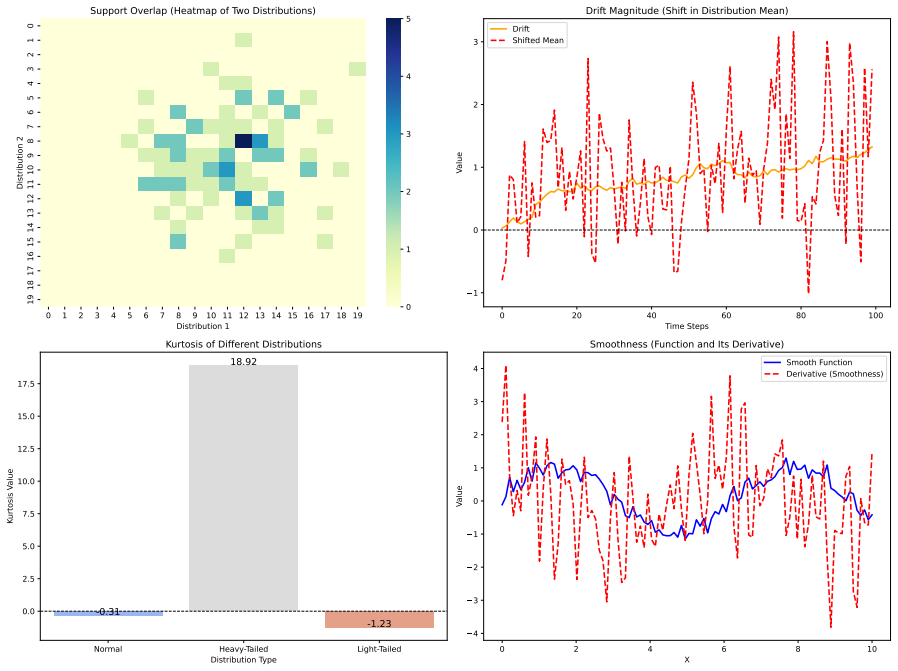
Data-driven selection metric family (PND, PNAV, TAT, NAG, support overlap, drift magnitude, kurtosis, smoothness)
Cite this review
Pith. "Pith review of DPO Kernels: A Semantically-Aware, Kernel-Enhanced, and Divergence-Rich Paradigm for Direct Preference Optimization." pith.science (2026). https://pith.science/paper/IYA2JWVZ
@misc{pith2026250103271,
  author       = {Pith},
  title        = {Pith review of: DPO Kernels: A Semantically-Aware, Kernel-Enhanced, and Divergence-Rich Paradigm for Direct Preference Optimization},
  year         = {2026},
  howpublished = {\url{https://pith.science/paper/IYA2JWVZ}},
  note         = {Machine review of arXiv:2501.03271}
}
read the original abstract
The rapid rise of large language models (LLMs) has unlocked many applications but also underscores the challenge of aligning them with diverse values and preferences. Direct Preference Optimization (DPO) is central to alignment but constrained by fixed divergences and limited feature transformations. We propose DPO-Kernels, which integrates kernel methods to address these issues through four key contributions: (i) Kernelized Representations with polynomial, RBF, Mahalanobis, and spectral kernels for richer transformations, plus a hybrid loss combining embedding-based and probability-based objectives; (ii) Divergence Alternatives (Jensen-Shannon, Hellinger, Renyi, Bhattacharyya, Wasserstein, and f-divergences) for greater stability; (iii) Data-Driven Selection metrics that automatically choose the best kernel-divergence pair; and (iv) a Hierarchical Mixture of Kernels for both local precision and global modeling. Evaluations on 12 datasets demonstrate state-of-the-art performance in factuality, safety, reasoning, and instruction following. Grounded in Heavy-Tailed Self-Regularization, DPO-Kernels maintains robust generalization for LLMs, offering a comprehensive resource for further alignment research.
Figures


Figures from the paper (21 more)




Reference graph
Works this paper leans on
-
[1]
Probability-Based Preference Alignment: multline* LDPO = Ex,y+,y− h log π(y+ | x) π(y− | x) i This is the standard DPO loss, ensuring the model assigns higher probability to the positive response y+ over the negative response y−. It provides the core preference alignment signal commonly used in reinforcement learning from human feedback (RLHF) (Christiano...
work page 2017
-
[2]
The factor γ determines how much the model should focus on aligning responses semantically
Embedding-Based Semantic Alignment: Lembed = Ex,y+,y− h γ log ey+ | ex ey− | ex i This term leverages embedding-based similarity scores ey+ and ey−. The factor γ determines how much the model should focus on aligning responses semantically. When γ is higher, seman- tic alignment plays a larger role relative to the probability-based term. D.3 Properties of...
-
[3]
Interpretable Embedding Signal: The dif- ference (ey+ − ey−) in the embedding space acts like a “semantic margin” separating positive from negative responses. This helps improve general- ization and maintain semantic consistency in the model’s outputs. D.4 Impact of the Hybrid Loss on Policy Learning • Semantic-Aware Preference Modeling: By in- corporatin...
work page 2023
-
[4]
Normalized Alignment Gap (NAG) The Nor- malized Alignment Gap (NAG) quantifies the rel- ative difference in distances between positive and negative samples: NAG = d(x, y−) − d(x, y+) d(x, y−) + d(x, y+) When NAG is close to zero, it indicates similar dis- tances for positive and negative samples, favoring Polynomial or Mahalanobis kernels. Larger devi- at...
-
[12]
Advances in Neural Informa- tion Processing Systems
Using the Nyström method to speed up kernel machines. Advances in Neural Informa- tion Processing Systems. Ronald J Williams. 1991. Function optimization using connectionist reinforcement learning algo- rithms. In Connectionist Models: Proceedings of the 1990 Summer School, pages 229–255. El- sevier. Eric Wong and J Zico Kolter. 2018. Provable de- fenses ...
work page 1991
-
[13]
Robust multiple kernel learning. In In- ternational Conference on Machine Learning (ICML), pages 1145–1152. Jaehong Yoon, Shoubin Yu, Vaidehi Patil, Huaxiu Yao, and Mohit Bansal. 2024. Safree: Training-free and adaptive guard for safe text- to-image and video generation. Preprint, arXiv:2410.12761. Tianyu Yu, Yuan Yao, Haoye Zhang, Taiwen He, Yifeng Han, ...
arXiv 2024
-
[14]
but use the original set of prompts provided in (Hartvigsen et al., 2022), specifically designed to elicit toxic language for certain demographic groups. To minimize evaluation costs, we use 500 "hateful" prompts per group. For base language models, the original ToxiGen prompts are used without modification, and re- sponses are greedily decoded up to the ...
work page 2022
-
[17]
Adaptive Control via γ: γ balances probability-based and embedding-based alignment signals: • γ = 0: The hybrid loss simplifies to the standard DPO loss, using only probability-based alignment. • γ >0: Embedding-based alignment is included, encouraging the model to consider semantic co- herence alongside probability alignment
Show all 61 references
-
[18]
This helps the model avoid reinforc- ing incorrect preferences when probability-based signals are uncertain
Soft Constraint on Semantic Consistency: The embedding-based term ensures the model does not reward misalignments if y+ and y− are seman- tically similar. This helps the model avoid reinforc- ing incorrect preferences when probability-based signals are uncertain
-
[20]
Reward Model Training: A reward model is trained to predict human preferences by learning from comparison data where human annotators rank different responses
-
[21]
the reward model serves as a learned proxy for human judgment, guiding the policy to generate more desirable out- puts
Policy Optimization: The language model (pol- icy) is then optimized using reinforcement learn- ing algorithms, such as Proximal Policy Optimiza- tion (PPO), to maximize the expected reward as defined by the trained reward model. The objective in RLHF can be formalized as maxi...
2017
-
[22]
It is defined as: PND = d(x, y+) − d(x, y−) where d(x, y+) and d(x, y−) denote the distances from x to the positive and negative responses, re- spectively
Positive-Negative Divergence (PND) The Positive-Negative Divergence (PND) measures the difference in alignment scores between positive and negative samples. It is defined as: PND = d(x, y+) − d(x, y−) where d(x, y+) and d(x, y−) denote the distances from x to the positive and ...
-
[23]
Conversely, low PNA V values imply stable alignment, favoring simpler kernels such as Mahalanobis or Spectral
Positive-Negative Alignment Variance (PNA V) The Positive-Negative Alignment Vari- ance (PNA V) captures the variability in alignment scores between positive and negative responses across multiple samples: PNA V= 1 n nX i=1 d(xi, y+ i ) − d(xi, y− i ) 2 High PNA V values indic...
-
[24]
Triplet Alignment Tightness (TAT) Triplet Alignment Tightness (TAT) assesses the relative tightness of the query, positive, and negative triplet in the embedding space: TAT= ∥y+ − y−∥ ∥y+ − x∥+∥y− − x∥ Higher TAT values signify tighter clustering of positive and negative sampl...
-
[26]
tailedness
Support Overlap Support Overlap quantifies the extent to which two distributionsP and Q share common support regions: Support Overlap = |P ∩ Q| |P ∪ Q| High overlap suggests that Bhattacharyya diver- gence is appropriate, as it effectively measures distribution similarity when...
-
[27]
Drift Magnitude Drift Magnitude measures the shift in the mean of a distribution over time, which is useful for detecting changes during train- ing: Drift Magnitude = 1 n nX i=1 d(xi, y+ i ) − d(xi, y− i ) Large drift magnitudes favor the use of Wasserstein divergence, which i...
-
[28]
tailedness
Kurtosis Kurtosis captures the "tailedness" of a distribution and is defined as: Kurtosis = E (x − µ)4 (E [(x − µ)2])2 High kurtosis indicates heavy tails, making Rényi divergence more appropriate due to its ability to handle extreme values. Lower kurtosis, indicat- ing lighte...
-
[29]
tailedness
Smoothness Smoothness assesses the variabil- ity in the change of distribution parameters over time: Smoothness = 1 T TX t=1 |pt − pt−1| Lower smoothness values indicate gradual changes, favoring Wasserstein divergence, which can ef- fectively capture gradual shifts. Higher sm...
2004
-
[30]
The RBF kernel exhibits isotropic influence (circular), while the Polynomial kernel allows nonlinear, bounded in- fluence
Local Kernels (RBF, Polynomial): Influence is confined to a neighborhood. The RBF kernel exhibits isotropic influence (circular), while the Polynomial kernel allows nonlinear, bounded in- fluence
-
[31]
local" kernels. In contrast, the Mahalanobis and Spectral kernels show a slower decay, reflecting their role as
Global Kernels (Spectral, Mahalanobis) : Influence extends across the feature space. Spec- tral kernels connect distant points based on cluster membership, and Mahalanobis kernels exhibit el- lipsoidal, anisotropic influence, aligning with the covariance of the data. 0 2 4 6 8...
2002
-
[33]
• Computing the logarithm of the ratio between the positive and negative class probabilities
Log Probability Ratio Modeling πθ(y | x) with a softmax function: πθ(y | x) = efθ(x,y) P y′ efθ(x,y′) Computing the log probability ratio involves: • Calculating exponentials for each of the C classes. • Computing the logarithm of the ratio between the positive and negative cl...
-
[34]
(e⊤y−ex+c)∇θ(e⊤y+ex)−(e⊤y+ex+c)∇θ(e⊤y−ex) (e⊤y−ex+c)2 # =γd e⊤y+ex+c e⊤y−ex+c !d−1 ·
Embedding-Based Term Calculating s+ and s− involves: • Evaluating the scoring function sθ(x, y) for the positive and negative samples. • Typically depends on the embedding dimension d. Time Complexity: O(d). Overall Computational Complexity Combining both components, the total...
-
[35]
• Softmax Calculation: Compute the exponential efθ(x,y) for each class and normalize by the sum over all classes
Log Probability Ratio Term The log probability ratio term is defined as: log π(y+ | x) π(y− | x) + c d where πθ(y | x) is modeled using a softmax func- tion: πθ(y | x) = efθ(x,y) P y′ efθ(x,y′) Steps Involved: • Score Computation: Calculate fθ(x, y) for each class y, which inv...
-
[36]
− 1 σ2 logπ(y+| x) π(y−| x) ·exp − logπ(y+|x) π(y−|x) 2 2σ2 ·∇θlogπ(y+| x)− ∇θlogπ(y−| x) − γ σ2 · e⊤xey+ e⊤xey− ·exp − e⊤xey+ e⊤xey− 2 2σ2 ·
Polynomial Kernel Term The polynomial kernel term is defined as: γ e⊤ y+ex + c e⊤ y−ex + c !d Steps Involved: • Dot Product Computation : Calculate the dot products e⊤ x ey+ and e⊤ x ey−, where ex, ey+, ey− ∈ Rd. • Addition of Constant: Add the constant c to each dot product t...
-
[37]
where πθ(y | x) is modeled using a softmax func- tion: πθ(y | x) = efθ(x,y) P y′ efθ(x,y′)
Log Probability Ratio Term The log probability ratio term is defined as: exp − log π(y+|x) π(y−|x) 2 2σ2 . where πθ(y | x) is modeled using a softmax func- tion: πθ(y | x) = efθ(x,y) P y′ efθ(x,y′) . Steps Involved: • Score Computation: Calculate fθ(x, y) for each cla...
-
[38]
• Ratio Calculation: Compute the ratio e⊤ x ey+ e⊤x ey−
RBF Kernel Term The RBF kernel term is defined as: γ exp − e⊤ x ey+ e⊤x ey− 2 2σ2 Steps Involved: • Dot Product Computation : Calculate the dot products e⊤ x ey+ and e⊤ x ey−, where ex, ey+, ey− ∈ Rd. • Ratio Calculation: Compute the ratio e⊤ x ey+ e⊤x ey− . • Exp...
-
[39]
Gradient of the Exponential Term ∇θ exp −λiz2 = exp −λiz2 · (−2λiz) · ∇θz
-
[40]
Gradient of the Feature Transformation Term Assuming ϕi(z) is differentiable with re- spect to z: ∇θϕi(z) = ϕ′ i(z) · ∇θz
-
[41]
Gradient of z z = log π(y+ | x) π(y− | x) , ∇θz = ∇θ log π(y+ | x) − ∇θ log π(y− | x) Combined Gradient for Each i ∇θ exp−λiz2 ϕi(z) = exp−λiz2 · (−2λiz)· ∇θz· ϕi(z) + exp−λiz2 · ϕ′i(z)· ∇θz. Gradient of the Spectral Kernel Term The second component involves a sum over spec- t...
-
[42]
Gradient of the Exponential Term ∇θ exp −λir2 = exp −λir2 · (−2λir) · ∇θr
-
[43]
Gradient of the Feature Transformation Term Assuming ϕi(r) is differentiable with re- spect to r: ∇θϕi(r) = ϕ′ i(r) · ∇θr
-
[44]
Gradient of r r = e⊤ x ey+ e⊤x ey− , ∇θr = (e⊤x ey−)∇θ(e⊤x ey+) − (e⊤x ey+)∇θ(e⊤x ey−) (e⊤x ey−)2 . Assuming ex and ey are differentiable with re- spect to θ: ∇θ(e⊤ x ey) = (∇θex)⊤ey + e⊤ x (∇θey) Combined Gradient for Each i ∇θ exp−λir2 ϕi(r) = exp−λir2 · (−2λir)· ∇θr· ϕi(r) ...
-
[45]
Steps Involved: • Score Computation: Calculate fθ(x, y) for each class y, which involves a dot product between input features and model parameters
Log Probability Ratio Term The log probability ratio term is defined as: pX i=1 exp −λiz2 ϕi(z), where z = log π(y+|x) π(y−|x). Steps Involved: • Score Computation: Calculate fθ(x, y) for each class y, which involves a dot product between input features and model parameters. •...
-
[46]
Steps Involved: • Dot Product Computation : Calculate the dot products e⊤ x ey+ and e⊤ x ey−, where ex, ey+, ey− ∈ Rd
Spectral Kernel Term The spectral kernel term is defined as: γ pX i=1 exp −λir2 ϕi(r), where r = e⊤ x ey+ e⊤x ey− . Steps Involved: • Dot Product Computation : Calculate the dot products e⊤ x ey+ and e⊤ x ey−, where ex, ey+, ey− ∈ Rd. • Ratio Calculation: Compute the ratio e⊤ ...
-
[47]
Steps Involved: • Score Computation: Calculate fθ(x, y) for each class y, which involves a dot product between input features and model parameters
Log Probability Ratio Term The log probability ratio term is defined as: exp − log π(y+|x) π(y−|x) − µ 2 2σ2 where πθ(y | x) is modeled using a softmax func- tion: πθ(y | x) = efθ(x,y) P y′ efθ(x,y′) , and z = log π(y+|x) π(y−|x). Steps Involved: • Score Computation: ...
-
[48]
Steps Involved: • Dot Product Computation : Calculate the dot products e⊤ x ey+ and e⊤ x ey−, where ex, ey+, ey− ∈ Rd
Mahalanobis Kernel Term The Mahalanobis kernel term is defined as: γ exp − e⊤ x ey+ e⊤x ey− − µ′ 2 2σ′2 where r = e⊤ x ey+ e⊤x ey− . Steps Involved: • Dot Product Computation : Calculate the dot products e⊤ x ey+ and e⊤ x ey−, where ex, ey+, ey− ∈ Rd. • Ratio Calc...
-
[49]
Gradient of the RBF Kernel ∇θKRBF(x, x′) =∇θexp −∥x−x′∥2 2σ2 = exp −∥x−x′∥2 2σ2 · (x′−x)σ2 · ∇θx, where σ is the bandwidth parameter
-
[50]
Gradient of the Polynomial Kernel ∇θKPoly(x, x′) =∇θ(x⊤x′ +c)d=d(x⊤x′ +c)d−1·x′∇θx+x∇θx′ , where c is a constant and d is the degree of the polynomial
-
[51]
Gradient of the Spectral Kernel ∇θKSpectral(x, x′) = pX i=1 exp−λiz2i −2λiziϕi(zi) +ϕ′i(zi) ∇θzi , where zi = log π(y+|x) π(y−|x) and ϕi(·) are feature trans- formation functions
-
[52]
Gradient of the Mahalanobis Kernel ∇θKMahalanobis(x, x′) = pX i=1 exp−λi(ri−µi)2 −2λi(ri−µi)σ2i ϕi(ri) +ϕ′i(ri) ∇θri , where ri = e⊤ x ey+ e⊤x ey− , µi are mean parameters, and σi are bandwidth parameters for each spectral compo- nent. Combined Gradient Expression Combining th...
-
[53]
RBF Kernel KRBF(x, x′) = exp − ∥x − x′∥2 2σ2 Steps Involved: • Compute the Euclidean distance ∥x − x′∥, which involves O(d) operations, where d is the dimen- sion of the input
Local Kernels a. RBF Kernel KRBF(x, x′) = exp − ∥x − x′∥2 2σ2 Steps Involved: • Compute the Euclidean distance ∥x − x′∥, which involves O(d) operations, where d is the dimen- sion of the input. • Exponentiation, which is a constant-time opera- tion. Time Complexity: O(d) b. Po...
-
[54]
Spectral Kernel KSpectral(x, x′) = pX i=1 exp −λiz2 i ϕi(zi), where zi = log π(y+|x) π(y−|x)
Global Kernels a. Spectral Kernel KSpectral(x, x′) = pX i=1 exp −λiz2 i ϕi(zi), where zi = log π(y+|x) π(y−|x). Steps Involved: • Compute the log probability ratio zi, which in- volves O(C) operations due to the softmax. • For each of the p spectral components: – Compute exp −...
2003
-
[55]
• Lipschitz Continuity: The gradient of the RBF kernel is Lipschitz continuous due to its exponen- tial decay property
RBF Kernel • Smoothness: The RBF kernel induces a smooth and convex loss landscape, which is conducive to fast and stable convergence (Bishop, 2006). • Lipschitz Continuity: The gradient of the RBF kernel is Lipschitz continuous due to its exponen- tial decay property. This en...
2006
-
[56]
Higher degrees in- troduce non-convexity, resulting in a more rugged loss landscape with multiple local minima and saddle points
Polynomial Kernel • Smoothness: The smoothness of the Polynomial kernel depends on its degree d. Higher degrees in- troduce non-convexity, resulting in a more rugged loss landscape with multiple local minima and saddle points. • Lipschitz Continuity: Lipschitz continuity dete-...
-
[57]
Orthonormal basis functions, such as wavelets, can introduce oscillatory behavior in the loss land- scape (Ng et al., 2001)
Spectral Kernel • Smoothness: The smoothness of the Spectral ker- nel is influenced by the choice of basis functions ϕi. Orthonormal basis functions, such as wavelets, can introduce oscillatory behavior in the loss land- scape (Ng et al., 2001). • Lipschitz Continuity: Lipschi...
2001
-
[58]
distance
Mahalanobis Kernel • Smoothness: The Mahalanobis kernel behaves similarly to the RBF kernel when the covariance matrix Σ is the identity matrix. If Σ is poorly con- ditioned, the loss landscape becomes anisotropic, leading to uneven smoothness across different di- mensions (We...
2009
-
[59]
HT-SR theory posits that ρ(λ) often follows a truncated power law: ρ(λ) ∝ λ−α, for λmin ≤ λ ≤ λmax
Empirical Spectral Density (ESD): The eigen- value distribution ρ(λ) of a weight matrix W is given by: ρ(λ) = 1 N NX i=1 δ(λ − λi), (2) where {λi} are the eigenvalues of W⊤W. HT-SR theory posits that ρ(λ) often follows a truncated power law: ρ(λ) ∝ λ−α, for λmin ≤ λ ≤ λmax. (3...
-
[60]
Weighted Alpha Metrics: HT-SR introduces the Weighted Alpha, computed as: αw = PN i=1 λ−α i log(λi)PN i=1 λ−α i , (4) and the Log α-Norm: Log-α = 1 N NX i=1 log(λi). (5) These metrics serve as robust predictors of model quality, outperforming traditional norm-based mea- sures,...
-
[61]
Correlation Flow,
Correlation Flow: Stable α values across network layers suggest "Correlation Flow," where features propagate effectively through the network. For weight matrices Wl at layer l, HT-SR ensures αl remains within the optimal range, preserving consistent feature extraction: αl ≈ co...
2012
-
[465]
Finale Doshi-Velez and Been Kim
PMLR. Finale Doshi-Velez and Been Kim. 2017. Towards a rigorous science of interpretable machine learning. arXiv preprint arXiv:1702.08608. Yann Dubois, Balázs Galambosi, Percy Liang, and Tatsunori B. Hashimoto. 2024a. Length- controlled alpacaeval: A simple way to debias auto...
2017 arXiv
-
[2001]
In Advances in Neural Information Processing Systems (NeurIPS), pages 849–856
On spectral clustering: Analysis and an algorithm. In Advances in Neural Information Processing Systems (NeurIPS), pages 849–856. Sebastian Nowozin, Botond Cseke, and Ryota Tomioka. 2016. f-gan: Training generative neu- ral samplers using variational divergence min- imization....
2016 arXiv
-
[2004]
stop execution if X is true
and adaptive graph-based models (Ng et al., 2001). • Unified Kernel Framework: HMK serves as a unified framework for integratinglocal and global kernels. Traditional approaches, such as Multiple Kernel Learning (MKL), utilize linear combina- tions of kernels but do not incorpo...
2001
-
[2006]
In IEEE Conference on Com- puter Vision and Pattern Recognition (CVPR), pages 1735–1742
Dimensionality reduction by learning an invariant mapping. In IEEE Conference on Com- puter Vision and Pattern Recognition (CVPR), pages 1735–1742. T. Hartvigsen, S. Gabriel, H. Palangi, M. Sap, D. Ray, and E. Kamar. 2022. Toxigen: A large- scale machine-generated dataset for ...
2022
-
[2007]
Pro- ceedings of the 20th Annual Conference on Learning Theory (COLT), pages 528–543
Adaptive online gradient descent. Pro- ceedings of the 20th Annual Conference on Learning Theory (COLT), pages 528–543. Peter Henderson et al. 2020. Towards transparent and reproducible ai research: A protocol for doc- ument energy consumption. Journal of Machine Learning Rese...
2020 arXiv
-
[2008]
Journal of machine learning research, 9(11):2579–2605
Visualizing data using t-sne. Journal of machine learning research, 9(11):2579–2605. Bram Wallace, Meihua Dang, Rafael Rafailov, Linqi Zhou, Aaron Lou, Senthil Purushwalkam, Stefano Ermon, Caiming Xiong, Shafiq Joty, and Nikhil Naik. 2023. Diffusion model alignment using direc...
2023 arXiv
-
[2009]
The MIT Press
Dataset shift in machine learning. The MIT Press. Alec Radford, Jong Wook Kim, Chris Hallacy, Aditya Ramesh, Gabriel Goh, Sandhini Agarwal, Girish Sastry, Amanda Askell, Pamela Mishkin, Jack Clark, et al. 2021. Learning transferable vi- sual models from natural language superv...
2021 arXiv
-
[2018]
In International Conference on Learning Representations (ICLR)
Towards deep learning models resistant to adversarial attacks. In International Conference on Learning Representations (ICLR). Charles H Martin, Tongsu (Serena) Peng, and Michael W Mahoney. 2021a. Predicting trends in the quality of state-of-the-art neural networks without acc...
2009
-
[2021]
arXiv preprint arXiv:2110.14168
Training verifiers to solve math word problems. arXiv preprint arXiv:2110.14168. Imre Csiszar. 2004. Information geometry and alternating minimization procedures. Statistics & Decisions. Ganqu Cui, Lifan Yuan, Ning Ding, Guanming Yao, Bingxiang He, Wei Zhu, Yuan Ni, Guotong Xi...
2004 arXiv
-
[2022]
arXiv preprint arXiv:2203.02155
Training language models to follow in- structions with human feedback. arXiv preprint arXiv:2203.02155. Gabriel Peyré and Marco Cuturi. 2019. Computa- tional Optimal Transport: With Applications to Data Science. Now Publishers Inc. Lutz Prechelt. 1998. Early stopping — but whe...
2019 arXiv
-
[2023]
GitHub reposi- tory
Alpacaeval: An automatic evaluator of instruction-following models. GitHub reposi- tory. Hunter Lightman, Vineet Kosaraju, Yura Burda, Harri Edwards, Bowen Baker, Teddy Lee, Jan Leike, John Schulman, Ilya Sutskever, and Karl Cobbe. 2023. Let’s verify step by step. Preprint, ar...
2023 arXiv
-
[2024]
Preprint, arXiv:2403.04132
Chatbot arena: An open platform for evaluating llms by human preference. Preprint, arXiv:2403.04132. Aakanksha Chowdhery et al. 2022. Palm: Scal- ing language models with pathways. In arXiv preprint arXiv:2204.02311. Paul F Christiano, Jan Leike, Tom B Brown, Miljan Martic, Sh...
2022 arXiv
Reviewed August 10, 2026 · model on record in the stance chip above.
Discussion (0). Continue with ORCID to comment.