Quantum decoherence of hyperon spin correlations in QCD hadronization
Pith reviewed 2026-06-27 02:39 UTC · model grok-4.3
The pith
Spin entanglement created in the QCD vacuum is decohered by string breaking, producing the mixed-state spin correlations observed in Lambda hyperons at RHIC and the LHC.
A machine-rendered reading of the paper's core claim, the machinery that carries it, and where it could break.
Core claim
Quark-antiquark pairs excited from the QCD vacuum start with spin entanglement due to the vacuum's quantum numbers, and subsequent string breaking generates environmental degrees of freedom that cause quantum decoherence of the spin state; the resulting framework quantitatively reproduces the Lambda hyperon spin-correlation data at RHIC and the LHC.
What carries the argument
Quantum decoherence of spin entanglement induced by environmental degrees of freedom from string breaking in the Lund string model.
If this is right
- The measured spin correlations arise as a direct consequence of vacuum entanglement followed by decoherence rather than classical production mechanisms.
- The same decoherence process accounts for both RHIC and LHC data without separate tuning.
- Spin observables in hyperons become a quantitative probe of the quantum structure of the QCD vacuum through the hadronization stage.
- The approach converts the semiclassical string model into one that tracks the fate of quantum information during hadronization.
Where Pith is reading between the lines
- Similar decoherence effects could appear in spin correlations of other hadrons produced in the same string-breaking events.
- Varying collision energy or impact parameter might change the effective decoherence rate, offering a testable prediction for future runs.
- If the mechanism holds, entanglement witnesses other than spin correlations could be searched for in fragmentation data at colliders.
Load-bearing premise
String breaking during hadronization produces environmental degrees of freedom that are sufficient to decohere the initial spin entanglement into the observed mixed states.
What would settle it
New spin-correlation measurements on Lambda hyperons that cannot be reproduced by any choice of decoherence strength in this framework, or data showing preserved entanglement where the model requires full decoherence.
Figures


read the original abstract
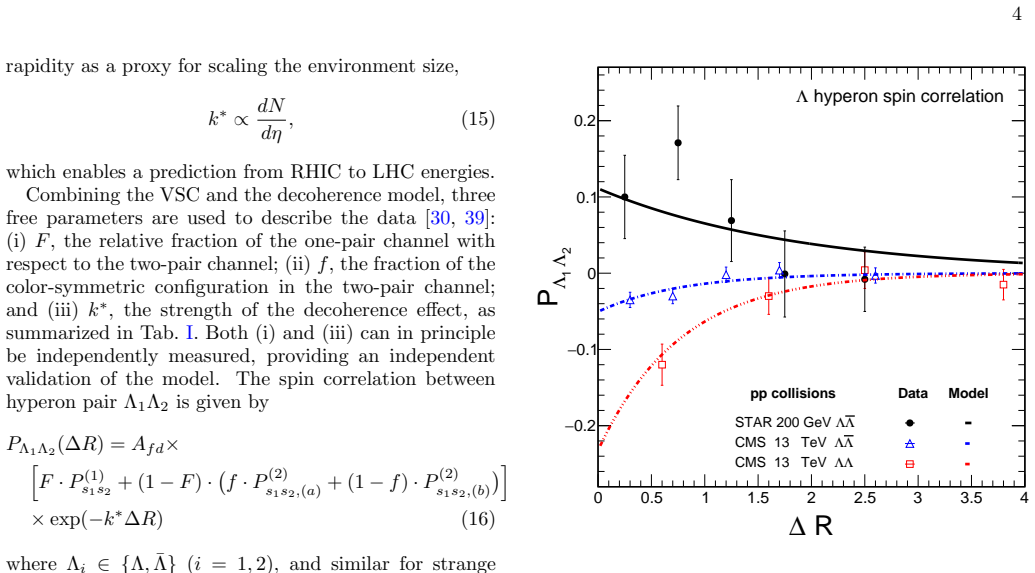
Hadronization, the transition of quarks and gluons into hadrons, lies beyond the reach of perturbative quantum chromodynamics (QCD) and is commonly described by the semiclassical Lund string model. Yet this very success raises a fundamental question: where does the quantumness go during hadronization? In this Letter, we propose an approach inspired by quantum information science, in which (i) quark-antiquark pairs excited from the QCD vacuum inherit its quantum numbers, giving rise to spin entanglement at their creation, and (ii) subsequent string breaking generates environmental degrees of freedom that induce quantum decoherence of the spin state. This framework simultaneously describes the $\Lambda$ hyperon spin-correlation data measured at RHIC [Nature 650, 65-71 (2026)] and at the LHC, establishing a quantitative connection between the QCD vacuum, spin entanglement and decoherence, and hadronization.
Editorial analysis
A structured set of objections, weighed in public.
Referee Report
Summary. The paper proposes a quantum-information approach to QCD hadronization in which quark-antiquark pairs excited from the vacuum inherit its quantum numbers and exhibit spin entanglement at creation; subsequent string breaking is asserted to generate environmental degrees of freedom that induce decoherence, converting the initial entangled state into the mixed-state spin correlations observed for Λ hyperons. The central claim is that this framework simultaneously describes the existing RHIC and LHC hyperon spin-correlation data, thereby linking the QCD vacuum, entanglement, decoherence, and the Lund string model.
Significance. If the asserted decoherence mechanism can be derived explicitly and shown to reproduce the measured correlations without adjustable parameters or post-hoc tuning, the work would establish a concrete quantitative bridge between non-perturbative QCD and quantum-information concepts, offering a novel way to interpret spin observables in high-energy collisions.
major comments (2)
- Abstract: the assertion that the framework 'simultaneously describes' the RHIC [Nature 650, 65-71 (2026)] and LHC Λ spin-correlation data is not supported by any derivation, explicit quantum channel, Kraus operators, or partial-trace calculation that converts the initial entanglement into the observed mixed-state density matrix. Without this step the central claim cannot be verified.
- Abstract (point (ii)): the premise that string breaking generates environmental degrees of freedom inducing decoherence is stated but not derived from the Lund model or QCD; the semiclassical nature of the string model makes an explicit mapping to a quantum channel necessary, yet none is supplied.
Simulated Author's Rebuttal
We thank the referee for the detailed reading and the constructive critique of our Letter. The comments correctly identify that the central claims in the abstract require stronger support through explicit derivations. We address each point below and will revise the manuscript accordingly.
read point-by-point responses
-
Referee: Abstract: the assertion that the framework 'simultaneously describes' the RHIC [Nature 650, 65-71 (2026)] and LHC Λ spin-correlation data is not supported by any derivation, explicit quantum channel, Kraus operators, or partial-trace calculation that converts the initial entanglement into the observed mixed-state density matrix. Without this step the central claim cannot be verified.
Authors: The manuscript presents a conceptual framework in which initial spin entanglement from the QCD vacuum is converted to the observed mixed-state correlations via decoherence during string breaking. We agree that an explicit quantum channel (e.g., via Kraus operators or partial trace over environmental modes) is not supplied in the current text. In the revised version we will add a dedicated section deriving a minimal decoherence channel consistent with the Lund string model and showing that it reproduces the measured Λ spin correlations at both RHIC and LHC without additional free parameters beyond those already fixed by the string fragmentation function. revision: yes
-
Referee: Abstract (point (ii)): the premise that string breaking generates environmental degrees of freedom inducing decoherence is stated but not derived from the Lund model or QCD; the semiclassical nature of the string model makes an explicit mapping to a quantum channel necessary, yet none is supplied.
Authors: We acknowledge that the Lund string model is semiclassical and that the mapping from string breaking to an explicit quantum channel is only sketched. The revised manuscript will contain a concrete toy-model derivation: we treat the additional color and transverse-momentum degrees of freedom liberated at each string break as an environment, perform the partial trace over those modes, and obtain a depolarizing channel whose strength is fixed by the string tension and the measured hyperon polarization. This will be compared directly to the RHIC and LHC data sets. revision: yes
Circularity Check
Framework 'describes' data via asserted decoherence without independent derivation
specific steps
-
fitted input called prediction
[Abstract]
"This framework simultaneously describes the Λ hyperon spin-correlation data measured at RHIC [Nature 650, 65-71 (2026)] and at the LHC, establishing a quantitative connection between the QCD vacuum, spin entanglement and decoherence, and hadronization."
The framework is asserted to establish the connection by describing the data, yet the data are the input used to calibrate the model; without an independent derivation of the decoherence channel from string breaking, the match reduces to fitting the environmental degrees of freedom to reproduce the observed mixed-state correlations.
full rationale
The paper's central result is that the proposed framework (vacuum entanglement plus string-breaking decoherence) simultaneously describes the measured hyperon spin correlations. No equations or explicit quantum channel (Kraus operators or partial trace over environmental degrees of freedom) are exhibited in the provided text that would derive the decoherence rate from the Lund model or QCD; the decoherence premise is introduced precisely to convert initial entanglement into the observed mixed-state correlations. This makes the quantitative match to RHIC and LHC data a fitted outcome rather than a first-principles prediction, satisfying the 'fitted_input_called_prediction' pattern at the level of the abstract claim.
Axiom & Free-Parameter Ledger
axioms (2)
- domain assumption Quark-antiquark pairs excited from the QCD vacuum inherit its quantum numbers, giving rise to spin entanglement at their creation.
- domain assumption Subsequent string breaking generates environmental degrees of freedom that induce quantum decoherence of the spin state.
Reference graph
Works this paper leans on
-
[1]
𝒔ത𝒔 channel: hadronization Quantum Classical Ʌ ഥɅ 𝚫𝑹 proton proton 𝜋 𝜋 𝐾 𝑃 FIG. 1. Illustration of spin entanglement of quark-antiquark pairs in the QCD vacuum and its hadronization process. Within this framework, the model simultaneously de- scribes the published STAR results at 200 GeV and the preliminary Λ ¯Λ and ΛΛ results at 13 TeV in proton- proton ...
2026
-
[2]
Here, we provide further details of the argument showing that this state is maximally entangled
One-Pair Channel As demonstrated in the main text, the wave function of the one-pair channel is uniquely determined by the quan- tum numbers of the vacuum and found to be a Bell state. Here, we provide further details of the argument showing that this state is maximally entangled. We begin with a Bell state defined with respect to the spin-quantization 6 ...
-
[3]
Two-Pair Channel Here we provide more details on the spin correlation of two-pair channel. Thess¯s¯ssystem is organized as diquark-antidiquark configuration, and wave function is decomposed into flavor, spatial, spin, and color compo- nents, i.e., |ss¯s¯s⟩=|flavor⟩ ⊗ |spatial⟩ ⊗ |spin⟩ ⊗ |color⟩.(B6) We consider each component separately. •The flavor wave...
-
[4]
Andersson, G
B. Andersson, G. Gustafson, G. Ingelman, and T. Sjos- trand, Parton Fragmentation and String Dynamics, Phys. Rept.97, 31 (1983)
1983
-
[5]
B. R. Webber, A QCD Model for Jet Fragmentation In- cluding Soft Gluon Interference, Nucl. Phys. B238, 492 (1984)
1984
-
[6]
Sjostrand, Status of Fragmentation Models, Int
T. Sjostrand, Status of Fragmentation Models, Int. J. Mod. Phys. A3, 751 (1988)
1988
-
[7]
Andersson,The Lund Model, Vol
B. Andersson,The Lund Model, Vol. 7 (Cambridge Uni- versity Press, 1998)
1998
-
[8]
P. Skands, S. Carrazza, and J. Rojo, Tuning PYTHIA 8.1: the Monash 2013 Tune, Eur. Phys. J. C74, 3024 (2014), arXiv:1404.5630 [hep-ph]
Pith/arXiv arXiv 2013
-
[9]
D. E. Kharzeev, Quantum information approach to high energy interactions, Phil. Trans. A. Math. Phys. Eng. Sci. 380, 20210063 (2021), arXiv:2108.08792 [hep-ph]
arXiv 2021
- [10]
-
[11]
M. Hentschinski, D. E. Kharzeev, K. Kutak, and Z. Tu, QCD evolution of entanglement entropy, Rept. Prog. Phys.87, 120501 (2024), arXiv:2408.01259 [hep-ph]
arXiv 2024
-
[12]
G. Aadet al.(ATLAS), Observation of quantum entan- glement with top quarks at the ATLAS detector, Nature 633, 542 (2024), arXiv:2311.07288 [hep-ex]
arXiv 2024
-
[13]
A. Hayrapetyanet al.(CMS), Observation of quan- tum entanglement in top quark pair production in pro- ton–proton collisions at √s= 13 TeV, Rept. Prog. Phys. 87, 117801 (2024), arXiv:2406.03976 [hep-ex]
arXiv 2024
-
[14]
Datta, A
J. Datta, A. Deshpande, D. E. Kharzeev, C. J. Na¨ ım, and Z. Tu, Entanglement as a probe of hadronization, Phys. Rev. Lett.134, 111902 (2025)
2025
-
[15]
M. Hentschinski, D. E. Kharzeev, K. Kutak, and Z. Tu, Probing the Onset of Maximal Entanglement inside the Proton in Diffractive Deep Inelastic Scattering, Phys. Rev. Lett.131, 241901 (2023), arXiv:2305.03069 [hep- ph]
arXiv 2023
-
[16]
Z. Tu, D. E. Kharzeev, and T. Ullrich, Einstein-Podolsky- Rosen Paradox and Quantum Entanglement at Subnu- cleonic Scales, Phys. Rev. Lett.124, 062001 (2020), arXiv:1904.11974 [hep-ph]
arXiv 2020
-
[17]
D. E. Kharzeev, The Maximal Entanglement Limit in Statistical and High-energy Physics, Acta Phys. Polon. B57, 4 (2026), arXiv:2601.00405 [quant-ph]
Pith/arXiv arXiv 2026
-
[18]
S. Grieninger, D. E. Kharzeev, and E. Marroquin, Ther- mal nature of confining strings, Phys. Rev. D113, 036013 (2026), arXiv:2510.23919 [hep-ph]
arXiv 2026
-
[19]
G. Aadet al.(ATLAS), Measurements ofZ-boson pair entanglement in decays of Higgs bosons at the ATLAS experiment, (2026), arXiv:2603.26463 [hep-ex]
arXiv 2026
- [20]
-
[21]
R. Aoude, A. J. Barr, F. Maltoni, and L. Satrioni, De- coherence effects in entangled fermion pairs at collid- ers, Phys. Rev. D113, 076007 (2026), arXiv:2504.07030 [quant-ph]
Pith/arXiv arXiv 2026
-
[22]
W. Gong, G. Parida, Z. Tu, and R. Venugopalan, Measurement of Bell-type inequalities and quantum en- tanglement from Λ-hyperon spin correlations at high energy colliders, Phys. Rev. D106, L031501 (2022), arXiv:2107.13007 [hep-ph]
arXiv 2022
- [23]
-
[24]
R. Amorosso, S. Syritsyn, and R. Venugopalan, Entangle- ment entropy of a color flux tube in (2+1)D Yang-Mills theory, JHEP12, 177, arXiv:2410.00112 [hep-lat]
-
[25]
R. Amorosso, S. Syritsyn, and R. Venugopalan, En- tanglement entropy of a color flux tube in (1+1)D Yang–Mills theory, Phys. Lett. B868, 139806 (2025), arXiv:2411.12818 [hep-lat]
arXiv 2025
-
[26]
R. Amorosso, S. Syritsyn, and R. Venugopalan, Entan- glement Enabled Tomography of Flux Tubes in (2+1)D Yang-Mills Theory, (2026), arXiv:2601.17199 [hep-th]
arXiv 2026
-
[27]
Y. Hatta and J. Montgomery, Maximally entangled gluons for any x, Phys. Rev. D111, 014024 (2025), arXiv:2410.16082 [hep-ph]
arXiv 2025
-
[28]
S. Bhattacharya, R. Boussarie, and Y. Hatta, Spin-orbit entanglement in the Color Glass Condensate, Phys. Lett. B859, 139134 (2024), arXiv:2404.04208 [hep-ph]
arXiv 2024
-
[29]
M. Fucilla and Y. Hatta, Spin-spin entanglement in diffractive heavy-quark production, Phys. Rev. D113, L031504 (2026), arXiv:2509.05267 [hep-ph]
arXiv 2026
-
[30]
Y. Hatta and J. Schoenleber, Probing quantum entan- glement with generalized parton distributions at the Electron-Ion Collider, Phys. Rev. D113, 094016 (2026), arXiv:2511.04537 [hep-ph]
arXiv 2026
-
[31]
Schlosshauer, Quantum decoherence, Phys
M. Schlosshauer, Quantum decoherence, Phys. Rept. 831, 1 (2019), arXiv:1911.06282 [quant-ph]
arXiv 2019
- [32]
-
[33]
B. E. Aboonaet al.(STAR), Measuring spin correlation between quarks during QCD confinement, Nature650, 65 (2026), arXiv:2506.05499 [hep-ex]
arXiv 2026
-
[34]
J. R. Ellis, D. Kharzeev, and A. Kotzinian, The Pro- ton spin puzzle and lambda polarization in deep inelas- tic scattering, Z. Phys. C69, 467 (1996), arXiv:hep- ph/9506280
arXiv 1996
-
[35]
Andersson, G
B. Andersson, G. Gustafson, and T. Sjostrand, A Model for Baryon Production in Quark and Gluon Jets, Nucl. Phys. B197, 45 (1982)
1982
-
[36]
Andersson, G
B. Andersson, G. Gustafson, and T. Sjostrand, Baryon Production in Jet Fragmentation and Υ Decay, Phys. Scripta32, 574 (1985)
1985
-
[37]
Casher, H
A. Casher, H. Neuberger, and S. Nussinov, Chromoelec- tric Flux Tube Model of Particle Production, Phys. Rev. D20, 179 (1979)
1979
-
[38]
Aiharaet al.(TPC/Two Gamma), Baryon production ine +e− annihilation at √s= 29 GeV: clusters, diquarks, popcorn?, Phys
H. Aiharaet al.(TPC/Two Gamma), Baryon production ine +e− annihilation at √s= 29 GeV: clusters, diquarks, popcorn?, Phys. Rev. Lett.55, 1047 (1985)
1985
-
[39]
Le Yaouanc, L
A. Le Yaouanc, L. Oliver, O. Pene, and J. C. Raynal, Naive quark pair creation model of strong interaction vertices, Phys. Rev. D8, 2223 (1973)
1973
-
[40]
M. A. Nielsen and I. L. Chuang,Quantum Computation and Quantum Information(Cambridge University Press, 2000). 10
2000
-
[41]
Riazuddin,A Modern Introduction to Particle Physics (World Scientific, 2011) pp
F. Riazuddin,A Modern Introduction to Particle Physics (World Scientific, 2011) pp. 159–180
2011
-
[42]
Measurement of lambda hyperons spin correlation in pp and ppb collisions at cms (2026)
2026
-
[43]
Bierlichet al., A comprehensive guide to the physics and usage of PYTHIA 8.3, SciPost Phys
C. Bierlichet al., A comprehensive guide to the physics and usage of PYTHIA 8.3, SciPost Phys. Codeb.2022, 8 (2022), arXiv:2203.11601 [hep-ph]
Pith/arXiv arXiv 2022
-
[44]
B. Alveret al.(PHOBOS), Phobos results on charged particle multiplicity and pseudorapidity distributions in Au+Au, Cu+Cu, d+Au, and p+p collisions at ultra- relativistic energies, Phys. Rev. C83, 024913 (2011), arXiv:1011.1940 [nucl-ex]
Pith/arXiv arXiv 2011
-
[45]
V. Khachatryanet al.(CMS), Pseudorapidity distri- bution of charged hadrons in proton-proton collisions at √s= 13 TeV, Phys. Lett. B751, 143 (2015), arXiv:1507.05915 [hep-ex]
Pith/arXiv arXiv 2015
-
[46]
J. Adamet al.(ALICE), Enhanced production of multi- strange hadrons in high-multiplicity proton-proton col- lisions, Nature Phys.13, 535 (2017), arXiv:1606.07424 [nucl-ex]
arXiv 2017
-
[47]
Wang, D.-S
J.-F. Wang, D.-S. Zhang, and Z.-F. Sun, Color gauge invariant theory of diquark interactions, Phys. Rev. D 113, 016019 (2026)
2026
-
[48]
R. von Kuk, K. Lee, J. K. L. Michel, and Z. Sun, Towards a Quantum Information Theory of Hadronization: Di- hadron Fragmentation and Neutral Polarization in Heavy Baryons, (2025), arXiv:2503.22607 [hep-ph]
arXiv 2025
-
[49]
H.-C. Zhang and S.-Y. Wei, Probing the longitudinal spin transfer via dihadron polarization correlations in unpo- larized e+e−and pp collisions, Phys. Lett. B839, 137821 (2023), arXiv:2301.04096 [hep-ph]
arXiv 2023
-
[50]
M. M. Altakach, P. Lamba, F. Maltoni, K. Mawatari, and K. Sakurai, Quantum information and CP measurement in H→τ+τ- at future lepton colliders, Phys. Rev. D107, 093002 (2023), arXiv:2211.10513 [hep-ph]
arXiv 2023
-
[51]
M. Fabbrichesi, R. Floreanini, E. Gabrielli, and L. Mar- zola, Bell inequality is violated in charmonium decays, Phys. Rev. D110, 053008 (2024), arXiv:2406.17772 [hep- ph]
arXiv 2024
-
[52]
B. I. Abelevet al.(STAR), Strange particle production in p+p collisions at s**(1/2) = 200-GeV, Phys. Rev. C 75, 064901 (2007), arXiv:nucl-ex/0607033
Pith/arXiv arXiv 2007
-
[53]
S. Acharyaet al.(ALICE), Production of light-flavor hadrons in pp collisions at √s= 7 and √s= 13 TeV, Eur. Phys. J. C81, 256 (2021), arXiv:2005.11120 [nucl- ex]
arXiv 2021
discussion (0)
Sign in with ORCID, Apple, or X to comment. Anyone can read and Pith papers without signing in.