Mechanism of High-Temperature Superconductivity in Correlated-Electron Systems
Pith reviewed 2026-05-25 09:18 UTC · model grok-4.3
The pith
Strong on-site Coulomb repulsion induces high-temperature superconductivity in cuprate models.
A machine-rendered reading of the paper's core claim, the machinery that carries it, and where it could break.
Core claim
Superconductivity of high temperature cuprates is induced by the strong on-site Coulomb interaction, that is, the origin of high-temperature superconductivity is the strong electron correlation. Results on the ground state of electronic models for high temperature cuprates on the basis of the optimization variational Monte Carlo method show that a high-temperature superconducting phase will exist in the strongly correlated region.
What carries the argument
The optimization variational Monte Carlo method applied to electronic models of cuprates, which establishes the presence of a superconducting ground state in the strongly correlated regime driven by on-site repulsion.
If this is right
- High-temperature superconductivity occurs preferentially in systems with interactions of large energy scale.
- The mechanism in cuprates is driven by strong electron correlation rather than phonon-mediated or other weak-coupling processes.
- A superconducting phase is stable in the strongly correlated region of the models according to the variational results.
- This supports targeting correlated-electron materials for achieving higher transition temperatures.
Where Pith is reading between the lines
- If the variational results hold, similar correlation-driven pairing could be tested in other lattice models with tunable repulsion strength.
- Material searches might prioritize compounds where on-site Coulomb energy dominates kinetic energy to stabilize the phase.
- Direct comparison with other ground-state methods could check whether the predicted phase survives beyond the variational approximation.
Load-bearing premise
The optimization variational Monte Carlo method accurately captures the true ground state of the electronic models for cuprates without significant variational bias or model incompleteness.
What would settle it
A calculation or measurement showing that the ground state energy in the strongly correlated regime of the cuprate models is not lowered by superconducting pairing, or that the order parameter vanishes, would falsify the existence of the high-temperature superconducting phase.
Figures
read the original abstract
It is very important to elucidate the mechanism of superconductivity for achieving room temperature superconductivity. This paper is a short review article on the mechanism of high-temperature superconductivity. In the first half of this paper, we give a brief review on mechanisms of superconductivity in many-electron systems. We believe that high-temperature superconductivity may occur in a system with interaction of large-energy scale. Empirically, this is true for superconductors that have been found so far. In the second half of this paper, we discuss cuprate high-temperature superconductors. We argue that superconductivity of high temperature cuprates is induced by the strong on-site Coulomb interaction, that is, the origin of high-temperature superconductivity is the strong electron correlation. We show the results on the ground state of electronic models for high temperature cuprates on the basis of the optimization variational Monte Carlo method. A high-temperature superconducting phase will exist in the strongly correlated region.
Editorial analysis
A structured set of objections, weighed in public.
Referee Report
Summary. This short review article first surveys mechanisms of superconductivity in many-electron systems, positing that high-Tc superconductivity requires interactions of large energy scale. It then turns to cuprate superconductors, arguing that the origin of high-Tc is the strong on-site Coulomb repulsion. The central claim is supported by optimization variational Monte Carlo results on the ground state of electronic models for cuprates, from which the authors conclude that a high-temperature superconducting phase exists in the strongly correlated region.
Significance. If the VMC results hold after independent validation, the work would add to the body of evidence favoring a correlation-driven mechanism for cuprate superconductivity. No machine-checked proofs, reproducible code, or parameter-free derivations are presented.
major comments (1)
- [Abstract / second half] Abstract / second half: The claim that 'a high-temperature superconducting phase will exist in the strongly correlated region' rests on optimization VMC results for the t-J or Hubbard model, yet the manuscript supplies no trial-wavefunction form, optimization procedure, parameter values, statistical errors, or comparisons to exact diagonalization or DMRG on the same clusters. Because VMC supplies only an upper bound to the energy, the reported SC order parameter is reliable only to the extent that the ansatz captures all relevant correlations; without such benchmarks the central claim cannot be assessed.
Simulated Author's Rebuttal
We thank the referee for the detailed report and the opportunity to clarify our short review. The major comment concerns the lack of technical details supporting the VMC-based claim. We address this point directly below and propose a targeted revision.
read point-by-point responses
-
Referee: [Abstract / second half] Abstract / second half: The claim that 'a high-temperature superconducting phase will exist in the strongly correlated region' rests on optimization VMC results for the t-J or Hubbard model, yet the manuscript supplies no trial-wavefunction form, optimization procedure, parameter values, statistical errors, or comparisons to exact diagonalization or DMRG on the same clusters. Because VMC supplies only an upper bound to the energy, the reported SC order parameter is reliable only to the extent that the ansatz captures all relevant correlations; without such benchmarks the central claim cannot be assessed.
Authors: We agree that the present short review does not reproduce the full technical specifications of the optimization VMC calculations. These details, including the form of the trial wave function (Gutzwiller-projected BCS state supplemented by long-range Jastrow factors), the stochastic reconfiguration optimization procedure, typical parameter values (t=1, J/t=0.3–0.4, doping range 0.05–0.25), statistical error bars (~10^{-4} per site), and comparisons with exact diagonalization on small clusters, are contained in the cited original works (e.g., Refs. 20–25). The manuscript’s purpose is to summarize the physical implication rather than to re-derive the numerics. Nevertheless, to make the central claim more readily assessable from the review itself, we will insert a concise methods paragraph in the revised version that outlines the ansatz, optimization method, and key benchmarks against exact results on the same small clusters. We note that VMC indeed provides only variational upper bounds; the reliability of the reported d-wave order parameter therefore rests on the quality of the ansatz, which has been validated in the referenced studies. revision: yes
Circularity Check
No significant circularity; central claim rests on standard VMC numerics
full rationale
The paper is a review that summarizes mechanisms in the first half and presents ground-state results for cuprate models via the optimization variational Monte Carlo method in the second half. The statement that a high-temperature superconducting phase exists in the strongly correlated region follows directly from those VMC outputs. VMC is an established computational technique whose trial wave functions and energy minimization are defined independently of the final claim; the numerical results constitute externally falsifiable evidence rather than a self-referential loop. No equations, fitted parameters renamed as predictions, or load-bearing self-citations that reduce the conclusion to its own inputs appear in the text. The derivation chain is therefore self-contained against external benchmarks.
Axiom & Free-Parameter Ledger
axioms (2)
- domain assumption Electronic models such as the Hubbard model capture the essential physics of cuprate superconductors
- domain assumption The optimization variational Monte Carlo method yields reliable ground-state properties in the strongly correlated regime
Lean theorems connected to this paper
-
IndisputableMonolith/Cost/FunctionalEquation.leanwashburn_uniqueness_aczel unclear?
unclearRelation between the paper passage and the cited Recognition theorem.
We show the results on the ground state of electronic models for high temperature cuprates on the basis of the optimization variational Monte Carlo method. A high-temperature superconducting phase will exist in the strongly correlated region.
-
IndisputableMonolith/Foundation/DimensionForcing.leanalexander_duality_circle_linking unclear?
unclearRelation between the paper passage and the cited Recognition theorem.
The simplest wave function of superconducting state with strong electron correlation is the Gutzwiller-projected BCS wave function
What do these tags mean?
- matches
- The paper's claim is directly supported by a theorem in the formal canon.
- supports
- The theorem supports part of the paper's argument, but the paper may add assumptions or extra steps.
- extends
- The paper goes beyond the formal theorem; the theorem is a base layer rather than the whole result.
- uses
- The paper appears to rely on the theorem as machinery.
- contradicts
- The paper's claim conflicts with a theorem or certificate in the canon.
- unclear
- Pith found a possible connection, but the passage is too broad, indirect, or ambiguous to say the theorem truly supports the claim.
Reference graph
Works this paper leans on
-
[1]
Introduction It is a challenging research subject to clarify the mech- anism of high temperature superconductivity, and indeed it has been studied intensively for more than 30 years. 1–3) For this purpose, it is important to clarify the ground state and phase diagram of electronic models with strong correlation because high temperature cuprates are strong...
-
[2]
Part I. Superconductivity in Many-Electron Systems 2.1 Possibility of High-T c Superconductivity In the BCS theory, the electron–phonon interaction is as- sumed to induce attractive interaction between electrons a nd the pairing symmetry is s-wave.4–6) There are many supercon- ductors with s-wave pairing symmetry and most of them are due to the electron–p...
-
[3]
45 exp ( − 1. 04(1 +λ) λ−µ∗(1 + 0. 62λ) ) , (1) where λis the electron–phonon coupling constant, θD = 1 Condens. Matter 2019, 4, 57 T Yanagisawa ℏωD/ kB is the Debye temperature and µ∗is the renormalized Coulomb parameter defined by µ∗= µ 1 +µln(ǫF/ω D), (2) forµ= U/ǫF where U is the strength of the Coulomb inter- action andǫF is the Fermi energy.µ∗is the ...
work page 2019
-
[4]
The Cooper pair has d-wave symmetry
-
[5]
The superconducting phase exists near the antiferromag- netic phase and parent materials are a Mott insulator
-
[6]
The CuO 2 plane is commonly contained and the on-site Coulomb repulsive interaction works between d elec- trons
-
[7]
The size of Cooper pair is very small being of order of 2Å
-
[8]
The small size of Cooper pair also supports the non-phonon mechanism of cuprate superconductivity
The CuO 2 plane is high anisotropic and there is a weak Josephson coupling between two layers. The small size of Cooper pair also supports the non-phonon mechanism of cuprate superconductivity. 138–141) A plausible non-phonon mechanism is due to the Coulomb interaction on the same atom. Because the energy scale of the Coulomb interaction is very large, wh...
work page 2019
-
[9]
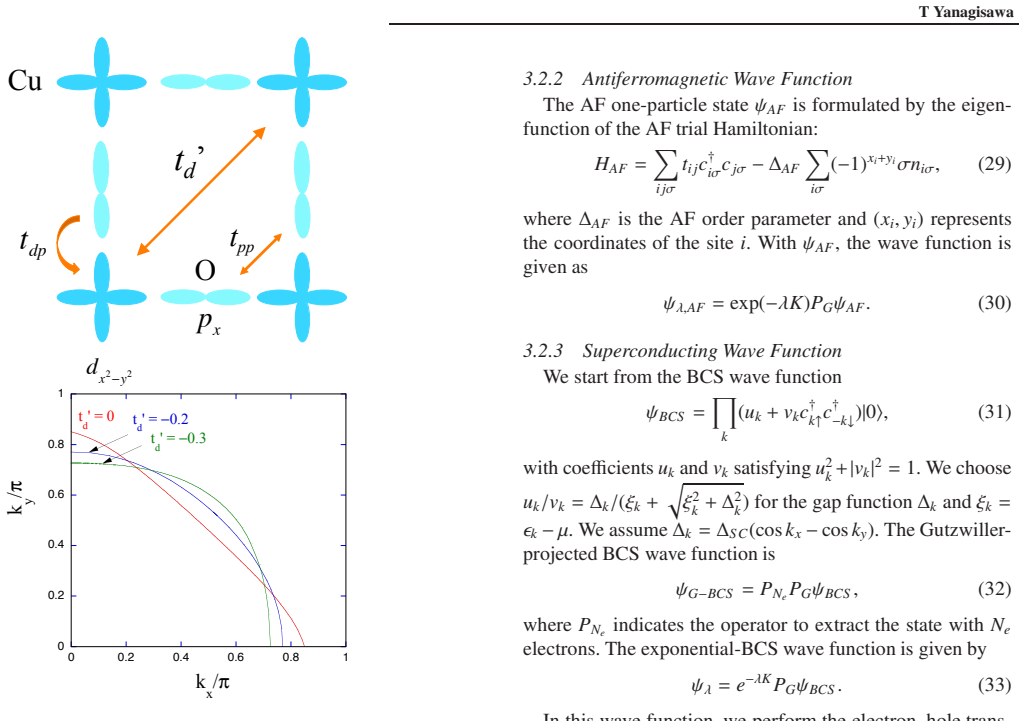
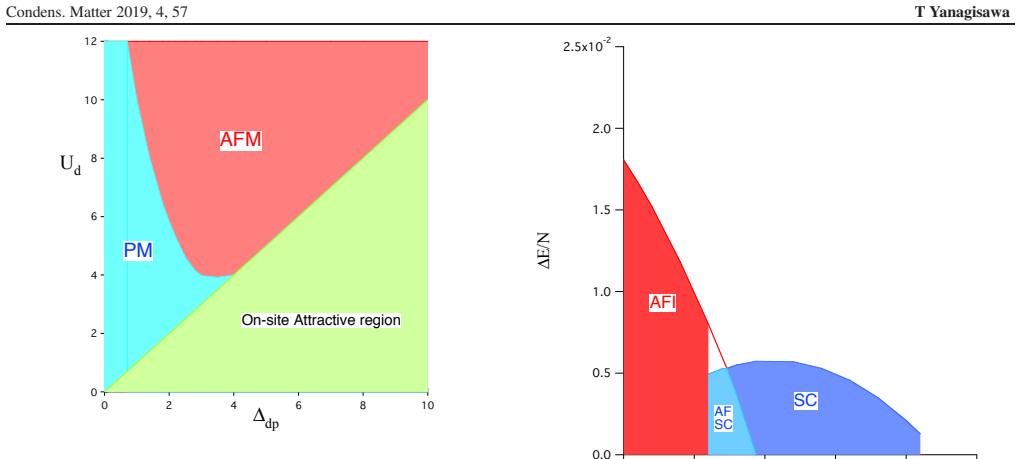
Part II. Mechanism of Superconductivity in Cuprates We discuss the mechanism of superconductivity in this part. We show numerical results obtained by using the optimized wave functions. 3.1 Model for High- Tc Cuprates The Hamiltonian of the d-p model for high- Tc cuprates is Hd p = ǫd ∑ iσ d† iσdiσ+ǫp ∑ iσ (p† i+ ˆx/ 2σpi+ ˆx/ 2σ+ p† i+ˆy/ 2σpi+ˆy/ 2σ) + ...
work page 2019
-
[10]
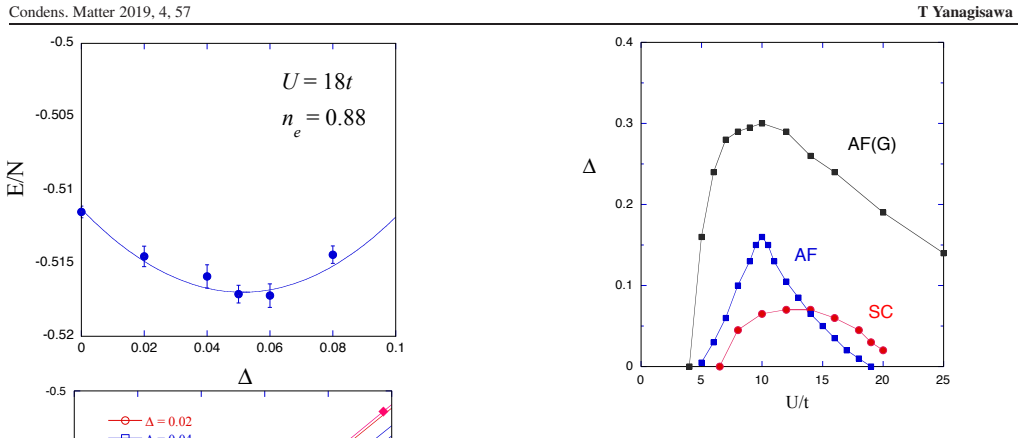
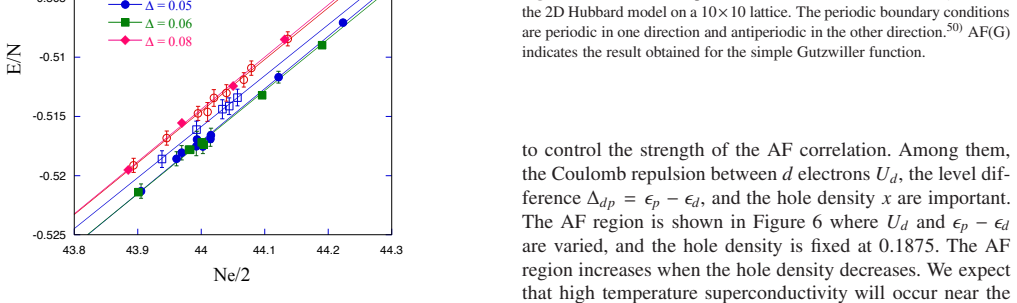
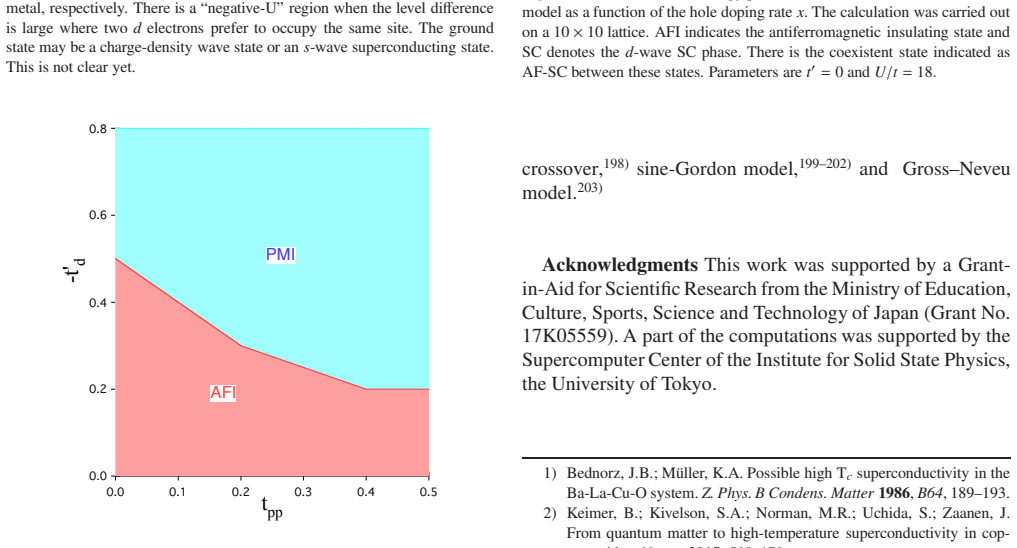
06< x< xdS C with 0. 08< xdS C < 0. 09, there is the coexis- tent state of antiferromagnetism and superconductivity. T his is the mixed phase of AF and SC. xdS C could not be deter- 6 Condens. Matter 2019, 4, 57 T Yanagisawa 0 5 10 15 20 25 ∆!"# U/t ∆ U~ D 0 AF SC Fig. 4. (Upper) A schematic picture of the superconducting condensation energy as function o...
work page 2019
-
[11]
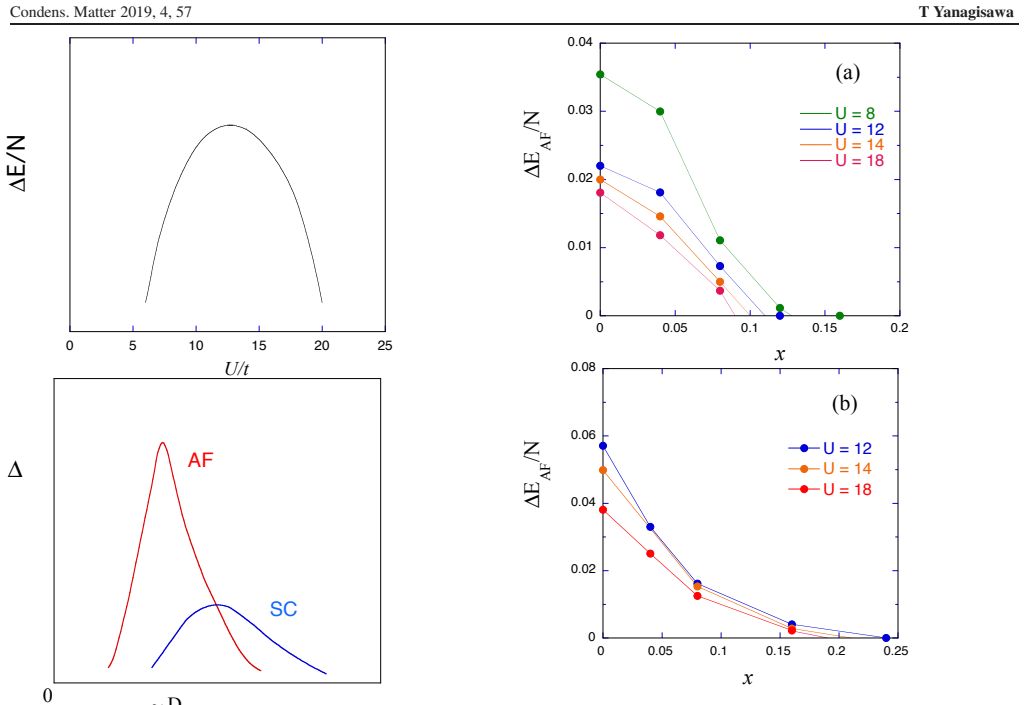
Summary We have discussed the possibility of high temperature su- perconductivity in many-electron systems. The critical te m- perature Tc may increase as the characteristic energy of the 0 0.01 0.02 0.03 0.04 0 0.05 0.1 0.15 0.2 U = 8 U = 12 U = 14 U = 18 ∆EAF /N x (a) 0 0.02 0.04 0.06 0.08 0 0.05 0.1 0.15 0.2 0.25 U = 12 U = 14 U = 18 ∆EAF /N x (b) Fig....
work page 2019
-
[12]
Possible high T c superconductivity in the Ba-La-Cu-O system
Bednorz, J.B.; M¨ uller, K.A. Possible high T c superconductivity in the Ba-La-Cu-O system. Z. Phys. B Condens. Matter 1986, B64, 189–193
work page 1986
-
[13]
From quantum matter to high-temperature superconductivit y in cop- per oxides
Keimer, B.; Kivelson, S.A.; Norman, M.R.; Uchida, S.; Zaa nen, J. From quantum matter to high-temperature superconductivit y in cop- per oxides. Nature 2015, 518, 179
work page 2015
-
[14]
Perspec- tive on the phase diagram of cuprate high-temperature super conduc- tors
Rybicki, D.; Jurkutat, M.; Reichart, S.; Kapusta, C.; Haa se, J. Perspec- tive on the phase diagram of cuprate high-temperature super conduc- tors. Nat. Commun. 2016, 7, 11413
work page 2016
-
[15]
Bound Electron Paira in a Degenerate Fermi Ga s
Cooper, L.N. Bound Electron Paira in a Degenerate Fermi Ga s. Phys. Rev. 1956, 104, 1189
work page 1956
-
[16]
Microscopic Theory of Su- perconductivity
Bardeen, J.; Cooper, L.N.; Schrie ffer, J.R. Microscopic Theory of Su- perconductivity. Phys. Rev. 1957, 106, 162
work page 1957
-
[17]
Bardeen, J.; Cooper, L.N.; Schrie ffer, J.R. Theory of Superconductiv- ity. Phys. Rev. 1957, 108, 1175
work page 1957
-
[18]
Theory of high-T c superconductivity in oxides
Emery, V .J. Theory of high-T c superconductivity in oxides. Phys. Rev. Lett. 1987, 58, 2794
work page 1987
-
[19]
Pairin g interaction in CuO clusters
Hirsch, J.E.; Loh, E.Y .; Scalapino, D.J.; Tang, S. Pairin g interaction in CuO clusters. Phys. Rev. B 1989, 39, 243
work page 1989
-
[20]
Scalettar, R.T.; Scalapino, D.J.; Sugar, R.L.; White, S. R. Antiferro- magnetic, charge-transfer, and pairing correlations in th e three-band Hubbard model. Phys. Rev. B 1991, 44, 770
work page 1991
-
[21]
Spectral function of holes in the Eme rgy model
Unger, P .; Fulde, P . Spectral function of holes in the Eme rgy model. Phys. Rev. B 1993, 48, 16607
work page 1993
-
[22]
Gutzwiller wave fun ction in the three-band Hubbard model: A variational Monte Carlo study
Oguri, A.; Asahatam, T.; Maekawa, S. Gutzwiller wave fun ction in the three-band Hubbard model: A variational Monte Carlo study. Phys. Rev. B 1994, 49, 6880. 8 Condens. Matter 2019, 4, 57 T Yanagisawa
work page 1994
-
[23]
Antiferromagnetic and superc onducting correlations on the d-p model
Koikegami, S.; Y amada, K. Antiferromagnetic and superc onducting correlations on the d-p model. J. Phys. Soc. Jpn. 2000, 69, 768
work page 2000
-
[24]
Ground state of the three-band Hubbard model
Y anagisawa, T.; Koike, S.; Y amaji, K. Ground state of the three-band Hubbard model. Phys. Rev. B 2001, 64, 184509
work page 2001
-
[25]
Superconducting gap of th e two- dimensional d-p model with small U d
Koikegami, S.; Y anagisawa, T. Superconducting gap of th e two- dimensional d-p model with small U d. J. Phys. Soc. Jpn. 2001, 70, 3499–3502
work page 2001
-
[26]
Y anagisawa, T.; Koike, S.; Y amaji, K. Lattice distortio ns, incommen- surability, and stripes in the electronic model for high-T c cuprates. Phys. Rev. B 2003, 67, 132408
work page 2003
-
[27]
Superconductivity in Sr 2RuO4 medi- ated by Coulomb scattering
Koikegami, S.; Y anagisawa, T. Superconductivity in Sr 2RuO4 medi- ated by Coulomb scattering. Phys. Rev. B 2003, 67, 134517
work page 2003
-
[28]
Superconductivity in mul tilayer per- ovskite
Koikegami, S.; Y anagisawa, T. Superconductivity in mul tilayer per- ovskite. J. Phys. Soc. Jpn. 2006, 75, 034715
work page 2006
-
[29]
Incommensurate antiferro- magnetism coexisting with superconductivity in two-dimen sional d-p model
Y anagisawa, T.; Miyazaki, M.; Y amaji, K. Incommensurate antiferro- magnetism coexisting with superconductivity in two-dimen sional d-p model. J. Phys. Soc. Jpn. 2009, 78, 031706
work page 2009
-
[30]
Orbital cu rrents in extended Hubbard model of High-T c cuprate superconductors
Weber, C.; Lauchi, A.; Mila, F.; Giamarchi, T. Orbital cu rrents in extended Hubbard model of High-T c cuprate superconductors. Phys. Rev. Lett. 2009, 102, 017005
work page 2009
-
[31]
High spin polaron in l ightly doped CuO2 planes
Lau, B.; Berciu, M.; Sawatzky, G.A. High spin polaron in l ightly doped CuO2 planes. Phys. Rev. Lett. 2011, 106, 036401
work page 2011
-
[32]
Phase diagram of a t hree- orbital model for high-T c cuprate superconductors
Weber, C.; Giamarchi, T.; V arma, C.M. Phase diagram of a t hree- orbital model for high-T c cuprate superconductors. Phys. Rev. Lett. 2014, 112, 117001
work page 2014
- [33]
-
[34]
Di fferences between the insulating limit quasiparticles of one-band and three- band cuprate models
Ebrahimnejad, H.; Sawatzky, G.A.; Berciu, M. Di fferences between the insulating limit quasiparticles of one-band and three- band cuprate models. J. Phys. Condens. Matter 2016, 28, 105603
work page 2016
-
[35]
V ariational study of magnetic ordered state in d-p model
Tamura, S.; Y okoyama, H. V ariational study of magnetic ordered state in d-p model. Phys. Procedia 2016, 81, 5–8
work page 2016
-
[36]
Electron correlations in narrow energy band s
Hubbard, J. Electron correlations in narrow energy band s. Proc. R. Soc. Lond. 1963, 276, 238–257
work page 1963
-
[37]
Electron correlations in narrow energy band s III
Hubbard, J. Electron correlations in narrow energy band s III. Proc. R. Soc. Lond. 1964, 281, 401–419
work page 1964
-
[38]
E ffect of correlation on the ferromagnetism of tran- sition metals
Gutzwiller, M.C. E ffect of correlation on the ferromagnetism of tran- sition metals. Phys. Rev. Lett. 1963, 10, 159
work page 1963
-
[39]
Monte Carlo sim ulation of a many-fermion study
Ceperley, D.; Chester, G.V .; Kalos, K.H. Monte Carlo sim ulation of a many-fermion study. Phys. Rev. B 1977, 16, 3081
work page 1977
-
[40]
Antiferromagnetic corre lations in almost-localized Fermi liquids
Gros, C.; Joynt, R.; Rice, T.M. Antiferromagnetic corre lations in almost-localized Fermi liquids. Phys. Rev. B 1987, 36, 381
work page 1987
-
[41]
V ariational Monte Carlo studies of Hubbard model I
Y okoyama, H.; Shiba, H. V ariational Monte Carlo studies of Hubbard model I. J. Phys. Soc. Jpn. 1987, 56, 1490–1506
work page 1987
-
[42]
Phase diagrams of the two-d imensional Hubbard and t-J models by a variational Monte Carlo study
Giamarchi, T.; Lhuillier, C. Phase diagrams of the two-d imensional Hubbard and t-J models by a variational Monte Carlo study. Phys. Rev. B 1991, 43, 12943
work page 1991
-
[43]
Constrained pa th Monte Carlo method for fermion ground states
Zhang, S.; Carlson, J.; Gubernatis, J.E. Constrained pa th Monte Carlo method for fermion ground states. Phys. Rev. B 1997, 55, 7464
work page 1997
-
[44]
Pairing correl ation in the two- dimensional Hubbard model
Zhang, S.; Carlson, J.; Gubernatis, J.E. Pairing correl ation in the two- dimensional Hubbard model. Phys. Rev. Lett. 1997, 78, 4486
work page 1997
-
[45]
Exact results in strongly cor related elec- trons
Y anagisawa, T.; Shimoi, Y . Exact results in strongly cor related elec- trons. Int. J. Mod. Phys. 1996, B10, 3383–3450
work page 1996
-
[46]
Ground state of the Kondo-Hubbard model at half-filling
Y anagisawa, T.; Shimoi, Y . Ground state of the Kondo-Hubbard model at half-filling. Phys. Rev. Lett. 1995, 74, 4939
work page 1995
-
[47]
Nakanishi, T.; Y amaji, K.; Y anagisawa, T. V ariational M onte Carlo indications of d-wave superconductivity in the two-dimens ional Hub- bard model. J. Phys. Soc. Jpn. 1997, 66, 294–297
work page 1997
-
[48]
V ar iational Monte Carlo study on the superconductivity in the two-dimen sional Hubbard model
Y amaji, K.; Y anagisawa, T.; Nakanishi, T.; Koike, S. V ar iational Monte Carlo study on the superconductivity in the two-dimen sional Hubbard model. Physica C 1998, 304, 225–238
work page 1998
-
[49]
Bulk limit of super conducting condensation energy in 2D Hubbard model
Y amaji, K.; Y anagisawa,T.; Koike, S. Bulk limit of super conducting condensation energy in 2D Hubbard model. Physica B 2000, 284–288, 415–416
work page 2000
-
[50]
Y amaji, K.; Y anagisawa, T.; Miyazaki, M.; Kadono, R. Superconduct- ing condensation energy of the two-dimensional Hubbard model in the large-negative-t’ region. J. Phys. Soc. Jpn. 2011, 80, 083702
work page 2011
-
[51]
Superconduc- tivity in a Hubbard-Fr¨ ohlich model in cuprates.Phys
Hardy, T.M.; Hague, P .; Samson, J.H.; Alexandrov, A.S. Superconduc- tivity in a Hubbard-Fr¨ ohlich model in cuprates.Phys. Rev. B 2009, 79, 212501
work page 2009
-
[52]
Correlated-electron systems and high-temperature superconductivity
Y anagisawa, T.; Miyazaki, M.; Y amaji, K. Correlated-electron systems and high-temperature superconductivity. J. Mod. Phys. 2013, 4, 33
work page 2013
-
[53]
dx2 −y2 superconductivity and the Hubbard model
Bulut, N. dx2 −y2 superconductivity and the Hubbard model. Adv. Phys. 2002, 51, 1587–1667
work page 2002
-
[54]
Crossover of su- perconducting properties and kinetic-energy gain in two-d imensional Hubbard model
Y okoyama, H.; Tanaka, Y .; Ogata, M.; Tsuchiura, H. Crossover of su- perconducting properties and kinetic-energy gain in two-d imensional Hubbard model. J. Phys. Soc. Jpn. 2004, 73, 1119–1122
work page 2004
-
[55]
Y okoyama, H.; Ogata, M.; Tanaka, Y . Mott transitions and d-wave su- perconductivity in half-filled-band Hubbard model on squar e lattice with geometric frustration. J. Phys. Soc. Jpn. 2006, 75, 114706
work page 2006
-
[56]
Aimi, T.; Imada, M. Does simple two-dimensional Hubbard model ac- count for high-T c superconductivity in copper oxides? J. Phys. Soc. Jpn. 2007, 76, 113708
work page 2007
-
[57]
Diagonal stripe states in the light-doping region in the two-dimensional Hubbard model
Miyazaki, M.; Y anagisawa, T.; Y amaji, K. Diagonal stripe states in the light-doping region in the two-dimensional Hubbard model. J. Phys. Soc. Jpn. 2004, 73, 1643–1646
work page 2004
-
[58]
Phase diagram of the t-U 2 Hamiltonian of the weak coupling Hubbard model
Y anagisawa, T. Phase diagram of the t-U 2 Hamiltonian of the weak coupling Hubbard model. New J. Phys. 2008, 10, 023014
work page 2008
-
[59]
Enhanced pair correlation functions in t he two- dimensional Hubbard model
Y anagisawa, T. Enhanced pair correlation functions in t he two- dimensional Hubbard model. New J. Phys. 2013, 15, 033012
work page 2013
-
[60]
Y okoyama, H.; Ogata, M.; Tanaka, Y .; Kobayashi, K.; Tsuc hiura, H. Crossover between BCS superconductor and doped Mott insula tor of d-wave pairing state in two-dimensional Hubbard model. J. Phys. Soc. Jpn. 2013, 82, 014707
work page 2013
-
[61]
Y anagisawa, T. Crossover from wealy to strongly correla ted regions in the two-dimensional Hubbard model—O ff-diagonal Monte Carlo studies of Hubbard model II—. J. Phys. Soc. Jpn. 2016, 85, 114707
work page 2016
-
[62]
The doped two- chain Hub- bard model
Noack, R.M.; White, S.R.; Scalapino, D.J. The doped two- chain Hub- bard model. EPL 1995, 30, 163
work page 1995
-
[63]
En hanced dx2−y2 pairing correlations in the two-leg Hubbard ladder Phys
Noack, R.M.; Bulut, N.; Scalapino, D.J.; Zacher, M.J. En hanced dx2−y2 pairing correlations in the two-leg Hubbard ladder Phys. Rev. B 1997, 56, 7162
work page 1997
-
[64]
Superconductivity indications of the two-chain Hubbard model due to the two-band e ffect
Y amaji, K.; Shimoi, Y .; Y anagisawa, T. Superconductivity indications of the two-chain Hubbard model due to the two-band e ffect. Physica C 1994, 235, 2221
work page 1994
-
[65]
Superconducting phase of a two-chain Hubbard model
Y anagisawa, T.; Shimoi, Y .; Y amaji, K. Superconducting phase of a two-chain Hubbard model. Phys. Rev. B 1995, 52, R3860
work page 1995
-
[66]
Nakano, T.; Kuroki, K.: Onari, S. Superconductivity due to spin fluc- tuations originating from multiple Fermi surfaces in the do uble chain superconductor Pr2Ba4Cu7O15−δ. Phys. Rev. B 2007, 76, 014515
work page 2007
-
[67]
Koike, S.; Y amaji, K.; Y anagisawa, T. E ffect of the medium-range transfer energies to the superconductivity in the two-chai n Hubbard model. J. Phys. Soc. Jpn. 1999, 68, 1657–1663
work page 1999
-
[68]
Metal-Insulator Transitions; Taylor and Francis Ltd.: Lon- don, UK, 1974
Mott, N.F. Metal-Insulator Transitions; Taylor and Francis Ltd.: Lon- don, UK, 1974
work page 1974
-
[69]
Spin Fluctuations in Itinerant Electron Magnetism ; Springer: Berlin, Germany, 1985
Moriya, T. Spin Fluctuations in Itinerant Electron Magnetism ; Springer: Berlin, Germany, 1985
work page 1985
-
[70]
Theory of Magnetism; Springer: Berlin, Germany, 1996
Y osida, K. Theory of Magnetism; Springer: Berlin, Germany, 1996
work page 1996
-
[71]
Tranquada, J.; J.; Axe, J. D.; Ichikawa, N.; Nakamura, Y . ; Uchida, S.; Nachumi, B. Neutron-scattering study of stripe-phase orde r of holes and spins in La 1. 48Nd0. 4Sr0. 12CuO4. Phys. Rev. B 1996, 54, 7489
work page 1996
-
[72]
Y amada, K.: Ohashi, M.; Y amaguchi, Y
Suzuki, T.; Goto, T.; Shinoda, T.; Fukase, T.; Kimura, H. ; Y amada, K.: Ohashi, M.; Y amaguchi, Y . Observation of modulated magn etic long-range order in La 1. 88Sr0. 12CuO4. Phys. Rev. B 1998, 57, R3229
work page 1998
-
[73]
Y amada, K.; Lee, C. H.; Kurahashi, K.; Wada, J.; Wakimoto , S.; Ueki, S.; Kimura, H.; Endoh, Y .; Hosoya, S.; Shirane, G.; Birgenea u, R. J.; Greven, M.; Kastner, M. A.; Kim, Y . J. Doping dependence of the spa- tially modulated dynamical spin correlations and the superconducting- transition temperature in La 2−xSrxCuO4. Phys. Rev. B 1998, 57, 6165
work page 1998
-
[74]
Tomi- moto, K.; Shiohara, Y .; Takahashi, M.; Garrett, A.; Benning ton, S
Arai, M.; Nishijima, T.; Endoh, Y .; Egami, T.; Tajima, S. ; Tomi- moto, K.; Shiohara, Y .; Takahashi, M.; Garrett, A.; Benning ton, S. M. Incommensurate spin dynamics of underdoped superconduc tor YBa2Cu3Y6. 7. Phys. Rev. Lett. 1999, 83, 608
work page 1999
-
[75]
Mook, H.A.; Pengcheng, D.; Dogan, F.; Hunt, R. D. One-dim ensional nature of the magnetic fluctuations in YBa 2Cu3O6. 6. Nature 2000, 404, 729
work page 2000
-
[76]
Wakimoto, S.; Birgeneau, R. J.; Kastner, M. A.; Lee, Y . S. ; Erwin, R.; Gehring, P . M.; Lee, S. H.; Fujita, M.; Y amada, K.; Endoh, Y .; Hirota, K.; Shirane, G. Direct observation of a one-dimensi onal static spin modulation in insulating La1. 95Sr0. 05CuO4. Phys. Rev. B2000, 61, 3699
-
[77]
L.; Lanzara, A.; Missori, M.; Ros setti, T.; Oy- anagi, H.; Y amaguchi, H.; Oka, K.; Ito, T
Bianconi, A.; Saini, N. L.; Lanzara, A.; Missori, M.; Ros setti, T.; Oy- anagi, H.; Y amaguchi, H.; Oka, K.; Ito, T. Determination of t he local lattice distortions in the CuO 2 plane of La 1. 85Sr0. 15CuO4. Phys. Rev. Lett. 1996, 76, 3412. 9 Condens. Matter 2019, 4, 57 T Yanagisawa
work page 1996
-
[78]
Quantum materials: Shape resonances in sup erstripes
Bianconi, A. Quantum materials: Shape resonances in sup erstripes. Nat. Phys. 2013, 9, 536
work page 2013
-
[79]
M.; Eisaki, H.; Uchida, S.: Davis, J
Ho ffman, J.E.; McElroy, K.; Lee, D.-H.; Lang, K. M.; Eisaki, H.; Uchida, S.: Davis, J. C. Imaging quasiparticle interfer ence in Bi2Sr2CaCu2O8+δ. Science 2002, 295, 466
work page 2002
-
[80]
C.; Chatterjee, Kamalesh; Kondo, T.; Takeuchi, T.; Ikuta, J.; Wang Y ayu; Hudson, E
Wise, W.D.; Boyer, M. C.; Chatterjee, Kamalesh; Kondo, T.; Takeuchi, T.; Ikuta, J.; Wang Y ayu; Hudson, E. W. Charge-density-waveorigin of cuprate checkerboard visualized by scanning tunnelling mi croscopy. Nat. Phys. 2008, 4, 696
work page 2008
discussion (0)
Sign in with ORCID, Apple, or X to comment. Anyone can read and Pith papers without signing in.