Signatures of unconventional magnetism in the layered metallic ferromagnet LaCrSb₃ from ferromagnetic resonance spectroscopy
Pith reviewed 2026-06-26 06:32 UTC · model grok-4.3
The pith
Ferromagnetic resonance data in LaCrSb3 indicates two interacting magnetic sublattices with orthogonal ferro- and antiferromagnetic order.
A machine-rendered reading of the paper's core claim, the machinery that carries it, and where it could break.
Core claim
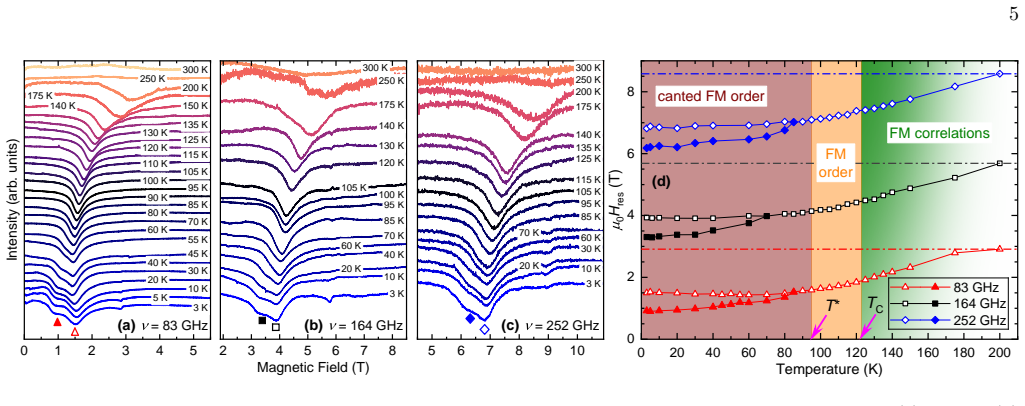
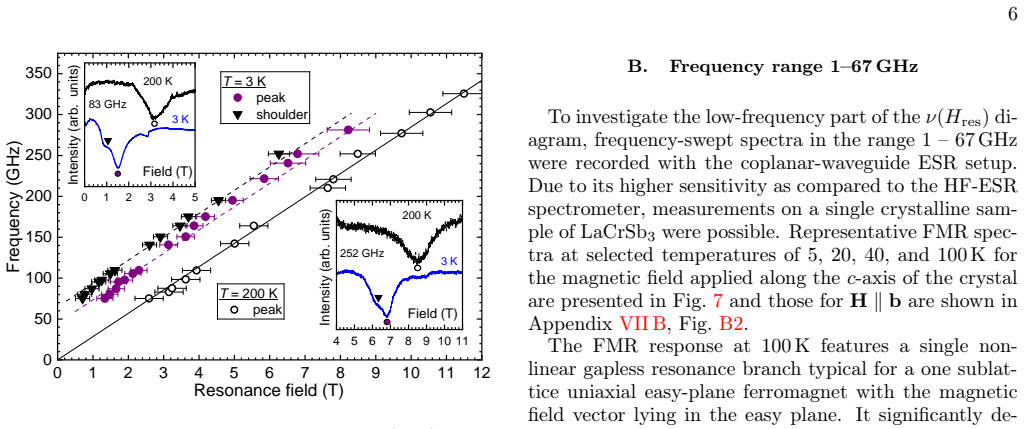
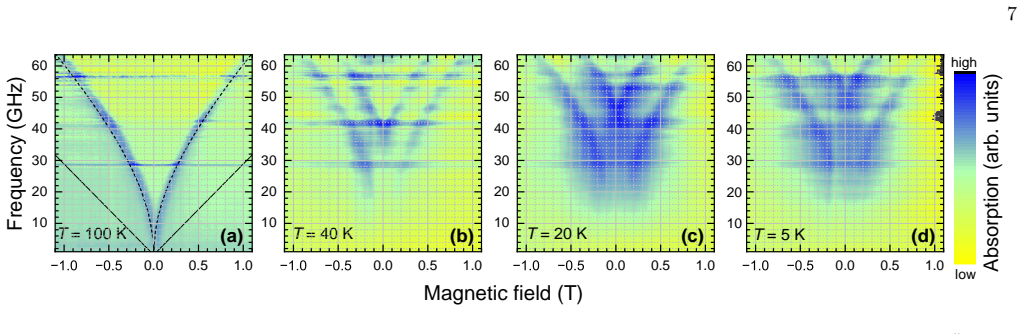
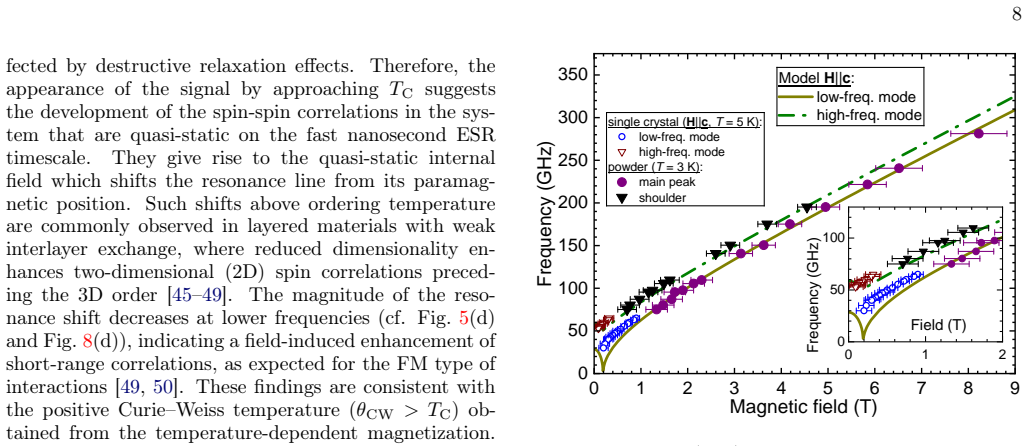
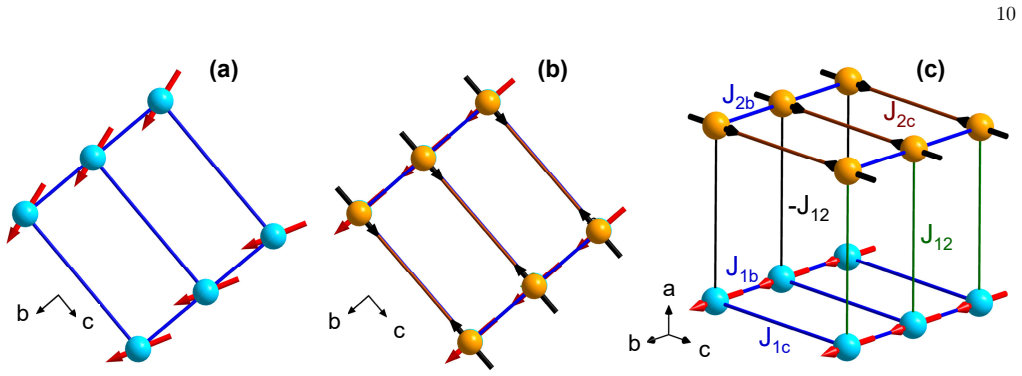
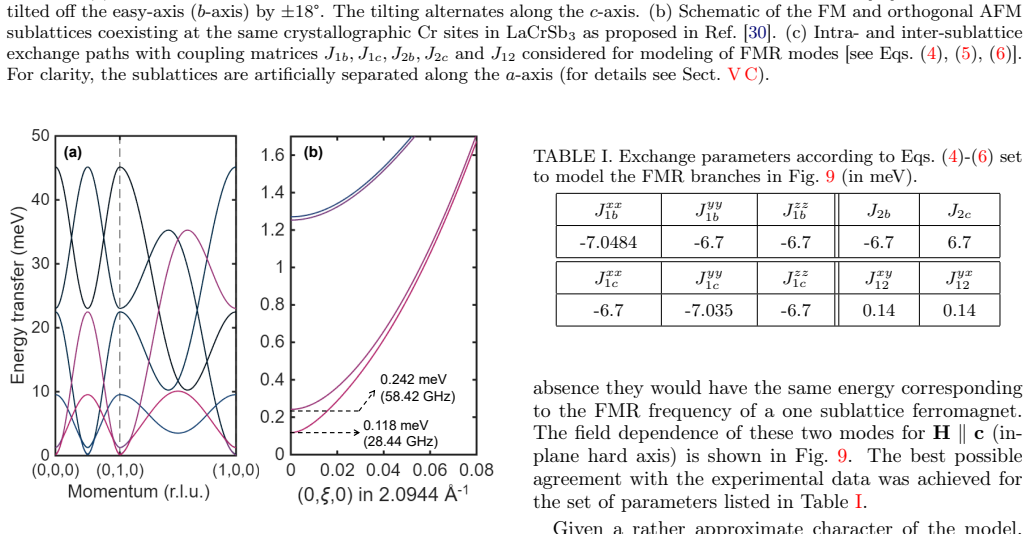
The frequency-field diagram of the FMR modes mapped below Tc strongly suggests presence of two magnetic sublattices in LaCrSb3. A quantitative understanding of the FMR excitations was achieved within a phenomenological model of interacting orthogonal ferro- and antiferromagnetic sublattices which was earlier proposed to explain unusually strong spin canting observed by neutron diffraction.
What carries the argument
phenomenological model of interacting orthogonal ferro- and antiferromagnetic sublattices
Load-bearing premise
That the observed FMR frequency-field dependence can be quantitatively accounted for by the 2002 phenomenological model of interacting orthogonal ferro- and antiferromagnetic sublattices without requiring additional fitting parameters or an alternative microscopic mechanism.
What would settle it
A measurement showing that the FMR resonance branches cannot be reproduced by the two-sublattice model using the same parameters that fit the neutron canting data, or that require a different number of sublattices.
Figures
read the original abstract
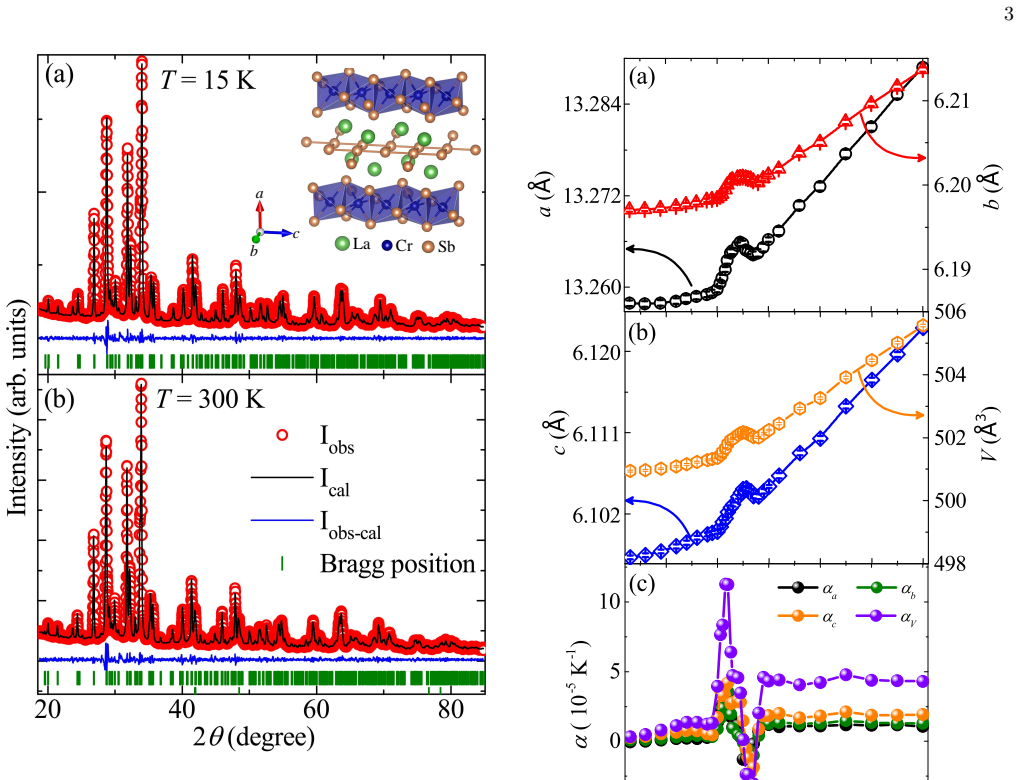
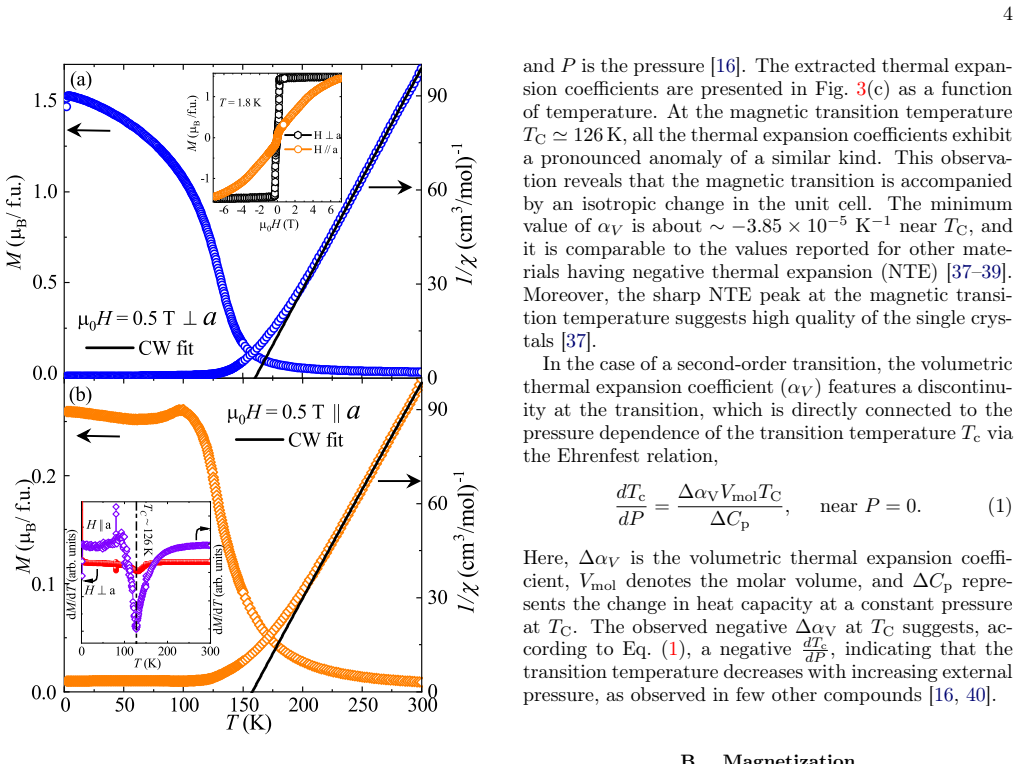
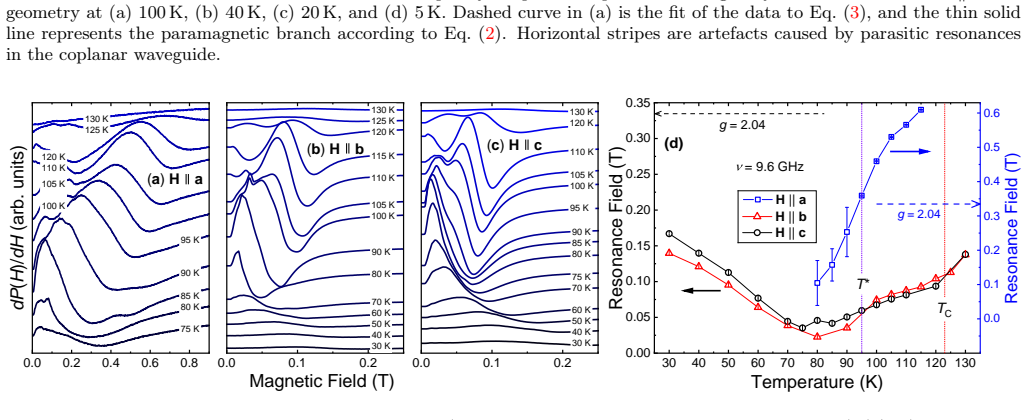
LaCrSb$_{3}$ is a metallic ferromagnet with a layered crystal structure demonstrating intriguing electronic and magnetic properties, such as large anomalous Hall effect, strong canting of the spin lattice, and a peculiar spin-reorientation transition. Here, we report the results of the temperature-dependent x-ray diffraction, static magnetization, and in particular electron spin resonance (ESR) and ferromagnetic resonance (FMR) experiments carried out over a wide range of frequencies, magnetic fields, and temperatures. Though x-ray data reveals no structural transition down to 15 K, a strong magneto-elastic coupling is detected across the ferromagnetic transition at $T_{\rm C} \simeq 126$ K. ESR results indicate a presence of the quasi-static short-range correlations extending far above $T_{\rm C}$, which is a typical fingerprint of the low-dimensional magnetism. The frequency-field diagram of the FMR modes mapped below $T_{\rm C}$ strongly suggests presence of two magnetic sublattices in LaCrSb$_{3}$. A quantitative understanding of the FMR excitations was achieved within a phenomenological model of interacting orthogonal ferro- and antiferromagnetic sublattices which was earlier proposed to explain unusually strong spin canting observed by neutron diffraction [E.~Granado et al., Phys. Rev. Lett. 89, 107204 (2002)]. The FMR results corroborate this scenario and call for the development of the underlying microscopic model of unconventional magnetism in LaCrSb$_{3}$.
Editorial analysis
A structured set of objections, weighed in public.
Referee Report
Summary. The manuscript reports complementary x-ray diffraction, magnetization, ESR, and broadband FMR measurements on the layered metallic ferromagnet LaCrSb3. It finds no structural transition down to 15 K but strong magneto-elastic coupling at Tc ≈ 126 K, quasi-static short-range correlations above Tc from ESR, and that the FMR frequency-field diagram below Tc indicates two magnetic sublattices whose excitations are quantitatively described by the 2002 phenomenological model of interacting orthogonal ferro- and antiferromagnetic sublattices (Granado et al., PRL 89, 107204) previously used for neutron-derived spin canting.
Significance. If the FMR quantitative description holds, the work supplies independent spectroscopic evidence corroborating the two-sublattice scenario for LaCrSb3’s unconventional magnetism, including its strong canting and large anomalous Hall effect. The mapping of multiple FMR modes and their assignment to the prior model constitute a clear experimental advance that strengthens the case for this magnetic structure and motivates microscopic theory.
major comments (1)
- [FMR analysis section] FMR analysis section (frequency-field diagram and model comparison): the central claim that the observed modes are quantitatively accounted for by the 2002 phenomenological model 'without requiring additional fitting parameters or an alternative microscopic mechanism' is load-bearing for the abstract and conclusion; the manuscript must explicitly tabulate the anisotropy fields, exchange constants, or canting angles used in the fit and demonstrate their numerical agreement with the original Granado et al. values (or state any adjustments).
minor comments (2)
- Abstract: the statement of 'quantitative understanding' would be strengthened by citing at least one key model parameter or the relevant equation from the 2002 reference.
- Figure captions for raw FMR spectra and frequency-field plots should report fit residuals or error bars on resonance positions to allow independent assessment of the mode assignments.
Simulated Author's Rebuttal
We thank the referee for the positive assessment and the recommendation for minor revision. We address the single major comment below and will revise the manuscript accordingly.
read point-by-point responses
-
Referee: [FMR analysis section] FMR analysis section (frequency-field diagram and model comparison): the central claim that the observed modes are quantitatively accounted for by the 2002 phenomenological model 'without requiring additional fitting parameters or an alternative microscopic mechanism' is load-bearing for the abstract and conclusion; the manuscript must explicitly tabulate the anisotropy fields, exchange constants, or canting angles used in the fit and demonstrate their numerical agreement with the original Granado et al. values (or state any adjustments).
Authors: We agree that an explicit tabulation of the parameters is required to substantiate the central claim. In the revised manuscript we will add a table in the FMR analysis section that lists the anisotropy fields, exchange constants, and canting angles employed to reproduce the frequency-field diagram. The table will also show the direct numerical comparison to the corresponding values reported by Granado et al. (PRL 89, 107204, 2002), confirming that the description uses the original phenomenological parameters without additional fitting or adjustments. revision: yes
Circularity Check
No significant circularity identified
full rationale
The derivation chain rests on independent FMR frequency-field data collected in this work, which is then compared to an external phenomenological model of orthogonal ferro- and antiferromagnetic sublattices first proposed in Granado et al. (Phys. Rev. Lett. 89, 107204, 2002) by unrelated authors. The paper explicitly states that quantitative understanding is achieved within that prior model without introducing new parameters, constituting a test of the external model rather than a self-referential fit or redefinition. No equations, ansatzes, or uniqueness claims originate from self-citation chains or reduce by construction to the present paper's inputs; the 2002 citation supplies the framework while the new ESR/FMR measurements supply the test data.
Axiom & Free-Parameter Ledger
axioms (1)
- domain assumption The phenomenological model of interacting orthogonal ferro- and antiferromagnetic sublattices from Granado et al. (2002) provides an accurate description of the magnetic excitations.
Reference graph
Works this paper leans on
-
[1]
ctd.qmat - Complexity and Topology in Quan- tum Matter
“ctd.qmat - Complexity and Topology in Quan- tum Matter” (project-id 390858490). SM, RK, VS, and RN would like to acknowledge Science and Engineer- ing Research Board (SERB), India bearing Grant No. CRG/2022/000997 for financial support. VII. APPENDIX A. Analysis of the ESR spectra
2022
-
[2]
X-band ESR In the X-band ESR setup, the field derivative of the ESR absorption signal is recorded. The experimental spectra, characterized by a single resonance line, were fitted with the first derivative of the Lorentzian function: Sabs = −2x (1 +x 2)2 + −2y (1 +y 2)2 ,(A1) where x= 2(H+H res) ∆H , y= 2(H−H res) ∆H .(A2) The contribution involvingyis nec...
-
[3]
HF-ESR In the HF-ESR setup, the mixing of absorptionSabs and dispersionSdisp components of the detected signal is unavoidable due to the complex impedance of the broad- band probehead. Generally, the HF-ESR signal with in- termixedS abs andS disp components and a Lorentzian line profile can thus be represented as: Samp D = 2A0 π (Sabs sinα+S disp cosα) +S...
-
[4]
R. A. Klemm,Layered Superconductors: Volume 1(Ox- ford University Press, 2011)
2011
-
[5]
Novoselov, A
K. Novoselov, A. Geim, S. Morozov, D. Jiang, Y. Zhang, S. Dubonos, I. Grigorieva, and A. Firsov, Electric field effect in atomically thin carbon films, Science306, 666 (2004)
2004
-
[6]
A. K. Geim and I. V. Grigorieva, Van der Waals het- erostructures, Nature499, 419 (2013)
2013
-
[7]
Ajayan, P
P. Ajayan, P. Kim, and K. Banerjee, Two-dimensional van der Waals materials, Physics Today69, 38 (2016)
2016
-
[8]
K. S. Novoselov, A. Mishchenko, A. Carvalho, and A. Castro Neto, 2D materials and van der Waals het- erostructures, Science353, 9439 (2016)
2016
-
[9]
Gibertini, M
M. Gibertini, M. Koperski, A. F. Morpurgo, and K. S. Novoselov, Magnetic 2D materials and heterostructures, Nat. Nanotechnol.14, 408 (2019)
2019
-
[10]
S. Yang, T. Zhang, and C. Jiang, van der Waals Mag- nets: Material Family, Detection and Modulation of Magnetism, and Perspective in Spintronics, Adv. Sci.8, 10.1002/advs.202002488 (2021)
-
[11]
H. Xu, S. Xu, X. Xu, J. Zhuang, W. Hao, and Y. Du, Recent advances in two-dimensional van der Waals mag- nets, Microstructures2, 2022011 (2022)
2022
-
[12]
P. Liu, Y. Zhang, K. Li, Y. Li, and Y. Pu, Recent ad- vances in 2D van der Waals magnets: Detection, modu- lation, and applications, iScience26, 107584 (2023)
2023
-
[13]
J.-X. Yin, B. Lian, and M. Z. Hasan, Topological kagome magnets and superconductors, Nature612, 647 (2022)
2022
-
[14]
Y. Wang, H. Wu, G. T. McCandless, J. Y. Chan, and M. N. Ali, Quantum states and intertwining phases in kagome materials, Nat. Rev. Phys.5, 635 (2023)
2023
-
[15]
C. Gong, L. Li, Z. Li, H. Ji, A. Stern, Y. Xia, T. Cao, W. Bao, C. Wang, Y. Wang,et al., Discovery of intrinsic ferromagnetism in two-dimensional van der Waals crys- tals, Nature546, 265 (2017)
2017
-
[16]
Bonilla, S
M. Bonilla, S. Kolekar, Y. Ma, H. C. Diaz, V. Kalappat- til, R. Das, T. Eggers, H. R. Gutierrez, M.-H. Phan, and M. Batzill, Strong room-temperature ferromagnetism in VSe2 monolayers on van der Waals substrates, Nat. Nan- otechnol.13, 289 (2018)
2018
-
[17]
Z. Wang, I. Gutiérrez-Lezama, N. Ubrig, M. Kroner, M. Gibertini, T. Taniguchi, K. Watanabe, A. Imamoğlu, E. Giannini, and A. F. Morpurgo, Very large tunnel- ing magnetoresistance in layered magnetic semiconduc- tor CrI3, Nat. Commun.9, 2516 (2018)
2018
-
[18]
Takahashi, T
H. Takahashi, T. Akiba, A. H. Mayo, K. Akiba, A. Miyake, M. Tokunaga, H. Mori, R. Arita, and S. Ishi- wata, Spin-orbit-derived giant magnetoresistance in a layered magnetic semiconductorAgCrSe 2, Phys. Rev. Mater.6, 054602 (2022)
2022
-
[19]
Singh and R
V. Singh and R. Nath, Negative thermal expansion and itinerant ferromagnetism in Mn1.4Fe3.6Si3, J. Appl. Phys.130, 033902 (2021)
2021
-
[20]
Leonard, I
M. Leonard, I. Dubenko, and N. Ali, Investigation of the ferromagnetism in RCrSb3 (R=La, Ce, Pr, Nd), J. Alloys and Compd.303-304, 265 (2000)
2000
-
[21]
S. J. Crerar, L. Deakin, and A. Mar, Structure and Phys- ical Properties of Ternary Antimonide YbCrSb3, Chem. Mater.17, 2780 (2005)
2005
-
[22]
Inamdar, A
M. Inamdar, A. Thamizhavel, and S. Ramakrishnan, Anisotropic magnetism in PrCrSb3: Bulk properties of single crystals, Phys. Rev. B77, 132410 (2008)
2008
-
[23]
Inamdar, A
M. Inamdar, A. Thamizhavel, and S. Ramakrishnan, Anisotropic magnetic behavior in CeCrSb 3, J. Magn. Magn. Mater.320, 2766 (2008)
2008
-
[24]
Kumar, N
N. Kumar, N. Lamba, J. Gayles, C. Le, P. Vir, S. N. Guin, Y. Sun, C. Felser, and C. Shekhar, Giant Anoma- lous Hall Conductivity in the Itinerant Ferromagnet LaCrSb3 and the Effect of f-Electrons, Adv. Quantum Technol.4, 2100023 (2021)
2021
-
[25]
A. Paul, S. Rom, P. Sanyal, and T. Saha Dasgupta, Origin of ferromagnetism and trends in Berry curvature driven anomalous Hall conductivity in the metallic rare- earth antimonidesRCrSb3 (R= La, Ce, Nd), Phys. Rev. B112, 094427 (2025)
2025
-
[26]
K. Rana, H. Kotegawa, R. R. Ullah, J. S. Harvey, S. L. Bud’ko, P. C. Canfield, H. Tou, V. Taufour, and Y. Fu- rukawa, Magnetic fluctuations in the itinerant ferromag- 14 netLaCrGe 3 studied by 139LaNMR, Phys. Rev. B99, 214417 (2019)
2019
-
[27]
K. Rana, H. Kotegawa, R. R. Ullah, E. Gati, S. L. Bud’ko, P. C. Canfield, H. Tou, V. Taufour, and Y. Fu- rukawa, Magnetic properties of the itinerant ferromagnet LaCrGe3 under pressure studied by 139LaNMR, Phys. Rev. B103, 174426 (2021)
2021
-
[28]
Signatures of two ferromagnetic states and goniopolarity in LaCrGe3 in the Hall effect
M. Sariket, N. Islam, S. Shamim, and N. Kumar, Ex- ploring the signature of two ferromagnetic states and goniopolarity in LaCrGe 3 through Hall effect, arXiv preprint arXiv:2508.21508 10.48550/arXiv.2508.21508 (2025)
work page internal anchor Pith review Pith/arXiv arXiv doi:10.48550/arxiv.2508.21508 2025
-
[29]
N. P. Raju, J. E. Greedan, M. J. Ferguson, and A. Mar, LaCrSb3: A New Itinerant Electron Ferromagnet with a Layered Structure, Chem. Mater.10, 3630 (1998)
1998
-
[30]
D. D. Jackson, M. Torelli, and Z. Fisk, Anisotropy in magnetic and transport properties ofLaTSb 3 (T= Cr, V), Phys. Rev. B65, 014421 (2001)
2001
-
[31]
MacFarlane, K
W. MacFarlane, K. Chow, Z. Salman, A. Tkachuk, and A. Mar, AµSR study of the unusual magnetism of LaCrSb3, Physica B: Condens. Matter374-375, 71 (2006)
2006
-
[32]
X. Yang, J. Pan, W. Gai, Y. Tao, H. Jia, L. Cao, and Y. Cao, Three-dimensional critical behavior and anisotropic magnetic entropy change in quasi-two- dimensionalLaCrSb 3, Phys. Rev. B105, 024419 (2022)
2022
-
[33]
Granado, H
E. Granado, H. Martinho, M. S. Sercheli, P. G. Pagliuso, D. D. Jackson, M. Torelli, J. W. Lynn, C. Rettori, Z. Fisk, and S. B. Oseroff, Unconventional Metallic Mag- netism inLaCrSb 3, Phys. Rev. Lett.89, 107204 (2002)
2002
-
[34]
Rodríguez-Carvajal, Recent advances in magnetic structure determination by neutron powder diffraction, Physica B: Condens
J. Rodríguez-Carvajal, Recent advances in magnetic structure determination by neutron powder diffraction, Physica B: Condens. Matter192, 55 (1993)
1993
-
[35]
M. J. Ferguson, R. W. Hushagen, and A. Mar, Crystal structures of La3ZrSb5, La3HfSb5, and LaCrSb3·Struc- tural relationships in ternary rare-earth antimonides, J. Alloys and Compd.249, 191 (1997)
1997
-
[36]
K. Dey, S. Sauerland, J. Werner, Y. Skourski, M. Abdel- Hafiez, R. Bag, S. Singh, and R. Klingeler, Magnetic phase diagram and magnetoelastic coupling ofNiTiO3, Phys. Rev. B101, 195122 (2020)
2020
-
[37]
Hoffmann, K
M. Hoffmann, K. Dey, J. Werner, R. Bag, J. Kaiser, H. Wadepohl, Y. Skourski, M. Abdel-Hafiez, S. Singh, and R. Klingeler, Magnetic phase diagram, magnetoe- lastic coupling, and Grüneisen scaling inCoTiO3, Phys. Rev. B104, 014429 (2021)
2021
-
[38]
K. K. Bestha, V. Kocsis, O. Janson, Y. Shemerliuk, S. Selter, S. Aswartham, T. Nakajima, H. Saito, B. Büch- ner, L. T. Corredor, and A. U. B. Wolter, Magnetoelastic coupling and large uniaxial pressure dependence of an- tiferromagnetic order in two-dimensional van der Waals Fe2P2S6 andNi 2P2S6 single crystals, Phys. Rev. B111, L020409 (2025)
2025
-
[39]
Singh, P
V. Singh, P. Bag, R. Rawat, and R. Nath, Critical behav- ior and magnetocaloric effect across the magnetic tran- sition in Mn1+xFe4−xSi3, Sci Rep10, 6981 (2020)
2020
-
[40]
X. Song, Z. Sun, Q. Huang, M. Rettenmayr, X. Liu, M. Seyring, G. Li, G. Rao, and F. Yin, Adjustable zero thermal expansion in antiperovskite manganese nitride, Adv. Mater.23, 4690 (2011)
2011
-
[41]
Huang, Y
R. Huang, Y. Liu, W. Fan, J. Tan, F. Xiao, L. Qian, and L. Li, Giant negative thermal expansion in NaZn13-type La (Fe, Si, Co)13 compounds, J. Am. Chem. Soc.135, 11469 (2013)
2013
-
[42]
Takenaka and H
K. Takenaka and H. Takagi, Zero thermal expansion in a pure-form antiperovskite manganese nitride, Appl. Phys. Lett.94, 131904 (2009)
2009
-
[43]
A. Eich, A. Grzechnik, L. Caron, Y. Cheng, J. Wilden, H. Deng, V. Hutanu, M. Meven, M. Hanfland, K. Glazyrin,et al., Magnetocaloric Mn 5Si3 and MnFe4Si3 at variable pressure and temperature, Mater. Res. Express6, 096118 (2019)
2019
-
[44]
Leonard, S
M. Leonard, S. Saha, and N. Ali, Magnetic properties of RTSb3, J. Appl. Phys.85, 4759 (1999)
1999
-
[45]
Abragam and B
A. Abragam and B. Bleaney,Electron paramagnetic res- onance of transition ions(Oxford University Press, Ox- ford, 2012)
2012
-
[46]
E. A. Turov,Physical Properties of Magnetically Ordered Crystals(Academic Press, New York, 1965)
1965
-
[47]
Barnes, Theory of electron spin resonance of magnetic ions in metals, Advances in Physics30, 801 (1981)
S. Barnes, Theory of electron spin resonance of magnetic ions in metals, Advances in Physics30, 801 (1981)
1981
-
[48]
Kataev, B
V. Kataev, B. Büchner, and A. Alfonsov, Electron Spin Resonance Spectroscopy on Magnetic van der Waals Compounds, Appl. Magn. Reson.55, 923 (2024)
2024
-
[49]
J. J. Abraham, Y. Senyk, Y. Shemerliuk, S. Selter, S. Aswartham, B. Büchner, V. Kataev, and A. Alfonsov, Magnetic anisotropy and low-energy spin dynamics in the van der Waals compounds Mn2P2S6 and MnNiP2S6, Phys. Rev. B107, 165141 (2023)
2023
-
[50]
Magar, S
A. Magar, S. K, V. Singh, J. Abraham, Y. Senyk, A. Al- fonsov, B. Büchner, V. Kataev, A. Tsirlin, and R. Nath, Large Magnetocaloric Effect in the Kagome Ferromag- netLi 9Cr3(P2O7)3(PO4)2, Phys. Rev. Appl.18, 054076 (2022)
2022
-
[51]
Zeisner, K
J. Zeisner, K. Mehlawat, A. Alfonsov, M. Roslova, T. Do- ert, A. Isaeva, B. Büchner, and V. Kataev, Electron spin resonance and ferromagnetic resonance spectroscopy in the high-field phase of the van der Waals magnetCrCl3, Phys. Rev. Mater.4, 064406 (2020)
2020
-
[52]
J. J. Abraham, Y. Guo, Y. Shemerliuk, S. Selter, S. Aswartham, K. K. Bestha, L. T. Corredor, A. U. B. Wolter, O.Kataeva, L.Rogić, N.Somun, D.Pelc, O.Jan- son, J. van den Brink, B. Büchner, V. Kataev, and A. Alfonsov, Magnetic-Field Tuning of the Spin Dy- namics in the Quasi-2D Van der Waals Antiferromagnet CuCrP2S6, Adv. Func. Mater. , e11057 (2025)
2025
-
[53]
Zeisner, A
J. Zeisner, A. Alfonsov, S. Selter, S. Aswartham, M. P. Ghimire, M. Richter, J. van den Brink, B. Büchner, and V. Kataev, Magnetic anisotropy and spin-polarized two- dimensional electron gas in the van der Waals ferromag- netCr 2Ge2Te6, Phys. Rev. B99, 165109 (2019)
2019
-
[54]
Inamdar, S
M. Inamdar, S. Ramakrishnan, A. Thamizhavel, and A. K. Nigam, Interplay of 3d and 4f magnetism in RCrSb3, J. Phys. Conf. Ser.150, 042163 (2009)
2009
-
[55]
Q. Mao, J. Ding, Z. Yan, X. Jia, B. Zhang, Y. Wang, H. Li, Y. Liu, X. Li, L. Xue, J. Ye, B. Chen, J. Yang, and X. Zhao, Quasi-two-dimensional ferromagnetism in LaCrSb3, J. Alloys Compd.1054, 186375 (2026)
2026
-
[56]
M. A. Prosnikov, M. E. Bal, M. I. Kolkov, A. I. Pankrats, R. V. Pisarev, and P. C. M. Christianen, Subterahertz and terahertz spin and lattice dynamics of the insulat- ing ferromagnetPbMnBO 4, Phys. Rev. Res.4, 013004 (2022)
2022
-
[57]
Toth and B
S. Toth and B. Lake, Linear spin wave theory for single-Q incommensurate magnetic structures, J. Phys.: Condens. Matter27, 166002 (2015)
2015
-
[58]
Tóth and S
S. Tóth and S. Ward, SpinW/spinw: SpinW 3.1, Zenodo (2019). 15
2019
-
[59]
Richter, J
M. Richter, J. Rusz, H. Rosner, K. Koepernik, I. Opahle, U. Nitzsche, and H. Eschrig, Unconventional metallic magnetisminLaCrSb 3,J.Magn.Magn.Mater,272-276, E251(2004),ProceedingsoftheInternationalConference on Magnetism (ICM 2003)
2004
-
[60]
J.ShimandB.Min,Electronicstructuresoflayeredcom- pound LaCrSb3, J. Magn. Magn. Mater.272-276, E241 (2004), proceedings of the International Conference on Magnetism (ICM 2003)
2004
discussion (0)
Sign in with ORCID, Apple, or X to comment. Anyone can read and Pith papers without signing in.