REVIEW 3 major objections 7 minor 3 cited by
Micro-expression action units are detected more accurately when multi-scale visual evidence and anatomical AU-relation tokens are fused into structured prompts that condition a large language model for deduction.
Reviewed by Pith at T0; open to challenge. T0 means a machine referee read the full paper against a public rubric. the ladder, T0–T4 →
T0 review · grok-4.5
2026-07-15 12:39 UTC pith:JC3TGMGM
load-bearing objection Solid engineering extension of AULLM that delivers real LOSO and cross-domain Macro-F1 gains on three ME-AU sets; the FACS-prior story is a bit oversold but the tables and ablations still hold. the 3 major comments →
AULLM++: Structured-Token-Conditioned Large Language Models for Micro-Expression Action Unit Detection
The pith
A machine-rendered reading of the paper's core claim, the machinery that carries it, and where it could break.
Core claim
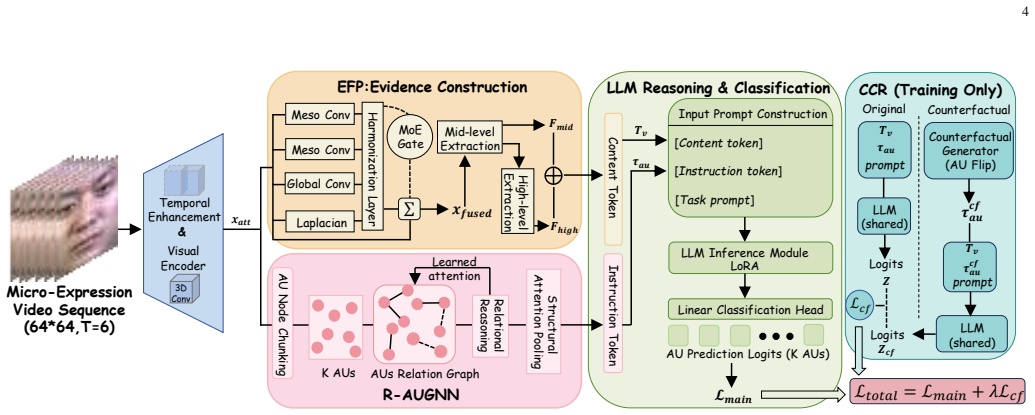
AULLM++ reaches state-of-the-art micro-expression AU detection (CASME II 82.4 %, SAMM 62.6 %, 4DME-Micro 57.7 % Macro-F1 under LOSO; 51.9 % average cross-domain) by converting multi-granularity visual features into a content token and FACS-prior AU relations into an instruction token, conditioning an LLM on their fusion, and applying counterfactual consistency regularization only at training time.
What carries the argument
The structured prompt formed by the Content Token (MGE-EFP gated fusion of Laplacian-enhanced mid-level textures with high-level semantics) and the Instruction Token (R-AUGNN sparse FACS prior plus instance-adaptive graph message passing), which together condition LoRA-adapted LLM deduction; Counterfactual Consistency Regularization intervenes only on instruction tokens during training.
Load-bearing premise
The hand-specified sparse anatomical prior among action units, once fused with instance attention, supplies genuine domain-invariant causal structure that legitimately guides the language model rather than merely encoding co-occurrence statistics of the training sets.
What would settle it
On a held-out micro-expression corpus whose AU co-occurrence statistics systematically violate the FACS prior, or in a full ablation that replaces the prior graph with a fully data-driven or empty graph, Macro-F1 and cross-domain transfer fall to or below pure visual baselines; that outcome would falsify the claim that the structural prior supplies useful causal guidance.
If this is right
- Micro-expression AU detectors can move from fragile visual pattern matching to guided logical deduction and thereby raise both within-domain Macro-F1 and cross-dataset transfer.
- Complex, visually similar AU combinations become more separable once synergistic and inhibitory muscle relationships are supplied as explicit instructions.
- Cross-domain robustness can be improved without any inference-time cost by intervening on structural tokens only during training.
- Affective systems that need fine-grained involuntary cues gain a concrete architecture that anchors language-model reasoning on physical facial anatomy.
Where Pith is reading between the lines
- The same content-plus-instruction token pattern could transfer to other low-signal multi-label problems such as subtle medical video events or rare industrial anomalies.
- If the LLM is functioning mainly as a soft multi-label decoder, lighter reasoning heads conditioned on the same tokens may deliver most of the gain at lower compute cost.
- Transparent step-by-step AU deduction, already flagged as future work, would make the same pipeline auditable for high-stakes behavioral analysis.
- Learning or adapting the anatomical prior from large macro-expression corpora rather than fixing it by hand could further reduce residual domain gaps.
Editorial analysis
A structured set of objections, weighed in public.
Referee Report
Summary. AULLM++ reformulates micro-expression Action Unit (AU) detection as a three-stage process—evidence construction, structure modeling, and LLM-based deduction—rather than pure visual multi-label classification. A Multi-Granularity Evidence-Enhanced Fusion Projector (MGE-EFP) fuses Laplacian-enhanced mid-level textures with high-level semantics into a compact Content Token T_v (Eqs. 1–4). A Relation-Aware AU Graph Neural Network (R-AUGNN) combines a hand-specified sparse FACS/psychological prior adjacency A_prior with instance-adaptive attention into  (Eq. 6), then GCN-encodes node features into Instruction Tokens τ_au. These tokens are concatenated into a structured LLM prompt (DeepSeek-R1-Distill-Qwen-1.5B with LoRA); training-only Counterfactual Consistency Regularization (CCR, Eq. 8) intervenes on instruction tokens to encourage target-AU flip and non-target invariance. On LOSO, the method reports Macro-F1 of 82.4% (CASME II), 62.6% (SAMM), and 57.7% (4DME-Micro), with cross-domain average 51.9% over six transfer directions, outperforming the conference AULLM and LED-based baselines. Ablations (Table V) and t-SNE/attention visualizations support each module.
Significance. If the empirical gains hold under stronger statistical scrutiny and a fully disclosed prior, the work is a meaningful step for micro-expression AU detection: it shows that highly compressed multi-granularity visual tokens plus explicit AU-relation tokens can condition a small LLM more effectively than dense visual pooling or motion-magnification CNNs, especially under cross-dataset shift. Strengths include a clear extension path from AULLM, systematic LOSO and six-way transfer evaluation, module ablations that isolate R-AUGNN/MGE-EFP/CCR/LLM, and a training-only regularizer with no inference cost. The framing of micro-expression AU detection as structured-token-conditioned deduction is useful for the community even if the LLM is primarily acting as a strong multi-label head rather than producing explicit chain-of-thought traces. Code release upon acceptance would further raise impact.
major comments (3)
- Methodology, R-AUGNN / Eq. (6): A_prior is described only as “pre-construct[ed] … based on extensive psychological statistics and FACS anatomical rules” and is never listed, derived, or released. The paper’s central narrative attributes cross-domain robustness to “domain-invariant physical rules” and “anatomical physical priors” that guide LLM deduction. Without the actual sparse adjacency (which edges, which weights, how “psychological statistics” were separated from dataset co-occurrence), the claim that R-AUGNN supplies causal anatomical structure rather than transferable co-occurrence bias cannot be audited. Table V shows FACS graph > fully-connected/self-loops, but that does not identify the source of the edges. Please publish A_prior (or a reproducible construction procedure independent of the evaluation sets) and discuss residual risk that non-zero edges encode long-tail co-occurr
- §IV.B–D and Tables I–IV: All headline Macro-F1 numbers are single-run point estimates. Datasets are tiny and long-tailed (CASME II 247 clips / 26 subjects; SAMM 159 / 32), yet training uses batch size 256 for 350 epochs with differential LRs and several free coefficients (α, γ, λ_ccr, λ_inv, λ_Δ). Within-domain gains over AULLM are small (CASME II 81.4→82.4; SAMM 61.9→62.6). Without multi-seed means±std, or at least LOSO fold variance / significance tests against AULLM and SSSNet LED, the SOTA and “superior cross-domain generalization” claims are under-supported. Please report multi-seed or fold-level variance for the main tables and clarify early-stopping / selection protocol under LOSO.
- §III, LLM-Driven Deduction and CCR (Eq. 8, Algorithm 1): The manuscript repeatedly frames the LLM stage as “logical deduction,” “causal deduction,” and “reasoning,” but the implemented pipeline freezes the LLM, injects LoRA, concatenates T_v and τ_au, and applies a linear multi-label head on a single hidden state—no intermediate reasoning traces, constrained decoding, or AU-consistency constraints at generation time. CCR forces target flip and non-target KL invariance under hand-crafted instruction perturbations; that is a useful regularizer, but calling it isolation of “authentic causal relationships” overstates what is demonstrated. Please either (i) provide evidence that the LLM performs non-trivial multi-AU logical inference beyond a strong classifier, or (ii) tone the causal/reasoning language to match the actual mechanism (structured-token-conditioned multi-label prediction with in
minor comments (7)
- Title inconsistency: the manuscript header uses “Structural Reasoning … for Micro-Expression Recognition,” while the abstract/arXiv-style title emphasizes “Structured-Token-Conditioned … Action Unit Detection.” Align title with the actual task (AU detection).
- Fig. 2 / Algorithm 1: CCR is said to loop over each AU k with re-forwarding; aggregation of L_ccr across k (sum vs mean) and interaction with batch size 256 should be stated explicitly for reproducibility.
- Notation: Content Token is T_v in the body but CT in the abstract; Instruction Token is τ_au / IT. Unify early and keep one symbol set.
- Related Work cites “[?], [26]” with a missing reference marker; fix the broken citation.
- Table III AU set (includes AU6, AU45) differs from CASME II/SAMM; briefly justify AU selection per dataset so Macro-F1 averages are comparable in spirit.
- Fig. 3 and Fig. 4 captions are thin; add dataset/AU labels and what “Baseline” is in Fig. 4 so qualitative claims are self-contained.
- Extensions paragraph claims “far more extensive experiments” including 4DME-Micro; ensure conference AULLM numbers on 4DME/SAMM are from the same protocol as this paper to avoid apples-to-oranges comparison.
Circularity Check
No derivation-by-construction circularity: SOTA and cross-domain claims are empirical Macro-F1 on held-out subjects/datasets; only mild self-extension of the authors' conference AULLM baseline.
specific steps
-
self citation load bearing
[Extensions from Conference Version; Tables I–IV (AULLM Conf. baseline)]
"This paper is a substantially extended version of our prior preliminary conference publication, AULLM [15]. ... AULLM (Conf.) [15] 92.2 88.4 ... 81.4 / AULLM++ (Ours) 93.1 ... 82.4 ... AULLM (Conf.) [15] ... 47.3 / AULLM++ (Ours) ... 51.9"
The narrative of evolutionary gains (structural priors, MGE-EFP, CCR) is partly framed against the authors' own conference system. This is ordinary self-baseline comparison, not load-bearing uniqueness: SOTA claims also rest on independent external methods (LED, SCA, DVASP, ResNet, LBP-TOP) and held-out LOSO/cross-domain metrics. Mild only; does not make test Macro-F1 tautological.
full rationale
AULLM++ is an empirical multi-label detection framework, not a first-principles derivation. Content tokens (MGE-EFP), instruction tokens (R-AUGNN with hand-specified sparse A_prior fused as Â=α A_prior+(1−α)A_dynamic), LLM LoRA decoding, and training-only CCR (flip target AU / KL-invariance on others) are architectural and regularization choices. Reported results (CASME II 82.4%, SAMM 62.6%, 4DME-Micro 57.7%; cross-domain avg 51.9%) are Macro-F1 under LOSO and train→test transfer against external baselines and the authors' prior conference system; they are not algebraic identities of the inputs. A_prior is an author-constructed FACS/psychological ansatz (not fitted to the test labels and then re-predicted), α and GCN weights are learned on training folds only, and CCR is disabled at inference. Self-citation of AULLM [15] is normal extended-work framing and is used as a comparable baseline, not as a uniqueness theorem that forces the present claims. No step reduces a claimed prediction to its own definition or fit by construction. Residual concerns about whether the hand-specified prior encodes co-occurrence statistics rather than pure anatomy are assumption/correctness issues, not circularity under the stated criteria.
Axiom & Free-Parameter Ledger
free parameters (5)
- α (static prior vs dynamic attention mix in Â)
- γ (Laplacian high-frequency enhancement strength)
- λ_ccr, λ_inv, λ_Δ (CCR loss weights)
- LoRA rank r=16, scale α=32; LR 2e-4/1e-4; batch 256; 350 epochs
- GCN depth L=2 and AU node feature dimension
axioms (5)
- domain assumption FACS anatomical/psychological rules define a useful sparse prior over AU synergy and inhibition for micro-expressions.
- domain assumption Micro-expression AU detection is multi-label binary classification under LOSO with Macro-F1 as the primary metric.
- ad hoc to paper Compressing fused visual features and graph instructions into a few tokens preserves enough signal for LLM multi-label deduction without dense patch flooding.
- ad hoc to paper Instruction-level counterfactual flips isolate causal AU logic better than pixel-space interventions for domain robustness.
- standard math Standard GCN message passing and BCE multi-label loss are valid computational substrates.
invented entities (3)
-
MGE-EFP Content Token (CT / T_v)
no independent evidence
-
R-AUGNN Instruction Token (IT / τ_au)
no independent evidence
-
Counterfactual Consistency Regularization (CCR) on instruction tokens
no independent evidence
Cite this review
Pith. "Pith review of AULLM++: Structured-Token-Conditioned Large Language Models for Micro-Expression Action Unit Detection." pith.science (2026). https://pith.science/paper/JC3TGMGM
@misc{pith2026260308387,
  author       = {Pith},
  title        = {Pith review of: AULLM++: Structured-Token-Conditioned Large Language Models for Micro-Expression Action Unit Detection},
  year         = {2026},
  howpublished = {\url{https://pith.science/paper/JC3TGMGM}},
  note         = {Machine review of arXiv:2603.08387}
}
read the original abstract
Micro-expression Action Unit (AU) detection identifies localized AUs from subtle facial muscle activations, providing a foundation for decoding affective cues. Previous methods face three key limitations: (1) heavy reliance on low-density visual information, rendering discriminative evidence vulnerable to background noise; (2) coarse-grained feature processing that misaligns with the demand for fine-grained representations; and (3) neglect of inter-AU correlations, restricting the parsing of complex expression patterns. We propose AULLM++, a reasoning-oriented framework leveraging Large Language Models (LLMs), which injects visual features into textual prompts as actionable semantic premises to guide inference. It formulates AU prediction into three stages: evidence construction, structure modeling, and deduction-based prediction. Specifically, a Multi-Granularity Evidence-Enhanced Fusion Projector (MGE-EFP) fuses mid-level texture cues with high-level semantics, distilling them into a compact Content Token (CT). Furthermore, inspired by micro- and macro-expression AU correspondence, we encode AU relationships as a sparse structural prior and learn interaction strengths via a Relation-Aware AU Graph Neural Network (R-AUGNN), producing an Instruction Token (IT). We then fuse CT and IT into a structured textual prompt and introduce Counterfactual Consistency Regularization (CCR) to construct counterfactual samples, enhancing the model's generalization. Extensive experiments demonstrate AULLM++ achieves state-of-the-art performance on standard benchmarks and exhibits superior cross-domain generalization.
Figures



Forward citations
Cited by 3 Pith papers
-
Navigating the Emotion Tree: Hierarchical Hyperbolic RAG for Multimodal Emotion Recognition
HyperEmo-RAG uses hierarchical hyperbolic embeddings and graph-based evidence injection to outperform prior methods in multimodal emotion recognition.
-
GMoT: Gated Motion-Aware Tokenization for Fine-Grained Micro-Gesture Video Reasoning with Multimodal LLMs
GMoT's gated motion tokens improve multimodal LLM micro-gesture recognition on iMiGUE and SMG, with limited support for reasoning-grounding claims.
-
AffectAgent: Collaborative Multi-Agent Reasoning for Retrieval-Augmented Multimodal Emotion Recognition
AffectAgent deploys a query planner, evidence filter, and emotion generator as collaborative agents trained via MAPPO with shared reward, plus MB-MoE and RAAF modules, to achieve superior multimodal emotion recognitio...
Reference graph
Works this paper leans on
-
[1]
Facial action coding system: a technique for the measurement of facial movement,
P. Ekman and W. V . Friesen, “Facial action coding system: a technique for the measurement of facial movement,”Consulting Psychologists Press, 1978
1978
-
[2]
Auformer: Vision transformers are parameter-efficient facial action unit detectors,
K. Yuan, Z. Yu, X. Liu, W. Xie, H. Yue, and J. Yang, “Auformer: Vision transformers are parameter-efficient facial action unit detectors,” inECCV, 2024
2024
-
[3]
Automatic analysis of facial actions: A survey,
B. Martinez, M. F. Valstar, B. Jiang, and M. Pantic, “Automatic analysis of facial actions: A survey,”IEEE Transactions on Affective Computing, 2019
2019
-
[4]
Representation flow for action recognition,
A. Piergiovanni and M. S. Ryoo, “Representation flow for action recognition,” inCVPR, 2019
2019
-
[5]
Dynamic texture recognition using local binary patterns with an application to facial expressions,
G. Zhao and M. Pietikainen, “Dynamic texture recognition using local binary patterns with an application to facial expressions,”IEEE Trans- actions on Pattern Analysis and Machine Intelligence, 2007
2007
-
[6]
Learning spatiotemporal features with 3d convolutional networks,
D. Tran, L. Bourdev, R. Fergus, L. Torresani, and M. Paluri, “Learning spatiotemporal features with 3d convolutional networks,”
-
[7]
Available: https://arxiv.org/abs/1412.0767
[Online]. Available: https://arxiv.org/abs/1412.0767
-
[8]
Spon- taneous facial micro-expression recognition using 3d spatiotemporal convolutional neural networks,
S. P. Teja Reddy, S. Teja Karri, S. R. Dubey, and S. Mukherjee, “Spon- taneous facial micro-expression recognition using 3d spatiotemporal convolutional neural networks,” in2019 International Joint Conference on Neural Networks (IJCNN), 2019
2019
-
[9]
A main directional mean optical flow feature for spontaneous micro- expression recognition,
Y .-J. Liu, J.-K. Zhang, W.-J. Yan, S.-J. Wang, G. Zhao, and X. Fu, “A main directional mean optical flow feature for spontaneous micro- expression recognition,”IEEE Transactions on Affective Computing, 2016
2016
-
[10]
Facial action unit detection with local key facial sub-region based multi-label classification for micro-expression analysis,
L. Zhang, O. Arandjelovic, and X. Hong, “Facial action unit detection with local key facial sub-region based multi-label classification for micro-expression analysis,” inProceedings of the 1st Workshop on Facial Micro-Expression: Advanced Techniques for Facial Expressions Generation and Spotting, 2021
2021
-
[11]
Semantic relationships guided representation learning for facial action unit recognition,
G. Li, X. Zhu, Y . Zeng, Q. Wang, and L. Lin, “Semantic relationships guided representation learning for facial action unit recognition,” in AAAI, 2019
2019
-
[12]
Au-assisted graph attention convolutional network for micro-expression recognition,
H.-X. Xie, L. Lo, H.-H. Shuai, and W.-H. Cheng, “Au-assisted graph attention convolutional network for micro-expression recognition,” in ACM MM, 2020
2020
-
[13]
Large language models: A survey,
S. Minaee, T. Mikolov, N. Nikzad, M. Chenaghlu, R. Socher, X. Am- atriain, and J. Gao, “Large language models: A survey,”arXiv preprint arXiv:2402.06196, 2024
Pith/arXiv arXiv 2024
-
[14]
J. Li, D. Li, S. Savarese, and S. Hoi, “Blip-2: Bootstrapping language- image pre-training with frozen image encoders and large language models,” 2023. [Online]. Available: https://arxiv.org/abs/2301.12597
Pith/arXiv arXiv 2023
-
[15]
Coun- terfactual vqa: A cause-effect look at language bias,
Y . Niu, K. Tang, H. Zhang, Z. Lu, X.-S. Hua, and J.-R. Wen, “Coun- terfactual vqa: A cause-effect look at language bias,” inCVPR, 2021
2021
-
[16]
Au-llm: Micro-expression action unit detection via enhanced llm-based feature fusion,
Z. Liu, K. Yuan, B. Zhao, Y . Xu, and Z. Yu, “Au-llm: Micro-expression action unit detection via enhanced llm-based feature fusion,” inChinese Conference on Biometric Recognition (CCBR), 2026
2026
-
[17]
4dme: A spontaneous 4d micro-expression dataset with multimodalities,
X. Li, S. Cheng, Y . Li, M. Behzad, J. Shen, S. Zafeiriou, M. Pantic, and G. Zhao, “4dme: A spontaneous 4d micro-expression dataset with multimodalities,”IEEE Transactions on Affective Computing, 2023
2023
-
[18]
Micro-expression action unit detection with spatial and channel attention,
Y . Li, X. Huang, and G. Zhao, “Micro-expression action unit detection with spatial and channel attention,”Neurocomputing, 2021
2021
-
[19]
Micro-expression action unit detection with dual-view attentive similarity-preserving knowledge distillation,
Y . Li, W. Peng, and G. Zhao, “Micro-expression action unit detection with dual-view attentive similarity-preserving knowledge distillation,” in2021 16th IEEE International Conference on Automatic Face and Gesture Recognition (FG 2021), 2021
2021
-
[20]
Learnable eulerian dynamics for micro-expression action unit detection,
T. Varanka, W. Peng, and G. Zhao, “Learnable eulerian dynamics for micro-expression action unit detection,” inImage Analysis, 2024
2024
-
[21]
Infused suppression of magnification artefacts for micro-au detection,
H.-Q. Khor, Y . Li, X. Jiang, and G. Zhao, “Infused suppression of magnification artefacts for micro-au detection,” inSCIA, 2025
2025
-
[22]
Deep residual learning for image recognition,
K. He, X. Zhang, S. Ren, and J. Sun, “Deep residual learning for image recognition,” inCVPR, 2016
2016
-
[23]
Uniemo: Unifying emotional understanding and generation with learnable expert queries,
Y . Zhu, L. Zhang, Z. Yu, R. Shao, T. Tan, and L. Nie, “Uniemo: Unifying emotional understanding and generation with learnable expert queries,” arXiv preprint arXiv:2507.23372, 2025
Pith/arXiv arXiv 2025
-
[24]
Joint patch and multi-label learning for facial action unit detection,
K. Zhao, W.-S. Chu, F. De la Torre, J. F. Cohn, and H. Zhang, “Joint patch and multi-label learning for facial action unit detection,” inCVPR, 2015
2015
-
[26]
Visual instruction tuning,
H. Liu, C. Li, Q. Wu, and Y . J. Lee, “Visual instruction tuning,” Advances in neural information processing systems, 2023
2023
-
[27]
Emosym: A symbiotic framework for unified emotional understanding and generation via latent reasoning,
Y . Zhu, Y . Lyu, Z. Yu, R. Shao, K. Zhou, and L. Nie, “Emosym: A symbiotic framework for unified emotional understanding and generation via latent reasoning,” inProceedings of the 33nd ACM International Conference on Multimedia, 2025
2025
-
[28]
Domain adversarial neural networks for domain generalization: When it works and how to improve,
A. Sicilia, X. Zhao, and S. J. Hwang, “Domain adversarial neural networks for domain generalization: When it works and how to improve,” 2022. [Online]. Available: https://arxiv.org/abs/2102.03924
Pith/arXiv arXiv 2022
-
[29]
The graph neural network model,
F. Scarselli, M. Gori, A. C. Tsoi, M. Hagenbuchner, and G. Monfardini, “The graph neural network model,”IEEE Transactions on Neural Networks, 2009
2009
-
[30]
Counterfactual explanations and algorithmic recourses for machine learning: A review,
S. Verma, V . Boonsanong, M. Hoang, K. E. Hines, J. P. Dickerson, and C. Shah, “Counterfactual explanations and algorithmic recourses for machine learning: A review,” 2022. [Online]. Available: https: //arxiv.org/abs/2010.10596
Pith/arXiv arXiv 2022
-
[31]
Squeeze-and-excitation networks,
J. Hu, L. Shen, and G. Sun, “Squeeze-and-excitation networks,” in CVPR, 2018
2018
-
[32]
Temporal and spatial feature fusion framework for dynamic micro expression recognition,
F. Liu, B. Nan, X. Qian, and X. Fu, “Temporal and spatial feature fusion framework for dynamic micro expression recognition,”arXiv preprint arXiv:2505.16372, 2025
Pith/arXiv arXiv 2025
-
[33]
Constrained and directional ensemble attention for facial action unit detection,
Z. Shao, B. Chen, Y . Zhou, X. Shi, C. Li, L. Ma, and D.-Y . Yeung, “Constrained and directional ensemble attention for facial action unit detection,”Pattern Recognition, 2026
2026
-
[34]
Micro-expression classification based on landmark relations with graph attention convolutional net- work,
A. J. Rakesh Kumar and B. Bhanu, “Micro-expression classification based on landmark relations with graph attention convolutional net- work,” in2021 IEEE/CVF Conference on Computer Vision and Pattern Recognition Workshops (CVPRW), 2021
2021
-
[35]
Visual prompt tuning,
M. Jia, L. Tang, B.-C. Chen, C. Cardie, S. Belongie, B. Hariharan, and S.-N. Lim, “Visual prompt tuning,” inEuropean conference on computer vision, 2022
2022
-
[36]
Learning to prompt for vision- language models,
K. Zhou, J. Yang, C. C. Loy, and Z. Liu, “Learning to prompt for vision- language models,”IJCV, 2022
2022
-
[37]
Lora: Low-rank adaptation of large language models,
E. J. Hu, Y . Shen, P. Wallis, Z. Allen-Zhu, Y . Li, S. Wang, L. Wang, W. Chenet al., “Lora: Low-rank adaptation of large language models,” inICLR, 2022
2022
-
[38]
Fitnets: Hints for thin deep nets,
A. Romero, N. Ballas, S. E. Kahou, A. Chassang, G. Gkioxari, and Y . Bengio, “Fitnets: Hints for thin deep nets,”arXiv preprint arXiv:1412.6550, 2014
Pith/arXiv arXiv 2014
-
[39]
Similarity-preserving knowledge distillation,
F. Tung and G. Mori, “Similarity-preserving knowledge distillation,” in ICCV, 2017
2017
-
[40]
S. Zagoruyko and N. Komodakis, “Paying more attention to attention: Improving the performance of convolutional neural networks via atten- tion transfer,”arXiv preprint arXiv:1612.03928, 2016
Pith/arXiv arXiv 2016
-
[41]
Casme ii: An improved spontaneous micro-expression database and the baseline evaluation,
W.-J. Yan, X. Li, S.-J. Wang, G. Zhaoet al., “Casme ii: An improved spontaneous micro-expression database and the baseline evaluation,” PLoS One, 2014
2014
-
[42]
Samm: A spontaneous micro-facial movement dataset,
A. K. Davison, C. Lansley, N. Costen, K. Tan, and M. H. Yap, “Samm: A spontaneous micro-facial movement dataset,”IEEE Transactions on Affective Computing, 2018
2018
-
[43]
Data leakage and evaluation issues in micro-expression analysis,
T. Varanka, Y . Li, W. Peng, and G. Zhao, “Data leakage and evaluation issues in micro-expression analysis,”IEEE TAFFC, 2023
2023
-
[44]
Deepseek-r1: Incentivizing reasoning capability in llms via reinforcement learning,
DeepSeek-AI, “Deepseek-r1: Incentivizing reasoning capability in llms via reinforcement learning,” 2025. [Online]. Available: https: //arxiv.org/abs/2501.12948
Pith/arXiv arXiv 2025
-
[45]
Dire: Enhancing facial expression recognition through domain-invariant representation learning for robust generalization,
H. Kim, Y . Jung, and B. C. Song, “Dire: Enhancing facial expression recognition through domain-invariant representation learning for robust generalization,”IEEE Transactions on Multimedia, 2025
2025
-
[46]
Micro-expression recognition with super- vised contrastive learning,
R. Zhi, J. Hu, and F. Wan, “Micro-expression recognition with super- vised contrastive learning,”Pattern Recognition Letters, 2022
2022
discussion (0)
Sign in with ORCID, Apple, or X to comment. Anyone can read and Pith papers without signing in.