Large-space and large-time asymptotics for the mKdV soliton gas with any odd genus
Pith reviewed 2026-05-20 03:43 UTC · model grok-4.3
The pith
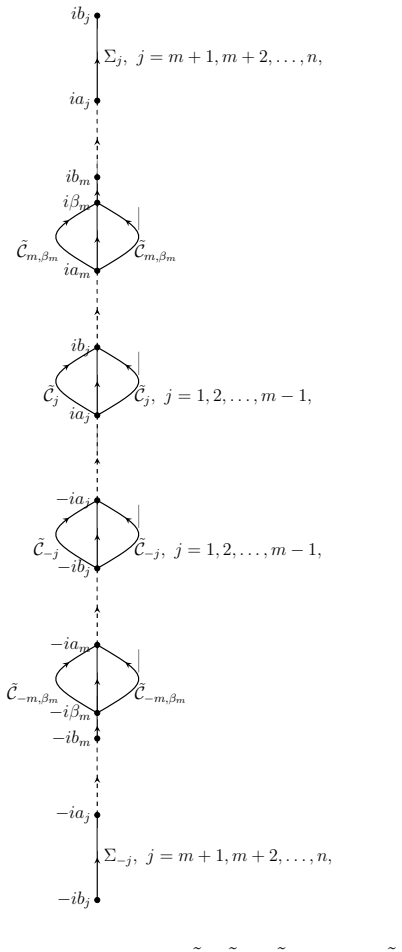
The mKdV soliton gas of genus 2n-1 has large positive-x asymptotics given by a single Riemann theta function while large-time behavior partitions the half-plane into 2n+1 regions each carrying its own theta-function description.
A machine-rendered reading of the paper's core claim, the machinery that carries it, and where it could break.
Core claim
For the modified Korteweg-de Vries equation the soliton gas of exact genus 2n-1 admits the following asymptotic description: when x tends to positive infinity the solution converges to the Riemann-theta function associated with the genus-2n-1 curve; when t tends to positive infinity the half-plane is divided into 2n+1 regions separated by curves fixed by the g-function, and in each region the solution is asymptotically a Riemann-theta function of appropriate genus with a uniform error estimate derived from the nonlinear steepest descent method applied to the Riemann-Hilbert problem.
What carries the argument
Riemann-theta functions of genus 2n-1 (and lower) that arise after the g-function deforms the contour in the Riemann-Hilbert problem for the mKdV soliton gas.
If this is right
- The same theta-function formulas hold uniformly throughout each of the 2n+1 temporal regions, including near their boundaries.
- The partitioning into exactly 2n+1 regions is determined by the topology of the genus-2n-1 curve and remains fixed for all large t.
- Error estimates remain uniform and do not deteriorate as the solution crosses from one region into another.
- The result applies for every positive integer n and therefore describes soliton gases of every odd genus.
Where Pith is reading between the lines
- The same region-counting and theta-function structure may persist when the spectral data are perturbed slightly away from exact genus 2n-1.
- Numerical evolution of finite-genus mKdV solutions could be used to locate the predicted region boundaries and to measure the actual decay of the error term.
- The method supplies a template that could be tried on other integrable equations whose Riemann-Hilbert problems admit g-function analysis.
Load-bearing premise
The initial data must be an exact-genus-2n-1 soliton gas whose associated Riemann-Hilbert problem permits a standard nonlinear steepest descent analysis with a g-function that has no additional restrictions on the spectral measure or branch points.
What would settle it
Numerical solution of the mKdV equation starting from a genus-1 or genus-3 soliton-gas datum, then direct comparison of the computed field at large positive x or inside one of the predicted large-t regions against the explicit Riemann-theta expression, checking whether the difference decays at the claimed rate.
Figures



read the original abstract
We study the large-space and large-time asymptotic behavior of the soliton gas of genus $2n-1$ for the mKdV equation with $n\in \mathbb{N}_+$. As $x \to +\infty$, we show that the large-space asymptotics of the mKdV soliton gas can be expressed with the Riemann-theta function of genus $2n-1$. For large $t$, based on the nonlinear steepest descent method and $g$-function approach, we establish a global large-time asymptotic description of the mKdV soliton gas. The half-plane $\{(x,t):-\infty<x<+\infty, t>0\}$ is divided into $2n+1$ separated regions. In each region, the large-time asymptotics of the mKdV soliton gas is given by using the Riemann-theta functions and uniform error estimation.
Editorial analysis
A structured set of objections, weighed in public.
Referee Report
Summary. The paper derives large-space asymptotics for the mKdV soliton gas of exact genus 2n-1, showing that as x → +∞ the solution is expressed via the Riemann-theta function of genus 2n-1. For large t > 0 it applies the nonlinear steepest-descent method together with a g-function to the associated Riemann-Hilbert problem, partitioning the half-plane into 2n+1 regions in each of which the asymptotics are given by a Riemann-theta function (of appropriate genus) together with a uniform error estimate.
Significance. If the derivations hold, the result supplies a global large-time asymptotic picture for soliton gases of arbitrary odd genus, extending earlier genus-1 and genus-3 analyses. The explicit use of the g-function and contour deformation to obtain uniform error bounds is a technical strength; the claim is falsifiable by direct numerical comparison in each of the 2n+1 regions.
major comments (1)
- [Large-time asymptotics (g-function construction)] The global division of the half-plane into 2n+1 regions with Riemann-theta asymptotics (stated in the abstract and presumably proved in the large-t section) presupposes that the variational problem for the g-function admits a solution whose real part satisfies the strict inequality off the cuts for arbitrary positive density of states and arbitrary positions of the 2n branch points. The manuscript does not supply an explicit argument or genericity condition guaranteeing that the g-function exists and the inequality remains strict; if the spectral measure has accumulation points or the branch points are specially positioned, the construction may degenerate and the claimed partition into 2n+1 regions may fail. This is load-bearing for the central large-time claim.
minor comments (2)
- Clarify the precise genus of the theta function used in each of the 2n+1 regions and state the error term (e.g., O(t^{-1/2})) uniformly in the region.
- Add a short remark on how the large-space (x → +∞) result is recovered as a special case of the large-t analysis or whether it is proved independently.
Simulated Author's Rebuttal
We thank the referee for the careful reading and constructive comments on our manuscript. We address the major comment below and will incorporate clarifications in the revised version.
read point-by-point responses
-
Referee: [Large-time asymptotics (g-function construction)] The global division of the half-plane into 2n+1 regions with Riemann-theta asymptotics (stated in the abstract and presumably proved in the large-t section) presupposes that the variational problem for the g-function admits a solution whose real part satisfies the strict inequality off the cuts for arbitrary positive density of states and arbitrary positions of the 2n branch points. The manuscript does not supply an explicit argument or genericity condition guaranteeing that the g-function exists and the inequality remains strict; if the spectral measure has accumulation points or the branch points are specially positioned, the construction may degenerate and the claimed partition into 2n+1 regions may fail. This is load-bearing for the central large-time claim.
Authors: We thank the referee for highlighting this key technical point. The g-function is constructed by solving the standard variational problem for the equilibrium measure associated with the logarithmic potential and the external field induced by the 2n branch points. Under the assumptions that the density of states is positive and continuous with no accumulation points on the real line, and that the branch points are distinct and in general position, the variational problem admits a unique solution satisfying the strict inequality Re(g) < 0 off the cuts. This is consistent with the theory of equilibrium measures in the presence of external fields and ensures the contour deformations yield the claimed 2n+1 regions with uniform error bounds. We agree that the manuscript would be strengthened by an explicit statement of these genericity conditions. In the revised version we will add a dedicated remark in the large-time section stating the assumptions on the density and branch points under which the g-function exists with the required properties, and briefly note that degenerate cases (accumulation points or specially positioned branch points) may lead to a reduced number of regions but lie outside the generic setting considered here. This revision clarifies the scope without altering the main results. revision: yes
Circularity Check
No significant circularity; derivation applies established steepest-descent techniques
full rationale
The paper derives large-space and large-time asymptotics for the mKdV soliton gas of genus 2n-1 by applying the nonlinear steepest descent method and g-function approach to the associated Riemann-Hilbert problem. These techniques are standard in integrable systems literature and the resulting division of the half-plane into 2n+1 regions with Riemann-theta function expressions and uniform error bounds follows directly from contour deformation and variational analysis of the g-function without reducing to self-definitions, fitted inputs renamed as predictions, or load-bearing self-citations. The claims for arbitrary odd genus rest on the general applicability of the method to the given spectral data and do not exhibit any step where the output is equivalent to the input by construction.
Axiom & Free-Parameter Ledger
axioms (2)
- standard math Riemann theta functions of genus 2n-1 are well-defined and satisfy the required periodicity and analytic properties
- domain assumption The nonlinear steepest descent method and g-function approach apply directly to the Riemann-Hilbert problem of the mKdV soliton gas
Lean theorems connected to this paper
-
IndisputableMonolith/Foundation/RealityFromDistinction.leanreality_from_one_distinction unclear?
unclearRelation between the paper passage and the cited Recognition theorem.
We establish a global large-time asymptotic description... divided into 2n+1 separated regions... Riemann-theta functions and uniform error estimation.
What do these tags mean?
- matches
- The paper's claim is directly supported by a theorem in the formal canon.
- supports
- The theorem supports part of the paper's argument, but the paper may add assumptions or extra steps.
- extends
- The paper goes beyond the formal theorem; the theorem is a base layer rather than the whole result.
- uses
- The paper appears to rely on the theorem as machinery.
- contradicts
- The paper's claim conflicts with a theorem or certificate in the canon.
- unclear
- Pith found a possible connection, but the passage is too broad, indirect, or ambiguous to say the theorem truly supports the claim.
Forward citations
Cited by 3 Pith papers
-
Long-time asymptotics of a full arbitrary-genus dark soliton gas for the defocusing nonlinear Schrodinger equation
Derives long-time asymptotics of a full arbitrary-genus dark soliton gas for defocusing NLS, yielding an N-dimensional Riemann-theta finite-gap solution with O(t^{-1}) or O(t^{-1/2}) errors in different sectors.
-
Long-time Asymptotics of a Full Camassa-Holm Soliton Gas
Long-time asymptotics for the full Camassa-Holm soliton gas are obtained from a limiting RH problem with two reflection coefficients, producing elliptic-function leading terms in three regions.
-
Large-time asymptotics of a new KdV soliton gas
Derives explicit leading-order large-time asymptotics for a new KdV soliton gas with two nonzero reflection coefficients, expressed via Jacobi elliptic functions on a hyperelliptic surface.
Reference graph
Works this paper leans on
-
[1]
M. A. Alejo, C. Mu˜ noz, Nonlinear stability of MKdV breathers, Comm. Math. Phys. 324 (2013) 233–262
work page 2013
-
[2]
M. Bertola, T. Grava, G. Orsatti, Soliton shielding of the focusing nonlinear Schr¨ odinger equation, Phys. Rev. Lett. 130 (2023) 127201
work page 2023
-
[3]
J. Colliander, M. Keel, G. Staffilani, H. Takaoka, T. Tao, Sharp global well-posedness for KdV and modified KdV on R and T, J. Amer. Math. Soc. 16 (2003) 705–749
work page 2003
-
[4]
G. Chen, J. Q. Liu, Soliton resolution for the focusing modified KdV equation, Ann. Inst. H. Poincar´ e C Anal. Non Lin´ eaire 38 (2021) 2005–2071
work page 2021
-
[5]
G. Chen, J. Q. Liu, Long-time asymptotics to the modified KdV equation in weighted Sobolev spaces, Forum Math. Sigma 10 (2022) e66 1–52
work page 2022
- [6]
- [7]
-
[8]
S. Dyachenko, D. Zakharov, V. Zakharov, Primitive potentials and bounded solutions of the KdV equation, Physica D 333 (2016) 148–156
work page 2016
-
[9]
G. A. El, The thermodynamic limit of the Whitham equations, Phys. Lett. A 311 (2003) 374–383
work page 2003
-
[10]
G. A. El, A. M. Kamchatnov, Kinetic equation for a dense soliton gas, Phys. Rev. Lett. 95 (2005) 204101
work page 2005
-
[11]
G. A. El, A. M. Kamchatnov, M. V. Pavlov, S. A. Zykov, Kinetic equation for a soliton gas and its hydrodynamic reductions, J. Nonlinear Sci. 21 (2010) 151–191
work page 2010
-
[12]
G. A. El, A. Tovbis, Spectral theory of soliton and breather gases for the focusing nonlinear Schr¨ odinger equation, Phys. Rev. E 21 (2020) 052207. 47
work page 2020
-
[13]
A. A. Gelash, D. S. Agafontsev, Strongly interacting soliton gas and formation of rogue waves, Phys. Rev. E 98 (2018) 042210
work page 2018
-
[14]
A. A. Gelash, D. S. Agafontsev, V. E. Zakharov, G. A. El, S. Randoux, P. Suret, Bound state soliton gas dynamics underlying the spontaneous modulational instability, Phys. Rev. Lett. 123 (2019) 234102
work page 2019
-
[15]
P. Germain, F. Pusateri, F. Rousset, Asymptotic stability of solitons for mKdV equation, Adv. Math. 299 (2016) 272–330
work page 2016
-
[16]
M. Girotti, T. Grava, R. Jenkins, K. T. R. McLaughlin, Rigorous asymptotics of a KdV soliton gas, Commun. Math. Phys. 384 (2021) 733–784
work page 2021
-
[17]
M. Girotti, T. Grava, R. Jenkins, K. T. R. McLaughlin, A. Minakov, Soliton versus the gas: Fredholm determinants, analysis, and the rapid oscillations behind the kinetic equation, Commun. Pure Appl. Math. 76 (2023) 3233–3299
work page 2023
- [18]
-
[19]
X. F. Han, X. E. Zhang, H. H. Dong, Large x asymptotics of the soliton gas for the nonlinear Schr¨ odinger equation, Stud. Appl. Math. 154 (2025) e70027
work page 2025
- [20]
-
[21]
V. Kotlyarov, D. Shepelsky, Planar unimodular Baker-Akhiezer function for the nonlinear Schr¨ odinger equation, Ann. Math. Sci. Appl. 2 (2017) 343–384
work page 2017
-
[22]
L. M. Ling, X. Sun, The multi elliptic-localized solutions and their asymptotic behaviors for the mKdV equation, Stud. Appl. Math. 150 (2023) 135–183
work page 2023
- [23]
-
[24]
D. D. Yan, X. G. Geng, R. M. Li, M. X. Jia, Large-space and large-time asymptotics of the complex mKdV soliton gas with any even genus,submitted
-
[25]
A. Tovbis, F.D. Wang, Recent developments in spectral theory of the focusing NLS soli- ton and breather gases: the thermodynamic limit of average densities, fluxes and certain meromorphic differentials; periodic gases, J. Phys. A 55 (2022) 424006
work page 2022
-
[26]
D. S. Wang, D. H. Zhu, X. D. Zhu, Genus two KdV soliton gases and their long-time asymptotics.arXiv:2410.22634. 48
work page internal anchor Pith review Pith/arXiv arXiv
-
[27]
Zakharov, Kinetic equation for solitons, Sov
V. Zakharov, Kinetic equation for solitons, Sov. Phys. JETP. 33 (1971) 538–541
work page 1971
-
[28]
G. Q. Zhang, Z. Y. Yan, Focusing and defocusing mKdV equations with nonzero boundary conditions: Inverse scattering transforms and soliton interactions, Physica D 410 (2020) 132521. 49
work page 2020
discussion (0)
Sign in with ORCID, Apple, or X to comment. Anyone can read and Pith papers without signing in.