REVIEW 5 major objections 5 minor 2 cited by
TranSplat: Surface Embedding-guided 3D Gaussian Splatting for Transparent Object Manipulation
T0 review · 5 major / 5 minor · reviewed 2026-08-08 · deepseek-v4-flash
Pith's one-line read TranSplat shows that surface embeddings from a latent diffusion model keep 3D Gaussian splatting from collapsing on transparent objects, yielding dense depth accurate enough for robot grasping.
desk verdict Genuinely new approach with strong synthetic results, but the real-world generalization claim needs a held-out split before I'd trust it. read the letter →
The pith
A machine-rendered reading of the paper's core claim, the machinery that carries it, and where it could break.
The reading
What carries the argument
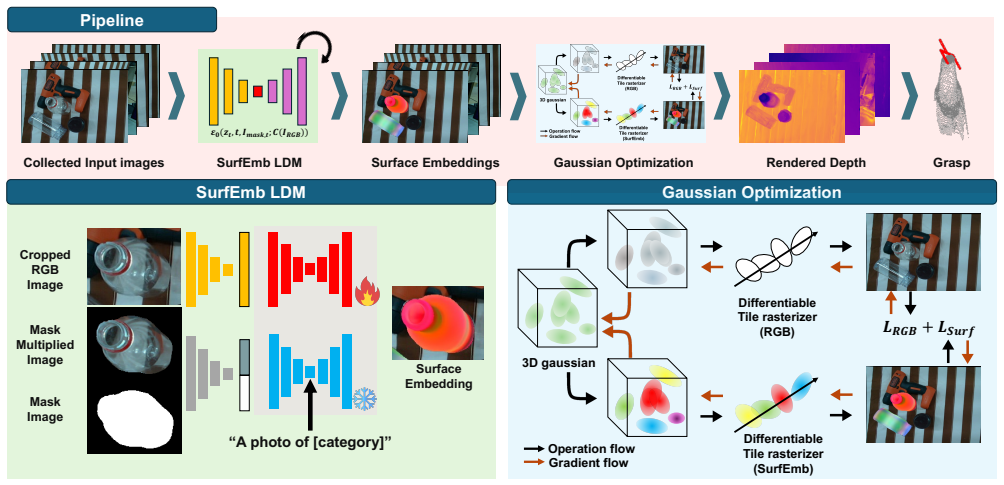
The load-bearing mechanism is joint Gaussian optimization with dual rasterization: the scene is represented as 3D Gaussians, and the differentiable tile rasterizer is run twice, once for RGB spherical-harmonic coefficients and once for surface-embedding coefficients, on the same shared Gaussian parameters. The surface embeddings act as surrogate features for non-Lambertian surfaces: because the embedding is continuous across viewpoints, it provides the optimization with a stable signal that does not suffer from reflection/refraction inconsistency, and the shared opacity means RGB alone cannot drive $\alpha$ to zero without also destroying the embedding rendering. The second component is the latent diffusion extractor, a ControlNet-style network with a frozen UNet and a trainable control branch, which produces these embeddings from masked cropped RGB images conditioned on category text and a control RGB input. Together these components let transparent surfaces keep nonzero opacity and render dense depth.
What would settle it
Run TranSplat on a transparent object whose category and CAD model were never seen during training of the surface-embedding generator, using a real sensor and a controlled viewpoint sweep; if depth MAE on the transparent surface rises to near the 3D-GS baseline while staying low on seen categories, the category-level transfer assumption is the bottleneck. A more direct test is to check whether the embedding of the same physical surface point stays constant across viewpoints: large embedding drift would falsify the claim that surface embeddings provide the view-invariant signal that prevents opacity collapse.
Extended reading notes
Core claim
The central claim is that transparent objects cease to be a special failure case for 3D Gaussian Splatting if the optimization is supervised by surface embeddings rather than by RGB alone. TranSplat trains a latent diffusion model with a ControlNet-style architecture to map a masked, cropped RGB image plus a category text label to a dense per-pixel embedding representing the object's surface in a view-invariant way; ground truth for this embedding comes from a category-level SurfEmb network trained on CAD models. During Gaussian optimization the renderer rasterizes both the RGB image and the surface-embedding image through the same set of Gaussians, sharing opacity $\alpha_j$, position, and covariance, with a loss that averages RGB and embedding terms. The paper's experiments show that this dual supervision keeps $\alpha$ from collapsing to zero on transparent surfaces, yielding lower MAE and RMSE than 3D-GS, SuGaR, Dex-NeRF, and Residual-NeRF on synthetic TransPose, synthetic ClearPose, and real TransPose, and that the rendered depth supports grasping by a pretrained GraspNet.
Load-bearing premise
The load-bearing assumption is that the category-level SurfEmb network, trained on CAD models from the TransPose categories, produces surface embeddings that transfer to unseen object instances and to real-world images; the paper's own ClearPose sequence 4 shows degradation when objects differ from the training CAD models.
Editorial extensions
If this is right
- Dense metric depth for transparent objects can be produced from ordinary RGB cameras alone, without thermal, polarization, or structured-light depth hardware.
- The trained model transfers to unseen object instances within the training categories, as shown on synthetic ClearPose.
- Rendering depth from as few as a quarter of the captured images still beats baselines using the full sequence, lowering the sensor sampling-rate requirement for robotic pipelines.
- The output depth plugs directly into off-the-shelf grasp planners such as pretrained GraspNet, turning transparent-object manipulation into a perception fix rather than a new control problem.
Reading between the lines
- If surface embeddings carry the geometric signal, the same dual-supervision trick may extend to other non-Lambertian or specular materials such as mirrors, polished metal, and wet surfaces where opacity collapse also occurs; the paper does not test this.
- The category-level embedding's dependence on CAD training data suggests a concrete scaling test: train on a disjoint set of categories and measure depth error on held-out transparent categories; the paper's ClearPose sequence 4 result predicts degradation when the object differs strongly from the CAD prior.
- The real-world results alternating between RGB-conditioned and RGB-free variants hint that sensor noise and occlusion can make the RGB control path harmful; a learned confidence or gating on the RGB conditioning could make the method more robust, an extension the paper lists as future work.
- One could benchmark directly whether the surface embeddings track physical surface points across viewpoints, isolating whether the depth gain comes from the embedding's geometric consistency or simply from extra regularization.
Editorial analysis
A structured set of objections, weighed in public.
Referee Report
Summary. The paper proposes TranSplat, a two-stage pipeline for depth completion of transparent objects. A latent diffusion model with ControlNet conditioning generates SurfEmb-style surface embeddings from RGB, mask, and text inputs; these embeddings are then used, together with RGB images, to supervise a 3D Gaussian Splatting scene optimized with an equal-weighted RGB and surface-embedding loss. Experiments on synthetic TransPose, synthetic ClearPose, and real TransPose report lower MAE/RMSE than 3D-GS, SuGaR, Dex-NeRF, and Residual-NeRF for most tested sequences, with ablations comparing RGB-conditioned and RGB-free variants, a study of reduced image counts, and a qualitative GraspNet-based grasping demonstration.
Significance. If the real-world results are validated under a clean train/test split, this is a useful contribution: it combines generative surface embeddings with 3D-GS to avoid opacity collapse, reports large and consistent improvements on most synthetic and real sequences, and the authors plan to release the synthetic dataset and model. The depth metric is evaluated against external ground truth, so the central comparison is not circular. However, the strongest practical claim—accurate depth completion for unseen real transparent objects—currently rests on an unverified evaluation split, and the grasping evaluation is only qualitative.
major comments (5)
- [IV-A2, IV-C, Table III] The latent diffusion extractor is stated to have been trained on 256x256 images from both real and synthetic TRansPose datasets, but the manuscript never reports the train/test split for this extractor. Since Table III evaluates on real TRansPose sequences 1-13, 25, and 26, if any of those sequences or their object instances appeared in the extractor's training set, the surface embeddings used at test time could be near-memorized and inflate the depth-completion results. This is load-bearing for the real-world generalization claim. Please report the exact split, evaluate only on sequences and object instances excluded from extractor training, or explicitly reframe the real TRansPose results as same-distribution evaluation rather than generalization to unseen objects. The degradation already visible on synthetic ClearPose sequence 4 (Table II) when objects differ from the CAD models used for embedding ground truth underscores the importance of this point.
- [Tables I and III] Table I omits synthetic TRansPose sequence 4, and Table III omits real TRansPose sequences 14-24, with no explanation. Because the text claims that TranSplat outperforms baselines across all sequences, the omissions could hide failures and should be filled in or explicitly justified (e.g., invalid ground truth or protocol exclusion). As written, the reader cannot tell whether the missing sequences were excluded selectively.
- [III-A] The ground-truth surface embeddings are said to come from a modified, category-level SurfEmb network, but the manuscript does not specify how that network is trained, which CAD models are used, or how category-level training avoids instance-specific features. Given that the 'unseen object' claim depends on this generator and that ClearPose sequence 4 already shows sensitivity to CAD-model mismatch, this description is necessary to assess generalization. Please provide training details for the SurfEmb ground-truth generator and evidence that category-level embeddings transfer to unseen instances.
- [IV-E, Fig. 6] The grasping experiment reports only that a pretrained GraspNet 'successfully identifies valid grasping points' from TranSplat-rendered depth. There is no quantitative grasp-success rate, no repeated trials, and no physical grasp or placement evaluation. This does not support the abstract's 'robot grasping tasks' claim as stated. Please add success-rate metrics over multiple trials, or soften the claim to grasp-candidate generation on TranSplat-completed depth.
- [Tables I-IV] All quantitative results are single-run MAE and RMSE values without error bars or statistical tests. Given the between-sequence variability and the fact that TranSplat is not best on every sequence (e.g., Table II sequences 4 and 5), the across-sequence superiority claim would be substantially strengthened by reporting standard deviations over multiple optimization runs, paired tests, or at least a statement of the number of runs performed.
minor comments (5)
- [Eqs. (5)-(7)] The loss weights (1/2 each for RGB and surface embedding, and lambda=0.2 in the D-SSIM terms) are fixed without a sensitivity study; please report an ablation or state that these values were not tuned.
- [Tables I-III] The baseline name is spelled 'SuGaR' in the text and references but 'SuGar' in the table headers; please unify the spelling.
- [IV-A2] The implementation section refers to a project page for further training details, but no URL is provided in the body; please include the URL or describe the remaining details directly.
- [Fig. 4] The figure caption lists many methods but the panel labels are difficult to parse in the PDF; please ensure each panel is clearly labeled with the method and dataset.
- [IV-D, Table IV] The reduced-image experiment reports that TranSplat with 1/2 or 1/4 of the images still outperforms baselines, but the real TRansPose case at 1/4 images shows a large jump in RMSE (0.2154 vs 0.0599 at full images); a brief explanation of this sensitivity would help the reader assess the efficiency claim.
Circularity Check
No circular reduction found: depth metrics are external, and the train/test split concern is a validity risk rather than a circular derivation.
full rationale
The derivation chain is not circular. Surface embeddings are produced by a latent diffusion model trained to regress CAD-derived SurfEmb features (Sec. III-A), then a per-scene 3D-GS is optimized with combined RGB and embedding losses (Eqs. 5-7), and depth accuracy is measured against external depth ground truth in Tables I-III. The embedding loss is a training signal for Gaussian attributes, not the evaluation target; the reported MAE and RMSE compare rendered depth to RGB-D sensor or BlenderProc ground truth, so performance does not reduce by construction to the embedding model's own outputs. The real TransPose evaluation has an undisclosed train/test split for the embedding extractor: Sec. IV-A2 says training was performed on 256x256 images from both real and synthetic TRansPose datasets, while Sec. IV-C evaluates on real TRansPose. This is a data-leakage and generalization-validity risk, not a demonstrated circular reduction, because the paper does not state that test sequences were used in that training. The paper's own admission in Sec. IV-B2 that ClearPose sequence 4 degrades when objects differ from the training CAD models further indicates that the depth results are not trivially forced by the embedding prior. The self-citation to the authors' TransPose dataset [16] is a published dataset with external ground truth, so it does not constitute load-bearing self-citation.
Assumptions & free parameters
free parameters (1)
- lambda (loss weight) =
0.2
assumptions (6)
- standard math The alpha-compositing equations of 3D Gaussian Splatting (Eq. 1-4) correctly model scene rendering and depth for transparent objects.
- domain assumption Surface embeddings from SurfEmb provide a viewpoint-consistent and illumination-robust representation of transparent object surfaces.
- domain assumption A latent diffusion model with ControlNet can generate surface embeddings that match the CAD-trained SurfEmb ground truth for unseen transparent objects.
- domain assumption A category-level SurfEmb model trained on TransPose CAD models transfers to unseen object instances and real-world images within the same categories.
- domain assumption The ground-truth depth in the real TransPose dataset is accurate enough to measure depth completion error for transparent objects.
- ad hoc to paper Jointly optimizing shared Gaussian parameters with the loss in Eq. 5 (half RGB, half surface embedding) prevents opacity collapse on transparent surfaces.
Cite this review
Pith. "Pith review of TranSplat: Surface Embedding-guided 3D Gaussian Splatting for Transparent Object Manipulation." pith.science (2026). https://pith.science/paper/JIBV77FF
@misc{pith2026250207840,
  author       = {Pith},
  title        = {Pith review of: TranSplat: Surface Embedding-guided 3D Gaussian Splatting for Transparent Object Manipulation},
  year         = {2026},
  howpublished = {\url{https://pith.science/paper/JIBV77FF}},
  note         = {Machine review of arXiv:2502.07840}
}
read the original abstract
Transparent object manipulation remains a significant challenge in robotics due to the difficulty of acquiring accurate and dense depth measurements. Conventional depth sensors often fail with transparent objects, resulting in incomplete or erroneous depth data. Existing depth completion methods struggle with interframe consistency and incorrectly model transparent objects as Lambertian surfaces, leading to poor depth reconstruction. To address these challenges, we propose TranSplat, a surface embedding-guided 3D Gaussian Splatting method tailored for transparent objects. TranSplat uses a latent diffusion model to generate surface embeddings that provide consistent and continuous representations, making it robust to changes in viewpoint and lighting. By integrating these surface embeddings with input RGB images, TranSplat effectively captures the complexities of transparent surfaces, enhancing the splatting of 3D Gaussians and improving depth completion. Evaluations on synthetic and real-world transparent object benchmarks, as well as robot grasping tasks, show that TranSplat achieves accurate and dense depth completion, demonstrating its effectiveness in practical applications. We open-source synthetic dataset and model: https://github. com/jeongyun0609/TranSplat
Figures


Figures from the paper (3 more)


Forward citations
Cited by 2 Pith papers
-
SwiftGS: Episodic Priors for Immediate Satellite Surface Recovery
SwiftGS uses episodic meta-training to predict geometry-radiation-decoupled Gaussian primitives and a lightweight SDF for zero-shot 3D satellite surface reconstruction with physics-aware rendering.
-
VolSplat: Rethinking Feed-Forward 3D Gaussian Splatting with Voxel-Aligned Prediction
VolSplat predicts 3D Gaussians from a shared voxel grid instead of from image pixels, reporting large gains in sparse-view novel view synthesis on RealEstate10K, ScanNet, and ACID.
Reference graph
Works this paper leans on
-
[1]
Glass segmentation with RGB-thermal image pairs,
D. Huo et al., “Glass segmentation with RGB-thermal image pairs,” IEEE Trans. Image Processing, vol. 32, pp. 1911–1926, 2023
work page 1911
-
[2]
Glass segmentation using intensity and spectral polarization cues,
H. Mei et al., “Glass segmentation using intensity and spectral polarization cues,” in Proc. IEEE Conf. on Comput. Vision and Pattern Recog., 2022, pp. 12 622–12 631
work page 2022
-
[3]
Deep polarization cues for transparent object segmentation,
A. Kalra et al., “Deep polarization cues for transparent object segmentation,” in Proc. IEEE Conf. on Comput. Vision and Pattern Recog., 2020, pp. 8602–8611
work page 2020
-
[4]
Rgb-d local implicit function for depth comple- tion of transparent objects,
L. Zhu et al., “Rgb-d local implicit function for depth comple- tion of transparent objects,” in Proc. IEEE Conf. on Comput. Vision and Pattern Recog., 2021, pp. 4649–4658
work page 2021
-
[5]
H. Fang et al., “Transcg: A Large-Scale Real-World Dataset for Transparent Object Depth Completion and a Grasping Baseline,” IEEE Robot. and Automat. Lett. , vol. 7, no. 3, pp. 7383–7390, 2022
work page 2022
-
[6]
Evo-nerf: Evolving NeRF for sequential robot grasping of transparent objects,
J. Kerr et al., “Evo-nerf: Evolving NeRF for sequential robot grasping of transparent objects,” in 6th annual conference on robot learning
-
[7]
Dex-Nerf: Using a Neural Radiance Field to Grasp Transparent Objects,
J. Ichnowski et al., “Dex-Nerf: Using a Neural Radiance Field to Grasp Transparent Objects,” in 6th annual conference on robot learning, 2022, pp. 526–536
work page 2022
-
[8]
Residual-nerf: Learning residual nerfs for transparent object manipulation,
B. P. Duisterhof, Y . Mao, S. H. Teng, and J. Ichnowski, “Residual-nerf: Learning residual nerfs for transparent object manipulation,” in Proc. IEEE Intl. Conf. on Robot. and Automat., 2024
work page 2024
Show all 33 references
-
[9]
Phocal: A multi-modal dataset for category- level object pose estimation with photometrically challenging objects,
P. Wang et al., “Phocal: A multi-modal dataset for category- level object pose estimation with photometrically challenging objects,” in Proc. IEEE Conf. on Comput. Vision and Pattern Recog., 2022, pp. 21 222–21 231
2022
-
[10]
Zerowaste dataset: Towards deformable object segmentation in cluttered scenes,
D. Bashkirova et al., “Zerowaste dataset: Towards deformable object segmentation in cluttered scenes,” in Proc. IEEE Conf. on Comput. Vision and Pattern Recog. , 2022, pp. 21 147– 21 157
2022
-
[11]
Clearpose: Large-scale transparent object dataset and benchmark,
X. Chen et al. , “Clearpose: Large-scale transparent object dataset and benchmark,” in Proc. European Conf. on Comput. Vision, 2022, pp. 381–396
2022
-
[12]
Clear grasp: 3d shape estimation of transparent objects for manipulation,
S. Sajjan, M. Moore, M. Pan, G. Nagaraja, J. Lee, A. Zeng, and S. Song, “Clear grasp: 3d shape estimation of transparent objects for manipulation,” in 2020 IEEE international confer- ence on robotics and automation (ICRA) . IEEE, 2020, pp. 3634–3642
2020
-
[13]
Nfl: Normal field learning for 6-dof grasping of transparent objects,
J. Lee, S. M. Kim, Y . Lee, and Y . M. Kim, “Nfl: Normal field learning for 6-dof grasping of transparent objects,” IEEE Robot. and Automat. Lett. , 2023
2023
-
[14]
3d gaussian splatting for real-time radiance field rendering
B. Kerbl, G. Kopanas, T. Leimk ¨uhler, and G. Drettakis, “3d gaussian splatting for real-time radiance field rendering.” ACM Trans. Graph., vol. 42, no. 4, pp. 139–1, 2023
2023
-
[15]
Surfemb: Dense and continuous correspondence distributions for object pose es- timation with learnt surface embeddings,
R. L. Haugaard and A. G. Buch, “Surfemb: Dense and continuous correspondence distributions for object pose es- timation with learnt surface embeddings,” in Proceedings of the IEEE/CVF Conference on Computer Vision and Pattern Recognition, 2022, pp. 6749–6758
2022
-
[16]
Transpose: Large-scale multispectral dataset for transparent object,
J. Kim, M.-H. Jeon, S. Jung, W. Yang, M. Jung, J. Shin, and A. Kim, “Transpose: Large-scale multispectral dataset for transparent object,” The International Journal of Robotics Research, p. 02783649231213117, 2024
2024
-
[17]
Ambiguity-Aware Multi-Object Pose Op- timization for Visually-Assisted Robot Manipulation ,
M.-H. Jeon et al., “Ambiguity-Aware Multi-Object Pose Op- timization for Visually-Assisted Robot Manipulation ,” IEEE Robot. and Automat. Lett. , 2022
2022
-
[18]
Multi-view object pose estimation from correspondence distributions and epipolar ge- ometry,
R. L. Haugaard and T. M. Iversen, “Multi-view object pose estimation from correspondence distributions and epipolar ge- ometry,” in 2023 IEEE International Conference on Robotics and Automation (ICRA) . IEEE, 2023, pp. 1786–1792
2023
-
[19]
Neusurfemb: A complete pipeline for dense correspondence- based 6d object pose estimation without cad models,
F. Milano, J. J. Chung, H. Blum, R. Siegwart, and L. Ott, “Neusurfemb: A complete pipeline for dense correspondence- based 6d object pose estimation without cad models,” arXiv preprint arXiv:2407.12207, 2024
2024
-
[20]
Repurposing diffusion-based image gen- erators for monocular depth estimation,
B. Ke, A. Obukhov, S. Huang, N. Metzger, R. C. Daudt, and K. Schindler, “Repurposing diffusion-based image gen- erators for monocular depth estimation,” in Proceedings of the IEEE/CVF Conference on Computer Vision and Pattern Recognition (CVPR), June 2024, pp. 9492–9502
2024
-
[21]
Diffusiondet: Dif- fusion model for object detection,
S. Chen, P. Sun, Y . Song, and P. Luo, “Diffusiondet: Dif- fusion model for object detection,” in Proceedings of the IEEE/CVF international conference on computer vision, 2023, pp. 19 830–19 843
2023
-
[22]
The surprising effectiveness of diffusion models for optical flow and monocular depth estimation,
S. Saxena, C. Herrmann, J. Hur, A. Kar, M. Norouzi, D. Sun, and D. J. Fleet, “The surprising effectiveness of diffusion models for optical flow and monocular depth estimation,” Advances in Neural Information Processing Systems , vol. 36, 2024
2024
-
[23]
Nomad: Goal masked diffusion policies for navigation and exploration,
A. Sridhar, D. Shah, C. Glossop, and S. Levine, “Nomad: Goal masked diffusion policies for navigation and exploration,” in 2024 IEEE International Conference on Robotics and Automation (ICRA). IEEE, 2024, pp. 63–70
2024
-
[24]
6d-diff: A keypoint diffusion framework for 6d object pose estimation,
L. Xu, H. Qu, Y . Cai, and J. Liu, “6d-diff: A keypoint diffusion framework for 6d object pose estimation,” in Proceedings of the IEEE/CVF Conference on Computer Vision and Pattern Recognition, 2024, pp. 9676–9686
2024
-
[25]
Nerrf: 3d reconstruction and view synthesis for transparent and specular objects with neural refractive-reflective fields,
X. Chen, J. Liu, H. Zhao, G. Zhou, and Y .-Q. Zhang, “Nerrf: 3d reconstruction and view synthesis for transparent and specular objects with neural refractive-reflective fields,” arXiv preprint arXiv:2309.13039, 2023
2023 arXiv
-
[26]
Said-nerf: Segmentation-aided nerf for depth completion of transparent objects,
A. Ummadisingu, J. Choi, K. Yamane, S. Masuda, N. Fukaya, and K. Takahashi, “Said-nerf: Segmentation-aided nerf for depth completion of transparent objects,” arXiv preprint arXiv:2403.19607, 2024
2024 arXiv
-
[27]
Adding conditional control to text-to-image diffusion models,
L. Zhang, A. Rao, and M. Agrawala, “Adding conditional control to text-to-image diffusion models,” in Proceedings of the IEEE/CVF International Conference on Computer Vision , 2023, pp. 3836–3847
2023
-
[28]
4d gaussian splatting for real-time dynamic scene rendering,
G. Wu, T. Yi, J. Fang, L. Xie, X. Zhang, W. Wei, W. Liu, Q. Tian, and X. Wang, “4d gaussian splatting for real-time dynamic scene rendering,” in Proceedings of the IEEE/CVF Conference on Computer Vision and Pattern Recognition , 2024, pp. 20 310–20 320
2024
-
[29]
Deformable 3d gaussians for high-fidelity monocular dy- namic scene reconstruction,
Z. Yang, X. Gao, W. Zhou, S. Jiao, Y . Zhang, and X. Jin, “Deformable 3d gaussians for high-fidelity monocular dy- namic scene reconstruction,” in Proceedings of the IEEE/CVF Conference on Computer Vision and Pattern Recognition , 2024, pp. 20 331–20 341
2024
-
[30]
Gaussian splatting slam,
H. Matsuki, R. Murai, P. H. Kelly, and A. J. Davison, “Gaussian splatting slam,” in Proceedings of the IEEE/CVF Conference on Computer Vision and Pattern Recognition , 2024, pp. 18 039–18 048
2024
-
[31]
B. O. Community, Blender - a 3D modelling and rendering package, Blender Foundation, Stichting Blender Foundation, Amsterdam, 2018. [Online]. Available: http://www.blender.org
2018
-
[32]
Sugar: Surface-aligned gaussian splatting for efficient 3d mesh reconstruction and high-quality mesh rendering,
A. Gu ´edon and V . Lepetit, “Sugar: Surface-aligned gaussian splatting for efficient 3d mesh reconstruction and high-quality mesh rendering,” in Proceedings of the IEEE/CVF Conference on Computer Vision and Pattern Recognition, 2024, pp. 5354– 5363
2024
-
[33]
Graspnet-1billion: A large-scale benchmark for general object grasping,
H.-S. Fang, C. Wang, M. Gou, and C. Lu, “Graspnet-1billion: A large-scale benchmark for general object grasping,” in Proceedings of the IEEE/CVF conference on computer vision and pattern recognition , 2020, pp. 11 444–11 453
2020
Reviewed August 8, 2026 · model on record in the stance chip above.
Discussion (0). Continue with ORCID to comment.