REVIEW 5 major objections 5 minor 56 references
A Streaming Sparse Cholesky Method for Derivative-Informed Gaussian Process Surrogates Within Digital Twin Applications
T0 review · 5 major / 5 minor · reviewed 2026-08-04 · deepseek-v4-flash
Pith's one-line read A derivative-informed Gaussian-process surrogate can update a digital twin from streaming inspection data without sacrificing the accuracy that derivative observations buy.
desk verdict A useful engineering combination of derivative-augmented GPs and sparse Cholesky streaming updates, with a clear evaluation gap: the dynamic update is never compared against full sparse re-factorization. read the letter →
The pith
A machine-rendered reading of the paper's core claim, the machinery that carries it, and where it could break.
The reading
What carries the argument
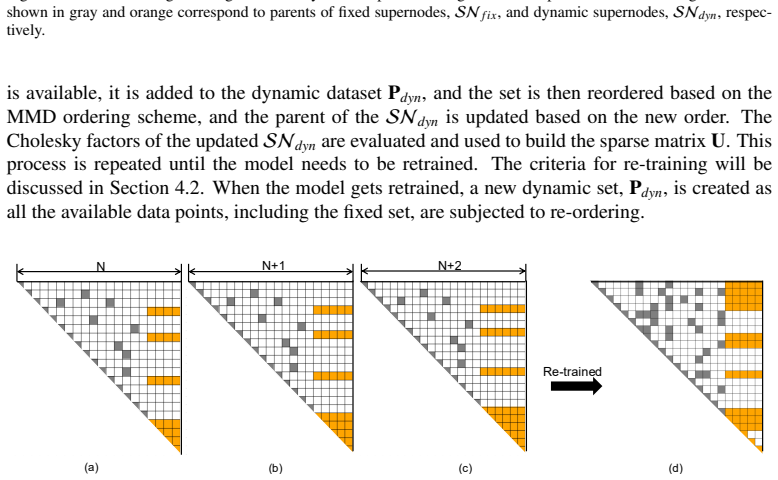
The central object is the derivative-augmented covariance matrix K_der, whose blocks are cross-covariances between function values and derivatives up to order d; solving it directly would scale as O((N N_d)^3), so the paper approximates its precision factor via sparse Cholesky factorization with maximum-minimum-distance ordering, aggregated supernodes, and Kullback-Leibler minimization over a sparsity pattern. The streaming extension is the dynamic supernode: a fixed portion of the factor is frozen, and new observations are absorbed by re-ordering and re-factoring only the dynamic supernode. The squared-exponential kernel's exponential bound on derivative blocks is what makes the sparsity pa
What would settle it
Inspect the same crack-growth digital twin with real inspection data in which only crack state (a,c) is measured: if relative error no longer drops from about 40% to about 26% when derivatives are approximated or omitted, the streaming-derivative claim fails for realistic deployments. A second check is to test Lemma 2.3.2 on a non-smooth target, since the proof uses the block covariance augmentation; if adding a derivative block raises predictive MSE, the monotone-error claim is wrong.
Extended reading notes
Core claim
On its own terms, the discovery is that derivative-augmented covariance matrices retain the structure that makes sparse Cholesky approximation work: the squared-exponential kernel's derivative blocks decay exponentially with squared distance, so a precision factor U built from maximum-minimum-distance ordering and Kullback-Leibler minimization remains sparse, and grouping derivatives pointwise preserves this while allowing cheap column addition. The paper proves positive definiteness of K_der, monotone non-increase of predictive MSE with derivative order, and exponential decay of derivative kernel blocks. Numerically, derivative order improves the sparse GP substantially on smooth test funct
Load-bearing premise
The method assumes derivative observations up to the chosen order are available exactly at every training and streaming point; in the digital-twin demonstration these derivatives are computed analytically from an assumed Paris-law crack-growth model, whereas real inspections only measure crack state.
Editorial extensions
If this is right
- For smooth targets, increasing derivative order from 0 to d never increases predictive MSE; on smooth test functions, 4th-order derivatives take MSE from roughly 1e-2 to 1e-13 at the studied sample sizes.
- Sparse Cholesky prediction matches exact GP prediction once the sparsity factor rho is large enough; below a problem-dependent threshold, sparsification can erase the derivative benefit, so rho must be set with N and derivative order in mind.
- Streaming updates that touch only the dynamic supernode avoid full re-factorization, and retraining is triggered by outlier detection, an unused-data budget, or sustained divergence of the updated model.
- In the crack-growth digital twin, dynamic updating reduces the relative gap between predicted and physical crack-growth rate from roughly 40% to 26% with first-order derivatives, and higher derivative orders or more frequent updates shrink the gap further.
Reading between the lines
- If derivative labels must be estimated from noisy physical measurements rather than taken analytically from an assumed law, the demonstrated accuracy gain is an upper bound; a numerical-differentiation or sensor-noise variant is the natural stress test and is not covered by the paper.
- Because the paper shows that permutation equivalence does not survive sparsification, any sparse GP that adds derivative rows should choose its ordering with update economics in mind, not just approximation quality; the pointwise grouping is a design choice, not a free normalization.
- The retraining triggers and the rho-increase fallback collectively act as a crude adaptive controller; one could extend them to tune the dynamic-block size and sparsity continuously from observed error, moving the method closer to a fully autonomous digital twin.
Editorial analysis
A structured set of objections, weighed in public.
Referee Report
Summary. The paper extends sparse Cholesky Gaussian-process surrogates to incorporate derivative observations, and proposes two dynamic supernode update strategies so that newly arriving data can be ingested without full re-factorization. The method is tested on Griewank/Rosenbrock benchmarks and on a digital-twin fatigue-crack-growth application, where derivative augmentation reduces prediction error and dynamic updates improve individualized crack-growth-rate predictions. The paper also sketches a noisy-data extension via whitening and an incomplete-Cholesky decomposition, and provides several lemmas on positive definiteness, error monotonicity, and exponential decay of derivative kernels.
Significance. If the central claim is established, the work is a useful engineering contribution: derivative-informed GPs are known to improve accuracy, sparse Cholesky gives near-linear scaling, and dynamic supernode updates could enable real-time digital-twin adaptation without full retraining. The paper is strong in assembling these pieces and in its breadth of experiments, including four ordering strategies, synthetic benchmarks, and a realistic aircraft-structure application. The main caveat is that the headline claim—that the streaming update preserves the accuracy benefit of derivative augmentation—is not directly tested, because the dynamic update is never compared against a full sparse re-factorization with the same hyperparameters. In addition, the evaluation protocol tunes hyperparameters on the test set, which weakens the numerical evidence. The theoretical lemmas are presented as proofs but at least one proves a different statement than the one claimed.
major comments (5)
- [§4.1 / Fig. 16] The central algorithmic claim—that dynamic sparse updates avoid full re-factorization without losing the accuracy benefits of derivative augmentation—is not directly tested. In SU-Approach1/Algorithm 2, only the dynamic supernode block is recomputed; all fixed supernode entries in the sparse factor U are left unchanged. Yet the KL-minimizing U in Eq. (10) has off-diagonal entries in fixed columns that depend on covariances with newly added points, so the updated factor is not the minimizer for the augmented covariance matrix. The paper never compares the dynamic update against full sparse re-factorization on the same data. Figure 16(b) vs 16(c) compares exact-GP retraining with dynamic sparse updating, confounding sparsity error with update error. An experiment comparing dynamic update vs full sparse re-factorization with identical hyperparameters is needed to support the paper's core cl
- [§2.4, §4.2, Algorithm 2] Hyperparameters are tuned on the test set, which inflates the reported accuracy. Section 2.4 states that the kernel length scale δ is "optimized for lower prediction error on the test dataset"; Section 4.2 says θ is optimized to reduce L(M) on D_test; and Algorithm 2 uses the test-set error both to accept/reject updates and to increase ρ during retraining. This is test-set leakage: the reported MSE values and the DT error η are not honest estimates of generalization performance. The protocol should use a validation split, marginal likelihood, or cross-validation, and the test set should be used only once for final evaluation.
- [Lemma 2.3.2 / Appendix C.2] The lemma claims a monotonicity result for the mean squared error, but the proof establishes monotonicity of the posterior variance. The final step asserts "MSE = E[σ^2_d]" by ignoring noise. In the noise-free interpolation setting used throughout the paper, posterior variance is an epistemic uncertainty measure, not the squared error against the deterministic test function f_test; indeed, the experiments compute MSE against f_test, not a Bayesian posterior risk. Either the lemma must be restated and proved for the quantity actually used (e.g., integrated posterior variance under the prior, or a genuine MSE bound under an assumed truth model), or the claim should be weakened. As written, the proof does not support the statement.
- [§3.3 / Appendix B.3] The noisy-data extension rests on an unproved sparsity-preservation assertion. Appendix B.3 states that adding I to the whitened kernel matrix "preserves exponential decay and sparsity," and uses this to justify the incomplete-Cholesky approximation L''L''^T ≈ (K_tilde + I)^{-1}. For derivative-augmented block covariance matrices with block-diagonal R, this is not a trivial consequence of the earlier exponential-decay lemma, and the authors explicitly note that K_der R ≈ R K_der fails. Either a proof or a careful numerical study of the resulting sparsity and approximation error is needed before the noisy-data observations in Section 3.5 can be taken as supported.
- [§5.3 / §5.4] The application assumes exact derivative labels that are not available from physical inspections. In Section 5.3, derivatives of dc/dN are computed analytically from the assumed Paris-law model, while the PT inspections only yield crack state (a, c). Thus the reported reduction of η from ~40% to ~21–26% depends on the surrogate being trained on derivatives of the exact model used to generate the PT data. This is an acknowledged modeling choice, but it limits the transfer of the demonstrated gains to real digital-twin deployments. The paper should either add a sensitivity study with noisy derivative data (e.g., via numerical differentiation or derivative noise) or clearly state this as a condition for the application-level claim rather than a limitation deferred to future work.
minor comments (5)
- [§2.1 / Eq. (1)] Notation is inconsistent: the text writes K(x*,X) and K((X,X)+R), then later uses K(X,X)+R. Please unify kernel-matrix notation throughout.
- [§3.5] The noisy-data experiments report only one configuration and the authors say a detailed comparison with the incomplete-Cholesky method of [44,46] is left to future work. Given that Section 3.5 is presented as validation of Section 3.3, at least a small comparison or an error-vs-sparsity diagnostic would help the reader assess the method.
- [Algorithm 2] The retraining loop (lines 14–20) increments ρ by 1 and re-fits until the test error improves or a sparsity lower bound is hit. This is effectively a test-set-based model-selection procedure and should be either moved to validation data or replaced by a fixed sparsity schedule. Also, line 8 has a duplicated 'or'.
- [Lemma 3.0.2 / Appendix C.5] The proof of Lemma 3.0.2 is a heuristic scaling argument rather than a rigorous derivation: showing that derivative blocks scale as δ^{-d} does not by itself prove that κ(K_der) increases with d and decreases with l. Either provide a formal eigenvalue bound or present the lemma as an observed phenomenon.
- [Figure 16] The right column omits the 'No derivatives' curves, but the reader is not told until the caption/paragraph below. Consider adding a small inset or a sentence in the caption to clarify that the omission is due to the coincidental alignment of the no-derivative model with the PT in this particular realization.
Circularity Check
Minor evaluation circularity from test-set hyperparameter optimization; the sparse-Cholesky derivation itself is self-contained.
-
fitted input called prediction
[Section 2.4, Section 4.2, Algorithm 2]
"During training, the kernel length scale, δ, is optimized for lower prediction error on the test dataset. // The hyperparameters, θ, are optimized to reduce the prediction error, L(M), on the test dataset, D_test."
The reported 'prediction error' is computed on the same D_test used to select δ/θ. Algorithm 2 further uses L(M) = MSE on D_test to accept or reject each dynamic update and to trigger retraining. Therefore the test labels are an input to the fitted hyperparameters and model-selection decisions, making the reported accuracy at least partly in-sample; the 'prediction' numbers are not independent of the fitted inputs. The central sparse-Cholesky derivation is unaffected, so this is partial rather than definitional circularity.
full rationale
The core method is not circular: the sparse factor U is obtained by KL minimization (Eq. 10) under an MMD-based sparsity pattern; derivative augmentation follows the standard derivative-GP covariance construction; and the DT application is evaluated on a separately simulated Paris-law physical twin rather than on the training data. Self-citations (e.g., [14]) are not load-bearing for the derivation. The paper's own limitation — derivatives are computed analytically from Eq. 11 rather than measured from the physical twin — is a transferability concern, not a circularity. The skeptic's fixed-column-update concern is a correctness/approximation-error issue: the paper does not compare dynamic updates against full sparse re-factorization, so the streaming-preserves-accuracy claim is under-supported, but this is not a case where a stated output equals an input by construction. The main circular element is statistical: δ/θ are optimized on D_test and Algorithm 2's accept/reject decisions use L(M) on the same D_test, so the numerical 'predictions' are partially in-sample. That is an evaluation-protocol circularity that inflates reported accuracy, but it does not make the sparse-Cholesky derivation equivalent to its own inputs.
Assumptions & free parameters
free parameters (5)
- Kernel length scale δ =
reported in [1.0, 10.0]
- Sparsification factor ρ =
10 in Sec. 3.4, 20 in Sec. 5.3, adaptively increased in Algorithm 2
- Diagonal jitter =
unspecified ('a small value')
- Dynamic set fraction =
0.2 (20%)
- Outlier detection hyperparameters (k, η_out, η_budget, η_div_th) =
unspecified
assumptions (5)
- domain assumption Sparse Cholesky factorization via KL minimization yields a near-optimal sparse precision matrix for kernel matrices with exponential decay.
- domain assumption MMD ordering produces Cholesky factors with near sparsity.
- ad hoc to paper Adding the identity to the whitened kernel matrix preserves exponential decay and sparsity (for the noisy decomposition).
- ad hoc to paper Posterior variance monotonicity implies MSE monotonicity (Lemma 2.3.2).
- domain assumption Exact derivative observations up to order d are available at every training/update point.
Cite this review
Pith. "Pith review of A Streaming Sparse Cholesky Method for Derivative-Informed Gaussian Process Surrogates Within Digital Twin Applications." pith.science (2026). https://pith.science/paper/JJ4PRR7Q
@misc{pith2026251100366,
  author       = {Pith},
  title        = {Pith review of: A Streaming Sparse Cholesky Method for Derivative-Informed Gaussian Process Surrogates Within Digital Twin Applications},
  year         = {2026},
  howpublished = {\url{https://pith.science/paper/JJ4PRR7Q}},
  note         = {Machine review of arXiv:2511.00366}
}
read the original abstract
Digital twins are developed to model the behavior of a specific physical asset (or twin), and they can consist of high-fidelity physics-based models or surrogates. A highly accurate surrogate is often preferred over multi-physics models as they enable forecasting the physical twin future state in real-time. To adapt to a specific physical twin, the digital twin model must be updated using in-service data from that physical twin. In this paper, we combine and extend several previous surrogate-related advancements with the goal of demonstrating an end-to-end digital twin (DT) solution for predicting performance of an aircraft structure (the physical asset). To this end, we extend Gaussian process (GP) models to include derivative data, for improved accuracy, with dynamic updating to ingest physical twin data during service. Including derivative data, however, comes at a prohibitive cost of increased covariance matrix dimension. We circumvent this issue through our modified dynamic sparse Cholesky linear system solver. Numerical experiments demonstrate that the prediction accuracy of the derivative-enhanced sparse Cholesky GP method produces improved models upon dynamic data additions. Lastly, we demonstrate the developed algorithm within a DT framework to model fatigue crack growth in an aerospace vehicle, thereby exhibiting through our assembled engineered system how digital twin technologies can be combined in practice.
Figures


Figures from the paper (14 more)




Reference graph
Works this paper leans on
-
[1]
Reengi- neering aircraft structural life prediction using a digital twin.International Journal of Aerospace Engineering, 2011(1):154798, 2011
Eric J Tuegel, Anthony R Ingraffea, Thomas G Eason, and S Michael Spottswood. Reengi- neering aircraft structural life prediction using a digital twin.International Journal of Aerospace Engineering, 2011(1):154798, 2011
2011
-
[2]
The digital twin paradigm for future nasa and us air force vehicles
Edward Glaessgen and David Stargel. The digital twin paradigm for future nasa and us air force vehicles. In53rd AIAA/ASME/ASCE/AHS/ASC structures, structural dynamics and materials conference 20th AIAA/ASME/AHS adaptive structures conference 14th AIAA, page 1818, 2012
2012
-
[3]
Grieves.Digital Twins: Past, Present, and Future, pages 97–121
Michael W. Grieves.Digital Twins: Past, Present, and Future, pages 97–121. Springer International Publishing, Cham, 2023. ISBN 978-3-031-21343-4
2023
-
[4]
Data-driven physics-based digital twins via a library of component-based reduced-order models.International Journal for Numerical Methods in Engineering, 123(13):2986–3003, 2022
Michael G Kapteyn, David J Knezevic, DBP Huynh, Minh Tran, and Karen E Willcox. Data-driven physics-based digital twins via a library of component-based reduced-order models.International Journal for Numerical Methods in Engineering, 123(13):2986–3003, 2022
2022
-
[5]
On the effects of modeling as-manufactured geometry: Toward digital twin.International Journal of Aerospace Engineering, 2014(1):439278, 2014
Albert Cerrone, Jacob Hochhalter, Gerd Heber, and Anthony Ingraffea. On the effects of modeling as-manufactured geometry: Toward digital twin.International Journal of Aerospace Engineering, 2014(1):439278, 2014
2014
-
[6]
Federal Aviation Administration. Advisory Circular 23-13A: Fatigue, Fail-Safe, and Damage Tolerance Evaluation of Metallic Structure for Normal, Utility, Acrobatic, and Commuter Category Airplanes.https://www.faa.gov/documentLibrary/media/ Advisory_Circular/AC_23-13A.pdf, 2005. Accessed: 2025-10-21
2005
-
[7]
Advisory Circular 25.571-1D: Damage Tolerance and Fatigue Evaluation of Structure.https://www.faa.gov/documentLibrary/media/ Advisory_Circular/AC_25_571-1D_.pdf, 2011
Federal Aviation Administration. Advisory Circular 25.571-1D: Damage Tolerance and Fatigue Evaluation of Structure.https://www.faa.gov/documentLibrary/media/ Advisory_Circular/AC_25_571-1D_.pdf, 2011. Accessed: 2025-10-21
2011
-
[8]
Min Liao, Guillaume Renaud, and Yan Bombardier. Airframe digital twin technology adaptability assessment and technology demonstration.Engineering Fracture Mechan- ics, 225:106793, 2020. ISSN 0013-7944. doi: https://doi.org/10.1016/j.engfracmech. 2019.106793. URLhttps://www.sciencedirect.com/science/article/pii/ S0013794419303182. 32
arXiv 2020
Show all 56 references
-
[9]
Probabilistic methods for risk assess- ment of airframe digital twin structures.Engineering Fracture Mechanics, 221:106674,
Harry Millwater, Juan Ocampo, and Nathan Crosby. Probabilistic methods for risk assess- ment of airframe digital twin structures.Engineering Fracture Mechanics, 221:106674,
-
[10]
McDowell
Gary Whelan and David L. McDowell. Uncertainty quantification in icme workflows for fatigue critical computational modeling.Engineering Fracture Mechanics, 220:106673,
-
[11]
Yeratapally, Patrick E
Saikumar R. Yeratapally, Patrick E. Leser, Jacob D. Hochhalter, William P. Leser, and Timothy J. Ruggles. A digital twin feasibility study (part i): Non-deterministic predictions of fatigue life in aluminum alloy 7075-t651 using a microstructure-based multi-scale model.Enginee...
2020
-
[12]
doi: https://doi.org/10.1016/j.engfracmech.2019.106673
ISSN 0013-7944. doi: https://doi.org/10.1016/j.engfracmech.2019.106673. URL https://www.sciencedirect.com/science/article/pii/S0013794419304497
2019
-
[13]
Sparse Cholesky Factorization for Solving Nonlinear PDEs via Gaussian Processes, March 2024
Yifan Chen, Houman Owhadi, and Florian Schäfer. Sparse Cholesky Factorization for Solving Nonlinear PDEs via Gaussian Processes, March 2024. URLhttp://arxiv.org/ abs/2304.01294. arXiv:2304.01294 [math]
2024 arXiv
-
[14]
Solv- ing High Frequency and Multi-Scale PDEs with GaussianProcesses.The Twelfth Interna- tional Conference on Learning Representations (ICLR 2024), March 2024
Shikai Fang, Madison Cooley, Da Long, Shibo Li, Robert Kirby, and Shandian Zhe. Solv- ing High Frequency and Multi-Scale PDEs with GaussianProcesses.The Twelfth Interna- tional Conference on Learning Representations (ICLR 2024), March 2024. doi: 10.48550/ arXiv.2311.04465. URL...
-
[16]
Aoi, and Jonathan W
Anqi Wu, Mikio C. Aoi, and Jonathan W. Pillow. Exploiting gradients and Hessians in Bayesian optimization and Bayesian quadrature, March 2018. URLhttp://arxiv.org/ abs/1704.00060. arXiv:1704.00060 [stat]
2018 arXiv
-
[17]
Explicit Estimation of Derivatives from Data and Dif- ferential Equations by Gaussian Process Regression, October 2020
Hongqiao Wang and Xiang Zhou. Explicit Estimation of Derivatives from Data and Dif- ferential Equations by Gaussian Process Regression, October 2020. URLhttp://arxiv. org/abs/2004.05796. arXiv:2004.05796 [stat]
2020 arXiv
-
[18]
Derivative Observations in Gaussian Process Models of Dynamic Systems
E Solak, R Murray-smith, W E Leithead, D J Leith, and Carl E Rasmussen. Derivative Observations in Gaussian Process Models of Dynamic Systems
-
[19]
Scaling Gaussian Processes with Derivative Information Using Variational Inference
Misha Padidar, Xinran Zhu, and Leo Huang. Scaling Gaussian Processes with Derivative Information Using Variational Inference. 33
-
[20]
DGP-LVM: Derivative Gaussian process latent variable models.Statistics and Computing, 35(5):120, October
Soham Mukherjee, Manfred Claassen, and Paul-Christian Bürkner. DGP-LVM: Derivative Gaussian process latent variable models.Statistics and Computing, 35(5):120, October
-
[21]
Scaling Gaussian Process Regression with Derivatives, October 2018
David Eriksson, Kun Dong, Eric Hans Lee, David Bindel, and Andrew Gordon Wil- son. Scaling Gaussian Process Regression with Derivatives, October 2018. URLhttp: //arxiv.org/abs/1810.12283. arXiv:1810.12283 [cs]
2018 arXiv
-
[22]
Hoerl and Robert W
Arthur E. Hoerl and Robert W. Kennard. Ridge regression: Biased estimation for nonorthogonal problems.Technometrics, 12(1):55–67, 1970. doi: 10.1080/00401706.1970. 10488634. URLhttps://www.tandfonline.com/doi/abs/10.1080/00401706. 1970.10488634
1970
-
[23]
Success rate of evolution strategies on the mul- timodal griewank function
Lisa Schönenberger and Hans-Georg Beyer. Success rate of evolution strategies on the mul- timodal griewank function. In2024 IEEE Congress on Evolutionary Computation (CEC), pages 1–8, 2024. doi: 10.1109/CEC60901.2024.10612209
2024 arXiv
-
[24]
When Gaussian Process Meets Big Data: A Review of Scalable GPs.IEEE Transactions on Neural Networks and Learning Systems, 31(11):4405–4423, November 2020
Haitao Liu, Yew-Soon Ong, Xiaobo Shen, and Jianfei Cai. When Gaussian Process Meets Big Data: A Review of Scalable GPs.IEEE Transactions on Neural Networks and Learning Systems, 31(11):4405–4423, November 2020. ISSN 2162-237X, 2162-2388. doi: 10.1109/ TNNLS.2019.2957109. URLht...
2020
-
[25]
Hida-matérn kernel hida-matérn kernel
Matthew Dowling. Hida-matérn kernel hida-matérn kernel. 2021. URLhttps://api. semanticscholar.org/CorpusID:245539494
2021
-
[26]
Recursive Sampling for the Nyström Method, November 2017
Cameron Musco and Christopher Musco. Recursive Sampling for the Nyström Method, November 2017. URLhttp://arxiv.org/abs/1605.07583. arXiv:1605.07583 [cs]
2017 arXiv
-
[27]
Epperly, Joel A
Yifan Chen, Ethan N. Epperly, Joel A. Tropp, and Robert J. Webber. Randomly pivoted Cholesky: Practical approximation of a kernel matrix with few entry evaluations.Commu- nications on Pure and Applied Mathematics, 78(5):995–1041, May 2025. ISSN 0010-3640, 1097-0312. doi: 10.10...
2025 doi
-
[28]
A. V . Vecchia. Estimation and Model Identification for Continuous Spatial Processes.Jour- nal of the Royal Statistical Society Series B: Statistical Methodology, 50(2):297–312, Jan- uary 1988. ISSN 1369-7412, 1467-9868. doi: 10.1111/j.2517-6161.1988.tb01729.x. URL https://aca...
1988
-
[29]
Heaton, Abhirup Datta, Andrew O
Matthew J. Heaton, Abhirup Datta, Andrew O. Finley, Reinhard Furrer, Joseph Guinness, Rajarshi Guhaniyogi, Florian Gerber, Robert B. Gramacy, Dorit Hammerling, Matthias Katzfuss, Finn Lindgren, Douglas W. Nychka, Furong Sun, and Andrew Zammit-Mangion. A Case Study Competition ...
2019 doi
-
[30]
Finley, and Alan E
Abhirup Datta, Sudipto Banerjee, Andrew O. Finley, and Alan E. Gelfand. Hierarchical Nearest-Neighbor Gaussian Process Models for Large Geostatistical Datasets.Journal of the American Statistical Association, 111(514):800–812, April 2016. ISSN 0162-1459, 1537-274X. doi: 10.108...
2016
-
[31]
Finley, Nicholas A
Abhirup Datta, Sudipto Banerjee, Andrew O. Finley, Nicholas A. S. Hamm, and Martijn Schaap. Nonseparable dynamic nearest neighbor Gaussian process models for large spatio-temporal data with an application to particulate mat- ter analysis.The Annals of Applied Statistics, 10(3)...
2016 doi
-
[32]
Sparse greedy gaussian process regression
Alex Smola and Peter Bartlett. Sparse greedy gaussian process regression. In T. Leen, T. Dietterich, and V . Tresp, editors,Advances in Neural Information Processing Systems, volume 13. MIT Press, 2000
2000
-
[33]
Covariance Tapering for Interpolation of Large Spatial Datasets.Journal of Computational and Graphical Statistics, 15(3):502–523, September 2006
Reinhard Furrer, Marc G Genton, and Douglas Nychka. Covariance Tapering for Interpolation of Large Spatial Datasets.Journal of Computational and Graphical Statistics, 15(3):502–523, September 2006. ISSN 1061-8600, 1537-2715. doi: 10. 1198/106186006X132178. URLhttp://www.tandfo...
2006
-
[34]
Random Features for Large-Scale Kernel Machines
Ali Rahimi and Ben Recht. Random Features for Large-Scale Kernel Machines
-
[35]
A unifying view of sparse ap- proximate gaussian process regression.Journal of Machine Learning Research, 6(65): 1939–1959, 2005
Joaquin Quiñonero-Candela and Carl Edward Rasmussen. A unifying view of sparse ap- proximate gaussian process regression.Journal of Machine Learning Research, 6(65): 1939–1959, 2005. URLhttp://jmlr.org/papers/v6/quinonero-candela05a. html
1939
-
[36]
Stein, Zhiyi Chi, and Leah J
Michael L. Stein, Zhiyi Chi, and Leah J. Welty. Approximating Likelihoods for Large Spatial Data Sets.Journal of the Royal Statistical Society Series B: Statistical Methodology, 66(2):275–296, May 2004. ISSN 1369-7412, 1467-9868. doi: 10.1046/j.1369-7412.2003. 05512.x. URLhttp...
2004
-
[37]
Variational sparse inverse Cholesky approximation for latent Gaussian processes via double Kullback-Leibler minimization, May 2023
Jian Cao, Myeongjong Kang, Felix Jimenez, Huiyan Sang, Florian Schafer, and Matthias Katzfuss. Variational sparse inverse Cholesky approximation for latent Gaussian processes via double Kullback-Leibler minimization, May 2023. URLhttp://arxiv.org/abs/ 2301.13303. arXiv:2301.13...
2023 arXiv
-
[38]
Scaled Vecchia approximation for fast computer-model emulation, July 2021
Matthias Katzfuss, Joseph Guinness, and Earl Lawrence. Scaled Vecchia approximation for fast computer-model emulation, July 2021. URLhttp://arxiv.org/abs/2005.00386. arXiv:2005.00386 [stat]
2021 arXiv
-
[39]
Sparse inverse Cholesky factorization of dense kernel matrices by greedy conditional selec- tion, May 2025
Stephen Huan, Joseph Guinness, Matthias Katzfuss, Houman Owhadi, and Florian Schäfer. Sparse inverse Cholesky factorization of dense kernel matrices by greedy conditional selec- tion, May 2025. URLhttp://arxiv.org/abs/2307.11648. arXiv:2307.11648 [stat]. 35
2025 arXiv
-
[40]
Permutation and Grouping Methods for Sharpening Gaussian Process Approximations.Technometrics, 60(4):415–429, October 2018
Joseph Guinness. Permutation and Grouping Methods for Sharpening Gaussian Process Approximations.Technometrics, 60(4):415–429, October 2018. ISSN 0040-1706, 1537-
2018
-
[41]
Ying Sun and Michael L. Stein. Statistically and Computationally Efficient Estimat- ing Equations for Large Spatial Datasets.Journal of Computational and Graphical Statistics, 25(1):187–208, January 2016. ISSN 1061-8600, 1537-2715. doi: 10.1080/ 10618600.2014.975230. URLhttps:...
2016
-
[42]
A General Framework for Vec- chia Approximations of Gaussian Processes.Statistical Science, 36(1), Febru- ary 2021
Matthias Katzfuss and Joseph Guinness. A General Framework for Vec- chia Approximations of Gaussian Processes.Statistical Science, 36(1), Febru- ary 2021. ISSN 0883-4237. doi: 10.1214/19-STS755. URLhttps: //projecteuclid.org/journals/statistical-science/volume-36/issue-1/ A-Ge...
2021 doi
-
[43]
Sparse Recovery of Elliptic Solvers from Matrix- Vector Products.SIAM Journal on Scientific Computing, 46(2):A998–A1025, April 2024
Florian Schäfer and Houman Owhadi. Sparse Recovery of Elliptic Solvers from Matrix- Vector Products.SIAM Journal on Scientific Computing, 46(2):A998–A1025, April 2024. ISSN 1064-8275, 1095-7197. doi: 10.1137/22M154226X. URLhttps://epubs.siam. org/doi/10.1137/22M154226X
2024 doi
-
[44]
Sparse Cholesky Factorization by Kullback–Leibler Minimization.SIAM Journal on Scientific Computing, 43(3):A2019– A2046, January 2021
Florian Schäfer, Matthias Katzfuss, and Houman Owhadi. Sparse Cholesky Factorization by Kullback–Leibler Minimization.SIAM Journal on Scientific Computing, 43(3):A2019– A2046, January 2021. ISSN 1064-8275, 1095-7197. doi: 10.1137/20M1336254. URL https://epubs.siam.org/doi/10.1...
2021 doi
-
[45]
Yifan Chen, Bamdad Hosseini, Houman Owhadi, and Andrew M. Stuart. Solving and Learning Nonlinear PDEs with Gaussian Processes, August 2021. URLhttp://arxiv. org/abs/2103.12959. arXiv:2103.12959 [math]
2021 arXiv
-
[46]
Correlation-based sparse inverse Cholesky factorization for fast Gaussian-process inference.Statistics and Computing, 33(3):56, June 2023
Myeongjong Kang and Matthias Katzfuss. Correlation-based sparse inverse Cholesky factorization for fast Gaussian-process inference.Statistics and Computing, 33(3):56, June 2023. ISSN 0960-3174, 1573-1375. doi: 10.1007/s11222-023-10231-5. URL http://arxiv.org/abs/2112.14591. ar...
2023 arXiv
-
[47]
Davis and William W
Timothy A. Davis and William W. Hager. Dynamic Supernodes in Sparse Cholesky Up- date/Downdate and Triangular Solves.ACM Transactions on Mathematical Software, 35 (4):1–23, February 2009. ISSN 0098-3500, 1557-7295. doi: 10.1145/1462173.1462176. URLhttps://dl.acm.org/doi/10.114...
2009
-
[48]
Leser, James E
Patrick E. Leser, James E. Warner, William P. Leser, Geoffrey F. Bomarito, John A. Newman, and Jacob D. Hochhalter. A digital twin feasibility study (Part II): Non- deterministic predictions of fatigue life using in-situ diagnostics and prognostics.Engi- neering Fracture Mecha...
2020
-
[49]
Computational fracture mechanics.Encyclopedia of computational mechanics, 2004
Anthony R Ingraffea. Computational fracture mechanics.Encyclopedia of computational mechanics, 2004. 36
2004
-
[50]
Tushar Gautam, Jacob Hochhalter, Shandian Zhe, Eric Lindgren, and Robert M. Kirby. Developing robust stress intensity factor models using fourier-based data analysis to guide machine learning method selection and training.Engineering Fracture Mechan- ics, 326:111387, 2025. ISS...
2025
-
[51]
Florian Schäfer, T. J. Sullivan, and Houman Owhadi. Compression, Inversion, and Ap- proximate PCA of Dense Kernel Matrices at Near-Linear Computational Complexity.Mul- tiscale Modeling&Simulation, 19(2):688–730, 2021. doi: 10.1137/19M129526X. URL https://doi.org/10.1137/19M129526X
2021 doi
-
[52]
point-wise ordering algorithm 2
C.Michael Hudson and Joseph T. Scardina. Effect of stress ratio on fatigue-crack growth in 7075-t6 aluminum-alloy sheet.Engineering Fracture Mechanics, 1(3):429–446, 1969. ISSN 0013-7944. doi: https://doi.org/10.1016/0013-7944(69)90003-4. URLhttps:// www.sciencedirect.com/scie...
1969
-
[56]
Kirby, and Jacob Hochhalter
Jonas Merrell, John Emery, Robert M. Kirby, and Jacob Hochhalter. Stress intensity fac- tor models using mechanics-guided decomposition and symbolic regression.Engineer- ing Fracture Mechanics, 310:110432, 2024. ISSN 0013-7944. doi: https://doi.org/10. 1016/j.engfracmech.2024....
2024
-
[58]
point-wise ordering algorithm 2
The algorithm to obtainP d me−1 is shown in Algorithm A1. Algorithm A1Constructing theP d me−1 array 1:Input: Pfrom MMD ordering 2:Output: P d me−1 3:td←⌊N d/N⌋ 4:forb←1 totddo 5:offset←b·N 6:fork←1 toNdo 7:P d me−1[offset+k]←P[k]+offset 8:end for 9:end for 38 To obtain theP d...
-
[2025]
doi: 10.1007/s11222-025-10644-4
ISSN 0960-3174, 1573-1375. doi: 10.1007/s11222-025-10644-4. URLhttp: //arxiv.org/abs/2404.04074. arXiv:2404.04074 [stat]
-
[2723]
URLhttp://arxiv.org/abs/1609
doi: 10.1080/00401706.2018.1437476. URLhttp://arxiv.org/abs/1609. 05372. arXiv:1609.05372 [stat]
2018
-
[7944]
URLhttps://www
doi: https://doi.org/10.1016/j.engfracmech.2020.106888. URLhttps://www. sciencedirect.com/science/article/pii/S0013794419307982
2020
Reviewed August 4, 2026 · model on record in the stance chip above.
Discussion (0). Continue with ORCID to comment.