Improving the Accuracy of the Exponentially Fitted Scheme on Piecewise Uniform Meshes
Pith reviewed 2026-06-30 13:45 UTC · model grok-4.3
The pith
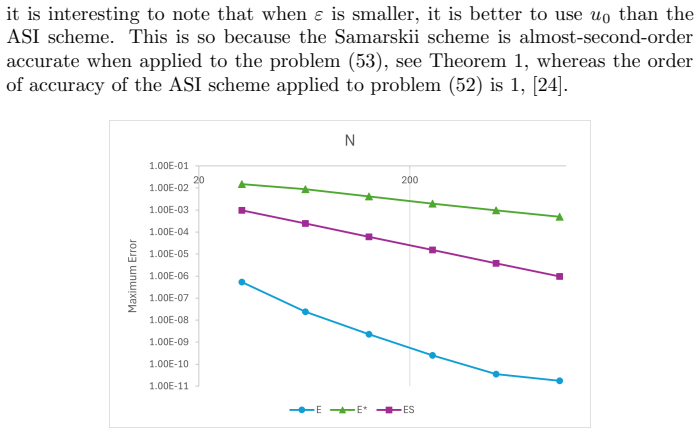
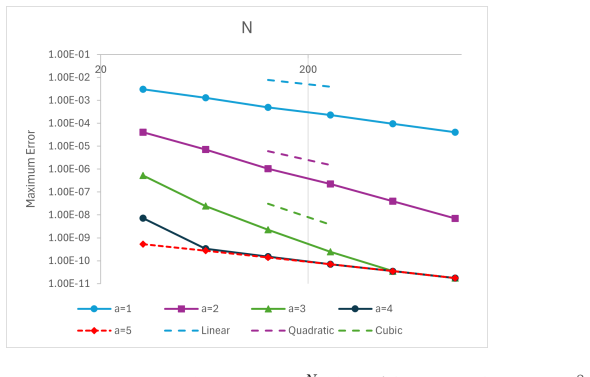
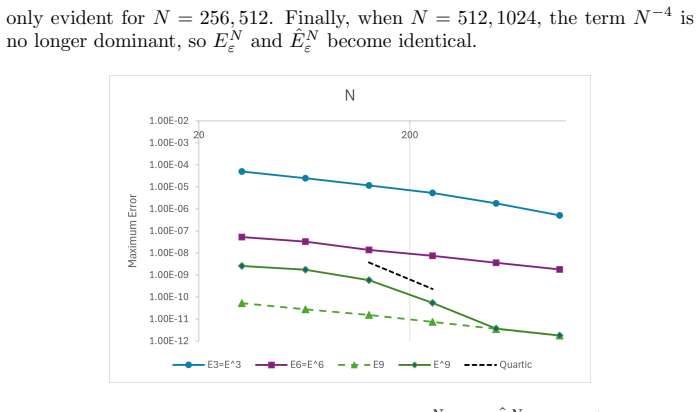
Decomposing the solution into reduced and layer parts lets the ASI scheme on Shishkin meshes produce errors that decrease as the mesh is refined and sometimes as the perturbation parameter shrinks.
A machine-rendered reading of the paper's core claim, the machinery that carries it, and where it could break.
Core claim
After decomposing the solution of the singularly perturbed problem as u = u0 + w and applying the ASI scheme to the layer component w on the Shishkin mesh (or its asymptotic version), the resulting approximation satisfies error estimates that tend to zero as the discretization parameter increases and, in certain cases, also as the perturbation parameter decreases.
What carries the argument
The exponentially fitted Allen-Southwell-Il'in (ASI) scheme applied to the layer component on the piecewise uniform Shishkin mesh after the decomposition u = u0 + w.
If this is right
- The maximum error decreases when the discretization parameter is increased.
- In some regimes the maximum error also decreases when the perturbation parameter is decreased.
- The ASI scheme produces smaller errors than other members of the Samarskii-type family on the same mesh.
- When the reduced solution u0 is linear the decomposition is unnecessary and the observed accuracy is even higher.
Where Pith is reading between the lines
- The same decomposition-plus-ASI approach could be tested on problems where u0 is only approximated rather than known exactly.
- The proved error reduction with smaller perturbation parameter may extend to other exponentially fitted schemes on layer-adapted meshes.
- The results suggest checking whether the same accuracy behavior appears for time-dependent or nonlinear singularly perturbed equations.
Load-bearing premise
The exact solution admits a decomposition into a reduced part u0 that can be treated as known and a layer part w that can be discretized separately on the mesh.
What would settle it
Numerical computation of the maximum pointwise error for a sequence of successively finer Shishkin meshes on a fixed test problem where the error fails to decrease as the number of intervals grows.
Figures



read the original abstract
A linear one-dimensional singularly perturbed convection-diffusion problem is solved numerically after its solution is decomposed as $u_0+w$, where $u_0$, the corresponding reduced solution, is treated as a function known exactly or approximately. The component $w$ is then calculated using the exponentially fitted Allen-Southwell-Il'in (ASI) scheme on the Shishkin mesh and its asymptotic version. We prove that this numerical method is highly accurate, with errors that diminish when the discretization parameter increases, and, in some cases, even when the perturbation parameter decreases. This is a theoretical confirmation of earlier numerical results showing that the ASI scheme outperforms the general class of Samarskii-type schemes to which it belongs. Even higher accuracy is proved when $u_0$ is linear, in which case, the decomposition is not needed. New numerical experiments are provided to illustrate all this.
Editorial analysis
A structured set of objections, weighed in public.
Referee Report
Summary. The manuscript addresses a linear one-dimensional singularly perturbed convection-diffusion problem by decomposing the solution as u = u0 + w, treating the reduced solution u0 as known exactly or approximately. The layer component w is discretized via the exponentially fitted Allen-Southwell-Il'in (ASI) scheme on Shishkin meshes (and asymptotic versions). The authors prove that the resulting method is highly accurate, with errors decreasing as the discretization parameter N increases and, in some cases, as the perturbation parameter ε decreases. This is presented as a theoretical confirmation that ASI outperforms the broader class of Samarskii-type schemes. Even higher accuracy is proved in the special case when u0 is linear (no decomposition needed), and new numerical experiments are supplied.
Significance. If the error analysis is complete and uniform in ε, the work supplies a useful theoretical underpinning for the observed superiority of the ASI scheme on piecewise-uniform meshes. The explicit treatment of the linear-u0 case and the parameter-uniform convergence statements would strengthen the literature on exponentially fitted methods for singularly perturbed problems.
major comments (2)
- [Abstract and error-analysis sections] The central error analysis (presumably the sections deriving the bounds for the ASI discretization of w) treats u0 as known exactly when stating the total error. When u0 is only approximated (explicitly allowed in the abstract), no explicit estimate is given showing that the approximation error from the reduced first-order problem remains smaller than the discretization error for w and is controlled uniformly in ε. This is load-bearing for the claim that the method remains highly accurate for the general case.
- [Error analysis and numerical-results sections] The statement that ASI 'outperforms the general class of Samarskii-type schemes' requires a direct comparison of the error constants or the precise dependence on ε and N. Without an explicit side-by-side bound or table contrasting the leading constants, the outperformance claim rests on the numerical experiments alone rather than the proved estimates.
minor comments (2)
- [Mesh-definition section] The abstract refers to 'its asymptotic version' of the Shishkin mesh; the precise definition and the difference in the error analysis between the standard and asymptotic meshes should be stated explicitly in the main text.
- [Problem-formulation section] Notation for the decomposition (u0 versus the numerical approximation of u0) should be introduced consistently from the outset to avoid ambiguity when the approximate case is discussed.
Simulated Author's Rebuttal
We thank the referee for the careful and constructive report. We address each major comment below, indicating planned revisions to strengthen the error analysis and clarify the comparison claims.
read point-by-point responses
-
Referee: [Abstract and error-analysis sections] The central error analysis (presumably the sections deriving the bounds for the ASI discretization of w) treats u0 as known exactly when stating the total error. When u0 is only approximated (explicitly allowed in the abstract), no explicit estimate is given showing that the approximation error from the reduced first-order problem remains smaller than the discretization error for w and is controlled uniformly in ε. This is load-bearing for the claim that the method remains highly accurate for the general case.
Authors: We agree this point requires clarification. The manuscript allows approximate u0 but the main bounds assume exact knowledge. In the revision we will add a short lemma (or remark in Section 3) deriving a uniform-in-ε bound for the reduced-problem approximation error on a uniform mesh; this error is O(N^{-1}) and remains smaller than the layer-component discretization error, preserving the overall parameter-uniform accuracy. The abstract will be updated to reference this estimate. revision: yes
-
Referee: [Error analysis and numerical-results sections] The statement that ASI 'outperforms the general class of Samarskii-type schemes' requires a direct comparison of the error constants or the precise dependence on ε and N. Without an explicit side-by-side bound or table contrasting the leading constants, the outperformance claim rests on the numerical experiments alone rather than the proved estimates.
Authors: The proved ASI bounds exhibit an explicit improvement with decreasing ε in the layer (a feature not generally available for arbitrary Samarskii schemes). We will insert a concise paragraph after the main theorem contrasting the leading terms: ASI yields an extra factor of ε in the layer contribution while standard Samarskii schemes retain an O(1) factor. A short table summarizing the ε- and N-dependence for ASI versus the generic Samarskii class will also be added. The numerical experiments remain the primary quantitative demonstration of superiority, as a exhaustive constant-by-constant derivation for every member of the class lies outside the paper's scope. revision: partial
Circularity Check
No circularity: independent error analysis for decomposed problem
full rationale
The paper presents a mathematical proof of error bounds for the ASI scheme applied to the layer component w after the decomposition u = u0 + w on the Shishkin mesh. No fitted parameters, self-definitional relations, or load-bearing self-citations are visible in the provided abstract or description that would cause any claimed prediction or accuracy result to reduce to its inputs by construction. The derivation is self-contained as a standard a priori error analysis under stated assumptions about u0, with no reduction of the central claim to a renaming, ansatz smuggling, or fitted-input prediction.
Axiom & Free-Parameter Ledger
Reference graph
Works this paper leans on
-
[1]
D.N. de G. Allen, R.V. Southwell, Relaxation methods applied to determine the motion, in 2D, of a viscous fluid past a fixed cylinder, Quart. J. Mech. Appl. Math. VIII (1955) 129–145
1955
-
[2]
Bakhvalov, The optimization of methods of solving boundary value problems with a boundary layer, USSR Comp
N.S. Bakhvalov, The optimization of methods of solving boundary value problems with a boundary layer, USSR Comp. Math. Math. Phys. 9 (1969) 139–166
1969
-
[3]
Chang, F.A
K.W. Chang, F.A. Howes, Nonlinear Singular Perturbation Phenomena: Theory and Application, Applied Mathematical Sciences, Vol. 56, Springer, New York, 1984
1984
-
[4]
Doolan, J.J.H
E.P. Doolan, J.J.H. Miller, W.H.A. Schilders, Uniform Numerical Methods for Problems with Initial and Boundary Layers, Boole Press, Dublin, 1980
1980
-
[5]
Farrell, A.F
P.A. Farrell, A.F. Hegarty, J.J.H. Miller, E. O’Riordan, G.I. Shishkin, Robust Computational Techniques for Boundary Layers, Chapman & Hall/CRC, Boca Raton, 2000
2000
-
[6]
X.C. Hu, T.A. Manteuffel, S. McCormick, T.F. Russell, Accurate dis- cretization for singular perturbations: the one-dimensional case, SIAM J. Numer. Anal. 32 (1995) 83–109
1995
-
[7]
Il’in, Differencing scheme for a differential equation with a small parameter affecting the highest derivative
A.M. Il’in, Differencing scheme for a differential equation with a small parameter affecting the highest derivative. Math. Notes 6 (1969) 596-602
1969
-
[8]
Kellog, A
R.B. Kellog, A. Tsan, Analysis of some difference approximations for a singular perturbation problem without turning points, Math. Comput. 32 (1978) 1025–1039
1978
-
[9]
Lenferink, Pointwise convergence of approximations to a convection- diffusion equation on a Shishkin mesh, Appl
W. Lenferink, Pointwise convergence of approximations to a convection- diffusion equation on a Shishkin mesh, Appl. Numer. Math. 32 (2000) 69– 86. 32
2000
-
[10]
Linss, Uniform pointwise convergence of an upwind finite volume method on layer-adapted meshes, Z
T. Linss, Uniform pointwise convergence of an upwind finite volume method on layer-adapted meshes, Z. Angew. Math. Mech. 82 (2002) 247–254
2002
-
[11]
Linß, Layer-Adapted Meshes for Reaction-Convection-Diffusion Prob- lems, Lecture Notes in Mathematics, Vol
T. Linß, Layer-Adapted Meshes for Reaction-Convection-Diffusion Prob- lems, Lecture Notes in Mathematics, Vol. 1985, Springer, Berlin, Heidel- berg, 2010
1985
-
[12]
T.A. Nhan, R. Vulanovi´ c, A note on a generalized Shishkin-type mesh, Novi Sad J. Math 48(2) (2018) 141–150, DOI: 10.30755/NSJOM.07880
-
[13]
H.-G. Roos, M. Stynes, L. Tobiska, Numerical Methods for Singularly Per- turbed Differential Equations, second ed., Springer, Berlin, 2008
2008
-
[14]
H.-G. Roos, T. Linß, Sufficient conditions for uniform convergence on layer- adapted grids, Computing 63 (1999) 27–45
1999
-
[15]
Runchal, Convergence and accuracy of three finite difference schemes for a two-dimensional conduction and convection problem, Internat
A.K. Runchal, Convergence and accuracy of three finite difference schemes for a two-dimensional conduction and convection problem, Internat. J. Nu- mer. Methods Engrg. 4 (1972) 541–550
1972
-
[16]
Samarskii, Monotonic difference schemes for elliptic and parabolic equations in the case of a non-selfadjoint elliptic operator, USSR Comput
A.A. Samarskii, Monotonic difference schemes for elliptic and parabolic equations in the case of a non-selfadjoint elliptic operator, USSR Comput. Math. Math. Phys. 5 (1965) 212–217
1965
-
[17]
Shishkin, A difference scheme for a singularly perturbed parabolic equation with a discontinuous boundary condition
G.I. Shishkin, A difference scheme for a singularly perturbed parabolic equation with a discontinuous boundary condition. USSR Comput. Math. Math. Phys. 29 (1989) 1–10
1989
-
[18]
Spalding, A novel finite difference formulation for differential expres- sions involving both first and second derivatives, Internat
D.B. Spalding, A novel finite difference formulation for differential expres- sions involving both first and second derivatives, Internat. J. Numer. Meth- ods Engrg. 4 (1972) 551–559
1972
-
[19]
Stynes, H.-G
M. Stynes, H.-G. Roos, The midpoint upwind scheme, Appl. Numer. Math. 23 (1997) 361–374
1997
-
[20]
Tobiska, Diskretisierungsverfahren zur L¨ osung singul¨ ar gest¨ orter Randw- ertprobleme, Z
L. Tobiska, Diskretisierungsverfahren zur L¨ osung singul¨ ar gest¨ orter Randw- ertprobleme, Z. Angew. Math. Mech. 63 (1983) 115–123
1983
-
[21]
Vulanovi´ c, On a numerical solution of a type of singularly perturbed boundary value problem by using a special discretization mesh, Univ
R. Vulanovi´ c, On a numerical solution of a type of singularly perturbed boundary value problem by using a special discretization mesh, Univ. u Novom Sadu Zb. Rad. Prir. Mat. Fak. Ser. Mat. 13 (1983) 187–201
1983
-
[22]
Vulanovi´ c, T.A
R. Vulanovi´ c, T.A. Nhan, Uniform convergence via preconditioning, Int. J. Numer. Anal. Model. Ser. B 5 (2014) 347356
2014
-
[23]
R. Vulanovi´ c, T.A. Nhan, An improved Kellogg-Tsan solution decompo- sition in numerical methods for singularly perturbed convection-diffusion problems, Appl. Numer. Math. 170 (2021) 128–145, DOI: 10.1016/j.apnum. 2021.07.019. 33
-
[24]
R. Vulanovi´ c, T.A. Nhan, Advantages of the Samarskii-Type Schemes on the Shishkin Mesh,J. Comput. Appl. Math.470 (2025) 116688, DOI: 10.1016/j.cam.2025.116688. 34
discussion (0)
Sign in with ORCID, Apple, or X to comment. Anyone can read and Pith papers without signing in.