Quantum Metric Bound State of Light
Pith reviewed 2026-06-26 09:55 UTC · model grok-4.3
The pith
In flat bands without CLS protection or kinetic energy, impurity-induced bound states have exponential decay length lower-bounded by the band's quantum metric.
A machine-rendered reading of the paper's core claim, the machinery that carries it, and where it could break.
Core claim
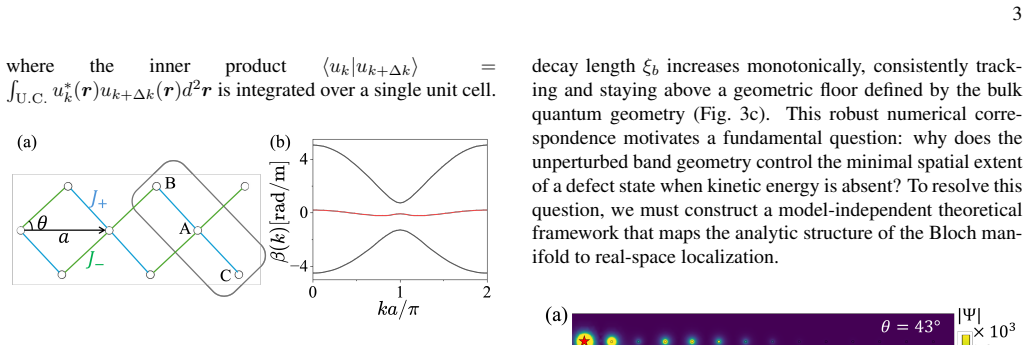
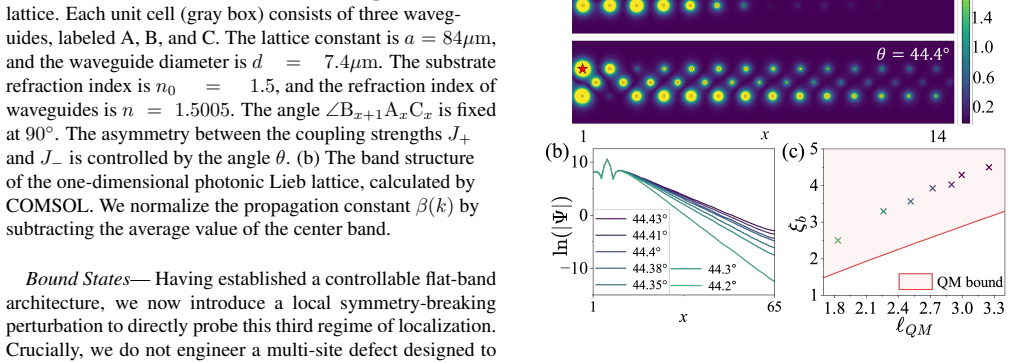
We provide a rigorous mathematical proof demonstrating that in the absence of kinetic energy and CLS protection, the exponential decay length of these states is lower-bounded by the quantum metric of the unperturbed flat band. We demonstrate the tightness of this geometric limit by constructing a family of highly tunable flat-band generators, and we verify its universality across diverse realistic architectures.
What carries the argument
The quantum metric of the unperturbed flat band, which supplies the geometric lower bound on the exponential decay length of bound states created by a generic local impurity.
If this is right
- The quantum metric becomes a predictive design principle for engineering confined modes in synthetic wave platforms.
- The bound applies universally across diverse realistic flat-band architectures.
- A family of highly tunable flat-band generators can be constructed to achieve the tight geometric limit.
- This establishes a classification of confinement into three regimes: effective-mass, CLS, and quantum-metric.
Where Pith is reading between the lines
- The result suggests that experimentalists could measure the quantum metric first and then predict the minimum achievable confinement length without solving the full impurity problem.
- Similar geometric bounds might appear in other wave systems such as acoustic or matter-wave lattices once kinetic energy and exact interference are removed.
- Tuning the quantum metric independently of band flatness could offer a new control knob for localization in mesoscopic devices.
Load-bearing premise
The states form under the condition of absent kinetic energy and CLS protection, with a generic local impurity that breaks phase-matching conditions for compact localized states.
What would settle it
Direct measurement of an impurity-induced bound state whose exponential decay length falls below the quantum metric length of the flat band would falsify the claimed lower bound.
Figures

read the original abstract
The spatial confinement of defect-induced bound states is conventionally governed by the effective mass in dispersive bands. More recently, Compact Localized States (CLSs) arising from exact destructive interference have been utilized to achieve confinement in flat bands. However, CLSs rely on pristine lattice symmetries and fine-tuned defect profiles. The introduction of a generic local impurity inevitably breaks these strict phase-matching conditions, resulting in extensive bound states whose fundamental length scale has remained an open question. Here, we establish a third regime of confinement: the quantum metric bound state. We provide a rigorous mathematical proof demonstrating that in the absence of kinetic energy and CLS protection, the exponential decay length of these states is lower-bounded by the quantum metric of the unperturbed flat band. We demonstrate the tightness of this geometric limit by constructing a family of highly tunable flat-band generators, and we verify its universality across diverse realistic architectures. Ultimately, this classification establishes the independently measurable quantum metric as a predictive design principle for engineering confined modes in synthetic wave platforms.
Editorial analysis
A structured set of objections, weighed in public.
Referee Report
Summary. The manuscript introduces 'quantum metric bound states' as a third regime of spatial confinement for defect-induced states in flat bands. It claims a rigorous mathematical proof that, when kinetic energy and compact localized state (CLS) protection are absent, a generic local impurity produces bound states whose exponential decay length is lower-bounded by the quantum metric of the unperturbed flat band. The bound is asserted to be tight, demonstrated via a family of tunable flat-band generators, and verified across multiple realistic lattice architectures.
Significance. If the claimed lower bound and its tightness hold, the work supplies an independently measurable geometric quantity (the quantum metric) as a predictive design rule for engineering confined modes in flat-band photonic, acoustic, or electronic systems, distinct from both effective-mass and CLS mechanisms.
major comments (1)
- [abstract] The central claim rests on a mathematical lower bound whose derivation steps, explicit assumptions, and error analysis are not accessible from the provided abstract and summary; without these, the support for universality and tightness cannot be assessed (abstract and § on the proof).
Simulated Author's Rebuttal
We thank the referee for their review of our manuscript. The single major comment concerns the accessibility of the mathematical proof. We address this point below and agree that revisions will improve clarity.
read point-by-point responses
-
Referee: [abstract] The central claim rests on a mathematical lower bound whose derivation steps, explicit assumptions, and error analysis are not accessible from the provided abstract and summary; without these, the support for universality and tightness cannot be assessed (abstract and § on the proof).
Authors: The manuscript contains a dedicated section deriving the lower bound on the exponential decay length in terms of the quantum metric, including the proof that this bound holds when kinetic energy and CLS protection are absent. We acknowledge that the current exposition of the derivation steps, the full list of assumptions, and the quantitative assessment of tightness (via the tunable flat-band family) can be made more explicit and self-contained. In the revised version we will expand this section with a step-by-step outline of the proof, an enumerated list of all assumptions, and an explicit error/tightness analysis that quantifies how closely the bound is saturated. revision: yes
Circularity Check
No significant circularity detected
full rationale
The paper's central claim is a mathematical lower bound on exponential decay length derived from the quantum metric of an unperturbed flat band, under explicitly stated conditions of absent kinetic energy and CLS protection. The abstract and description frame this as a rigorous proof with independent content, demonstrated as tight via explicit construction of tunable flat-band generators and verified across architectures. No load-bearing step reduces by construction to a fitted parameter, self-definition, or self-citation chain; the derivation is presented as self-contained against the stated assumptions without renaming known results or smuggling ansatze. This is the expected outcome for a geometry-based bound with external verifiability.
Axiom & Free-Parameter Ledger
axioms (1)
- domain assumption Absence of kinetic energy and CLS protection for the bound states under generic local impurity
invented entities (1)
-
quantum metric bound state
no independent evidence
Reference graph
Works this paper leans on
-
[1]
S. Xia, A. Ramachandran, S. Xia, D. Li, X. Liu, L. Tang, Y . Hu, D. Song, J. Xu, D. Leykam, et al., Phys. Rev. Lett.121, 263902 (2018), 1810.12618
Pith/arXiv arXiv 2018
-
[2]
N. Myoung, H. C. Park, A. Ramachandran, E. Lidorikis, and J.-W. Ryu, Scientific Reports9, 2862 (2019), 1801.08671
Pith/arXiv arXiv 2019
-
[3]
L. Tang, D. Song, S. Xia, S. Xia, J. Ma, W. Yan, Y . Hu, J. Xu, D. Leykam, and Z. Chen, Nanophotonics9, 43 (2020)
2020
-
[4]
R. A. Vicencio Poblete, Advances in Physics X6, 1878057 (2021)
2021
-
[5]
S. Xia, Y . Liang, L. Tang, D. Song, J. Xu, and Z. Chen, Phys. Rev. Lett.131, 013804 (2023), 2302.01796
arXiv 2023
-
[6]
C. Danieli, A. Andreanov, D. Leykam, and S. Flach, Nanopho- tonics13, 3925 (2024), 2403.17578
arXiv 2024
-
[7]
R. A. Vicencio, C. Cantillano, L. Morales-Inostroza, B. Real, C. Mej´ıa-Cort´es, S. Weimann, A. Szameit, and M. I. Molina, Phys. Rev. Lett.114, 245503 (2015), 1412.4713
Pith/arXiv arXiv 2015
-
[8]
S. Mukherjee, A. Spracklen, D. Choudhury, N. Goldman, P. ˜A- hberg, E. Andersson, and R. R. Thomson, Phys. Rev. Lett.114, 245504 (2015), 1412.6342
Pith/arXiv arXiv 2015
-
[9]
F. Baboux, L. Ge, T. Jacqmin, M. Biondi, E. Galopin, A. Lema ˜A®tre, L. Le Gratiet, I. Sagnes, S. Schmidt, H. E. T ¨ureci, et al., Phys. Rev. Lett.116, 066402 (2016), 1505.05652
Pith/arXiv arXiv 2016
-
[10]
C. E. Whittaker, E. Cancellieri, P. M. Walker, D. R. Gule- vich, H. Schomerus, D. Vaitiekus, B. Royall, D. M. Whittaker, E. Clarke, I. V . Iorsh, et al., Phys. Rev. Lett.120, 097401 (2018), 1705.03006
Pith/arXiv arXiv 2018
-
[11]
P. Wang, Y . Zheng, X. Chen, C. Huang, Y . V . Kartashov, L. Torner, V . V . Konotop, and F. Ye, Nature (London)577, 42 (2019), 2009.08131. 6
arXiv 2019
-
[12]
K. Dong, T. Zhang, J. Li, Q. Wang, F. Yang, Y . Rho, D. Wang, C. P. Grigoropoulos, J. Wu, and J. Yao, Phys. Rev. Lett.126, 223601 (2021)
2021
-
[13]
W. Maimaiti, A. Andreanov, H. C. Park, O. Gendelman, and S. Flach, Phys. Rev. B95, 115135 (2017), 1610.02970
Pith/arXiv arXiv 2017
-
[14]
Leykam and S
D. Leykam and S. Flach, APL Photonics3, 070901 (2018)
2018
-
[15]
J.-W. Rhim and B.-J. Yang, Phys. Rev. B99, 045107 (2019), 1808.05926
Pith/arXiv arXiv 2019
-
[16]
H.-R. Xia, Z. Wang, Y . Wang, Z. Gao, and M. Xiao, Phys. Rev. Lett.135, 176902 (2025), 2509.12843
arXiv 2025
-
[17]
S. Xia, Y . Hu, D. Song, Y . Zong, L. Tang, and Z. Chen, Optics Letters41, 1435 (2016)
2016
-
[18]
Longhi, Optics Letters44, 287 (2019), 1812.03356
S. Longhi, Optics Letters44, 287 (2019), 1812.03356
arXiv 2019
-
[19]
J. P. Provost and G. Vallee, Communications in Mathematical Physics76, 289 (1980)
1980
-
[20]
Anandan and Y
J. Anandan and Y . Aharonov, Physical review letters65, 1697 (1990)
1990
-
[21]
N. Marzari, A. A. Mostofi, J. R. Yates, I. Souza, and D. Vander- bilt, Reviews of Modern Physics84, 1419 (2012), 1112.5411
Pith/arXiv arXiv 2012
-
[22]
Rossi, Current Opinion in Solid State and Materials Science 25, 100952 (2021)
E. Rossi, Current Opinion in Solid State and Materials Science 25, 100952 (2021)
2021
-
[23]
J. Yu, B. A. Bernevig, R. Queiroz, E. Rossi, P. T¨orm¨a, and B.-J. Yang, npj Quantum Materials10, 101 (2025)
2025
-
[24]
Liu, X.-B
T. Liu, X.-B. Qiang, H.-Z. Lu, and X. Xie, National Science Review12, nwae334 (2025)
2025
- [25]
-
[26]
S. A. Chen and K. T. Law, Phys. Rev. Lett.132, 026002 (2024), 2303.15504
arXiv 2024
-
[27]
J.-X. Hu, S. A. Chen, and K. T. Law, Communications Physics 8, 20 (2025)
2025
-
[28]
Z. C. F. Li, Y . Deng, S. A. Chen, D. K. Efetov, and K. T. Law, Physical Review Research7, 023273 (2025), 2404.09211
arXiv 2025
-
[29]
X. Guo, X. Ma, X. Ying, and K. T. Law, Phys. Rev. Lett.135, 076601 (2025), 2406.05789
arXiv 2025
- [30]
-
[31]
S. Lee, S. H. Lee, and B.-J. Yang, arXiv e-prints arXiv:2511.02240 (2025), 2511.02240
arXiv 2025
-
[32]
Y . Kim, S. Flach, and A. Andreanov, arXiv e-prints arXiv:2510.17258 (2025), 2510.17258
Pith/arXiv arXiv 2025
-
[33]
W. Chen, K. Yang, T. Cao, S.-Z. Lin, J. Yu, and D. Xiao, arXiv preprint arXiv:2605.03133 (2026)
Pith/arXiv arXiv 2026
-
[34]
C. W. Chau, T. Xiang, S. A. Chen, and K. T. Law, arXiv e-prints arXiv:2602.01354 (2026), 2602.01354
arXiv 2026
-
[35]
W.-B. Dai, J. Zhao, S. A. Chen, and K. T. Law, arXiv e-prints arXiv:2605.03987 (2026), 2605.03987
Pith/arXiv arXiv 2026
-
[36]
N. Marzari and D. Vanderbilt, Phys. Rev. B56, 12847 (1997), cond-mat/9707145
Pith/arXiv arXiv 1997
-
[37]
Borwein and T
P. Borwein and T. Erd ´elyi,Polynomials and polynomial in- equalities(Springer Science & Business Media, 2012)
2012
-
[38]
W. Maimaiti, A. Andreanov, and S. Flach, Phys. Rev. B103, 165116 (2021), 2101.03794
arXiv 2021
-
[39]
Y . Chen, J. Huang, K. Jiang, and J. Hu, Science Bulletin68, 3165 (2023), 2212.13526
arXiv 2023
-
[40]
B. Liu, S. Liu, Y . Zhang, C. He, J. Yang, and H. Xiang, Phys. Rev. B112, L241111 (2025)
2025
-
[41]
T. Neupert, L. Santos, C. Chamon, and C. Mudry, Phys. Rev. Lett.106, 236804 (2011), 1012.4723
Pith/arXiv arXiv 2011
-
[42]
S. A. Parameswaran, R. Roy, and S. L. Sondhi, Comptes Ren- dus Physique14, 816 (2013), 1302.6606
Pith/arXiv arXiv 2013
-
[43]
L. Asteria, D. T. Tran, T. Ozawa, M. Tarnowski, B. S. Rem, N. Fl ¨aschner, K. Sengstock, N. Goldman, and C. Weitenberg, Nature Physics15, 449 (2019), 1805.11077
Pith/arXiv arXiv 2019
-
[44]
Gianfrate, O
A. Gianfrate, O. Bleu, L. Dominici, V . Ardizzone, M. De Giorgi, D. Ballarini, G. Lerario, K. W. West, L. N. Pfeiffer, D. D. Solnyshkov, et al., Nature (London)578, 381 (2020)
2020
-
[45]
C. Han, S. Fan, H.-T. Zhou, K. He, Y . Jia, C. Li, H. Li, X.-D. Yang, L.-Q. Chen, T. Yang, et al., Nature Communications16, 634 (2025)
2025
-
[46]
Craster, S
R. Craster, S. Guenneau, M. Kadic, and M. Wegener, Reports on Progress in Physics86, 094501 (2023)
2023
-
[47]
Z. Xu, X. Kong, J. Chang, D. F. Sievenpiper, and T. J. Cui, Phys. Rev. Lett.129, 253001 (2022)
2022
-
[48]
T. Byrnes, N. Y . Kim, and Y . Yamamoto, Nature Physics10, 803 (2014), 1411.6822
Pith/arXiv arXiv 2014
-
[49]
K. Sun, Y . Cai, L. Huang, and Z. Han, Nature Communications 15, 4019 (2024)
2024
-
[50]
Y . Wang, Z. Wang, Y . Deng, L. Wang, P. Xu, J. Cui, C. Y . Leong, C. Yu, and C.-W. Qiu, Laser & Photonics Reviews20, 01247 (2026). END MA TTER Bound state in multi-band systems— In the following, we assume the system has multiple bands, and a weak local im- purity is introduced. The Green function is given by G0(R;E) = 1 Vk X n Z dkeik·R Pn(k) E−E nk ,(9...
2026
discussion (0)
Sign in with ORCID, Apple, or X to comment. Anyone can read and Pith papers without signing in.