BSMArt 2: simpler and faster parameter space scans
Pith reviewed 2026-06-28 05:00 UTC · model grok-4.3
The pith
An updated parameter scanning tool adds CMA-ES and other algorithms that make it easier to find diverse testable points in new physics models.
A machine-rendered reading of the paper's core claim, the machinery that carries it, and where it could break.
Core claim
The updated tool incorporates new algorithms including Affine Monte Carlo, Contour Finding, machine learning scanners, deep learning scanners, and covariance matrix adaptation evolution strategy methods. Two variants of the evolution strategy scans are used to identify diverse parameter points in models relevant to soft lepton excesses at the collider, showing that such points can be found readily.
What carries the argument
The covariance matrix adaptation evolution strategy algorithm variants, used to optimize searches through the parameter space of new physics models.
If this is right
- The new methods allow efficient location of parameter points that could explain observed anomalies in collider data.
- Architectural changes make the tool easier to install and use with added examples.
- Multiple scanning options give users choices suited to different exploration tasks.
- Demonstrations with lepton excess models illustrate practical applications in high-energy physics.
Where Pith is reading between the lines
- These scanning improvements might enable broader exploration of model spaces that were previously too computationally intensive.
- The techniques could apply to parameter searches in other areas of particle physics beyond collider anomalies.
- Combining the tool with automated model generation systems might accelerate the full cycle from model building to testing.
Load-bearing premise
The newly added scanning algorithms deliver gains in speed, diversity of found points, or coverage compared to previous approaches.
What would settle it
Performing side-by-side tests on a benchmark new physics model, measuring the time to find a set number of distinct viable points and the variety of those points using both the new algorithms and conventional scanning techniques.
Figures



read the original abstract
We present version 2 of BSMArt, a powerful yet lightweight scanning tool designed to simplify the exploration of parameter spaces of new physics models. Aside from architectural improvements, simpler installation and expanded documentation with examples, the new version includes additional tools and new machine learning and Monte Carlo scanning algorithms: Affine MC, Contour Finding, MLScanner, DLScanner, MLS, and CMA-ES. We showcase two variants of CMA-ES scans with physics applications relevant for soft lepton excesses at the LHC. We demonstrate that it is easily possible to find diverse and interesting parameter points for future testing.
Editorial analysis
A structured set of objections, weighed in public.
Referee Report
Summary. The paper presents BSMArt 2, an updated lightweight scanning tool for BSM parameter spaces that includes architectural improvements, simpler installation, expanded documentation, and new algorithms (Affine MC, Contour Finding, MLScanner, DLScanner, MLS, and CMA-ES). It showcases two CMA-ES variants applied to models relevant for soft lepton excesses at the LHC and claims that these make it easily possible to locate diverse and interesting parameter points for future testing.
Significance. A validated tool with demonstrably faster or more efficient scanning algorithms would aid exploration of new physics models by lowering barriers to finding viable parameter points. However, the central claims of simplicity and speed rest on unshown implementation details and lack any quantitative validation, which substantially reduces the assessed significance.
major comments (1)
- Abstract: the claims that the new algorithms make scans 'simpler and faster' and that 'it is easily possible to find diverse and interesting parameter points' are presented without any acceptance rates, wall-time measurements, parameter-space coverage metrics, diversity measures, or head-to-head comparisons against random sampling, MCMC, or the prior BSMArt version; these data are required to substantiate the central performance assertions.
Simulated Author's Rebuttal
We thank the referee for the constructive report. We address the major comment below.
read point-by-point responses
-
Referee: Abstract: the claims that the new algorithms make scans 'simpler and faster' and that 'it is easily possible to find diverse and interesting parameter points' are presented without any acceptance rates, wall-time measurements, parameter-space coverage metrics, diversity measures, or head-to-head comparisons against random sampling, MCMC, or the prior BSMArt version; these data are required to substantiate the central performance assertions.
Authors: We agree that the abstract asserts performance improvements without the quantitative metrics requested. The manuscript describes the new algorithms and demonstrates their application to soft lepton excess models but does not contain acceptance rates, wall-time data, coverage metrics, or direct comparisons to random sampling, MCMC, or BSMArt 1. We will revise the abstract to remove unsubstantiated claims of simplicity and speed and add a dedicated subsection with benchmark results, including head-to-head comparisons where feasible. revision: yes
Circularity Check
No circularity: tool-description paper with no derivation chain
full rationale
The paper describes a software package (BSMArt 2) and new scanning algorithms (Affine MC, CMA-ES variants, etc.) for exploring BSM parameter spaces. It contains no equations, no fitted parameters, no predictions derived from first principles, and no load-bearing self-citations that close a logical loop. The central claim is an existence demonstration via the tool rather than a mathematical result that reduces to its own inputs. Absence of quantitative benchmarks is a separate evidentiary issue, not circularity.
Axiom & Free-Parameter Ledger
Reference graph
Works this paper leans on
-
[1]
"USER" when the observable is already a likelihood/ p-value
-
[2]
This allows a soft cutoff, to safely handle extreme values
"SIGUSER" to apply a sigmoid function to a user-supplied value. This allows a soft cutoff, to safely handle extreme values
-
[3]
"EXPUSER" when the supplied value is a log-likelihood so we would need to exponentiate it to obtain a likelihood
-
[4]
MINUSEXPUSER
"MINUSEXPUSER" when the supplied value is a negative-log-likelihood so we would need to exponentiate the negative of it to obtain a likelihood. • "CFUNCTION" is a special function that gives zero within a specified range, and increases linearly outside of it. This is intended for use with the new CMAES ND scan described in the following sections. 17 In ad...
-
[5]
PRIOR": <TYPE> in the variable definition, along with
Priors In general, algorithms such as MCMCs are designed to asymptote to sampling from the posterior distribution. Bayes’ theorem tells us that P (x|D) = P (D|x)π(x) P (D) ≡ P (D|x)π(x) Z , (1) where P (D|x) is the probability of observing data D given variables x, π(x) is the prior probability of variables x, P (D) ↔ Z is the probability of data D, which...
2000
-
[6]
Setup": {
Contour2D A simple algorithm for finding contours in two dimensions is implemented as a Contour2D scan. It works by first creating a very coarse grid, finding the contour, and then sampling points that lie close to this contour (but not too close to each other). It performs a specified number of iterations. The contour is specified by a function, or a thr...
-
[7]
Networks
ContourGP An interesting algorithm was proposed in [44] to find contours using Gaussian Pro- cesses (GPs). Since GPs generalise very well from little data, they are excellent interpola- tors; but even better they give a prediction for the uncertainty of each point. Exploiting this, the ContourGP algorithm aims to choose not the points that lie closest to ...
2000
-
[8]
CMAES_ND
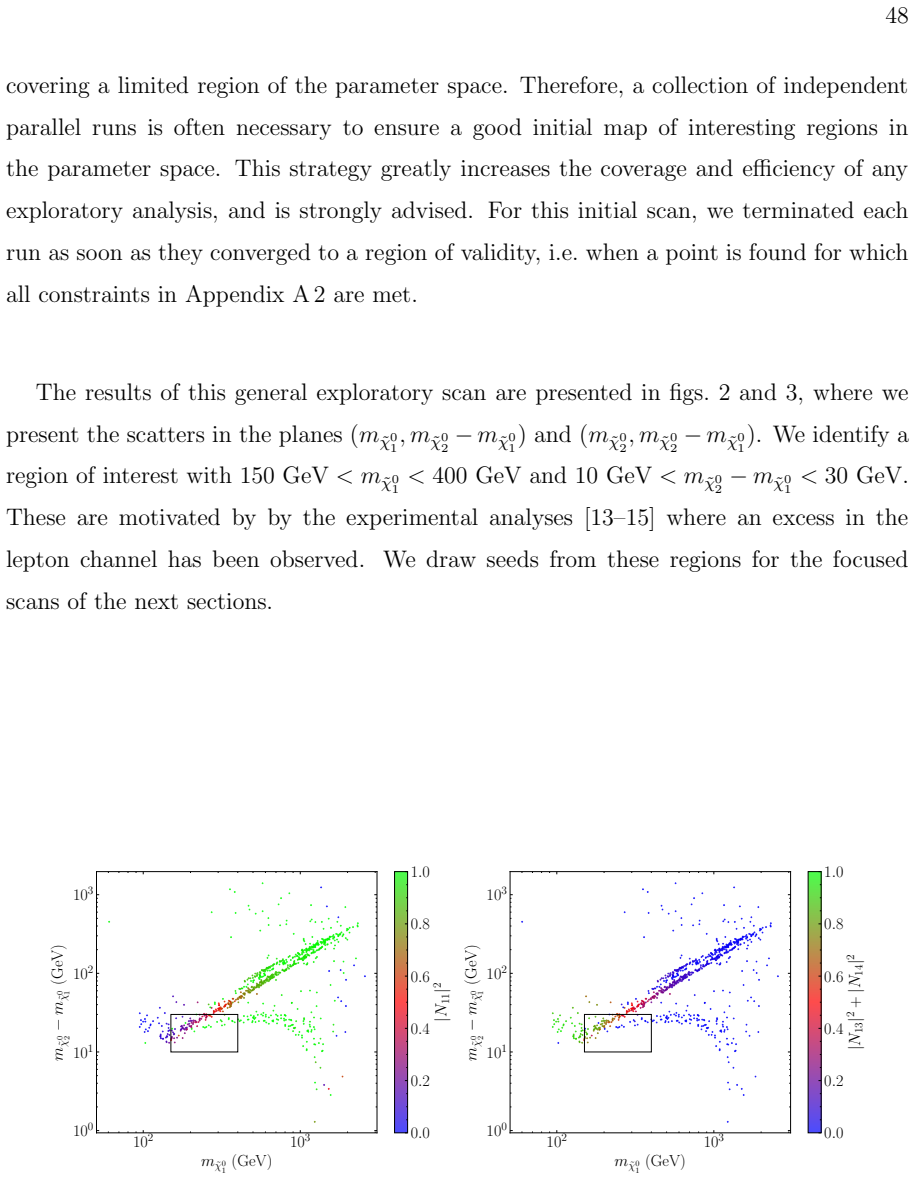
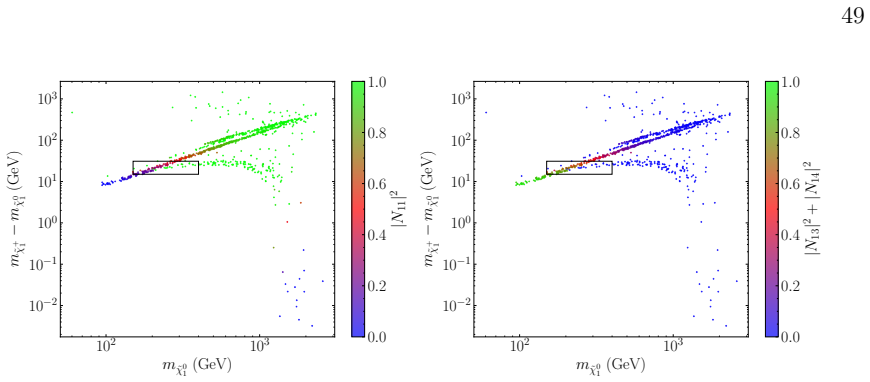
General exploratory scan We first perform a general exploratory scan consisting of 1000 independent runs of "CMAES_ND" working in parallel. A single run by itself often converges quickly to a valid region of the parameter space due to the exploitative and local nature of CMA-ES, albeit 48 covering a limited region of the parameter space. Therefore, a coll...
-
[9]
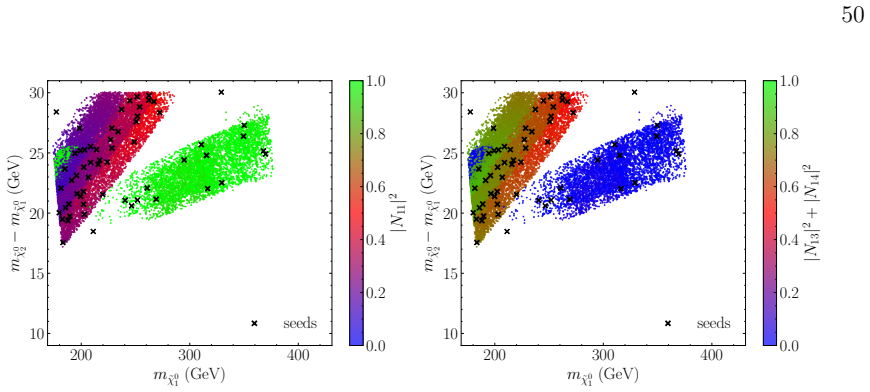
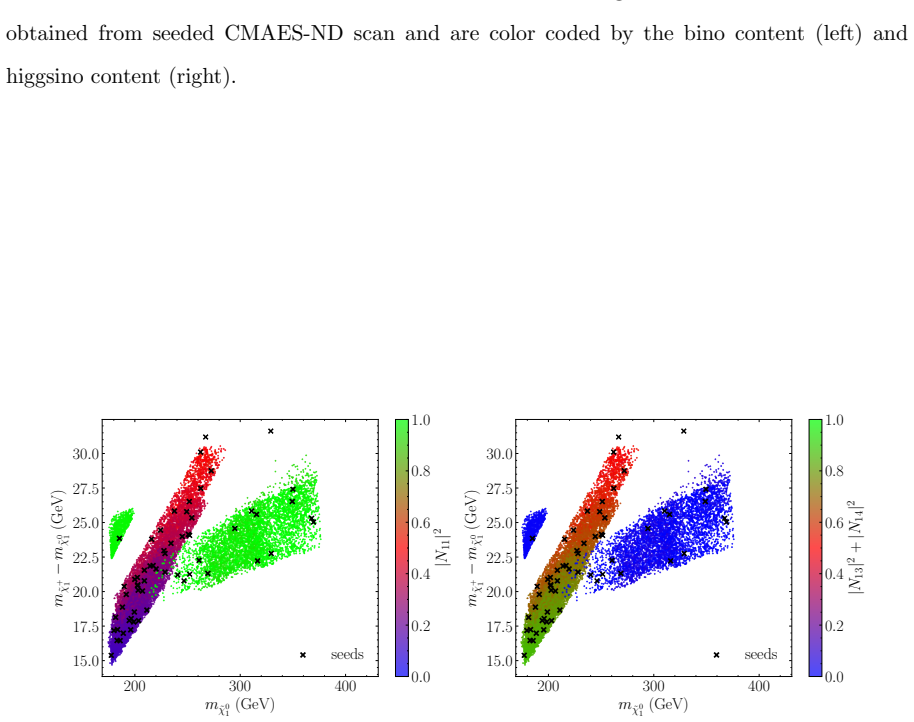
Seeded HBOS ND scan From the seeds drawn from the exploratory general scan above, we initialise runs using "HBOS" novelty reward. We further demand the seeds used in this scan to have BR(˜χ0 2 → ˜χ0 1 + ℓ+ + ℓ−) > 0.07 (ℓ being e or µ) as this helps to explain the excesses even if the production is surpressed due to mixing effects in either the neutralino...
-
[10]
Optimiser
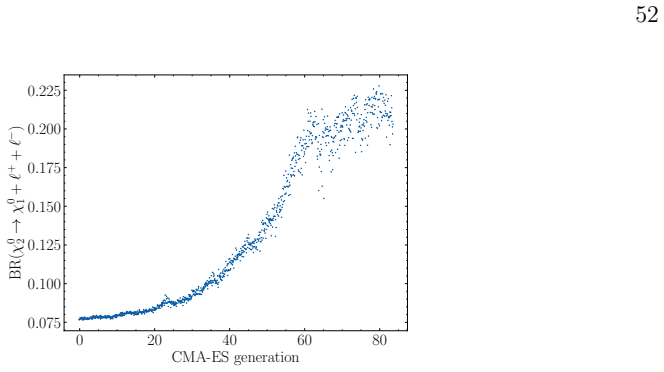
Seeded Optimiser ND scan The possibility for high branching ratios for the second lightest neutralino state de- caying to the LSP+leptons can be further explored. Here we illustrate the functionality of the "Optimiser" novelty detection option, by using it in a seeded scan focused on maximising BR(˜χ0 2 → ˜χ0 1 + ℓ+ + ℓ−). In fig. 7 we see the evolution o...
2025
-
[11]
Ranges for the observable constraints considered for the seeded BSMArt pMSSM CMAES-ND scan
Parameters Parameter Interval Parameter Interval M1 [−4, 4] TeV |M ˜L1|2 [0, 16] TeV2 M2 [−4, 4] TeV |M˜e1|2 [0, 16] TeV2 M3 [0, 10] TeV |M ˜L3|2 [0, 16] TeV2 µ [−4, 4] TeV |M˜e3|2 [0, 16] TeV2 At [−7, 7] TeV |M˜q1|2 [0, 16] TeV2 Ab [−7, 7] TeV |M˜u1|2 [0, 16] TeV2 Aτ [−7, 7] TeV |M ˜d1 |2 [0, 16] TeV2 |MA|2 [0, 16] TeV2 |M˜q3|2 [0, 16] TeV2 tan β [2, 60]...
-
[12]
We also remove points excluded by LEP: m ˜χ± 1 < 91.9 GeV for ∆ m(˜χ± 1 , ˜χ0
Constraints Points with masses below 45 GeV are excluded by Z width. We also remove points excluded by LEP: m ˜χ± 1 < 91.9 GeV for ∆ m(˜χ± 1 , ˜χ0
-
[13]
< 3 GeV and m ˜χ± 1 < 103 GeV for ∆m(˜χ± 1 , ˜χ0
-
[14]
Codes": { 3
≥ 3 GeV. 57 Observable Allowed values Scan type mh [122, 128] GeV Both mχ0 2 [200, 400] GeV Seeded m ˜χ0 2 − m ˜χ0 1 [10, 30] GeV Seeded BR(˜χ0 2 → ˜χ0 1 + ℓ+ + ℓ−) > 0.07 Seeded Ωh2 [0.08, 1.14] Both DM DD p-value > 0.1 Both r-value < 1 Both TABLE VII. Ranges for the observable constraints considered for the BSMArt pMSSM CMAES-ND scans. Appendix B: JSON ...
- [15]
-
[16]
Staub, SARAH 4 : A tool for (not only SUSY) model builders
F. Staub, SARAH 4 : A tool for (not only SUSY) model builders . Comput. Phys. Commun. 185 (2014) 1773–1790, arXiv:1309.7223 [hep-ph]
Pith/arXiv arXiv 2014
-
[17]
M. D. Goodsell, K. Nickel, and F. Staub, Two-Loop Higgs mass calculations in supersymmetric models beyond the MSSM with SARAH and SPheno . Eur. Phys. J. C 75 (2015) no. 1, 32, arXiv:1411.0675 [hep-ph]
Pith/arXiv arXiv 2015
-
[18]
M. D. Goodsell, S. Liebler, and F. Staub, Generic calculation of two-body partial decay widths at the full one-loop level . Eur. Phys. J. C 77 (2017) no. 11, 758, arXiv:1703.09237 [hep-ph]
Pith/arXiv arXiv 2017
-
[19]
W. Porod, SPheno, a program for calculating supersymmetric spectra, SUSY particle decays and SUSY particle production at e+ e- colliders . Comput. Phys. Commun. 153 (2003) 275–315, arXiv:hep-ph/0301101
Pith/arXiv arXiv 2003
-
[20]
W. Porod and F. Staub, SPheno 3.1: Extensions including flavour, CP-phases and models beyond the MSSM . Comput. Phys. Commun. 183 (2012) 2458–2469, arXiv:1104.1573 [hep-ph]
Pith/arXiv arXiv 2012
-
[21]
P. Athron, J.-h. Park, D. St¨ ockinger, and A. Voigt,FlexibleSUSY—A spectrum generator generator for supersymmetric models . Comput. Phys. Commun. 190 (2015) 139–172, arXiv:1406.2319 [hep-ph]
Pith/arXiv arXiv 2015
-
[22]
P. Athron, M. Bach, D. Harries, T. Kwasnitza, J.-h. Park, D. St¨ ockinger, A. Voigt, and J. Ziebell, FlexibleSUSY 2.0: Extensions to investigate the phenomenology of SUSY and non-SUSY models. Comput. Phys. Commun. 230 (2018) 145–217, arXiv:1710.03760 [hep-ph]
Pith/arXiv arXiv 2018
- [23]
-
[24]
W. Kotlarski and A. Voigt, From Lagrangian to Higgs physics constraints for SUSY and non-SUSY models: interfacing FlexibleSUSY with HiggsTools and Lilith . 65 arXiv:2603.12119 [hep-ph]
-
[25]
B. C. Allanach, SOFTSUSY: a program for calculating supersymmetric spectra . Comput. Phys. Commun. 143 (2002) 305–331, arXiv:hep-ph/0104145
Pith/arXiv arXiv 2002
-
[26]
ATLAS Collaboration, G. Aad et al., Searches for electroweak production of supersymmetric particles with compressed mass spectra in √s = 13 TeV pp collisions with the ATLAS detector. Phys. Rev. D 101 (2020) no. 5, 052005, arXiv:1911.12606 [hep-ex]
arXiv 2020
-
[27]
ATLAS Collaboration, G. Aad et al., Search for chargino–neutralino pair production in final states with three leptons and missing transverse momentum in √s = 13 TeV pp collisions with the ATLAS detector . Eur. Phys. J. C 81 (2021) no. 12, 1118, arXiv:2106.01676 [hep-ex]
arXiv 2021
-
[28]
CMS Collaboration, A. Tumasyan et al., Search for supersymmetry in final states with two or three soft leptons and missing transverse momentum in proton-proton collisions at √s = 13 TeV. JHEP 04 (2022) 091, arXiv:2111.06296 [hep-ex]
arXiv 2022
-
[29]
ATLAS Collaboration, G. Aad et al., Search for new phenomena in events with an energetic jet and missing transverse momentum in pp collisions at √s =13 TeV with the ATLAS detector. Phys. Rev. D 103 (2021) no. 11, 112006, arXiv:2102.10874 [hep-ex]
arXiv 2021
-
[30]
CMS Collaboration, A. Tumasyan et al., Search for new particles in events with energetic jets and large missing transverse momentum in proton-proton collisions at √s = 13 TeV. JHEP 11 (2021) 153, arXiv:2107.13021 [hep-ex]
arXiv 2021
-
[31]
D. Agin, B. Fuks, M. D. Goodsell, and T. Murphy, Monojets reveal overlapping excesses for light compressed higgsinos . Phys. Lett. B 853 (2024) 138597, arXiv:2311.17149 [hep-ph]
arXiv 2024
-
[32]
D. Agin, B. Fuks, M. D. Goodsell, and T. Murphy, Seeking a coherent explanation of LHC excesses for compressed spectra. Eur. Phys. J. C 84 (2024) no. 11, 1218, arXiv:2404.12423 [hep-ph]
arXiv 2024
-
[33]
H. Baer, V. Barger, X. Tata, and K. Zhang, Winos from natural SUSY at the high luminosity LHC. Phys. Rev. D 109 (2024) no. 1, 015027, arXiv:2310.10829 [hep-ph] . 66
arXiv 2024
-
[34]
M. Chakraborti, S. Heinemeyer, and I. Saha, Consistent excesses in the search for ˜χ0 2 ˜χ± 1 : wino/bino vs. Higgsino dark matter . Eur. Phys. J. C 84 (2024) no. 8, 812, arXiv:2403.14759 [hep-ph]
arXiv 2024
-
[35]
S. P. Martin, Implications of purity constraints on light Higgsinos . Phys. Rev. D 109 (2024) no. 9, 095045, arXiv:2403.19598 [hep-ph]
arXiv 2024
-
[36]
L. Constantin, S. Kraml, A. Lessa, T. Reymermier, and W. Waltenberger, On the coverage of electroweak-inos within the pMSSM with SModelS – a comparison with the ATLAS pMSSM study. arXiv:2512.14502 [hep-ph]
-
[37]
U. Ellwanger, C. Hugonie, S. F. King, and S. Moretti, NMSSM explanation for excesses in the search for neutralinos and charginos and a 95 GeV Higgs boson . Eur. Phys. J. C 84 (2024) no. 8, 788, arXiv:2404.19338 [hep-ph]
arXiv 2024
-
[38]
J. Y. Araz, B. Fuks, M. D. Goodsell, and T. Murphy, Deciphering compressed electroweakino excesses with MadAnalysis 5 . arXiv:2507.08927 [hep-ph]
-
[39]
E. Bagnaschi, M. Chakraborti, S. Heinemeyer, and I. Saha, Consistent Excesses in the LHC Electroweak SUSY Searches: GUT-based Singlino/Higgsino Interpretation in the NMSSM. arXiv:2512.16783 [hep-ph]
-
[40]
D. Agin, B. Fuks, M. D. Goodsell, and T. Murphy, A joint explanation for the soft lepton and monojet LHC excesses in the wino-bino model . Eur. Phys. J. C 85 (2025) no. 10, 1145, arXiv:2506.21676 [hep-ph]
Pith/arXiv arXiv 2025
-
[41]
M. D. Goodsell and A. Joury, BSMArt: Simple and fast parameter space scans . Comput. Phys. Commun. 297 (2024) 109057, arXiv:2301.01154 [hep-ph]
arXiv 2024
-
[42]
A. E. Faraggi and M. D. Goodsell, MW in string derived Z ′ models. Eur. Phys. J. C 84 (2024) no. 6, 589, arXiv:2312.13411 [hep-ph]
arXiv 2024
-
[43]
GAMBIT Collaboration, G. D. Martinez, J. McKay, B. Farmer, P. Scott, E. Roebber, A. Putze, and J. Conrad, Comparison of statistical sampling methods with ScannerBit, the GAMBIT scanning module . Eur. Phys. J. C 77 (2017) no. 11, 761, arXiv:1705.07959 [hep-ph]
arXiv 2017
-
[44]
F. Feroz and M. P. Hobson, Multimodal nested sampling: an efficient and robust alternative to MCMC methods for astronomical data analysis . Mon. Not. Roy. Astron. 67 Soc. 384 (2008) 449, arXiv:0704.3704 [astro-ph]
Pith/arXiv arXiv 2008
-
[45]
F. Feroz, M. P. Hobson, and M. Bridges, MultiNest: an efficient and robust Bayesian inference tool for cosmology and particle physics . Mon. Not. Roy. Astron. Soc. 398 (2009) 1601–1614, arXiv:0809.3437 [astro-ph]
Pith/arXiv arXiv 2009
-
[46]
F. Feroz, M. P. Hobson, E. Cameron, and A. N. Pettitt, Importance Nested Sampling and the MultiNest Algorithm . Open J. Astrophys. 2 (2019) no. 1, 10, arXiv:1306.2144 [astro-ph.IM]
Pith/arXiv arXiv 2019
-
[47]
Staub, xBIT: an easy to use scanning tool with machine learning abilities
F. Staub, xBIT: an easy to use scanning tool with machine learning abilities . arXiv preprint arXiv:1906.03277 (2019) , arXiv:1906.03277 [hep-ph] . https://arxiv.org/abs/1906.03277
Pith/arXiv arXiv 1906
-
[48]
L. Shang and Y. Zhang, EasyScan HEP: A tool for connecting programs to scan the parameter space of physics models . Comput. Phys. Commun. 296 (2024) 109027, arXiv:2304.03636 [hep-ph]
arXiv 2024
- [49]
-
[50]
A. Hammad and R. Ramos, DLScanner: A parameter space scanner package assisted by deep learning methods. Comput. Phys. Commun. 314 (2025) 109659, arXiv:2412.19675 [hep-ph]
arXiv 2025
-
[51]
M. A. Diaz, S. Dasmahapatra, and S. Moretti, hep-aid: A Python Library for Sample Efficient Parameter Scans in Beyond the Standard Model Phenomenology . arXiv:2412.17675 [hep-ph]
-
[52]
E. Guo, P. Jackson, J. M. Yang, and P. Zhu, Jarvis-HEP: A lightweight Python framework for workflow composition and parameter scans in high-energy physics . arXiv:2604.25557 [hep-ph]
-
[53]
R. Boto, T. N. Dao, F. Egle, K. Elyaouti, M. Gabelmann, M. M¨ uhlleitner, and J. Plotnikov, NMSSMScanner: Efficient Scans in the NMSSM Parameter Space Proof of Concept. arXiv:2604.25009 [hep-ph] . 68
-
[54]
S. S. AbdusSalam et al., Simple and statistically sound recommendations for analysing physical theories. Rept. Prog. Phys. 85 (2022) no. 5, 052201, arXiv:2012.09874 [hep-ph]
arXiv 2022
-
[55]
M. D. Goodsell and A. Joury, Active learning BSM parameter spaces. Eur. Phys. J. C 83 (2023) no. 4, 268, arXiv:2204.13950 [hep-ph]
arXiv 2023
-
[56]
M. D. Goodsell and R. Moutafis, How heavy can dark matter be? Constraining colourful unitarity with SARAH . Eur. Phys. J. C 81 (2021) no. 9, 808, arXiv:2012.09022 [hep-ph]
arXiv 2021
-
[57]
Goodman and J
J. Goodman and J. Weare, Ensemble samplers with affine invariance . Commun. Appl. Math. Comput. Sc. 5 (2010) no. 1, 65–80
2010
-
[58]
L. Heinrich, G. Louppe, and K. Cranmer, diana-hep/excursion: Initial Zenodo Release , Nov., 2018. https://doi.org/10.5281/zenodo.1634428
-
[59]
F. A. de Souza, M. Crispim Rom˜ ao, N. F. Castro, M. Nikjoo, and W. Porod, Exploring parameter spaces with artificial intelligence and machine learning black-box optimization algorithms. Phys. Rev. D 107 (2023) no. 3, 035004, arXiv:2206.09223 [hep-ph]
arXiv 2023
-
[60]
J. C. Rom˜ ao and M. Crispim Rom˜ ao,Combining evolutionary strategies and novelty detection to go beyond the alignment limit of the Z3 3HDM . Phys. Rev. D 109 (2024) no. 9, 095040, arXiv:2402.07661 [hep-ph]
arXiv 2024
-
[61]
F. A. de Souza, N. F. Castro, M. Crispim Rom˜ ao, and W. Porod, Exploring scotogenic parameter spaces and mapping uncharted dark matter phenomenology with multi-objective search algorithms. JHEP 10 (2025) 116, arXiv:2505.08862 [hep-ph]
arXiv 2025
-
[62]
F. A. de Souza, R. Boto, M. Crispim Rom˜ ao, P. N. Figueiredo, J. C. Rom˜ ao, and J. P. Silva, Unearthing large pseudoscalar Yukawa couplings with machine learning . JHEP 07 (2025) 268, arXiv:2505.10625 [hep-ph]
arXiv 2025
-
[63]
F. A. de Souza, R. Boto, M. Crispim Rom˜ ao, P. N. de Figueiredo, and J. C. Rom˜ ao, Machine Learning insights on the Z3 3HDM with Dark Matter . arXiv:2603.00254 [hep-ph]
-
[64]
H. Bahl, T. Biek¨ otter, S. Heinemeyer, C. Li, S. Paasch, G. Weiglein, and J. Wittbrodt, HiggsTools: BSM scalar phenomenology with new versions of HiggsBounds and 69 HiggsSignals. Comput. Phys. Commun. 291 (2023) 108803, arXiv:2210.09332 [hep-ph]
arXiv 2023
-
[65]
G. Belanger, F. Boudjema, P. Brun, A. Pukhov, S. Rosier-Lees, P. Salati, and A. Semenov, Indirect search for dark matter with micrOMEGAs2.4 . Comput. Phys. Commun. 182 (2011) 842–856, arXiv:1004.1092 [hep-ph]
Pith/arXiv arXiv 2011
-
[66]
G. Alguero, G. Belanger, F. Boudjema, S. Chakraborti, A. Goudelis, S. Kraml, A. Mjallal, and A. Pukhov, micrOMEGAs 6.0: N-component dark matter . Comput. Phys. Commun. 299 (2024) 109133, arXiv:2312.14894 [hep-ph]
arXiv 2024
-
[67]
J. E. Camargo-Molina, B. O’Leary, W. Porod, and F. Staub, Vevacious: A Tool For Finding The Global Minima Of One-Loop Effective Potentials With Many Scalars . Eur. Phys. J. C 73 (2013) no. 10, 2588, arXiv:1307.1477 [hep-ph]
Pith/arXiv arXiv 2013
-
[68]
D. M. Straub, flavio: a Python package for flavour and precision phenomenology in the Standard Model and beyond . arXiv:1810.08132 [hep-ph]
-
[69]
J. Alwall, R. Frederix, S. Frixione, V. Hirschi, F. Maltoni, O. Mattelaer, H. S. Shao, T. Stelzer, P. Torrielli, and M. Zaro, The automated computation of tree-level and next-to-leading order differential cross sections, and their matching to parton shower simulations. JHEP 07 (2014) 079, arXiv:1405.0301 [hep-ph]
Pith/arXiv arXiv 2014
-
[70]
T. Sj¨ ostrand, S. Ask, J. R. Christiansen, R. Corke, N. Desai, P. Ilten, S. Mrenna, S. Prestel, C. O. Rasmussen, and P. Z. Skands, An introduction to PYTHIA 8.2 . Comput. Phys. Commun. 191 (2015) 159–177, arXiv:1410.3012 [hep-ph]
Pith/arXiv arXiv 2015
-
[71]
Bierlich et al., A comprehensive guide to the physics and usage of PYTHIA 8.3
C. Bierlich et al., A comprehensive guide to the physics and usage of PYTHIA 8.3 . SciPost Phys. Codeb. 2022 (2022) 8, arXiv:2203.11601 [hep-ph]
Pith/arXiv arXiv 2022
-
[72]
M. D. Goodsell, HackAnalysis 2: A powerful and hackable recasting tool . arXiv:2406.10042 [hep-ph]
-
[73]
S. Kraml, S. Kulkarni, U. Laa, A. Lessa, W. Magerl, D. Proschofsky-Spindler, and W. Waltenberger, SModelS: a tool for interpreting simplified-model results from the LHC and its application to supersymmetry . Eur. Phys. J. C 74 (2014) 2868, arXiv:1312.4175 [hep-ph]. 70
Pith/arXiv arXiv 2014
-
[74]
F. Ambrogi et al., SModelS v1.2: long-lived particles, combination of signal regions, and other novelties. Comput. Phys. Commun. 251 (2020) 106848, arXiv:1811.10624 [hep-ph]
arXiv 2020
-
[75]
G. Alguero, S. Kraml, and W. Waltenberger, A SModelS interface for pyhf likelihoods . Comput. Phys. Commun. 264 (2021) 107909, arXiv:2009.01809 [hep-ph]
arXiv 2021
-
[76]
G. Alguero, J. Heisig, C. K. Khosa, S. Kraml, S. Kulkarni, A. Lessa, H. Reyes-Gonz´ alez, W. Waltenberger, and A. Wongel, Constraining new physics with SModelS version 2 . JHEP 08 (2022) 068, arXiv:2112.00769 [hep-ph]
arXiv 2022
-
[77]
M. M. Altakach, S. Kraml, A. Lessa, S. Narasimha, T. Pascal, C. Ramos, Y. Villamizar, and W. Waltenberger, SModelS v3: going beyond Z2 topologies. JHEP 11 (2024) 074, arXiv:2409.12942 [hep-ph]
arXiv 2024
-
[78]
H. Bahl, J. Braathen, M. Gabelmann, and G. Weiglein, anyH3: precise predictions for the trilinear Higgs coupling in the Standard Model and beyond . Eur. Phys. J. C 83 (2023) no. 12, 1156, arXiv:2305.03015 [hep-ph] . [Erratum: Eur.Phys.J.C 84, 498 (2024)]
arXiv 2023
-
[79]
H. Bahl, J. Braathen, M. Gabelmann, K. Radchenko, and G. Weiglein, “Precise predictions for trilinear Higgs couplings and Higgs pair production in extended scalar sectors with anyH3 and anyHH,” in International Workshop on Future Linear Colliders . 3, 2026. arXiv:2603.28296 [hep-ph]
arXiv 2026
-
[80]
DESY-26-010
anyH3 and anyHH: precise predictions for trilinear Higgs couplings and double Higgs production in extended scalar sectors . DESY-26-010
discussion (0)
Sign in with ORCID, Apple, or X to comment. Anyone can read and Pith papers without signing in.