REVIEW 1 major objections 1 cited by
A charge-weighted azimuthal correlator isolates the Sivers distribution from track signs and directions alone.
Reviewed by Pith at T0; open to challenge. T0 means a machine referee read the full paper against a public rubric. the ladder, T0–T4 →
T0 review · grok-4.3
2026-05-19 15:23 UTC pith:JNTRV6U5
load-bearing objection The paper introduces a charge-correlator observable for the Sivers function that uses only track charges and angles to bypass fragmentation functions. the 1 major comments →
Sivers Tomography from Charge and Angle Only
The pith
A machine-rendered reading of the paper's core claim, the machinery that carries it, and where it could break.
Core claim
The one-point charge-correlator admits an infrared-collinear safe factorization theorem in back-to-back deep-inelastic scattering that expresses the observable as the product of the usual Sivers distribution and a perturbatively calculable charge-weighted jet function when the transverse separation b is much smaller than the inverse QCD scale, without any non-perturbative fragmentation or track-function inputs.
What carries the argument
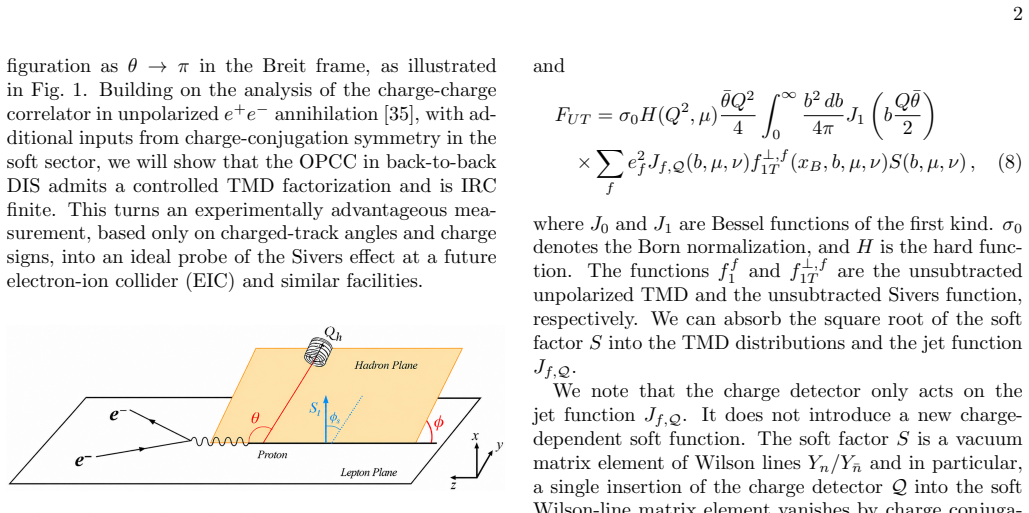
The one-point charge-correlator, which weights each final-state track by its electric charge and measures the azimuthal correlation between the resulting charge flow and the proton transverse spin.
Load-bearing premise
The factorization theorem applies when the transverse separation between the struck parton and the observed charge flow remains small enough that the charge-weighted jet function stays fully perturbative.
What would settle it
A statistically significant discrepancy between the measured charge-weighted azimuthal asymmetry and the prediction obtained by convoluting an independently determined Sivers function with the calculated perturbative jet function at small b would falsify the factorization claim.
If this is right
- The observable remains finite under soft and collinear emissions because total charge is conserved.
- No non-perturbative fragmentation functions enter the factorization because charge conservation cancels their contributions.
- Resummed predictions at N3LL accuracy for the unpolarized distribution and N2LL for the Sivers asymmetry become available.
- Experimental implementation requires only the electric charges and azimuthal angles of reconstructed tracks.
Where Pith is reading between the lines
- The same charge-weighting idea could be adapted to other spin-dependent distributions such as the Boer-Mulders function in similar kinematics.
- At an Electron-Ion Collider the method would reduce reliance on particle-identification detectors for Sivers measurements.
- Comparison of OPCC results with traditional jet-based or hadron-based Sivers extractions would provide a direct test of the charge-weighted jet function calculation.
Editorial analysis
A structured set of objections, weighed in public.
Referee Report
Summary. The paper proposes a one-point charge-correlator (OPCC) probe of the Sivers effect in back-to-back deep-inelastic scattering. This measurement uses only the signs and directions of charged tracks, with no calorimetric or particle-identification information required. The observable weights the final state by its electric charge and measures the azimuthal correlation between the charge flow and the transverse spin of the proton. This probe is shown to be IRC finite and admits a factorization involving the usual Sivers distribution and a perturbatively calculable charge-weighted jet function for small transverse separation b ≪ Λ_QCD^{-1}, with no reliance on non-perturbative fragmentation functions or track functions due to charge conservation. The authors validate the factorization against the full fixed-order QCD and present resummed predictions at N³LL accuracy for the unpolarized distribution and N²LL for the Sivers asymmetry.
Significance. If the factorization and IRC finiteness hold, the OPCC provides a theoretically clean probe of the Sivers TMD that relies only on charge and angle information, eliminating non-perturbative fragmentation inputs via charge conservation. The explicit validation against fixed-order QCD and the high-order resummation (N³LL unpolarized, N²LL polarized) are strengths that support applicability at an EIC. This establishes a simplified measurement paradigm for spin-dependent TMDs.
major comments (1)
- The factorization theorem (abstract and implied derivation) asserts that the charge-weighted jet function remains perturbatively calculable at small b without additional non-perturbative inputs; an explicit demonstration that charge conservation fully cancels all track-function-like contributions at the level of the operator definition would make this load-bearing step more transparent.
Simulated Author's Rebuttal
We thank the referee for their positive assessment of the manuscript and for the constructive suggestion regarding the factorization theorem. We address the major comment below.
read point-by-point responses
-
Referee: The factorization theorem (abstract and implied derivation) asserts that the charge-weighted jet function remains perturbatively calculable at small b without additional non-perturbative inputs; an explicit demonstration that charge conservation fully cancels all track-function-like contributions at the level of the operator definition would make this load-bearing step more transparent.
Authors: We agree that an explicit demonstration at the operator level would improve transparency. The charge-weighted jet function is defined in Sec. 3 via the matrix element of the electromagnetic current operator summed over all final-state partons with their electric charges. Because the total charge is conserved in the hard subprocess and the sum over all possible non-perturbative hadronizations must reproduce the net charge of the initial-state partons (a consequence of the Ward identity for the U(1) electromagnetic current), all track-function-like contributions cancel identically when the charge weighting is performed. This cancellation is already implicit in the derivation leading to Eq. (3.12), but we will add a short paragraph immediately after that equation that spells out the operator-level cancellation step by step, including the relevant charge sum rule. We will also include a brief footnote referencing the analogous cancellation in the literature on charge-weighted observables. revision: yes
Circularity Check
No significant circularity; derivation from standard QCD and charge conservation
full rationale
The paper derives the OPCC observable's IRC finiteness and factorization into the Sivers TMD plus a perturbatively calculable charge-weighted jet function at small b directly from QCD principles and charge conservation, which removes the need for non-perturbative fragmentation or track functions. No equations or claims reduce the central result to a fitted parameter, self-defined quantity, or load-bearing self-citation chain. Validation against fixed-order QCD is presented as an independent check rather than a tautology. The derivation chain is therefore self-contained against external benchmarks with no identified reductions by construction.
Axiom & Free-Parameter Ledger
axioms (2)
- standard math Standard QCD factorization applies in the back-to-back limit for small transverse separation b.
- domain assumption Charge conservation eliminates dependence on non-perturbative fragmentation or track functions.
read the original abstract
We propose a one-point charge-correlator (OPCC) probe of the Sivers effect in back-to-back deep-inelastic scattering. This measurement uses only the signs and directions of charged tracks, with no calorimetric or particle-identification information required. The observable weights the final state by its electric charge and measures the azimuthal correlation between the charge flow and the transverse spin of the proton. This probe is shown to be IRC finite and admits a factorization involving the usual Sivers distribution and a perturbatively calculable charge-weighted jet function for small transverse seperation $b\ll \Lambda_{\rm QCD}^{-1}$, with no reliance on non-perturbative fragmentation functions or track functions due to charge conservation. We validate the factorization against the full fixed-order QCD and present resummed predictions at N\(^3\)LL accuracy for the unpolarized distribution and N\(^2\)LL for the Sivers asymmetry. The OPCC provides a theoretically clean and simple experimental measurement, and establishes a charge-and-angle measurement paradigm for spin physics at a future Electron-Ion Collider.
Figures


Lean theorems connected to this paper
-
IndisputableMonolith/Cost/FunctionalEquation.leanwashburn_uniqueness_aczel unclear?
unclearRelation between the paper passage and the cited Recognition theorem.
admits a factorization involving the usual Sivers distribution and a perturbatively calculable charge-weighted jet function for small transverse separation b ≪ Λ_QCD^{-1}, with no reliance on non-perturbative fragmentation functions or track functions due to charge conservation
-
IndisputableMonolith/Foundation/RealityFromDistinction.leanreality_from_one_distinction unclear?
unclearRelation between the paper passage and the cited Recognition theorem.
TMD factorization ... Jf,Q(b, μ, ν) ... S(b, μ, ν)
What do these tags mean?
- matches
- The paper's claim is directly supported by a theorem in the formal canon.
- supports
- The theorem supports part of the paper's argument, but the paper may add assumptions or extra steps.
- extends
- The paper goes beyond the formal theorem; the theorem is a base layer rather than the whole result.
- uses
- The paper appears to rely on the theorem as machinery.
- contradicts
- The paper's claim conflicts with a theorem or certificate in the canon.
- unclear
- Pith found a possible connection, but the passage is too broad, indirect, or ambiguous to say the theorem truly supports the claim.
Forward citations
Cited by 1 Pith paper
-
Transverse Charge Distribution as a Probe of Nucleon Transversity
A charge-flow measurement built only from track angles and charge signs contains a leading-twist chiral-odd dipole that matches the charge-weighted Collins moment, giving enhanced transversity-sensitive asymmetries.
Reference graph
Works this paper leans on
-
[1]
Science Requirements and Detector Concepts for the Electron-Ion Collider: EIC Yellow Report
R. Abdul Khaleket al., Nucl. Phys. A1026, 122447 (2022), 2103.05419
work page internal anchor Pith review Pith/arXiv arXiv 2022
- [2]
- [3]
-
[4]
D. W. Sivers, Phys. Rev. D41, 83 (1990)
work page 1990
-
[5]
S. J. Brodsky, D. S. Hwang, and I. Schmidt, Phys. Lett. B530, 99 (2002), hep-ph/0201296
work page internal anchor Pith review Pith/arXiv arXiv 2002
-
[6]
Parton Distributions in Light-Cone Gauge: Where Are the Final-State Interactions?
X.-d. Ji and F. Yuan, Phys. Lett. B543, 66 (2002), hep-ph/0206057
work page internal anchor Pith review Pith/arXiv arXiv 2002
-
[7]
A. V. Belitsky, X. Ji, and F. Yuan, Nucl. Phys. B656, 165 (2003), hep-ph/0208038
work page internal anchor Pith review Pith/arXiv arXiv 2003
-
[8]
C. L. Basham, L. S. Brown, S. D. Ellis, and S. T. Love, Phys. Rev. D19, 2018 (1979)
work page 2018
-
[9]
C. L. Basham, L. S. Brown, S. D. Ellis, and S. T. Love, Phys. Rev. Lett.41, 1585 (1978)
work page 1978
-
[10]
C. L. Basham, L. S. Brown, S. D. Ellis, and S. T. Love, Phys. Rev. D17, 2298 (1978)
work page 1978
-
[11]
F. R. Ore, Jr. and G. F. Sterman, Nucl. Phys. B165, 93 (1980)
work page 1980
-
[12]
N. A. Sveshnikov and F. V. Tkachov, Phys. Lett. B382, 403 (1996), hep-ph/9512370
work page internal anchor Pith review Pith/arXiv arXiv 1996
-
[13]
G. P. Korchemsky, G. Oderda, and G. F. Sterman, AIP Conf. Proc.407, 988 (1997), hep-ph/9708346
work page internal anchor Pith review Pith/arXiv arXiv 1997
-
[14]
G. P. Korchemsky and G. F. Sterman, Nucl. Phys. B 555, 335 (1999), hep-ph/9902341
work page internal anchor Pith review Pith/arXiv arXiv 1999
-
[15]
A. V. Belitsky, G. P. Korchemsky, and G. F. Sterman, Phys. Lett. B515, 297 (2001), hep-ph/0106308
work page internal anchor Pith review Pith/arXiv arXiv 2001
-
[16]
C. Lee and G. F. Sterman, Phys. Rev. D75, 014022 (2007), hep-ph/0611061
work page internal anchor Pith review Pith/arXiv arXiv 2007
-
[17]
D. M. Hofman and J. Maldacena, JHEP05, 012 (2008), 0803.1467
work page internal anchor Pith review Pith/arXiv arXiv 2008
-
[18]
Energy Correlators: A Journey From Theory to Experiment
I. Moult and H. X. Zhu, (2025), 2506.09119
work page Pith review arXiv 2025
-
[19]
Accessing nucleon transversity with one-point energy correlators
M.-S. Gao, Z.-B. Kang, W. Li, and D. Y. Shao, Phys. Rev. Lett.136, 151902 (2026), 2509.15809
work page internal anchor Pith review Pith/arXiv arXiv 2026
-
[20]
Gluon Polarimetry with Energy-Energy Correlators,
Y.-K. Song, S.-Y. Wei, L. Yang, and J. Zhou, Phys. Rev. Lett.136, 131901 (2026), 2509.14960
-
[21]
Z.-B. Kang, A. Metz, D. Pitonyak, and C. Zhang, (2026), 2604.28131
work page internal anchor Pith review Pith/arXiv arXiv 2026
-
[22]
I. Moult and H. X. Zhu, JHEP08, 160 (2018), 1801.02627
work page internal anchor Pith review Pith/arXiv arXiv 2018
- [23]
- [24]
-
[25]
S. Bhattacharya, Z.-B. Kang, D. Padilla, and J. Penttala, (2025), 2504.10475
work page internal anchor Pith review arXiv 2025
-
[26]
J. Gao, H. T. Li, and Y. J. Zhu, Phys. Rev. D113, 034028 (2026), 2509.17596
work page internal anchor Pith review arXiv 2026
- [27]
- [28]
- [29]
-
[30]
K.-B. Chen, J.-P. Ma, and X.-B. Tong, JHEP08, 227 (2024), 2406.08559
- [31]
-
[32]
From correlation functions to event shapes in QCD
D. Chicherin, J. M. Henn, E. Sokatchev, and K. Yan, JHEP02, 053 (2021), 2001.10806
work page Pith review arXiv 2021
- [33]
-
[34]
One-point correlators of conserved and non-conserved charges in QCD
M. Riembau and M. Son, Phys. Rev. D111, 014004 (2025), 2407.12082
work page Pith review arXiv 2025
-
[35]
P. F. Monni, G. Vita, Z. Xu, and H. X. Zhu, (2025), 2508.00977
work page Pith review arXiv 2025
-
[36]
C. W. Bauer, S. Fleming, and M. E. Luke, Phys. Rev. D 63, 014006 (2000), hep-ph/0005275
work page internal anchor Pith review Pith/arXiv arXiv 2000
-
[37]
C. W. Bauer, S. Fleming, D. Pirjol, and I. W. Stewart, Phys. Rev. D63, 114020 (2001), hep-ph/0011336
work page internal anchor Pith review Pith/arXiv arXiv 2001
-
[38]
C. W. Bauer and I. W. Stewart, Phys. Lett. B516, 134 (2001), hep-ph/0107001
work page internal anchor Pith review Pith/arXiv arXiv 2001
-
[39]
C. W. Bauer, D. Pirjol, and I. W. Stewart, Phys. Rev. D65, 054022 (2002), hep-ph/0109045
work page internal anchor Pith review Pith/arXiv arXiv 2002
- [40]
- [41]
- [42]
-
[43]
J. Collins and T. C. Rogers, Phys. Rev. D109, 016006 (2024), 2309.03346
-
[44]
D. Kotlorz and O. V. Teryaev, Phys. Rev. C112, 035204 (2025), 2502.00733
- [45]
-
[46]
A. Chakrabortyet al., Phys. Rev. D106, 074009 (2022), 2204.02422
-
[47]
G. Vita, P. F. Monni, H. Zhu, and Z. Xu, The qqc jet function at n3lo, 2025
work page 2025
-
[48]
Bootstrapping rapidity anomalous dimension for transverse-momentum resummation
Y. Li and H. X. Zhu, Phys. Rev. Lett.118, 022004 (2017), 1604.01404
work page internal anchor Pith review Pith/arXiv arXiv 2017
- [49]
-
[50]
TMD Evolution: Matching SIDIS to Drell-Yan and W/Z Boson Production
P. Sun and F. Yuan, Phys. Rev. D88, 114012 (2013), 1308.5003
work page internal anchor Pith review Pith/arXiv arXiv 2013
-
[51]
L.-Y. Dai, Z.-B. Kang, A. Prokudin, and I. Vitev, Phys. Rev. D92, 114024 (2015), 1409.5851
work page internal anchor Pith review Pith/arXiv arXiv 2015
-
[52]
Collinear matching for Sivers function at next-to-leading order
I. Scimemi, A. Tarasov, and A. Vladimirov, JHEP05, 125 (2019), 1901.04519
work page internal anchor Pith review Pith/arXiv arXiv 2019
-
[53]
G. Abelof, R. Boughezal, X. Liu, and F. Petriello, Phys. Lett. B763, 52 (2016), 1607.04921
work page internal anchor Pith review Pith/arXiv arXiv 2016
- [54]
- [55]
-
[56]
M. G. Echevarria, A. Idilbi, Z.-B. Kang, and I. Vitev, Phys. Rev. D89, 074013 (2014), 1401.5078
work page internal anchor Pith review Pith/arXiv arXiv 2014
- [57]
-
[58]
X. Liu, F. Ringer, W. Vogelsang, and F. Yuan, Phys. Rev. Lett.122, 192003 (2019), 1812.08077
work page internal anchor Pith review Pith/arXiv arXiv 2019
- [59]
-
[60]
M. Arratia, Z.-B. Kang, A. Prokudin, and F. Ringer, Phys. Rev. D102, 074015 (2020), 2007.07281
- [61]
-
[62]
H1, V. Andreevet al., Phys. Rev. Lett.128, 132002 (2022), 2108.12376
-
[63]
M. Arratiaet al., Phys. Rev. D107, 094036 (2023), 2212.02432
- [64]
-
[65]
Nucleon Energy Correlators as a Probe of Light-Quark Dipole Operators at the Electron-Ion Collider
Y. Huang, X.-B. Tong, and H.-L. Wang, Phys. Rev. Lett. 136, 131902 (2026), 2508.08516
work page internal anchor Pith review Pith/arXiv arXiv 2026
discussion (0)
Sign in with ORCID, Apple, or X to comment. Anyone can read and Pith papers without signing in.