Covert Signaling for Communication and Sensing over the Bosonic Channels
Pith reviewed 2026-06-30 22:57 UTC · model grok-4.3
The pith
A mixture of two consecutive photon-number states minimizes detectability for covert sparse signaling over lossy thermal-noise bosonic channels.
A machine-rendered reading of the paper's core claim, the machinery that carries it, and where it could break.
Core claim
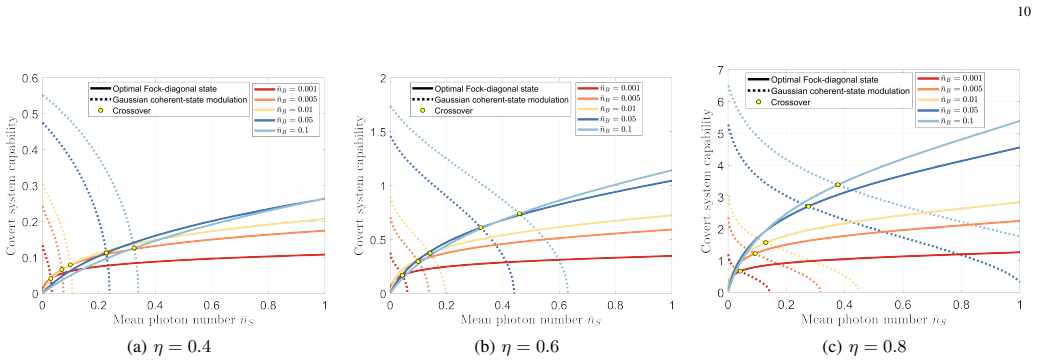
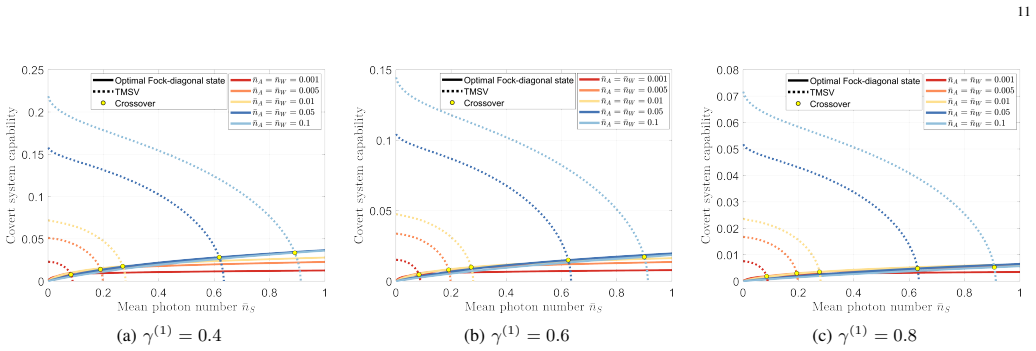
We characterize the input signal state that minimizes detectability. We find an unintuitive optimal quantum state structure: a mixture of just two consecutive photon-number states. In particular, in the low-brightness regime, the optimal signal state is a mixture of vacuum and a single photon. Since these states are generally suboptimal for both communication and active sensing, we explore the resulting trade-off and identify input-power thresholds for transitions between optimizing covertness and performance in communication and sensing tasks.
What carries the argument
The optimal input quantum state, a statistical mixture of two consecutive photon-number states, that satisfies the square-root-law covertness constraint while minimizing detection probability.
If this is right
- Sparse signaling with these states meets the square-root law covertness requirement while remaining compatible with digital transmitters.
- Input-power thresholds exist at which the transmitter should switch from the covertness-optimal two-state mixture to states that maximize communication rate or sensing performance.
- In the low-brightness regime the vacuum-plus-single-photon mixture is the unique optimal state for minimizing detectability.
- The same two-state structure applies across optical, microwave, and radio-frequency channels modeled by the lossy thermal-noise bosonic channel.
Where Pith is reading between the lines
- Transmitters could be simplified by using on-off keying hardware to realize the low-brightness optimal state.
- The result suggests similar number-state mixtures may minimize detectability on other bosonic channels with different loss or noise parameters.
- An optical-table experiment comparing detection error rates for the two-state mixture versus coherent states at equal energy would directly test the prediction.
Load-bearing premise
The analysis assumes sparse signaling with constant-energy pulses sent on a vanishing fraction of channel uses to meet the square-root law covertness constraint.
What would settle it
A calculation or experiment that demonstrates a different photon-number mixture or non-number-state achieves strictly lower detection probability at the same average energy and covertness level would falsify the claimed optimality.
Figures
read the original abstract
Preventing signal detection in communication and active sensing requires careful control of transmission power. In fact, the square-root laws (SRL) for covert classical and quantum communication and sensing prescribe that the average output energy per channel use scales as $1/\sqrt{n}$ for $n$ channel uses. \emph{Diffuse} and \emph{sparse} signaling achieve this. The former transmits signals whose energy decays as $1/\sqrt{n}$ over all $n$ channel uses, which is convenient for mathematical analysis. The latter transmits constant-energy signals only approximately $\propto\sqrt{n}$ times out of $n$ channel uses, remaining silent on the others. This offers significant practical advantages in compatibility with modern digital transmitters. Here, we study sparse signaling over the lossy thermal-noise bosonic channel, which is a quantum model of many practical channels (including optical, microwave, and radio-frequency). We characterize the input signal state that minimizes detectability. We find an unintuitive optimal quantum state structure: a mixture of just two consecutive photon-number states. In particular, in the low-brightness regime, the optimal signal state is a mixture of vacuum and a single photon. Since these states are generally suboptimal for both communication and active sensing, we explore the resulting trade-off and identify input-power thresholds for transitions between optimizing covertness and performance in communication and sensing tasks.
Editorial analysis
A structured set of objections, weighed in public.
Referee Report
Summary. The manuscript examines sparse signaling (constant-energy pulses on a vanishing fraction of uses) over the lossy thermal-noise bosonic channel to satisfy the square-root-law covertness constraint. It characterizes the input quantum state minimizing detectability, reporting that the optimum is a mixture of two consecutive photon-number states; in the low-brightness regime this reduces to a vacuum-plus-single-photon mixture. The work then quantifies the resulting trade-off between covertness and performance for classical communication and active sensing tasks.
Significance. If the optimality claim holds, the result supplies a concrete, low-dimensional state structure that is simultaneously practical for modern transmitters and provably optimal for covertness under the bosonic channel model. The explicit identification of power thresholds separating covertness-optimal from rate- or sensing-optimal regimes is a falsifiable prediction that could guide experimental design in optical and microwave covert systems.
minor comments (3)
- §II, Eq. (3): the definition of the sparse-signaling constraint should explicitly state whether the support size is exactly floor(sqrt(n)) or allowed to fluctuate; the subsequent optimization appears to treat it as deterministic.
- Fig. 2 caption: the plotted quantity is labeled 'covertness metric' but the axis is the Helstrom error; clarify whether this is 1-P_e or the full error probability.
- §IV.B: the transition thresholds between covertness-optimal and communication-optimal regimes are stated numerically; an analytic expression or scaling law would strengthen the claim.
Simulated Author's Rebuttal
We thank the referee for the positive assessment of the manuscript, the recognition of its potential significance for experimental design, and the recommendation of minor revision. No major comments were provided in the report.
Circularity Check
No significant circularity identified
full rationale
The paper's central result is a characterization of the optimal input state (mixture of two consecutive Fock states) that minimizes detectability under the explicitly stated sparse-signaling model on the lossy thermal-noise bosonic channel. No derivation step reduces by construction to its own inputs, no fitted parameter is relabeled as a prediction, and no load-bearing premise rests on a self-citation chain. The square-root-law covertness constraint and sparse signaling are presented as the modeling scope rather than derived outputs. The abstract and reader's summary contain no equations that exhibit self-definition or renaming of known results.
Axiom & Free-Parameter Ledger
axioms (2)
- domain assumption Square-root law for covert classical and quantum communication and sensing (average output energy per channel use scales as 1/sqrt(n))
- domain assumption Lossy thermal-noise bosonic channel as quantum model of practical optical, microwave, and RF channels
Forward citations
Cited by 1 Pith paper
-
Toward Practical Two-Way Covert Communication
Proof-of-concept experiment for two-way covert optical communication with narrowband laser and proposal of correlator receiver for quantum light sources without mode matching.
Reference graph
Works this paper leans on
-
[1]
Square root law for commu- nication with low probability of detection on AWGN channels,
B. A. Bash, D. Goeckel, and D. Towsley, “Square root law for commu- nication with low probability of detection on AWGN channels,” inProc. IEEE Int. Symp. Inform. Theory (ISIT), Cambridge, MA, Jul. 2012
2012
-
[2]
Limits of reliable communication with low probability of detec- tion on AWGN channels,
——, “Limits of reliable communication with low probability of detec- tion on AWGN channels,”IEEE J. Sel. Areas Commun., vol. 31, no. 9, pp. 1921–1930, Sep. 2013
1921
-
[3]
Covert communication over noisy channels: A resolv- ability perspective,
M. R. Bloch, “Covert communication over noisy channels: A resolv- ability perspective,”IEEE Transactions on Information Theory, vol. 62, no. 5, pp. 2334–2354, 2016
2016
-
[4]
Optimal throughput for covert communication over a classical-quantum channel,
L. Wang, “Optimal throughput for covert communication over a classical-quantum channel,” inProc. Inform. Theory Workshop (ITW), Cambridge, UK, Sep. 2016, pp. 364–368, arXiv:1603.05823 [cs.IT]
Pith/arXiv arXiv 2016
-
[5]
Quantum-secure covert communication on bosonic channels,
B. A. Bash, A. H. Gheorghe, M. Patel, J. L. Habif, D. Goeckel, D. Towsley, and S. Guha, “Quantum-secure covert communication on bosonic channels,”Nat. Commun., vol. 6, Oct. 2015
2015
-
[6]
Covert communications: A comprehensive survey,
X. Chen, J. An, Z. Xiong, C. Xing, N. Zhao, F. R. Yu, and A. Nal- lanathan, “Covert communications: A comprehensive survey,”IEEE Commun. Surv. Tutor ., vol. 25, no. 2, pp. 1173–1198, 2023
2023
-
[7]
Fundamental Limits of Quantum-Secure Covert Communication Over Bosonic Chan- nels,
M. S. Bullock, C. N. Gagatsos, S. Guha, and B. A. Bash, “Fundamental Limits of Quantum-Secure Covert Communication Over Bosonic Chan- nels,”IEEE Journal on Selected Areas in Communications, vol. 38, no. 3, pp. 471–482, Mar. 2020
2020
-
[8]
Covert capacity of bosonic channels,
C. N. Gagatsos, M. S. Bullock, and B. A. Bash, “Covert capacity of bosonic channels,”IEEE J. Sel. Areas Inf. Theory, vol. 1, pp. 555–567, 2020
2020
-
[9]
Signaling for covert quantum sensing,
M. Tahmasbi, B. A. Bash, S. Guha, and M. Bloch, “Signaling for covert quantum sensing,” inProc. IEEE Int. Symp. Inform. Theory (ISIT), 2021, pp. 1041–1045
2021
-
[10]
Experimental validation of provably covert communication using software-defined radio,
R. Bali, T. E. Bailey, M. S. Bullock, and B. A. Bash, “Experimental validation of provably covert communication using software-defined radio,”IEEE Journal on Selected Areas in Communications, 2026
2026
-
[11]
Gaussian quantum information,
C. Weedbrook, S. Pirandola, R. García-Patrón, N. J. Cerf, T. C. Ralph, J. H. Shapiro, and S. Lloyd, “Gaussian quantum information,”Rev. Mod. Phys., vol. 84, pp. 621–669, May 2012
2012
-
[12]
M. O. Scully and M. S. Zubairy,Quantum Optics. Cambridge, UK: Cambridge University Press, 1997
1997
-
[13]
D. F. Walls and G. J. Milburn,Quantum Optics. Springer, 2008
2008
-
[14]
G. S. Agarwal,Quantum Optics. Cambridge, UK: Cambridge Univer- sity Press, 2012
2012
-
[15]
Orszag,Quantum Optics, 3rd ed
M. Orszag,Quantum Optics, 3rd ed. Berlin, Germany: Springer, 2016
2016
-
[16]
Fundamental limits of quantum-secure covert communication over bosonic channels,
M. S. Bullock, C. N. Gagatsos, S. Guha, and B. A. Bash, “Fundamental limits of quantum-secure covert communication over bosonic channels,” IEEE J. Sel. Areas Commun., vol. 38, no. 3, pp. 471–482, Mar. 2020
2020
-
[17]
Square root law for covert quantum communication over optical channels,
E. J. D. Anderson, C. K. Eyre, I. M. Dailey, F. Rozp˛ edek, and B. A. Bash, “Square root law for covert quantum communication over optical channels,” inProc. IEEE Int. Conf. Quantum Comput. Eng. (QCE), Montréal, QC, Canada, 2024
2024
-
[18]
Achievability of covert quantum communication,
E. J. D. Anderson, M. S. Bullock, F. Rozp˛ edek, and B. A. Bash, “Achievability of covert quantum communication,” inIEEE Int. Symp. Inf. Theory (ISIT), 2025
2025
-
[19]
Quantum illumination with gaussian states,
S.-H. Tan, B. I. Erkmen, V . Giovannetti, S. Guha, S. Lloyd, L. Maccone, S. Pirandola, and J. H. Shapiro, “Quantum illumination with gaussian states,”Phys. Rev. Lett., vol. 101, p. 253601, Dec. 2008. 12
2008
-
[20]
C. W. Helstrom,Quantum Detection and Estimation Theory. New York, NY , USA: Academic Press, Inc., 1976
1976
-
[21]
Wilde,Quantum Information Theory, 2nd ed
M. Wilde,Quantum Information Theory, 2nd ed. Cambridge University Press, 2016
2016
-
[22]
Covert capacity of bosonic channels,
C. N. Gagatsos, M. S. Bullock, and B. A. Bash, “Covert capacity of bosonic channels,” Accepted for publication by IEEE J. Sel. Areas Inf. Theory, arXiv:2002.06733 [quant-ph], 2020
arXiv 2002
-
[23]
Achievability of covert quantum communication,
E. J. D. Anderson, M. S. Bullock, F. Rozp˛ edek, and B. A. Bash, “Achievability of covert quantum communication,” 2025, presented at the 2025 IEEE Int. Symp. Inf. Theory (ISIT)
2025
-
[24]
Perturbation theory for quantum informa- tion,
M. R. Grace and S. Guha, “Perturbation theory for quantum informa- tion,” in2022 IEEE Information Theory Workshop (ITW). IEEE, 2022, pp. 500–505
2022
-
[25]
Gaussian quantum information,
C. Weedbrook, S. Pirandola, R. García-Patrón, N. J. Cerf, T. C. Ralph, J. H. Shapiro, and S. Lloyd, “Gaussian quantum information,”Reviews of modern physics, vol. 84, no. 2, pp. 621–669, 2012
2012
-
[26]
Reference frames, superselection rules, and quantum information,
S. D. Bartlett, T. Rudolph, and R. W. Spekkens, “Reference frames, superselection rules, and quantum information,”Reviews of Modern Physics, vol. 79, no. 2, pp. 555–609, 2007
2007
-
[27]
The askey-scheme of hyperge- ometric orthogonal polynomials and its q-analogue,
R. Koekoek and R. F. Swarttouw, “The askey-scheme of hyperge- ometric orthogonal polynomials and its q-analogue,”arXiv preprint math/9602214, 1996
Pith/arXiv arXiv 1996
-
[28]
Niculescu and L.-E
C. Niculescu and L.-E. Persson,Convex functions and their applications. Springer, 2006, vol. 23
2006
-
[29]
Limits and security of free-space quantum communica- tions,
S. Pirandola, “Limits and security of free-space quantum communica- tions,”Physical Review Research, vol. 3, no. 1, p. 013279, 2021
2021
-
[30]
Quantum communications in a moderate- to-strong turbulent space,
M. Ghalaii and S. Pirandola, “Quantum communications in a moderate- to-strong turbulent space,”Communications Physics, vol. 5, no. 1, p. 38, 2022
2022
-
[31]
On the classical capacity of quantum gaussian channels,
C. Lupo, S. Pirandola, P. Aniello, and S. Mancini, “On the classical capacity of quantum gaussian channels,”Physica Scripta, vol. 2011, no. T143, p. 014016, 2011
2011
-
[32]
Discriminating states: The quantum chernoff bound,
K. M. R. Audenaert, J. Calsamiglia, R. Muñoz Tapia, E. Bagan, L. Masanes, A. Acin, and F. Verstraete, “Discriminating states: The quantum chernoff bound,”Phys. Rev. Lett., vol. 98, p. 160501, Apr. 2007
2007
-
[33]
The chernoff lower bound for symmetric quantum hypothesis testing,
M. Nussbaum and A. Szkoła, “The chernoff lower bound for symmetric quantum hypothesis testing,”Ann. Statist., vol. 37, no. 2, pp. 1040–1057, Apr. 2009
2009
-
[34]
Optimal probes for continuous-variable quantum illumination,
M. Bradshaw, L. O. Conlon, S. Tserkis, M. Gu, P. K. Lam, and S. M. Assad, “Optimal probes for continuous-variable quantum illumination,” Physical Review A, vol. 103, no. 6, p. 062413, 2021
2021
-
[35]
Minimum error probability of quantum illumination,
G. De Palma and J. Borregaard, “Minimum error probability of quantum illumination,”Phys. Rev. A, vol. 98, p. 012101, Jul. 2018
2018
-
[36]
The quantum theory of optical communications,
J. H. Shapiro, “The quantum theory of optical communications,”IEEE journal of selected topics in Quantum Electronics, vol. 15, no. 6, pp. 1547–1569, 2009. APPENDIXI Proof: Lemma 1:Letˆaandˆebe annihilation operators of the input and environment modes, respectively. Under the beam-splitter relation [36] of the thermal-loss channel, Willie’s output mode is ...
2009
discussion (0)
Sign in with ORCID, Apple, or X to comment. Anyone can read and Pith papers without signing in.