Time-Inconsistent Singular Control Problems with a Running Minimum Process
Pith reviewed 2026-05-20 03:49 UTC · model grok-4.3
The pith
A verification theorem characterizes equilibria in time-inconsistent singular control problems with a running minimum under weaker regularity conditions.
A machine-rendered reading of the paper's core claim, the machinery that carries it, and where it could break.
Core claim
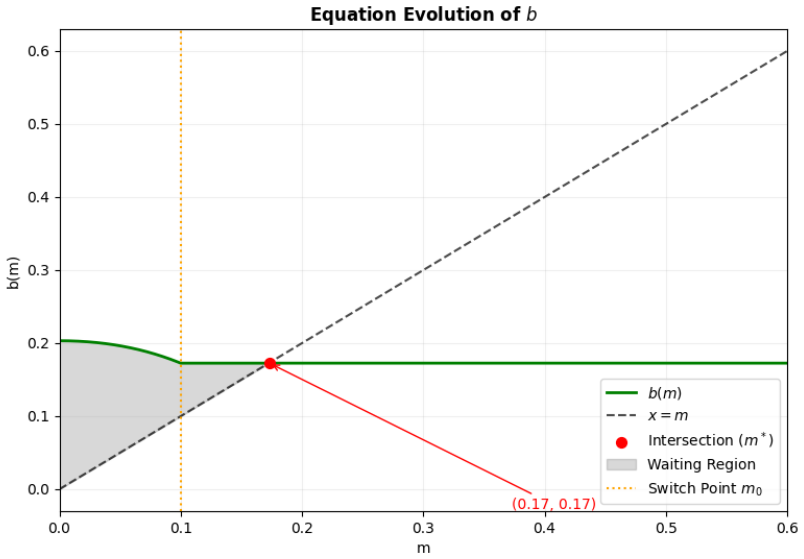
We derive a verification theorem that characterizes equilibria under substantially weaker regularity conditions than those imposed in the existing literature, and we obtain a stronger notion of equilibrium by enlarging the class of feasible perturbations. We first establish the mathematical foundations by proving existence and uniqueness of strong solutions to Skorokhod reflection problems involving the running minimum and by characterizing admissible singular control laws. For the dividend problem we prove the monotonicity and local concavity of the dividend boundary.
What carries the argument
The verification theorem for characterizing equilibria in the time-inconsistent singular control framework, supported by existence and uniqueness of strong solutions to Skorokhod reflection problems involving the running minimum.
If this is right
- Equilibria exist for the dividend problem with the running minimum under the new verification theorem.
- The dividend boundary is monotone.
- The dividend boundary is locally concave, providing a mathematical account of smoothing and scarring effects.
- Numerical simulations confirm robustness of the equilibrium over wide parameter ranges.
Where Pith is reading between the lines
- The weaker regularity conditions may permit analysis of control problems with jumps or less smooth state processes.
- The enlarged class of perturbations could be used to compare equilibrium notions across different time-inconsistent models.
- Monotonicity and concavity results for the boundary might extend to other singular control problems with path-dependent running statistics.
Load-bearing premise
Existence and uniqueness of strong solutions to the class of Skorokhod reflection problems involving the running minimum.
What would settle it
A concrete singular control problem satisfying the framework setup in which the associated Skorokhod reflection problem lacks a unique strong solution, or in which the verification theorem fails to produce an equilibrium despite the claimed boundary properties.
Figures



read the original abstract
This paper develops a time-inconsistent and path-dependent singular control framework incorporating a running minimum process. We derive a verification theorem that characterizes equilibria under substantially weaker regularity conditions than those imposed in the existing literature, and we obtain a stronger notion of equilibrium by enlarging the class of feasible perturbations. We first establish the mathematical foundations of the framework by proving the existence and uniqueness of strong solutions to a class of Skorokhod reflection problems involving the running minimum and by characterizing admissible singular control laws. We further demonstrate the existence of an equilibrium through a dividend problem, where the running minimum leads to a highly coupled and nonlinear differential-algebraic system. For this problem, we prove the monotonicity and local concavity of the dividend boundary, thereby providing a mathematical explanation for dividend smoothing and scarring effects. Numerical simulations confirm the robustness of the equilibrium across a wide range of parameter values.
Editorial analysis
A structured set of objections, weighed in public.
Referee Report
Summary. The paper develops a time-inconsistent singular control framework incorporating a running minimum process. It proves existence and uniqueness of strong solutions to Skorokhod reflection problems with the running minimum, characterizes admissible singular control laws, derives a verification theorem characterizing equilibria under weaker regularity conditions than prior literature, and obtains a stronger equilibrium notion by enlarging the class of feasible perturbations. The framework is applied to a dividend problem, yielding a highly coupled nonlinear differential-algebraic system for which monotonicity and local concavity of the dividend boundary are proved, providing a mathematical account of dividend smoothing and scarring; numerical simulations illustrate robustness across parameter ranges.
Significance. If the central results hold, the paper advances singular stochastic control by relaxing regularity assumptions in the verification theorem and strengthening the equilibrium concept. The dividend-problem construction supplies a concrete, falsifiable illustration of path-dependent effects and offers insight into observed corporate dividend behavior. The rigorous treatment of the running-minimum reflection problems constitutes a technical contribution that could support further work on path-dependent time-inconsistent problems.
major comments (2)
- [Mathematical foundations / Skorokhod reflection problems] The section establishing existence and uniqueness of strong solutions to the Skorokhod reflection problems involving the running minimum (the load-bearing step identified in the abstract for admissible controls and the subsequent verification theorem): the argument must be checked to confirm that the fixed-point or contraction mapping closes for the path-dependent minimum without implicitly reintroducing regularity conditions comparable to those in the existing literature, as any such dependence would undermine the claim of substantially weaker conditions for the verification theorem.
- [Dividend problem application] The dividend-problem construction and the proof of monotonicity and local concavity of the dividend boundary: the highly coupled nonlinear differential-algebraic system is central to the economic interpretation; the derivation should explicitly verify that the local concavity holds uniformly in a neighborhood of the boundary without additional parameter restrictions that would limit the explanation of scarring effects.
minor comments (2)
- [Introduction / Preliminaries] The notation distinguishing the running minimum process from the state process should be introduced earlier and used consistently to improve readability of the admissible-control definition.
- [Literature review] A brief comparison table or paragraph contrasting the regularity assumptions here with those in the cited prior works on time-inconsistent singular control would help readers assess the claimed improvement.
Simulated Author's Rebuttal
We thank the referee for the careful reading of our manuscript and for the constructive comments. We address each major comment below.
read point-by-point responses
-
Referee: [Mathematical foundations / Skorokhod reflection problems] The section establishing existence and uniqueness of strong solutions to the Skorokhod reflection problems involving the running minimum (the load-bearing step identified in the abstract for admissible controls and the subsequent verification theorem): the argument must be checked to confirm that the fixed-point or contraction mapping closes for the path-dependent minimum without implicitly reintroducing regularity conditions comparable to those in the existing literature, as any such dependence would undermine the claim of substantially weaker conditions for the verification theorem.
Authors: We thank the referee for this important observation. The existence and uniqueness result for the Skorokhod reflection problems with running minimum is proved in Section 3 by constructing a contraction mapping on the space of adapted càdlàg processes equipped with the uniform metric. The contraction constant is derived from the Lipschitz property of the Skorokhod map and the monotonicity of the running minimum; it does not depend on any additional regularity of the candidate value function or control. Consequently, the argument does not reintroduce the C^{2} or higher regularity assumptions present in earlier verification theorems. We will add a short paragraph after the contraction estimate to make the independence from path-dependent regularity explicit. revision: partial
-
Referee: [Dividend problem application] The dividend-problem construction and the proof of monotonicity and local concavity of the dividend boundary: the highly coupled nonlinear differential-algebraic system is central to the economic interpretation; the derivation should explicitly verify that the local concavity holds uniformly in a neighborhood of the boundary without additional parameter restrictions that would limit the explanation of scarring effects.
Authors: We agree that uniformity should be stated clearly. In the proof of local concavity (Theorem 5.3), the second derivative of the free boundary with respect to the state variable is obtained via the implicit-function theorem applied to the coupled system. The sign of this derivative is controlled by the continuity of the coefficients and the standing assumptions (A1)–(A4); the size of the neighborhood in which concavity holds depends only on these quantities and not on further parameter restrictions. This supports the scarring interpretation across the ranges used in the numerical experiments. We will insert an explicit remark after Theorem 5.3 confirming the uniformity. revision: yes
Circularity Check
Derivation chain is self-contained with independent proofs
full rationale
The paper proves existence and uniqueness of strong solutions to the Skorokhod reflection problems with running minimum as a new foundational result, then uses this to define admissible controls and derive a verification theorem under weaker regularity than prior literature. The dividend problem analysis, including monotonicity and local concavity of the boundary, follows from these independent mathematical developments. No steps reduce by construction to fitted inputs, self-definitions, or unverified self-citation chains; the central claims rest on explicit new proofs rather than renaming or smuggling prior ansatzes.
Axiom & Free-Parameter Ledger
axioms (1)
- domain assumption Existence and uniqueness of strong solutions to Skorokhod reflection problems involving the running minimum
Lean theorems connected to this paper
-
IndisputableMonolith/Cost/FunctionalEquation.leanwashburn_uniqueness_aczel unclear?
unclearRelation between the paper passage and the cited Recognition theorem.
We derive a verification theorem that characterizes equilibria under substantially weaker regularity conditions... extended HJB system... Skorokhod reflection problem involving the running minimum
What do these tags mean?
- matches
- The paper's claim is directly supported by a theorem in the formal canon.
- supports
- The theorem supports part of the paper's argument, but the paper may add assumptions or extra steps.
- extends
- The paper goes beyond the formal theorem; the theorem is a base layer rather than the whole result.
- uses
- The paper appears to rely on the theorem as machinery.
- contradicts
- The paper's claim conflicts with a theorem or certificate in the canon.
- unclear
- Pith found a possible connection, but the passage is too broad, indirect, or ambiguous to say the theorem truly supports the claim.
Reference graph
Works this paper leans on
- [1]
-
[2]
Time-Inconsistent Control Theory with Finance Applications , publisher =
Tomas Bj. Time-Inconsistent Control Theory with Finance Applications , publisher =. 2021 , doi =
work page 2021
- [3]
-
[4]
Journal of Economic Theory , volume =
Karp, Larry , title =. Journal of Economic Theory , volume =. 2007 , month =
work page 2007
-
[5]
On the singular control of a diffusion and its running infimum or supremum , author =. 2025 , journal =
work page 2025
-
[6]
Equilibria for time-inconsistent singular control problems , author =. 2024 , journal =
work page 2024
-
[7]
Equilibrium strategies for singular dividend control problems under the mean-variance criterion , author =. 2026 , journal =
work page 2026
- [8]
-
[9]
Journal of Theoretical Probability , volume =
Peskir, Goran , title =. Journal of Theoretical Probability , volume =. 2005 , month =
work page 2005
-
[10]
Finance Research Letters , volume =
Smoothed or not smoothed: The impact of the 2008 global financial crisis on dividend stability in the. Finance Research Letters , volume =. 2021 , issn =. doi:https://doi.org/10.1016/j.frl.2019.101423 , url =
-
[11]
Journal of Corporate Finance , volume =
Dividend payouts: Evidence from. Journal of Corporate Finance , volume =. 2013 , issn =. doi:https://doi.org/10.1016/j.jcorpfin.2013.04.001 , url =
-
[12]
The Review of Economic Studies , volume =
A Note on Measurement of Utility , author =. The Review of Economic Studies , volume =. 1937 , doi =
work page 1937
-
[13]
Bather, John and Chernoff, Herman , journal =
-
[14]
Some Solvable Stochastic Control Problems , journal =
Bene. Some Solvable Stochastic Control Problems , journal =. 1980 , volume =
work page 1980
-
[15]
Davis, M. H. A. and Norman, A. R. , journal =
-
[16]
Advances in Applied Probability , volume =
Ferrari, Giorgio and Yang, Shuzhen , year =. Advances in Applied Probability , volume =
- [17]
-
[18]
Insurance: Mathematics and Economics , volume=
Asmussen, S. Insurance: Mathematics and Economics , volume=
-
[19]
Insurance: Mathematics and Economics , volume =
Kulenko, Natalie and Schmidli, Hanspeter , year =. Insurance: Mathematics and Economics , volume =
-
[20]
SIAM Journal on Financial Mathematics , volume =
Liang, Zongxia and Luo, Xiaodong , year =. SIAM Journal on Financial Mathematics , volume =
-
[21]
Available at SSRN 4958481 , year=
Dynamic mean-variance portfolio selection with transaction costs , author=. Available at SSRN 4958481 , year=
-
[22]
Journal of Financial Economics , volume=
Why do firms pay dividends? International evidence on the determinants of dividend policy , author=. Journal of Financial Economics , volume=. 2008 , publisher=
work page 2008
-
[23]
The Annals of Probability , year =
Peskir, Goran , title =. The Annals of Probability , year =
-
[24]
Journal of Applied Probability , volume=
Optimal stopping problems in diffusion-type models with running maxima and drawdowns , author=. Journal of Applied Probability , volume=. 2014 , publisher=. doi:10.1017/S0021900200119774 , url=
-
[25]
SIAM Journal on Control and Optimization , volume =
Chen, Xiaoshan and Guan, Chonghu and Yi, Fahuai , title =. SIAM Journal on Control and Optimization , volume =. 2021 , doi =
work page 2021
-
[26]
Journal of Financial Economics , volume=
An equilibrium model of irreversible investment , author=. Journal of Financial Economics , volume=. 2001 , publisher=
work page 2001
-
[27]
A class of singular control problems with tipping points , author=. 2025 , journal =
work page 2025
-
[28]
Applied Mathematics and Optimization , volume=
Generalized solution in singular stochastic control: the nondegenerate problem , author=. Applied Mathematics and Optimization , volume=. 1992 , publisher=
work page 1992
-
[29]
Dividend Policy Changes in the Pre-, Mid-, and Post-Financial Crisis: Evidence from the
Abdulkadir, Rihanat Idowu and Abdullah, Nur Adiana Hiau and Wong, Woei-Chyuan , journal=. Dividend Policy Changes in the Pre-, Mid-, and Post-Financial Crisis: Evidence from the
-
[30]
Kozlowski, Julian and Veldkamp, Laura and Venkateswaran, Venky , institution=. Scarring Body and Mind: The. 2020 , month =. doi:10.3386/w27439 , url =
-
[31]
American Economic Review , year =
Distribution of Incomes of Corporations Among Dividends, Retained Earnings, and Taxes , author =. American Economic Review , year =
-
[32]
Communications on Pure and Applied Mathematics , volume =
Stochastic Differential Equations with Reflecting Boundary Conditions , author =. Communications on Pure and Applied Mathematics , volume =. 1984 , month = jul, doi =
work page 1984
-
[33]
Stochastics and Stochastic Reports , volume =
Paul Dupuis and Hitoshi Ishii , title =. Stochastics and Stochastic Reports , volume =. 1991 , publisher =
work page 1991
-
[34]
Zongxia Liang and Xiaodong Luo and Xiang Yu , title =. 2025 , journal =
work page 2025
-
[35]
Insurance: Mathematics and Economics , volume =
Irreversible reinsurance: A singular control approach , author =. Insurance: Mathematics and Economics , volume =. 2022 , doi =
work page 2022
discussion (0)
Sign in with ORCID, Apple, or X to comment. Anyone can read and Pith papers without signing in.