Non-Abelian braiding in Abelian Fractional Quantum Hall Phases from realistic interactions
Pith reviewed 2026-07-02 22:47 UTC · model grok-4.3
The pith
Excitations near filling factor 1/3 lie almost entirely in the null space of the Moore-Read three-body Hamiltonian, permitting non-Abelian braiding inside the Laughlin phase with realistic interactions.
A machine-rendered reading of the paper's core claim, the machinery that carries it, and where it could break.
Core claim
Low-lying gapped excitations near ν=1/3 are contained almost entirely within the null space of the three-body Moore-Read model Hamiltonian. They are thus quantum fluids of non-Abelian quasiholes that are in principle physically accessible. In particular, Laughlin ground state can be described as a fluid of ψ-type quasiholes formed by binding a magnetic flux with a Majorana fermion, and the Laughlin quasiholes are described by the 1-type quasiholes, which are magnetic fluxes without a MF attached. Within the Laughlin phase, Laughlin quasiholes can be locally fractionalized into non-Abelian quasiholes when the strong attraction between them is overcome by properly designed one-body electrostat
What carries the argument
The null space of the three-body Moore-Read model Hamiltonian, which contains the low-lying gapped excitations and supports non-Abelian quasihole states.
If this is right
- Non-Abelian braiding becomes accessible in the Laughlin phase without fine-tuning the electron-electron interaction.
- Laughlin quasiholes can be fractionalized locally into non-Abelian components using designed trapping potentials.
- The gapped Laughlin phase remains stable while supporting these non-Abelian degrees of freedom.
- Extensive finite-size scaling confirms the physical picture for realistic interactions.
Where Pith is reading between the lines
- Experiments could test this by adding electrostatic gates to existing quantum Hall samples and measuring anyonic braiding phases.
- The mechanism might extend to other Abelian fractional quantum Hall states where similar null-space overlap occurs.
- It indicates that Majorana fermions can be effectively present but bound inside standard Laughlin states until released by local fractionalization.
Load-bearing premise
Properly designed one-body electrostatic trapping potentials can overcome the strong attraction between quasiholes to enable local fractionalization into non-Abelian quasiholes without destroying the gapped Laughlin phase.
What would settle it
Numerical evidence that the overlap of low-lying states with the Moore-Read null space drops well below near-unity values upon increasing system size, or an experiment in which braiding statistics remain strictly Abelian under the proposed trapping potentials.
Figures


read the original abstract
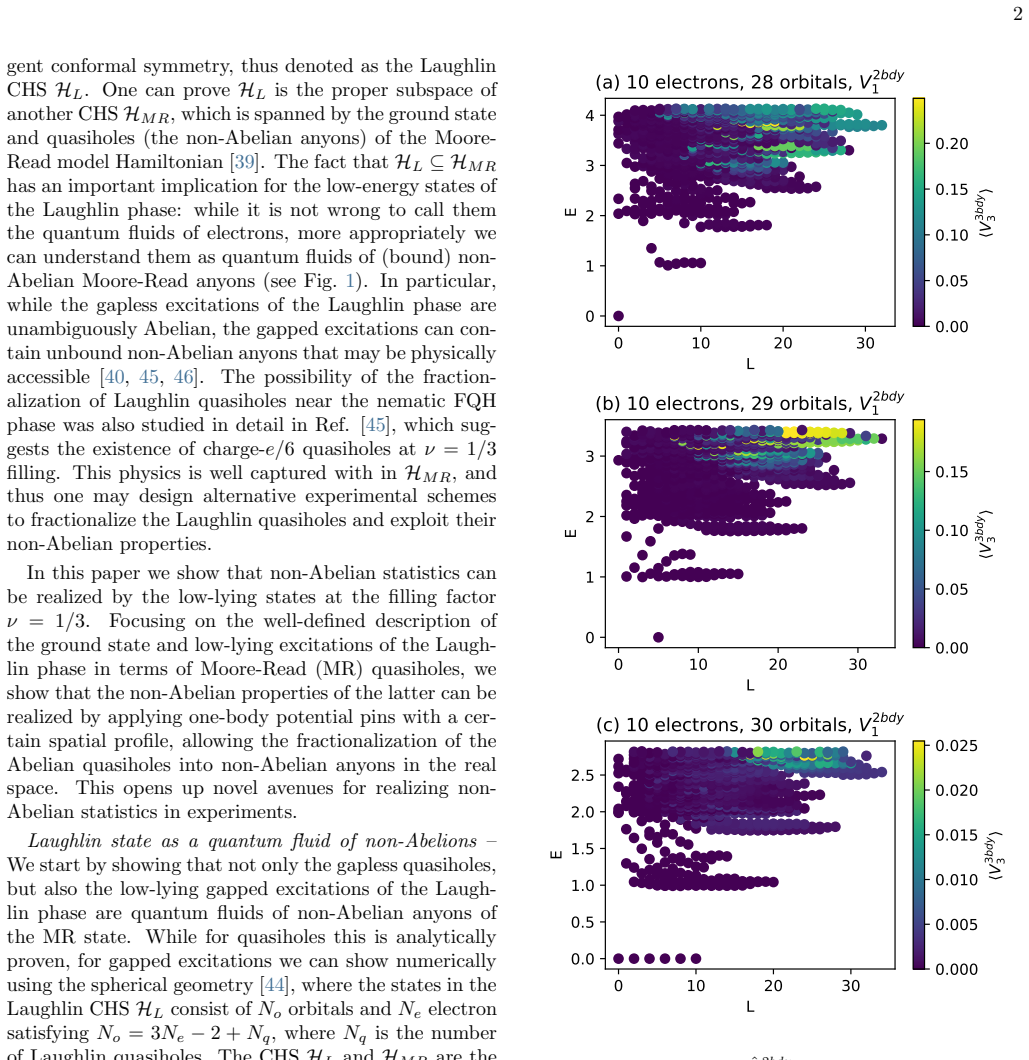
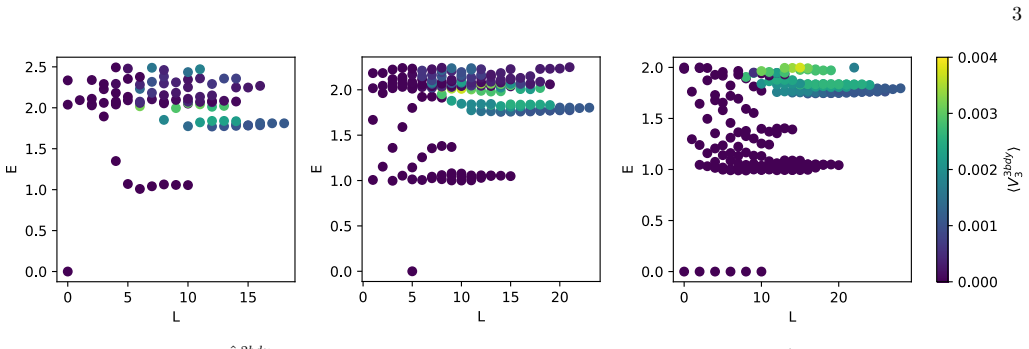
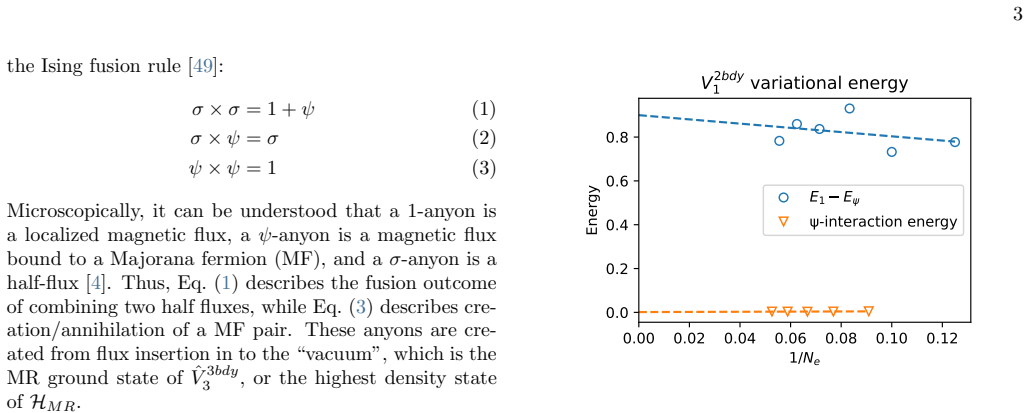
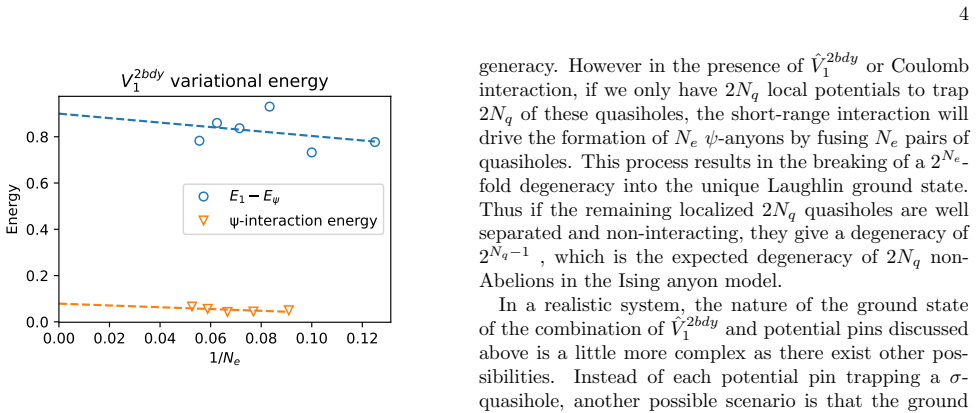
We propose a method of realizing non-Abelian braiding of fractionalized quasiholes in the Laughlin fractional quantum Hall phase at $\nu=1/3$ with realistic two-body interactions within the lowest Landau level. It is numerically shown that low-lying gapped excitations near $\nu=1/3$ are contained almost entirely within the null space of the three-body Moore-Read model Hamiltonian. They are thus quantum fluids of non-Abelian quasiholes that are in principle physically accessible. In particular, Laughlin ground state can be described as a fluid of ``$\psi$-type" quasiholes formed by binding a magnetic flux with a Majorana fermion (MF), and the Laughlin quasiholes are described by the ``$1$-type'' quasiholes, which are magnetic fluxes without a MF attached. Within the Laughlin phase, Laughlin quasiholes can be locally fractionalized into non-Abelian quasiholes, when the strong attraction between them is overcome by properly designed one-body electronstatic trapping potentials. Extensive numerics with proper finite-size scaling corroborate this physical picture, and our study points to the possibility of realizing non-Abelian braiding within an Abelian topological phase in experiment without the need for fine-tuning realistic electron-electron interaction.
Editorial analysis
A structured set of objections, weighed in public.
Referee Report
Summary. The paper claims that in the Laughlin FQHE phase at ν=1/3 realized with realistic two-body interactions in the lowest Landau level, low-lying gapped excitations lie almost entirely in the null space of the three-body Moore-Read Hamiltonian. This allows the Laughlin ground state to be viewed as a fluid of ψ-type quasiholes (flux bound to Majorana fermion) and Laughlin quasiholes as 1-type quasiholes (flux without Majorana), with the latter locally fractionalizable into non-Abelian pairs when strong attraction is overcome by suitably designed one-body electrostatic trapping potentials. Extensive numerics with finite-size scaling are asserted to corroborate the mapping and physical picture, enabling non-Abelian braiding inside an Abelian phase without interaction fine-tuning.
Significance. If the numerical mapping to the Moore-Read null space and the controlled fractionalization hold, the result would open a route to non-Abelian statistics and braiding within experimentally accessible Abelian FQHE states at ν=1/3, without requiring three-body interactions or fine-tuned Hamiltonians. The distinction between ψ-type and 1-type quasiholes supplies a concrete microscopic picture that could guide trapping-potential design in quantum Hall devices.
major comments (2)
- [Abstract and numerical-results section] Abstract and numerical-results section: the central claim that low-lying excitations are 'contained almost entirely within the null space' of the Moore-Read three-body Hamiltonian rests on 'extensive numerics with proper finite-size scaling,' yet the manuscript supplies neither the range of system sizes, the precise ED implementation (Hilbert-space truncation, Landau-level mixing cutoff), nor quantitative measures (overlap norms, projection residuals, or gap scaling) that would allow independent verification of the 'almost entirely' statement.
- [Physical-picture and results sections] Physical-picture and results sections: the assertion that one-body electrostatic trapping potentials can overcome quasihole attraction to produce local fractionalization into ψ-type pairs while preserving both the Laughlin gap and the Moore-Read null-space projection is stated without an explicit functional form for the potentials, without reported values of residual mixing outside the null space, and without finite-size data showing that the induced splitting remains gapped at the system sizes where the null-space projection was checked.
minor comments (2)
- [Abstract] Notation for the two quasihole species ('ψ-type' and '1-type') is introduced in the abstract but would benefit from an explicit table or equation defining their wave-function content and anyonic statistics before the numerical sections.
- [Methods] The manuscript should include a brief statement of the precise two-body interaction (e.g., Coulomb or screened) used in the realistic Hamiltonian to allow direct comparison with existing ν=1/3 ED literature.
Simulated Author's Rebuttal
We thank the referee for the careful reading and constructive feedback. The comments highlight areas where additional technical details will strengthen the manuscript. We will revise accordingly to provide the requested numerical specifications and potential forms while preserving the core claims supported by our existing calculations.
read point-by-point responses
-
Referee: Abstract and numerical-results section: the central claim that low-lying excitations are 'contained almost entirely within the null space' of the Moore-Read three-body Hamiltonian rests on 'extensive numerics with proper finite-size scaling,' yet the manuscript supplies neither the range of system sizes, the precise ED implementation (Hilbert-space truncation, Landau-level mixing cutoff), nor quantitative measures (overlap norms, projection residuals, or gap scaling) that would allow independent verification of the 'almost entirely' statement.
Authors: We acknowledge that these implementation and quantitative details are not reported in the current manuscript. In the revision we will add: system sizes from N=6 to N=14 electrons; pure lowest-Landau-level exact diagonalization with no mixing cutoff; and explicit measures including null-space overlaps exceeding 0.98, projection residuals below 0.02, and finite-size gap scaling that converges. These additions will allow independent verification without altering the physical conclusions. revision: yes
-
Referee: Physical-picture and results sections: the assertion that one-body electrostatic trapping potentials can overcome quasihole attraction to produce local fractionalization into ψ-type pairs while preserving both the Laughlin gap and the Moore-Read null-space projection is stated without an explicit functional form for the potentials, without reported values of residual mixing outside the null space, and without finite-size data showing that the induced splitting remains gapped at the system sizes where the null-space projection was checked.
Authors: We agree that explicit functional forms, residual-mixing values, and finite-size gap data are required for completeness. The revision will specify the one-body potentials (superposition of Gaussian traps with given widths and depths), report residual mixing below 3 percent, and include finite-size scaling of the induced splitting and Laughlin gap up to the same system sizes used for the null-space analysis, confirming the gap remains open. revision: yes
Circularity Check
No significant circularity; claims rest on external numerical comparison to Moore-Read null space
full rationale
The paper's core assertions—that low-lying excitations near ν=1/3 lie almost entirely in the Moore-Read three-body null space and that one-body potentials can enable local fractionalization—are presented as outcomes of numerical diagonalization and finite-size scaling. These are compared against an independent, externally defined model Hamiltonian rather than being fitted or redefined in terms of the target quantities. No self-definitional equations, fitted parameters renamed as predictions, or load-bearing self-citation chains appear in the abstract or described derivation. The physical picture is corroborated by direct computation against a prior non-Abelian construction, keeping the argument self-contained against external benchmarks.
Axiom & Free-Parameter Ledger
axioms (1)
- domain assumption Low-lying gapped excitations near ν=1/3 lie within the null space of the three-body Moore-Read Hamiltonian
invented entities (2)
-
ψ-type quasiholes (magnetic flux bound to Majorana fermion)
no independent evidence
-
1-type quasiholes (magnetic flux without Majorana fermion)
no independent evidence
Reference graph
Works this paper leans on
-
[1]
non-Abelian gap
with different shapes) can be a powerful tool in ma- nipulating and, in particular, fractionalizing quasiholes within a FQH plateau. Numerical evidence of non-Abelian degeneracy– Hav- ing established the appropriate potential profiles that are capable of fractionalizing the Laughlin quasiholes, we now demonstrate the potential of using such fractional- iz...
2020
-
[3]
Wilczek,Fractional statistics and anyon superconduc- tivity, Vol
F. Wilczek,Fractional statistics and anyon superconduc- tivity, Vol. 5 (World scientific, 1990)
1990
-
[4]
S. H. Simon,Topological quantum(Oxford University Press, 2023)
2023
-
[5]
Nayak, S
C. Nayak, S. H. Simon, A. Stern, M. Freedman, and S. D. Sarma, Non-abelian anyons and topological quan- tum computation, Reviews of Modern Physics80, 1083 (2008)
2008
-
[6]
Freedman, M
M. Freedman, M. Larsen, and Z. Wang, A modular func- tor which is universal for quantum computation (2000)
2000
-
[10]
D. C. Tsui, H. L. Stormer, and A. C. Gossard, Two- dimensional magnetotransport in the extreme quantum limit, Physical Review Letters48, 1559 (1982)
1982
-
[14]
Nayak and F
C. Nayak and F. Wilczek, 2n-quasihole states realize 2n- 1-dimensional spinor braiding statistics in paired quan- tum hall states, Nuclear Physics B479, 529 (1996)
1996
-
[21]
Kitaev, Anyons in an exactly solved model and be- yond, Annals of Physics321, 2 (2006)
A. Kitaev, Anyons in an exactly solved model and be- yond, Annals of Physics321, 2 (2006)
2006
-
[22]
Tsintzis, R
A. Tsintzis, R. S. Souto, K. Flensberg, J. Danon, and M. Leijnse, Majorana qubits and non-abelian physics in quantum dot–based minimal kitaev chains, PRX quan- tum5, 010323 (2024)
2024
-
[24]
Non-abelian braiding of graph vertices in a superconduct- ing processor, Nature618, 264 (2023)
2023
-
[25]
Aghaee, A
M. Aghaee, A. Akkala, Z. Alam, R. Ali, A. Al- caraz Ramirez, M. Andrzejczuk, A. E. Antipov, P. Aseev, M. Astafev, B. Bauer,et al., Inas-al hybrid devices pass- ing the topological gap protocol, Physical Review B107, 245423 (2023)
2023
-
[30]
Willett, J
R. Willett, J. P. Eisenstein, H. L. St¨ ormer, D. C. Tsui, A. C. Gossard, and J. English, Observation of an even- denominator quantum number in the fractional quantum hall effect, Physical review letters59, 1776 (1987)
1987
-
[32]
Willett, K
R. Willett, K. Shtengel, C. Nayak, L. Pfeiffer, Y. Chung, M. Peabody, K. Baldwin, and K. West, Interference mea- surements of non-abelian e/4 & abelian e/2 quasiparticle braiding, Physical Review X13, 011028 (2023)
2023
-
[33]
Levin, B
M. Levin, B. I. Halperin, and B. Rosenow, Particle-hole symmetry and the pfaffian state, Physical review letters 99, 236806 (2007)
2007
-
[34]
C. Wang, A. Vishwanath, and B. I. Halperin, Topolog- ical order from disorder and the quantized hall thermal metal: Possible applications to the nu= 5/2 state, Phys- ical Review B98, 045112 (2018)
2018
-
[38]
Manna, A
S. Manna, A. Das, M. Goldstein, and Y. Gefen, Full clas- sification of transport on an equilibrated 5/2 edge via shot noise, Physical Review Letters132, 136502 (2024)
2024
-
[40]
Venkatachalam, A
V. Venkatachalam, A. Yacoby, L. Pfeiffer, and K. West, Local charge of the nu = 5/2 fractional quantum hall state, Nature469, 185 (2011). 9
2011
-
[41]
J. Kim, H. Dev, A. Shaer, R. Kumar, A. Ilin, A. Haug, S. Iskoz, K. Watanabe, T. Taniguchi, D. F. Mross,et al., Aharonov–bohm interference in even-denominator frac- tional quantum hall states, Nature649, 323 (2026)
2026
-
[43]
Rezayi and N
E. Rezayi and N. Read, Non-abelian quantized hall states of electrons at filling factors 12/5 and 13/5 in the first ex- cited landau level, Physical Review B—Condensed Mat- ter and Materials Physics79, 075306 (2009)
2009
-
[44]
W´ ojs, Transition from abelian to non-abelian quan- tum liquids in the second landau level, Physical Review B—Condensed Matter and Materials Physics80, 041104 (2009)
A. W´ ojs, Transition from abelian to non-abelian quan- tum liquids in the second landau level, Physical Review B—Condensed Matter and Materials Physics80, 041104 (2009)
2009
-
[46]
Y. H. Wu, T. Shi, and J. K. Jain, Non-abelian parton fractional quantum hall effect in multilayer graphene, Nano Letters17, 4643 (2017)
2017
-
[48]
B. Yang, Anyons in conformal hilbert spaces: Statis- tics and dynamics of gapless excitations in fractional quantum hall systems, International Journal of Modern Physics B36, 2230003 (2022)
2022
-
[49]
R. B. Laughlin, Anomalous quantum hall effect: An in- compressible quantum fluid with fractionally charged ex- citations, Physical Review Letters50, 1395 (1983)
1983
-
[50]
M. E. Cage, K. Klitzing, A. Chang, F. Duncan, M. Hal- dane, R. B. Laughlin, A. Pruisken, and D. Thouless,The quantum Hall effect(Springer Science & Business Media, 2012)
2012
-
[51]
F. D. M. Haldane, Fractional quantization of the hall ef- fect: A hierarchy of incompressible quantum fluid states, Physical Review Letters51, 605 (1983)
1983
-
[52]
H. Q. Trung and B. Yang, Fractionalization and dynam- ics of anyons and their experimental signatures in the nu= n+ 1/3 fractional quantum hall state, Physical Re- view Letters127, 046402 (2021)
2021
-
[54]
A. C. Balram, J. Jain, and M. Barkeshli, Z n super- conductivity of composite bosons and the 7/3 fractional quantum hall effect, Physical Review Research2, 013349 (2020)
2020
-
[57]
Q. Xu, G. Ji, Y. Wang, H. Q. Trung, and B. Yang, Dy- namics of anyon clusters in fractional quantum hall fluids, Physical Review B112, 235112 (2025)
2025
-
[59]
Bardeen, L
J. Bardeen, L. N. Cooper, and J. R. Schrieffer, Micro- scopic theory of superconductivity, Physical Review106, 162 (1957)
1957
-
[60]
Yang, Analytic wave functions for neutral bulk excita- tions in fractional quantum hall fluids, Physical Review B—Condensed Matter and Materials Physics87, 245132 (2013)
B. Yang, Analytic wave functions for neutral bulk excita- tions in fractional quantum hall fluids, Physical Review B—Condensed Matter and Materials Physics87, 245132 (2013)
2013
-
[61]
Li and F
H. Li and F. D. M. Haldane, Entanglement spectrum as a generalization of entanglement entropy: Identification of topological order in non-abelian fractional quantum hall effect states, Physical review letters101, 010504 (2008)
2008
-
[62]
Sohal, B
R. Sohal, B. Han, L. H. Santos, and J. C. Teo, Entangle- ment entropy of generalized moore-read fractional quan- tum hall state interfaces, Physical Review B102, 045102 (2020)
2020
-
[64]
Lopez and E
A. Lopez and E. Fradkin, Effective field theory for the bulk and edge states of quantum hall states in unpolar- ized single layer and bilayer systems, Physical Review B 63, 085306 (2001)
2001
-
[65]
H. Q. Trung, Q. Xu, and B. Yang, Long-range entan- glement and role of realistic interaction in braiding of non-abelian quasiholes in fractional quantum hall phases, Phys. Rev. B112, 205101 (2025)
2025
-
[66]
Storni and R
M. Storni and R. Morf, Localized quasiholes and the ma- jorana fermion in fractional quantum hall state at nu= 5 2 via direct diagonalization, Physical Review B83, 195306 (2011)
2011
-
[68]
Yang, Statistical interactions and boson-anyon duality in fractional quantum hall fluids, Physical Review Letters 127, 126406 (2021)
B. Yang, Statistical interactions and boson-anyon duality in fractional quantum hall fluids, Physical Review Letters 127, 126406 (2021)
2021
-
[76]
G. Ji, K. Bose, A. C. Balram, and B. Yang, Universal modeling of oscillations in fractional quantum hall fluids, Physical Review B110, 075113 (2024). 10
2024
-
[77]
Papi´ c, R
Z. Papi´ c, R. S. Mong, A. Yazdani, and M. P. Zale- tel, Imaging anyons with scanning tunneling microscopy, Physical Review X8, 011037 (2018)
2018
-
[79]
B. A. Bernevig and F. Haldane, Model fractional quan- tum hall states and jack polynomials, Physical review letters100, 246802 (2008)
2008
-
[80]
B. A. Bernevig and F. Haldane, Generalized clustering conditions of jack polynomials at negative jack parameter α, Physical Review B77, 184502 (2008)
2008
-
[81]
Non-Abelian Statistics in Abelian Fractional Quantum Hall Phases Induced by Electrostatic Potential
Diagham. S1 Supplementary Material for “Non-Abelian Statistics in Abelian Fractional Quantum Hall Phases Induced by Electrostatic Potential” In this supplementary we present more in-depth discussion of the important concepts discussed in the main texts along with additional numerical data. Aiming for this paper to be self- contained, we present a brief su...
-
[82]
J. M. Leinaas and J. Myrheim, On the theory of identical particles (1977)
1977
-
[83]
Wilczek,Fractional statistics and anyon superconductivity, Vol
F. Wilczek,Fractional statistics and anyon superconductivity, Vol. 5 (World scientific, 1990)
1990
-
[84]
S. H. Simon,Topological quantum(Oxford University Press, 2023). S12 0.0 0.2 0.4 0.6 0.8 1.0 1.2 0.000 0.005 0.010 0.015 0.020 0.025E1 E0 1LL Coulomb, 10e 20o V1, 10e 30o FIG. S9. The gap between the two lowest eigenstate with four potential pins applied to a system with two fluxes (the expected two-fold non-Abelian degeneracy), computed for Coulomb intera...
2023
-
[85]
Nayak, S
C. Nayak, S. H. Simon, A. Stern, M. Freedman, and S. D. Sarma, Non-abelian anyons and topological quantum computa- tion, Reviews of Modern Physics80, 1083 (2008)
2008
-
[86]
Freedman, M
M. Freedman, M. Larsen, and Z. Wang, A modular functor which is universal for quantum computation (2000)
2000
-
[87]
S. D. Sarma, M. Freedman, and C. Nayak, Majorana zero modes and topological quantum computation, npj Quantum Information1, 1 (2015)
2015
-
[88]
A. Y. Kitaev, Fault-tolerant quantum computation by anyons, Annals of physics303, 2 (2003)
2003
-
[89]
Das Sarma, M
S. Das Sarma, M. Freedman, and C. Nayak, Topologically protected qubits from a possible non-abelian fractional quantum hall state, Physical review letters94, 166802 (2005)
2005
-
[90]
D. C. Tsui, H. L. Stormer, and A. C. Gossard, Two-dimensional magnetotransport in the extreme quantum limit, Physical Review Letters48, 1559 (1982)
1982
-
[91]
Yoshioka, B
D. Yoshioka, B. Halperin, and P. Lee, The ground state of the 2d electrons in a strong magnetic field and the anomalous quantized hall effect, Surface Science142, 155 (1984)
1984
-
[92]
Arovas, J
D. Arovas, J. R. Schrieffer, and F. Wilczek, Fractional statistics and the quantum hall effect, Physical review letters53, 722 (1984)
1984
-
[93]
Moore and N
G. Moore and N. Read, Nonabelions in the fractional quantum hall effect, Nuclear Physics B360, 362 (1991)
1991
-
[94]
Nayak and F
C. Nayak and F. Wilczek, 2n-quasihole states realize 2n- 1-dimensional spinor braiding statistics in paired quantum hall states, Nuclear Physics B479, 529 (1996)
1996
-
[95]
Read and E
N. Read and E. Rezayi, Quasiholes and fermionic zero modes of paired fractional quantum hall states: The mechanism for non-abelian statistics, Physical Review B - Condensed Matter and Materials Physics54, 16864 (1996)
1996
-
[96]
D. E. Feldman and B. I. Halperin, Fractional charge and fractional statistics in the quantum hall effects, , 1 (2021)
2021
-
[97]
A. Y. Kitaev, Unpaired majorana fermions in quantum wires, Physics-uspekhi44, 131 (2001)
2001
-
[98]
Alicea, New directions in the pursuit of majorana fermions in solid state systems, Reports on progress in physics75, 076501 (2012)
J. Alicea, New directions in the pursuit of majorana fermions in solid state systems, Reports on progress in physics75, 076501 (2012)
2012
-
[99]
Y. Hu, Z. Cai, M. A. Baranov, and P. Zoller, Majorana fermions in noisy kitaev wires, Physical Review B92, 165118 (2015)
2015
-
[100]
Franz, Race for majorana fermions, Physics3, 24 (2010)
M. Franz, Race for majorana fermions, Physics3, 24 (2010)
2010
-
[101]
Kitaev, Anyons in an exactly solved model and beyond, Annals of Physics321, 2 (2006)
A. Kitaev, Anyons in an exactly solved model and beyond, Annals of Physics321, 2 (2006)
2006
-
[102]
Tsintzis, R
A. Tsintzis, R. S. Souto, K. Flensberg, J. Danon, and M. Leijnse, Majorana qubits and non-abelian physics in quantum dot–based minimal kitaev chains, PRX quantum5, 010323 (2024)
2024
-
[103]
Li, Z.-Z
S.-W. Li, Z.-Z. Li, C. Cai, and C. Sun, Probing zero modes of a defect in a kitaev quantum wire, Physical Review B89, 134505 (2014)
2014
-
[104]
Non-abelian braiding of graph vertices in a superconducting processor, Nature618, 264 (2023)
2023
-
[105]
Aghaee, A
M. Aghaee, A. Akkala, Z. Alam, R. Ali, A. Alcaraz Ramirez, M. Andrzejczuk, A. E. Antipov, P. Aseev, M. Astafev, B. Bauer,et al., Inas-al hybrid devices passing the topological gap protocol, Physical Review B107, 245423 (2023)
2023
-
[106]
M. A. Quantum, M. Aghaee, A. Alcaraz Ramirez, Z. Alam, R. Ali, M. Andrzejczuk, A. Antipov, M. Astafev, A. Barzegar, B. Bauer,et al., Interferometric single-shot parity measurement in inas–al hybrid devices, Nature638, 651 (2025)
2025
- [107]
-
[108]
Frolov, Quantum computing’s reproducibility crisis: Majorana fermions, Nature592, 350 (2021)
S. Frolov, Quantum computing’s reproducibility crisis: Majorana fermions, Nature592, 350 (2021)
2021
-
[109]
Rini, Microsoft’s claim of a topological qubit faces tough questions, Physics18, 68 (2025)
M. Rini, Microsoft’s claim of a topological qubit faces tough questions, Physics18, 68 (2025)
2025
-
[110]
Willett, J
R. Willett, J. P. Eisenstein, H. L. St¨ ormer, D. C. Tsui, A. C. Gossard, and J. English, Observation of an even-denominator quantum number in the fractional quantum hall effect, Physical review letters59, 1776 (1987)
1987
-
[111]
Pan, J.-S
W. Pan, J.-S. Xia, V. Shvarts, D. Adams, H. Stormer, D. Tsui, L. Pfeiffer, K. Baldwin, and K. West, Exact quantization of the even-denominator fractional quantum hall state at nu = 5/2 landau level filling factor, Physical review letters83, 3530 (1999)
1999
-
[112]
Willett, K
R. Willett, K. Shtengel, C. Nayak, L. Pfeiffer, Y. Chung, M. Peabody, K. Baldwin, and K. West, Interference measurements of non-abelian e/4 & abelian e/2 quasiparticle braiding, Physical Review X13, 011028 (2023)
2023
-
[113]
Levin, B
M. Levin, B. I. Halperin, and B. Rosenow, Particle-hole symmetry and the pfaffian state, Physical review letters99, 236806 (2007)
2007
-
[114]
C. Wang, A. Vishwanath, and B. I. Halperin, Topological order from disorder and the quantized hall thermal metal: Possible applications to the nu= 5/2 state, Physical Review B98, 045112 (2018)
2018
- [115]
-
[116]
H. Asasi and M. Mulligan, Partial equilibration of anti-pfaffian edge modes at nu= 5/2, arXiv preprint arXiv:2004.04161 (2020)
-
[117]
Hein and C
M. Hein and C. Sp˚ ansl¨ att, Thermal conductance and noise of majorana modes along interfaced nu = 5 2 fractional quantum hall states, Physical Review B107, 245301 (2023)
2023
-
[118]
Manna, A
S. Manna, A. Das, M. Goldstein, and Y. Gefen, Full classification of transport on an equilibrated 5/2 edge via shot noise, Physical Review Letters132, 136502 (2024)
2024
-
[119]
Dolev, M
M. Dolev, M. Heiblum, V. Umansky, A. Stern, and D. Mahalu, Observation of a quarter of an electron charge at the nu = 5/2 quantum hall state, Nature452, 829 (2008)
2008
-
[120]
Venkatachalam, A
V. Venkatachalam, A. Yacoby, L. Pfeiffer, and K. West, Local charge of the nu = 5/2 fractional quantum hall state, Nature 469, 185 (2011)
2011
discussion (0)
Sign in with ORCID, Apple, or X to comment. Anyone can read and Pith papers without signing in.