Channel Charting for Position and Orientation
Pith reviewed 2026-06-26 22:41 UTC · model grok-4.3
The pith
Channel charting extended with orientation triplet and alignment losses estimates both position and orientation from CSI without labels.
A machine-rendered reading of the paper's core claim, the machinery that carries it, and where it could break.
Core claim
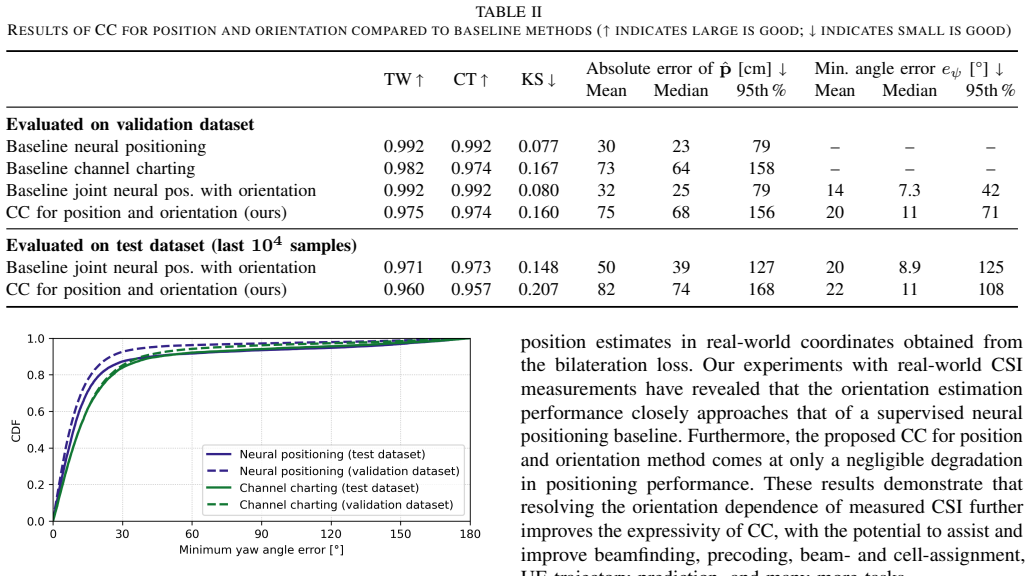
The paper demonstrates that adding a novel orientation triplet loss accounting for angle periodicity and an alignment loss that embeds estimated orientations in real-world coordinates allows channel charting to jointly estimate position and orientation in a self-supervised manner. Using real-world CSI measurements from a standard-compliant 5G NR system, the resulting accuracy for both position and orientation comes close to that of supervised approaches trained with ground-truth labels.
What carries the argument
The orientation triplet loss and alignment loss that embed orientations self-supervised while handling periodicity.
If this is right
- Position and orientation can be estimated jointly from CSI without any ground-truth labels.
- Accuracy for both estimates approaches supervised performance on real 5G NR measurements.
- The estimates support downstream tasks such as beamfinding, precoding, and beam- or cell-assignment.
- The approach operates on standard-compliant 5G systems using ordinary channel measurements.
Where Pith is reading between the lines
- Lowering the need for labeled data could reduce the cost of adding localization features to existing 5G deployments.
- The same loss design might apply to other periodic quantities in signal processing beyond orientation.
- Evaluating the method on additional frequency bands or mixed indoor-outdoor settings would test how far the self-supervised performance holds.
Load-bearing premise
The triplet and alignment losses avoid systematic biases from angle periodicity or measurement noise that would make accuracy fall below supervised baselines.
What would settle it
A new collection of 5G NR CSI measurements in which the proposed method's orientation estimation error exceeds the supervised baseline by a noticeable margin would falsify the claim of close accuracy.
Figures





read the original abstract
Channel charting (CC) in real-world coordinates is a recently proposed self-supervised machine learning method that maps high-dimensional channel state information (CSI) to user equipment (UE) position. In this paper, we extend CC to also estimate UE orientation, which can further assist tasks such as beamfinding, precoding, and beam- and cell-assignment. To this end, we propose a novel orientation triplet loss that accounts for angle periodicity and an alignment loss that embeds estimated orientations in real-world coordinates in a self-supervised fashion. Using real-world CSI measurements from a standard-compliant 5G NR system, we demonstrate that the proposed method achieves position and orientation estimation accuracy close to that of supervised approaches trained with ground-truth labels.
Editorial analysis
A structured set of objections, weighed in public.
Referee Report
Summary. The paper extends channel charting to jointly estimate UE position and orientation from CSI in a self-supervised manner. It introduces an orientation triplet loss that accounts for angle periodicity and an alignment loss that embeds estimated orientations into real-world coordinates. On real-world CSI measurements from a standard-compliant 5G NR system, the method is claimed to achieve position and orientation accuracy close to that of supervised baselines trained with ground-truth labels.
Significance. If the empirical claims hold with rigorous quantitative support, the work would be significant for self-supervised localization and orientation estimation in wireless systems, potentially aiding beam management tasks without requiring labeled data. The use of real 5G NR measurements is a positive aspect for practical relevance.
major comments (2)
- [Abstract] Abstract: the central claim that the method 'achieves position and orientation estimation accuracy close to that of supervised approaches' is stated without any error metrics, RMSE values, dataset size, or comparison tables; this makes the empirical contribution impossible to evaluate from the provided description and requires explicit quantitative results in the evaluation section.
- [Methods (alignment loss definition)] The alignment loss is presented as enabling self-supervised embedding of orientations in real-world coordinates, yet the description leaves open whether this loss implicitly relies on external references or fitted parameters that would undermine the self-supervised claim; the methods section must provide the exact loss formulation and training procedure to resolve this.
minor comments (2)
- Provide the precise mathematical definition of the orientation triplet loss, including how periodicity is handled (e.g., via angular distance metric).
- Include ablation studies on the contribution of each loss term and details on the real-world dataset (number of samples, environment, ground-truth acquisition method).
Simulated Author's Rebuttal
We thank the referee for the constructive comments. We address each major comment point by point below and will revise the manuscript to improve clarity.
read point-by-point responses
-
Referee: [Abstract] Abstract: the central claim that the method 'achieves position and orientation estimation accuracy close to that of supervised approaches' is stated without any error metrics, RMSE values, dataset size, or comparison tables; this makes the empirical contribution impossible to evaluate from the provided description and requires explicit quantitative results in the evaluation section.
Authors: We agree that the abstract would benefit from including quantitative support for the claim. The evaluation section already contains the detailed error metrics, RMSE values, dataset size, and comparison tables. To make the abstract self-contained, we will revise it to explicitly summarize these key quantitative results. revision: yes
-
Referee: [Methods (alignment loss definition)] The alignment loss is presented as enabling self-supervised embedding of orientations in real-world coordinates, yet the description leaves open whether this loss implicitly relies on external references or fitted parameters that would undermine the self-supervised claim; the methods section must provide the exact loss formulation and training procedure to resolve this.
Authors: The alignment loss is designed to be fully self-supervised, using only the CSI measurements and the position estimates from channel charting to align orientations to real-world coordinates without any external references, ground-truth labels, or additional fitted parameters. The exact loss formulation and training procedure are provided in the methods section. To eliminate any ambiguity, we will expand the description with the complete mathematical expression and a step-by-step outline of the training procedure. revision: yes
Circularity Check
No significant circularity identified
full rationale
The paper presents an empirical self-supervised extension of channel charting to orientation estimation via novel triplet and alignment losses, with central claims validated directly against supervised baselines on external real-world 5G NR CSI measurements. No load-bearing derivation, self-definitional equations, fitted-input predictions, or self-citation chains that reduce the result to its inputs by construction appear in the abstract or description. The method is self-contained against external benchmarks.
Axiom & Free-Parameter Ledger
Reference graph
Works this paper leans on
-
[1]
6G white paper on localization and sensing,
A. Bourdoux, A. N. Barreto, B. van Liempd, C. de Lima, D. Dar- dari, D. Belotet al., “6G white paper on localization and sensing,” arXiv:2006.01779, Jun. 2020
-
[2]
Channel charting: Locating users within the radio environment using channel state information,
C. Studer, S. Medjkouh, E. Gonulta¸ s, T. Goldstein, and O. Tirkkonen, “Channel charting: Locating users within the radio environment using channel state information,”IEEE Access, vol. 6, pp. 47 682–47 698, 2018
2018
-
[3]
Channel charting in real-world coordinates with distributed MIMO,
S. Taner, V . Palhares, and C. Studer, “Channel charting in real-world coordinates with distributed MIMO,”IEEE Trans. Wireless Commun., vol. 24, no. 9, pp. 7286–7300, 2025
2025
-
[4]
CSI-based user positioning, channel charting, and device classification with an NVIDIA 5G testbed,
R. Wiesmayr, F. Zumegen, S. Taner, C. Dick, and C. Studer, “CSI-based user positioning, channel charting, and device classification with an NVIDIA 5G testbed,” inProc. Asilomar Conf. Signals, Syst., Comput., Oct. 2025
2025
-
[5]
Angle-delay profile-based and timestamp-aided dissimilarity metrics for channel charting,
P. Stephan, F. Euchner, and S. ten Brink, “Angle-delay profile-based and timestamp-aided dissimilarity metrics for channel charting,”IEEE Trans. Commun., vol. 72, no. 9, pp. 5611–5625, 2024
2024
-
[6]
Three-dimensional radio localization: A channel charting-based approach,
——, “Three-dimensional radio localization: A channel charting-based approach,” inProc. Asilomar Conf. Signals, Syst., Comput., Oct. 2025
2025
-
[7]
Triplet- based wireless channel charting: Architecture and experiments,
P. Ferrand, A. Decurninge, L. G. Ordóñez, and M. Guillaud, “Triplet- based wireless channel charting: Architecture and experiments,”IEEE J. Sel. Areas Commun., vol. 39, no. 8, pp. 2361–2373, 2021
2021
-
[8]
Joint Localization and Orientation with Triple-Beam Fingerprints in Massive MIMO-OFDM
Y . Zhao, Z. Jin, J. Tang, L. You, C. Sun, X.-G. Xiaet al., “Joint localization and orientation with triple-beam fingerprints in massive MIMO-OFDM,”arXiv:2605.26549, May 2026
work page internal anchor Pith review Pith/arXiv arXiv 2026
-
[9]
Aerial Testbed (ATB),
NVIDIA, “Aerial Testbed (ATB),” https://docs.nvidia.com/aerial/testbed/ latest/index.html, 2026, accessed: 2026-06-14
2026
-
[10]
DNN-based localization from channel estimates: Feature design and experimental results,
P. Ferrand, A. Decurninge, and M. Guillaud, “DNN-based localization from channel estimates: Feature design and experimental results,” in Proc. IEEE Global Telecommun. Conf. (GLOBECOM), Dec. 2020
2020
-
[11]
Automatic differentiation in PyTorch,
A. Paszke, S. Gross, S. Chintala, G. Chanan, E. Yang, Z. DeVitoet al., “Automatic differentiation in PyTorch,” Oct. 2017
2017
-
[12]
Adam: A Method for Stochastic Optimization
D. P. Kingma and J. Ba, “Adam: A method for stochastic optimization,” arXiv:1412.6980, Jan. 2017
work page internal anchor Pith review Pith/arXiv arXiv 2017
-
[13]
Optuna: A next-generation hyperparameter optimization framework,
T. Akiba, S. Sano, T. Yanase, T. Ohta, and M. Koyama, “Optuna: A next-generation hyperparameter optimization framework,” in25th ACM SIGKDD Int’l’ Conf. Knowledge Discovery Data Mining, Aug. 2019
2019
-
[14]
OptunaHub: A Platform for Black-Box Optimization
Y . Ozaki, S. Watanabe, and T. Yanase, “OptunaHub: A platform for black-box optimization,”arXiv:2510.02798, Apr. 2026
work page internal anchor Pith review Pith/arXiv arXiv 2026
discussion (0)
Sign in with ORCID, Apple, or X to comment. Anyone can read and Pith papers without signing in.