Combining traffic counts and Bluetooth data for link-origin-destination matrix estimation in large urban networks: The Brisbane case study
Pith reviewed 2026-05-24 20:08 UTC · model grok-4.3
The pith
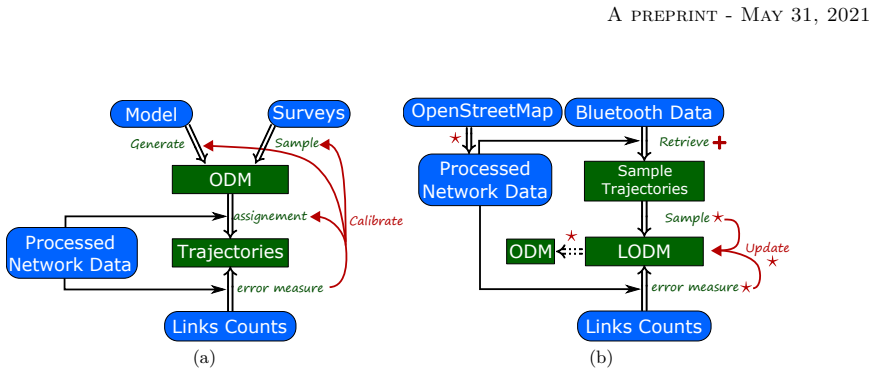
Bluetooth data paired with traffic counts enables estimation of three-dimensional link-origin-destination matrices.
A machine-rendered reading of the paper's core claim, the machinery that carries it, and where it could break.
Core claim
Link-origin-destination matrices can be recovered by solving an inverse problem that incorporates both aggregate traffic counts and the partial origin-destination and itinerary information supplied by Bluetooth detectors; the objective function encodes a trade-off among traffic conservation, consistency with measurements and other structural properties, and the approach is implemented and illustrated on the Brisbane urban network.
What carries the argument
The inverse-problem formulation whose objective function represents a trade-off between important properties the traffic has to satisfy, producing the three-dimensional link-origin-destination matrix.
If this is right
- The resulting matrices supply link-level assignment information in addition to origin-destination totals.
- The method scales to networks instrumented with hundreds of Bluetooth detectors.
- Traffic analysis gains new granularity for planning and operations once the matrices are obtained.
- The same inverse-problem structure can accept other partial itinerary data sources.
Where Pith is reading between the lines
- If the weighting parameters can be learned from limited ground-truth data, the approach might generalize across cities with different detector densities.
- The three-dimensional matrices could feed directly into dynamic traffic assignment models or real-time control algorithms.
- Comparison of successive daily matrices might reveal recurring route-choice patterns without additional modeling.
Load-bearing premise
The chosen weighting of the objective-function terms and the exact definitions of the traffic properties yield a matrix that is both valid and useful without further external checks.
What would settle it
Independent traffic observations or surveys in Brisbane that show systematic mismatch between the estimated link flows or origin-destination volumes and the held-out measurements.
Figures


read the original abstract
Origin-Destination matrix estimation is a keystone for traffic representation and analysis. Traditionally estimated thanks to traffic counts, surveys and socio-economic models, recent technological advances permit to rethink the estimation problem. Road user identification technologies, such as connected GPS, Bluetooth or Wifi detectors bring additional information, that is, for a fraction of the users, the origin, the destination and to some extend the itinerary taken. In the present work, this additional information is used for the estimation of a more comprehensive traffic representation tool: the link-origin-destination matrix. Such three-dimensional matrices extend the concept of traditional origin-destination matrices by also giving information on the traffic assignment. Their estimation is solved as an inverse problem whose objective function represents a trade-off between important properties the traffic has to satisfy. This article presents the theory and how to implement such method on real dataset. With the case study of Brisbane City where over 600 hundreds Bluetooth detectors have been installed it also illustrates the opportunities such link-origin-destination matrices create for traffic analysis.
Editorial analysis
A structured set of objections, weighed in public.
Referee Report
Summary. The paper claims to develop and implement a method for estimating three-dimensional link-origin-destination (link-OD) matrices by combining traffic counts with Bluetooth-derived origin, destination, and partial path information. The estimation is formulated as an inverse problem whose objective function trades off consistency with observed counts, Bluetooth paths, and other traffic properties; the approach is demonstrated on the Brisbane network using data from over 600 Bluetooth detectors, with discussion of resulting opportunities for traffic analysis.
Significance. If the estimated link-OD matrices can be shown to recover actual flows more accurately than count-only baselines, the work would provide a practical way to obtain assignment-aware traffic representations at urban scale. The deployment of a large real-world Bluetooth sensor network and the explicit treatment of implementation details on that dataset constitute a concrete strength.
major comments (2)
- [Case study and results (likely §4–5)] The central construction solves the inverse problem by minimizing an objective that trades off consistency with traffic counts, Bluetooth-derived paths, and other traffic properties, yet the manuscript supplies no quantitative comparison of the resulting link-OD entries to independent survey or probe-vehicle OD data, nor any cross-validation that would show the chosen weights recover known matrices better than count-only baselines.
- [Method (objective-function formulation)] The objective-function weights and constraint definitions are presented as producing a valid matrix, but no external validation or sensitivity analysis against ground-truth matrices is reported; this is load-bearing for the claim that the estimated matrices constitute a useful traffic representation tool.
minor comments (1)
- [Abstract] Abstract contains the phrase 'over 600 hundreds Bluetooth detectors', which is a typographical error.
Simulated Author's Rebuttal
We thank the referee for the positive assessment of the real-world deployment and implementation details. We address the two major comments below, which both concern validation.
read point-by-point responses
-
Referee: [Case study and results (likely §4–5)] The central construction solves the inverse problem by minimizing an objective that trades off consistency with traffic counts, Bluetooth-derived paths, and other traffic properties, yet the manuscript supplies no quantitative comparison of the resulting link-OD entries to independent survey or probe-vehicle OD data, nor any cross-validation that would show the chosen weights recover known matrices better than count-only baselines.
Authors: We agree that a direct quantitative comparison to independent ground-truth OD data would strengthen the results. No such comprehensive link-level survey or probe-vehicle dataset exists for the Brisbane network at the required scale and granularity. The presented validation relies on internal consistency with the input counts and Bluetooth paths. In revision we will add an explicit discussion of this limitation together with a sensitivity study on the objective weights. revision: partial
-
Referee: [Method (objective-function formulation)] The objective-function weights and constraint definitions are presented as producing a valid matrix, but no external validation or sensitivity analysis against ground-truth matrices is reported; this is load-bearing for the claim that the estimated matrices constitute a useful traffic representation tool.
Authors: The formulation guarantees feasibility with respect to the observed counts and Bluetooth information by construction. We acknowledge that external validation against held-out ground-truth matrices is absent. We will incorporate a sensitivity analysis on the weighting parameters in the revised manuscript to address robustness. revision: yes
- No independent ground-truth link-OD survey or probe data is available for the Brisbane network, preventing quantitative comparison or cross-validation against count-only baselines.
Circularity Check
No significant circularity; estimation reduces to standard inverse-problem optimization on external data inputs.
full rationale
The paper formulates link-OD matrix estimation as minimization of an objective trading off consistency with observed traffic counts and Bluetooth-derived paths. No quoted step shows a fitted parameter renamed as a prediction, a self-citation chain supplying the uniqueness or ansatz, or any result defined in terms of itself. The derivation remains self-contained against the supplied count and detector data; external validation is a separate correctness issue, not circularity.
Axiom & Free-Parameter Ledger
free parameters (1)
- objective-function weights
axioms (1)
- domain assumption Traffic must satisfy a collection of properties (flow conservation, consistency with counts, etc.) that can be expressed in a single scalar objective.
Lean theorems connected to this paper
-
IndisputableMonolith/Cost/FunctionalEquation.leanwashburn_uniqueness_aczel unclear?
unclearRelation between the paper passage and the cited Recognition theorem.
Their estimation is solved as an inverse problem whose objective function represents a trade-off between important properties the traffic has to satisfy.
-
IndisputableMonolith/Foundation/RealityFromDistinction.leanreality_from_one_distinction unclear?
unclearRelation between the paper passage and the cited Recognition theorem.
fK(Q) = sum (I - E) Q ^2 (Kirchhoff conservation)
What do these tags mean?
- matches
- The paper's claim is directly supported by a theorem in the formal canon.
- supports
- The theorem supports part of the paper's argument, but the paper may add assumptions or extra steps.
- extends
- The paper goes beyond the formal theorem; the theorem is a base layer rather than the whole result.
- uses
- The paper appears to rely on the theorem as machinery.
- contradicts
- The paper's claim conflicts with a theorem or certificate in the canon.
- unclear
- Pith found a possible connection, but the passage is too broad, indirect, or ambiguous to say the theorem truly supports the claim.
Reference graph
Works this paper leans on
-
[1]
Methods for the study of retail relationships
W. J. Reilly et al., “Methods for the study of retail relationships”, 1929
work page 1929
-
[2]
What’s missing from australian household travel surveys? Off-peak travel!
T. Veitch, M. Paech, and J. Eaton, “What’s missing from australian household travel surveys? Off-peak travel!”, in Australasian Transport Research Forum 2013, Brisbane, Oct. 2013
work page 2013
-
[3]
C. Antoniou, J. Barcel´ o, M. Breen, M. Bullejos, J. Casas, E. Cipriani, B. Ciuffo, T. Djukic, S. Hoogen- doorn, V. Marzano, et al., “Towards a generic benchmarking platform for origin–destination flows es- timation/updating algorithms: Design, demonstration and validation”, Transportation Research Part C: Emerging Technologies, vol. 66, pp. 79–98, 2016
work page 2016
-
[4]
On combining maximum entropy trip matrix estimation with user optimal assignment
C. Fisk, “On combining maximum entropy trip matrix estimation with user optimal assignment”, Transportation Research Part B: Methodological, vol. 22, no. 1, pp. 69–73, 1988
work page 1988
-
[5]
Entropy in urban and regional modelling: Retrospect and prospect
A. Wilson, “Entropy in urban and regional modelling: Retrospect and prospect.”, Geographical Anal- ysis, vol. 42, no. 4, pp. 364–394, 2010
work page 2010
-
[6]
The most likely trip matrix estimated from traffic counts
H. J. Van Zuylen and L. G. Willumsen, “The most likely trip matrix estimated from traffic counts”, Transportation Research Part B: Methodological, vol. 14, no. 3, pp. 281–293, 1980
work page 1980
-
[7]
W. H. Lam and H. Lo, “Estimation of origin-destination matrix from traffic counts: A comparison of entropy maximizing and information minimizing models”, Transportation Planning and Technology , vol. 16, no. 2, pp. 85–104, 1991
work page 1991
-
[8]
A maximum likelihood model for estimating origin-destination matrices
H. Spiess, “A maximum likelihood model for estimating origin-destination matrices”, Transportation Research Part B: Methodological, vol. 21, no. 5, pp. 395–412, 1987
work page 1987
-
[9]
Methods to combine different data sources and estimate origin-destination matrices
M. Ben-Akiva, “Methods to combine different data sources and estimate origin-destination matrices”, Transportation and traffic theory, 1987
work page 1987
-
[10]
A bayesian method for estimating traffic flows based on plate scanning
E. Castillo, P. Jim´ enez, J. M. Men´ endez, and M. Nogal, “A bayesian method for estimating traffic flows based on plate scanning”, Transportation, vol. 40, no. 1, pp. 173–201, 2013
work page 2013
-
[11]
K. Perrakis, D. Karlis, M. Cools, and D. Janssens, “Bayesian inference for transportation origin– destination matrices: The poisson–inverse gaussian and other poisson mixtures”, Journal of the Royal Statistical Society: Series A (Statistics in Society) , vol. 178, no. 1, pp. 271–296, 2015
work page 2015
-
[12]
Inferences on trip matrices from observations on link volumes: A bayesian statistical approach
M. Maher, “Inferences on trip matrices from observations on link volumes: A bayesian statistical approach”, Transportation Research Part B: Methodological, vol. 17, no. 6, pp. 435–447, 1983
work page 1983
-
[13]
Estimation of origin–destination matrices from link counts and sporadic routing data
K. Parry and M. L. Hazelton, “Estimation of origin–destination matrices from link counts and sporadic routing data”, Transportation Research Part B: Methodological, vol. 46, no. 1, pp. 175–188, 2012
work page 2012
-
[14]
An iterative assignment approach to capacity restraint on arterial networks
R. Smock, “An iterative assignment approach to capacity restraint on arterial networks”, Highway Research Board Bulletin, no. 347, 1962
work page 1962
-
[15]
Estimation of an od matrix from traffic counts–a review
L. G. Willumsen, “Estimation of an od matrix from traffic counts–a review.”, 1978
work page 1978
-
[16]
Iterative update of route choice proportions in od estimation
M. Yousefikia, A. R. Mamdoohi, and M. Noruzoliaee, “Iterative update of route choice proportions in od estimation”, in Proceedings of the Institution of Civil Engineers-Transport , Thomas Telford Ltd, vol. 169, 2016, pp. 53–60
work page 2016
-
[17]
Estimation of origin-destination matrices from link traffic counts on congested networks
H. Yang, T. Sasaki, Y. Iida, and Y. Asakura, “Estimation of origin-destination matrices from link traffic counts on congested networks”, Transportation Research Part B: Methodological, vol. 26, no. 6, pp. 417–434, 1992
work page 1992
-
[18]
Estimation of trip matrices from traffic counts and survey data: A generalized least squares estimator
E. Cascetta, “Estimation of trip matrices from traffic counts and survey data: A generalized least squares estimator”, Transportation Research Part B: Methodological , vol. 18, no. 4-5, pp. 289–299, 1984
work page 1984
-
[19]
A modified physarum-inspired model for the user equilibrium traffic assignment problem
S. Xu, W. Jiang, X. Deng, and Y. Shou, “A modified physarum-inspired model for the user equilibrium traffic assignment problem”, Applied Mathematical Modelling, vol. 55, pp. 340–353, 2018
work page 2018
-
[20]
H. D. Sherali, R. Sivanandan, and A. G. Hobeika, “A linear programming approach for synthesizing origin-destination trip tables from link traffic volumes”, Transportation Research Part B: Methodolog- ical, vol. 28, no. 3, pp. 213–233, 1994
work page 1994
-
[21]
H. Yang, Q. Meng, and M. G. Bell, “Simultaneous estimation of the origin-destination matrices and travel-cost coefficient for congested networks in a stochastic user equilibrium”, Transportation Science, vol. 35, no. 2, pp. 107–123, 2001
work page 2001
-
[22]
M. J. Maher, X. Zhang, and D. Van Vliet, “A bi-level programming approach for trip matrix estimation and traffic control problems with stochastic user equilibrium link flows”, Transportation Research Part B: Methodological, vol. 35, no. 1, pp. 23–40, 2001. 14 A preprint - May 31, 2021
work page 2001
-
[23]
E. Codina and J. Barcel´ o, “Adjustment of o–d trip matrices from observed volumes: An algorithmic approach based on conjugate directions”, European Journal of Operational Research , vol. 155, no. 3, pp. 535–557, 2004
work page 2004
-
[24]
On the calibration of the combined distribution-assignment model
S. Erlander, S. Nguyen, and N. F. Stewart, “On the calibration of the combined distribution-assignment model”, Transportation Research Part B: Methodological, vol. 13, no. 3, pp. 259–267, 1979
work page 1979
-
[25]
Network model calibration studies
T. Toledo, T. Kolechkina, P. Wagner, B. Ciuffo, C. Azevedo, V. Marzano, and G. Fl¨ otter¨ od, “Network model calibration studies”, Daamen W., Buisson C. and S. Hoogendoorn (eds). Traffic simulation and data: Validation methods and applications, CRC Press, Taylor and Francis, London, pp. 141–162, 2015
work page 2015
-
[26]
A robust framework for the estimation of dynamic od trip matrices for reliable traffic management
J. Barcel´ o and L. Montero, “A robust framework for the estimation of dynamic od trip matrices for reliable traffic management”, Transportation Research Procedia, vol. 10, pp. 134–144, 2015
work page 2015
-
[27]
Quasi-dynamic estimation of od flows from traffic counts without prior od matrix
D. Bauer, G. Richter, J. Asamer, B. Heilmann, G. Lenz, and R. K¨ olbl, “Quasi-dynamic estimation of od flows from traffic counts without prior od matrix”, IEEE Transactions on Intelligent Transportation Systems, vol. 19, no. 6, pp. 2025–2034, 2017
work page 2025
-
[28]
Updating origin–destination matrices with aggregated data of gps traces
Q. Ge and D. Fukuda, “Updating origin–destination matrices with aggregated data of gps traces”, Transportation Research Part C: Emerging Technologies, vol. 69, pp. 291–312, 2016
work page 2016
-
[29]
Origin-destination estimation using probe vehicle trajectory and link counts
X. Yang, Y. Lu, and W. Hao, “Origin-destination estimation using probe vehicle trajectory and link counts”, Journal of Advanced Transportation, vol. 2017, 2017
work page 2017
-
[30]
Optimal traffic sensor location for origin–destination estimation using a compressed sensing framework
P. Ye and D. Wen, “Optimal traffic sensor location for origin–destination estimation using a compressed sensing framework”, IEEE Transactions on Intelligent Transportation Systems, vol. 18, no. 7, pp. 1857– 1866, 2016
work page 2016
-
[31]
A primal-dual algorithm for link dependent origin destination matrix estimation
G. Michau, N. Pustelnik, P. Borgnat, P. Abry, A. Nantes, A. Bhaskar, and E. Chung, “A primal-dual algorithm for link dependent origin destination matrix estimation”, IEEE Transactions on Signal and Information Processing over Networks , vol. 3, no. 1, pp. 104–113, 2016
work page 2016
-
[32]
Fundamental understanding on the use of bluetooth scanner as a comple- mentary transport data
A. Bhaskar and E. Chung, “Fundamental understanding on the use of bluetooth scanner as a comple- mentary transport data”, Transportation Research Part C: Emerging Technologies, vol. 37, pp. 42–72, 2013
work page 2013
-
[33]
Bluetooth data in an urban context: Retrieving vehicle trajectories
G. Michau, A. Nantes, A. Bhaskar, E. Chung, P. Abry, and P. Borgnat, “Bluetooth data in an urban context: Retrieving vehicle trajectories”, IEEE Transactions on Intelligent Transportation Systems , vol. 18, no. 9, pp. 2377–2386, 2017
work page 2017
-
[34]
Evaluation of traffic data obtained via gps-enabled mobile phones: The mobile century field experiment
J. C. Herrera, D. B. Work, R. Herring, X. J. Ban, Q. Jacobson, and A. M. Bayen, “Evaluation of traffic data obtained via gps-enabled mobile phones: The mobile century field experiment”, Transportation Research Part C: Emerging Technologies, vol. 18, no. 4, pp. 568–583, 2010
work page 2010
-
[35]
A. M. Hainen, J. S. Wasson, S. M. Hubbard, S. M. Remias, G. D. Farnsworth, and D. M. Bullock, “Estimating route choice and travel time reliability with field observations of bluetooth probe vehicles”, Transportation Research Record, vol. 2256, no. 1, pp. 43–50, 2011
work page 2011
-
[36]
Vehicle trajectory reconstruction using automatic vehicle identification and traffic count data
Y. Feng, J. Sun, and P. Chen, “Vehicle trajectory reconstruction using automatic vehicle identification and traffic count data”, Journal of advanced transportation, vol. 49, no. 2, pp. 174–194, 2015
work page 2015
-
[37]
P. G´ omez, M. Men´ endez, and E. M´ erida-Casermeiro, “Evaluation of trade-offs between two data sources for the accurate estimation of origin–destination matrices”, Transportmetrica B: Transport Dynamics, vol. 3, no. 3, pp. 222–245, 2015
work page 2015
-
[38]
G. Michau, A. Nantes, E. Chung, P. Abry, and P. Borgnat, “Retrieving trip information from a discrete detectors network: The case of brisbane bluetooth detectors”, in Proceedings of CAITR, Sydney, 02 Feb. 2014, Sydney, 2014
work page 2014
-
[39]
Generating route-specific origin–destination tables using bluetooth technology
C. Carpenter, M. Fowler, and T. J. Adler, “Generating route-specific origin–destination tables using bluetooth technology”, Transportation Research Record, vol. 2308, no. 1, pp. 96–102, 2012
work page 2012
-
[40]
Understanding road usage patterns in urban areas
P. Wang, T. Hunter, A. M. Bayen, K. Schechtner, and M. C. Gonz´ alez, “Understanding road usage patterns in urban areas”, Scientific reports, vol. 2, p. 1001, 2012
work page 2012
-
[41]
Estimation of origin-destination matrix from traffic counts: The state of the art
S. Bera and K. Rao, “Estimation of origin-destination matrix from traffic counts: The state of the art”, 2011
work page 2011
-
[42]
Nonsmooth convex opti- mization for structured illumination microscopy image reconstruction
J. Boulanger, N. Pustelnik, L. Condat, L. Sengmanivong, and T. Piolot, “Nonsmooth convex opti- mization for structured illumination microscopy image reconstruction”, Inverse problems, vol. 34, no. 9, p. 095 004, 2018
work page 2018
-
[43]
Le Gall, Brownian motion, martingales, and stochastic calculus
J.-F. Le Gall, Brownian motion, martingales, and stochastic calculus . Springer, 2016, vol. 274
work page 2016
-
[44]
A douglas-rachford splitting approach to nonsmooth convex variational signal recovery
P. L. Combettes and J.-C. Pesquet, “A douglas-rachford splitting approach to nonsmooth convex variational signal recovery”, IEEE Journal of Selected Topics in Signal Processing, vol. 1, no. 4, p. 564, 2007. 15
work page 2007
discussion (0)
Sign in with ORCID, Apple, or X to comment. Anyone can read and Pith papers without signing in.