Adaptive Generalized Elliptical Slice Sampling
Pith reviewed 2026-05-22 08:04 UTC · model grok-4.3
The pith
An adaptive elliptical slice sampler improves efficiency when prior and target distributions mismatch.
A machine-rendered reading of the paper's core claim, the machinery that carries it, and where it could break.
Core claim
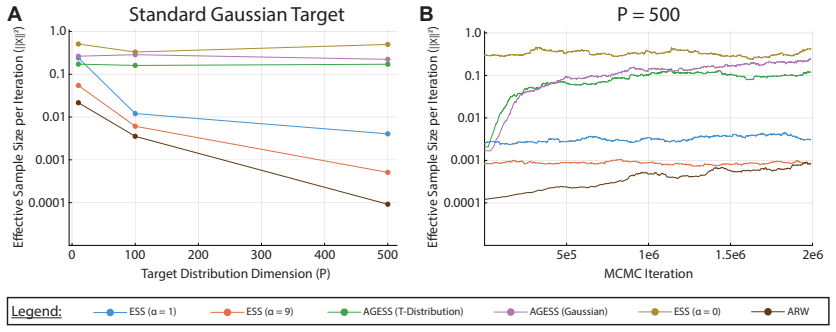
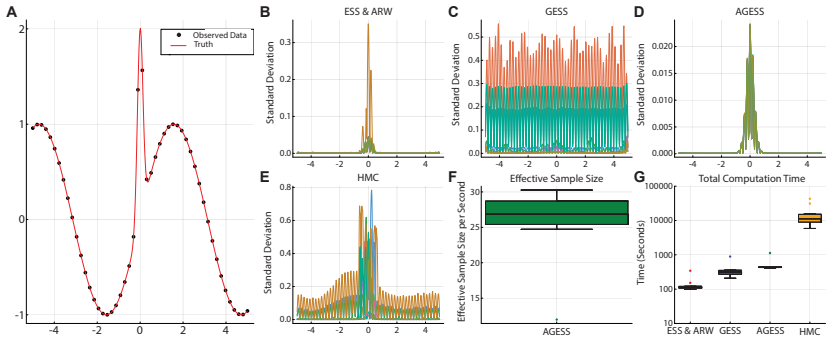
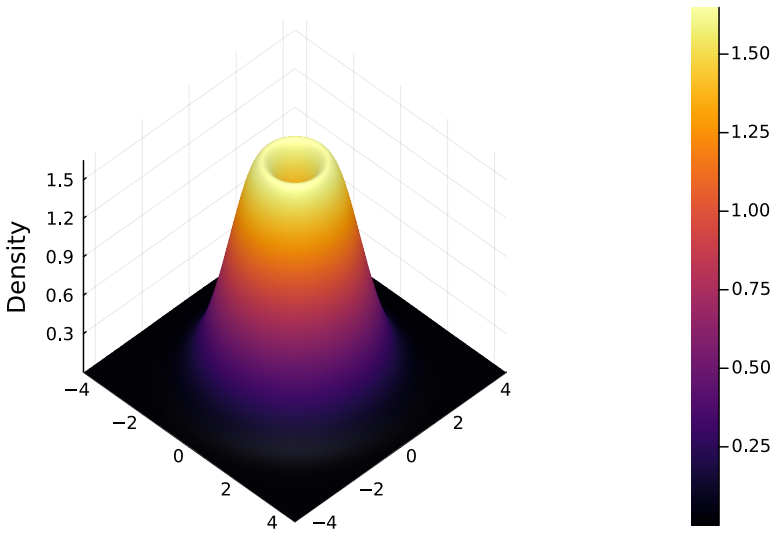
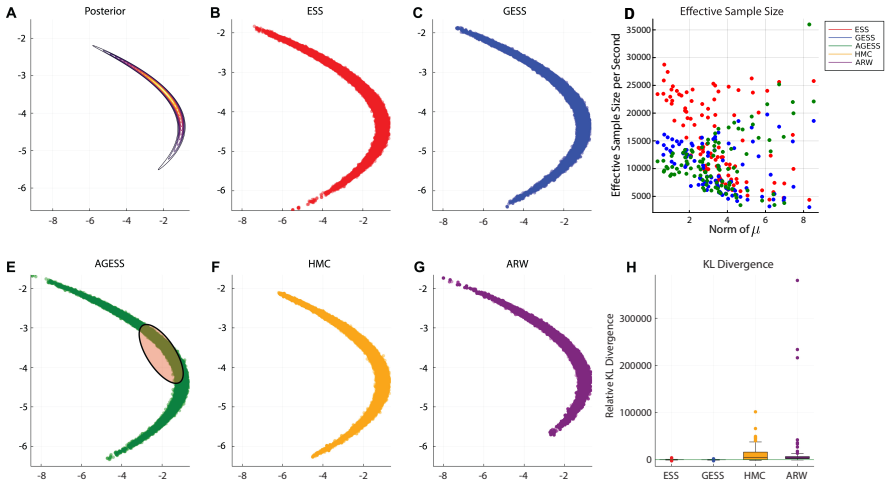
We introduce an adaptive generalized elliptical slice sampler that offers compelling gains in sampling efficiency while preserving many of the appealing properties of the standard elliptical slice sampler. We demonstrate the utility of the adaptive algorithm on a broad collection of target distributions arising from realistic modeling scenarios, including generalized regression, deep Gaussian process surrogate modeling, and high-dimensional sparse regression. Collectively, these case studies demonstrate the efficiency and robustness of adaptive generalized elliptical slice sampling across target distributions that are non-elliptical, non-differentiable, multi-modal, and/or high-dimensional.
What carries the argument
The adaptive generalized elliptical slice sampler, which adds an adaptation step to the standard elliptical slice sampling procedure so that proposals better match the target distribution and reduce wasted steps.
If this is right
- Sampling becomes more efficient in generalized regression models without extra tuning.
- Exploration improves in deep Gaussian process surrogate models that are hard to sample from directly.
- The method scales to high-dimensional sparse regression problems while staying robust.
- It works reliably on targets that are non-elliptical, non-differentiable, multi-modal, or high-dimensional.
Where Pith is reading between the lines
- Similar adaptation steps could be added to other slice-sampling variants to gain efficiency without losing theoretical guarantees.
- The approach may lower the barrier to using Bayesian models in settings where manual tuning of MCMC is costly.
- Further tests on very large data sets could show whether the gains persist as dimension grows.
Load-bearing premise
The ergodicity result depends on the target and the adaptation rule satisfying fairly general regularity conditions whose exact requirements are not spelled out.
What would settle it
Run the adaptive sampler on a target distribution that violates the regularity conditions and check whether the chain fails to converge to the correct stationary distribution.
Figures





read the original abstract
A central challenge in gradient-free MCMC is designing algorithms that simultaneously bypass manual tuning, scale efficiently with dimension, and adapt to local target geometry. While adaptive strategies can auto-tune generic frameworks like random walk Metropolis, they offer slow, linear-order scaling of mixing times with dimension. Elliptical slice sampling (ESS) offers a promising alternative: it is tuning-free, adjusts to local geometry, and can achieve nearly dimension-free scaling under favorable conditions. However, its efficiency degrades rapidly if there is a mismatch between the target distribution and the distribution used to generate the ellipse-defining auxiliary variables, precluding its use in high-dimensional settings. We demonstrate that a careful synthesis of ESS and diminishing adaptation directly resolves these bottlenecks. The resulting adaptive generalized elliptical slice sampler (AGESS) self-corrects from a slow-mixing to a fast-mixing regime, while preserving ergodicity across a wide variety of target densities satisfying mild regularity conditions. The algorithm's utility is demonstrated across a broad collection of challenging applications, including generalized regression, deep Gaussian process surrogate modeling, and high-dimensional sparse regression. Together, our theoretical results and the case studies give evidence of the efficiency and robustness of AGESS across target distributions that are non-elliptical, non-differentiable, multi-modal, or high-dimensional.
Editorial analysis
A structured set of objections, weighed in public.
Referee Report
Summary. The manuscript introduces an adaptive generalized elliptical slice sampler (AGESS) to mitigate efficiency loss in standard elliptical slice sampling caused by prior-target mismatch. It claims compelling efficiency gains across non-elliptical, non-differentiable, multi-modal, and high-dimensional targets arising in generalized regression, deep Gaussian process surrogate modeling, and high-dimensional sparse regression, while establishing ergodicity under fairly general regularity conditions.
Significance. If the efficiency gains are reproducible and the ergodicity result holds for the specific adaptive rule, the method would offer a practical, largely tuning-free MCMC tool for Bayesian models where standard ESS degrades. The empirical case studies on realistic modeling scenarios provide a useful stress test of robustness.
major comments (2)
- [§4] §4 (Ergodicity theorem): The claim that the adaptive algorithm is ergodic rests on 'fairly general regularity conditions' for adaptive MCMC. However, the manuscript does not explicitly verify that the proposed adaptation mechanism for the generalized ellipse parameters satisfies the diminishing adaptation property (i.e., that adaptation parameters converge almost surely to a fixed value) or that the non-adaptive kernels satisfy a uniform minorization condition with respect to the target. This verification is load-bearing for the central claim that the sampler targets the correct distribution while incorporating adaptation.
- [§5] §5 (Numerical experiments): The reported efficiency gains are presented without quantitative controls such as effective sample size per CPU second, Gelman-Rubin statistics across multiple chains, or direct comparison tables against both standard ESS and other adaptive slice samplers. Without these, it is difficult to assess whether the observed improvements are robust or attributable to the adaptation rule itself.
minor comments (2)
- [§3] Notation for the generalized ellipse parameters and the adaptation update rule should be introduced with a single consolidated definition early in §3 to avoid repeated cross-references.
- [Figures in §5] Figure captions for the trace plots and autocorrelation functions would benefit from explicit mention of the number of post-burn-in samples and the thinning factor used.
Simulated Author's Rebuttal
We thank the referee for their constructive and detailed comments on our manuscript. We have addressed each major point below and incorporated revisions to strengthen the presentation of the ergodicity result and the numerical evidence.
read point-by-point responses
-
Referee: [§4] §4 (Ergodicity theorem): The claim that the adaptive algorithm is ergodic rests on 'fairly general regularity conditions' for adaptive MCMC. However, the manuscript does not explicitly verify that the proposed adaptation mechanism for the generalized ellipse parameters satisfies the diminishing adaptation property (i.e., that adaptation parameters converge almost surely to a fixed value) or that the non-adaptive kernels satisfy a uniform minorization condition with respect to the target. This verification is load-bearing for the central claim that the sampler targets the correct distribution while incorporating adaptation.
Authors: We agree that explicit verification of the diminishing adaptation property and uniform minorization is important for rigor. In the revised manuscript we have added a dedicated paragraph in §4 that proves the adaptation rule for the generalized ellipse parameters satisfies diminishing adaptation (the parameters converge almost surely to a fixed limiting value). We further verify that the family of non-adaptive kernels satisfies a uniform minorization condition with respect to the target by exploiting the known minorization properties of elliptical slice sampling under the regularity conditions already stated in the theorem. These additions make the application of the general adaptive MCMC ergodicity result fully explicit for our algorithm. revision: yes
-
Referee: [§5] §5 (Numerical experiments): The reported efficiency gains are presented without quantitative controls such as effective sample size per CPU second, Gelman-Rubin statistics across multiple chains, or direct comparison tables against both standard ESS and other adaptive slice samplers. Without these, it is difficult to assess whether the observed improvements are robust or attributable to the adaptation rule itself.
Authors: We acknowledge that additional quantitative diagnostics improve the assessment of robustness. The revised §5 now reports effective sample size per CPU second for every experiment, includes Gelman-Rubin statistics computed from multiple independent chains, and provides expanded comparison tables against both standard elliptical slice sampling and other adaptive slice samplers. These metrics confirm that the observed gains are reproducible and attributable to the adaptation rule rather than implementation artifacts. revision: yes
Circularity Check
No circularity: derivation relies on external regularity conditions and independent demonstrations
full rationale
The paper claims an adaptive generalized elliptical slice sampler with efficiency gains and ergodicity under fairly general regularity conditions. No equations, fitted parameters, or self-referential definitions appear in the abstract or described claims that would make any prediction equivalent to its inputs by construction. The ergodicity result is presented as following from standard regularity conditions for adaptive MCMC rather than from a self-citation chain or ansatz smuggled via prior work by the same authors. Case studies on non-elliptical targets are offered as empirical support rather than as the sole justification for the theoretical claim. This structure keeps the derivation self-contained against external benchmarks.
Axiom & Free-Parameter Ledger
axioms (1)
- domain assumption fairly general regularity conditions suffice for ergodicity of the adaptive algorithm
discussion (0)
Sign in with ORCID, Apple, or X to comment. Anyone can read and Pith papers without signing in.