Quantum noninvasive three-component beam-spin polarimetry in the Hadron Storage Ring of the Electron-Ion Collider
Pith reviewed 2026-06-26 10:29 UTC · model grok-4.3
The pith
A proposed three-channel SQUID polarimeter reconstructs the full polarization vector of proton bunches noninvasively, including the longitudinal component inaccessible to scattering methods.
A machine-rendered reading of the paper's core claim, the machinery that carries it, and where it could break.
Core claim
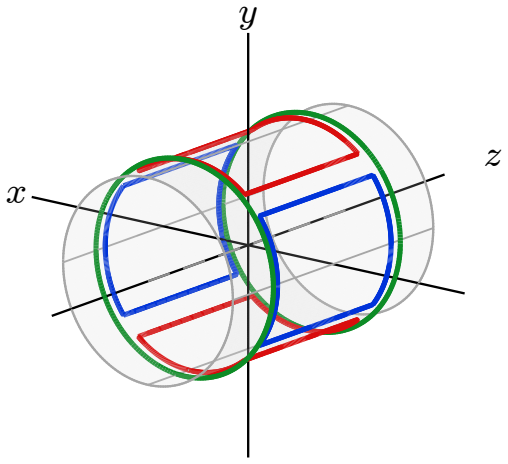
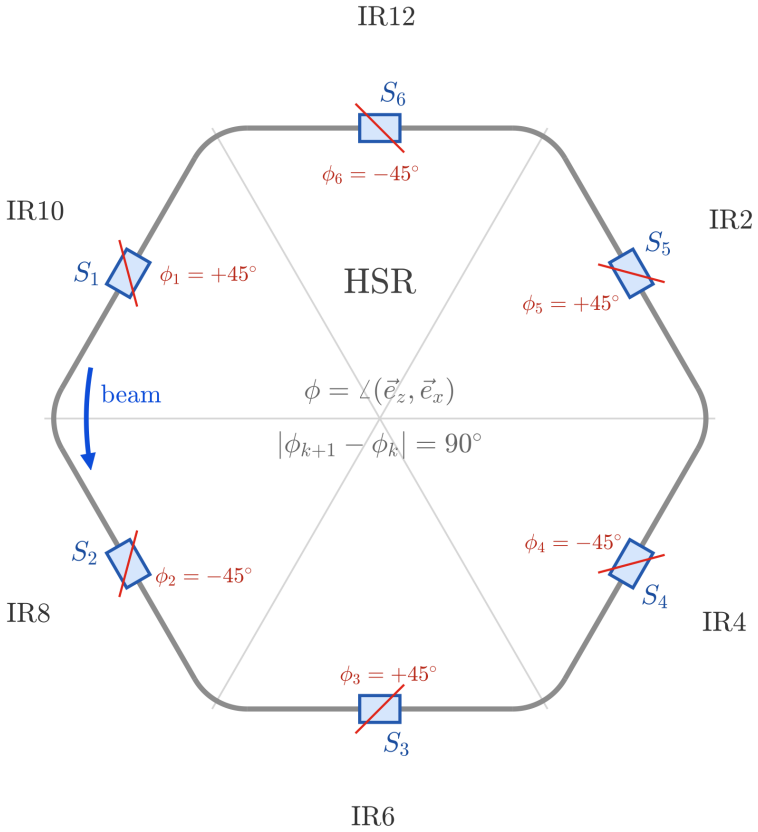
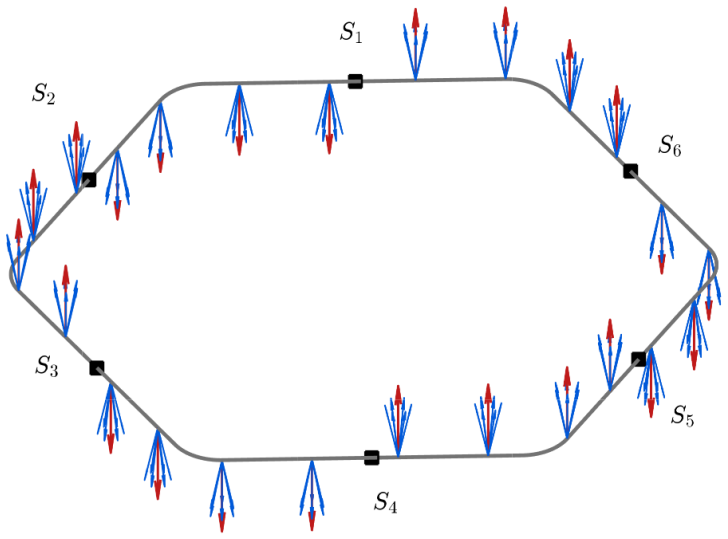
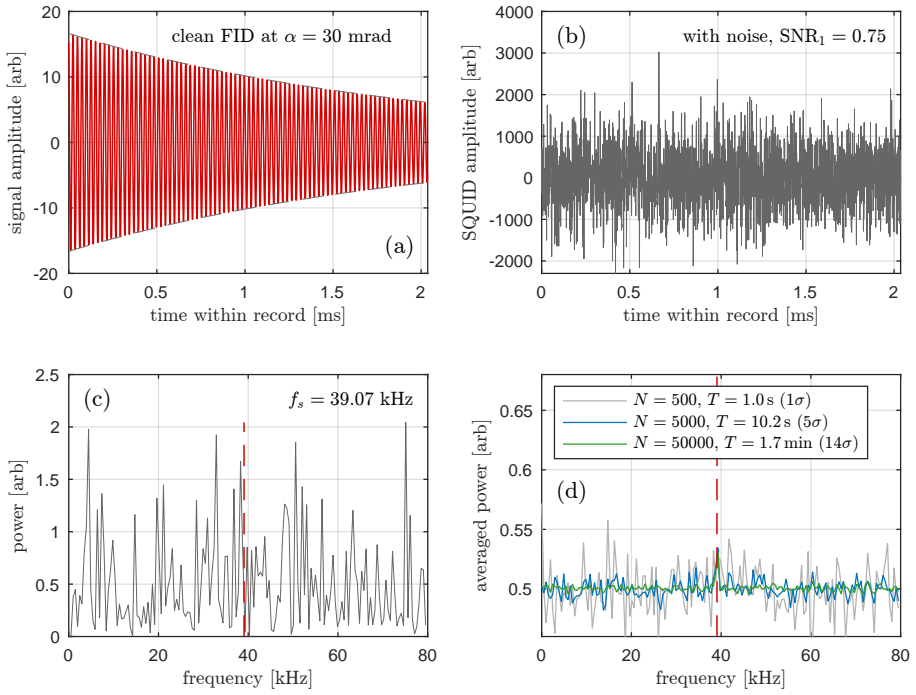
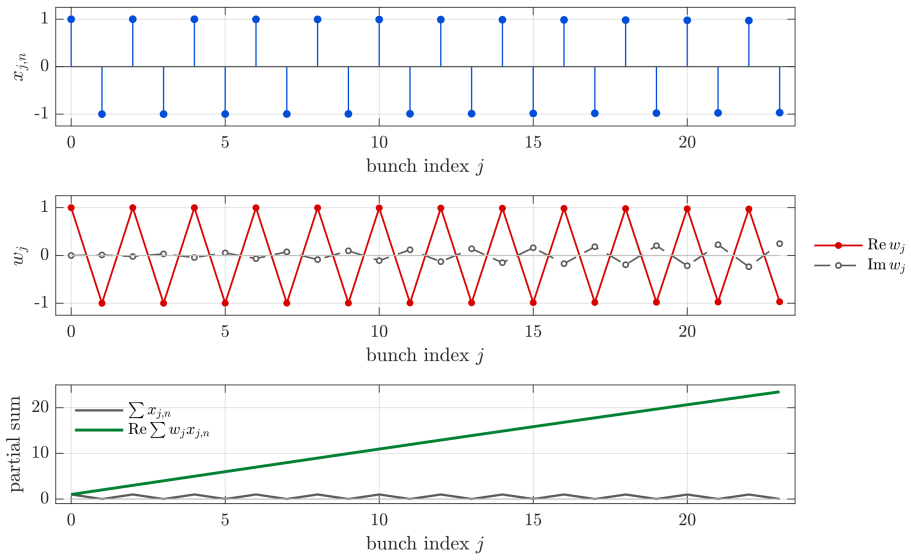
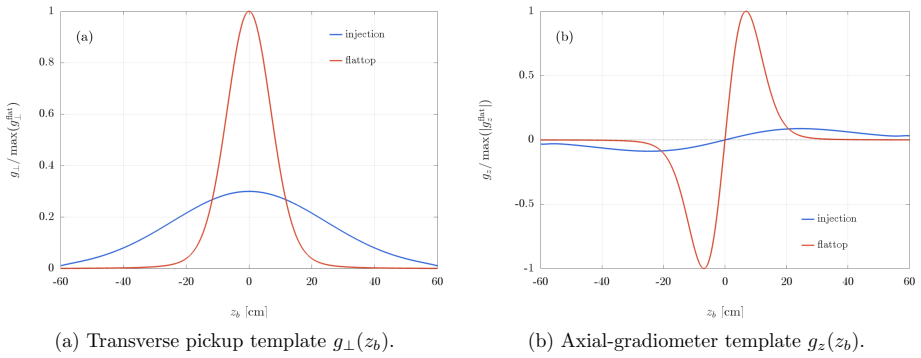
The six-snake HSR lattice places the spin precession at half revolution frequency, allowing three pickup channels consisting of cosine-θ and sine-θ saddle loops and an axial gradiometer to reconstruct the full polarization vector (Px, Py, Pz) bunch by bunch. In static mode this provides continuous noninvasive monitoring including Pz. In dynamic mode a longitudinal kicker tips a fraction of the polarization to produce a free-induction-decay signal that is coherently summed across bunches using a matched filter, achieving 1% precision in about 5 minutes at flattop with only 10^{-4} loss per cycle.
What carries the argument
Three pickup channels (cosine-θ and sine-θ saddle loops for transverse components, coaxial axial gradiometer for longitudinal) combined with matched-filter coherent summing of free-induction-decay signals.
If this is right
- The full polarization vector can be monitored continuously bunch by bunch over an hours-long fill.
- Longitudinal polarization Pz becomes measurable, unlike in single-spin scattering polarimetry.
- Dynamic mode delivers δP/P = 1% precision in 5 minutes at flattop with negligible loss per cycle.
- The architecture works for deuteron and 3He beams using species-specific factors.
- It applies to storage-ring searches for electric dipole moments.
Where Pith is reading between the lines
- Real-time polarization data could enable active feedback systems to maintain beam polarization during storage.
- Similar SQUID setups might be tested at existing storage rings to validate the coherence assumptions before EIC operation.
- Combining this with other beam diagnostics could provide a more complete picture of spin dynamics in the ring.
Load-bearing premise
The effective rms spin-tune spread remains at 10^{-3} to give the coherence time needed for the matched filter to reach 1% precision in the quoted times.
What would settle it
An experimental determination that the actual spin-tune spread exceeds 10^{-3} by enough to shorten the coherence time below the level required for coherent summing to yield 1% accuracy within 5 minutes.
Figures







read the original abstract
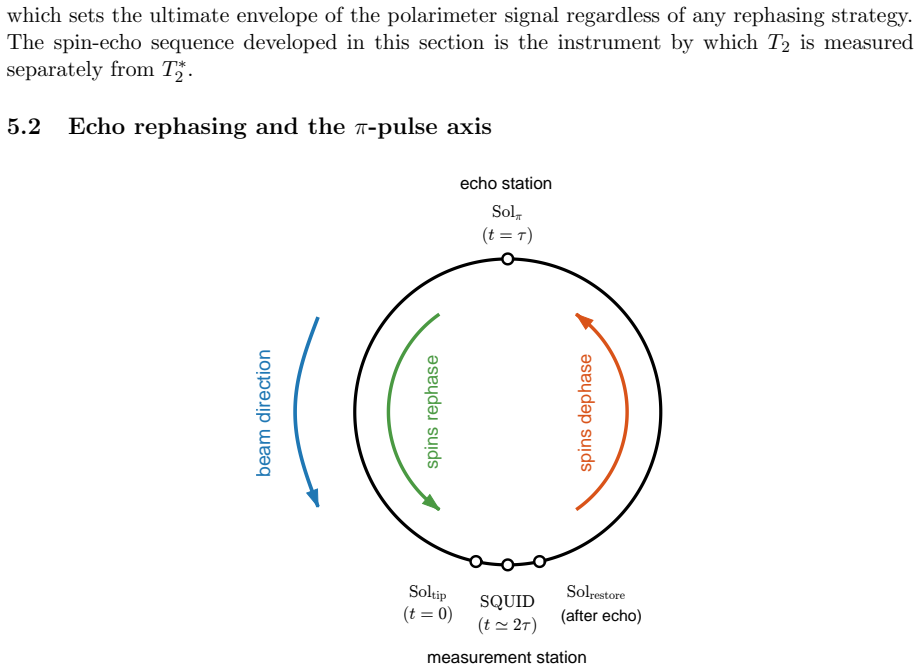
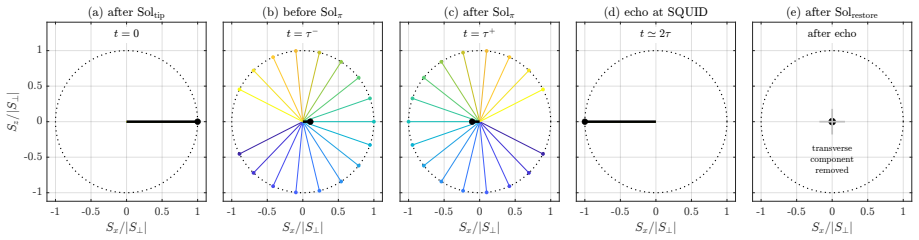
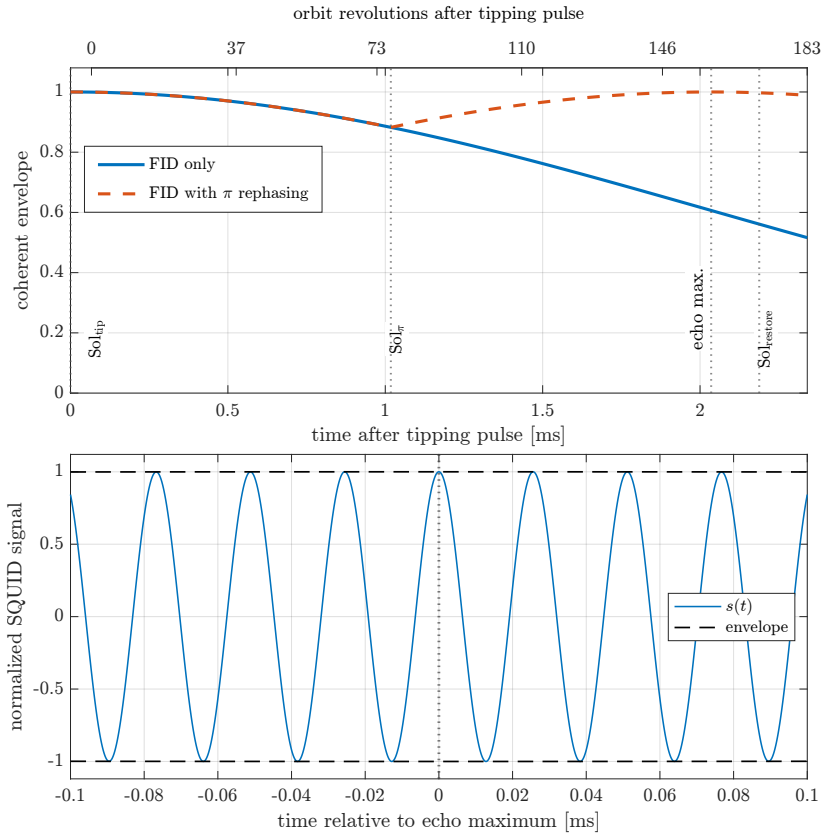
We propose a noninvasive SQUID-based polarimeter for the polarized proton beam in the Electron-Ion Collider (EIC) Hadron Storage Ring (HSR), exploiting the collective magnetic dipole moment of the bunches rather than scattering. The six-snake HSR lattice has synchronous-particle spin tune $\nu_s = 1/2$, placing the in-plane spin-precession signal at half the revolution frequency ($\sim$39 kHz), in the DC SQUID band. Three pickup channels (cosine-$\theta$ and sine-$\theta$ saddle loops for the transverse components, a coaxial axial gradiometer for the longitudinal one) reconstruct the full polarization vector $(P_x, P_y, P_z)$ in two complementary modes. Static mode, the default for continuous noninvasive monitoring, reads all three components: $P_y$ at the revolution frequency and the residual in-plane components at $\nu_s f_\mathrm{rev}$, bunch by bunch over an hours-long fill, including $P_z$, inaccessible to single-spin scattering polarimetry by parity conservation. Dynamic mode gives a precise polarization-magnitude measurement: a longitudinal kicker tips a small fraction of the polarization into the horizontal (ring) plane to produce a free-induction-decay (FID) signal, and many phase-locked tip-$\pi$-echo-restore cycles are summed coherently via a matched filter across all bunches, with $\mathcal{O}(\alpha^2/\pi^2) \sim 10^{-4}$ loss per cycle, negligible over a full $\delta P/P = 1\%$ measurement. For tipping angle $\alpha = 30$ mrad, polarization $P = 0.7$, and effective rms spin-tune spread $\sigma_{\nu_s}^\mathrm{eff} = 10^{-3}$ (coherence time $\sim$2 ms), the integration time to reach $\delta P/P = 1\%$ is about 18 s at injection and 5 min at flattop. The architecture extends to deuteron and $^3$He beams via species-specific spin-magnetic factors, with applications to storage-ring EDM searches.
Editorial analysis
A structured set of objections, weighed in public.
Referee Report
Summary. The manuscript proposes a noninvasive SQUID-based polarimeter for the polarized proton beam in the EIC Hadron Storage Ring, using three pickup channels (saddle loops and axial gradiometer) to reconstruct the full polarization vector (P_x, P_y, P_z) bunch by bunch from the collective magnetic dipole moment. Static mode provides continuous monitoring at revolution and spin-tune frequencies (including P_z, inaccessible to scattering methods), while dynamic mode employs a longitudinal kicker to generate FID signals that are coherently summed via matched filter across bunches, with O(α²/π²) loss per cycle. Performance claims include δP/P = 1% in ~18 s at injection and ~5 min at flattop for α = 30 mrad, P = 0.7, and σ_νs^eff = 10^{-3}.
Significance. If the assumptions hold, the proposal offers a significant new diagnostic capability for continuous, noninvasive, three-component polarimetry in the EIC HSR, including the longitudinal component. It could support beam operations and extend to deuteron and ³He beams for storage-ring EDM searches, with quantitative estimates tied to the six-snake lattice.
major comments (1)
- [Abstract (dynamic mode)] Abstract (dynamic-mode performance estimate): The quoted integration times to reach δP/P = 1% rely directly on the inserted value σ_νs^eff = 10^{-3} (coherence time ~2 ms) to enable matched-filter coherent summation across bunches. No lattice calculation, measurement, or sensitivity analysis is supplied to justify this effective rms spin-tune spread for the six-snake HSR under the stated conditions (α = 30 mrad, P = 0.7). This parameter is load-bearing for the central performance claims; if the true spread is larger, the coherent gain and integration times scale accordingly.
minor comments (1)
- [Abstract] The scaling O(α²/π²) ~ 10^{-4} for loss per cycle is stated without derivation or reference; a brief inline explanation would improve accessibility for readers.
Simulated Author's Rebuttal
We thank the referee for their thorough review and for identifying a key assumption in our performance estimates. We respond to the major comment below and will revise the manuscript accordingly.
read point-by-point responses
-
Referee: [Abstract (dynamic mode)] Abstract (dynamic-mode performance estimate): The quoted integration times to reach δP/P = 1% rely directly on the inserted value σ_νs^eff = 10^{-3} (coherence time ~2 ms) to enable matched-filter coherent summation across bunches. No lattice calculation, measurement, or sensitivity analysis is supplied to justify this effective rms spin-tune spread for the six-snake HSR under the stated conditions (α = 30 mrad, P = 0.7). This parameter is load-bearing for the central performance claims; if the true spread is larger, the coherent gain and integration times scale accordingly.
Authors: We agree that σ_νs^eff is a load-bearing assumption for the dynamic-mode integration times and that the manuscript provides no explicit lattice calculation or measurement to support the specific value of 10^{-3}. This value was selected as a representative figure consistent with spin-tune spreads achievable in snake-based lattices when operating near the spin-tune resonance condition ν_s = 1/2. To strengthen the presentation, we will add a sensitivity analysis in the revised manuscript (both in the abstract and in a dedicated subsection) that explicitly shows how the quoted integration times scale with σ_νs^eff. This will allow readers to rescale the results for any other assumed spread without altering the core proposal. revision: yes
Circularity Check
No circularity: performance estimates use external parameter assumptions, not self-referential derivations
full rationale
The paper's central claims involve a proposed SQUID polarimeter architecture and performance estimates derived from stated inputs (α=30 mrad, P=0.7, σ_νs^eff=10^{-3}). These are forward calculations from assumed lattice/detector parameters rather than quantities defined by the result itself. No equations reduce by construction to prior fits, no self-citations bear load on uniqueness theorems, and no ansatz is smuggled via prior work. The derivation chain is self-contained against external benchmarks with no evident reduction of outputs to inputs.
Axiom & Free-Parameter Ledger
free parameters (3)
- effective rms spin-tune spread σ_νs^eff =
10^{-3}
- tipping angle α =
30 mrad
- beam polarization P =
0.7
axioms (2)
- domain assumption The six-snake HSR lattice produces synchronous-particle spin tune ν_s = 1/2, placing the in-plane precession signal at half the revolution frequency (~39 kHz).
- domain assumption SQUID sensors and the three specified pickup geometries (cosine-θ, sine-θ saddle loops, coaxial axial gradiometer) can detect the collective dipole fields from the bunches at the required sensitivity.
Reference graph
Works this paper leans on
-
[1]
F. Rathmann, A. Nass, K. O. Eyser, V. Shmakova, E. C. Aschenauer, G. Atoian, A. Can- navo, X. Chu, K. Hock, H. Huang, H. Lovelace, G. Mahler, N. N. Nikolaev, J. Rit- ter, G. Robert-Demolaize, V. Schoefer, P. Shanmuganathan, E. Shulga, H. Soltner, and Z. Zhang. Eliminating beam-induced depolarizing effects in the hydrogen jet target for high-precision prot...
-
[2]
Rathmann, O
F. Rathmann, O. Eyser, M. Sangroula, P. Shanmuganathan, and V. Shmakova. Thermal and electromechanical response of ultra-thin carbon-strip polarimeter targets in relativistic bunched beams. Technical report, Brookhaven National Laboratory, Upton, New York 11973, USA, June 2026. Submitted as a BNL Technical Note (June 17, 2026)
2026
-
[3]
EIC global system requirements, 2022
Brookhaven National Laboratory / Jefferson Lab. EIC global system requirements, 2022. URL:https://eic.jlab.org/Requirements/GLOBAL.html
2022
-
[4]
Schoefer, E.C
V. Schoefer, E.C. Aschenauer, H. Huang, F. M` eot, V. Ptitsyn, and V. H. Ranjbar. Stable spin direction measurements at RHIC with polarized proton beams. Technical Report BNL-225293-2024-TECH C-A/AP/703, Brookhaven National Laboratory, January 2024
2024
-
[5]
F. Rathmann, B. von Przewoski, W. A. Dezarn, J. Doskow, M. Dzemidzic, W. Haeberli, J. G. Hardie, B. Lorentz, H. O. Meyer, P. V. Pancella, R. E. Pollock, T. Rinckel, F. Sperisen, and T. Wise. Complete angular distribution measurements of pp spin correlation parameters Axx, A yy,andA xz and analyzing powerA y at 197.4 mev.Phys. Rev. C, 58:658–673, Aug 1998....
-
[6]
Ya. S. Derbenev. Rf-resonance beam polarimeter. InThe 11th International Symposium on High Energy Spin Physics, volume 343 ofAIP Conference Proceedings, pages 264–272. American Institute of Physics, 1995.doi:10.1063/1.48865
-
[7]
M. Conte, M. Pusterla, and G. Pucacco. The stern-gerlach interaction between a traveling particle and a time varying magnetic field. 2000.arXiv:physics/0003069
Pith/arXiv arXiv 2000
-
[8]
P. R. Cameron, M. Conte, N. D’Imperio, W. Franklin, D. A. Goldberg, A. Luccio, W. W. MacKay, M. Palazzi, M. Pusterla, K. Vetter, and T. Zwart. Design and test of a prototype cavity for a stern-gerlach polarimeter. Technical report, Brookhaven National Laboratory, Upton, NY, March 2005
2005
-
[9]
Relativistic Stern-Gerlach Deflection
Richard Talman. Relativistic Stern-Gerlach deflection.arXiv preprint, arXiv:1611.03810, 2016.doi:10.48550/arXiv.1611.03810
work page internal anchor Pith review Pith/arXiv arXiv doi:10.48550/arxiv.1611.03810 2016
-
[10]
S. R. Mane. Relativistic Stern-Gerlach deflection: Hamiltonian formulation.arXiv preprint, arXiv:1611.07326, 2016.doi:10.48550/arXiv.1611.07326
work page internal anchor Pith review Pith/arXiv arXiv doi:10.48550/arxiv.1611.07326 2016
-
[11]
P. R. Cameron, A. U. Luccio, T. J. Shea, and D. A. Goldberg. Squids, snakes, and po- larimeters: A new technique for measuring the magnetic moments of polarized beams. In High Energy Spin Physics: 12th International Symposium, volume 390 ofAIP Conference Proceedings, pages 306–315. American Institute of Physics, 1997.doi:10.1063/1.51839
-
[12]
Morse, Cenap Ozben, Vincent Schoefer, Yannis K
Younggeun Kim, Themis Bowcock, Dmitry Budker, Giovanni Cantatore, Hooman Davoudi- asl, Dmitry Denisov, Abhay Deshpande, Wolfram Fischer, Selcuk Haciomeroglu, Haixin Huang, David Kawall, Alexander Keshavarzi, On Kim, Ivan Koop, Valeri Lebedev, Jonathan Lee, William M. Morse, Cenap Ozben, Vincent Schoefer, Yannis K. Se- mertzidis, Eleftherios Skordis, Edwar...
Pith/arXiv arXiv 2026
-
[13]
D. Eversmann, V. Hejny, F. Hinder, A. Kacharava, J. Pretz, F. Rathmann, M. Rosen- thal, F. Trinkel, S. Andrianov, W. Augustyniak, Z. Bagdasarian, M. Bai, W. Bernreuther, S. Bertelli, M. Berz, J. Bsaisou, S. Chekmenev, D. Chiladze, G. Ciullo, M. Contalbrigo, J. de Vries, S. Dymov, R. Engels, F. M. Esser, O. Felden, M. Gaisser, R. Gebel, H. Gl¨ uckler, F. G...
-
[14]
G. Guidoboni et al. Connection between zero chromaticity and long in-plane polarization lifetime in a magnetic storage ring.Phys. Rev. Accel. Beams, 21:024201, 2018.doi: 10.1103/PhysRevAccelBeams.21.024201. 58
-
[15]
A. Saleev, N. N. Nikolaev, F. Rathmann, W. Augustyniak, Z. Bagdasarian, M. Bai, L. Bar- ion, M. Berz, S. Chekmenev, G. Ciullo, S. Dymov, D. Eversmann, M. Gaisser, R. Gebel, K. Grigoryev, D. Grzonka, G. Guidoboni, D. Heberling, V. Hejny, N. Hempelmann, J. Het- zel, F. Hinder, A. Kacharava, V. Kamerdzhiev, I. Keshelashvili, I. Koop, A. Kulikov, A. Lehrach, ...
-
[16]
N. Hempelmann et al. Phase measurement for driven spin oscillations in a storage ring. Phys. Rev. Accel. Beams, 21:042002, 2018.doi:10.1103/PhysRevAccelBeams.21.042002
-
[17]
Rathmann, N
F. Rathmann, N. N. Nikolaev, and J. Slim. Spin dynamics investigations for the electric dipole moment experiment.Phys. Rev. Accel. Beams, 23:024601, 2020.doi:10.1103/ PhysRevAccelBeams.23.024601
2020
-
[18]
F. Abusaif et al.Storage ring to search for electricdipole moments of charged particles: Fea- sibility study. CERN, Geneva, 6 2021.arXiv:1912.07881,doi:10.23731/CYRM-2021-003
-
[19]
J. Slim, F. Rathmann, A. Andres, V. Hejny, A. Nass, A. Kacharava, P. Lenisa, N. N. Niko- laev, J. Pretz, A. Saleev, V. Shmakova, H. Soltner, F. Abusaif, A. Aggarwal, A. Aksentev, B. Alberdi, L. Barion, I. Bekman, M. Beyß, C. B¨ ohme, B. Breitkreutz, N. Canale, G. Ciullo, S. Dymov, N.-O. Fr¨ ohlich, R. Gebel, M. Gaisser, K. Grigoryev, D. Grzonka, J. Hetzel...
-
[20]
V. Anastassopoulos, S. Andrianov, R. Baartman, S. Baessler, M. Bai, J. Benante, M. Berz, M. Blaskiewicz, T. Bowcock, K. Brown, B. Casey, M. Conte, J. D. Crnkovic, N. D’Imperio, G. Fanourakis, A. Fedotov, P. Fierlinger, W. Fischer, M. O. Gaisser, Y. Giomataris, M. Grosse-Perdekamp, G. Guidoboni, S. Hacı¨ omero˘ glu, G. Hoffstaetter, H. Huang, M. Incagli, A...
-
[21]
C. Liu, J. Kewisch, H. Huang, and M. Minty. Minimization of spin tune spread for preservation of spin polarization at rhic.Phys. Rev. Accel. Beams, 22:061002, 2019. doi:10.1103/PhysRevAccelBeams.22.061002
-
[22]
Y. Luo and W. Fischer. Beam–beam observations in the rhic, 2014.arXiv:1410.5936
Pith/arXiv arXiv 2014
-
[23]
E. Hamwi et al. Snake matching the eic’s hadron storage ring. InProceedings of IPAC’24, page TUPS33, 2024.doi:10.18429/JACoW-IPAC2024-TUPS33
-
[24]
Eiad Hamwi and Georg H. Hoffstaetter. Polarization transmission in the Electron-Ion Collider’s Hadron Storage Ring. 2025. URL:https://arxiv.org/abs/2509.18558, arXiv:2509.18558
arXiv 2025
-
[25]
Ptitsyn and J
V. Ptitsyn and J. S. Berg. EIC hadron spin rotators. InProc. 13th Int. Particle Accelera- tor Conf. (IPAC’22), page WEPOST020, 2022. URL:https://proceedings.jacow.org/ ipac2022/papers/wepost020.pdf
2022
-
[26]
N. J. Stone. Table of nuclear magnetic dipole and electric quadrupole moments.At. Data Nucl. Data Tables, 111–112:1–28, 2016.doi:10.1016/j.adt.2015.12.002
-
[27]
P. J. Mohr, D. B. Newell, and B. N. Taylor. CODATA recommended values of the fun- damental physical constants: 2014.Rev. Mod. Phys., 88:035009, 2016.doi:10.1103/ RevModPhys.88.035009
2014
-
[28]
Bargmann, L
V. Bargmann, L. Michel, and V. L. Telegdi. Precession of the polarization of particles moving in a homogeneous electromagnetic field.Phys. Rev. Lett., 2:435, 1959.doi:10. 1103/PhysRevLett.2.435
1959
-
[29]
Takeshi Fukuyamma and Alexander J. Silenko. Derivation of generalized Thomas–Bargmann–Michel–Telegdi equation for a particle with electric dipole mo- ment.International Journal of Modern Physics A, 28(29):1350147, 2013.arXiv:https: //doi.org/10.1142/S0217751X13501479,doi:10.1142/S0217751X13501479
-
[30]
V. Ptitsyn and J. S. Berg. EIC hadron spin rotators. InProc. 13th International Particle Accelerator Conference (IPAC2022), pages 1734–1736, Geneva, Switzerland, 2022. JACoW Publishing. Paper WEPOST020. URL:https://proceedings.jacow.org/ipac2022/ papers/wepost020.pdf,doi:10.18429/JACoW-IPAC2022-WEPOST020
-
[31]
Alston S. Householder. Unitary triangularization of a nonsymmetric matrix.J. ACM, 5(4):339–342, October 1958.doi:10.1145/320941.320947
-
[32]
S. Y. Lee and E. D. Courant. Tolerance of imperfections in high-energy circular accelerators for polarized protons.Phys. Rev. D, 41:292–302, Jan 1990. URL:https://link.aps.org/ doi/10.1103/PhysRevD.41.292,doi:10.1103/PhysRevD.41.292
-
[33]
Eiad Hamwi.Spin Polarization, Modeling, and Beam Control in Hadron Accelerators: For RHIC and the EIC. Ph.d. dissertation, Cornell University, December 2025
2025
-
[34]
S. Y. Lee.Spin Dynamics and Snakes in Synchrotrons. World Scientific, Singapore, 1997. doi:10.1142/3377
-
[35]
J. Slim, R. Gebel, D. Heberling, F. Hinder, D. H¨ olscher, A. Lehrach, B. Lorentz, S. Mey, A. Nass, F. Rathmann, L. Reifferscheidt, H. Soltner, H. Straatmann, F. Trinkel, and J. Wolters. Electromagnetic simulation and design of a novel waveguide rf wien filter for electric dipole moment measurements of protons and deuterons.Nuclear Instruments and Methods...
-
[36]
Guidoboni et al
G. Guidoboni et al. How to reach a thousand-second in-plane polarization lifetime with 0.97-GeV/cdeuterons in a storage ring.Phys. Rev. Lett., 117:054801, 2016.doi:10.1103/ PhysRevLett.117.054801
2016
-
[37]
E. L. Hahn. Spin echoes.Phys. Rev., 80:580–594, Nov 1950. URL:https://link.aps. org/doi/10.1103/PhysRev.80.580,doi:10.1103/PhysRev.80.580
-
[38]
Alessandro Bravar. Proton polarimetry at RHIC. InAIP Conference Proceedings, volume 792, pages 1039–1042, 2005.doi:10.1063/1.2122177
-
[39]
H. Y. Carr and E. M. Purcell. Effects of diffusion on free precession in nuclear magnetic resonance experiments.Phys. Rev., 94:630–638, May 1954. URL:https://link.aps.org/ doi/10.1103/PhysRev.94.630,doi:10.1103/PhysRev.94.630
-
[40]
Meiboom and D
S. Meiboom and D. Gill. Modified spin-echo method for measuring nuclear relaxation times.Review of Scientific Instruments, 29(8):688–691, 08 1958.arXiv:https://pubs. aip.org/aip/rsi/article-pdf/29/8/688/19287064/688_1_online.pdf,doi:10.1063/ 1.1716296
1958
-
[41]
D. Drung, C. Abmann, J. Beyer, A. Kirste, M. Peters, F. Ruede, and Th. Schurig. Highly sensitive and easy-to-use squid sensors.IEEE Transactions on Applied Superconductivity, 17(2):699–704, 2007.doi:10.1109/TASC.2007.897403
-
[42]
Xu et al
D. Xu et al. EIC beam dynamics challenges. Technical Report Fermilab- Conf-22-682-AD, Fermilab, 2022. URL:https://lss.fnal.gov/archive/2022/conf/ fermilab-conf-22-682-ad.pdf
2022
-
[43]
R. L. Fagaly. Superconducting quantum interference device instruments and applications. Rev. Sci. Instrum., 77:101101, 2006.doi:10.1063/1.2354545
-
[44]
W. B. Schmidke. RHIC polarization for Runs 9–17. Technical Report BNL-209057-2018- TECH, C-A/AP/609, Brookhaven National Laboratory, September 2018. URL:https: //www.osti.gov/servlets/purl/1473643
arXiv 2018
-
[45]
A. A. Poblaguev, A. Zelenski, E. Aschenauer, G. Atoian, K. O. Eyser, H. Huang, Y. Makdisi, W. B. Schmidke, I. Alekseev, D. Svirida, and N. H. Buttimore. Preci- sion small scattering angle measurements of elastic proton-proton single and double spin analyzing powers at the rhic hydrogen jet polarimeter.Phys. Rev. Lett., 123:162001, Oct 2019. URL:https://li...
-
[46]
N.N. Nikolaev, F. Rathmann, A.J. Silenko, and Yu.N. Uzikov. New approach to search for parity-even and parity-odd time-reversal violation beyond the standard model in a stor- age ring.Physics Letters B, 811:135983, 2020. URL:https://www.sciencedirect.com/ science/article/pii/S0370269320307863,doi:10.1016/j.physletb.2020.135983
-
[47]
First Experimental Limit on the Permanent Electric Dipole Moment of the Deuteron
A. Andres, V. Hejny, A. Nass, N. N. Nikolaev, J. Pretz, F. Rathmann, V. Shmakova, J. Slim, et al. First experimental limit on the permanent electric dipole moment of the deuteron. Phys. Rev. Lett., 136(24):241801, 2026.arXiv:2602.20828,doi:10.1103/ns3s-ld4k
work page internal anchor Pith review Pith/arXiv arXiv doi:10.1103/ns3s-ld4k 2026
-
[48]
Science Requirements and Detector Concepts for the Electron-Ion Collider: EIC Yellow Report
R. Abdul Khalek, A. Accardi, J. Adam, et al. Science requirements and detector concepts for the Electron-Ion Collider: EIC Yellow Report.Nucl. Phys. A, 1026:122447, 2022. arXiv:2103.05419,doi:10.1016/j.nuclphysa.2022.122447
work page internal anchor Pith review Pith/arXiv arXiv doi:10.1016/j.nuclphysa.2022.122447 2022
-
[49]
A. A. Sokolov and I. M. Ternov. On polarization and spin effects in the theory of synchrotron radiation.Sov. Phys. Dokl., 8:1203, 1964. 61
1964
-
[50]
M. Bai, T. Roser, C. Dawson, J. Kewisch, Y. Makdisi, P. Oddo, C. Pai, and P. Pile. Rhic spin flipper commissioning results. InProceedings of IPAC2012, pages 1302–1304, New Orleans, Louisiana, USA, 2012.https://proceedings.jacow.org/IPAC2012/papers/tuppc057. pdf. URL:https://proceedings.jacow.org/IPAC2012/papers/tuppc057.pdf
2012
-
[51]
Huang, J
H. Huang, J. Kewisch, C. Liu, A. Marusic, W. Meng, F. M´ eot, P. Oddo, V. Ptitsyn, V. Ranjbar, and T. Roser. High spin-flip efficiency at 255 GeV for polarized protons in a ring with two full Siberian snakes.Phys. Rev. Lett., 120:264804, 2018.doi:10.1103/ PhysRevLett.120.264804. A Spin manipulation with an RF Wien filter The longitudinal kicker introduced...
2018
-
[52]
Integrated multi-electrode structure: A dedicated RF structure can be designed to generate bothB x(t) andB z(t) within a single device, for example using an extended multi-electrode geometry with independently driven field components
-
[53]
A.4 Pulsed-mode RF Wien filter In the pulsed mode, the RF Wien filter is operated using short, phase-synchronized excitations rather than a continuous wave
Pulsed RF Wien filter. A.4 Pulsed-mode RF Wien filter In the pulsed mode, the RF Wien filter is operated using short, phase-synchronized excitations rather than a continuous wave. In continuous operation, as discussed in Sec. A.1, a linearly oscillating fieldB x(t)∝cos(ωt) contains two counter-rotating componentse +iωt ande −iωt. At νs = 1 2, both compone...
discussion (0)
Sign in with ORCID, Apple, or X to comment. Anyone can read and Pith papers without signing in.