On nonconvex constellations among primes II: (458,3240)
Pith reviewed 2026-05-20 07:14 UTC · model grok-4.3
The pith
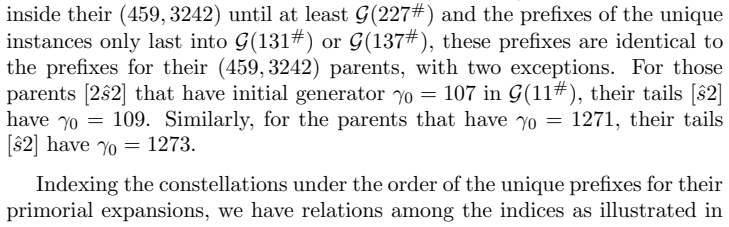
Each (458,3240) constellation occurs only inside its (459,3242) parent until the gap cycle G(227#).
A machine-rendered reading of the paper's core claim, the machinery that carries it, and where it could break.
Core claim
Each of the (458,3240) constellations sits inside a (459,3242) constellation, which we call its parent. We show that no (458,3240) constellation occurs outside of its parent until the cycle G(227#). The early evolution of the (458,3240) constellations is dominated by the evolution of their parents, which we have previously studied. For each (458,3240)-counterexample we calculate its asymptotic relative population, among other constellations of length J=458.
What carries the argument
The nesting of each (458,3240) constellation inside its parent (459,3242) constellation inside successive primorial gap cycles G(p#), together with the breadth-first tracking of admissible driving terms.
If this is right
- The calculated asymptotic relative populations give explicit density estimates for each of the 116 constellations among all length-458 constellations.
- Searches for these constellations in finite ranges can be confined to the interiors of their parent constellations up to G(227#).
- The dominance of parent evolution implies that the first admissible instances of the smaller constellations are inherited directly from the larger ones.
- The same parent-child relation and population calculation can be repeated for other lengths of Engelsma counterexamples.
Where Pith is reading between the lines
- The observed nesting hierarchy may generalize to other pairs of close constellation lengths and could be used to organize exhaustive searches over larger primorials.
- If the relative populations remain stable beyond G(211#), they supply a practical way to rank the expected frequency of different admissible tuples without full enumeration.
- The structure invites comparison with other problems in prime gaps where one admissible set is contained in another, such as chains of constellations differing by a single prime.
Load-bearing premise
The analytic methods and driving terms developed for the parent (459,3242) cases extend without modification or new inadmissible configurations to these 116 smaller instances.
What would settle it
The appearance of any one of the 116 specific (458,3240) constellations in the primes outside all of its identified parent (459,3242) constellations and before the cycle G(227#).
Figures





read the original abstract
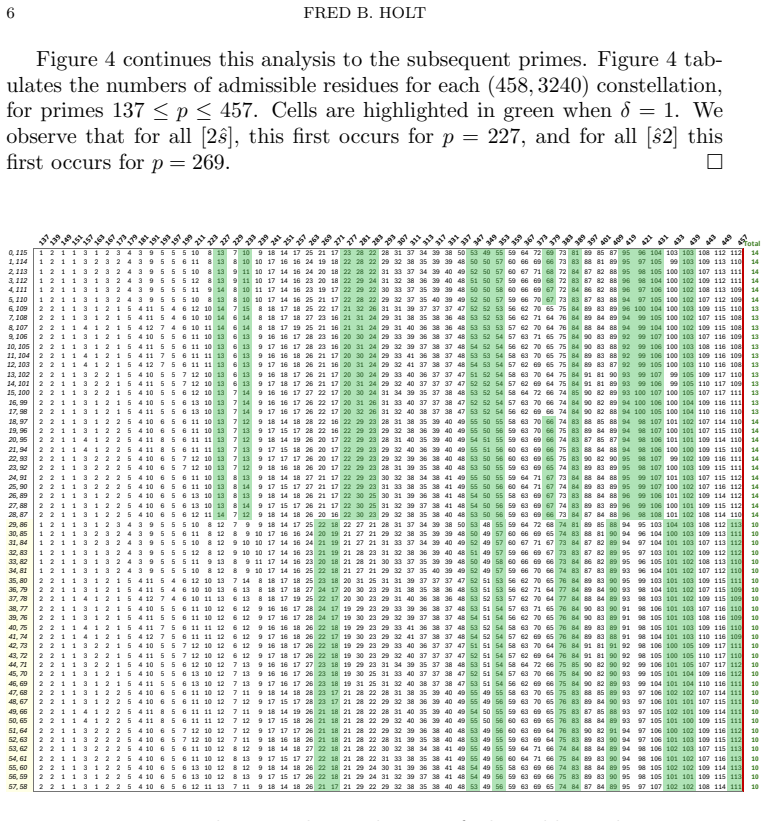
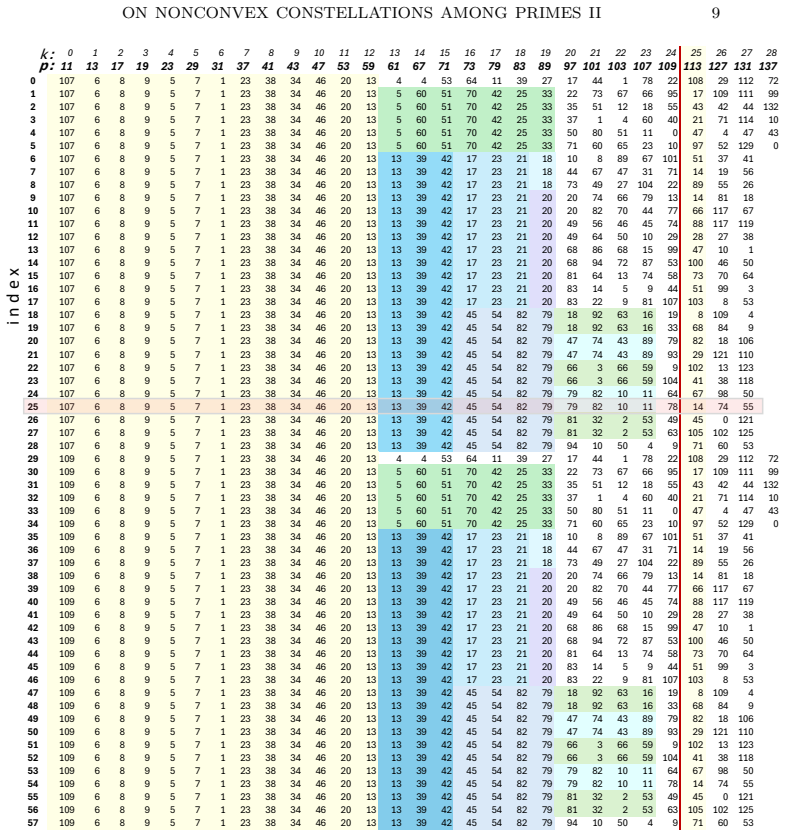
Extending our work on the $k$-tuple conjecture, we previously applied those methods to the Engelsma counterexamples (narrow constellations) of length $J=459$ and span $|s|=3242$. Here we extend that analysis to the $116$ Engelsma counterexamples of length $J=458$ and $|s|=3240$. We track the evolution of these $116$ counterexamples from inadmissible driving terms starting in the cycle of gaps ${\mathcal G}(11^\#)$ up through their first appearance in ${\mathcal G}(113^\#)$. We continue developing primorial coordinates for each admissible instance through a breadth-first exhaustive search through ${\mathcal G}(211^\#)$. Each of the $(458,3240)$ constellations sits inside a $(459,3242)$ constellation, which we call its {\em parent}. We show that no $(458,3240)$ constellation occurs outside of its parent until the cycle ${\mathcal G}(227^\#)$. The early evolution of the $(458,3240)$ constellations is dominated by the evolution of their parents, which we have previously studied. For each $(458,3240)$-counterexample we calculate its asymptotic relative population, among other constellations of length $J=458$.
Editorial analysis
A structured set of objections, weighed in public.
Referee Report
Summary. The manuscript extends the authors' prior analysis of Engelsma counterexamples for J=459 and |s|=3242 to the 116 cases with J=458 and |s|=3240. It tracks the evolution of these counterexamples from inadmissible driving terms in the gap cycle G(11#) through first admissible appearance in G(113#), then continues via primorial coordinates and breadth-first exhaustive search up to G(211#). The central claims are that every such (458,3240) constellation remains inside a parent (459,3242) constellation until G(227#), and that asymptotic relative populations among all J=458 constellations can be computed for each of the 116 instances.
Significance. If the tracking and population results hold, the work supplies concrete data on the early evolution and relative densities of these specific nonconvex constellations, extending the k-tuple conjecture framework to a new family of Engelsma counterexamples. The exhaustive breadth-first enumeration through G(211#) and the explicit population calculations constitute a verifiable computational contribution that could be checked against independent implementations.
major comments (2)
- [§3] §3 (breadth-first search description): the claim that no independent (458,3240) constellation appears before G(227#) rests on the assertion that the search through G(211#) exhaustively enumerates all admissible extensions of the 116 driving terms; the text does not explicitly state the termination criterion or the check that no new admissible configurations arise in the primorial coordinate system between G(113#) and G(211#), which is load-bearing for the parent-containment result.
- [§4] §4 (population calculations): the asymptotic relative populations for the 116 (458,3240) instances are derived from the same driving-term and evolution framework used in the prior (459,3242) paper; it is unclear whether these densities are obtained from independent benchmarks or reduce to quantities already fitted in the earlier work, which directly affects the independence of the new population claims.
minor comments (2)
- [§2] The notation for gap cycles G(p#) and primorial coordinates is used without a self-contained definition or forward reference to the prior paper; a short clarifying paragraph in §2 would improve readability.
- [Table 1] Table 1 (or equivalent listing of the 116 instances) reports first-appearance cycles but does not include the corresponding parent (459,3242) identifiers; adding this column would make the containment statement easier to verify.
Simulated Author's Rebuttal
We thank the referee for the careful and constructive review. We address each major comment below and indicate the changes we will incorporate in the revised manuscript.
read point-by-point responses
-
Referee: [§3] §3 (breadth-first search description): the claim that no independent (458,3240) constellation appears before G(227#) rests on the assertion that the search through G(211#) exhaustively enumerates all admissible extensions of the 116 driving terms; the text does not explicitly state the termination criterion or the check that no new admissible configurations arise in the primorial coordinate system between G(113#) and G(211#), which is load-bearing for the parent-containment result.
Authors: We agree that an explicit statement of the termination criterion and the verification step is needed to support the parent-containment claim. In the revised §3 we will insert a new paragraph that (i) defines the breadth-first search termination condition as the point at which every admissible extension of the 116 driving terms has been enumerated up to G(211#) with no further independent constellations discovered, and (ii) reports the explicit check confirming that every admissible (458,3240) instance remains inside its parent (459,3242) constellation throughout the interval G(113#) to G(211#). These additions will make the load-bearing argument fully transparent. revision: yes
-
Referee: [§4] §4 (population calculations): the asymptotic relative populations for the 116 (458,3240) instances are derived from the same driving-term and evolution framework used in the prior (459,3242) paper; it is unclear whether these densities are obtained from independent benchmarks or reduce to quantities already fitted in the earlier work, which directly affects the independence of the new population claims.
Authors: The asymptotic relative populations are obtained by direct computation from the enumerated admissible extensions and their observed frequencies in the gap cycles up to G(211#), using the same methodological framework as the earlier paper but applied to the distinct set of 116 driving terms and their specific evolution. While the underlying sieve-theoretic machinery is shared, the numerical values themselves are newly determined for the J=458 case and do not simply reuse fitted parameters from the (459,3242) analysis. In the revised §4 we will add one clarifying sentence stating that the populations are computed afresh from the breadth-first enumeration results for these constellations. revision: partial
Circularity Check
Moderate self-citation load-bearing for parent evolution and population framework
specific steps
-
self citation load bearing
[Abstract]
"Each of the (458,3240) constellations sits inside a (459,3242) constellation, which we call its parent. We show that no (458,3240) constellation occurs outside of its parent until the cycle G(227#). The early evolution of the (458,3240) constellations is dominated by the evolution of their parents, which we have previously studied. For each (458,3240)-counterexample we calculate its asymptotic relative population, among other constellations of length J=458."
The demonstration of containment until G(227#) and the calculation of asymptotic relative populations both reduce to extending the author's prior (459,3242) analysis and k-tuple framework. The current paper's search and population results are presented as new but inherit their validity from the self-cited prior results on parent constellations without independent external verification or re-derivation of the driving terms and evolution rules.
full rationale
The paper conducts a new breadth-first exhaustive search through G(211#) starting from driving terms in G(11#) and G(113#) and computes new asymptotic relative populations for the 116 instances. These steps appear self-contained and independent. However, the central claim that every (458,3240) remains inside its (459,3242) parent until G(227#) and that early evolution is dominated by parents explicitly invokes the author's prior analysis of the J=459 case. This creates moderate circularity burden because the load-bearing containment result and population calculations extend the prior framework without re-deriving or machine-verifying the parent behaviors independently in the present work.
Axiom & Free-Parameter Ledger
Lean theorems connected to this paper
-
IndisputableMonolith/Foundation/ArithmeticFromLogic.leanLogicNat recovery and embed_strictMono_of_one_lt unclear?
unclearRelation between the paper passage and the cited Recognition theorem.
We track the evolution of these 116 counterexamples from inadmissible driving terms starting in the cycle of gaps G(11#) up through their first appearance in G(113#). ... Each of the (458,3240) constellations sits inside a (459,3242) constellation, which we call its parent.
-
IndisputableMonolith/Cost/FunctionalEquation.leanwashburn_uniqueness_aczel and Jcost_pos_of_ne_one unclear?
unclearRelation between the paper passage and the cited Recognition theorem.
The asymptotic relative population ... w_s,J(∞) = ∏_{q≤J+1} (q-ν_q) · ∏_{J+1<q≤|s|/2} (q-ν_q)/(q-J-1)
What do these tags mean?
- matches
- The paper's claim is directly supported by a theorem in the formal canon.
- supports
- The theorem supports part of the paper's argument, but the paper may add assumptions or extra steps.
- extends
- The paper goes beyond the formal theorem; the theorem is a base layer rather than the whole result.
- uses
- The paper appears to rely on the theorem as machinery.
- contradicts
- The paper's claim conflicts with a theorem or certificate in the canon.
- unclear
- Pith found a possible connection, but the passage is too broad, indirect, or ambiguous to say the theorem truly supports the claim.
Reference graph
Works this paper leans on
- [1]
-
[2]
G.H. Hardy and J.E. Littlewood. Some problems in 'partitio numerorum' III : On the expression of a number as a sum of primes. In G. H . H ardy C ollected P apers , volume 1, pages 561--630. Clarendon Press, 1966
work page 1966
-
[3]
F.B. Holt. Patterns among the P rimes . KDP, 2022
work page 2022
- [4]
-
[5]
F.B. Holt. On nonconvex constellations among primes I . arXiv:2603.25896v3 , 2026
work page internal anchor Pith review Pith/arXiv arXiv 2026
-
[6]
Combinatorics of the gaps between primes
F.B. Holt and H. Rudd. Combinatorics of the gaps between primes. Connections in Discrete Mathematics - Simon Fraser University , (https://arxiv.org/pdf/1510.00743), 2015
work page internal anchor Pith review Pith/arXiv arXiv 2015
- [7]
-
[8]
A. Sutherland. Sieve theory and gaps between primes: narrow admissible tuples. In Explicit Methods in Number Theory , Mathematisches Forschungsinstitut Oberwolfach, 2015
work page 2015
discussion (0)
Sign in with ORCID, Apple, or X to comment. Anyone can read and Pith papers without signing in.