Exact noise characterization of entanglement distribution in star networks
Pith reviewed 2026-06-27 21:48 UTC · model grok-4.3
The pith
Analytical expressions quantify the average noise and its distribution for GHZ state distribution under dephasing in star networks.
A machine-rendered reading of the paper's core claim, the machinery that carries it, and where it could break.
Core claim
In star networks for multipartite entanglement distribution, elementary links are generated at random times and stored until all succeed. This leads to waiting-time-dependent dephasing noise on the stored links. We obtain exact analytical formulas for the resulting average noise and the full distribution of that noise for GHZ states. The formulas apply to both the factory and piecemaker protocols and cover global cut-off times as well as depolarizing noise in the factory case.
What carries the argument
The distribution of random waiting times for elementary link successes, which sets the amount of dephasing applied to each stored link.
If this is right
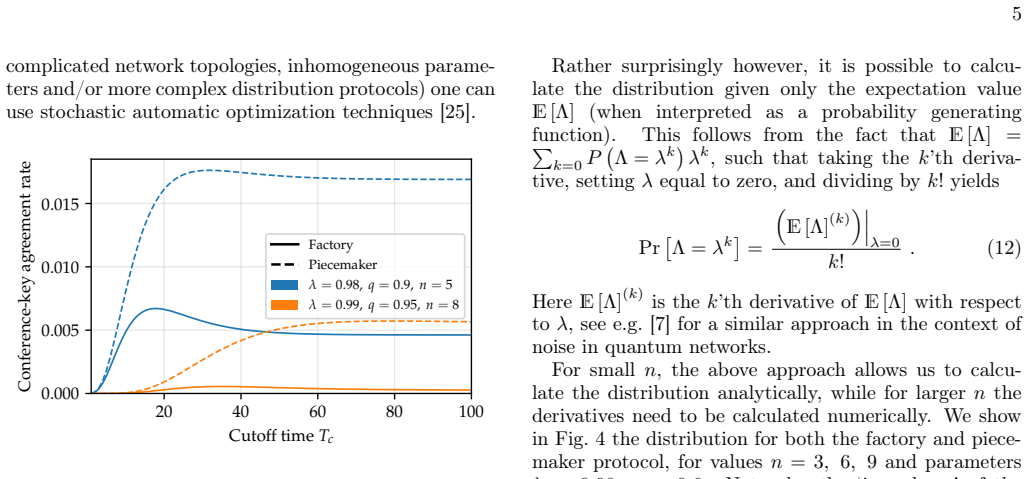
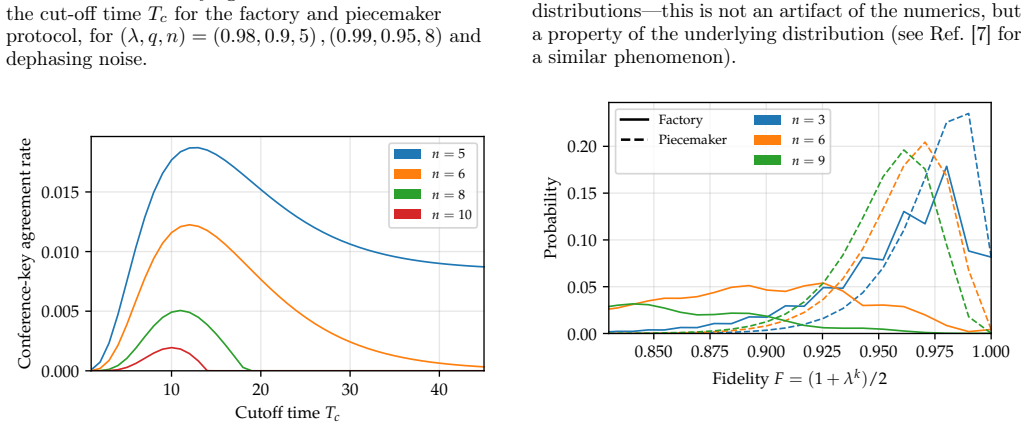
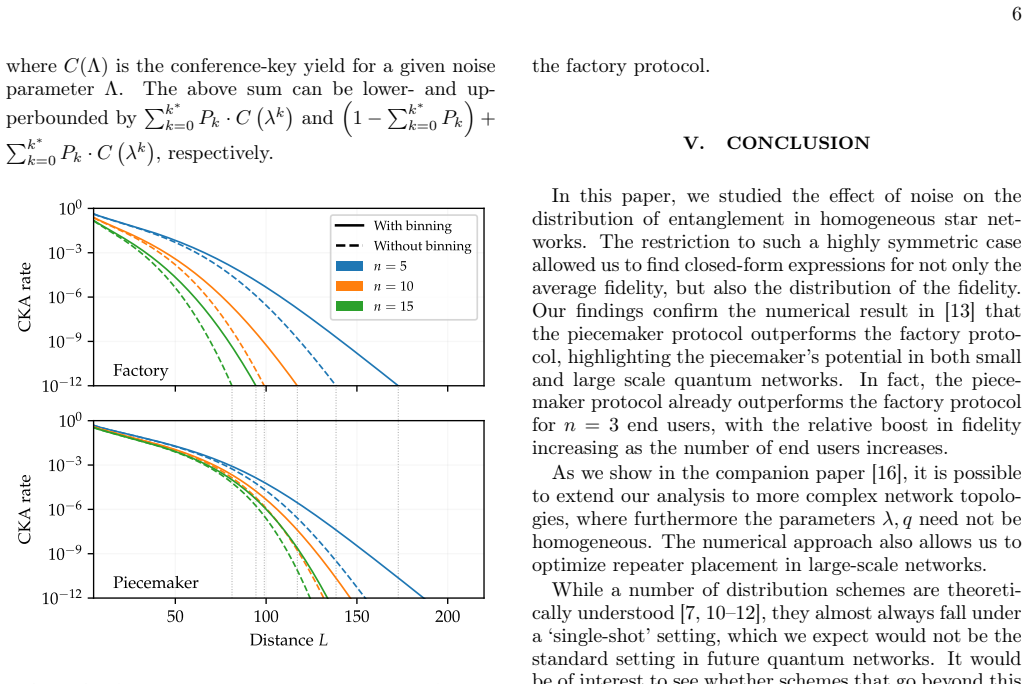
- A global cut-off time can be optimized rapidly using the closed-form expressions without Monte Carlo simulations.
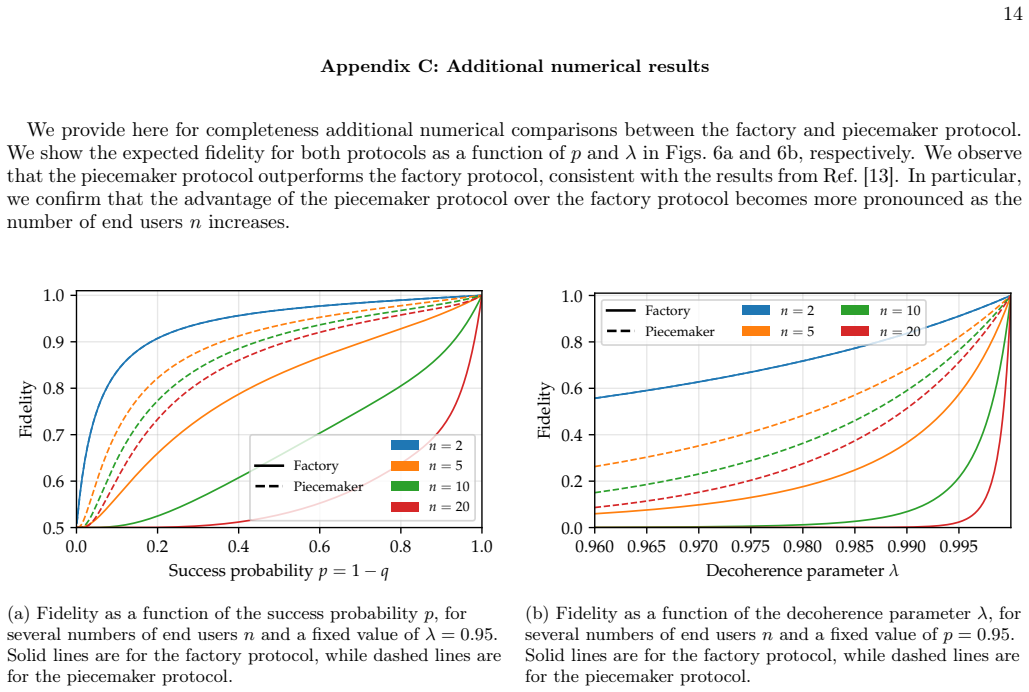
- The factory and piecemaker protocols can be compared directly on their exact noise performance.
- The factory protocol analysis extends to depolarizing noise for arbitrary input states.
- The derived noise distribution gives the precise fidelity achievable for distributed GHZ states.
Where Pith is reading between the lines
- The same waiting-time approach could be applied to other network shapes once their success-time statistics are known.
- Exact expressions reduce reliance on numerical sampling when planning memory lifetimes or cut-off policies.
- The framework suggests that memory dephasing during waits is the dominant, fully characterizable noise source in near-term star networks.
Load-bearing premise
Decoherence arises solely from dephasing during the random waiting times that successful links spend in memory.
What would settle it
Measuring the actual distribution of output noise in a physical star network realizing GHZ distribution and checking whether it matches the analytical distribution obtained by integrating over the exponential waiting-time law under the dephasing channel.
Figures

read the original abstract
Multipartite entanglement forms the core of many networking applications. In the near-term future, it is expected that multipartite distribution will be achieved first through star topologies, making it important to understand the noise incurred during the distribution process. In such networks, elementary links are created stochastically and successful links must be stored while waiting for the remaining links, causing memory decoherence that depends on the random waiting times. We derive analytical expressions for both the average noise and its distribution, when distributing GHZ states under memory dephasing in star networks. We study and compare two distribution protocols: the factory and piecemaker protocol. Furthermore, we find expressions for the case of a global cut-off (allowing fast optimization of the cut-off without requiring Monte Carlo simulations) and extend the analysis for the factory protocol to depolarizing noise for arbitrary states.
Editorial analysis
A structured set of objections, weighed in public.
Referee Report
Summary. The manuscript derives analytical (closed-form) expressions for both the average noise and the full noise distribution incurred when distributing GHZ states under memory dephasing in star networks. It compares the factory and piecemaker protocols, supplies expressions for a global cut-off time, and extends the factory-protocol analysis to depolarizing noise acting on arbitrary states.
Significance. If the derivations hold, the closed-form results eliminate the need for Monte Carlo sampling when optimizing cut-off times and supply exact characterizations of noise statistics; this is a concrete advance for modeling multipartite entanglement distribution in near-term quantum networks.
minor comments (1)
- [Abstract] The abstract states that derivations exist but supplies no equations, key assumptions, or verification steps; while the full text presumably contains them, a brief inline reference to the central result (e.g., the form of the waiting-time distribution or the dephasing map) would improve readability for readers who stop at the abstract.
Simulated Author's Rebuttal
We thank the referee for their positive assessment of our manuscript and for recommending acceptance. No major comments were raised in the report.
Circularity Check
No significant circularity detected
full rationale
The paper derives closed-form analytical expressions for average noise and its distribution under memory dephasing for GHZ distribution in star networks. No equations, fitting procedures, or self-citation chains are visible in the provided abstract or description that reduce any claimed prediction or result to its inputs by construction. The modeling assumptions (storage during random waiting times under dephasing) are standard and externally falsifiable, leaving the derivation self-contained against benchmarks.
Axiom & Free-Parameter Ledger
Reference graph
Works this paper leans on
-
[1]
Murta, F
G. Murta, F. Grasselli, H. Kampermann, and D. Bruß, Quantum conference key agreement: A review, Advanced Quantum Technologies3, 2000025 (2020)
2020
-
[2]
Markham and B
D. Markham and B. C. Sanders, Graph states for quan- tum secret sharing, Physical Review A—Atomic, Molec- ular, and Optical Physics78, 042309 (2008)
2008
-
[3]
Gravier, J
S. Gravier, J. Javelle, M. Mhalla, and S. Perdrix, Quan- tum secret sharing with graph states, inInternational Doctoral Workshop on Mathematical and Engineering Methods in Computer Science(Springer, 2012) pp. 15– 31
2012
-
[4]
Zhang and Q
Z. Zhang and Q. Zhuang, Distributed quantum sensing, Quantum Science and Technology6, 043001 (2021)
2021
-
[5]
X. Kong, T. Xin, S.-J. Wei, B. Wang, Y. Wang, K. Li, and G.-L. Long, Demonstration of multiparty quantum clock synchronization., Quantum Information Processing 17(2018)
2018
-
[6]
Lamas-Linares and J
A. Lamas-Linares and J. Troupe, Secure quantum clock synchronization, inAdvances in Photonics of Quantum Computing, Memory, and Communication XI,Vol.10547 (SPIE, 2018) pp. 59–66. 7
2018
-
[7]
K. Goodenough, T. Coopmans, and D. Towsley, On noise in swap ASAP repeater chains: Exact analytics, distribu- tions and tight approximations (2024), arXiv:2404.07146 [quant-ph]
arXiv 2024
-
[9]
B. Li, T. Coopmans, and D. Elkouss, Efficient optimiza- tion of cutoffs in quantum repeater chains, IEEE Trans- actions on Quantum Engineering2, 1 (2021)
2021
-
[10]
Kamin, E
L. Kamin, E. Shchukin, F. Schmidt, and P. van Loock, Exact rate analysis for quantum repeaters with imperfect memories and entanglement swapping as soon as possi- ble, Physical Review Research5, 023086 (2023)
2023
-
[11]
Chehimi, K
M. Chehimi, K. Goodenough, W. Saad, D. Towsley, and T. X. Zhou, Entanglement distribution delay optimiza- tion in quantum networks with distillation, IEEE Journal on Selected Areas in Communications (2025)
2025
-
[12]
G. Avis, F. Rozpędek, and S. Wehner, Analysis of multipartite entanglement distribution using a central quantum-network node, Physical Review A107, 012609 (2023)
2023
-
[13]
L. Prielinger, K. Goodenough, G. Avis, S. Kras- tanov, D. Towsley, and G. Vardoyan, Piecemaker: a resource-efficient entanglement distribution protocol, arXiv preprint arXiv:2508.14737 (2025)
Pith/arXiv arXiv 2025
-
[14]
A.Sen, K.Goodenough,andD.Towsley,Multipartiteen- tanglement distribution in quantum networks using sub- graph complementations, Quantum9, 1911 (2025)
1911
-
[15]
Cuquet and J
M. Cuquet and J. Calsamiglia, Growth of graph states in quantum networks, Physical Review A—Atomic, Molec- ular, and Optical Physics86, 042304 (2012)
2012
-
[16]
Goodenough and P
K. Goodenough and P. Emonts, Optimization of quan- tum networks using tensor networks (2026), in prepara- tion
2026
-
[17]
J. Memmen, J. Kunzelmann, N. Walk, J. Eisert, and J. Wallnöfer, Strategy optimization for quantum confer- ence key agreement in asymmetric star networks, arXiv preprint arXiv::2605.18677 (2026)
Pith/arXiv arXiv 2026
-
[18]
Github repository: Patrickemonts/repeater-network- analytics,https://github.com/patrickemonts/ repeater-network-analytics
-
[19]
Rozpędek, K
F. Rozpędek, K. Goodenough, J. Ribeiro, N. Kalb, V. C. Vivoli, A. Reiserer, R. Hanson, S. Wehner, and D. Elk- ouss, Parameter regimes for a single sequential quantum repeater, Quantum Science and Technology3, 034002 (2018)
2018
-
[20]
Rozpędek, R
F. Rozpędek, R. Yehia, K. Goodenough, M. Ruf, P. C. Humphreys, R. Hanson, S. Wehner, and D. Elkouss, Near-term quantum-repeater experiments with nitrogen- vacancy centers: Overcoming the limitations of direct transmission, Physical Review A99, 052330 (2019)
2019
-
[21]
Azuma, S
K. Azuma, S. Bäuml, T. Coopmans, D. Elkouss, and B. Li, Tools for quantum network design, AVS Quantum Science3, 014101 (2021)
2021
-
[22]
Praxmeyer, Reposition time in probabilistic imperfect memories (2013), arXiv:1309.3407 [quant-ph]
L. Praxmeyer, Reposition time in probabilistic imperfect memories (2013), arXiv:1309.3407 [quant-ph]
Pith/arXiv arXiv 2013
-
[23]
Shchukin, F
E. Shchukin, F. Schmidt, and P. van Loock, Waiting time in quantum repeaters with probabilistic entangle- ment swapping, Physical Review A100, 032322 (2019)
2019
-
[24]
Epping, H
M. Epping, H. Kampermann, D. Bruß,et al., Multi- partite entanglement can speed up quantum key distri- bution in networks, New Journal of Physics19, 093012 (2017)
2017
-
[25]
Avis and S
G. Avis and S. Krastanov, Optimization of quantum- repeater networks using stochastic automatic differentia- tion, Physical Review Research7, 033111 (2025)
2025
-
[26]
B. Li, T. Coopmans, and D. Elkouss, Efficient Opti- mization of Cutoffs in Quantum Repeater Chains, IEEE Transactions on Quantum Engineering2, 1 (2021)
2021
-
[27]
Y. Jing, D. Alsina, and M. Razavi, Quantum key dis- tribution over quantum repeaters with encoding: Using error detection as an effective postselection tool, Physical Review Applied14, 064037 (2020)
2020
-
[28]
Goodenough, S
K. Goodenough, S. De Bone, V. Addala, S. Krastanov, S. Jansen, D. Gijswijt, and D. Elkouss, Near-term n to k distillation protocols using graph codes, IEEE Journal on Selected Areas in Communications42, 1830 (2024)
2024
-
[29]
J. A. Kunzelmann, A. Trushechkin, N. Wyderka, H. Kampermann, and D. Bruß, Multiplexed multipartite quantum repeater rates in the stationary regime, arXiv preprint arXiv:2505.18031 (2025)
arXiv 2025
-
[30]
R. P. Stanley, Enumerative combinatorics volume 1 sec- ond edition, Cambridge studies in advanced mathematics (2011)
2011
-
[31]
Wyderka and O
N. Wyderka and O. Gühne, Characterizing quantum states via sector lengths, Journal of Physics A: Math- ematical and Theoretical53, 345302 (2020)
2020
-
[32]
Miller, D
D. Miller, D. Loss, I. Tavernelli, H. Kampermann, D. Bruß, and N. Wyderka, Shor–laflamme distributions of graph states and noise robustness of entanglement, Journal of Physics A: Mathematical and Theoretical56, 335303 (2023)
2023
-
[33]
E. Vallée, K. Goodenough, P. E. Gunnells, T. Coopmans, and J. Tura, Sector length distributions of recursively definable graph states through analytic combinatorics, arXiv preprint arXiv:2604.09766 (2026)
Pith/arXiv arXiv 2026
-
[34]
E. M. Rains, Quantum weight enumerators, IEEE Trans- actions on Information Theory44, 1388 (2002)
2002
-
[35]
E. M. Rains, Quantum shadow enumerators, IEEE trans- actions on information theory45, 2361 (1999)
1999
-
[36]
D. Miller, K. Levi, L. Postler, A. Steiner, L. Bittel, G. A. White, Y. Tang, E. J. Kuehnke, A. A. Mele, S. Kha- tri,et al., Experimental measurement and a physical interpretation of quantum shadow enumerators, arXiv preprint arXiv:2408.16914 (2024)
Pith/arXiv arXiv 2024
-
[37]
D. Miller and J. Eisert, Detecting entanglement from few partial transpose moments and their decay via weight enumerators, arXiv preprint arXiv:2604.12576 (2026)
Pith/arXiv arXiv 2026
-
[38]
N. K. Bernardes, L. Praxmeyer, and P. van Loock, Rate analysis for a hybrid quantum repeater, Physical Review A83, 012323 (2011). 8 Appendix A: Factory protocol
2011
-
[39]
As before, letnbe the number of end users in such a network, andλ, qbe the (homogeneous) parameters describing the decoherence and the failure probability, respectively
Derivation for the factory protocol under dephasing We prove here a closed-form expression of the average noise in the factory protocol, in the case of dephasing. As before, letnbe the number of end users in such a network, andλ, qbe the (homogeneous) parameters describing the decoherence and the failure probability, respectively. A possible instance of t...
-
[40]
We use the fact that anyn-qubit state can be expanded in the Pauli basis, ρ= 1 2n X P Tr(P ρ)·P,(A5) where thePare all4 n (phaseless) Pauli strings of lengthn
Depolarizing noise for the factory protocol for arbitrary states We now extend the analysis from the previous subsection to uniform depolarizing on arbitrary states. We use the fact that anyn-qubit state can be expanded in the Pauli basis, ρ= 1 2n X P Tr(P ρ)·P,(A5) where thePare all4 n (phaseless) Pauli strings of lengthn. Since quantum channels are line...
-
[41]
Herew(P)is the weight ofP, i.e
Extending to then-qubit case, we find that for uniform depolarizing noise Pauli strings get transformed asP7→λ w(P) P. Herew(P)is the weight ofP, i.e. the number of non-identity entries inP. From linearity of expectation values and the fact that we consider the homogeneous setting (both in decoherence and link success probability), we are free to consider...
discussion (0)
Sign in with ORCID, Apple, or X to comment. Anyone can read and Pith papers without signing in.