REVIEW 3 major objections 6 minor 38 references
From Regulation to Requirements: An Automated Requirement Derivation and Explanation Pipeline
T0 review · 3 major / 6 minor · reviewed 2026-07-11 · grok-4.5
Pith's one-line read An automated pipeline can turn entire regulatory documents into system-agnostic software requirements with plain-language explanations that engineers without legal training can act on.
desk verdict Solid end-to-end RE pipeline with open tool and full-document eval; moderate correctness and non-legal ground truth are real but do not sink the contribution. read the letter →
The pith
A machine-rendered reading of the paper's core claim, the machinery that carries it, and where it could break.
The reading
What carries the argument
The regulation-to-requirements pipeline: zero-shot identification of requirement-bearing clauses followed by a single joint generation step that emits the minimum necessary software requirements, their plain-language explanations, and typed cross-references, all from clause text alone.
What would settle it
Have a panel of legal experts re-annotate the same full GDPR and EU AI Act clause sets and re-score the derived requirements; if identification F1 falls below the SetFit baseline or explanation clarity drops once the outputs must satisfy real audit criteria, the central claim fails.
Extended reading notes
Core claim
A two-stage large-language-model pipeline that first filters every clause of a regulation for requirement-bearing content and then jointly derives system-agnostic software requirements plus plain-language explanations can produce outputs of high completeness and near-ceiling explanation clarity across the full GDPR and EU AI Act, and those explanations measurably improve practitioner comprehension and confidence.
Load-bearing premise
Both the labels for which clauses count as requirement-bearing and the quality scores for derived requirements and explanations rest solely on the judgement of requirements engineers who have no formal legal training.
Editorial extensions
If this is right
- When a regulation is amended, re-running the pipeline plus the traceability matrix immediately surfaces which derived requirements are affected.
- Requirements engineers without legal training can begin compliance work from an automated first draft instead of reading every clause manually.
- The same regulation-agnostic prompts can be applied to newly enacted laws without custom configuration or re-training.
- Plain-language explanations become a shared artefact that developers, testers and auditors can use when implementing or checking compliance.
Reading between the lines
- If the identification stage’s known false-positive bias is tolerable, teams may prefer over-generation followed by human pruning over the risk of silently dropping obligations.
- Linking the pipeline to existing requirements-management tools would turn it into a continuous compliance monitor that flags drift whenever source text changes.
- Success on EU drafting conventions does not guarantee the same surface-cue strategy will work on rights- and exception-heavy common-law statutes; that is a direct next test.
Editorial analysis
A structured set of objections, weighed in public.
Referee Report
Summary. The paper presents Reg2Req, a two-stage LLM pipeline that (i) identifies requirement-bearing clauses in full regulatory documents and (ii) derives system-agnostic software requirements with plain-language explanations and typed cross-references. Evaluated on all 398 GDPR and 574 EU AI Act clauses, identification reaches macro F1 0.82/0.78 (outperforming a SetFit baseline); human ratings report high completeness (4.60/4.45), moderate correctness (3.74/3.54), and near-ceiling explanation clarity (4.92/4.94). An ablation argues the identification stage is necessary; a 25-practitioner within-subjects study finds explanations improve comprehension and confidence (p < 0.001). A public tool adds FR/NFR classification, use-case seeding, definition indexing, and a traceability matrix.
Significance. If the results hold under stronger validation, this is a useful systems contribution to regulatory RE: it treats requirement-bearing clause identification as an explicit, full-document RE stage (distinct from legal obligation mining), evaluates on complete clause sets rather than pre-selected articles, and pairs derivation with engineer-facing explanations whose benefit is measured in a controlled user study. Public release of Reg2Req, prompts, and annotated GDPR/AI Act datasets is a concrete community asset and strengthens reproducibility. The work is timely given expanding EU and global digital regulation, and the supporting workflow features (traceability matrix, definition indexing) address practical adoption barriers even if they are secondary contributions.
major comments (3)
- Table III (Section IV-C): requirement correctness is only moderate (3.74 GDPR / 3.54 EU AI Act) with the largest SDs, and the paper itself attributes failures to unresolved exceptions, conditions, and rights-granting clauses (e.g., GDPR-28-3/R5 restating an unresolved cross-reference). Completeness and clarity are high, but the central claim is production of correct, actionable software requirements from legal text. Either elevate a mitigation already listed as future work (e.g., retrieval over cross-referenced provisions) into the evaluated pipeline, or reframe claims more tightly as draft/seed requirements that require expert review, with quantitative characterization of when correctness fails.
- Sections IV-A1, IV-A2, and VII-B: ground-truth labels for both requirement-bearing identification and quality ratings were produced solely by requirements engineers without formal legal training (Krippendorff α ≈ 0.71–0.81 on overlaps). The paper correctly notes this yields an RE interpretation rather than legally authoritative labels, but that caveat undercuts the compliance-facing claim. A stratified legal-expert adjudication (even on a modest sample of edge cases: rights, exceptions, cross-reference-heavy clauses) is needed to secure construct validity of both the identification task and correctness scores.
- Table IV / Section IV-D (RQ3): the necessity of the upstream identification stage rests entirely on LLM-as-judge scores for the ablated condition. Spearman ρ 0.77–0.85 is reported only against full-pipeline human ratings; ablated outputs are larger and likely differently distributed (more non-requirement clauses forced through derivation). A human-rated sample of ablated outputs, or at least a correlation check stratified by clause type, is required before the large completeness drops (−1.23) can be treated as definitive evidence that the stage is necessary.
minor comments (6)
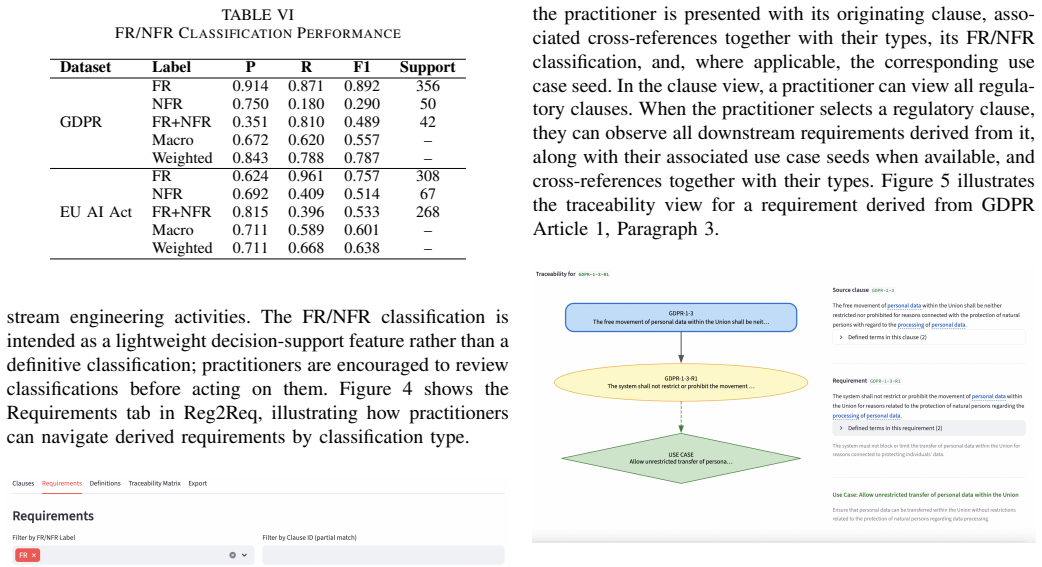
- Section V-A / Table VI: NFR recall on GDPR is 0.18 and overall AI Act accuracy is 66.7%; the text notes this but the UI and user-study framing still present FR/NFR classification as a ready decision-support feature—add a stronger on-tool caveat and report confusion patterns more prominently.
- Section VI / RQ5: supporting-feature utility was assessed from screenshots rather than live interaction; state this limitation next to Table VII, not only in threats.
- Figures 2–3: prompts are abbreviated in the main text; ensure the replication package path and exact model snapshots (GPT-5 / GPT-5.4) are cited at first use so readers can reproduce without hunting the Zenodo record.
- Related Work (II-B): the qualitative differentiation from XTRAREG is clear; a short side-by-side table of scope (full document vs. two articles), explanation audience, and configuration burden would help readers place the contribution faster.
- Section III-A: the decision to append lettered sub-points to parent paragraphs and to drop recitals is reasonable but should cite the drafting convention more tightly and note any known cases where recitals have been treated as quasi-operative in compliance practice.
- Throughout: standardize “requirement-bearing” hyphenation and ensure all α values report the exact metric (identification vs. each quality dimension) in one place for quick reference.
Circularity Check
No significant circularity: empirical pipeline results are scored against independent human annotations and a held-out baseline, not forced by construction.
full rationale
This is an empirical requirements-engineering / NLP systems paper, not a first-principles derivation. Requirement-bearing clause identification is evaluated as binary classification against labels produced by six external RE annotators (Krippendorff’s α=0.81 on a shared subset) and is compared to a SetFit baseline trained and tested on a stratified held-out split; the reported macro F1 values (0.82/0.78) are therefore not redefined by any fitted parameter of the pipeline itself. Derived-requirement correctness, completeness, and clarity, and explanation quality, are human Likert ratings of model outputs, not quantities recovered from a fit. The ablation (full pipeline vs. no identification stage) uses an LLM-as-judge proxy that was separately correlated with the same human ratings (Spearman ρ=0.77–0.85); that validation does not make the quality drop by construction. The user study measures before/after comprehension and confidence on held-out practitioners. Related-work citations (including XTRAREG) are used for contrast, not as load-bearing uniqueness theorems by the same authors. No self-definitional loop, fitted-input-as-prediction, or ansatz-via-self-citation appears in the evaluation chain. Score 0 is therefore the correct outcome.
Assumptions & free parameters
assumptions (4)
- domain assumption A clause is requirement-bearing iff it specifies, grants or constrains an observable system behavior, interaction or property needed for compliance (independent of pure legal obligation).
- domain assumption Requirements engineers without formal legal training can produce reliable ground-truth labels and quality ratings for legal-to-software translation.
- ad hoc to paper Zero-shot GPT-5 with the iteratively engineered prompts (Figs. 2–3) is sufficiently consistent for both identification and derivation across full regulatory documents.
- domain assumption Recitals and lettered sub-points can be safely excluded or folded into parent paragraphs without loss of system-level requirements.
invented entities (2)
-
Requirement-bearing clause identification as an explicit, independently evaluable RE pipeline stage
-
Three-type surface-level cross-reference taxonomy (DEFINITION / EXCEPTION / NEUTRAL)
Cite this review
Pith. "Pith review of From Regulation to Requirements: An Automated Requirement Derivation and Explanation Pipeline." pith.science (2026). https://pith.science/paper/JYA5TU3W
@misc{pith2026260704448,
  author       = {Pith},
  title        = {Pith review of: From Regulation to Requirements: An Automated Requirement Derivation and Explanation Pipeline},
  year         = {2026},
  howpublished = {\url{https://pith.science/paper/JYA5TU3W}},
  note         = {Machine review of arXiv:2607.04448}
}
read the original abstract
Ensuring software compliance with regulations such as the General Data Protection Regulation (GDPR) and the Artificial Intelligence Act (EU AI Act) poses a significant challenge, as requirements engineers must translate complex legal text into actionable software requirements - a process that remains largely manual and error-prone in practice. We present an automated regulation-to-requirements pipeline that identifies requirement-bearing clauses in regulatory documents and derives system-agnostic software requirements, accompanied by plain-language explanations, traceable to their legal sources. We evaluate the pipeline on the full clause sets of the GDPR (398 clauses) and the EU AI Act (574 clauses). For requirement-bearing clause identification, the approach achieves macro-averaged F1 scores of 0.82 and 0.78, respectively, outperforming a SetFit-based baseline. Human evaluation shows high completeness (4.60 and 4.45) and correctness (3.74 and 3.54) of derived requirements, while explanation clarity scores are near-ceiling (4.92 and 4.94) on a 1-5 scale. We implement the approach in Reg2Req, a publicly released tool that further supports requirement classification, use case seeding, cross-reference analysis, definition indexing, and a traceability matrix to operationalize regulatory compliance in practice. A user study with 25 practitioners shows that the plain-language explanations significantly improve comprehension of derived requirements and confidence in acting on them (p < 0.001), and that all participants would use Reg2Req as a starting point for deriving software requirements from a regulation.
Figures


Figures from the paper (2 more)


Reference graph
Works this paper leans on
-
[1]
Systematic mapping study on requirements engineering for regulatory compliance of software systems,
O. Kosenkov, P. Elahidoost, T. Gorschek, J. Fischbach, D. Mendez, M. Unterkalmsteiner, D. Fucci, and R. Mohanani, “Systematic mapping study on requirements engineering for regulatory compliance of software systems,”Information and Software Technology, vol. 178, p. 107622, 2025
2025
-
[2]
Ai-enabled regulatory change analysis of legal requirements,
S. Abualhaija, M. Ceci, N. Sannier, D. Bianculli, L. C. Briand, D. Zet- zsche, and M. Bodellini, “Ai-enabled regulatory change analysis of legal requirements,” in2024 IEEE 32nd International Requirements Engineering Conference (RE). IEEE, 2024, pp. 5–17
2024
-
[3]
Regulatory compliance,
H. Y .-F. Lim, “Regulatory compliance,” inArtificial Intelligence. Ed- ward Elgar Publishing, 2025, pp. 149–177
2025
-
[4]
European Parliament and Council of the European Union, 2016, “Reg- ulation (EU) 2016/679 of the European Parliament and of the Council on the protection of natural persons with regard to the processing of personal data and on the free movement of such data (General Data Protection Regulation),” Official Journal of the European Union, Tech. Rep. L 119, 201...
2016
-
[5]
Reg- ulation (EU) 2024/1689 of the European Parliament and of the Council laying down harmonised rules on artificial intelligence (Artificial Intelli- gence Act),
European Parliament and Council of the European Union, 2024, “Reg- ulation (EU) 2024/1689 of the European Parliament and of the Council laying down harmonised rules on artificial intelligence (Artificial Intelli- gence Act),” Official Journal of the European Union, Tech. Rep. L 1689, 2024, oJ L, 12.7.2024
2024
-
[6]
Reg- ulation (EU) 2023/2854 of the European Parliament and of the Council on harmonised rules on fair access to and use of data (Data Act),
European Parliament and Council of the European Union, 2023, “Reg- ulation (EU) 2023/2854 of the European Parliament and of the Council on harmonised rules on fair access to and use of data (Data Act),” Official Journal of the European Union, Tech. Rep. L 2854, 2023, oJ L, 22.12.2023
2023
-
[7]
Reg- ulation (EU) 2022/2065 of the European Parliament and of the Council on a single market for digital services (Digital Services Act),
European Parliament and Council of the European Union, 2022, “Reg- ulation (EU) 2022/2065 of the European Parliament and of the Council on a single market for digital services (Digital Services Act),” Official Journal of the European Union, Tech. Rep. L 277, 2022, oJ L 277, 27.10.2022
2022
-
[8]
California consumer privacy act of 2018, as amended by the California Privacy Rights Act of 2020,
State of California, “California consumer privacy act of 2018, as amended by the California Privacy Rights Act of 2020,” 2020, cal. Civ. Code §§ 1798.100–1798.199.100
2018
Show all 38 references
-
[9]
The digital personal data protection act, 2023,
Government of India, “The digital personal data protection act, 2023,” No. 22 of 2023, Gazette of India Extraordinary, Part II, Section 1, 2023, received assent on 11 August 2023
2023
-
[10]
Advancing requirements engineering through generative ai: Assessing the role of llms,
C. Arora, J. Grundy, and M. Abdelrazek, “Advancing requirements engineering through generative ai: Assessing the role of llms,” in Generative AI for Effective Software Development. Springer, 2024, pp. 129–148
2024
-
[11]
GDPR: A culture of non- compliance?
noyb – European Center for Digital Rights, “GDPR: A culture of non- compliance?” Online, 2024, available: https://noyb.eu. Accessed: May 21, 2026
2024
-
[12]
Analyzing regulatory rules for privacy and security requirements,
T. D. Breaux and A. I. Ant ´on, “Analyzing regulatory rules for privacy and security requirements,”IEEE Transactions on Software Engineering, vol. 34, no. 1, pp. 5–20, 2008
2008
-
[13]
An automated framework for the extraction of semantic legal metadata from legal texts,
A. Sleimi, N. Sannier, M. Sabetzadeh, L. C. Briand, M. Ceci, and J. Dann, “An automated framework for the extraction of semantic legal metadata from legal texts,”Empirical Software Engineering, vol. 26, no. 3, p. 43, 2021
2021
-
[14]
Automating the extraction of rights and obligations for regulatory compliance,
N. Kiyavitskaya, N. Zeni, T. D. Breaux, A. I. Ant ´on, J. R. Cordy, L. Mich, and J. Mylopoulos, “Automating the extraction of rights and obligations for regulatory compliance,” inProceedings of the 27th Inter- national Conference on Conceptual Modeling (ER 2008), ser. Lecture ...
2008
-
[15]
GaiusT: Supporting the extraction of rights and obligations for regula- tory compliance,
N. Zeni, N. Kiyavitskaya, L. Mich, J. R. Cordy, and J. Mylopoulos, “GaiusT: Supporting the extraction of rights and obligations for regula- tory compliance,”Requirements Engineering, vol. 20, no. 1, pp. 1–22, 2015
2015
-
[16]
Compliance checking between business processes and business contracts,
G. Governatori, Z. Milosevic, and S. Sadiq, “Compliance checking between business processes and business contracts,” inProceedings of the 10th IEEE International Enterprise Distributed Object Computing Conference (EDOC). IEEE, 2006
2006
-
[17]
PrOnto: Privacy ontology for legal reasoning about personal data processing,
M. Palmirani, M. Martoni, A. Rossi, C. Bartolini, and L. Robaldo, “PrOnto: Privacy ontology for legal reasoning about personal data processing,” inProceedings of the 17th IFIP International Electronic Government Conference (EGOV). Springer, 2018
2018
-
[18]
A meta-model for mod- elling law-compliant requirements,
A. Siena, A. Perini, A. Susi, and J. Mylopoulos, “A meta-model for mod- elling law-compliant requirements,” inProceedings of the International Workshop on Requirements Engineering and Law (RELAW), 2008
2008
-
[19]
Nomos 2: Making laws explicit in requirements engineering,
S. Ingolfo, A. Siena, and J. Mylopoulos, “Nomos 2: Making laws explicit in requirements engineering,” inProceedings of the CAiSE Forum, 2013
2013
-
[20]
Legal goal-oriented require- ment language (Legal GRL) for modeling regulations,
S. Ghanavati, D. Amyot, and A. Rifaut, “Legal goal-oriented require- ment language (Legal GRL) for modeling regulations,” inProceedings of the International Workshop on Modeling in Software Engineering (MiSE), 2014
2014
-
[21]
Gracenote.ai: Legal generative AI for regulatory compliance,
J. Ioannidis, J. Harper, M. S. Quah, and D. Hunter, “Gracenote.ai: Legal generative AI for regulatory compliance,” inProceedings of the Legal AI and Intelligent Agents Workshop (LegalAIIA), 2023
2023
-
[22]
Rethinking legal compliance automation: Opportunities with large language models,
S. Hassani, M. Sabetzadeh, D. Amyot, and J. Liao, “Rethinking legal compliance automation: Opportunities with large language models,” in Proceedings of the 32nd IEEE International Requirements Engineering Conference (RE), 2024, pp. 432–440
2024
-
[23]
LLM-assisted extraction of regulatory requirements: A case study on the GDPR,
S. Abualhaija, M. Ceci, N. Sannier, D. Bianculli, S. Lannier, M. Siclari, O. V oordeckers, and S. Tosza, “LLM-assisted extraction of regulatory requirements: A case study on the GDPR,” inProceedings of the 33rd IEEE International Requirements Engineering Conference (RE), 2025
2025
-
[24]
The law of recitals in European Commu- nity legislation,
T. Klimas and J. Vaiciukaite, “The law of recitals in European Commu- nity legislation,”ILSA Journal of International and Comparative Law, vol. 15, 2008
2008
-
[25]
Introducing GPT-5,
OpenAI, “Introducing GPT-5,” https://openai.com/index/ introducing-gpt-5/, 2025, accessed: 2025
2025
-
[26]
Phoenix and M
J. Phoenix and M. Taylor,Prompt Engineering for Generative AI: Future-Proof Inputs for Reliable AI Outputs. O’Reilly Media, 2024
2024
-
[27]
Krippendorff,Content Analysis: An Introduction to Its Methodology, 2nd ed
K. Krippendorff,Content Analysis: An Introduction to Its Methodology, 2nd ed. Thousand Oaks, CA: Sage Publications, 2004
2004
-
[28]
Efficient few-shot learning without prompts,
L. Tunstall, N. Reimers, U. E. S. Jo, L. Bates, D. Korat, M. Wasserblat, and O. Pereg, “Efficient few-shot learning without prompts,” 2022. [Online]. Available: https://arxiv.org/abs/2209.11055
2022 arXiv
-
[29]
Sentence-BERT: Sentence embeddings using siamese BERT-networks,
N. Reimers and I. Gurevych, “Sentence-BERT: Sentence embeddings using siamese BERT-networks,” inProceedings of the 2019 Conference on Empirical Methods in Natural Language Processing (EMNLP). Association for Computational Linguistics, 2019. [Online]. Available: https://arxiv.o...
2019 arXiv
-
[30]
Scikit-learn: Machine learning in Python,
F. Pedregosa, G. Varoquaux, A. Gramfort, V . Michel, B. Thirion, O. Grisel, M. Blondel, P. Prettenhofer, R. Weiss, V . Dubourg, J. Vander- plas, A. Passos, D. Cournapeau, M. Brucher, M. Perrot, and E. Duch- esnay, “Scikit-learn: Machine learning in Python,”Journal of Machine L...
2011
-
[31]
GPT-5.4 model,
OpenAI, “GPT-5.4 model,” https://developers.openai.com/api/docs/ models/gpt-5.4, 2025, model snapshot: gpt-5.4-2026-03-05. Knowledge cutoff: August 2025
2025
-
[32]
Judging LLM-as-a-judge with MT-bench and chatbot arena,
L. Zheng, W.-L. Chiang, Y . Sheng, S. Zhuang, Z. Wu, Y . Zhuang, Z. Lin, Z. Li, D. Li, E. P. Xing, H. Zhang, J. E. Gonzalez, and I. Stoica, “Judging LLM-as-a-judge with MT-bench and chatbot arena,” inAdvances in Neural Information Processing Systems (NeurIPS),
-
[33]
Available: https://arxiv.org/abs/2306.05685
[Online]. Available: https://arxiv.org/abs/2306.05685
-
[34]
The proof and measurement of association between two things,
C. Spearman, “The proof and measurement of association between two things,”The American Journal of Psychology, vol. 15, no. 1, pp. 72–101, 1904
1904
-
[35]
Require- ments classification with interpretable machine learning and dependency parsing,
F. Dalpiaz, D. Dell’Anna, F. B. Aydemir, and S. C ¸ evikol, “Require- ments classification with interpretable machine learning and dependency parsing,” inProceedings of the 27th IEEE International Requirements Engineering Conference (RE). IEEE, 2019, pp. 142–152
2019
-
[36]
Cockburn,Writing Effective Use Cases, ser
A. Cockburn,Writing Effective Use Cases, ser. Agile Software Devel- opment Series. Boston, MA: Addison-Wesley, 2001
2001
-
[37]
Individual comparisons by ranking methods,
F. Wilcoxon, “Individual comparisons by ranking methods,”Biometrics Bulletin, vol. 1, no. 6, pp. 80–83, 1945
1945
-
[38]
How is ChatGPT’s behavior changing over time?
L. Chen, M. Zaharia, and J. Zou, “How is ChatGPT’s behavior changing over time?”Harvard Data Science Review, vol. 6, no. 2, 2024
2024
Reviewed July 11, 2026 · model on record in the stance chip above.
Discussion (0). Sign in to comment.