REVIEW 2 major objections 14 references
Learning to Contest: Decentralized Robust Fairness in Cooperative MARL via Cross-Attention
T0 review · 2 major / 0 minor · reviewed 2026-06-27 · grok-4.3
Pith's one-line read A permutation-equivariant cross-attention policy enables decentralized contesting of free-riders in fair cooperative MARL while keeping exploitability near the centralized oracle.
desk verdict CAN shows a decentralized cross-attention policy can keep fair MARL exploitability low by contesting free-riders when leverage exists, and the objective itself matters more than the adversarial training. read the letter →
The pith
A machine-rendered reading of the paper's core claim, the machinery that carries it, and where it could break.
The reading
What carries the argument
CAN: permutation-equivariant cross-attention policy that infers free-rider count from observed behaviour and sets contest level proportionally.
What would settle it
An experiment showing exploitability rising to the unprotected level of N when cross-attention cannot distinguish free-rider counts from behavior or when 1-c is set to zero.
Extended reading notes
Core claim
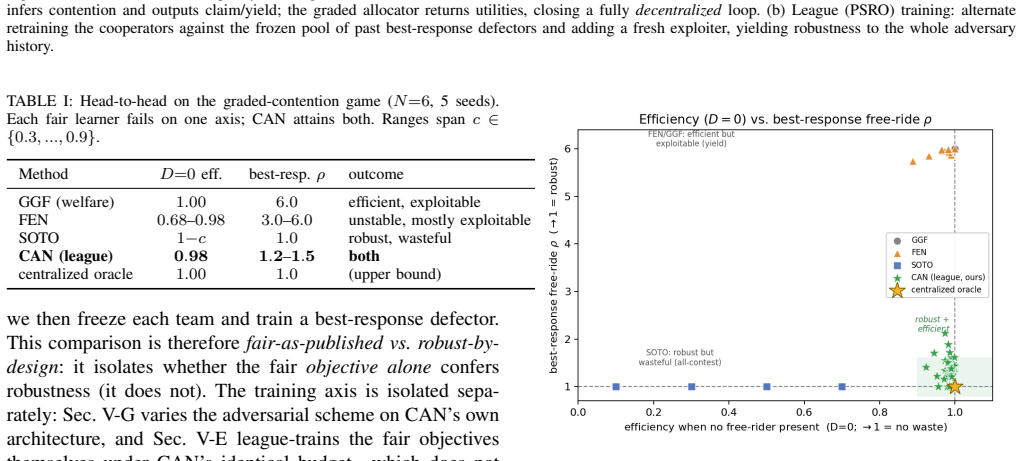
We show that a decentralized defense becomes possible once contention is graded: when a contested resource still delivers a fraction 1-c, a worst-off cooperator that contests a free-rider strictly improves on yielding, so leverage exists for every c < 1. CAN, a permutation-equivariant cross-attention policy over agents' observed behaviour that infers how many free-riders are present and responds proportionally, keeps best-response exploitability near the centralized oracle at essentially no efficiency cost.
Load-bearing premise
The environment supplies graded contention leverage where 1-c is positive, and observed behavior is informative enough for accurate inference of free-rider numbers.
Editorial extensions
If this is right
- CAN achieves low exploitability across multiple environments and team sizes limited only by contest leverage.
- Identical adversarial training on other fair objectives does not produce comparable robustness.
- Defenses deter but do not immunize against committed defectors, with effectiveness decreasing as leverage (1-c)/2 approaches zero.
- The boundary of robustness is mapped by the game's contest leverage rather than eliminated.
Reading between the lines
- Similar cross-attention mechanisms might apply to other multi-agent settings with partial observability of defection.
- If agents learn to mask behavior, the inference of free-rider count could fail and limit the defense.
- Varying the parameter c across a continuous range could map the exact leverage threshold where the method stops working.
Editorial analysis
A structured set of objections, weighed in public.
Referee Report
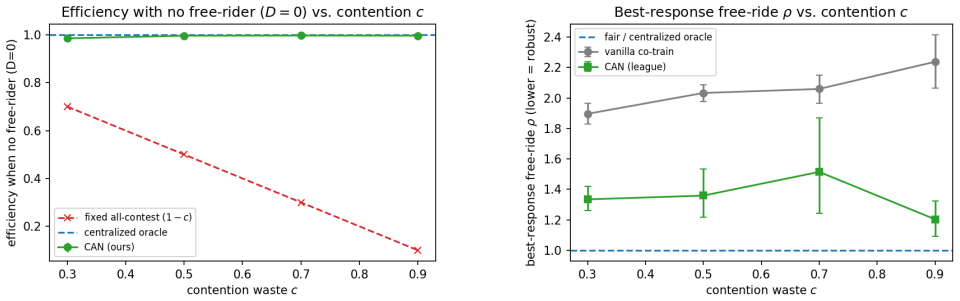
Summary. The paper claims that in cooperative MARL with graded contention (resource still yields 1-c when contested), decentralized robust fairness is possible via CAN: a permutation-equivariant cross-attention policy that infers free-rider count from observed behavior and contests proportionally (turn-taking when none, minimal contest when some). Trained against an adversarial league, CAN keeps best-response exploitability near the centralized oracle (ρ ≈ 1.2–1.5 vs. ρ = N) at negligible efficiency cost, while GGF/FEN/SOTO collapse; identical adversarial training on those objectives fails to rescue them, so the objective enables hardening. Robustness is bounded exactly by contest leverage (1-c)/2 and the paper maps this boundary rather than claiming to eliminate it.
Significance. If the empirical claims hold, the work shows that decentralized defenses against free-riding become feasible once contention is graded, offering a practical alternative to centralized need-based allocators. The distinction that the welfare objective (not adversarial training alone) enables hardening, together with the explicit mapping of robustness limits to leverage, would be a useful clarification for fair MARL design. The permutation-equivariant architecture and league training are concrete strengths.
major comments (2)
- [CAN policy description] The central mechanism asserts that the cross-attention module infers free-rider count from behavior to set contest level proportionally, enabling the objective-specific hardening. No direct verification is described (e.g., attention-weight correlation with ground-truth free-rider count or ablation isolating the inference pathway); performance differentials alone do not confirm inference succeeds versus generic league robustness.
- [Experimental results] The claim that CAN achieves ρ ≈ 1.2–1.5 while other objectives collapse, and that the objective (not training) is decisive, rests on experiments whose baselines, statistical controls, run counts, and variance are not inspectable. This weakens evaluation of whether the differential outcome is robust.
Simulated Author's Rebuttal
We thank the referee for the constructive feedback on our work. We address each major comment below and outline revisions to improve clarity and transparency.
read point-by-point responses
-
Referee: [CAN policy description] The central mechanism asserts that the cross-attention module infers free-rider count from behavior to set contest level proportionally, enabling the objective-specific hardening. No direct verification is described (e.g., attention-weight correlation with ground-truth free-rider count or ablation isolating the inference pathway); performance differentials alone do not confirm inference succeeds versus generic league robustness.
Authors: The manuscript motivates the cross-attention design precisely for processing observed behaviors in a permutation-equivariant manner to enable proportional responses. The primary supporting evidence is the controlled comparison showing that identical adversarial league training fails to produce comparable robustness under the other objectives (GGF, FEN, SOTO), indicating the objective-architecture pairing is decisive rather than generic hardening. We acknowledge that direct mechanistic verification (e.g., attention correlations or targeted ablations) is absent from the current version. We will add an ablation isolating the cross-attention pathway and, where feasible, attention-weight analysis in the revised manuscript. revision: yes
-
Referee: [Experimental results] The claim that CAN achieves ρ ≈ 1.2–1.5 while other objectives collapse, and that the objective (not training) is decisive, rests on experiments whose baselines, statistical controls, run counts, and variance are not inspectable. This weakens evaluation of whether the differential outcome is robust.
Authors: We agree that fuller reporting of experimental details is needed for independent assessment. The manuscript and appendix contain baseline descriptions and some setup information, but we will expand the main experimental section with explicit run counts, variance statistics, and any additional controls used. This will make the robustness claims more readily verifiable. revision: yes
Circularity Check
No significant circularity; empirical differential supports objective distinction
full rationale
The paper's derivation begins with a direct logical claim that graded contention (1-c > 0) creates leverage for a worst-off agent to contest rather than yield, then introduces CAN as a cross-attention policy trained adversarially. The central distinction—that the objective (not training alone) enables hardening—is evidenced by the explicit comparison showing that GGF, FEN, and SOTO collapse even under identical adversarial training. This is an independent empirical contrast rather than a reduction to self-definition, fitted parameters renamed as predictions, or load-bearing self-citations. No equations, uniqueness theorems, or ansatzes from prior self-work are invoked to force the result; the inference of free-rider count is an architectural claim whose effectiveness is tested via task metrics, not assumed by construction.
Assumptions & free parameters
Cite this review
Pith. "Pith review of Learning to Contest: Decentralized Robust Fairness in Cooperative MARL via Cross-Attention." pith.science (2026). https://pith.science/paper/JYIQPOSM
@misc{pith2026260606162,
  author       = {Pith},
  title        = {Pith review of: Learning to Contest: Decentralized Robust Fairness in Cooperative MARL via Cross-Attention},
  year         = {2026},
  howpublished = {\url{https://pith.science/paper/JYIQPOSM}},
  note         = {Machine review of arXiv:2606.06162}
}
abstract
Fair cooperative multi-agent reinforcement learning (MARL) teams that maximize an egalitarian welfare are exploitable: a single self-interested agent free-rides on the surplus that fair agents forgo to raise the worst-off, and the known remedy is a centralized need-based allocator. We show that a decentralized defense becomes possible once contention is graded: when a contested resource still delivers a fraction $1-c$, a worst-off cooperator that contests a free-rider strictly improves on yielding, so leverage exists for every $c < 1$. We introduce CAN, a permutation-equivariant cross-attention policy over agents' observed behaviour that infers how many free-riders are present and responds proportionally -- turn-taking when none, contesting just enough when some. Trained against an adversarial league, CAN keeps best-response exploitability near the centralized oracle ($\rho \approx 1.2\text{--}1.5$ vs. $\rho = N$ unprotected) at essentially no efficiency cost, whereas the fair-MARL learners (GGF, FEN, SOTO) each collapse to an exploitable or wasteful extreme. Giving those objectives CAN's identical adversarial training does not rescue them, so the objective -- not adversarial training alone -- is what makes hardening possible. Against a committed (non-adaptive) defector, every learned defense including ours provides deterrence rather than immunity, weakening as the leverage $(1-c)/2$ vanishes. Across further environments and team sizes the same principle sets the scope: robustness holds exactly as far as the game's contest leverage reaches, and we map that boundary rather than claim to remove it.
Figures

Figures from the paper (6 more)


Reference graph
Works this paper leans on
-
[1]
Learning fairness in multi-agent systems,
J. Jiang and Z. Lu, “Learning fairness in multi-agent systems,” in Advances in Neural Information Processing Systems (NeurIPS), 2019
2019
-
[2]
Learning fair poli- cies in decentralized cooperative multi-agent reinforcement learning,
M. Zimmer, C. Glanois, U. Siddique, and P. Weng, “Learning fair poli- cies in decentralized cooperative multi-agent reinforcement learning,” inInternational Conference on Machine Learning (ICML), 2021
2021
-
[3]
Learning fair policies in multi- objective (deep) reinforcement learning with average and discounted rewards,
U. Siddique, P. Weng, and M. Zimmer, “Learning fair policies in multi- objective (deep) reinforcement learning with average and discounted rewards,”International Conference on Machine Learning (ICML), 2020
2020
-
[4]
Mediated multi-agent reinforcement learning,
D. Ivanov, I. Zisman, and K. Chernyshev, “Mediated multi-agent reinforcement learning,” inInternational Conference on Autonomous Agents and Multiagent Systems (AAMAS), 2023, pp. 49–57
2023
-
[5]
On the exploitability of fair multi-agent reinforcement learn- ing,
C. Savcı, “On the exploitability of fair multi-agent reinforcement learn- ing,” Manuscript, 2026, available: https://github.com/highcansavci/ can-fair-marl/releases/tag/exploitability-manuscript-v1
2026
-
[6]
A unified game-theoretic ap- proach to multiagent reinforcement learning,
M. Lanctot, V . Zambaldi, A. Gruslys, A. Lazaridou, K. Tuyls, J. P ´erolat, D. Silver, and T. Graepel, “A unified game-theoretic ap- proach to multiagent reinforcement learning,” inAdvances in Neural Information Processing Systems (NeurIPS), 2017
2017
-
[7]
Multi-agent reinforcement learning in sequential social dilemmas,
J. Z. Leibo, V . Zambaldi, M. Lanctot, J. Marecki, and T. Graepel, “Multi-agent reinforcement learning in sequential social dilemmas,” inInternational Conference on Autonomous Agents and Multiagent Systems (AAMAS), 2017
2017
-
[8]
Inequity aversion improves cooperation in intertemporal social dilemmas,
E. Hughes, J. Z. Leibo, M. Phillips, K. Tuyls, E. Du ´e˜nez-Guzm´an, A. G. Casta ˜neda, I. Dunning, T. Zhu, K. McKee, R. Kosteret al., “Inequity aversion improves cooperation in intertemporal social dilemmas,” inAdvances in Neural Information Processing Systems (NeurIPS), 2018
2018
Show all 14 references
-
[9]
Learning reciprocity in complex sequential social dilemmas,
T. Eccles, E. Hughes, J. Kram ´ar, S. Wheelwright, and J. Z. Leibo, “Learning reciprocity in complex sequential social dilemmas,”arXiv preprint arXiv:1903.08082, 2019
1903 arXiv
-
[10]
Actor-attention-critic for multi-agent reinforce- ment learning,
S. Iqbal and F. Sha, “Actor-attention-critic for multi-agent reinforce- ment learning,” inInternational Conference on Machine Learning (ICML), 2019
2019
-
[11]
Multi- agent actor-critic for mixed cooperative-competitive environments,
R. Lowe, Y . Wu, A. Tamar, J. Harb, P. Abbeel, and I. Mordatch, “Multi- agent actor-critic for mixed cooperative-competitive environments,” in Advances in Neural Information Processing Systems (NeurIPS), 2017
2017
-
[12]
Attention is all you need,
A. Vaswani, N. Shazeer, N. Parmar, J. Uszkoreit, L. Jones, A. N. Gomez, Ł. Kaiser, and I. Polosukhin, “Attention is all you need,” in Advances in Neural Information Processing Systems (NeurIPS), 2017
2017
-
[13]
Fictitious self-play in extensive-form games,
J. Heinrich, M. Lanctot, and D. Silver, “Fictitious self-play in extensive-form games,” inInternational Conference on Machine Learning (ICML), 2015
2015
-
[14]
A quantitative measure of fairness and discrimination for resource allocation in shared computer systems,
R. K. Jain, D.-M. W. Chiu, and W. R. Hawe, “A quantitative measure of fairness and discrimination for resource allocation in shared computer systems,”DEC Research Report TR-301, 1984
1984
Reviewed June 27, 2026 · model on record in the stance chip above.
Discussion (0). Sign in to comment.