OQ~208: A New Fe~II Changing-look Active Galactic Nucleus and Implications for the Nature of the Changing-look Phenomenon
Pith reviewed 2026-06-27 00:26 UTC · model grok-4.3
The pith
OQ 208 is a new FeII changing-look AGN in which both the FeII complex and Balmer broad lines disappear together.
A machine-rendered reading of the paper's core claim, the machinery that carries it, and where it could break.
Core claim
OQ~208 exhibits the disappearance of both its strong FeII complex (RFe ≡ FeII/Hβ =0.64) and its Balmer broad-line emission on a timescale of ∼14 yr. The simultaneous disappearance implies that in this object, both the FeII and Balmer emission come from the same region exposed to the ionizing continuum. An anticorrelation between the FeII strength and the continuum (and also Eddington ratio) during the CL events in dozens of CL-AGNs suggests a negative response of RFe to both L5100 and Lbol/LEdd, which can be understood by the Comptonization process in a hot, optically thin accretion flow.
What carries the argument
The simultaneous disappearance of the FeII complex and Balmer broad lines, taken as direct evidence that both arise from the same gas region.
If this is right
- The broad-line region in OQ 208 functions as a single zone for both FeII and Balmer emission.
- The changing-look phenomenon extends to the FeII complex in addition to Balmer lines.
- FeII strength decreases when the continuum luminosity and Eddington ratio increase.
- Comptonization in a hot accretion flow can produce the observed negative response of RFe to luminosity changes.
Where Pith is reading between the lines
- Monitoring OQ 208 in future epochs could test whether the FeII and Balmer lines reappear together when the continuum brightens.
- The shared origin constrains possible geometries of the broad-line region across changing-look AGNs.
- The anticorrelation may allow inference of accretion-state transitions from FeII measurements in other variable sources.
Load-bearing premise
The observed spectral changes are intrinsic to the AGN and not produced by calibration differences, aperture effects, or variable obscuration between the different observation epochs.
What would settle it
A new spectrum of OQ 208 taken with matched instrumental setup and aperture that either shows the lines reappearing together with a brighter continuum or confirms they remain absent.
Figures


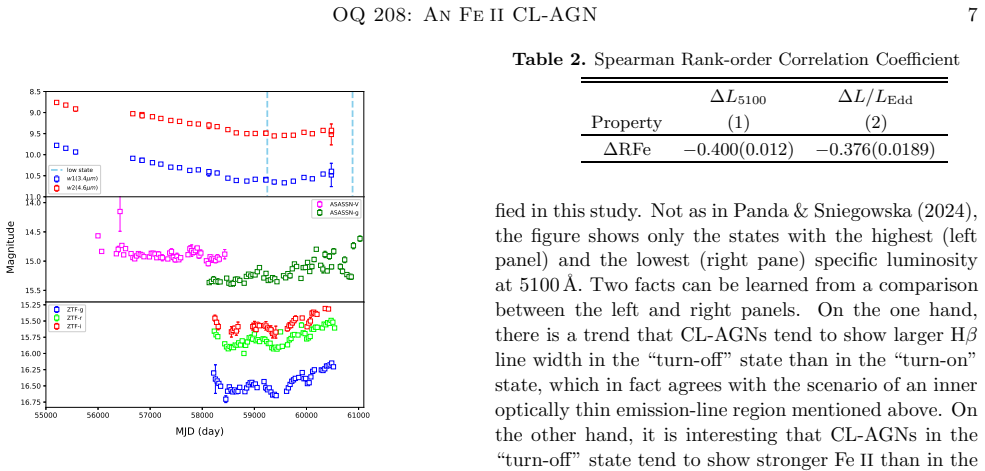


read the original abstract
In addition to the traditional hydrogen Balmer emission lines, here we extend the optical changing-look (CL) phenomenon occurring in some active galactic nuclei (AGNs) to the optical FeII complex. Multiepoch spectroscopy allows to identify OQ~208, a local flat-spectrum radio source, as a new FeII CL-AGN owing to the disappearance of both its strong FeII complex (RFe $\equiv$ FeII/H$\beta =0.64$) and its Balmer broad-line emission on a timescale of $\sim14$\,yr. The simultaneous disappearance implies that in this object, both the FeII and Balmer emission come from the same region exposed to the ionizing continuum. We further identify an anticorrelation between the FeII strength and the continuum (and also Eddington ratio) during the CL events in dozens of CL-AGNs recently studied by Panda \& Sniegowska (2024), suggesting a negative response of RFe to both $L_{5100}$ and $L_{\mathrm{bol}}/L_{\mathrm{Edd}}$; this can be understood by the Comptonization process in a hot, optically thin accretion flow.
Editorial analysis
A structured set of objections, weighed in public.
Referee Report
Summary. The paper identifies OQ 208 as a new Fe II changing-look AGN based on multi-epoch optical spectroscopy showing the disappearance of both a strong Fe II complex (RFe ≡ FeII/Hβ = 0.64) and Balmer broad-line emission over a timescale of ~14 yr. It concludes that the simultaneous disappearance implies both Fe II and Balmer emission originate from the same region exposed to the ionizing continuum. The work additionally reports an anticorrelation between Fe II strength and continuum luminosity (plus Eddington ratio) across other CL-AGNs drawn from Panda & Sniegowska (2024), interpreted as a negative response of RFe to L5100 and Lbol/LEdd via Comptonization in a hot, optically thin accretion flow.
Significance. If the reported spectral changes are confirmed to be intrinsic, the identification of the first Fe II CL-AGN would extend the changing-look phenomenon beyond Balmer lines and provide direct evidence for a shared physical origin of Fe II and Balmer emission in at least one object. The anticorrelation result, if independently verified, could constrain broad-line region models. The manuscript draws on an external study for the multi-object anticorrelation but presents OQ 208 as a new case study.
major comments (2)
- [Abstract] Abstract: The central claim that OQ 208 exhibits intrinsic disappearance of both the Fe II complex (RFe=0.64) and Balmer lines rests on multi-epoch spectra being directly comparable. However, the abstract supplies no spectra, flux measurements with uncertainties, reduction pipeline description, or quantitative checks on epoch alignment, slit/aperture matching, or flux calibration. This information is load-bearing for attributing the changes solely to the ionizing continuum rather than systematics.
- [Abstract] Abstract and discussion of physical implications: The inference that Fe II and Balmer emission arise from the same region exposed to the continuum assumes the observed changes are not produced by variable obscuration, host contamination, or aperture effects between epochs. No explicit tests (e.g., comparison of continuum levels, seeing conditions, or alternative models) against these alternatives are described, undermining the shared-region conclusion.
minor comments (1)
- [Abstract] The value RFe ≡ FeII/Hβ =0.64 is stated without specifying the exact wavelength integration windows or subtraction method for the Fe II template.
Simulated Author's Rebuttal
We thank the referee for their thoughtful review and for highlighting areas where the presentation can be strengthened. We address each major comment below and will revise the manuscript to incorporate the suggested clarifications and additional tests.
read point-by-point responses
-
Referee: [Abstract] Abstract: The central claim that OQ 208 exhibits intrinsic disappearance of both the Fe II complex (RFe=0.64) and Balmer lines rests on multi-epoch spectra being directly comparable. However, the abstract supplies no spectra, flux measurements with uncertainties, reduction pipeline description, or quantitative checks on epoch alignment, slit/aperture matching, or flux calibration. This information is load-bearing for attributing the changes solely to the ionizing continuum rather than systematics.
Authors: We agree that the abstract is necessarily concise and omits supporting details. The full manuscript presents the multi-epoch spectra (Figure 1), reports line fluxes and RFe values with uncertainties (Table 1), describes the reduction pipeline and flux calibration (Section 2), and includes quantitative checks on epoch alignment and aperture matching (Section 3.1). To address the referee's concern, we will revise the abstract to note that the reported changes are based on flux-calibrated, aperture-matched spectra obtained with consistent procedures. revision: yes
-
Referee: [Abstract] Abstract and discussion of physical implications: The inference that Fe II and Balmer emission arise from the same region exposed to the continuum assumes the observed changes are not produced by variable obscuration, host contamination, or aperture effects between epochs. No explicit tests (e.g., comparison of continuum levels, seeing conditions, or alternative models) against these alternatives are described, undermining the shared-region conclusion.
Authors: We acknowledge that the current text does not include explicit quantitative tests against variable obscuration, host contamination, or aperture effects. In the revised manuscript we will add a new paragraph in the discussion section that compares the observed continuum levels and slopes between epochs, assesses host-galaxy contamination using available imaging, and evaluates seeing conditions and slit losses. These additions will strengthen the case that the observed disappearance is intrinsic. revision: yes
Circularity Check
No significant circularity detected
full rationale
The paper's identification of OQ~208 rests on direct multi-epoch spectroscopic observations of line disappearance, with the anticorrelation drawn from the independent external reference Panda & Sniegowska (2024). No equations, fitted parameters renamed as predictions, or self-citation chains reduce any load-bearing claim to the paper's own inputs by construction. The derivation chain is observational and externally supported.
Axiom & Free-Parameter Ledger
Reference graph
Works this paper leans on
-
[1]
L., Dou, L
Ai, Y. L., Dou, L. M., Yang, C. W., et al. 2020, , 890, 29
2020
-
[2]
Balogh, M.L. et al. 1999, , 527, 54
1999
-
[3]
Bon, E., Gavrilovic, N., La Mura, G., & Popovic, L. C. 2009a, , 53, 121
-
[4]
C., Gavrilovic, N., La Mura, G., & Mediavilla, E
Bon, E., Popovic, L. C., Gavrilovic, N., La Mura, G., & Mediavilla, E. 2009b, , 400, 924
-
[5]
Boroson, T. A. 2002, , 565, 78
2002
-
[6]
Boroson, T. A. & Green, R. F.\ 1992, , 80, 109
1992
-
[7]
1983, , 273, 105
Bruzual, A.G. 1983, , 273, 105
1983
-
[8]
Cao, X., You, B., & Wei, X.\ 2023, , 526, 2, 2331
2023
-
[9]
A., Clayton, G
Cardelli, J. A., Clayton, G. C., & Mathis, J. S. 1989, , 345, 245
1989
-
[10]
P., & Filippenko, A
Chen, K., Halpern, J. P., & Filippenko, A. V. 1989, , 339, 742
1989
-
[11]
D., McHardy, I
Connolly, S. D., McHardy, I. M., Skipper, C. J., et al.\ 2016, , 459, 4, 3963
2016
-
[12]
Constantin, A., Green, P., Aldcroft, T., et al.\ 2009, , 705, 2, 1336
2009
-
[13]
De Rosa, A., Vignali, C., Bogdanovi \'c , T., et al.\ 2019, , 86, 101525
2019
-
[14]
Dexter, J., & Begelman, M. C. 2019, , 483, L17
2019
-
[15]
Antonucci, R. R. J. 1993, , 31, 473
1993
-
[16]
Arnaud, K. A. 1996, ASPC, 101, 17
1996
-
[17]
A., Phillips, M
Baldwin, J. A., Phillips, M. M., & Terlevich, R.\ 1981, , 93, 5
1981
-
[18]
C., Denney, K
Bentz, M. C., Denney, K. D., Grier, C. J., et al. 2013, , 767, 149
2013
-
[19]
Berton, M., Foschini, L., Ciroi, S., et al.\ 2016, , 591, A88
2016
-
[20]
K., Nicholl, M., Berger, E., et al
Blanchard, P. K., Nicholl, M., Berger, E., et al. 2017, , 843, 106
2017
-
[21]
2015, ,360, 41
Bon, N., Bon, E., Marziani, P., & Jovanovic, P. 2015, ,360, 41
2015
-
[22]
Boroson, T. A. 2005, , 130, 381
2005
-
[23]
S., & Vaughan, A
Bowen, I. S., & Vaughan, A. H., Jr. 1973, ApOpt, 12, 1430
1973
-
[24]
2008, , 675, 83
Bruhweiler, F., & Verner, E. 2008, , 675, 83
2008
-
[25]
2003, , 344, 1000
Bruzual, G., & Charlot, S. 2003, , 344, 1000
2003
-
[26]
Charlton, P. J. L., Ruan, J. J., Haggard, D., et al. 2019, , 876, 75
2019
-
[27]
C., Newman, J
Cooper, M. C., Newman, J. A., Davis, M., Finkbeiner, D. P., & Gerke, B. F. 2012, spec2d, ASCL, 1203.003
2012
-
[28]
Cracco, V., Ciroi, S., Berton, M., et al.\ 2016, , 462, 2, 1256
2016
-
[29]
I., Hicks, E
Davies, R. I., Hicks, E. K. S., Erwin, P., et al. 2007, , 466, 4917
2007
-
[30]
I., Maciejewski, W., Hicks, E
Davies, R. I., Maciejewski, W., Hicks, E. K. S., et al. 2014, , 792, 101
2014
-
[31]
C., et al
Dietrich, M., Hamann, F., Shields, J. C., et al. 2002, , 581, 912
2002
-
[32]
S., Popovic, L
Dimitrijevic, M. S., Popovic, L. C., Kovacevic, J., Dacic, M., & Ilic, D. 2007, , 374, 1181
2007
-
[33]
A., Law-Smith, J
Dodd, S. A., Law-Smith, J. A. P., Auchettl, K., et al. 2021, , 907, 21
2021
-
[34]
Dong, Q., Zhang, Z.-X., Gu, W.-M., et al.\ 2025, , 986, 2, 160
2025
-
[35]
Elitzur, M., & Ho, L. C. 2009, , 701, 91
2009
-
[36]
A., McClintock, J
Esin, A. A., McClintock, J. E., & Narayan, R.\ 1997, , 489, 2, 865
1997
-
[37]
2016, , 128, 115005
Fan, Z., Wang, H., Jiang, X., et al. 2016, , 128, 115005
2016
-
[38]
C., Hu, C., Li, S
Feng, H. C., Hu, C., Li, S. S., et al. 2021a, , 909, 18
-
[39]
W., & Gu, W
Feng, J., Cao, X., Li, J. W., & Gu, W. M. 2021b, , 916, 61
-
[40]
Filippenko, A. V. 1982, , 94, 715
1982
-
[41]
L., Brandt, W
Donley, J. L., Brandt, W. N., Eracleous, M., & Boller, T. 2002, , 124, 1308
2002
-
[42]
J., Djorgovski, S
Drake, A. J., Djorgovski, S. G., Mahabal, A., et al. 2011, , 735, 106
2011
-
[43]
X., et al
Du, P., Hu, C., Lu, K. X., et al. 2015, , 806, 22
2015
-
[44]
M., Hu, C., et al
Du, P., Wang, J. M., Hu, C., et al. 2014, , 438, 2828
2014
-
[45]
D., De Rosa, G., Croxall, K., et al
Denney, K. D., De Rosa, G., Croxall, K., et al. 2014, , 796, 134
2014
-
[46]
Elitzur, M., 2012, , 747, 33
2012
-
[47]
C., & Trump, J
Elitzur, M., Ho, L. C., & Trump, J. R. 2014, , 438, 3340
2014
-
[48]
2006, , 648, 101
Elitzur, M., & Shlosman, I. 2006, , 648, 101
2006
-
[49]
Eracleous, M., & Halpern, J. P. 1994, , 90, 1
1994
-
[50]
A., Page, K
Evans, P. A., Page, K. L., Osborne, J. P., et al. 2020, , 247, 54
2020
-
[51]
M., Phillips, A
Faber, S. M., Phillips, A. C., Kibrick, R. I., et al. 2003, SPIE, 4841, 1657
2003
-
[52]
& Franceschini, A.\ 1987, , 225, 155
Fasano, G. & Franceschini, A.\ 1987, , 225, 155
1987
-
[53]
J., Hewett, P
Francis, P. J., Hewett, P. C., Foltz, C. B., & Chaffee, F.H. 1992, , 398, 476
1992
-
[54]
J., et al
Frederick, S., Gezari, S., Graham, M. J., et al. 2019, , 883, 31
2019
-
[55]
Gaspari, M., Ruszkowski, M., & Oh, S. P. 2013, , 432, 3401
2013
-
[56]
C., et al
Gezari, S., Basa, S., Martin, D. C., et al. 2008, , 676, 944
2008
-
[57]
2004, , 611, 1005
Gehrels, N., Chincarini, G., Giommi, P., et al. 2004, , 611, 1005
2004
-
[58]
B., et al
Gezari, S., Hung, T., Cenko, S. B., et al. 2017, , 835, 144
2017
-
[59]
X., Sun, M
Guo, H. X., Sun, M. Y., Liu, X., Wang, T. G., Kong, M. Z., Wang, S., Sheng, Z. F., & He, Z. C. 2019, , 833, 44
2019
-
[60]
Gaskell, M., Thakur, N., Tian, B., et al.\ 2022, Astronomische Nachrichten, 343, 1-2, e210112
2022
-
[61]
& Cao, X.\ 2009, , 399, 1, 349
Gu, M. & Cao, X.\ 2009, , 399, 1, 349
2009
-
[62]
A., et al.\ 2024, , 270, 2, 26
Guo, W.-J., Zou, H., Fawcett, V. A., et al.\ 2024, , 270, 2, 26
2024
-
[63]
L., et al.\ 2025, , 278, 1, 28
Guo, W.-J., Zou, H., Greenwell, C. L., et al.\ 2025, , 278, 1, 28
2025
-
[64]
E., & Ho, L
Greene, J. E., & Ho, L. C. 2007, , 670, 92
2007
-
[65]
Grupe, D., Beuermann, K., Mannheim, K., et al.\ 1999, , 350, 805
1999
-
[66]
Grupe, D., Komossa, S., & Saxton, R.\ 2015, , 803, 2, L28
2015
-
[67]
E., Romani, R
Healey, S. E., Romani, R. W., Taylor, G. B., et al.\ 2007, , 171, 1, 61
2007
-
[68]
Hu, C., Li, S.-S., Guo, W.-J., et al.\ 2020, , 905, 1, 75
2020
-
[69]
C.\ 2008, , 46, 475
Ho, L. C.\ 2008, , 46, 475
2008
-
[70]
R., et al
Husemann, B., Urrutia, T., Tremblay, G. R., et al. 2016, , 593, L9
2016
-
[71]
& Czerny, B.\ 2000, , 5, 1, 7
Janiuk, A. & Czerny, B.\ 2000, , 5, 1, 7
2000
-
[72]
J., Wu, X
Jin, J. J., Wu, X. B., & Feng, X. T. 2022, , 926, 184
2022
-
[73]
& Grupe, D.\ 2024, Serbian Astronomical Journal, 209, 1
Komossa, S. & Grupe, D.\ 2024, Serbian Astronomical Journal, 209, 1
2024
-
[74]
Korista, K. T. & Goad, M. R.\ 2004, , 606, 2, 749
2004
-
[75]
Krolik, J. H. & Kallman, T. R.\ 1988, , 324, 714
1988
-
[76]
1994, in ASP Conf
Kriss, G. 1994, in ASP Conf. Ser. 61, Astronomical Data Analysis Software and Systems III, ed. D. R. Crabtree, R. J. Hanisch, & J. Barnes (San Fransisco, CA: ASP), 437
1994
-
[77]
R.\ 2018, The Astronomer's Telegram, 11266, 1
Kulkarni, S. R.\ 2018, The Astronomer's Telegram, 11266, 1
2018
-
[78]
2018, \ Astronomy, 2, 102
Lawrence, A. 2018, \ Astronomy, 2, 102
2018
-
[79]
& Cao, X.\ 2025, , 988, 2, 207
Li, S.-L. & Cao, X.\ 2025, , 988, 2, 207
2025
-
[80]
Liu, H., Wu, Q., & Lyu, B.\ 2022, , 930, 1, 46
2022
discussion (0)
Sign in with ORCID, Apple, or X to comment. Anyone can read and Pith papers without signing in.