REVIEW 2 major objections 6 minor 18 references
Using Theory of Mind to Arbitrate between Social and Non-social Learning
T0 review · 2 major / 6 minor · reviewed 2026-07-31 · grok-4.5
Pith's one-line read People decide whether to watch others or explore alone by mentalizing about goals and weighing expected costs.
desk verdict Clean integration of BToM with observe-vs-act utility that actually fits human whom-to-watch data; absolute under-prediction is real but does not sink the relative claim. read the letter →
The pith
A machine-rendered reading of the paper's core claim, the machinery that carries it, and where it could break.
The reading
What carries the argument
The Rational Mentalizing model: Bayesian inverse planning over another agent's goal and belief, forward simulation of each hypothesis's trajectory to obtain a residual plan cost, and a hard comparison of that expected watching cost Q_obs against self-exploration cost C_self.
What would settle it
In the same game, if human observation counts reverse or decouple from the model's Q_obs versus C_self ranking—especially when the greedy residual planner and human exploration paths diverge, or when non-instrumental monitoring of the less-informative agent stays high—the utility-arbitration claim fails.
Extended reading notes
Core claim
Selective social learning is guided by Theory of Mind in the service of utility maximization. At each timestep the observer compares the non-social exploration cost under its current beliefs against the posterior-weighted expected cost of watching each available agent (observation steps until the candidate set narrows, plus residual planning cost afterward) and observes only the cheapest informative source when watching is cheaper than acting.
Load-bearing premise
The leftover cost after watching is well captured by a fixed greedy nearest-wizard planner, and the decision is a hard threshold comparison of that scalar to the expected watching cost.
Editorial extensions
If this is right
- When agents pursue different goals, the value of watching cannot be read off outcomes alone; it must be computed from inferred goals and beliefs.
- Whom-to-watch choices fall out of the same cost comparison: the agent whose simulated trajectory is expected to shrink the observer's candidate set fastest per observation step.
- Selective trust can emerge as a byproduct of mentalizing rather than a separate accuracy-tracking module: expertise matters only insofar as it changes expected informativeness in the current map.
- Ablations that keep only mentalizing over-observe; ablations that keep only cost comparison cannot choose the right source once goals diverge.
Reading between the lines
- The same arbitration could be ported to advice-taking and pedagogical settings if the generative model is extended so the observed agent sometimes optimizes for the learner rather than its own goal.
- The systematic under-prediction of absolute observation suggests a measurable curiosity or hedging term that could be added without discarding the instrumental core.
- Cross-trial accumulation of agent-specific priors—histories of who tended to be informative—would turn the per-trial posterior into a longer-horizon trust model testable in repeated play.
Editorial analysis
A structured set of objections, weighed in public.
Referee Report
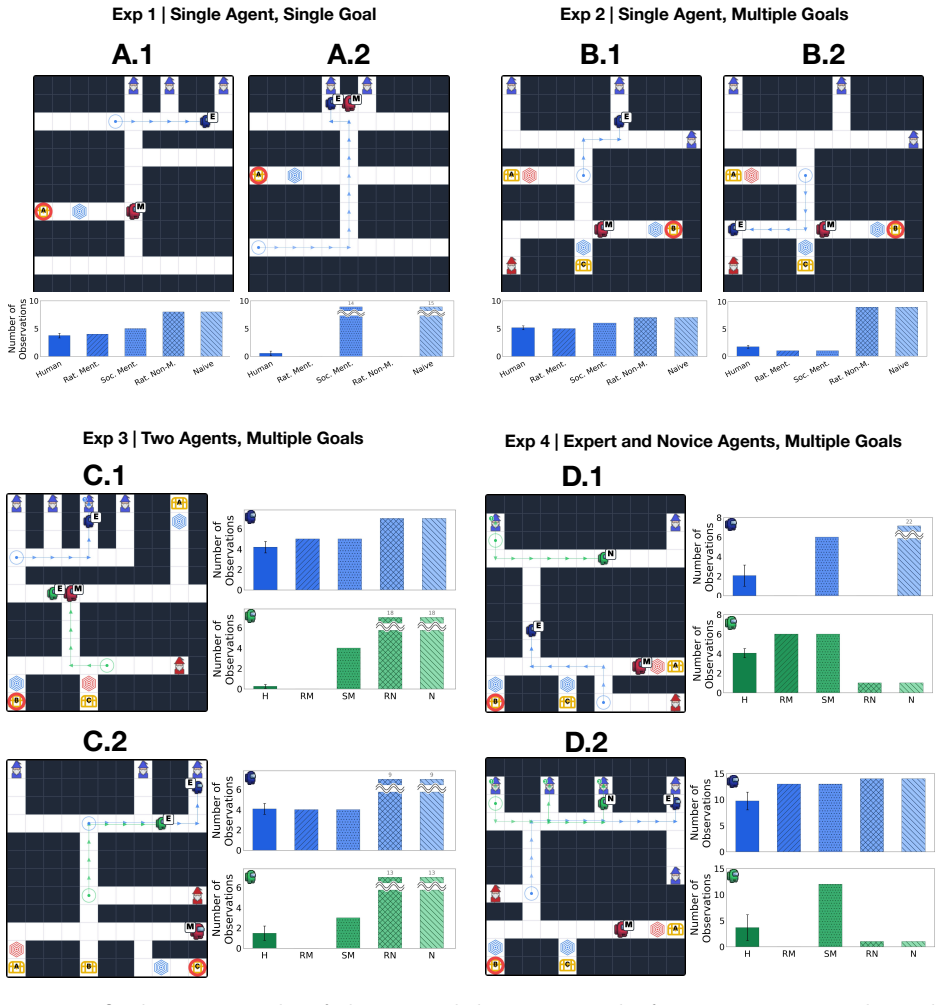
Summary. The paper proposes a Rational Mentalizing model of selective social learning: at each step the observer compares the non-social exploration cost C_self(b_t) to a posterior-weighted expected cost of watching agent j, Q^j_obs(t)=Σ_i p_i[c_obs T_i + C_plan(b'_t)], obtained by Bayesian Theory of Mind (inverse planning over goals and beliefs) plus forward simulation of how that agent’s trajectory would shrink the observer’s candidate set. Observation occurs only when watching is cheaper; with multiple agents the argmin selects whom to watch. A novel multi-agent grid game (observe-or-act turns; wizards/amulets; expert/novice NPCs) creates parametric trade-offs across four experiments of increasing complexity (goal uncertainty, whom-to-watch, expertise). With parameters fixed a priori and shared across experiments, the full model matches human observation counts (pooled CCC=0.89, near split-half reliability ceilings), while three ablations that remove mentalizing, utility comparison, or both fit substantially worse and fail in opposite directions (over- vs under-observe).
Significance. If the result holds, the paper supplies a concrete, testable account of how Theory of Mind is used not only to interpret others but to decide whether social observation is worth its cost relative to individual exploration—bridging Bayesian ToM, active information seeking, and social-learning-strategy literatures that have largely treated observed behavior as a reliability-weighted signal rather than as goal-directed evidence. Strengths that raise the contribution above a pure modeling exercise include: a novel paradigm with controllable goal/expertise structure; a priori shared parameters never fit to human observation; high split-half reliability of the behavioral target; ablations that dissociate components; and released code, stimuli, and anonymized data (OSF). The whom-to-watch and expert/novice reversals are especially diagnostic relative to heuristic or pure RL social-learning accounts.
major comments (2)
- [Methods §6.4, Algorithm 1, Discussion] Methods §6.4 and Algorithm 1 implement utility maximization as a hard myopic rule: observe j* iff min_j Q^j_obs(t) < C_self(b_t), else permanently commit to a greedy nearest-wizard self-exploration planner C_self(b)=Σ_k[d(x_{k-1},w^{(k)})+c_int]+d(x_K,x_g). Discussion correctly notes systematic under-prediction of absolute observation and total steps, plus residual watching of the non-chosen agent. That pattern is exactly what a misspecified C_self magnitude, missing interleaving of observe/act, or softer-than-argmin choice would produce. Because the central claim is that selective social learning is guided by ToM “in the service of utility maximization,” the paper should either (i) report a sensitivity analysis (soft-max over {act, observe-j}, alternative residual planners, or a small exploration bonus) showing that relative CCC/whom-to-watch results are robust, or (ii) explicitly downg
- [§4, Methods §6.5, Introduction] The Rational Observer ablation (Methods §6.5) decides once at trial start using a fixed horizon to the other agent’s first wizard interaction, with no online re-evaluation and no goal inference. That is a weak foil for “cost-benefit without mentalizing”: a stronger non-mentalizing baseline would recompute expected information value online from observed trajectories treated as exogenous signals (e.g., reliability-weighted or volatility-based arbitration in the spirit of Behrens et al. / Diaconescu et al., which the Introduction cites). If such a baseline still fails on Experiments 2–4 (goal divergence, whom, novice), the ToM necessity claim is stronger; if it closes much of the gap on observation counts, the unique contribution of generative mentalizing needs tighter bounds. At minimum, justify why the once-and-done Rational Observer is the right contrast rather than an online non-ToM act
minor comments (6)
- [§4.1, Figure 3] Figure 3 reports pooled CCC and r, but per-experiment observation scatter with identity lines (partially in SI Figs. A12–A13) should be promoted or at least cross-referenced more clearly in the main Results so readers can see absolute calibration, not only concordance.
- [§3, Methods §6.4] Eq. (1) and Eq. (4) are identical; renumber or drop the duplicate and keep a single definition of Q^j_obs(t).
- [Appendix A, Table A2] The Mentalizing Observer’s divergence threshold ε=0.1 (Table A2) is listed among free parameters; briefly state that it was set a priori like the others and, if any informal tuning occurred, disclose it.
- [Throughout / References] Typographical inconsistencies: “Theoryof Mind”, “Muthukrishnaetal.”, “VélezandHyowonGweon”, missing spaces in keywords and some references. A pass for spacing and en-dashes would help.
- [Figure 5, §6.3] Figure 5’s “3×move + 5×interact” execution-cost definition is clear in the caption but should be stated once in Methods when point costs are introduced so the observation–execution coupling analysis is self-contained.
- [§4, Appendix A.3] SI notes total cost is not model-diagnostic (Fig. A14) while observation cost is—this is an important design lesson; one sentence in main §4 would help readers who only skim the SI.
Circularity Check
No significant circularity: a priori fixed-cost ToM arbitration yields out-of-sample behavioral predictions, not tautologies.
full rationale
The paper’s load-bearing claim is that observers decide whether/whom to watch by comparing C_self(b_t) to the posterior-weighted Q^j_obs(t)=Σ_i p_i[c_obs T_i + C_plan(b'_t)], with posteriors from Bayesian inverse planning (SIPS) and residual costs from a greedy wizard tour. That comparison is a genuine generative procedure: map geometry, NPC policies, and fixed point costs are inputs; observation counts and whom-to-watch patterns are outputs that could (and for ablations do) mismatch humans. Methods explicitly state all parameters (β=0.5, c_obs=1, movement 3, interaction 5, convergence 0.95, prune 0.1) were set a priori, held identical across four experiments, and never fit to human observation. Predictions are scored against held-out participant behavior (pooled CCC=0.89 near split-half ceilings) and three ablations that remove mentalizing or utility comparison. Self-citations to Baker/Zhi-Xuan/Ying BToM–SIPS supply the inverse-planning engine as reusable machinery, not a uniqueness theorem that forces the arbitration result. Under-prediction of absolute observation is a misspecification concern, not circularity: the model is not definitionally equal to the data it is tested on. No fitted-input-as-prediction, self-definitional identity, or renamed empirical law is present.
Assumptions & free parameters
free parameters (5)
- Boltzmann planning temperature β =
0.5 (a priori)
- State-convergence threshold =
0.95 (a priori)
- Hypothesis-pruning threshold =
0.1 (a priori)
- Mentalizing Observer belief-divergence ε =
0.1 (a priori)
- Per-step point costs (move=3, interact=5, observe=1) =
3 / 5 / 1
assumptions (6)
- domain assumption Observed NPCs are near-optimal planners with Boltzmann policies over cost-to-go under latent goal and belief (Eq. 2).
- domain assumption Observer maintains a joint posterior over the other agent’s goal and amulet belief via Bayesian inverse planning / SIPS particle filter (Eq. 3).
- ad hoc to paper Decision rule is myopic one-step re-evaluation: observe j* iff min_j Q^j_obs(t) < C_self(b_t), else act (Algorithm 1).
- ad hoc to paper Non-social cost C_self is the cost of a greedy nearest-first wizard tour plus path to goal under current belief.
- domain assumption Agents’ actions do not change each other’s environment state; amulets/barriers/chests are non-rival.
- standard math Standard probability calculus and Bayes rule for updating posteriors from action likelihoods.
invented entities (2)
-
Rational Mentalizing decision procedure (Q_obs via simulated ToM trajectories vs C_self)
independent evidence
-
Social learning grid game (observe-or-act turns, wizards/amulets, expert/novice NPCs)
Cite this review
Pith. "Pith review of Using Theory of Mind to Arbitrate between Social and Non-social Learning." pith.science (2026). https://pith.science/paper/K2ZHUDYL
@misc{pith2026260728601,
  author       = {Pith},
  title        = {Pith review of: Using Theory of Mind to Arbitrate between Social and Non-social Learning},
  year         = {2026},
  howpublished = {\url{https://pith.science/paper/K2ZHUDYL}},
  note         = {Machine review of arXiv:2607.28601}
}
read the original abstract
Social learning is a powerful mechanism through which agents learn about the world from others. However, humans sometimes choose direct experience over social learning, which can carry time and cognitive resource costs. How do people balance social and non-social learning? We propose a Rational Mentalizing model of the decision to engage in social learning. This model estimates the utility of social learning by reasoning about another agent's goal and the informativeness of their future actions. It then weighs the utility of social learning against the utility of non-social learning. Using a novel game where players choose between observing other agents or exploring the environment, we show that the Rational Mentalizing model can quantitatively capture human trade-offs between these strategies. These findings suggest that selective social learning is guided by 'Theory of Mind' in the service of utility maximization.
Figures


Figures from the paper (2 more)

Reference graph
Works this paper leans on
-
[6]
Elizabeth Dutemple, Hanifa Hakimi, and Diane Poulin-Dubois
doi: 10.7554/eLife.54051. Elizabeth Dutemple, Hanifa Hakimi, and Diane Poulin-Dubois. Do I know what they know? link- ing metacognition, theory of mind, and selective social learning.Journal of experimental child psychology, 227:105572,
-
[13]
David Schultner, Lucas Molleman, and Björn Lindström
doi: 10.1016/j.cognition.2019.104013. David Schultner, Lucas Molleman, and Björn Lindström. Feature-based reward learning shapes human social learning strategies.Nature Human Behaviour, 9:2183–2198,
arXiv 2019
-
[15]
Natalia Vélez and Hyowon Gweon
doi: 10.1111/tops.12388. Natalia Vélez and Hyowon Gweon. Learning from other minds: an optimistic critique of reinforce- ment learning models of social learning.Current Opinion in Behavioral Sciences, 38:110–115,
-
[16]
doi: 10.1016/j.cobeha.2021.01.006. Henry M Wellman. Understanding the psychological world: Developing a theory of mind. In Usha Goswami, editor,Blackwell Handbook of Childhood Cognitive Development, pages 167–187. Blackwell,
-
[18]
Lance Ying, Ryan Truong, Katherine M Collins, Cedegao E Zhang, Megan Wei, Tyler Brooke- Wilson, Tan Zhi-Xuan, Lionel Wong, and Joshua B Tenenbaum. Language-informed synthe- sis of rational agent models for grounded theory-of-mind reasoning on-the-fly. arXiv preprint arXiv:2506.16755,
-
[1994]
Maayan Pereg, Uri Hertz, Ido Ben-Artzi, and Nitzan Shahar
doi: 10.1037/0033-295X.101.4.608. Maayan Pereg, Uri Hertz, Ido Ben-Artzi, and Nitzan Shahar. Disentangling the contribution of individual and social learning processes in human advice-taking behavior.npj Science of Learning, 9(1):4,
-
[2005]
doi: 10.1111/j.1467-8624.2005.00849.x. Kevin N Laland. Social learning strategies.Learning & Behavior, 32(1):4–14,
arXiv 2005
-
[2008]
Guido Biele, Jörg Rieskamp, and Richard Gonzalez
doi: 10.1038/nature07538. Guido Biele, Jörg Rieskamp, and Richard Gonzalez. Computational models for the combination of advice and individual learning.Cognitive Science, 33(2):206–242,
Show all 18 references
-
[2009]
2009.01010.x
doi: 10.1111/j.1551-6709. 2009.01010.x. Elizabeth Bonawitz and Patrick Shafto. Computational models of development, social influences. Current Opinion in Behavioral Sciences, 7:95–100,
2009 arXiv
-
[2010]
Stephanie Stacy, Chenfei Li, Minglu Zhao, Yiling Yun, Qingyi Zhao, Max Kleiman-Weiner, and Tao Gao
doi: 10.1111/ j.1468-0017.2010.01394.x. Stephanie Stacy, Chenfei Li, Minglu Zhao, Yiling Yun, Qingyi Zhao, Max Kleiman-Weiner, and Tao Gao. Modeling communication to coordinate perspectives in cooperation. InProceedings of the Annual Meeting of the Cognitive Science Society, v...
2010
-
[2011]
Sophie Bridgers, Julian Jara-Ettinger, and Hyowon Gweon
doi: 10.1016/j.cognition.2010.10.001. Sophie Bridgers, Julian Jara-Ettinger, and Hyowon Gweon. Young children consider the expected utility of others’ learning to decide what to teach.Nature Human Behaviour, 4(2):144–152,
2010 doi
-
[2014]
Michael Muthukrishna, Thomas JH Morgan, and Joseph Henrich
doi: 10.1037/a0032108. Michael Muthukrishna, Thomas JH Morgan, and Joseph Henrich. The when and who of social learning and conformist transmission.Evolution and Human Behavior, 37(1):10–20,
-
[2016]
Learning how to behave: cognitive learning processes account for asymmetries in adap- tation to social norms.Proceedings of the Royal Society B, 288(1952):20210293,
Uri Hertz. Learning how to behave: cognitive learning processes account for asymmetries in adap- tation to social norms.Proceedings of the Royal Society B, 288(1952):20210293,
1952
-
[2019]
Andreea Oliviana Diaconescu, Madeline Stecy, Lars Kasper, Christopher J Burke, Zoltan Nagy, Christoph Mathys, and Philippe N Tobler
doi: 10.3758/s13423-018-1470-5. Andreea Oliviana Diaconescu, Madeline Stecy, Lars Kasper, Christopher J Burke, Zoltan Nagy, Christoph Mathys, and Philippe N Tobler. Neural arbitration between social and individual learning systems.eLife, 9:e54051,
-
[2020]
Anna Coenen, Jonathan D Nelson, and Todd M Gureckis
doi: 10.1038/s41562-019-0748-6. Anna Coenen, Jonathan D Nelson, and Todd M Gureckis. Asking the right questions about the psychology of human inquiry: Nine open challenges.Psychonomic Bulletin & Review, 26(5): 1548–1587,
-
[2021]
Cecilia Heyes
doi: 10.1098/rspb.2021.0293. Cecilia Heyes. What’s social about social learning?Journal of comparative psychology, 126(2): 193–202,
2021
-
[2024]
Luke Rendell, Laurel Fogarty, William JE Hoppitt, Thomas JH Morgan, Mike M Webster, and Kevin N Laland
doi: 10.1038/s41539-024-00214-0. Luke Rendell, Laurel Fogarty, William JE Hoppitt, Thomas JH Morgan, Mike M Webster, and Kevin N Laland. Cognitive culture: theoretical and empirical insights into social learning strate- gies.Trends in Cognitive Sciences, 15(2):68–76,
-
[2025]
Lance Ying, Tan Zhi-Xuan, Lionel Wong, Vikash Mansinghka, and Joshua Tenenbaum
doi: 10.1038/s41467-025-58365-6. Lance Ying, Tan Zhi-Xuan, Lionel Wong, Vikash Mansinghka, and Joshua Tenenbaum. Grounding language about belief in a Bayesian theory-of-mind. arXiv preprint arXiv:2402.10416,
Reviewed July 31, 2026 · model on record in the stance chip above.
Discussion (0). Continue with ORCID to comment.