InfoQuant: Shaping Activation Distributions for Low-Bit LLM Quantization
Pith reviewed 2026-06-29 23:02 UTC · model grok-4.3
The pith
InfoQuant reshapes LLM activations via orthogonal transformation so low-bit uniform quantizers incur less error.
A machine-rendered reading of the paper's core claim, the machinery that carries it, and where it could break.
Core claim
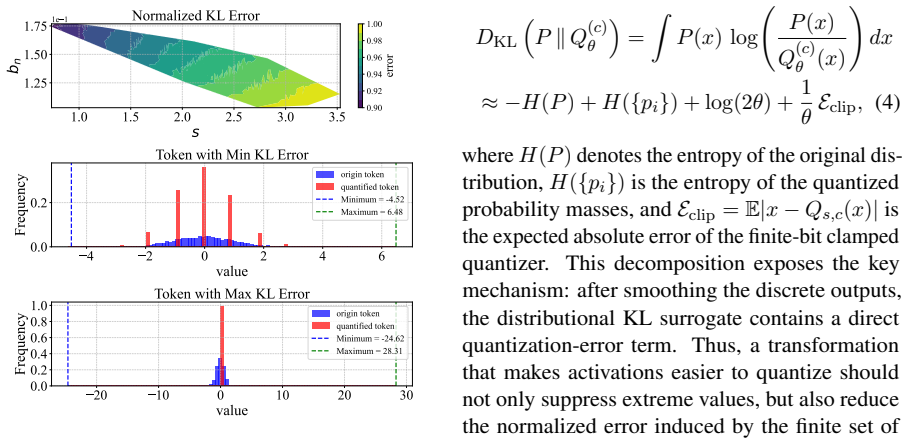
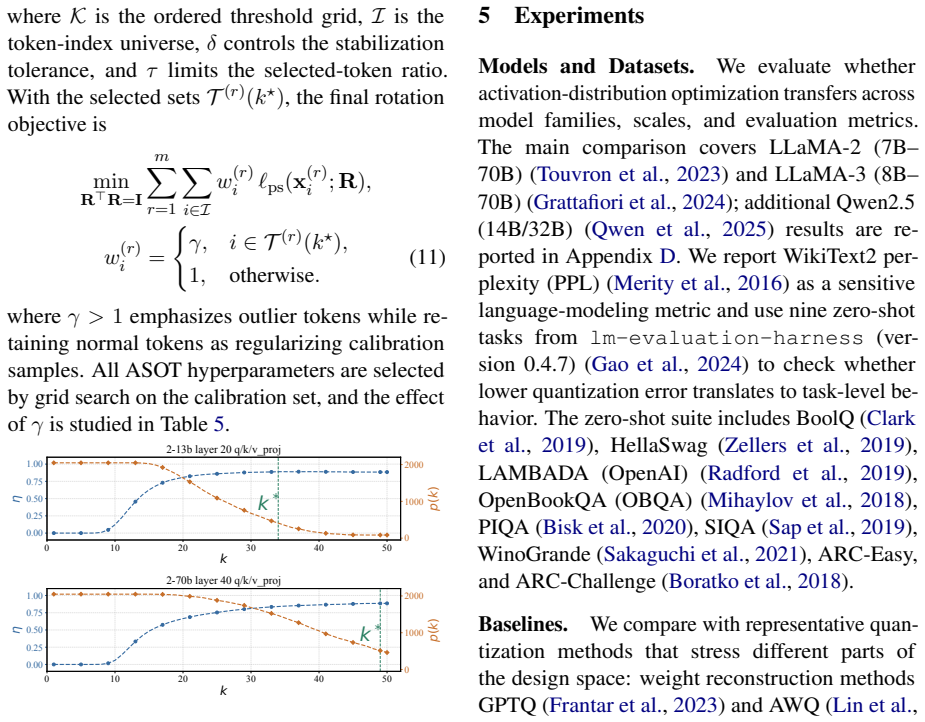
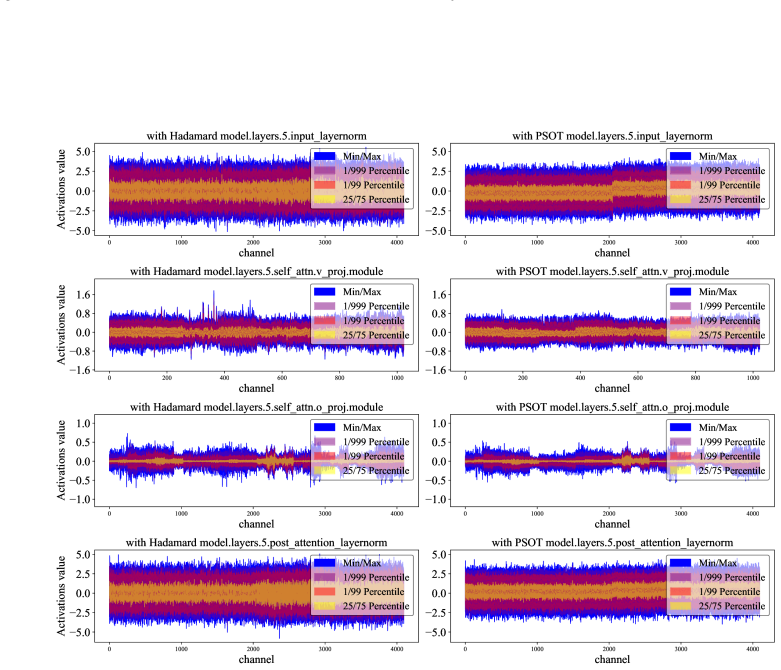
Quantization error drops when activations are transformed so their joint distribution has both a reduced numerical range and sufficient dispersion within that range; the Peak Suppression Orthogonal Transformation reliably produces such distributions in a train-free manner, and adaptive outlier-token selection stabilizes the transformation across models.
What carries the argument
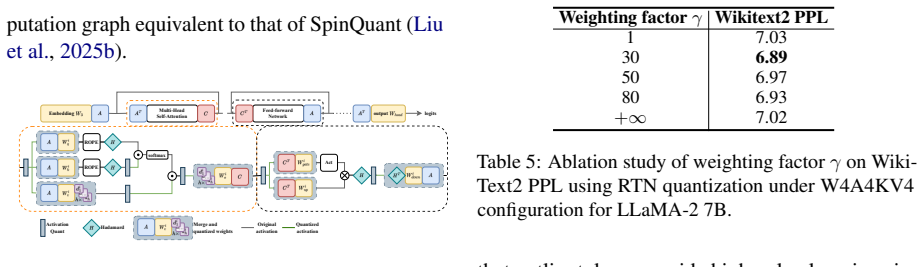
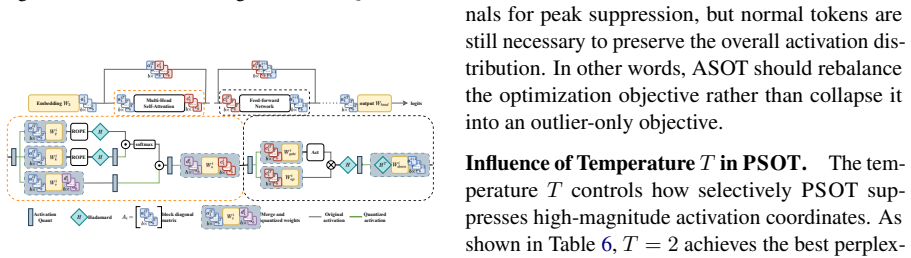
Peak Suppression Orthogonal Transformation (PSOT), an orthogonal matrix applied to activation tensors that suppresses peaks while keeping values spread inside the reduced range.
If this is right
- 4-bit activation and KV-cache quantization preserves nearly all original model accuracy on average.
- The performance gap between 4-bit and full-precision LLaMA-2 13B shrinks by 42 percent relative to prior state-of-the-art post-training methods.
- The same distribution-shaping step works across multiple LLM families without any model retraining.
Where Pith is reading between the lines
- The same range-plus-dispersion criterion might be used to design transformations for weight-only or mixed-precision quantization.
- Pre-computing the orthogonal matrix once per layer could allow hardware to apply the reshaping with negligible extra latency at inference time.
- If the criterion proves stable, it could serve as a diagnostic for whether a given quantization scheme is likely to work before any accuracy measurement.
Load-bearing premise
The information-theoretic rule that smaller range plus maintained dispersion inside the range is the right target for a low-bit uniform quantizer, and that PSOT plus adaptive selection can achieve it without changing model behavior.
What would settle it
A new LLM family where applying PSOT and adaptive selection produces no reduction in the gap to floating-point accuracy compared with the previous best post-training method.
Figures



read the original abstract
Low-bit activation quantization remains a major bottleneck in efficient large language model (LLM) deployment. The difficulty is not only that activations contain outliers, but that their distributions are often poorly matched to a low-bit uniform quantizer. Existing post-training quantization (PTQ) methods suppress peaks, balance channels, or minimize reconstruction error, yet they rarely specify what activation distribution is actually easy to discretize. As a result, activations may appear numerically smoother while still incurring large quantization error because the quantization range remains wide or most values collapse into a few levels near the mean. We recast activation transformation as quantizer-facing distribution design and analyze quantization error from an information-theoretic perspective. Our analysis shows that quantization-friendly activations should jointly have a smaller numerical range and sufficient dispersion within that range. Guided by this analysis, we propose InfoQuant, a train-free method that employs Peak Suppression Orthogonal Transformation (PSOT) to shape activations into more quantization-friendly distributions. We further introduce adaptive outlier-token selection to improve the robustness of PSOT during optimization. Across multiple LLM families, InfoQuant consistently outperforms prior PTQ and end-to-end training baselines. Under W4A4KV4, it preserves 97% of floating-point accuracy on average and reduces the LLaMA-2 13B performance gap by 42% over the previous state of the art. Code is available at [https://github.com/LLIKKE/InfoQuant](https://github.com/LLIKKE/InfoQuant)
Editorial analysis
A structured set of objections, weighed in public.
Referee Report
Summary. The manuscript proposes InfoQuant, a train-free post-training quantization method for low-bit LLM activations. It recasts activation transformation as quantizer-facing distribution design and uses an information-theoretic analysis to argue that quantization-friendly activations should have a smaller numerical range combined with sufficient dispersion within that range. The method introduces Peak Suppression Orthogonal Transformation (PSOT) together with adaptive outlier-token selection to produce such distributions. Empirical claims state that InfoQuant outperforms prior PTQ and end-to-end training baselines across LLM families, preserving 97% of floating-point accuracy on average under W4A4KV4 and reducing the LLaMA-2 13B performance gap by 42% relative to the previous state of the art.
Significance. If the empirical results prove robust, the work supplies a principled, train-free route to activation quantization that focuses on explicit distribution shaping rather than outlier suppression alone. The code release and the attempt to ground the transformation in an information-theoretic criterion are strengths that could aid reproducibility and further development in efficient LLM inference.
minor comments (3)
- The abstract states strong average gains but does not list the exact models, datasets, or number of runs; adding these details would strengthen the summary.
- Notation for the PSOT transformation and the adaptive outlier selection criterion should be introduced with explicit equations or pseudocode in the main text for clarity.
- Figure captions and table headers would benefit from stating the exact bit-width configuration (e.g., W4A4KV4) and the metric used for the reported accuracy percentages.
Simulated Author's Rebuttal
We thank the referee for the positive assessment of InfoQuant and the recommendation for minor revision. The provided summary correctly captures the core contribution: recasting activation transformation as distribution design via an information-theoretic lens, with PSOT and adaptive outlier selection yielding strong W4A4KV4 results. No specific major comments appear in the report.
Circularity Check
No significant circularity
full rationale
The paper's central chain begins with an information-theoretic analysis that independently derives the target properties (smaller numerical range + sufficient intra-range dispersion) for low quantization error under uniform discretization. PSOT and adaptive outlier selection are then introduced as a train-free procedure to realize those properties. No equations reduce the reported accuracy gains or distribution targets to quantities defined by the method itself, fitted parameters renamed as predictions, or self-citation chains. The performance claims rest on external benchmarks rather than internal redefinitions, satisfying the criteria for a self-contained, non-circular derivation.
Axiom & Free-Parameter Ledger
axioms (1)
- domain assumption Quantization-friendly activations should jointly have a smaller numerical range and sufficient dispersion within that range
invented entities (1)
-
Peak Suppression Orthogonal Transformation (PSOT)
no independent evidence
Reference graph
Works this paper leans on
-
[1]
A Systematic Classification of Knowledge, Reasoning, and Context within the ARC Dataset
KURTAIL : KURTOSIS-BASED LLM QUANTIZATION. InSparsity in LLMs (SLLM): Deep Dive into Mixture of Experts, Quantization, Hardware, and Inference. Saleh Ashkboos, Maximilian L. Croci, Marcelo Gennari do Nascimento, Torsten Hoefler, and James Hensman. 2024a. SliceGPT: Compress large language models by deleting rows and columns. InThe Twelfth Inter- national C...
work page internal anchor Pith review Pith/arXiv arXiv 2020
-
[2]
Flatquant: Flatness matters for llm quantization
Flatquant: Flatness matters for llm quantiza- tion.Preprint, arXiv:2410.09426. Hugo Touvron, Louis Martin, Kevin Stone, Peter Al- bert, Amjad Almahairi, Yasmine Babaei, Nikolay Bashlykov, Soumya Batra, Prajjwal Bhargava, Shruti Bhosale, and 1 others. 2023. Llama 2: Open foun- dation and fine-tuned chat models.arXiv preprint arXiv:2307.09288. Albert Tseng,...
discussion (0)
Sign in with ORCID, Apple, or X to comment. Anyone can read and Pith papers without signing in.