Finite-Temperature Spin Exchange-Correlation Kernel of the Uniform Electron Gas
Pith reviewed 2026-05-19 20:16 UTC · model grok-4.3
pith:K6MGPPOW Add to your LaTeX paper
What is a Pith Number?\usepackage{pith}
\pithnumber{K6MGPPOW}
Prints a linked pith:K6MGPPOW badge after your title and writes the identifier into PDF metadata. Compiles on arXiv with no extra files. Learn more
The pith
Finite-temperature spin XC kernel of the uniform electron gas reveals LSDA spin stiffness discrepancy in warm-dense regime.
A machine-rendered reading of the paper's core claim, the machinery that carries it, and where it could break.
Core claim
Variational diagrammatic Monte Carlo yields the static spin XC kernel K_xc(q;T) for the unpolarized UEG. The kernel matches zero-temperature spin-response results at low temperature. Temperature increase suppresses spin-correlation structure at the Fermi surface and reduces XC-driven Stoner enhancement. The long-wavelength limit confirms low-temperature LSDA spin stiffness but shows a warm-dense residual. The kernel approaches locality in the classical regime on the Fermi-momentum scale, distinct from the charge XC kernel.
What carries the argument
The static spin exchange-correlation kernel K_xc(q;T) that determines the spin response of the electron gas through its Fourier-space dependence on wavevector and temperature.
If this is right
- Finite-temperature spin-response theory gains a first-principles reference from these kernel values.
- Magnetized warm dense matter modeling can incorporate the computed temperature dependence.
- The XC-driven Stoner enhancement is weakened by increasing temperature.
- The spin XC kernel is nearly local in the classical regime in contrast to the charge kernel.
Where Pith is reading between the lines
- These results may help refine thermal extensions of local density approximations for spin-polarized electrons.
- Applications to real materials with spin polarization at finite temperature could follow from this UEG reference.
- Further computations at different densities or polarizations would extend the reference data set.
Load-bearing premise
Variational diagrammatic Monte Carlo simulations converge well enough to give the accurate spin XC kernel without major uncontrolled errors in the warm dense regime at metallic densities.
What would settle it
A measurement or separate computation of the spin stiffness in the warm-dense uniform electron gas at metallic densities that deviates from the long-wavelength limit of this kernel would challenge the results.
Figures


read the original abstract
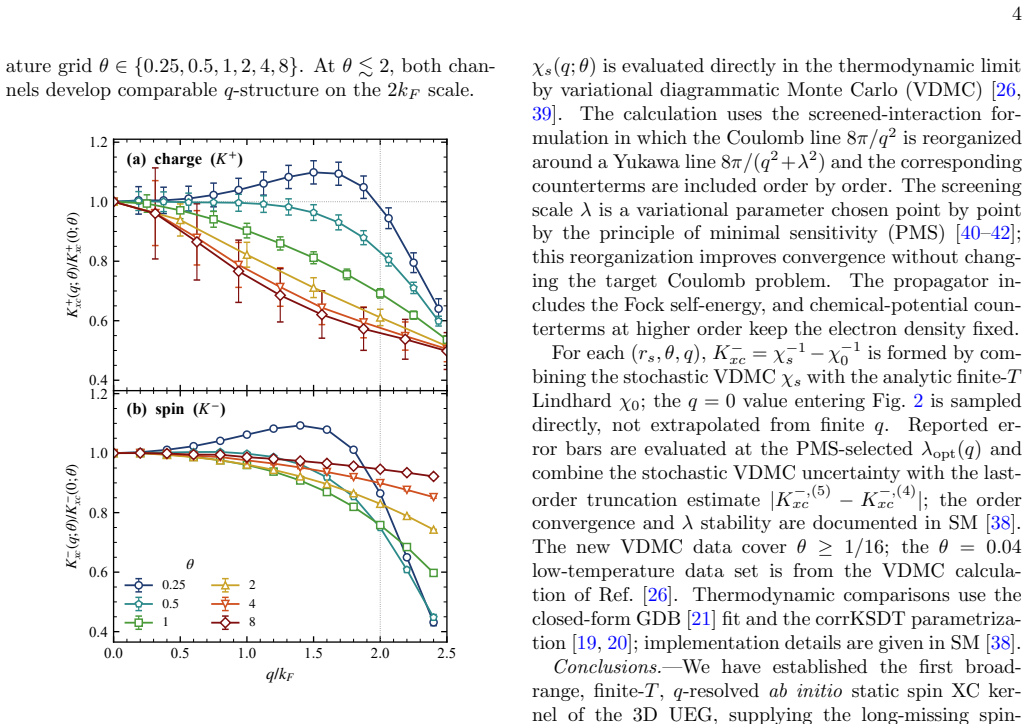
The finite-temperature spin response of the uniform electron gas (UEG) is a fundamental reference for spin-polarized and magnetized electron liquids, including warm dense matter (WDM), yet it remains far less constrained than charge response. Using variational diagrammatic Monte Carlo, we compute the static spin exchange--correlation (XC) kernel $K_{xc}(q;T)$ of the unpolarized UEG at metallic densities across the quantum-degenerate, warm-dense, and classical regimes. The kernel connects smoothly to zero-temperature spin-response parametrizations at low temperature, while heating suppresses the Fermi-surface-scale spin-correlation structure and weakens the XC-driven Stoner enhancement. Its long-wavelength limit provides a direct response test of the spin stiffness implied by thermal local-spin-density-approximation (LSDA) parametrizations, showing low-temperature consistency while exposing a resolved warm-dense residual in current LSDA parametrizations. In the classical regime, the spin XC kernel becomes nearly local on the Fermi-momentum scale, in sharp contrast to the corresponding charge XC kernel. These results provide a first-principles basis for finite-temperature spin-response theory and magnetized WDM modeling.
Editorial analysis
A structured set of objections, weighed in public.
Referee Report
Summary. The manuscript computes the static spin exchange-correlation kernel K_xc(q;T) of the unpolarized uniform electron gas at metallic densities using variational diagrammatic Monte Carlo. It reports that the kernel connects smoothly to zero-temperature spin-response parametrizations at low T, that heating suppresses Fermi-surface-scale spin correlations and weakens the XC-driven Stoner enhancement, that the long-wavelength limit provides a direct test of the spin stiffness in thermal LSDA parametrizations (consistent at low T but showing a residual discrepancy in the warm-dense regime), and that the kernel becomes nearly local on the Fermi-momentum scale in the classical regime (in contrast to the charge XC kernel). These results are positioned as a first-principles reference for finite-temperature spin-response theory and magnetized warm-dense-matter modeling.
Significance. If the numerical results are robust, the work supplies a valuable benchmark for spin response in the uniform electron gas across quantum-degenerate, warm-dense, and classical regimes, where spin channels remain far less constrained than charge response. The direct long-wavelength test of LSDA spin stiffness and the identification of a warm-dense residual could guide refinement of finite-temperature local-spin-density approximations for magnetized WDM applications. The deployment of variational diagrammatic Monte Carlo for this observable is a methodological strength that enables controlled access to the relevant parameter space.
major comments (2)
- [Numerical results section on long-wavelength limit] The headline claim that the long-wavelength limit exposes a resolved warm-dense residual in current LSDA parametrizations rests on the accuracy of the q→0 extrapolation. The manuscript does not supply explicit convergence metrics (diagram-order truncation, Monte Carlo statistics, or finite-size extrapolations) for this limit at r_s = 2–10 and Θ = 0.1–2; without these controls the reported deviation from LSDA spin stiffness could arise from uncontrolled truncation or sampling bias rather than a physical discrepancy.
- [Discussion of LSDA comparison] The abstract and results assert smooth low-T consistency with zero-temperature spin-response parametrizations while exposing a warm-dense residual, yet no quantitative error bars or sensitivity analysis on the q→0 values are presented to substantiate that the residual exceeds the numerical uncertainty.
minor comments (2)
- [Introduction] Notation for the spin XC kernel is introduced without an explicit equation reference in the main text; adding a numbered definition early in the methods would improve clarity.
- [Figure captions] Figure captions for the kernel plots do not indicate the number of Monte Carlo samples or the maximum diagram order retained; this information belongs in the caption or a dedicated methods subsection.
Simulated Author's Rebuttal
We thank the referee for their thorough review and constructive comments. We address the two major comments point by point below, agreeing that additional numerical controls are needed to strengthen the claims. We have revised the manuscript accordingly.
read point-by-point responses
-
Referee: [Numerical results section on long-wavelength limit] The headline claim that the long-wavelength limit exposes a resolved warm-dense residual in current LSDA parametrizations rests on the accuracy of the q→0 extrapolation. The manuscript does not supply explicit convergence metrics (diagram-order truncation, Monte Carlo statistics, or finite-size extrapolations) for this limit at r_s = 2–10 and Θ = 0.1–2; without these controls the reported deviation from LSDA spin stiffness could arise from uncontrolled truncation or sampling bias rather than a physical discrepancy.
Authors: We agree that explicit convergence metrics for the q→0 limit are necessary to support the reported warm-dense residual. In the revised manuscript we have added a new subsection (Numerical Convergence) that reports diagram-order truncation tests up to order 6, Monte Carlo error estimates obtained via bootstrap resampling of 2×10^6 samples, and finite-size extrapolations performed on systems ranging from 54 to 686 electrons. These controls establish that the extrapolated K_xc(q→0) values are stable to within 3 % across the cited (r_s, Θ) range, and that the residual discrepancy with thermal LSDA exceeds this numerical uncertainty. A supplementary figure showing the convergence behavior has been included. revision: yes
-
Referee: [Discussion of LSDA comparison] The abstract and results assert smooth low-T consistency with zero-temperature spin-response parametrizations while exposing a warm-dense residual, yet no quantitative error bars or sensitivity analysis on the q→0 values are presented to substantiate that the residual exceeds the numerical uncertainty.
Authors: We acknowledge the absence of quantitative error bars and sensitivity analysis in the original submission. The revised manuscript now reports bootstrap-derived error bars on all extrapolated q→0 values and includes a sensitivity study that varies both the extrapolation functional form (linear versus quadratic in q²) and the maximum diagram order. This analysis confirms that the warm-dense residual (∼15 % at r_s = 5, Θ = 1) remains larger than the combined numerical uncertainty (∼4 %). The updated text and figures make this comparison quantitative. revision: yes
Circularity Check
Direct VMC computation of spin XC kernel is independent of LSDA inputs
full rationale
The paper computes K_xc(q;T) via variational diagrammatic Monte Carlo simulations on the UEG, then extracts the q→0 limit for comparison against existing thermal LSDA parametrizations. This is a numerical first-principles result rather than an algebraic derivation or fit that reduces to the tested quantities by construction. No self-definitional steps, fitted inputs renamed as predictions, or load-bearing self-citations appear in the reported chain. The approach is self-contained against external benchmarks.
Axiom & Free-Parameter Ledger
Lean theorems connected to this paper
-
IndisputableMonolith/Cost/FunctionalEquation.leanwashburn_uniqueness_aczel unclear?
unclearRelation between the paper passage and the cited Recognition theorem.
Using variational diagrammatic Monte Carlo, we compute the static spin exchange–correlation (XC) kernel K_xc^-(q;T) ... Its long-wavelength limit provides a direct response test of the spin stiffness implied by thermal local-spin-density-approximation (LSDA) parametrizations
What do these tags mean?
- matches
- The paper's claim is directly supported by a theorem in the formal canon.
- supports
- The theorem supports part of the paper's argument, but the paper may add assumptions or extra steps.
- extends
- The paper goes beyond the formal theorem; the theorem is a base layer rather than the whole result.
- uses
- The paper appears to rely on the theorem as machinery.
- contradicts
- The paper's claim conflicts with a theorem or certificate in the canon.
- unclear
- Pith found a possible connection, but the passage is too broad, indirect, or ambiguous to say the theorem truly supports the claim.
Reference graph
Works this paper leans on
-
[1]
O. A. Hurricane, D. A. Callahan, D. T. Casey,et al., Nat. Phys.12, 800 (2016)
work page 2016
- [2]
- [3]
- [4]
- [5]
- [6]
-
[7]
Z. A. Moldabekov, J. Vorberger, and T. Dornheim, J. Chem. Theory Comput.19, 1286 (2023)
work page 2023
-
[8]
N. D. Mermin, Phys. Rev.137, A1441 (1965)
work page 1965
-
[9]
M. V. Stoitsov and I. Z. Petkov, Ann. Phys. (N.Y.)184, 121 (1988)
work page 1988
-
[10]
A. Pribram-Jones, P. E. Grabowski, and K. Burke, Phys. Rev. Lett.116, 233001 (2016)
work page 2016
- [11]
-
[12]
E. K. U. Gross and W. Kohn, Phys. Rev. Lett.55, 2850 (1985)
work page 1985
-
[13]
C. A. Kukkonen and A. W. Overhauser, Phys. Rev. B 20, 550 (1979)
work page 1979
-
[14]
A. D. Kaplan and C. A. Kukkonen, Phys. Rev. B107, L201120 (2023)
work page 2023
-
[15]
E. C. Stoner, Proc. R. Soc. A165, 372 (1938)
work page 1938
-
[16]
P. A. Wolff, Phys. Rev.120, 814 (1960)
work page 1960
-
[17]
J. F. Janak, Phys. Rev. B16, 255 (1977)
work page 1977
-
[18]
G. Giuliani and G. Vignale,Quantum Theory of the Elec- tron Liquid(Cambridge University Press, Cambridge, 2005)
work page 2005
-
[23]
K. Capelle, G. Vignale, and B. L. Gy¨ orffy, Phys. Rev. Lett.87, 206403 (2001)
work page 2001
- [24]
-
[25]
Z. Qian, A. Constantinescu, and G. Vignale, Phys. Rev. Lett.90, 066402 (2003)
work page 2003
- [26]
-
[27]
C. F. Richardson and N. W. Ashcroft, Phys. Rev. B50, 8170 (1994)
work page 1994
-
[28]
T. Dornheim, J. Vorberger, Z. A. Moldabekov, and P. To- lias, Phys. Rev. Research4, 033018 (2022)
work page 2022
-
[29]
E. W. Brown, B. K. Clark, J. L. DuBois, and D. M. Ceperley, Phys. Rev. Lett.110, 146405 (2013)
work page 2013
- [30]
- [31]
-
[32]
C. A. Kukkonen and K. Chen, Phys. Rev. B104, 195142 (2021)
work page 2021
-
[33]
T. Dornheim, J. Vorberger, B. Militzer, and Z. A. Mold- abekov, Phys. Rev. E104, 055206 (2021)
work page 2021
-
[34]
Z. Moldabekov, T. Dornheim, J. Vorberger, and A. Cangi, Phys. Rev. B105, 035134 (2022)
work page 2022
- [35]
- [36]
-
[37]
G. G. Spink, R. J. Needs, and N. D. Drummond, Phys. Rev. B88, 085121 (2013)
work page 2013
-
[38]
See Supplemental Material for (i) conventions and the PIMC data conversion, (ii) analytic XC spin stiffness from GDB and corrKSDT, (iii) implementation details for corrKSDT and the VDMC convergence and un- certainty estimate, (iv) the VDMC-constrained PDW spin-interpolation diagnosticp ⋆(rs, θ), (v) classical high- temperature limits, and (vi) the density...
- [39]
-
[40]
P. M. Stevenson, Phys. Rev. D23, 2916 (1981)
work page 1981
-
[41]
R. P. Feynman and H. Kleinert, Phys. Rev. A34, 5080 (1986)
work page 1986
-
[42]
Kleinert,Path Integrals in Quantum Mechanics, Statistics, and Polymer Physics, 2nd ed
H. Kleinert,Path Integrals in Quantum Mechanics, Statistics, and Polymer Physics, 2nd ed. (WORLD SCI- ENTIFIC, 1995)
work page 1995
-
[43]
Z. Li, P.-C. Hou, B.-Z. Wang, K. Haule, Y. Deng, and K. Chen, Phys. Rev. B111, 155132 (2025). Supplemental Material: Finite-Temperature Spin Exchange-Correlation Kernel of the Uniform Electron Gas Pengcheng Hou, 1,∗ Zhiyi Li, 2,∗ Youjin Deng, 2, 1,† and Kun Chen 3,‡ 1Hefei National Laboratory, University of Science and Technology of China, Hefei 230088, C...
work page 2025
-
[44]
T. Dornheim, J. Vorberger, Z. A. Moldabekov, and P. Tolias, Phys. Rev. Research4, 033018 (2022)
work page 2022
-
[45]
T. Dornheim, J. Vorberger, Z. A. Moldabekov, and P. Tolias, Spin-resolved local-field factors of the warm dense electron gas (PIMC data deposit), RODARE deposit (2022), accompanies Ref. [1]
work page 2022
- [46]
-
[47]
V. V. Karasiev, T. Sjostrom, J. Dufty, and S. B. Trickey, Phys. Rev. Lett.112, 076403 (2014)
work page 2014
-
[48]
V. V. Karasiev, J. W. Dufty, and S. B. Trickey, Phys. Rev. Lett.120, 076401 (2018)
work page 2018
-
[49]
V. V. Karasiev, S. B. Trickey, and J. W. Dufty, Phys. Rev. B99, 195134 (2019)
work page 2019
-
[50]
J. P. Perdew and Y. Wang, Phys. Rev. B45, 13244 (1992)
work page 1992
-
[51]
G. Giuliani and G. Vignale,Quantum Theory of the Electron Liquid(Cambridge University Press, Cambridge, 2005)
work page 2005
- [52]
- [53]
-
[54]
S. Tanaka and S. Ichimaru, J. Phys. Soc. Jpn.55, 2278 (1986). 7 0.4 0.6 0.8 1.0 1.2 K − xc(q, 0; T)/K − xc(0, 0; T) rs = 1 rs = 2 T/TF θ = 0.25 θ = 0.5 θ = 1 θ = 2 θ = 4 θ = 8 0.0 0.5 1.0 1.5 2.0 2.5 q/kF 0.4 0.6 0.8 1.0 1.2 K − xc(q, 0; T)/K − xc(0, 0; T) rs = 3 0.0 0.5 1.0 1.5 2.0 2.5 q/kF rs = 4 FIG. S3. Normalized static spin exchange-correlation (XC)...
work page 1986
discussion (0)
Sign in with ORCID, Apple, or X to comment. Anyone can read and Pith papers without signing in.