Adaptive multi-line fitting for stable line-core intensity and Doppler velocity
Pith reviewed 2026-05-21 02:27 UTC · model grok-4.3
The pith
LineFit uses adaptive Voigt fitting to stabilize core intensities and Doppler velocities from complex solar spectral profiles.
A machine-rendered reading of the paper's core claim, the machinery that carries it, and where it could break.
Core claim
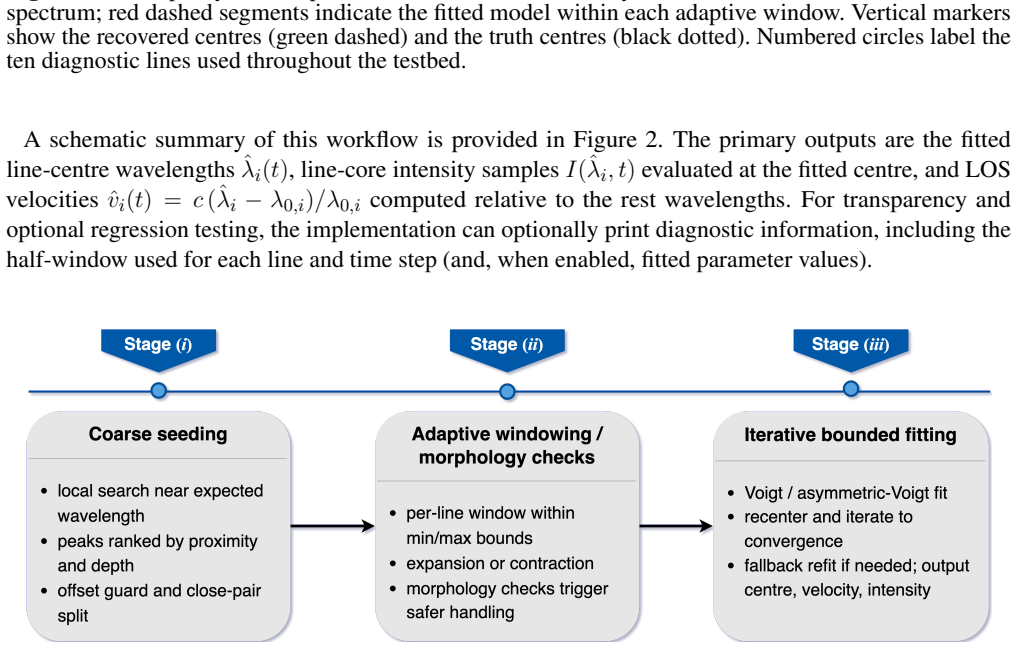
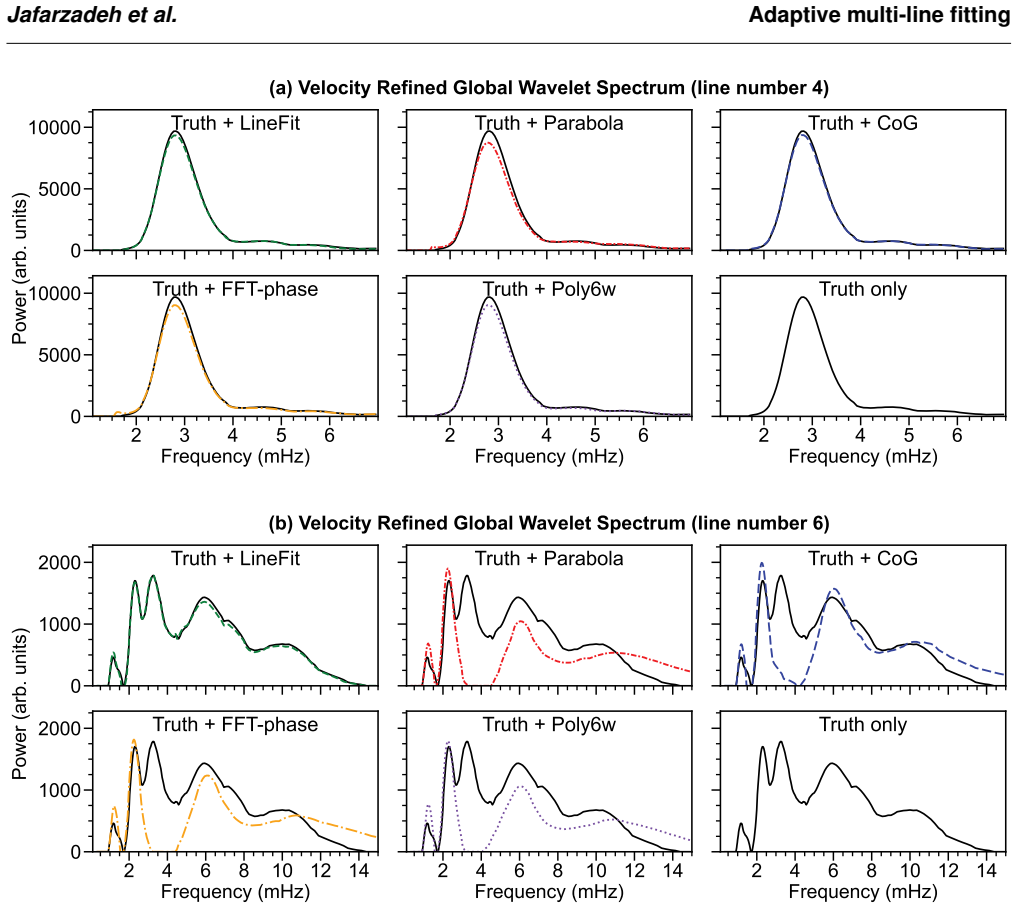
LineFit models each line locally with bounded non-linear least-squares fits to a Voigt-family profile, including an asymmetric-Voigt option to accommodate unequal wing broadening, and incorporates close-pair ownership control together with conservative, per-line window adaptation and split-core-aware handling. Using a synthetic time series with unambiguous ground truth, benchmarks show LineFit is most robust in key stress cases involving intermittently split-core profiles and correspondingly yields power spectra that agree most closely with the truth.
What carries the argument
LineFit, the adaptive multi-line fitting routine that performs bounded non-linear least-squares optimization of Voigt-family profiles with explicit split-core and blending controls.
If this is right
- LineFit reduces step-like artefacts in intensity and velocity time series extracted from rapidly evolving or split-core profiles.
- Downstream power spectra, phase, and coherence diagnostics become less biased by mis-tracking events.
- A hybrid emulation layer can accelerate the fitting process by at least three orders of magnitude while preserving the accuracy gains.
- The same fitting controls apply directly to any dense-window spectrograph that samples tens to hundreds of lines per spatial pixel.
Where Pith is reading between the lines
- Cleaner velocity and intensity series could improve multi-height tracking of magnetohydrodynamic waves across the solar atmosphere.
- The method could be tested on archival or upcoming data from instruments that already record wide spectral windows to quantify real-world gains beyond synthetics.
- Similar adaptive fitting logic might transfer to other domains that face crowded or variable line profiles, such as stellar atmospheres or laboratory plasma spectroscopy.
Load-bearing premise
The synthetic time series used for benchmarking accurately captures the morphological complexity, noise properties, and evolution rates present in real observational data from next-generation solar spectrographs.
What would settle it
Apply LineFit and the four baseline estimators to real solar spectrograph time series containing independently verified wave signals; if the power spectra or coherence measures from LineFit do not remain closer to the expected physical behaviour than the baselines, the robustness advantage would not hold.
Figures



read the original abstract
Next-generation solar spectrographs increasingly record dense wavelength windows in which tens to hundreds of spectral lines are sampled at each spatial location and time step. This expands the scope for multi-line, multi-height diagnostics of magnetohydrodynamic motions, but also raises a practical challenge: deriving stable line-core intensity and line-of-sight velocity time series when profiles evolve rapidly, become asymmetric, blend, or develop multi-lobed cores. Common fast estimators can perform well for simple, isolated absorption lines, yet can intermittently misidentify the core in crowded or morphologically complex cases. Even infrequent mis-tracking can leave step-like artefacts that redistribute power and bias spectral, phase, and coherence measures used in wave and dynamics analyses. We introduce LineFit, a fully reproducible adaptive multi-line fitting approach tailored to dense-window spectroscopy. LineFit models each line locally with bounded non-linear least-squares fits to a Voigt-family profile, including an asymmetric-Voigt option to accommodate unequal wing broadening, and incorporates close-pair ownership control together with conservative, per-line window adaptation and split-core-aware handling. Using a synthetic time series with unambiguous ground truth, we benchmark LineFit against four widely used fast baselines and assess both instantaneous centre errors and downstream time-series diagnostics. Several fast methods remain competitive for many lines, whereas LineFit is most robust in key stress cases involving intermittently split-core profiles and correspondingly yields power spectra that agree most closely with the truth. We also demonstrate a proof-of-principle that benchmarks hybrid acceleration of the LineFit software via supervised emulation, offering at least three orders-of-magnitude improvement in processing time.
Editorial analysis
A structured set of objections, weighed in public.
Referee Report
Summary. The manuscript introduces LineFit, an adaptive multi-line fitting procedure for extracting stable line-core intensity and Doppler velocity time series from dense spectral windows. Each line is modeled locally via bounded non-linear least-squares to a Voigt-family profile (with an asymmetric-Voigt option), incorporating close-pair ownership control, conservative per-line window adaptation, and split-core handling. Performance is assessed on a single synthetic time series with ground truth against four fast baselines, with the claim that LineFit is most robust for intermittently split-core profiles and yields power spectra closest to truth; a proof-of-principle supervised-emulation accelerator is also shown.
Significance. If the synthetic benchmarks prove representative, LineFit would offer a practical, reproducible improvement for multi-height MHD diagnostics in next-generation solar spectrographs by reducing step-like artefacts that bias wave and coherence analyses. The use of unambiguous ground-truth synthetics and the hybrid acceleration demonstration are clear strengths that support reproducibility and computational feasibility.
major comments (1)
- [Benchmarking section] Benchmarking section: the central claim that LineFit outperforms baselines specifically on intermittently split-core profiles and produces power spectra closest to ground truth is demonstrated exclusively on one synthetic time series. No quantitative comparison (histograms of asymmetry parameters, power-law indices of temporal variability, or noise power spectra) is provided between the synthetic ensemble and real data from instruments such as DKIST/VISP. This is load-bearing for the practical-superiority interpretation because the performance gap only implies utility for next-generation observations if the synthetic morphological complexity, blending rates, and noise properties match those of actual dense-window data.
minor comments (1)
- [Abstract] Abstract: quantitative error metrics, exact fitting bounds, and window-adaptation thresholds are not reported, making it difficult for readers to gauge the magnitude of the reported robustness improvement.
Simulated Author's Rebuttal
We thank the referee for their constructive feedback on our manuscript. We address the major comment regarding the benchmarking section below and have updated the manuscript to incorporate additional comparisons that strengthen the connection to real observational data.
read point-by-point responses
-
Referee: Benchmarking section: the central claim that LineFit outperforms baselines specifically on intermittently split-core profiles and produces power spectra closest to ground truth is demonstrated exclusively on one synthetic time series. No quantitative comparison (histograms of asymmetry parameters, power-law indices of temporal variability, or noise power spectra) is provided between the synthetic ensemble and real data from instruments such as DKIST/VISP. This is load-bearing for the practical-superiority interpretation because the performance gap only implies utility for next-generation observations if the synthetic morphological complexity, blending rates, and noise properties match those of actual dense-window data.
Authors: We acknowledge that a direct quantitative comparison between the synthetic data and real observations would further bolster the interpretation of our results for practical applications. In the revised version of the manuscript, we have added a discussion in the Benchmarking section that compares key statistical properties of our synthetic time series to those reported in the literature for solar spectra observed with instruments like DKIST/VISP. This includes comparisons of asymmetry parameter distributions, temporal variability power-law indices, and noise power spectra. These additions demonstrate that the synthetic ensemble was designed to capture the relevant complexities of dense-window solar spectroscopy, thereby supporting the applicability of LineFit's superior performance in intermittently split-core cases to real data. We maintain that the use of ground-truth synthetics remains a key strength for rigorous evaluation, but agree that bridging to real data properties enhances the manuscript. revision: yes
Circularity Check
No significant circularity; method and validation are independent of self-defined inputs
full rationale
The paper presents LineFit as a new adaptive multi-line fitting procedure using bounded non-linear least-squares to Voigt-family profiles with explicit options for asymmetry, close-pair control, and split-core handling. Performance is assessed via direct comparison to external synthetic ground truth and four independent fast baselines, with no equations or claims reducing fitted parameters back to quantities defined by LineFit itself. No load-bearing self-citations, uniqueness theorems, or ansatzes imported from prior author work are invoked to justify the core method. The derivation chain remains self-contained against the provided synthetic benchmark.
Axiom & Free-Parameter Ledger
free parameters (1)
- per-line fitting bounds and window adaptation thresholds
axioms (1)
- domain assumption Voigt-family profiles adequately model the observed solar spectral lines even when asymmetric or split.
Lean theorems connected to this paper
-
IndisputableMonolith/Cost/FunctionalEquation.leanwashburn_uniqueness_aczel unclear?
unclearRelation between the paper passage and the cited Recognition theorem.
LineFit models each line locally with bounded non-linear least-squares fits to a Voigt-family profile, including an asymmetric-Voigt option
-
IndisputableMonolith/Foundation/AlexanderDuality.leanalexander_duality_circle_linking unclear?
unclearRelation between the paper passage and the cited Recognition theorem.
split-core-aware handling
What do these tags mean?
- matches
- The paper's claim is directly supported by a theorem in the formal canon.
- supports
- The theorem supports part of the paper's argument, but the paper may add assumptions or extra steps.
- extends
- The paper goes beyond the formal theorem; the theorem is a base layer rather than the whole result.
- uses
- The paper appears to rely on the theorem as machinery.
- contradicts
- The paper's claim conflicts with a theorem or certificate in the canon.
- unclear
- Pith found a possible connection, but the passage is too broad, indirect, or ambiguous to say the theorem truly supports the claim.
Reference graph
Works this paper leans on
-
[1]
Asensio Ramos , A. and D \' az Baso , C. J. (2019). Stokes inversion based on convolutional neural networks . 626, A102. doi:10.1051/0004-6361/201935628 2019A&A...626A.102A
-
[2]
Bate , W., Jess , D. B., Grant , S. D. T., Hillier , A., Skirvin , S. J., Van Doorsselaere , T., et al. (2024). Unveiling the True Nature of Plasma Dynamics from the Reference Frame of a Superpenumbral Fibril . 970, 66. doi:10.3847/1538-4357/ad4d97 2024ApJ...970...66B
-
[3]
Beckers , J. M. and Brown , T. M. (2013). The History of the Fourier Tachometer . In Fifty Years of Seismology of the Sun and Stars, eds. K. Jain , S. C. Tripathy , F. Hill , J. W. Leibacher , and A. A. Pevtsov . vol. 478 of Astronomical Society of the Pacific Conference Series, 93 2013ASPC..478...93B
work page 2013
-
[4]
Berretti , M., Stangalini , M., Verth , G., Fedun , V., Jafarzadeh , S., Jess , D. B., et al. (2025). Umbral oscillations in the photosphere: A comprehensive statistical study . 697, A156. doi:10.1051/0004-6361/202453176 2025A&A...697A.156B
-
[5]
M., Tomczyk , S., Kubo , M., Socas-Navarro , H., Schou , J., Couvidat , S., et al
Borrero , J. M., Tomczyk , S., Kubo , M., Socas-Navarro , H., Schou , J., Couvidat , S., et al. (2011). VFISV: Very Fast Inversion of the Stokes Vector for the Helioseismic and Magnetic Imager . 273, 267--293. doi:10.1007/s11207-010-9515-6 2011SoPh..273..267B
-
[6]
Bouchy , F., Pepe , F., and Queloz , D. (2001). Fundamental photon noise limit to radial velocity measurements . 374, 733--739. doi:10.1051/0004-6361:20010730 2001A&A...374..733B
-
[7]
Calchetti , D., Stangalini , M., Jafarzadeh , S., Valori , G., Albert , K., Albelo Jorge , N., et al. (2023). Spectropolarimetric investigation of magnetohydrodynamic wave modes in the photosphere: First results from PHI on board Solar Orbiter . 674, A109. doi:10.1051/0004-6361/202245826 2023A&A...674A.109C
-
[8]
J., Mathioudakis , M., Quintero Noda , C., Keys , P
Campbell , R. J., Mathioudakis , M., Quintero Noda , C., Keys , P. H., and Orozco Su \'a rez , D. (2025). Application of Deep Learning to the Classification of Stokes Profiles: From the Quiet Sun to Sunspots . 988, 9. doi:10.3847/1538-4357/addb49 2025ApJ...988....9C
-
[9]
B., Jafarzadeh, S., Berretti, M., Grant, S
Chambers, G., Jess, D. B., Jafarzadeh, S., Berretti, M., Grant, S. D. T., Stangalini, M., et al. (2026). Standing oscillations in a resonant sunspot atmosphere captured by integral field spectroscopy. Frontiers in Astronomy and Space Sciences in prep. Submitted to Frontiers in Astronomy and Space Sciences 2026FrASS...Chambers_inprep
work page 2026
-
[10]
P., Wachter , R., Sankarasubramanian , K., Schou , J., and Scherrer , P
Couvidat , S., Rajaguru , S. P., Wachter , R., Sankarasubramanian , K., Schou , J., and Scherrer , P. H. (2012). Line-of-Sight Observables Algorithms for the Helioseismic and Magnetic Imager (HMI) Instrument Tested with Interferometric Bidimensional Spectrometer (IBIS) Observations . 278, 217--240. doi:10.1007/s11207-011-9927-y 2012SoPh..278..217C
-
[11]
de la Cruz Rodr \' guez , J., Leenaarts , J., Danilovic , S., and Uitenbroek , H. (2019). STiC: A multiatom non-LTE PRD inversion code for full-Stokes solar observations . 623, A74. doi:10.1051/0004-6361/201834464 2019A&A...623A..74D
-
[12]
De Moortel , I. and Nakariakov , V. M. (2012). Magnetohydrodynamic waves and coronal seismology: an overview of recent results . Philosophical Transactions of the Royal Society of London Series A 370, 3193--3216. doi:10.1098/rsta.2011.0640 2012RSPTA.370.3193D
-
[13]
R., Daw , A., Hansteen , V., et al
De Pontieu , B., Mart \' nez-Sykora , J., Testa , P., Winebarger , A. R., Daw , A., Hansteen , V., et al. (2020). The Multi-slit Approach to Coronal Spectroscopy with the Multi-slit Solar Explorer (MUSE) . 888, 3. doi:10.3847/1538-4357/ab5b03 2020ApJ...888....3D
-
[14]
De Pontieu , B., Title , A. M., Lemen , J. R., Kushner , G. D., Akin , D. J., Allard , B., et al. (2014). The Interface Region Imaging Spectrograph (IRIS) . 289, 2733--2779. doi:10.1007/s11207-014-0485-y 2014SoPh..289.2733D
-
[15]
Duckenfield , T. J., Jess , D. B., Morton , R. J., and Jafarzadeh , S. (2025). Determining the Polarization of a Coronal Standing Kink Oscillation Using Spectral Imaging Techniques with CoMP . 982, 202. doi:10.3847/1538-4357/adb8d6 2025ApJ...982..202D
-
[16]
Feller , A., Gandorfer , A., Grauf , B., H \"o lken , J., Iglesias , F. A., Korpi-Lagg , A., et al. (2025). The Sunrise Ultraviolet Spectropolarimeter and Imager: Instrument Description . 300, 65. doi:10.1007/s11207-025-02471-7 2025SoPh..300...65F
-
[17]
Figueira , P. (2018). Deriving High-Precision Radial Velocities . In Asteroseismology and Exoplanets: Listening to the Stars and Searching for New Worlds, eds. T. L. Campante , N. C. Santos , and M. J. P. F. G. Monteiro . vol. 49 of Astrophysics and Space Science Proceedings, 181. doi:10.1007/978-3-319-59315-9_10 2018ASSP...49..181F
-
[18]
C., Pepe , F., Lovis , C., and Nardetto , N
Figueira , P., Santos , N. C., Pepe , F., Lovis , C., and Nardetto , N. (2013). Line-profile variations in radial-velocity measurements. Two alternative indicators for planetary searches . 557, A93. doi:10.1051/0004-6361/201220779 2013A&A...557A..93F
-
[19]
K., Fligge , M., and Bruls , J
Frutiger , C., Solanki , S. K., Fligge , M., and Bruls , J. H. M. J. (2000). Properties of the solar granulation obtained from the inversion of low spatial resolution spectra . 358, 1109--1121 2000A&A...358.1109F
work page 2000
-
[20]
Gilchrist-Millar , C. A., Jess , D. B., Grant , S. D. T., Keys , P. H., Beck , C., Jafarzadeh , S., et al. (2021). Magnetoacoustic wave energy dissipation in the atmosphere of solar pores . Philosophical Transactions of the Royal Society of London Series A 379, 20200172. doi:10.1098/rsta.2020.0172 2021RSPTA.37900172G
-
[21]
Goodfellow, I., Bengio, Y., and Courville, A. (2016). Deep Learning (MIT Press). http://www.deeplearningbook.org Goodfellow2016
work page 2016
-
[22]
Grant, S. D. T., Berretti, M., Chambers, G., Jess, D. B., Stangalini, M., Jafarzadeh, S., et al. (2026). Probing oscillations in the lower solar atmosphere with the francis integral field unit. Frontiers in Astronomy and Space Sciences in prep. Submitted to Frontiers in Astronomy and Space Sciences 2026FrASS...Grant_inprep
work page 2026
-
[23]
Grant , S. D. T., Jess , D. B., Stangalini , M., Jafarzadeh , S., Fedun , V., Verth , G., et al. (2022). The Propagation of Coherent Waves Across Multiple Solar Magnetic Pores . 938, 143. doi:10.3847/1538-4357/ac91ca 2022ApJ...938..143G
-
[24]
K., Feller , A., Doerr , H.-P., Cao , W., et al
H \"o lken , J., van Noort , M., Solanki , S. K., Feller , A., Doerr , H.-P., Cao , W., et al. (2026). Toward solar many-line inversions of high-resolution spectropolarimetric data . 705, A220. doi:10.1051/0004-6361/202556890 2026A&A...705A.220H
-
[25]
Iglesias , F. A. and Feller , A. (2019). Instrumentation for solar spectropolarimetry: state of the art and prospects . Optical Engineering 58, 082417. doi:10.1117/1.OE.58.8.082417 2019OptEn..58h2417I
-
[26]
B., Stangalini , M., Grant , S
[Dataset] Jafarzadeh , S., Jess , D. B., Stangalini , M., Grant , S. D. T., Higham , J. E., Pessah , M. E., et al. (2025 a ). Walsatools - wave analysis tools. doi:10.5281/zenodo.17569951 walsatools..2025...17569951
-
[27]
B., Stangalini , M., Grant , S
Jafarzadeh , S., Jess , D. B., Stangalini , M., Grant , S. D. T., Higham , J. E., Pessah , M. E., et al. (2025 b ). Wave analysis tools . Nature Reviews Methods Primers 5, 21. doi:10.1038/s43586-025-00392-0 2025NRvMP...5...21J
-
[28]
Jafarzadeh , S., Jess , D. B., Stangalini , M., Keys , P. H., Grant , S. D. T., Duckenfield , T. J., et al. (2026 a ). Magnetically Structured Oscillatory Power Along an Active-Region Transect in Near-UV Sunrise iii /SUSI Spectroscopy . in prep. (Focus Issue on Early Science Results from Sunrise iii ) Jafarzadeh2026_paper2
work page 2026
-
[29]
B., Stangalini , M., Morton , R
Jafarzadeh , S., Jess , D. B., Stangalini , M., Morton , R. J., Felipe , T., Berretti , M., et al. (2026 b ). Multi-line Wave Signatures in a Sunspot from Near-UV Sunrise iii /SUSI Observations . in prep. (Focus Issue on Early Science Results from Sunrise iii ) Jafarzadeh2026_paper1
work page 2026
-
[30]
E., Tremblay , B., Centeno , R., and Rempel , M
Jarolim , R., Molnar , M. E., Tremblay , B., Centeno , R., and Rempel , M. (2025). PINN ME: A Physics-informed Neural Network Framework for Accurate Milne-Eddington Inversions of Solar Magnetic Fields. 985, L7. doi:10.48550/arXiv.2502.13924 2025ApJ...985L...7J
-
[31]
Jess , D. B., Grant , S. D. T., Bate , W., Liu , J., Jafarzadeh , S., Keys , P. H., et al. (2023 a ). The Fibre Resolved OpticAl and Near-Ultraviolet Czerny-Turner Imaging Spectropolarimeter (FRANCIS) . 298, 146. doi:10.1007/s11207-023-02237-z 2023SoPh..298..146J
-
[32]
Jess , D. B., Jafarzadeh , S., Keys , P. H., Stangalini , M., Verth , G., and Grant , S. D. T. (2023 b ). Waves in the lower solar atmosphere: the dawn of next-generation solar telescopes . Living Reviews in Solar Physics 20, 1. doi:10.1007/s41116-022-00035-6 2023LRSP...20....1J
-
[33]
Jess , D. B., Keys , P. H., Stangalini , M., and Jafarzadeh , S. (2021). High-resolution wave dynamics in the lower solar atmosphere . Philosophical Transactions of the Royal Society of London Series A 379, 20200169. doi:10.1098/rsta.2020.0169 2021RSPTA.37900169J
-
[34]
Jess , D. B., Morton , R. J., Verth , G., Fedun , V., Grant , S. D. T., and Giagkiozis , I. (2015). Multiwavelength Studies of MHD Waves in the Solar Chromosphere. An Overview of Recent Results . 190, 103--161. doi:10.1007/s11214-015-0141-3 2015SSRv..190..103J
-
[35]
Katsukawa , Y., del Toro Iniesta , J. C., Solanki , S. K., Kubo , M., Hara , H., Shimizu , T., et al. (2020). Sunrise Chromospheric Infrared SpectroPolarimeter (SCIP) for sunrise III: system design and capability . In Ground-based and Airborne Instrumentation for Astronomy VIII, eds. C. J. Evans , J. J. Bryant , and K. Motohara . vol. 11447 of Society of ...
-
[36]
Korpi-Lagg , A., Gandorfer , A., Solanki , S. K., del Toro Iniesta , J. C., Katsukawa , Y., Bernasconi , P., et al. (2025). SUNRISE III: Overview of Observatory and Instruments . 300, 75. doi:10.1007/s11207-025-02485-1 2025SoPh..300...75K
-
[37]
Lagg , A., Smitha , H. N., Solanki , S. K., and et al. (2026). Direct Measurement of the Height Dependence of p -mode Propagation in the Lower Solar Atmosphere with Sunrise iii . in prep. (Focus Issue on Early Science Results from Sunrise iii ) Lagg+2026
work page 2026
-
[38]
Lagg , A., Woch , J., Krupp , N., and Solanki , S. K. (2004). Retrieval of the full magnetic vector with the He I multiplet at 1083 nm. Maps of an emerging flux region . 414, 1109--1120. doi:10.1051/0004-6361:20031643 2004A&A...414.1109L
-
[39]
Lecun , Y., Bottou , L., Bengio , Y., and Haffner , P. (1998). Gradient-based learning applied to document recognition . IEEE Proceedings 86, 2278--2324. doi:10.1109/5.726791 1998IEEEP..86.2278L
-
[40]
Lites , B., Casini , R., Garcia , J., and Socas-Navarro , H. (2007). A suite of community tools for spectro-polarimetric analysis . 78, 148 2007MmSAI..78..148L
work page 2007
-
[41]
MacBride , C. D., Jess , D. B., Grant , S. D. T., Khomenko , E., Keys , P. H., and Stangalini , M. (2021). Accurately constraining velocity information from spectral imaging observations using machine learning techniques . Philosophical Transactions of the Royal Society of London Series A 379, 20200171. doi:10.1098/rsta.2020.0171 2021RSPTA.37900171M
-
[42]
Mili \'c , I. and van Noort , M. (2018). Spectropolarimetric NLTE inversion code SNAPI . 617, A24. doi:10.1051/0004-6361/201833382 2018A&A...617A..24M
-
[43]
P., Bello Gonz \'a lez , N., Bellot Rubio , L., Cao , W., Cauzzi , G., Deluca , E., et al
Rast , M. P., Bello Gonz \'a lez , N., Bellot Rubio , L., Cao , W., Cauzzi , G., Deluca , E., et al. (2021). Critical Science Plan for the Daniel K. Inouye Solar Telescope (DKIST) . 296, 70. doi:10.1007/s11207-021-01789-2 2021SoPh..296...70R
-
[44]
Riethm \"u ller , T. L. and Solanki , S. K. (2019). The potential of many-line inversions of photospheric spectropolarimetric data in the visible and near UV . 622, A36. doi:10.1051/0004-6361/201833379 2019A&A...622A..36R
-
[45]
Ruiz Cobo , B. and del Toro Iniesta , J. C. (1992). Inversion of Stokes Profiles . 398, 375. doi:10.1086/171862 1992ApJ...398..375R
-
[46]
Ruiz Cobo , B., Quintero Noda , C., Gafeira , R., Uitenbroek , H., Orozco Su \'a rez , D., and P \'a ez Ma \ n \'a , E. (2022). DeSIRe: Departure coefficient aided Stokes Inversion based on Response functions . 660, A37. doi:10.1051/0004-6361/202140877 2022A&A...660A..37R
-
[47]
Shimizu , T., Imada , S., Kawate , T., Suematsu , Y., Hara , H., Tsuzuki , T., et al. (2021). The Solar-C (EUVST) mission: the latest status . In Society of Photo-Optical Instrumentation Engineers (SPIE) Conference Series, eds. J.-W. A. den Herder , S. Nikzad , and K. Nakazawa . vol. 11444 of Society of Photo-Optical Instrumentation Engineers (SPIE) Confe...
-
[48]
Socas-Navarro , H., de la Cruz Rodr \' guez , J., Asensio Ramos , A., Trujillo Bueno , J., and Ruiz Cobo , B. (2015). An open-source, massively parallel code for non-LTE synthesis and inversion of spectral lines and Zeeman-induced Stokes profiles . 577, A7. doi:10.1051/0004-6361/201424860 2015A&A...577A...7S
-
[49]
Solanki , S. K., Smitha , H. N., Lagg , A., and et al. (2026). Sunrise iii : Instrument, mission, data, and first results . in prep. (Focus Issue on Early Science Results from Sunrise iii ) solankietal2026
work page 2026
-
[50]
B., Verth , G., Fedun , V., Fleck , B., Jafarzadeh , S., et al
Stangalini , M., Jess , D. B., Verth , G., Fedun , V., Fleck , B., Jafarzadeh , S., et al. (2021). A novel approach to identify resonant MHD wave modes in solar pores and sunspot umbrae: B - analysis . 649, A169. doi:10.1051/0004-6361/202140429 2021A&A...649A.169S
-
[51]
Stangalini , M., Verth , G., Fedun , V., Aldhafeeri , A. A., Jess , D. B., Jafarzadeh , S., et al. (2022). Large scale coherent magnetohydrodynamic oscillations in a sunspot . Nature Communications 13, 479. doi:10.1038/s41467-022-28136-8 2022NatCo..13..479S
-
[52]
R., Berukoff , S., Casini , R., Kuhn , J
Tritschler , A., Rimmele , T. R., Berukoff , S., Casini , R., Kuhn , J. R., Lin , H., et al. (2016). Daniel K. Inouye Solar Telescope: High-resolution observing of the dynamic Sun . Astronomische Nachrichten 337, 1064. doi:10.1002/asna.201612434 2016AN....337.1064T
-
[53]
Tziotziou , K., Tsiropoula , G., Mein , N., and Mein , P. (2007). Dual-line spectral and phase analysis of sunspot oscillations . 463, 1153--1163. doi:10.1051/0004-6361:20066412 2007A&A...463.1153T
-
[54]
Uitenbroek , H. (2003). The Accuracy of the Center-of-Gravity Method for Measuring Velocity and Magnetic Field Strength in the Solar Photosphere . 592, 1225--1233. doi:10.1086/375736 2003ApJ...592.1225U
discussion (0)
Sign in with ORCID, Apple, or X to comment. Anyone can read and Pith papers without signing in.