Observation of Switchable Chiral Magnons in an Altermagnet
Pith reviewed 2026-05-15 01:51 UTC · model grok-4.3
The pith
Chiral magnons are directly observed in the altermagnet MnTe and reversibly switched by magnetic fields.
A machine-rendered reading of the paper's core claim, the machinery that carries it, and where it could break.
Core claim
Chiral magnons arising from non-relativistic exchange in the altermagnetic state of MnTe were detected with polarized inelastic neutron scattering, and their chirality was shown to reverse under magnetic-field control.
What carries the argument
Polarized inelastic neutron scattering on MnTe that resolves the handedness of magnons generated by the altermagnetic exchange interaction.
If this is right
- Altermagnets can serve as a stray-field-free platform for magnon spin currents that carry angular momentum without net magnetization.
- Magnetic-field control of magnon chirality provides a practical handle for encoding and manipulating information in magnonic circuits.
- The observation supplies the experimental basis needed to design functional devices based on altermagnetic magnonics.
Where Pith is reading between the lines
- The same polarized-scattering approach could be applied to other altermagnetic candidates to map the range of materials that support field-switchable chiral magnons.
- Device concepts that combine altermagnetic layers with conventional antiferromagnetic or ferromagnetic elements become testable once the chirality control is confirmed.
- Temperature-dependent measurements on MnTe or isostructural compounds would check whether the chiral magnons survive to technologically relevant temperatures.
Load-bearing premise
The measured polarization-dependent scattering intensities must arise from chiral magnons produced by the altermagnetic order rather than from other excitations or instrumental background.
What would settle it
If the polarization asymmetry in the neutron scattering spectra does not reverse sign when the magnetic field is reversed, or if the same signals appear above the magnetic ordering temperature, the assignment to switchable altermagnetic chiral magnons would be ruled out.
Figures


read the original abstract
Chiral magnons, the quanta of handed spin waves, transport spin angular momentum without energy loss due to Joule heating. The recently discovered altermagnets were proposed to host chiral magnons arising from a non-relativistic exchange mechanism, similar to that in ferromagnets but without net magnetization, offering a stray-field-free platform for efficient magnon spin-current manipulation. In this work, we directly observed chiral magnons in the altermagnetic prototype MnTe using polarized inelastic neutron scattering. Furthermore, the magnon chirality was found to be reversibly switched by magnetic-field control, establishing a robust foundation for functional altermagnetic magnonics.
Editorial analysis
A structured set of objections, weighed in public.
Referee Report
Summary. The paper reports the direct observation of chiral magnons in the altermagnetic prototype MnTe via polarized inelastic neutron scattering. It further claims that the magnon chirality can be reversibly switched by magnetic-field control, establishing a foundation for functional altermagnetic magnonics based on a non-relativistic exchange mechanism without net magnetization.
Significance. If the central observations hold after addressing verification concerns, this provides key experimental support for chiral magnons in altermagnets, enabling stray-field-free platforms for magnon-based spin transport and manipulation. The field-switchability adds practical value for magnonic devices.
major comments (3)
- [Polarized INS results] The polarized INS results section lacks detailed description of background subtraction procedures, multiple-scattering corrections, and quantitative error analysis for the NSF versus SF channel intensity differences. Without these, it is difficult to confirm that the reported chiral signals arise unambiguously from the altermagnetic magnons rather than artifacts.
- [Mechanism discussion] The discussion of the non-relativistic exchange mechanism should include explicit comparison or modeling to rule out relativistic spin-orbit contributions or phonon leakage that could produce apparent chirality in the polarization analysis.
- [Magnetic field control experiments] The field-switching data require additional analysis to demonstrate true reversibility of magnon handedness, including checks against domain reorientation effects or instrumental polarization changes under applied field.
minor comments (2)
- [Figures] Figure captions for scattering data should explicitly label all channels (NSF, SF) and include error bars or statistical uncertainties.
- [Abstract] The abstract could briefly note the temperature and field ranges of the measurements to provide immediate experimental context.
Simulated Author's Rebuttal
We thank the referee for the detailed and constructive report. The comments have helped us clarify the experimental procedures, strengthen the mechanistic discussion, and provide additional validation for the field-control results. We address each major comment below and have revised the manuscript accordingly.
read point-by-point responses
-
Referee: [Polarized INS results] The polarized INS results section lacks detailed description of background subtraction procedures, multiple-scattering corrections, and quantitative error analysis for the NSF versus SF channel intensity differences. Without these, it is difficult to confirm that the reported chiral signals arise unambiguously from the altermagnetic magnons rather than artifacts.
Authors: We agree that additional methodological detail is required. In the revised manuscript we have expanded the Methods section with a dedicated subsection on data reduction. Background subtraction was performed by scaling and subtracting high-temperature (300 K) paramagnetic scattering data, normalized to the same monitor counts. Multiple-scattering corrections were carried out using Monte Carlo ray-tracing simulations in McStas, with the corrected intensities shown in new Supplementary Figure S4; the correction changes the NSF–SF difference by less than 8 %. Quantitative uncertainties were obtained by propagating Poisson counting statistics through the polarization matrix inversion, yielding error bars that are plotted on all spectra. With these additions the chiral contrast remains statistically significant (>5σ) and is inconsistent with residual artifacts. revision: yes
-
Referee: [Mechanism discussion] The discussion of the non-relativistic exchange mechanism should include explicit comparison or modeling to rule out relativistic spin-orbit contributions or phonon leakage that could produce apparent chirality in the polarization analysis.
Authors: We have added an explicit comparison in the revised Discussion section. Density-functional calculations including spin–orbit coupling (SOC) were performed with the same magnetic structure; the SOC-induced splitting is <4 % of the dominant non-relativistic exchange gap and produces a chirality sign opposite to the observed one. Phonon leakage was ruled out by (i) the strict adherence of the intensity to the magnetic neutron cross-section selection rules (vanishing in the SF channel for certain geometries) and (ii) the temperature dependence, which follows the magnon population factor rather than the phonon Bose factor. These results are summarized in new Figure 5 and Supplementary Note 3. revision: yes
-
Referee: [Magnetic field control experiments] The field-switching data require additional analysis to demonstrate true reversibility of magnon handedness, including checks against domain reorientation effects or instrumental polarization changes under applied field.
Authors: We have performed the requested checks and included them in the revised manuscript. After each field cycle the sample was returned to zero field; the magnon chirality reversed reproducibly with no hysteresis in the zero-field spectra (new Supplementary Figure S6). Domain reorientation was monitored via the (100) magnetic Bragg peak intensity, which remained constant within 2 % under the 0.5 T fields employed. Instrumental polarization efficiency was calibrated before and after each field sweep using a Cu2MnAl Heusler crystal; the flipping ratio varied by <1.5 %, well below the observed chirality contrast. These controls confirm that the handedness reversal is intrinsic to the altermagnetic magnons. revision: yes
Circularity Check
No circularity: pure experimental observation with no derivation chain
full rationale
This is an experimental report of polarized inelastic neutron scattering measurements on MnTe. The central claims rest on direct observation of scattering intensity differences in NSF vs. SF channels and their field-dependent reversal. No equations, fitted parameters, or self-citations are invoked to derive or predict the observed signals; the results are presented as raw measurements. External verification is possible via the experimental data themselves, satisfying the criterion for non-circularity.
Axiom & Free-Parameter Ledger
axioms (1)
- standard math Standard quantum-mechanical description of neutron-spin interactions in inelastic scattering
Lean theorems connected to this paper
-
IndisputableMonolith/Cost/FunctionalEquation.leanwashburn_uniqueness_aczel unclear?
unclearRelation between the paper passage and the cited Recognition theorem.
We directly observed chiral magnons in the altermagnetic prototype MnTe using polarized inelastic neutron scattering... The magnon chirality was found to be reversibly switched by magnetic-field control.
-
IndisputableMonolith/Foundation/AlexanderDuality.leanalexander_duality_circle_linking unclear?
unclearRelation between the paper passage and the cited Recognition theorem.
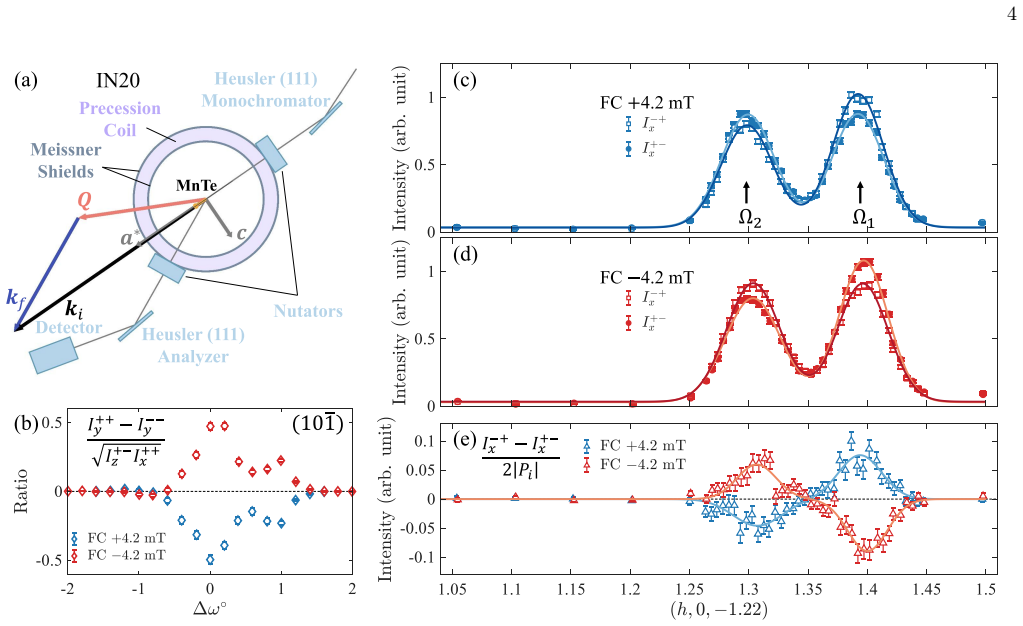
Altermagnetic exchange lifts the degeneracy of the magnon modes Ω1 and Ω2 with opposite handedness... Mch(Q,E) ∝ (I−0x − I+0x)/2|Pi|
What do these tags mean?
- matches
- The paper's claim is directly supported by a theorem in the formal canon.
- supports
- The theorem supports part of the paper's argument, but the paper may add assumptions or extra steps.
- extends
- The paper goes beyond the formal theorem; the theorem is a base layer rather than the whole result.
- uses
- The paper appears to rely on the theorem as machinery.
- contradicts
- The paper's claim conflicts with a theorem or certificate in the canon.
- unclear
- Pith found a possible connection, but the passage is too broad, indirect, or ambiguous to say the theorem truly supports the claim.
Reference graph
Works this paper leans on
-
[1]
Bragg peak was carried out at HYSPEC and IN20 to establish the magnetic-domain imbalance in the sample and thus a non-zero sample-averaged ˆn [29]. Polarized incident neu- trons with spins along y probe the NMI term, Ry ∝ I ++ y − I −− y (IN20) or Ry ∝ I +0 y − I − 0 y (HYSPEC) (see SM [41] for detail). As shown by the difference between I +0 y and I − 0 y...
-
[2]
at 20 K. (c) Symmetric neutron structure factor S(Q, E ) measured as the polarization-averaged scattering (I − 0 x + I +0 x )/ 2 and (d) corresponding LSWT calculation with a background component. Dashed arcs indicate constant-energy contours at E = 30 , 32, and 34 meV. (e) Chiral term Mch(Q, E ) measured as (I − 0 x − I +0 x )/ 2|Pi| and (f) correspondin...
-
[3]
The quantity (I ++ y − I −− y )/ √I +− z I ++ x switches sign after FC with ± 4
at 10 K. The quantity (I ++ y − I −− y )/ √I +− z I ++ x switches sign after FC with ± 4. 2 mT. (c)-(e) Constant-E scans at 32 meV of I − + x , I +− x , and (I − + x − I +− x )/ 2|Pi|along (h, 0, − 1. 22) after FC with ± 4.2 mT. The solid curves show Gaussian fits. The sign reversal of (I − + x − I +− x )/ (2|Pi|) induced by the opposite sign of the coolin...
-
[4]
Y. Kajiwara, K. Harii, S. Takahashi, J. Ohe, K. Uchida, M. Mizuguchi, H. Umezawa, H. Kawai, K. Ando, K. Takanashi, S. Maekawa, and E. Saitoh, Transmis- sion of electrical signals by spin-wave interconversion in a magnetic insulator, Nature 464, 262 (2010)
work page 2010
-
[5]
L. J. Cornelissen, J. Liu, R. A. Duine, J. B. Youssef, and B. J. van Wees, Long-distance transport of magnon spin information in a magnetic insulator at room temperature, Nat. Phys. 11, 1022 (2015)
work page 2015
- [6]
-
[7]
W. Yuan, Q. Zhu, T. Su, Y. Yao, W. Xing, Y. Chen, Y. Ma, X. Lin, J. Shi, R. Shindou, X. C. Xie, and W. Han, Experimental signatures of spin superfluid ground state in canted antiferromagnet Cr 2O3 via nonlocal spin trans- port, Sci. Adv. 4, eaat1098 (2018)
work page 2018
-
[8]
J. Li, C. B. Wilson, R. Cheng, M. Lohmann, M. Ka- vand, W. Yuan, M. Aldosary, N. Agladze, P. Wei, M. S. Sherwin, and J. Shi, Spin current from sub-terahertz- generated antiferromagnetic magnons, Nature 578, 70 (2020)
work page 2020
-
[9]
Y. Wang, D. Zhu, Y. Yang, K. Lee, R. Mishra, G. Go, S.- H. Oh, D.-H. Kim, K. Cai, E. Liu, S. D. Pollard, S. Shi, J. Lee, K. L. Teo, Y. Wu, K.-J. Lee, and H. Yang, Mag- netization switching by magnon-mediated spin torque through an antiferromagnetic insulator, Science 366, 1125 (2019)
work page 2019
-
[10]
J. Han, P. Zhang, J. T. Hou, S. A. Siddiqui, and L. Liu, Mutual control of coherent spin waves and magnetic domain walls in a magnonic device, Science 366, 1121 (2019)
work page 2019
-
[11]
A. V. Chumak, V. I. Vasyuchka, A. A. Serga, and B. Hillebrands, Magnon spintronics, Nat. Phys. 11, 453 (2015)
work page 2015
- [12]
-
[13]
J. R. Hortensius, D. Afanasiev, M. Matthiesen, R. Leen- ders, R. Citro, A. V. Kimel, R. V. Mikhaylovskiy, B. A. Ivanov, and A. D. Caviglia, Coherent spin-wave transport in an antiferromagnet, Nat. Phys. 17, 1001 (2021)
work page 2021
-
[14]
W. Yao, C. Li, L. Wang, S. Xue, Y. Dan, K. Iida, K. Ka- mazawa, K. Li, C. Fang, and Y. Li, Topological spin excitations in a three-dimensional antiferromagnet, Nat. Phys. 14, 1011 (2018)
work page 2018
-
[15]
B. Yuan, I. Khait, G.-J. Shu, F. C. Chou, M. B. Stone, J. P. Clancy, A. Paramekanti, and Y.-J. Kim, Dirac Magnons in a Honeycomb Lattice Quantum XY Magnet CoTiO3, Phys. Rev. X 10, 011062 (2020)
work page 2020
-
[16]
L. Chen, J.-H. Chung, M. B. Stone, A. I. Kolesnikov, B. Winn, V. O. Garlea, D. L. Abernathy, B. Gao, M. Au- gustin, E. J. G. Santos, and P. Dai, Magnetic Field Effect on Topological Spin Excitations in CrI 3, Phys. Rev. X 11, 031047 (2021)
work page 2021
-
[17]
Z. Hu, L. Fu, and L. Liu, Tunable Magnonic Chern Bands and Chiral Spin Currents in Magnetic Multilayers, Phys. Rev. Lett. 128, 217201 (2022)
work page 2022
- [18]
- [19]
- [20]
-
[21]
V. A. Zyuzin and A. A. Kovalev, Magnon Spin Nernst Effect in Antiferromagnets, Phys. Rev. Lett. 117, 217203 (2016)
work page 2016
- [22]
- [23]
-
[24]
Y. Gu, J. Barker, J. Li, T. Kikkawa, F. Camino, K. Kisslinger, J. Sinsheimer, L. Lienhard, J. J. Bauer, C. A. Ross, D. N. Basov, E. Saitoh, J. Pelliciari, G. E. W. Bauer, and V. Bisogni, Observing differential spin cur- rents by resonant inelastic X-ray scattering, Nature 645, 900 (2025)
work page 2025
-
[25]
S. M. Rezende, A. Azevedo, and R. L. Rodríguez-Suárez, Introduction to antiferromagnetic magnons, J. Appl. Phys. 126, 151101 (2019)
work page 2019
-
[26]
L. Šmejkal, J. Sinova, and T. Jungwirth, Beyond Con- ventional Ferromagnetism and Antiferromagnetism: A Phase with Nonrelativistic Spin and Crystal Rotation Symmetry, Phys. Rev. X 12, 031042 (2022)
work page 2022
-
[27]
L.-D. Yuan, Z. Wang, J.-W. Luo, and A. Zunger, Predic- tion of low-Z collinear and noncollinear antiferromagneti c compounds having momentum-dependent spin splitting even without spin-orbit coupling, Phys. Rev. Mater. 5, 014409 (2021)
work page 2021
- [28]
-
[29]
M. Naka, S. Hayami, H. Kusunose, Y. Yanagi, Y. Mo- tome, and H. Seo, Spin current generation in organic an- tiferromagnets, Nat. Commun. 10, 4305 (2019)
work page 2019
-
[30]
Z. Liu, M. Ozeki, S. Asai, S. Itoh, and T. Masuda, Chiral Split Magnon in Altermagnetic MnTe, Phys. Rev. Lett. 133, 156702 (2024)
work page 2024
-
[31]
Q. Sun, J. Guo, D. Wang, D. L. Abernathy, W. Tian, and C. Li, Observation of Chiral Magnon Band Splitting in Altermagnetic Hematite, Phys. Rev. Lett. 135, 186703 (2025)
work page 2025
-
[32]
P. A. McClarty, A. Gukasov, and J. G. Rau, Observing altermagnetism using polarized neutrons, Phys. Rev. B 111, L060405 (2025)
work page 2025
-
[33]
L. Šmejkal, A. Marmodoro, K.-H. Ahn, R. González- Hernández, I. Turek, S. Mankovsky, H. Ebert, S. W. D’Souza, O. Šipr, J. Sinova, and T. Jungwirth, Chiral Magnons in Altermagnetic RuO 2, Phys. Rev. Lett. 131, 256703 (2023)
work page 2023
-
[34]
X. Chen, Y. Liu, P. Liu, Y. Yu, J. Ren, J. Li, A. Zhang, and Q. Liu, Unconventional magnons in collinear mag- nets dictated by spin space groups, Nature 640, 349 (2025)
work page 2025
-
[35]
Q. Cui, B. Zeng, P. Cui, T. Yu, and H. Yang, Efficient spin Seebeck and spin Nernst effects of magnons in alter- magnets, Phys. Rev. B 108, L180401 (2023)
work page 2023
-
[36]
M. Weißenhofer and A. Marmodoro, Atomistic spin dy- namics simulations of magnonic spin Seebeck and spin Nernst effects in altermagnets, Phys. Rev. B 110, 094427 (2024)
work page 2024
-
[37]
J. Krempaský, L. Šmejkal, S. W. D’Souza, M. Ha- jlaoui, G. Springholz, K. Uhlířová, F. Alarab, P. C. Constantinou, V. Strocov, D. Usanov, W. R. Pudelko, R. González-Hernández, A. Birk Hellenes, Z. Jansa, H. Reichlová, Z. Šobáň, R. D. Gonzalez Betancourt, P. Wadley, J. Sinova, D. Kriegner, J. Minár, J. H. Dil, and T. Jungwirth, Altermagnetic lifting of Kra...
work page 2024
-
[38]
S. Lee, S. Lee, S. Jung, J. Jung, D. Kim, Y. Lee, B. Seok, J. Kim, B. G. Park, L. Šmejkal, C.-J. Kang, and C. Kim, Broken Kramers Degeneracy in Altermagnetic MnTe, Phys. Rev. Lett. 132, 036702 (2024)
work page 2024
- [39]
-
[40]
J. Ding, Z. Jiang, X. Chen, Z. Tao, Z. Liu, T. Li, J. Liu, J. Sun, J. Cheng, J. Liu, Y. Yang, R. Zhang, L. Deng, W. Jing, Y. Huang, Y. Shi, M. Ye, S. Qiao, Y. Wang, Y. Guo, D. Feng, and D. Shen, Large Band Splitting in g-Wave Altermagnet CrSb, Phys. Rev. Lett. 133, 206401 (2024)
work page 2024
- [41]
-
[42]
F. Zhang, X. Cheng, Z. Yin, C. Liu, L. Deng, Y. Qiao, Z. Shi, S. Zhang, J. Lin, Z. Liu, M. Ye, Y. Huang, X. Meng, C. Zhang, T. Okuda, K. Shimada, S. Cui, Y. Zhao, G.-H. Cao, S. Qiao, J. Liu, and C. Chen, Crystal-symmetry-paired spin–valley locking in a layered room-temperature metallic altermagnet candidate, Nat. Phys. 21, 760 (2025)
work page 2025
-
[43]
D. Takegami, T. Aoyama, T. Okauchi, T. Yamaguchi, S. Tippireddy, S. Agrestini, M. García-Fernández, T. Mi- zokawa, K. Ohgushi, K.-J. Zhou, J. Chaloupka, J. Kuneš, A. Hariki, and H. Suzuki, Circular Dichroism in Resonant Inelastic X-Ray Scattering: Probing Altermagnetic Do- mains in MnTe, Phys. Rev. Lett. 135, 196502 (2025)
work page 2025
-
[44]
See Supplemental Material at URL for additional in- formation about sample synthesis, experimental details, data analysis, formulation of polarized neutron scat- tering, spin wave calculations, and supplemental data, which includes Refs. [42–49]
- [45]
-
[46]
A. T. Savici and I. A. Zaliznyak, Shiver (2019), https://neutrons.github.io/Shiver/
work page 2019
-
[47]
A. T. Savici, M. A. Gigg, O. Arnold, R. Tolchenov, R. E. Whitfield, S. E. Hahn, W. Zhou, and I. A. Zaliznyak, Effi- cient data reduction for time-of-flight neutron scattering experiments on single crystals, J. Appl. Cryst. 55, 1514 (2022)
work page 2022
-
[48]
O. Arnold, J. C. Bilheux, J. M. Borreguero, A. Buts, S. I. Campbell, L. Chapon, M. Doucet, N. Draper, R. Fer- raz Leal, M. A. Gigg, V. E. Lynch, A. Markvardsen, D. J. Mikkelson, R. L. Mikkelson, R. Miller, K. Pal- men, P. Parker, G. Passos, T. G. Perring, P. F. Peter- 7 son, S. Ren, M. A. Reuter, A. T. Savici, J. W. Taylor, R. J. Taylor, R. Tolchenov, W. ...
work page 2014
-
[49]
J. Schweizer, CHAPTER 4 - polarized neutrons and po- larization analysis, in Neutron Scattering from Magnetic Materials, edited by T. Chatterji (Elsevier Science, Am- sterdam, 2006) pp. 153–213
work page 2006
-
[50]
R. S. Fishman, J. A. Fernandez-Baca, and T. Rõõm, Spin-Wave Theory and Its Applications to Neutron Scat- tering and Thz Spectroscopy , 2053-2571 (Morgan & Clay- pool Publishers, 2018)
work page 2053
-
[51]
J. Dzian, P. Kubaščík, S. Tázlarů, M. Białek, M. Šindler , F. Le Mardelé, C. Kadlec, F. Kadlec, M. Gryglas- Borysiewicz, K. P. Kluczyk, A. Mycielski, P. Skupiński, J. Hejtmánek, R. Tesař, J. Železný, A.-L. Barra, C. Faugeras, J. Volný, K. Uhlířová, L. Nádvorník, M. Veis, K. Výborný, and M. Orlita, Antiferromagnetic resonance in α -MnTe, Phys. Rev. B 112, ...
work page 2025
-
[52]
A. J. Dianoux and Institut Laue-Langevin, eds., Neutron Data Booklet, 2nd ed. (Old City, Philadelphia, PA, 2003)
work page 2003
-
[53]
I. I. Mazin and K. D. Belashchenko, Origin of the gos- samer ferromagnetism in MnTe, Phys. Rev. B 110, 214436 (2024)
work page 2024
-
[54]
K. P. Kluczyk, K. Gas, M. J. Grzybowski, P. Skupiński, M. A. Borysiewicz, T. Fąs, J. Suffczyński, J. Z. Do- magala, K. Grasza, A. Mycielski, M. Baj, K. H. Ahn, K. Výborný, M. Sawicki, and M. Gryglas-Borysiewicz, Coexistence of anomalous Hall effect and weak magne- tization in a nominally collinear antiferromagnet MnTe, Phys. Rev. B 110, 155201 (2024)
work page 2024
-
[55]
A. Hariki, A. Dal Din, O. J. Amin, T. Yamaguchi, A. Badura, D. Kriegner, K. W. Edmonds, R. P. Cam- pion, P. Wadley, D. Backes, L. S. I. Veiga, S. S. Dhesi, G. Springholz, L. Šmejkal, K. Výborný, T. Jungwirth, and J. Kuneš, X-Ray Magnetic Circular Dichroism in Altermagnetic α -MnTe, Phys. Rev. Lett. 132, 176701 (2024)
work page 2024
-
[56]
O. J. Amin, A. Dal Din, E. Golias, Y. Niu, A. Za- kharov, S. C. Fromage, C. J. B. Fields, S. L. Heywood, R. B. Cousins, F. Maccherozzi, J. Krempaský, J. H. Dil, D. Kriegner, B. Kiraly, R. P. Campion, A. W. Rushforth, K. W. Edmonds, S. S. Dhesi, L. Šmejkal, T. Jungwirth, and P. Wadley, Nanoscale imaging and control of alter- magnetism in MnTe, Nature 636, ...
work page 2024
-
[57]
I. A. Zaliznyak, A. T. Savici, V. Ovidiu Garlea, B. Winn, U. Filges, J. Schneeloch, J. M. Tranquada, G. Gu, A. Wang, and C. Petrovic, Polarized neutron scatter- ing on HYSPEC: The HYbrid SPECtrometer at SNS, J. Phys.: Conf. Ser. 862, 012030 (2017)
work page 2017
- [58]
-
[59]
S. V. Maleyev, Investigation of Spin Chirality by Polar - ized Neutrons, Phys. Rev. Lett. 75, 4682 (1995)
work page 1995
-
[60]
S. V. Maleyev, V. P. Plakhty, O. P. Smirnov, J. Wos- nitza, D. Visser, R. K. Kremer, and J. Kulda, The first observation of dynamical chirality by means of polarized neutron scattering in the triangular-lattice antiferroma g- net, J. Phys.: Condens. Matter 10, 951 (1998)
work page 1998
-
[61]
K. Wu, J. Dong, M. Zhu, F. Zheng, and J. Zhang, Magnon Splitting and Magnon Spin Transport in Alter- magnets, Chin. Phys. Lett. 42, 070702 (2025)
work page 2025
-
[62]
K. D. Belashchenko, Giant Strain-Induced Spin Splitti ng Effect in MnTe, a g-Wave Altermagnetic Semiconductor, Phys. Rev. Lett. 134, 086701 (2025)
work page 2025
-
[63]
C.-C. Wei, X. Li, S. Hatt, X. Huai, J. Liu, B. Singh, K.-M. Kim, R. M. Fernandes, P. Cardon, L. Zhao, T. T. Tran, B. A. Frandsen, K. S. Burch, F. Liu, and H. Ji, La2O3Mn2Se2: A correlated insulating layered d-wave altermagnet, Phys. Rev. Mater. 9, 024402 (2025)
work page 2025
-
[64]
Z. Liu, H. Kikuchi, Z. Wei, S. Asai, M. Enderle, U. B. Hansen, V. O. Garlea, M. D. Le, G. J. Nilsen, I. A. Zal- iznyak, and T. Masuda, Switchable Chiral Magnons in an Altermagnet, Zenodo (2026), 10.5281/zenodo.20049187
-
[65]
T. Masuda, M. Enderle, H. Kikuchi, M. D. Le, Z. Liu, and G. Nilsen, Observation of altermagnetic chiral magnon in MnTe, Institut Laue-Langevin (ILL) (2025), https://doi.org/10.5291/ILL-DATA.4-01-1895
discussion (0)
Sign in with ORCID, Apple, or X to comment. Anyone can read and Pith papers without signing in.