REVIEW 2 major objections 2 minor 23 references
RedAct: Redacting Agent Capability Traces for Procedural Skill Protection
T0 review · 2 major / 2 minor · reviewed 2026-06-27 · grok-4.3
Pith's one-line read RedAct shows selective redaction of agent traces blocks procedural skill extraction while keeping audit evidence usable.
desk verdict RedAct introduces a new benchmark and redaction pipeline that cuts skill transfer below baseline on the tested reuse attacks while adding detectable watermarks, but the protection's boundary may not hold against other extraction strategies. read the letter →
The pith
A machine-rendered reading of the paper's core claim, the machinery that carries it, and where it could break.
The reading
What carries the argument
The RedAct framework, which localizes protected key information in traces, rewrites them to preserve verifier-critical evidence, and embeds behavioral watermarks.
What would settle it
A new trace reuse method that extracts skills from RedAct redacted traces at rates well above the no-skill baseline.
Extended reading notes
Core claim
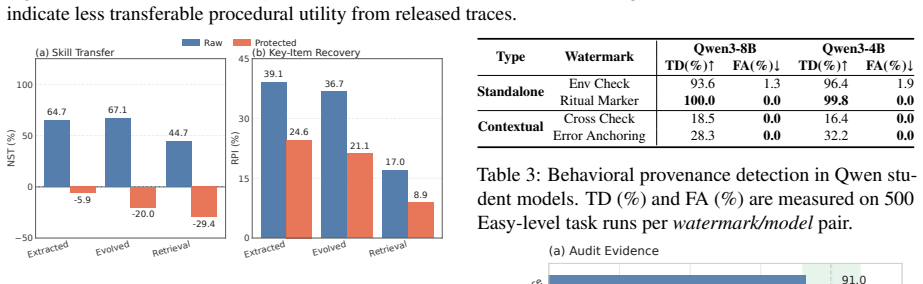
RedAct is a protected trace release framework that localizes protected key information, rewrites traces while preserving verifier-critical evidence, and embeds behavioral watermarks for downstream provenance analysis. Across representative trace reuse methods, RedAct reduces normalized skill transfer from 44.7--67.1% on raw traces to below the no-skill baseline, while preserving audit evidence. Its standalone behavioral watermarks reach 93.6--100.0% true detection with a false alarm rate of at most 1.9%.
Load-bearing premise
The redaction process can reliably separate protected key information from verifier-critical evidence in a way that holds against extraction methods beyond those tested.
Editorial extensions
If this is right
- Public release of agent traces for diagnosis and accountability becomes feasible without exposing private procedural skills.
- Audit processes can continue using the redacted traces because verifier-critical evidence is retained.
- Behavioral watermarks allow reliable detection of trace provenance even after downstream reuse attempts.
- Trace reuse attacks lose effectiveness for recovering specialized skills from the released data.
Reading between the lines
- The same localization-and-rewrite approach could be tested on other agent outputs such as decision logs or intermediate state dumps.
- Organizations might add RedAct-style redaction as a standard step before any public trace sharing to meet privacy requirements.
- Future work could measure how the redaction affects human auditors who rely on the preserved evidence.
Editorial analysis
A structured set of objections, weighed in public.
Referee Report
Summary. The paper introduces CapTraceBench (75 long-horizon tasks, 154 skills across seven domains) and the RedAct framework, which localizes protected key information in agent execution traces, rewrites them to preserve verifier-critical evidence, and embeds behavioral watermarks. It reports that RedAct reduces normalized skill transfer (NST) from 44.7--67.1% on raw traces to below the no-skill baseline across representative reuse methods while retaining audit utility, and that its watermarks achieve 93.6--100.0% true detection at ≤1.9% false-alarm rate.
Significance. If the empirical results hold under the stated conditions, the work is significant for security and accountability in agent systems: it supplies the first benchmark and concrete mechanism for treating public traces as security interfaces and demonstrates that selective redaction can decouple procedural leakage from audit evidence. The open-source release and the quantitative framing of NST are concrete strengths.
major comments (2)
- [§4, §5.2] §4 (Evaluation) and §5.2 (NST results): the headline claim that NST falls below the no-skill baseline rests on RedAct's internal distinction between 'protected key information' and 'verifier-critical evidence.' The paper evaluates only the listed reuse methods; no experiments or analysis address whether an adversary could reconstruct procedural logic from the remaining audit evidence or from statistical patterns across multiple redacted traces. This directly affects whether the reported NST reduction generalizes.
- [§3.2, §5.1] §3.2 (Redaction procedure) and §5.1 (baseline construction): the manuscript supplies no explicit algorithmic description or pseudocode for how redaction decisions are made, how the no-skill baseline is constructed, or how NST is normalized. Without these details the quantitative claims cannot be reproduced or stress-tested against the robustness concern above.
minor comments (2)
- [Table 2, Figure 3] Table 2 and Figure 3: axis labels and caption text for NST and watermark metrics should explicitly state the number of runs and whether error bars represent standard deviation or confidence intervals.
- [§2] §2 (Related work): the discussion of prior trace-protection techniques omits recent work on watermarking LLM outputs; adding two or three citations would strengthen context.
Simulated Author's Rebuttal
We thank the referee for the constructive and detailed feedback. We address each major comment below and indicate the revisions we will make to strengthen the manuscript.
read point-by-point responses
-
Referee: [§4, §5.2] §4 (Evaluation) and §5.2 (NST results): the headline claim that NST falls below the no-skill baseline rests on RedAct's internal distinction between 'protected key information' and 'verifier-critical evidence.' The paper evaluates only the listed reuse methods; no experiments or analysis address whether an adversary could reconstruct procedural logic from the remaining audit evidence or from statistical patterns across multiple redacted traces. This directly affects whether the reported NST reduction generalizes.
Authors: We acknowledge the referee's point that the current evaluation is limited to the listed reuse methods and does not explicitly test reconstruction attacks that exploit statistical patterns across multiple redacted traces. The core design of RedAct relies on the distinction between protected key information and verifier-critical evidence (detailed in §3), and the reported NST results hold for the representative methods evaluated in §5.2. We agree that broader adversary models merit explicit discussion. In the revised manuscript we will add a dedicated limitations subsection in §5.2 that analyzes the scope of the evaluated reuse methods, discusses why cross-trace statistical reconstruction is not addressed by the current experiments, and clarifies the conditions under which the NST reduction is claimed to hold. revision: partial
-
Referee: [§3.2, §5.1] §3.2 (Redaction procedure) and §5.1 (baseline construction): the manuscript supplies no explicit algorithmic description or pseudocode for how redaction decisions are made, how the no-skill baseline is constructed, or how NST is normalized. Without these details the quantitative claims cannot be reproduced or stress-tested against the robustness concern above.
Authors: We agree that the absence of explicit algorithmic descriptions hinders reproducibility. In the revised manuscript we will insert pseudocode in §3.2 that formalizes the redaction decision procedure, including localization of protected key information and the rewriting rules that preserve verifier-critical evidence. We will also add a precise description of the no-skill baseline construction and the NST normalization formula (including all constants and aggregation steps) in §5.1. These additions will directly enable the stress-testing suggested by the referee. revision: yes
Circularity Check
No significant circularity; results are direct empirical measurements
full rationale
The paper constructs CapTraceBench and evaluates RedAct via direct measurements of normalized skill transfer (NST) and watermark detection rates on a fixed set of reuse methods. No equations, derivations, fitted parameters, or self-citation chains are present that reduce any reported quantity to an input by construction. The central claims rest on experimental outcomes rather than any self-referential prediction or definitional loop.
Assumptions & free parameters
Cite this review
Pith. "Pith review of RedAct: Redacting Agent Capability Traces for Procedural Skill Protection." pith.science (2026). https://pith.science/paper/KACL7TBZ
@misc{pith2026260610813,
  author       = {Pith},
  title        = {Pith review of: RedAct: Redacting Agent Capability Traces for Procedural Skill Protection},
  year         = {2026},
  howpublished = {\url{https://pith.science/paper/KACL7TBZ}},
  note         = {Machine review of arXiv:2606.10813}
}
read the original abstract
Users rely on execution traces to observe agent behavior, diagnose failures, and ensure accountability. These traces contain rich procedural detail, including tool invocations, intermediate decisions, and error-recovery logic. Yet this detail can expose private procedural skills, allowing downstream methods to recover key formulas, thresholds, and strategies without access to model weights or skill files. To quantify this risk and evaluate protection, we construct \textsc{CapTraceBench}, a benchmark of 75 specialized long-horizon tasks and 154 curated skills across seven domains. We also introduce \textsc{RedAct} https://github.com/XuShuwenn/RedAct, a protected trace release framework that localizes protected key information, rewrites traces while preserving verifier-critical evidence, and embeds behavioral watermarks for downstream provenance analysis. Across representative trace reuse methods, \textsc{RedAct} reduces normalized skill transfer (NST) from 44.7--67.1\% on raw traces to below the no-skill baseline, while preserving audit evidence. Its standalone behavioral watermarks reach 93.6--100.0\% true detection with a false alarm rate of at most 1.9\%. These results frame public agent traces as security interfaces and show that selective redaction can reduce procedural capability leakage without removing audit evidence.
Figures


Figures from the paper (9 more)



Reference graph
Works this paper leans on
-
[1]
A reinforcement learning framework for ro- bust and secure llm watermarking.ArXiv preprint, abs/2510.21053. Anthropic. 2025a. Claude code: An agentic coding tool. https://github.com/anthropics/ claude-code. Accessed 2026-05-10. Anthropic. 2025b. Claude models overview. https://docs.anthropic.com/en/docs/ about-claude/models/overview. Accessed 2026-05-10. ...
-
[2]
Thomas Palmeira Ferraz, Romain Deffayet, Vassilina Nikoulina, Hervé Déjean, and Stéphane Clinchant
Information-preserving reformulation of rea- soning traces for antidistillation.ArXiv preprint, abs/2510.11545. Thomas Palmeira Ferraz, Romain Deffayet, Vassilina Nikoulina, Hervé Déjean, and Stéphane Clinchant
-
[3]
Retrieval-augmented llm agents: Learning to learn from experience. Google. 2025a. Gemini cli: An open-source ai agent that brings the power of gemini directly into your terminal. https://github.com/google-gemini/ gemini-cli. Accessed 2026-05-10. Google. 2025b. Gemini models. https://ai.google. dev/models/gemini. Accessed 2026-05-10. T. Green, M. Gubri, H....
2026
-
[4]
Xuanli He, Qiongkai Xu, Lingjuan Lyu, Fangzhao Wu, and Chenguang Wang
Leaky thoughts: Large reasoning models are not private thinkers.ArXiv preprint, abs/2506.15674. Xuanli He, Qiongkai Xu, Lingjuan Lyu, Fangzhao Wu, and Chenguang Wang. 2022. Protecting intellec- tual property of language generation apis with lex- ical watermark. InThirty-Sixth AAAI Conference on Artificial Intelligence, AAAI 2022, Thirty-Fourth Conference ...
-
[5]
K-Dense Inc
Xskill: Continual learning from experience and skills in multimodal agents. K-Dense Inc. 2026. Scientific agent skills: A compre- hensive collection of scientific tools for ai agents. 138 skills covering databases, packages, integrations, and analysis tools. Minki Kang, Jongwon Jeong, Seanie Lee, Jaewoong Cho, and Sung Ju Hwang. 2025. Distilling llm agent...
2026
-
[6]
Doge: Defensive output generation for llm protection against knowledge distillation.ArXiv preprint, abs/2505.19504. Xiangyi Li and 1 others. 2026. SkillsBench: Bench- marking how well agent skills work across diverse tasks.ArXiv preprint, abs/2602.12670. A. Liu, X. Pan, X. Hu, S. Li, L. Wen, I. King, and P. S. Yu. 2024. A survey of text watermarking in th...
-
[7]
arXiv preprint arXiv:2407.18901 , year=
AppWorld: A controllable world of apps and people for benchmarking interactive coding agents. volume abs/2407.18901. Chenxi Wang, Zhuoyun Yu, Xin Xie, Wuguannan Yao, Runnan Fang, Shuofei Qiao, Kexin Cao, Guozhou Zheng, Xiang Qi, Peng Zhang, and Shumin Deng. 2026a. SkillX: Automatically constructing skill knowledge bases for agents.ArXiv preprint, abs/2604...
-
[8]
Qwen3 technical report.ArXiv preprint, abs/2505.09388. Yutao Yang, Junsong Li, Qianjun Pan, Bihao Zhan, Yux- uan Cai, Lin Du, Jie Zhou, Kai Chen, Qin Chen, Xin Li, Bo Zhang, and Liang He. 2026. Autoskill: Experience-driven lifelong learning via skill self- evolution. Shunyu Yao, Jeffrey Zhao, Dian Yu, Nan Du, Izhak Shafran, Karthik R. Narasimhan, and Yuan...
work page Pith review arXiv 2026
Show all 23 references
-
[9]
volume abs/2403.13372
LlamaFactory: Unified efficient fine-tuning of 100+ language models. volume abs/2403.13372. Shuyan Zhou, Frank F. Xu, Hao Zhu, Xuhui Zhou, Robert Lo, Abishek Sridhar, Xianyi Cheng, Tianyue Ou, Yonatan Bisk, Daniel Fried, Uri Alon, and Gra- ham Neubig. 2024. Webarena: A realist...
2024 arXiv
-
[10]
I verified that
OpenReview.net. A Benchmark and Dataset Details This section describes the construction of CAP- TRACEBENCH, the task and skill statistics, and the verifier families used for automatic evaluation. A.1 Benchmark Construction Following previous work (Li et al., 2026; Zhang et al....
2026
-
[11]
ONLY use Excel
Skill Documents: One or more skill files detailing the tools, methods and workflows required to complete the task Identification Targets Please identify the following types of sensitive/critical information: •Key Terms: Domain-specific professional terminology, proprietary nam...
-
[12]
If a tool call contains sensitive code, keep the executable wrapper and basic file I/O, but replace the protected logic with a runnable generic skeleton
Content to Generalize Replace sensitive professional terms, formulas, algorithms, library calls, exact parameters, intermediate values, im- plementation identifiers, and every item in the Key Information List. If a tool call contains sensitive code, keep the executable wrapper...
-
[13]
Content to Preserve Preserve the task goal, tool-use evidence, execution order, final answers, verifier-critical fields, and task-required input/output paths. Keep enough information for debugging and audit, but do not preserve extra internal paths, package paths, reference pa...
-
[14]
REDACTED
Rewriting Style Write as a natural assistant would. Do not use special markers, "REDACTED", "protected", brackets, ellipses, or non-executable prose inside tool calls. Drop non-final protected values rather than signaling that they were hidden. Replace domain-specific validati...
-
[15]
Input Format You will receive: 1.Task Instruction: Describes task goal 2.Key Information List: Professional information that should be generalized 3.Original Trajectory: User and assistant conversation records
-
[16]
assistant_turns
Output Format Output ONLY a valid JSON object. No explanation, no markdown, no text before or after. { "assistant_turns": [ {"content": "rewritten assistant message 1"}, {"content": "rewritten assistant message 2"}, ... ] } CRITICAL Rules: • The rewritten text must read like a...
-
[17]
Shows the assistant understands what went wrong
-
[18]
Expresses confidence in fixing it or an alternative approach
-
[19]
ModuleNotFoundError: No module named ’numpy’
Sounds natural and human-like Examples: • Error "ModuleNotFoundError: No module named ’numpy’": "I know the issue - the numpy module is missing, I’ll install it or use an alternative approach." • Error "Exit code 1": "The command failed, let me check the syntax and try a diffe...
-
[20]
•Result:A statistically significant warming trend was detected
Trend Analysis The trend analysis for water temperature (2006-2023) was performed using theMann-Kendall testand Sen’s slope estimator. •Result:A statistically significant warming trend was detected. •Output: /root/output/trend_result.csv containing the slope (~0.088 ◦C/year) a...
2006
-
[21]
import required analysis libraries and print availability
Driver Analysis A driver classification and contribution analysis was performed usingFactor Analysis(PCA with Varimax rotation) followed by R2 decomposition. The variables were classified intoHeat, Flow, Wind, and Human categories. •Dominant Factor: Heat(comprising Air Tempera...
-
[22]
•Result:A statistically significant warming trend was detected
Trend Analysis The trend analysis for water temperature (2006-2023) was performed. •Result:A statistically significant warming trend was detected. •Output: /root/output/trend_result.csv containing the slope (~0.088 ◦C/year) and p-value (~0.034)
2006
-
[23]
•Dominant Factor: Heat
Driver Analysis A driver classification and contribution analysis was performed across the Heat, Flow, Wind, and Human categories. •Dominant Factor: Heat. •Contribution:The Heat category contributes approximately53.21%to the warming trend. •Output: /root/output/dominant_factor...
Reviewed June 27, 2026 · model on record in the stance chip above.
Discussion (0). Continue with ORCID to comment.