REVIEW 4 major objections 3 minor 25 references
Open-source Polymer Generative Pipeline
T0 review · 4 major / 3 minor · reviewed 2026-08-12 · deepseek-v4-flash
Pith's one-line read An open-source pipeline can generate hypothetical polymers tuned to a target ionization-potential range.
desk verdict A genuinely useful integration whose central 'tailored generation' claim is self-confirming as written; needs independent validation and a code release before it does what the abstract says. read the letter →
The pith
A machine-rendered reading of the paper's core claim, the machinery that carries it, and where it could break.
The reading
What carries the argument
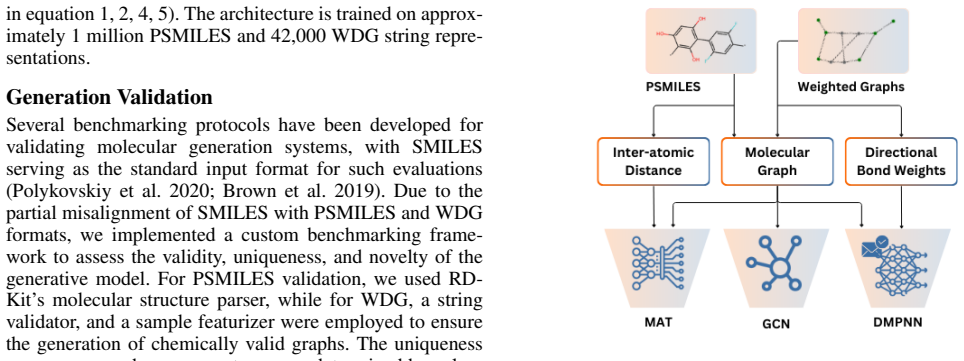
The load-bearing machinery is the weighted directed graph (WDG) representation and its two-way conversion to PSMILES. A WDG stores atoms, monomer fractions, and bond weights in a string-like graph notation, which lets a directed message-passing neural network encode both connectivity and stoichiometric information; converting WDG to PSMILES makes the same data usable by sequence generators, while converting PSMILES to WDG adds weights. Around this representation, the pipeline couples a discriminator pool (MAT, GCN, DMPNN), a generator pool (BRICS and an LSTM), and a validator/filter loop that accepts only candidates whose predicted IP satisfies a comparison-operator query. The DMPNN discriminator on WDG is what carries the property prediction, and the filter is what turns that prediction into a targeted generation loop.
What would settle it
Take a batch of polymers that the filter selects, compute their ionization potentials with an independent quantum-chemical method (or synthesize and measure them), and compare with the discriminator's predictions; if the selected set is no better matched than a random set, the targeting is an artifact. Separately, round-trip WDG to PSMILES and back to WDG and check whether the reconstructed bond weights and monomer fractions match the originals; any drift shows the conversion is lossy.
Extended reading notes
Core claim
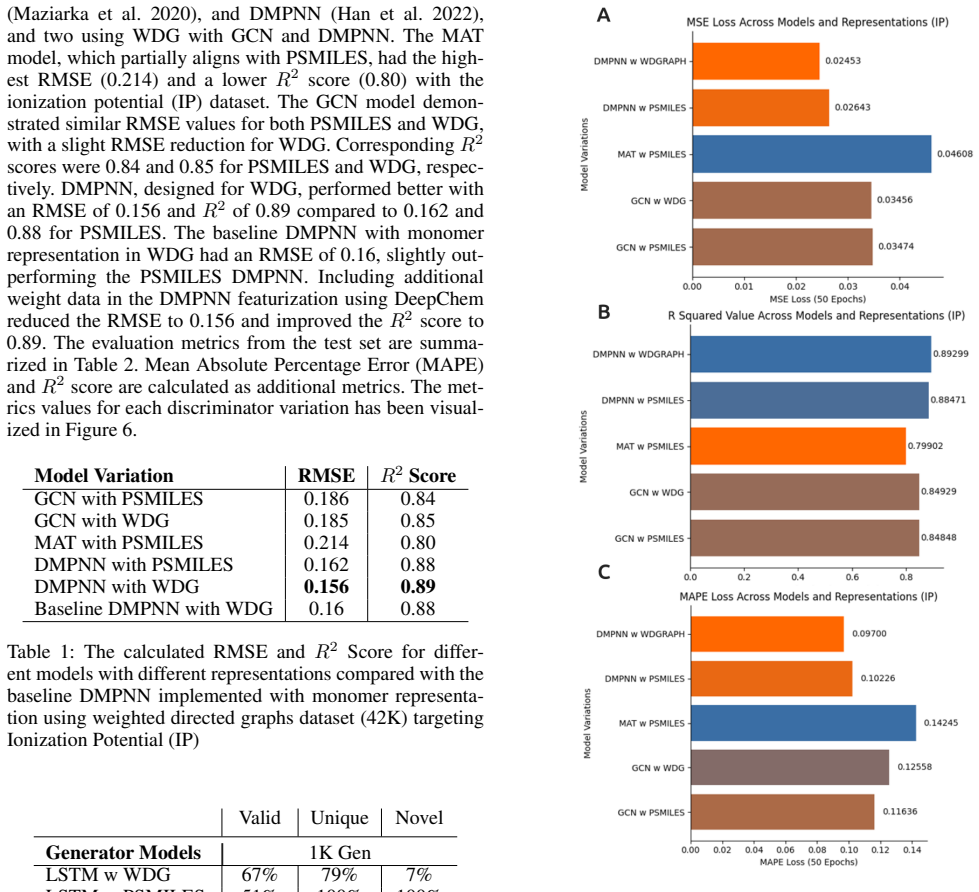
The central claim is that a closed loop of representation conversion, generative sampling, and discriminator-based filtering can produce novel, property-tailored hypothetical polymers. The paper demonstrates this by training discriminators on a 42K copolymer dataset encoded as weighted directed graphs and converted PSMILES, comparing MAT, GCN, and DMPNN architectures. DMPNN on WDG gives the best ionization-potential predictions, with RMSE 0.156 and $R^2$ 0.89, slightly better than the earlier DMPNN monomer baseline. For generation, a rule-based BRICS approach produced 100% valid, unique, and novel PSMILES, while an LSTM trained on PSMILES produced mostly novel candidates at 51% validity. The paper takes this combined evidence to show that property-directed polymer generation is feasible with open-source components.
Load-bearing premise
The pipeline assumes that converting between weighted directed graphs and PSMILES preserves the chemistry and property-relevant information of every polymer, so a discriminator trained on converted data gives trustworthy ionization-potential predictions for generated polymers.
Editorial extensions
If this is right
- With WDG input, the DMPNN discriminator reaches an RMSE of 0.156 and an $R^2$ of 0.89 on ionization-potential prediction, so polymer property screening can operate directly on graph ensembles rather than on simplified monomer strings.
- A rule-based BRICS generator produced 100% valid, unique, and novel PSMILES candidates, which means fragment-based enumeration can feed a stream of new polymer strings into the property filter.
- Narrowing the filter window from 0.1 to 0.01 roughly increases generation time by tenfold, so the pipeline explicitly trades compute against how tightly the target property must be matched.
- Because the validator, featurizers, and filter stack are integrated into DeepChem, the pipeline's components can be reused outside this specific experiment.
Reading between the lines
- A natural next check the paper does not run is to recompute the selected candidates' ionization potentials with an independent quantum-chemical method; if the agreement vanishes, the targeting would be a discriminator artifact rather than chemical control.
- Because the pipeline treats ionization potential as just a training label, the same architecture should extend to other polymer properties, but only one property is demonstrated; testing on a property with different structure-property sensitivity would reveal whether the WDG-to-PSMILES conversion stays lossless.
- The roughly tenfold slowdown from narrowing the filter margin suggests that rejection sampling becomes expensive for tight target windows, so a generator conditioned directly on the target property could be a more efficient next step.
Editorial analysis
A structured set of objections, weighed in public.
Referee Report
Summary. The manuscript proposes an open-source generative pipeline for hypothetical polymers that combines discriminative models (GCN, MAT, DMPNN) with generative models (LSTM and BRICS) and a query-based filter, targeting ionization potential (IP). The pipeline operates on two representations, PSMILES and weighted directed graphs (WDG), with a conversion mechanism between them. The authors report discriminator RMSE/R² values across five model-representation combinations, generator validity/uniqueness/novelty statistics for LSTM and BRICS, and timing results for the filter under two margins. The central claim is that the pipeline generates novel polymers tailored to a desired IP range, and that the discriminators improve on prior state-of-the-art results.
Significance. If the central claim were substantiated, the pipeline would be a useful modular contribution to polymer informatics: it integrates several representation formats and generative strategies into the DeepChem framework, and the side-by-side comparison of discriminators across representations is informative. The paper also ships a custom featurizer for WDG and a BRICS-based generator adapted to PSMILES. However, the evidence for property-targeted generation is currently self-referential, and the reported discriminator improvements are small and presented without statistical uncertainty. The significance of the work therefore depends on additional validation that is not yet present, which limits the manuscript in its current form.
major comments (4)
- [Targeted Polymer Filtration with Discriminator; Pipeline Performance Assessment] The central claim that the pipeline generates polymers 'tailored to the desired property range' is not supported by the experiments. The filtration loop and the evaluation both use the same DMPNN-WDG discriminator, and the Pipeline Performance Assessment section reports only the number of iterations or elapsed time to reach a candidate count. The paper never reports the distribution of discriminator-predicted IP values for the accepted polymers, nor any independent measurement or alternative-model estimate of the properties of the generated candidates. Because acceptance into the candidate set and the definition of 'tailoring' are both determined by the same model, the success criterion is circular. The authors should report, for accepted candidates, the full distribution of predicted IPs relative to the target window, and validate a sample of the generated polymers with an independent oracle (e.g., DFT calculations or a different trained model) to demonstrate that the filtering genuinely selects polymers with the target property.
- [Representational Variations and Conversions; Datasets] The conversion between WDG and PSMILES is load-bearing for the pipeline, because generated PSMILES must be converted to WDG before the discriminator can evaluate them. The manuscript states in the Datasets section that 'Auxiliary details are added or omitted during the conversion between PSMILES and WDG,' but the paper does not quantify what information is lost or show that the round-trip conversion preserves bond weights, monomer fractions, or stoichiometric details for generated polymers. If the conversion drops or distorts property-relevant information, the discriminator is evaluating a structure that differs from the one generated, and the reported filtering behavior is not trustworthy. The authors should present a conversion-fidelity analysis, ideally on held-out examples and on typical generator outputs, and either fix the conversion or restrict the claim to representations for which the conversion is information-preserving.
- [Experimental Results, Table 1] The claimed discriminator improvement over the baseline is not statistically supported. The best model (DMPNN with WDG) achieves RMSE 0.156 and R² 0.89, compared with the baseline DMPNN at RMSE 0.16 and R² 0.88. These differences are small, and no error bars, confidence intervals, or repeated-split results are provided, despite the use of a single 80:20 train-test split. Given the 42K dataset size, the observed gap is plausibly within run-to-run or split-to-split noise. Moreover, the filter margins used in the time-constraint analysis (0.1 and 0.01) are of the same order as, or smaller than, the RMSE of the best discriminator (0.156), which raises the question of whether the filter is selecting on signal or on noise. The authors should report uncertainty estimates, perform multiple splits or bootstrap resampling, and discuss the relationship between the filter margin and the discriminator's prediction noise.
- [Title, Abstract] The manuscript is titled 'Open-source Polymer Generative Pipeline' and the abstract repeats the 'open-source' claim, but no code repository, data link, or availability statement is provided anywhere in the text. For a computational pipeline paper, this is a central deficiency: the claimed contribution is not reproducible without the implementation. The authors should either provide a working, publicly accessible code/data release or remove the 'open-source' descriptor from the title and abstract.
minor comments (3)
- [Experimental Results, Tables 1 and 2] The text says 'The evaluation metrics from the test set are summarized in Table 2,' but the discriminator metrics appear in Table 1 and the generator metrics in Table 2; the citation should be corrected.
- [Methodology, Neural Network-Based Generative Method] Equation (1) labels the input gate activation as 'fi,' but the standard notation and the surrounding text imply this should be 'i_t'; similarly, Equation (4) uses 'ft' for the forget gate, which is consistent, but the input-gate symbol should be made consistent throughout.
- [References] The two references 'Aldeghi and Coley 2022a' and 'Aldeghi and Coley 2022b' point to the same publication, and the in-text citation format is inconsistent; one reference key should be used.
Circularity Check
Targeted-generation claim reduces to the filter: accepted polymers pass the filter by construction, and no independent IP measurements are reported.
-
self definitional
[Methodology, 'Targeted Polymer Filtration with Discriminator'; Experiments, 'Pipeline Performance Assessment']
"The generated polymer’s properties are checked against the filter to determine if they meet the desired criteria."
The only property assigned to each generated polymer is the discriminator's prediction, and acceptance is defined as that prediction satisfying the filter. The pipeline-performance section then measures success as the time needed to collect a target count of accepted candidates, with filter margins set around the mean IP. It never reports the distribution of discriminator predictions for accepted candidates nor any experimentally measured (or otherwise independently predicted) IP values for the generated polymers.
full rationale
Most of the paper is not circular: the discriminator evaluation uses a held-out test split from the 42K WDG dataset and is a legitimate independent benchmark; the generator validity/uniqueness/novelty metrics are computed against training data and are self-contained; and the conversion between PSMILES and WDG is described as a practical alignment step with acknowledged information loss rather than as a derivation of the target property. The one load-bearing circular step is the targeted-generation claim. Because the filter and the success criterion use the same discriminator prediction, the pipeline's 'tailoring' outcome is definitional unless accepted polymers are verified by an independent property source. No such verification is reported; the pipeline-performance experiment only reports wall-clock time to accumulate candidates. This is not a self-citation or uniqueness-import issue, and the absence of released code is a reproducibility concern, not circularity. Score 6 reflects that the central claim of property-tailored generation is partially reduced to the filter definition, while the discriminator's independent test accuracy gives the pipeline some external grounding.
Assumptions & free parameters
free parameters (3)
- LSTM hidden dimension =
256
- LSTM embedding dimension =
128
- Number of LSTM training epochs =
5 for PSMILES, 50 for WDG
assumptions (4)
- domain assumption The 42K WDG dataset IP labels are accurate experimental values transferred through representation conversion.
- ad hoc to paper Converting WDG to PSMILES and back preserves the chemical identity and property-relevant structure of each polymer.
- ad hoc to paper BRICS fragmentation with virtual atoms produces chemically valid polymer precursors when wildcards are restored.
- domain assumption The discriminator's predicted IP is a sufficient oracle for judging whether generated polymers are tailored to the target property.
invented entities (1)
-
Virtual atom placeholder '[At]'
Cite this review
Pith. "Pith review of Open-source Polymer Generative Pipeline." pith.science (2026). https://pith.science/paper/KFJPVDAK
@misc{pith2026241208658,
  author       = {Pith},
  title        = {Pith review of: Open-source Polymer Generative Pipeline},
  year         = {2026},
  howpublished = {\url{https://pith.science/paper/KFJPVDAK}},
  note         = {Machine review of arXiv:2412.08658}
}
read the original abstract
Polymers play a crucial role in the development of engineering materials, with applications ranging from mechanical to biomedical fields. However, the limited polymerization processes constrain the variety of organic building blocks that can be experimentally tested. We propose an open-source computational generative pipeline that integrates neural-network-based discriminators, generators, and query-based filtration mechanisms to overcome this limitation and generate hypothetical polymers. The pipeline targets properties, such as ionization potential (IP), by aligning various representational formats to generate hypothetical polymer candidates. The discriminators demonstrate improvements over state-of-the-art models due to optimized architecture, while the generators produce novel polymers tailored to the desired property range. We conducted extensive evaluations to assess the generative performance of the pipeline components, focusing on the polymers' ionization potential (IP). The developed pipeline is integrated into the DeepChem framework, enhancing its accessibility and compatibility for various polymer generation studies.
Figures


Figures from the paper (5 more)



Reference graph
Works this paper leans on
-
[1]
, " * write output.state after.block = add.period write newline
ENTRY address archivePrefix author booktitle chapter edition editor eid eprint howpublished institution isbn journal key month note number organization pages publisher school series title type volume year label extra.label sort.label short.list INTEGERS output.state before.all mid.sentence after.sentence after.block FUNCTION init.state.consts #0 'before.a...
-
[2]
write newline
" write newline "" before.all 'output.state := FUNCTION n.dashify 't := "" t empty not t #1 #1 substring "-" = t #1 #2 substring "--" = not "--" * t #2 global.max substring 't := t #1 #1 substring "-" = "-" * t #2 global.max substring 't := while if t #1 #1 substring * t #2 global.max substring 't := if while FUNCTION word.in bbl.in capitalize " " * FUNCT...
-
[3]
Aldeghi, M.; and Coley, C. W. 2022 a . A graph representation of molecular ensembles for polymer property prediction. Chemical Science, 13(35): 10486--10498
work page 2022
-
[4]
Aldeghi, M.; and Coley, C. W. 2022 b . A graph representation of molecular ensembles for polymer property prediction. Chemical Science, 13(35): 10486--10498
work page 2022
-
[5]
J.; Segler, M.; and Hern \'a ndez-Lobato, J
Bradshaw, J.; Paige, B.; Kusner, M. J.; Segler, M.; and Hern \'a ndez-Lobato, J. M. 2019. A model to search for synthesizable molecules. Advances in Neural Information Processing Systems, 32
work page 2019
-
[6]
H.; and Vaucher, A
Brown, N.; Fiscato, M.; Segler, M. H.; and Vaucher, A. C. 2019. GuacaMol: benchmarking models for de novo molecular design. Journal of chemical information and modeling, 59(3): 1096--1108
2019
-
[7]
C.; Gadepally, V.; and Ramsundar, B
Frey, N. C.; Gadepally, V.; and Ramsundar, B. 2023. Fast-flows: Flow-based models for molecular graph generation. https://arxiv.org/abs/2201.12419. arXiv:2201.12419
arXiv 2023
-
[8]
Atomic Convolutional Networks for Predicting Protein-Ligand Binding Affinity
Gomes, J.; Ramsundar, B.; Feinberg, E. N.; and Pande, V. S. 2017. Atomic Convolutional Networks for Predicting Protein-Ligand Binding Affinity. CoRR, abs/1703.10603
work page Pith review arXiv 2017
Show all 25 references
-
[9]
Graves, A.; and Graves, A. 2012. Long short-term memory. Supervised sequence labelling with recurrent neural networks, 37--45
2012
-
[10]
A.; et al
Gurnani, R.; Shukla, S.; Kamal, D.; Wu, C.; Hao, J.; Kuenneth, C.; Aklujkar, P.; Khomane, A.; Daniels, R.; Deshmukh, A. A.; et al. 2024. AI-assisted discovery of high-temperature dielectrics for energy storage. Nature communications, 15(1): 6107
2024
-
[11]
Han, X.; Jia, M.; Chang, Y.; Li, Y.; and Wu, S. 2022. Directed message passing neural network (D-MPNN) with graph edge attention (GEA) for property prediction of biofuel-relevant species. Energy and AI, 10: 100201
2022
-
[12]
IT, A. 2023. Inside the nascent industry of AI-designed drugs. Nature medicine, 29: 1292--1295
2023
-
[13]
Jin, W.; Barzilay, R.; and Jaakkola, T. 2020. Hierarchical generation of molecular graphs using structural motifs. In International conference on machine learning, 4839--4848. PMLR
2020
-
[14]
Jumper, J.; Evans, R.; Pritzel, A.; Green, T.; Figurnov, M.; Ronneberger, O.; Tunyasuvunakool, K.; Bates, R.; Z \' dek, A.; Potapenko, A.; et al. 2021. Highly accurate protein structure prediction with AlphaFold. nature, 596(7873): 583--589
2021
-
[15]
Kuenneth, C.; and Ramprasad, R. 2023. polyBERT: a chemical language model to enable fully machine-driven ultrafast polymer informatics. Nature Communications, 14(1): 4099
2023
-
[16]
W.; Mochigase, H.; Beech, H
Lin, T.-S.; Coley, C. W.; Mochigase, H.; Beech, H. K.; Wang, W.; Wang, Z.; Woods, E.; Craig, S. L.; Johnson, J. A.; Kalow, J. A.; et al. 2019. BigSMILES: a structurally-based line notation for describing macromolecules. ACS central science, 5(9): 1523--1531
2019
-
[17]
Ma, R.; and Luo, T. 2020. PI1M: a benchmark database for polymer informatics. Journal of Chemical Information and Modeling, 60(10): 4684--4690
2020
-
[18]
Maziarka, .; Danel, T.; Mucha, S.; Rataj, K.; Tabor, J.; and Jastrz e bski, S. 2020. Molecule attention transformer. arXiv preprint arXiv:2002.08264
2020 arXiv
-
[19]
S.; Aykol, M.; Cheon, G.; and Cubuk, E
Merchant, A.; Batzner, S.; Schoenholz, S. S.; Aykol, M.; Cheon, G.; and Cubuk, E. D. 2023. Scaling deep learning for materials discovery. Nature, 624(7990): 80--85
2023
-
[20]
Ohno, M.; Hayashi, Y.; Zhang, Q.; Kaneko, Y.; and Yoshida, R. 2023. Smipoly: Generation of a synthesizable polymer virtual library using rule-based polymerization reactions. Journal of Chemical Information and Modeling, 63(17): 5539--5548
2023
-
[21]
O.; Omotosho, T
Oladele, I. O.; Omotosho, T. F.; and Adediran, A. A. 2020. Polymer-based composites: an indispensable material for present and future applications. International Journal of Polymer Science, 2020(1): 8834518
2020
-
[22]
Polykovskiy, D.; Zhebrak, A.; Sanchez-Lengeling, B.; Golovanov, S.; Tatanov, O.; Belyaev, S.; Kurbanov, R.; Artamonov, A.; Aladinskiy, V.; Veselov, M.; et al. 2020. Molecular sets (MOSES): a benchmarking platform for molecular generation models. Frontiers in pharmacology, 11: 565644
2020
-
[23]
Ramsundar, B.; Eastman, P.; MacBride, A.; and Trang, N. V. 2021. Making DeepChem a Better Framework for AI-Driven Science
2021
-
[24]
Ramsundar, B.; Eastman, P.; Walters, P.; Pande, V.; Leswing, K.; and Wu, Z. 2019. Deep Learning for the Life Sciences. O'Reilly Media. https://www.amazon.com/Deep-Learning-Life-Sciences-Microscopy/dp/1492039837
2019
-
[25]
Zhang, S.; Tong, H.; Xu, J.; and Maciejewski, R. 2019. Graph convolutional networks: a comprehensive review. Computational Social Networks, 6(1): 1--23
2019
Reviewed August 12, 2026 · model on record in the stance chip above.
Discussion (0). Continue with ORCID to comment.