Mode-Tensorized Canonical Polyadic Decomposition for MIMO Channel Estimation
Pith reviewed 2026-05-20 07:18 UTC · model grok-4.3
The pith
Reshaping MIMO channel tensors by factorizing modes into virtual dimensions lets Canonical Polyadic decomposition separate propagation paths more cleanly and estimate channels more accurately at low SNR.
A machine-rendered reading of the paper's core claim, the machinery that carries it, and where it could break.
Core claim
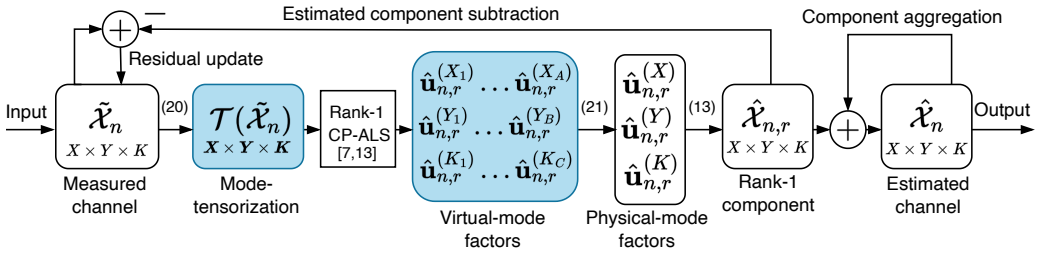
The mode-tensorized CP decomposition (MTCPD) algorithm reshapes the original low-order channel tensor into a higher-order tensor by factorizing its modes into multiple virtual modes. By exploiting the sparse structure of MIMO channels and the plane-wave propagation model in the far-field regime, the proposed mode tensorization enhances the separability of individual propagation paths. It is shown that increasing the number of tensor modes improves component separation and provides inherent denoising effects. A metric for analyzing the virtual factors obtained from MTCPD enables estimation of the canonical rank and selection of the most informative components.
What carries the argument
Mode-tensorized Canonical Polyadic Decomposition (MTCPD), which applies CP decomposition to a higher-order tensor created by factorizing the modes of the original MIMO channel tensor.
If this is right
- Increasing the number of modes through factorization produces stronger separation of the individual propagation-path components.
- The extra modes supply an inherent denoising effect that grows stronger as more modes are introduced.
- The proposed metric on virtual factors permits reliable estimation of canonical rank and selection of the components that matter most for system performance.
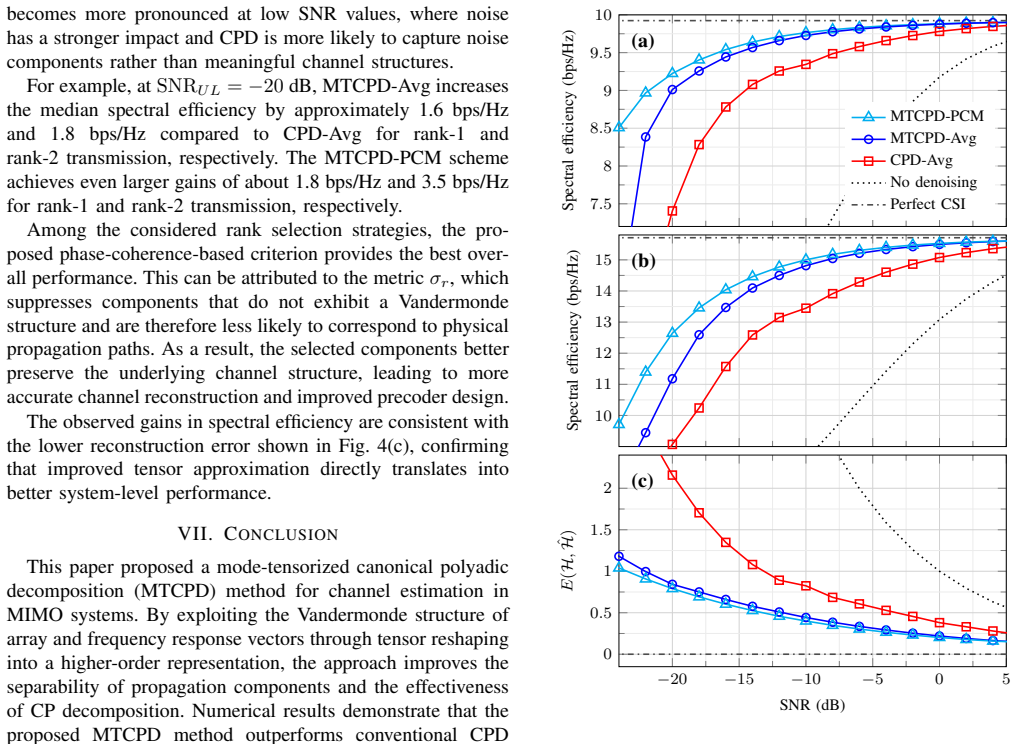
- Channel estimation error drops below that of conventional tensor methods when SNR is low.
Where Pith is reading between the lines
- The same mode-factorization idea could be tested on other tensor-structured problems in wireless communications that already assume sparsity.
- Real-time implementations might adapt the number of virtual modes according to measured SNR to balance accuracy and computation.
- The approach may combine naturally with existing sparse-recovery methods that operate on the same far-field channel model.
Load-bearing premise
MIMO channels exhibit a sparse structure and obey the plane-wave propagation model in the far-field regime, allowing mode factorization to increase separability of propagation paths.
What would settle it
Numerical experiments in which adding virtual modes fails to reduce estimation error relative to ordinary CP decomposition at low SNR would falsify the central claim.
Figures


read the original abstract
This paper proposes a channel estimation method for Multiple-Input Multiple-Output (MIMO) systems based on Canonical Polyadic (CP) decomposition applied to a mode-factorized tensor representation of the channel. The proposed approach reshapes the original low-order channel tensor into a higher-order tensor by factorizing its modes into multiple virtual modes, thereby introducing additional dimensions. By exploiting the sparse structure of MIMO channels and the plane-wave propagation model in the far-field regime, the proposed mode tensorization enhances the separability of individual propagation paths. It is shown that increasing the number of tensor modes improves component separation and provides inherent denoising effects. Building on these properties, a mode-tensorized CP decomposition (MTCPD) algorithm is developed. In addition, a metric for analyzing the virtual factors obtained from MTCPD is proposed, enabling estimation of the canonical rank and selection of the most informative components contributing to overall system performance. Numerical results demonstrate that the proposed method improves channel estimation accuracy compared to conventional tensor-based approaches, particularly under low signal-to-noise ratio conditions.
Editorial analysis
A structured set of objections, weighed in public.
Referee Report
Summary. The paper proposes a channel estimation method for MIMO systems based on Canonical Polyadic (CP) decomposition applied to a mode-factorized tensor representation of the channel. The approach reshapes the original low-order channel tensor into a higher-order tensor by factorizing its modes into multiple virtual modes. By exploiting the sparse structure of MIMO channels and the plane-wave propagation model in the far-field regime, the mode tensorization is claimed to enhance separability of individual propagation paths and provide inherent denoising effects. A mode-tensorized CP decomposition (MTCPD) algorithm is developed, along with a metric for analyzing virtual factors to estimate the canonical rank and select informative components. Numerical results are stated to demonstrate improved channel estimation accuracy compared to conventional tensor-based approaches, particularly under low SNR conditions.
Significance. If the claimed accuracy gains are confirmed with rigorous controls, the mode-tensorization technique could provide a useful extension to tensor-based MIMO channel estimation by increasing tensor order for better path separation and denoising in low-SNR regimes. The virtual-factor metric for rank selection offers a practical addition to standard CP methods. The work builds directly on established assumptions of channel sparsity and far-field propagation without introducing circularity in the core construction.
major comments (2)
- [Abstract and Numerical Results] Abstract and Numerical Results section: the claim that numerical results demonstrate improvement in estimation accuracy lacks error bars, exact baseline definitions, data exclusion criteria, and step-by-step derivation of the MTCPD updates; these omissions make it impossible to verify that the reported gains are attributable to mode tensorization rather than implementation details.
- [Method] Method section on reshaping: while the mode factorization is presented as a deterministic re-indexing that preserves multilinear structure, the manuscript should explicitly state the conditions (e.g., on virtual mode counts or rank) under which the subsequent CP decomposition retains uniqueness and the denoising effect is guaranteed, as these are load-bearing for the low-SNR performance claim.
minor comments (2)
- The notation distinguishing original modes from virtual modes is introduced without a small illustrative example or diagram, which would improve readability of the tensor reshaping step.
- [Introduction] A few references to prior CP-based MIMO estimators appear in the introduction but could be expanded with direct comparisons in the related-work subsection.
Simulated Author's Rebuttal
We thank the referee for the constructive comments. We address each major comment below and describe the revisions planned for the next version of the manuscript.
read point-by-point responses
-
Referee: [Abstract and Numerical Results] Abstract and Numerical Results section: the claim that numerical results demonstrate improvement in estimation accuracy lacks error bars, exact baseline definitions, data exclusion criteria, and step-by-step derivation of the MTCPD updates; these omissions make it impossible to verify that the reported gains are attributable to mode tensorization rather than implementation details.
Authors: We agree that the current presentation of the numerical results would benefit from greater detail to support independent verification. In the revised manuscript we will add error bars to the performance curves, supply exact parameter settings and implementations for each baseline method, state any data exclusion rules applied during evaluation, and include a step-by-step derivation of the MTCPD factor updates (either in the main text or as a dedicated appendix). These additions will make it possible to attribute observed gains specifically to the mode-tensorization step. revision: yes
-
Referee: [Method] Method section on reshaping: while the mode factorization is presented as a deterministic re-indexing that preserves multilinear structure, the manuscript should explicitly state the conditions (e.g., on virtual mode counts or rank) under which the subsequent CP decomposition retains uniqueness and the denoising effect is guaranteed, as these are load-bearing for the low-SNR performance claim.
Authors: We acknowledge the value of making the uniqueness and denoising guarantees explicit. The mode factorization is a deterministic re-indexing, yet the manuscript does not currently list the precise conditions on the number of virtual modes and the target rank that ensure CP uniqueness after tensorization. In the revision we will add a concise statement of these conditions, drawing on standard results for CP uniqueness, and we will clarify under which far-field and sparsity assumptions the denoising effect holds. This will directly support the low-SNR performance claims. revision: yes
Circularity Check
No significant circularity in the derivation chain
full rationale
The paper's central derivation begins with the standard CP decomposition applied after a deterministic mode-factorization reshaping of the channel tensor. This reshaping step is explicitly justified by the external domain assumptions of MIMO sparsity and far-field plane-wave propagation rather than being fitted or defined in terms of the output quantities. The MTCPD algorithm, virtual-factor metric for rank estimation, and component selection are constructed as direct applications of multilinear algebra tools to the resulting higher-order tensor, with no reduction to self-referential definitions, fitted inputs renamed as predictions, or load-bearing self-citations. Numerical performance claims are validated against conventional tensor methods as independent benchmarks, keeping the derivation self-contained.
Axiom & Free-Parameter Ledger
free parameters (1)
- number of virtual modes
axioms (1)
- domain assumption MIMO channels are sparse and obey the plane-wave far-field propagation model.
Lean theorems connected to this paper
-
IndisputableMonolith/Foundation/AlexanderDuality.leanalexander_duality_circle_linking unclear?
unclearRelation between the paper passage and the cited Recognition theorem.
We define a mode-tensorization operator T^K that reshapes v^(K)(α) into a C-th order tensor V = T^K(v^(K)) ... V admits an exact rank-one decomposition V = v^(K1)(α1) ◦ ... ◦ v^(KC)(αC)
-
IndisputableMonolith/Foundation/ArithmeticFromLogic.leanembed_eq_pow unclear?
unclearRelation between the paper passage and the cited Recognition theorem.
in the extreme case where all sub-dimensions are equal to 2 ... number of parameters scales logarithmically as R(log2(XYK)+1)
What do these tags mean?
- matches
- The paper's claim is directly supported by a theorem in the formal canon.
- supports
- The theorem supports part of the paper's argument, but the paper may add assumptions or extra steps.
- extends
- The paper goes beyond the formal theorem; the theorem is a base layer rather than the whole result.
- uses
- The paper appears to rely on the theorem as machinery.
- contradicts
- The paper's claim conflicts with a theorem or certificate in the canon.
- unclear
- Pith found a possible connection, but the passage is too broad, indirect, or ambiguous to say the theorem truly supports the claim.
Reference graph
Works this paper leans on
-
[1]
E. Bj ¨ornson and ¨O. T. Demir, eds.,Introduction to Multiple Antenna Communications and Reconfigurable Surfaces. Emerald Publishing Limited, 2024
work page 2024
-
[2]
Tensor-based channel estimation for massive mimo-ofdm systems,
D. C. Ara ´ujo, A. L. F. de Almeida, J. P. C. L. Da Costa, and R. T. de Sousa, “Tensor-based channel estimation for massive mimo-ofdm systems,”IEEE Access, vol. 7, pp. 42133–42147, 2019
work page 2019
-
[3]
Channel estimation for movable-antenna mimo systems via tensor decomposition,
R. Zhang, L. Cheng, W. Zhang, X. Guan, Y . Cai, W. Wu, and R. Zhang, “Channel estimation for movable-antenna mimo systems via tensor decomposition,”IEEE Wireless Communications Letters, vol. 13, no. 11, pp. 3089–3093, 2024
work page 2024
-
[4]
Deep unfolding-aided ten- sor decomposition for mmwave mimo-ofdm channel estimation,
S. Hara, T. Takahashi, and H. Ochiai, “Deep unfolding-aided ten- sor decomposition for mmwave mimo-ofdm channel estimation,” in GLOBECOM 2025 - 2025 IEEE Global Communications Conference, pp. 3523–3528, 2025
work page 2025
-
[5]
Tensor-based channel estimation for near-field millimeter wave xl-mimo systems,
S. Cheng, L. You, Z. Jin, L. Cheng, and X. Gao, “Tensor-based channel estimation for near-field millimeter wave xl-mimo systems,” IEEE Wireless Communications Letters, vol. 14, no. 7, pp. 1909–1913, 2025. 7.5 8 8.5 9 9.5 10 (a) Spectral efficiency (bps/Hz) MTCPD-PCM MTCPD-Avg CPD-Avg No denoising Perfect CSI 10 11 12 13 14 15 (b) Spectral efficiency (bps/...
work page 1909
-
[6]
Y . He, Z. Peng, M. Liu, G. Wu, J. Chen, J. Fang, and F. Liu, “Full- order tensor-based parameters estimation and channel reconstruction for heterogeneous bi-static mmwave isac,”IEEE Transactions on Vehicular Technology, vol. 74, no. 12, pp. 19171–19187, 2025
work page 2025
-
[7]
G. Ballard and T. G. Kolda,Tensor Decompositions for Data Science. Cambridge University Press, 2025
work page 2025
- [8]
-
[9]
Revisit cp tensor decomposition: Statistical optimality and fast convergence,
R. Tang, J. Chhor, O. Klopp, and A. R. Zhang, “Revisit cp tensor decomposition: Statistical optimality and fast convergence,” 2025
work page 2025
-
[10]
X. Gong, W. Chen, B. Ai, and G. Leus, “Deep-learning-aided alternating least squares for tensor cp decomposition and its application to massive mimo channel estimation,” 2024
work page 2024
-
[11]
A block sparsity based estimator for mmwave massive mimo channels with beam squint,
M. Wang, F. Gao, N. Shlezinger, M. F. Flanagan, and Y . C. Eldar, “A block sparsity based estimator for mmwave massive mimo channels with beam squint,”IEEE Transactions on Signal Processing, vol. 68, p. 49–64, 2020
work page 2020
-
[12]
P. Chen and L. Cheng, “Estimating channels with hundreds of sub-paths for mu-mimo uplink: A structured high-rank tensor approach,”IEEE Signal Processing Letters, vol. 31, pp. 2320–2324, 2024
work page 2024
-
[13]
Canonical decomposition of multidimensional noisy mimo channel estimation,
A. Blagodarnyi, A. Sherstobitov, V . Lyashev, and E. Tyrtyshnikov, “Canonical decomposition of multidimensional noisy mimo channel estimation,”T-Comm, vol. 19, pp. 11–18, 01 2025
work page 2025
-
[14]
Quadriga: A 3-d multi-cell channel model with time evolution for enabling virtual field trials,
S. Jaeckel, L. Raschkowski, K. B ¨orner, and L. Thiele, “Quadriga: A 3-d multi-cell channel model with time evolution for enabling virtual field trials,”IEEE Transactions on Antennas and Propagation, vol. 62, no. 6, pp. 3242–3256, 2014
work page 2014
discussion (0)
Sign in with ORCID, Apple, or X to comment. Anyone can read and Pith papers without signing in.