Same Coeffect, Different Base: Connecting Two Dominant Approaches to Graded Types
Pith reviewed 2026-06-29 01:57 UTC · model grok-4.3
The pith
Translations show graded coeffect systems with pervasive annotations and those using modal operators on linear types express the same context dependencies.
A machine-rendered reading of the paper's core claim, the machinery that carries it, and where it could break.
Core claim
We answer this question by giving translations between pairs of calculi of both lineages that we prove type-, grade- and operational-semantics preserving. We show that the same notions of context dependence can be expressed in either style, building a bridge between the two lineages that enables transfer of results and ideas, while helping language designers to make better informed choices.
What carries the argument
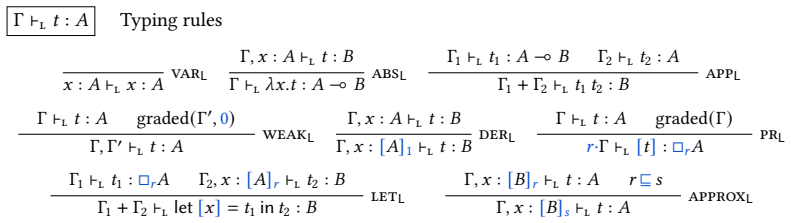
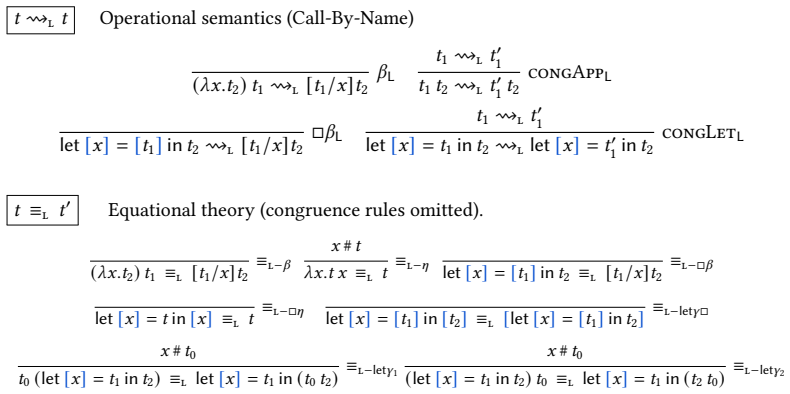
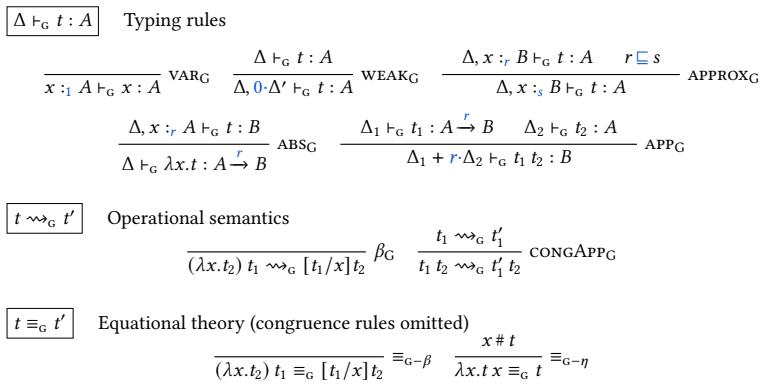
The mutual translations between graded-base calculi (coeffect annotations on function types) and linear-base calculi (graded modal operator over linear types) that preserve typing judgments, grade annotations, and operational semantics.
If this is right
- Proofs and results established in one lineage apply directly to the other via the translations.
- Language designers can select either base structure without losing the ability to model particular context dependencies.
- Operational behavior and resource accounting remain consistent when moving programs between the two styles.
- Existing implementations in languages using one style can draw on techniques developed in the other.
Where Pith is reading between the lines
- The equivalence may allow hybrid systems that combine features from both bases without duplication of effort.
- Future work on extending graded coeffects to new domains can target whichever base is mechanically simpler for the extension.
- Tooling for type inference or program transformation could be shared across languages that adopt either style.
Load-bearing premise
The specific pairs of calculi chosen stand in for the full range of graded-base and linear-base systems that have appeared in the literature.
What would settle it
A concrete context-dependence property that can be typed and reduced in one style but has no corresponding typing or reduction sequence under the translation to the other style.
Figures



read the original abstract
Graded types provide a way to augment a type system with fine-grained information, e.g., to track side effects or context dependence and resource use (called coeffects). Graded types for coeffects have found their way into languages such as Haskell, Idris, and Granule, enabling resourceful reasoning via coeffect analysis with varying levels of generality. Two separate lineages of graded coeffect system have emerged in the last decade: those in which coeffect annotations are pervasive, requiring annotations on function types (which we call graded-base) and those in which coeffects are added by way of a graded modal type operator atop linear types (which we call linear-base). The latter has its origins in Girard's Linear Logic which has been a rich humus for programming language research focused on resources, whereas the graded-base approach emerged in the mid-2010s, seeing rapid adoption in programming language theory and practice, e.g. in QTT and Linear Haskell. The relationship between these two styles has however remained an open question. We answer this question by giving translations between pairs of calculi of both lineages that we prove type-, grade- and operational-semantics preserving. We show that the same notions of context dependence can be expressed in either style, building a bridge between the two lineages that enables transfer of results and ideas, while helping language designers to make better informed choices.
Editorial analysis
A structured set of objections, weighed in public.
Referee Report
Summary. The paper claims that the same notions of context dependence (coeffects) can be expressed in either the graded-base or linear-base style of graded type systems. It establishes this by defining type-, grade-, and operational-semantics-preserving translations between specific pairs of calculi drawn from each lineage.
Significance. If the translations are sound and the chosen calculi capture the essential structure of each lineage, the work provides a concrete bridge between two previously separate approaches to graded coeffects. This would enable transfer of results across lineages and give language designers clearer criteria for choosing between pervasive grade annotations and graded modal operators atop linear types.
major comments (2)
- [Abstract] Abstract: the claim that the translations show the same notions of context dependence are expressible in either style is load-bearing on the selected pairs being representative of the graded-base and linear-base lineages. The manuscript must explicitly state the features of the chosen calculi (arbitrary semirings, support for non-idempotent grades, multiple modalities, contraction rules, etc.) and argue why preservation results extend beyond the concrete instances.
- [Abstract] The abstract states that type-, grade-, and operational-semantics preservation have been proved, yet the full derivations, lemmas, and edge-case handling are not visible. Without these, it is impossible to verify that the translations are faithful for the full range of grades and reductions present in the source calculi.
Simulated Author's Rebuttal
We thank the referee for the careful review and constructive feedback. We address the two major comments point by point below, indicating the revisions we will make to strengthen the manuscript.
read point-by-point responses
-
Referee: [Abstract] Abstract: the claim that the translations show the same notions of context dependence are expressible in either style is load-bearing on the selected pairs being representative of the graded-base and linear-base lineages. The manuscript must explicitly state the features of the chosen calculi (arbitrary semirings, support for non-idempotent grades, multiple modalities, contraction rules, etc.) and argue why preservation results extend beyond the concrete instances.
Authors: We agree that the strength of the central claim depends on the representativeness of the chosen calculi. In the revised manuscript we will add an explicit subsection (likely in the introduction or a new 'Design Choices' section) that enumerates the supported features of both the graded-base and linear-base calculi, including arbitrary semirings, non-idempotent grades, multiple modalities, and contraction/weakening rules. We will also include a short argument explaining why the core structures captured by these calculi are representative of each lineage and why the preservation results are expected to extend to other systems sharing those structures. revision: yes
-
Referee: [Abstract] The abstract states that type-, grade-, and operational-semantics preservation have been proved, yet the full derivations, lemmas, and edge-case handling are not visible. Without these, it is impossible to verify that the translations are faithful for the full range of grades and reductions present in the source calculi.
Authors: The complete proofs, including all lemmas, derivations, and edge-case handling for the full range of grades and reductions, appear in the appendix of the current manuscript. To improve visibility we will add explicit forward references from the main text (in Sections 4 and 5) to the relevant appendix subsections and insert a concise high-level overview of the proof strategy for type, grade, and operational-semantics preservation in the body of the paper. revision: yes
Circularity Check
No circularity; translations and preservation proofs are original contributions between independent calculi
full rationale
The paper's central result consists of newly constructed type-, grade-, and operational-semantics-preserving translations between specific pairs of calculi drawn from the graded-base and linear-base lineages. These translations are presented and proved directly in the work rather than derived from or reduced to any prior equations, fitted parameters, or self-citations by the authors. The abstract and description indicate that the calculi are selected from existing independent literature, and the bridge is established by explicit mappings whose correctness is shown rather than assumed by definition or external self-referential uniqueness theorems. No step matches the enumerated circularity patterns.
Axiom & Free-Parameter Ledger
axioms (1)
- standard math Standard properties of type systems and operational semantics in lambda calculi
Reference graph
Works this paper leans on
-
[1]
A unified view of modalities in type systems.Proc. ACM Program. Lang.4, ICFP (2020), 90:1–90:28. doi:10.1145/3408972 Andreas Abel, Nils Anders Danielsson, and Oskar Eriksson
-
[2]
A Graded Modal Dependent Type Theory with a Universe and Erasure, Formalized.Proc. ACM Program. Lang.7, ICFP (2023), 920–954. doi:10.1145/3607862 Robert Atkey
-
[3]
InProceedings of the 33rd Annual ACM/IEEE Symposium on Logic in Computer Science, LICS 2018, Oxford, UK, July 09-12,
Syntax and Semantics of Quantitative Type Theory. InProceedings of the 33rd Annual ACM/IEEE Symposium on Logic in Computer Science, LICS 2018, Oxford, UK, July 09-12,
2018
-
[4]
56–65. doi:10.1145/3209108.3209189 P. N. Benton
-
[5]
A Mixed Linear and Non-Linear Logic: Proofs, Terms and Models (Extended Abstract). InComputer Science Logic, 8th International Workshop, CSL ’94, Kazimierz, Poland, September 25-30, 1994, Selected Papers (Lecture Notes in Computer Science, Vol. 933), Leszek Pacholski and Jerzy Tiuryn (Eds.). Springer, 121–135. doi:10.1007/BFB0022251 Jean-Philippe Bernardy...
-
[6]
Linear Haskell: practical linearity in a higher-order polymorphic language.Proc. ACM Program. Lang.2, POPL (2018), 5:1–5:29. doi:10.1145/3158093 Riccardo Bianchini, Francesco Dagnino, Paola Giannini, and Elena Zucca. 2023a. Multi-Graded Featherweight Java. In37th European Conference on Object-Oriented Programming, ECOOP 2023, July 17-21, 2023, Seattle, Wa...
-
[7]
Don’t exhaust, don’t waste.CoRR abs/2507.13792 (2025). arXiv:2507.13792 doi:10.48550/ARXIV.2507.13792 Riccardo Bianchini, Francesco Dagnino, Paola Giannini, Elena Zucca, and Marco Servetto
-
[8]
Coeffects for sharing and mutation.Proc. ACM Program. Lang.6, OOPSLA2 (2022), 870–898. doi:10.1145/3563319 Edwin C. Brady. 2021a. Idris 2: Quantitative Type Theory in Practice. In35th European Conference on Object-Oriented Programming, ECOOP 2021, July 11-17, 2021, Aarhus, Denmark (Virtual Conference) (LIPIcs, Vol. 194), Anders Møller and Manu Sridharan (...
-
[9]
A graded dependent type system with a usage-aware semantics.Proc. ACM Program. Lang.5, POPL (2021), 1–32. doi:10.1145/3434331 Soichiro Fujii, Shin-ya Katsumata, and Paul-André Melliès
-
[10]
Towards a Formal Theory of Graded Monads. InFoundations of Software Science and Computation Structures - 19th International Conference, FOSSACS 2016, Held as Part of the European Joint Conferences on Theory and Practice of Software, ETAPS 2016, Eindhoven, The Netherlands, April 2-8, 2016, Proceedings (Lecture Notes in Computer Science, Vol. 9634), Bart Ja...
-
[11]
Combining effects and coeffects via grading. InProceedings of the 21st ACM SIGPLAN International Conference on Functional Programming, ICFP 2016, Nara, Japan, September 18-22, 2016, Jacques Garrigue, Gabriele Keller, and Eijiro Sumii (Eds.). ACM, 476–489. doi:10.1145/2951913.2951939 Aïna Linn Georges, Benjamin Peters, Laila Elbeheiry, Leo White, Stephen D...
-
[12]
Data Race Freedom à la Mode.Proc. ACM Program. Lang.9, POPL (2025), 656–686. doi:10.1145/3704859 Dan R. Ghica and Alex I. Smith
-
[13]
InProceedings of the 1986 ACM Conference on LISP and Functional Programming
Integrating functional and imperative programming. InProceedings of the 1986 ACM Conference on LISP and Functional Programming. 28–38. Jean-Yves Girard
1986
-
[14]
Jean-Yves Girard, Andre Scedrov, and Philip J Scott
Linear logic.Theoretical computer science50, 1 (1987), 1–101. Jean-Yves Girard, Andre Scedrov, and Philip J Scott
1987
-
[15]
Jack Hughes, Danielle Marshall, James Wood, and Dominic Orchard
Bounded linear logic: a modular approach to polynomial-time computability.Theoretical computer science97, 1 (1992), 1–66. Jack Hughes, Danielle Marshall, James Wood, and Dominic Orchard
1992
-
[16]
In5th International Workshop on Trends in Linear Logic and Applications (TLLA 2021)
Linear Exponentials as Graded Modal Types. In5th International Workshop on Trends in Linear Logic and Applications (TLLA 2021). Rome (virtual), Italy (Jun 2021), https://hal-lirmm. ccsd. cnrs. fr/lirmm-03271465. 28 Jack Hughes and Dominic Orchard
2021
-
[17]
Resourceful Program Synthesis from Graded Linear Types. InLogic-Based Program Synthesis and Transformation - 30th International Symposium, LOPSTR 2020, Bologna, Italy, September 7-9, 2020, Proceedings (Lecture Notes in Computer Science, Vol. 12561), Maribel Fernández (Ed.). Springer, 151–170. doi:10.1007/978-3-030-68446- 4_8 Jack Hughes and Dominic Orchard
-
[18]
Program Synthesis from Graded Types. InProgramming Languages and Systems - 33rd European Symposium on Programming, ESOP 2024, Held as Part of the European Joint Conferences on Theory and Practice of Software, ETAPS 2024, Luxembourg City, Luxembourg, April 6-11, 2024, Proceedings, Part I (Lecture Notes in Computer Science, Vol. 14576), Stephanie Weirich (E...
-
[19]
InProceed- ings Second Joint International Workshop on Linearity & Trends in Linear Logic and Applications, Linearity&TLLA@IJCAR- FSCD 2020, Online, 29-30 June 2020 (EPTCS, Vol
Deriving Distributive Laws for Graded Linear Types. InProceed- ings Second Joint International Workshop on Linearity & Trends in Linear Logic and Applications, Linearity&TLLA@IJCAR- FSCD 2020, Online, 29-30 June 2020 (EPTCS, Vol. 353), Ugo Dal Lago and Valeria de Paiva (Eds.). 109–131. doi:10.4204/ EPTCS.353.6 Shin-ya Katsumata
2020
-
[20]
Parametric effect monads and semantics of effect systems. InThe 41st Annual ACM SIGPLAN- SIGACT Symposium on Principles of Programming Languages, POPL ’14, San Diego, CA, USA, January 20-21, 2014, Suresh Jagannathan and Peter Sewell (Eds.). ACM, 633–646. doi:10.1145/2535838.2535846 Vilem Liepelt, Danielle Marshall, Dominic Orchard, Michael Vollmer, and Vi...
-
[21]
Sam Lindley
On Graded Coeffect Types for Information-Flow Control.Lecture Notes in Computer ScienceTo Appear (2024). Sam Lindley
2024
-
[22]
Oxidizing OCaml with Modal Memory Management.Proc. ACM Program. Lang.8, ICFP (2024), 485–514. doi:10.1145/3674642 John M Lucassen and David K Gifford
-
[23]
InProceedings of the 15th ACM SIGPLAN-SIGACT symposium on Principles of programming languages
Polymorphic effect systems. InProceedings of the 15th ACM SIGPLAN-SIGACT symposium on Principles of programming languages. 47–57. Conor McBride. 2016.I Got Plenty o’ Nuttin’. Springer International Publishing, Cham, 207–233. doi:10.1007/978-3-319- 30936-1_12 Eugenio Moggi
-
[24]
doi:10.1109/LICS.1989.39155 Eugenio Moggi
IEEE Computer Society, 14–23. doi:10.1109/LICS.1989.39155 Eugenio Moggi
-
[25]
Notions of Computation and Monads.Inf. Comput.93, 1 (1991), 55–92. doi:10.1016/0890-5401(91)90052- 4 B Moon, H Eades III, and D Orchard
-
[26]
Graded Modal Dependent Type Theory. InProgramming Languages and Systems30th European Symposium on Programming, ESOP 2021, Held as Part of the European Joint Conferences on Theory and Practice of Software, ETAPS 2021, Luxembourg City, Luxembourg, March 27–April 1, 2021, Proceedings, Vol. 12648. 462–490. Alan Mycroft, Dominic A. Orchard, and Tomas Petricek
2021
-
[27]
Effect Systems Revisited - Control-Flow Algebra and Semantics. InSemantics, Logics, and Calculi - Essays Dedicated to Hanne Riis Nielson and Flemming Nielson on the Occasion of Their 60th Birthdays (Lecture Notes in Computer Science, Vol. 9560), Christian W. Probst, Chris Hankin, and René Rydhof Hansen (Eds.). Springer, 1–32. doi:10.1007/978-3-319-27810-0...
-
[28]
Dominic Orchard, Vilem-Benjamin Liepelt, and Harley Eades III
Type and effect systems.Principles of Program Analysis(1999), 283–363. Dominic Orchard, Vilem-Benjamin Liepelt, and Harley Eades III
1999
-
[29]
Quantitative program reasoning with graded modal types.PACMPL3, ICFP (2019), 110:1–110:30. doi:10.1145/3341714 Dominic A. Orchard, Tomas Petricek, and Alan Mycroft
-
[30]
arXiv:1401.5391 http://arxiv.org/abs/1401.5391 Tomas Petricek, Dominic Orchard, and Alan Mycroft
The semantic marriage of monads and effects.CoRR abs/1401.5391 (2014). arXiv:1401.5391 http://arxiv.org/abs/1401.5391 Tomas Petricek, Dominic Orchard, and Alan Mycroft
Pith/arXiv arXiv 2014
-
[31]
Coeffects: Unified Static Analysis of Context-Dependence. InAutomata, Languages, and Programming - 40th International Colloquium, ICALP 2013, Riga, Latvia, July 8-12, 2013, Proceedings, Part II (Lecture Notes in Computer Science, Vol. 7966), Fedor V. Fomin, Rusins Freivalds, Marta Z. Kwiatkowska, and David Peleg (Eds.). Springer, 385–397. doi:10.1007/978-...
-
[32]
Call-by-name, call-by-value and the 𝜆-calculus.Theoretical computer science1, 2 (1975), 125–159. The GHC Developers. 2020.GHC User’s Guide: Linear Types. https://web.archive.org/web/20241206233933/https://downloads. haskell.org/ghc/9.0.1/docs/html/users_guide/exts/linear_types.html Cassia Torczon, Emmanuel Suárez Acevedo, Shubh Agrawal, Joey Velez-Ginorio...
arXiv 1975
-
[33]
2026 Sulfur fractionation in coronal plumes as observed by Solar Orbiter/SPICE
Effects and Coeffects in Call-By-Push-Value (Extended Version).CoRRabs/2311.11795 (2023). arXiv:2311.11795 doi:10.48550/ARXIV. 2311.11795 29 Niki Vazou, Eric Seidel, Richard Eisenberg, Simon Peyton Jones, and Dimitrios Vytiniotis
work page internal anchor Pith review doi:10.48550/arxiv 2023
-
[34]
https://icfp20.sigplan.org/details/hiw-2020- papers/1/Liquid-Haskell-as-a-GHC-Plugin Victoria Vollmer, Danielle Marshall, Harley Eades III, and Dominic Orchard
2020
-
[35]
A Mixed Linear and Graded Logic: Proofs, Terms, and Models. 326 (2025), 32:1–32:21. doi:10.4230/LIPICS.CSL.2025.32 Philip Wadler and Peter Thiemann
-
[36]
David Walker
The marriage of effects and monads.ACM Transactions on Computational Logic (TOCL)4, 1 (2003), 1–32. David Walker
2003
-
[37]
James Wood and Robert Atkey
Substructural type systems.Advanced topics in types and programming languages(2005), 3–44. James Wood and Robert Atkey
2005
-
[38]
A linear algebra approach to linear metatheory.arXiv preprint arXiv:2005.02247(2020). James Wood and Robert Atkey
arXiv 2005
-
[39]
A Framework for Substructural Type Systems. InProgramming Languages and Systems - 31st European Symposium on Programming, ESOP 2022, Held as Part of the European Joint Conferences on Theory and Practice of Software, ETAPS 2022, Munich, Germany, April 2-7, 2022, Proceedings (Lecture Notes in Computer Science, Vol. 13240), Ilya Sergey (Ed.). Springer, 376–4...
discussion (0)
Sign in with ORCID, Apple, or X to comment. Anyone can read and Pith papers without signing in.