What Browsers Do in the Shaders: A Measurement Study of WebGPU Privacy
Pith reviewed 2026-06-26 01:06 UTC · model grok-4.3
The pith
WebGPU persistent pipeline compilation state can be probed to reveal prior GPU activity across origins.
A machine-rendered reading of the paper's core claim, the machinery that carries it, and where it could break.
Core claim
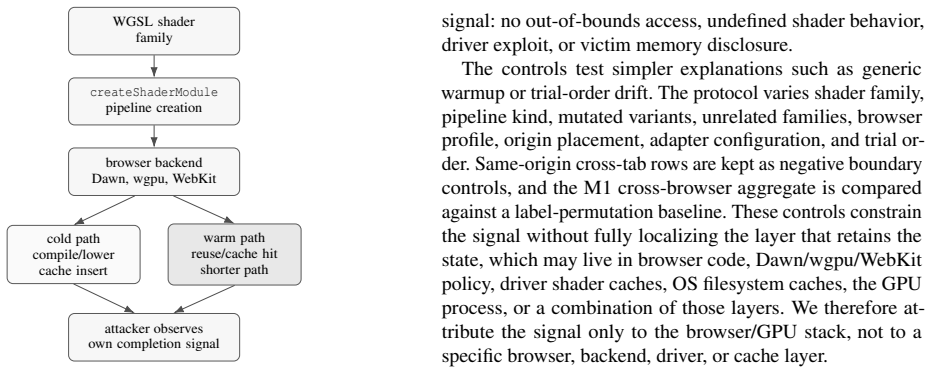
Our controlled results identify persistent pipeline compilation state as the clearest surface. Cold/warm pipeline probes reveal prior compilation state across selected origin, profile, and browser placements. Controlled browser/native experiments also show native GPU activity can be inferred from browser-visible observables under labeled workloads. Other resource probes provide weaker positive results and negative controls. The participant field study shows active WebGPU behavior is highly distinctive within the sample, with deterministic components stable within runs and lower exact stability across repeated visits. A page-load crawl finds WebGPU use mainly as adapter probing and static sup
What carries the argument
Cold/warm pipeline probes that detect persistent pipeline compilation state across boundaries
If this is right
- Pipeline-cache partitioning would block the clearest observed leakage path.
- Source-level key separation can serve as a practical proxy for testing cache isolation.
- Privacy analysis for WebGPU must be performed surface by surface rather than with blanket policies.
- Active WebGPU behavior patterns are distinctive enough to support fingerprinting within the studied sample.
- Real-world pages rarely exercise the heavier shader and pipeline surfaces that carry the strongest signals.
Where Pith is reading between the lines
- Similar state-persistence effects could appear in other browser-exposed GPU interfaces if they share compilation caches.
- Aggressive cache clearing on navigation or profile changes might be needed to limit cross-context leakage.
- Performance cost of proposed mitigations could be measured by comparing page-load times before and after cache resets.
- The same probe technique might be adapted to test isolation between different browser profiles or private modes.
Load-bearing premise
That signals observed in controlled lab scenarios and a small participant field study will generalize across diverse real-world GPU drivers, OSes, and browser versions without substantial confounding from unmeasured variables.
What would settle it
No observable difference in pipeline compilation behavior between cold and warm states when tested across a broad sample of real GPU drivers, operating systems, and browser versions.
Figures

read the original abstract
WebGPU lets ordinary web pages run GPU workloads through a validated programming model. Validation protects memory safety, but shared browser, driver, OS, and GPU state can still expose privacy-relevant signals. We present WGPULens, a framework for measuring those signals across controlled scenarios, browser-native co-residency, a participant field study, public page loads, and mitigation policies. Our framework separates measurements: controlled scenarios support leakage, boundary, and mitigation claims; participant runs support deployment, compatibility, and fingerprintability; and a Tranco crawl measures WebGPU exposure in real-world pages. Our controlled results identify persistent pipeline compilation state as the clearest surface. Cold/warm pipeline probes reveal prior compilation state across selected origin, profile, and browser placements. Controlled browser/native experiments also show native GPU activity can be inferred from browser-visible observables under labeled workloads. Other resource probes provide weaker positive results and negative controls. The participant field study shows active WebGPU behavior is highly distinctive within the sample, with deterministic components stable within runs and lower exact stability across repeated visits. A page-load crawl finds WebGPU use mainly as adapter probing and static support code, with no observed page-load shader, pipeline, queue, query, or map activity. Mitigation pilots identify source-level key separation as a proxy for evaluating pipeline-cache partitioning. Overall, WGPULens shows that WebGPU privacy analysis must be surface-specific: browsers need to measure which GPU state crosses which boundary, which browser-visible signals reveal it, and what the corresponding mitigations cost.
Editorial analysis
A structured set of objections, weighed in public.
Referee Report
Summary. The manuscript introduces WGPULens, a framework for measuring WebGPU privacy signals via controlled probes, browser-native co-residency tests, a participant field study, a Tranco crawl of public pages, and mitigation pilots. Controlled results identify persistent pipeline compilation state as the primary leakage surface, with cold/warm pipeline probes demonstrating prior compilation across origins, profiles, and browsers; additional experiments show inference of native GPU activity from browser observables. The field study reports high distinctiveness of active WebGPU behavior with stable deterministic components within runs, while the crawl finds WebGPU usage limited to adapter probing and static code with no shader/pipeline activity. The work concludes that WebGPU privacy analysis must be surface-specific.
Significance. If the empirical results hold, the paper makes a meaningful contribution by providing convergent evidence from complementary methods on an emerging web API's privacy surfaces. The identification of pipeline compilation state via direct cold/warm probes, the negative controls on other resources, and the real-world crawl data are useful for browser implementers. The framework's separation of measurement goals (leakage vs. deployment vs. exposure) and the pilot on source-level key separation as a mitigation proxy add practical value. The absence of invented parameters or circular derivations strengthens the observational claims.
major comments (2)
- [§4] §4 (Controlled Scenarios): The central claim that cold/warm pipeline probes reveal prior compilation state across placements is load-bearing, yet the abstract notes limited detail on sample sizes, statistical thresholds, and hardware diversity; the main text must report exact run counts, GPU/OS configurations tested, and criteria for 'revealing' state to rule out driver-specific confounds.
- [Participant Field Study] Participant Field Study section: The claim that active WebGPU behavior is 'highly distinctive' within the sample and supports fingerprintability requires explicit reporting of participant count, number of repeated visits, and quantitative stability metrics (e.g., exact match rates or similarity scores across runs) to substantiate the deployment and fingerprintability conclusions.
minor comments (3)
- [Figures] Figure captions and legends for probe timing plots should explicitly label cold vs. warm conditions and include error bars or confidence intervals for all reported timings.
- [Related Work] Related Work: Add citations to prior WebGL/WebGPU fingerprinting studies (e.g., on shader compilation or adapter enumeration) to better situate the novelty of the pipeline-state surface.
- [Tranco Crawl] Tranco Crawl section: Specify the exact Tranco list version/date used and the total number of pages successfully loaded to allow replication of the exposure measurements.
Simulated Author's Rebuttal
We thank the referee for the positive evaluation and recommendation of minor revision. The two requests for additional quantitative details are well-taken and will be addressed directly in the revised manuscript.
read point-by-point responses
-
Referee: [§4] §4 (Controlled Scenarios): The central claim that cold/warm pipeline probes reveal prior compilation state across placements is load-bearing, yet the abstract notes limited detail on sample sizes, statistical thresholds, and hardware diversity; the main text must report exact run counts, GPU/OS configurations tested, and criteria for 'revealing' state to rule out driver-specific confounds.
Authors: We agree that the current reporting is insufficient for reproducibility and to exclude confounds. The revised §4 will report exact run counts per configuration, the full list of tested GPU models, OS versions, and browser versions, the statistical thresholds applied, and the precise decision criteria used to classify a probe as revealing prior state (including how driver variability was assessed). revision: yes
-
Referee: Participant Field Study section: The claim that active WebGPU behavior is 'highly distinctive' within the sample and supports fingerprintability requires explicit reporting of participant count, number of repeated visits, and quantitative stability metrics (e.g., exact match rates or similarity scores across runs) to substantiate the deployment and fingerprintability conclusions.
Authors: We accept this point. The revised Participant Field Study section will state the exact participant count, the number of repeated visits per participant, and the quantitative stability metrics (exact match rates and similarity scores) that underlie the distinctiveness and fingerprintability claims. revision: yes
Circularity Check
No significant circularity
full rationale
The paper is a pure empirical measurement study. Its claims rest on direct observations from controlled cold/warm pipeline probes, participant field runs, and page-load crawls. No equations, first-principles derivations, or statistical predictions appear in the provided text; therefore no step reduces a reported signal to a fitted parameter or self-citation defined by the study itself. All load-bearing results are external browser/GPU behavior measured under labeled conditions, satisfying the self-contained criterion for a score of 0.
Axiom & Free-Parameter Ledger
axioms (1)
- domain assumption Browser-visible observables can reflect native GPU compilation and execution state across origin boundaries.
Reference graph
Works this paper leans on
-
[1]
FPDetective: Dusting the web for fingerprinters
Gunes Acar, Marc Juarez, Nick Nikiforakis, Claudia Diaz, Seda Gürses, Frank Piessens, and Bart Preneel. FPDetective: Dusting the web for fingerprinters. In Proceedings of the 2013 ACM SIGSAC Conference on Computer and Communications Security, pages 1129– 1140, 2013
2013
-
[2]
FP-Radar: Longitudinal measurement and early detection of browser fingerprinting.Proceedings on Pri- vacy Enhancing Technologies, 2022(2):557–577, 2022
Pouneh Nikkhah Bahrami, Umar Iqbal, and Zubair Shafiq. FP-Radar: Longitudinal measurement and early detection of browser fingerprinting.Proceedings on Pri- vacy Enhancing Technologies, 2022(2):557–577, 2022
2022
-
[3]
DarthShader: Fuzzing We- bGPU shader translators and compilers
Lukas Bernhard, Nico Schiller, Moritz Schloegel, Nils Bars, and Thorsten Holz. DarthShader: Fuzzing We- bGPU shader translators and compilers. InProceedings of the 2024 ACM SIGSAC Conference on Computer and Communications Security, pages 690–704, 2024. 14
2024
-
[4]
Fingerprinting protections
Brave Software. Fingerprinting protections. https://github.com/brave/brave-browser/ wiki/Fingerprinting-Protections, 2026
2026
-
[5]
(Cross- )browser fingerprinting via OS and hardware level fea- tures
Yinzhi Cao, Song Li, and Erik Wijmans. (Cross- )browser fingerprinting via OS and hardware level fea- tures. InNetwork and Distributed System Security Sym- posium, 2017
2017
-
[6]
Chrome ships We- bGPU
Chrome Developers. Chrome ships We- bGPU. https://developer.chrome.com/blog/ webgpu-release/, 2023
2023
-
[7]
WebGPU is now sup- ported in major browsers
Chrome for Developers. WebGPU is now sup- ported in major browsers. https://web.dev/blog/ webgpu-supported-major-browsers, 2026
2026
-
[8]
Abu-Ghazaleh, Andres Marquez, and Kevin J
Sankha Baran Dutta, Hoda Naghibijouybari, Nael B. Abu-Ghazaleh, Andres Marquez, and Kevin J. Barker. Leaky buddies: Cross-component covert channels on integrated CPU-GPU systems. In48th ACM/IEEE An- nual International Symposium on Computer Architec- ture, pages 972–984, 2021
2021
-
[9]
Abu-Ghazaleh, Andres Marquez, and Kevin J
Sankha Baran Dutta, Hoda Naghibijouybari, Arjun Gupta, Nael B. Abu-Ghazaleh, Andres Marquez, and Kevin J. Barker. Spy in the GPU-box: Covert and side channel attacks on multi-GPU systems. In50th ACM/IEEE Annual International Symposium on Com- puter Architecture, pages 45:1–45:13, 2023
2023
-
[10]
How unique is your web browser? InPrivacy Enhancing Technologies Symposium, pages 1–18, 2010
Peter Eckersley. How unique is your web browser? InPrivacy Enhancing Technologies Symposium, pages 1–18, 2010
2010
-
[11]
Online track- ing: A 1-million-site measurement and analysis
Steven Englehardt and Arvind Narayanan. Online track- ing: A 1-million-site measurement and analysis. In Proceedings of the 2016 ACM SIGSAC Conference on Computer and Communications Security, pages 1388– 1401, 2016
2016
-
[12]
WebGPU-SPY: Finding fingerprints in the sandbox through GPU cache attacks
Ethan Ferguson, Adam Wilson, and Hoda Naghibijouy- bari. WebGPU-SPY: Finding fingerprints in the sandbox through GPU cache attacks. InProceedings of the 19th ACM Asia Conference on Computer and Communica- tions Security, pages 158–171, 2024
2024
-
[13]
Grand pwning unit: Accelerating mi- croarchitectural attacks with the GPU
Pietro Frigo, Cristiano Giuffrida, Herbert Bos, and Kaveh Razavi. Grand pwning unit: Accelerating mi- croarchitectural attacks with the GPU. In2018 IEEE Symposium on Security and Privacy, pages 195–210, 2018
2018
-
[14]
Generic and automated drive-by GPU cache attacks from the browser
Lukas Giner, Roland Czerny, Christoph Gruber, Fabian Rauscher, Andreas Kogler, Daniel De Almeida Braga, and Daniel Gruss. Generic and automated drive-by GPU cache attacks from the browser. InProceedings of the 19th ACM Asia Conference on Computer and Commu- nications Security, pages 128–140, 2024
2024
-
[15]
Hiding in the crowd: An analysis of the effec- tiveness of browser fingerprinting at large scale
Alejandro Gómez-Boix, Pierre Laperdrix, and Benoit Baudry. Hiding in the crowd: An analysis of the effec- tiveness of browser fingerprinting at large scale. InThe Web Conference, pages 309–318, 2018
2018
-
[16]
Privacy bud- get
Google Privacy Sandbox. Privacy bud- get. https://privacysandbox.google.com/ protections/privacy-budget, 2024
2024
-
[17]
WebGPU im- plementation status
GPU for the Web Community Group. WebGPU im- plementation status. https://github.com/gpuweb/ gpuweb/wiki/Implementation-Status, 2026
2026
-
[18]
Behind bars: A side-channel attack on NVIDIA MIG cache partitioning using mem- ory barriers
Cheng Gu, Reese Levine, Zhenkai Zhang, Tyler Sorensen, and Yanan Guo. Behind bars: A side-channel attack on NVIDIA MIG cache partitioning using mem- ory barriers. In35th USENIX Security Symposium. USENIX Association, 2026
2026
-
[19]
Unveiling privacy risks in WebGPU through hardware-based device fingerprinting
Konrad Hohentanner, Nils Kemmerzell, and Steffen Florschütz. Unveiling privacy risks in WebGPU through hardware-based device fingerprinting. InProceedings of the 18th ACM Conference on Security and Privacy in Wireless and Mobile Networks, pages 65–75, 2025
2025
-
[20]
Fingerprinting the fingerprinters: Learning to detect browser fingerprinting behaviors
Umar Iqbal, Steven Englehardt, and Zubair Shafiq. Fingerprinting the fingerprinters: Learning to detect browser fingerprinting behaviors. InIEEE Symposium on Security and Privacy, pages 1143–1161, 2021
2021
-
[21]
WEBGL_debug_renderer_info
Khronos Group. WEBGL_debug_renderer_info. https://registry.khronos.org/webgl/ extensions/WEBGL_debug_renderer_info/, 2014
2014
-
[22]
Trusted browsers for uncertain times
David Kohlbrenner and Hovav Shacham. Trusted browsers for uncertain times. In25th USENIX Secu- rity Symposium. USENIX Association, 2016
2016
-
[23]
DRAWN APART: A device identification tech- nique based on remote GPU fingerprinting
Tomer Laor, Naif Mehanna, Antonin Durey, Vitaly Dyadyuk, Pierre Laperdrix, Clémentine Maurice, Yossi Oren, Romain Rouvoy, Walter Rudametkin, and Yuval Yarom. DRAWN APART: A device identification tech- nique based on remote GPU fingerprinting. InNetwork and Distributed System Security Symposium, 2022
2022
-
[24]
Poster: LockedA- part: Faster GPU fingerprinting through the com- pute API
Tomer Laor and Yossi Oren. Poster: LockedA- part: Faster GPU fingerprinting through the com- pute API. https://www.uasc.cc/proceedings25/ uasc25-laor.pdf, 2025
2025
-
[25]
Browser fingerprinting: A survey.ACM Transactions on the Web, 14(2), 2020
Pierre Laperdrix, Nataliia Bielova, Benoit Baudry, and Gildas Avoine. Browser fingerprinting: A survey.ACM Transactions on the Web, 14(2), 2020
2020
-
[26]
Stealing webpages rendered on your browser by exploiting GPU vulnerabilities
Sangho Lee, Youngsok Kim, Jangwoo Kim, and Jong Kim. Stealing webpages rendered on your browser by exploiting GPU vulnerabilities. InIEEE Symposium on Security and Privacy, pages 19–33, 2014. 15
2014
-
[27]
SafeRace: Assessing and addressing WebGPU memory safety in the presence of data races
Reese Levine, Ashley Lee, Neha Abbas, Kyle Little, and Tyler Sorensen. SafeRace: Assessing and addressing WebGPU memory safety in the presence of data races. Proceedings of the ACM on Programming Languages, 9(OOPSLA2):697–725, 2025
2025
-
[28]
Reese Levine, Rithik Sharma, Nikhil Jain, Abhijit Ramesh, Zheyuan Chen, Neha Abbas, James Contini, and Tyler Sorensen. Llamas on the web: Memory- efficient, performance-portable, and multi-precision LLM inference with WebGPU. https://arxiv.org/ abs/2605.20706, 2026
Pith/arXiv arXiv 2026
-
[29]
Who touched my browser fin- gerprint? A large-scale measurement study and classifi- cation of fingerprint dynamics
Song Li and Yinzhi Cao. Who touched my browser fin- gerprint? A large-scale measurement study and classifi- cation of fingerprint dynamics. InInternet Measurement Conference, pages 370–385, 2020
2020
-
[30]
J˛ edrzej Maczan. Characterizing WebGPU dispatch over- head for LLM inference across four GPU vendors, three backends, and three browsers. https://arxiv.org/ abs/2604.02344, 2026
Pith/arXiv arXiv 2026
-
[31]
WEBGL_debug_renderer_info ex- tension
MDN Web Docs. WEBGL_debug_renderer_info ex- tension. https://developer.mozilla.org/en-US/ docs/Web/API/WEBGL_debug_renderer_info, 2024
2024
-
[32]
GPUAdapterInfo
MDN Web Docs. GPUAdapterInfo. https: //developer.mozilla.org/en-US/docs/Web/API/ GPUAdapterInfo, 2026
2026
-
[33]
WebGPU API
MDN Web Docs. WebGPU API. https://developer. mozilla.org/en-US/docs/Web/API/WebGPU_API, 2026
2026
-
[34]
Veiled pathways: Investigating covert and side channels within GPU uncore
Yuanqing Miao, Yingtian Zhang, Dinghao Wu, Danfeng Zhang, Gang Tan, Rui Zhang, and Mahmut Taylan Kan- demir. Veiled pathways: Investigating covert and side channels within GPU uncore. InIEEE/ACM Interna- tional Symposium on Microarchitecture, pages 1169– 1183, 2024
2024
-
[35]
Pixel Perfect: Fingerprinting canvas in HTML5
Keaton Mowery and Hovav Shacham. Pixel Perfect: Fingerprinting canvas in HTML5. InProceedings of W2SP 2012, 2012
2012
-
[36]
Resist fingerprinting
Mozilla. Resist fingerprinting. https: //firefox-source-docs.mozilla.org/ toolkit/components/resistfingerprinting/ resistfingerprinting/index.html, 2026
2026
-
[37]
Shipping WebGPU on Windows in Firefox 141
Mozilla Gfx Team. Shipping WebGPU on Windows in Firefox 141. https: //mozillagfx.wordpress.com/2025/07/15/ shipping-webgpu-on-windows-in-firefox-141/ , 2025
2025
-
[38]
Rendered insecure: GPU side channel attacks are practical
Hoda Naghibijouybari, Ajaya Neupane, Zhiyun Qian, and Nael Abu-Ghazaleh. Rendered insecure: GPU side channel attacks are practical. InProceedings of the 2018 ACM SIGSAC Conference on Computer and Communi- cations Security, pages 2139–2153, 2018
2018
-
[39]
Cookieless monster: Exploring the ecosys- tem of web-based device fingerprinting
Nick Nikiforakis, Alexandros Kapravelos, Wouter Joosen, Christopher Kruegel, Frank Piessens, and Gio- vanni Vigna. Cookieless monster: Exploring the ecosys- tem of web-based device fingerprinting. InIEEE Sym- posium on Security and Privacy, pages 541–555, 2013
2013
-
[40]
Pixel thief: Exploiting SVG filter leakage in firefox and chrome
Sioli O’Connell, Lishay Aben Sour, Ron Magen, Daniel Genkin, Yossi Oren, Hovav Shacham, and Yuval Yarom. Pixel thief: Exploiting SVG filter leakage in firefox and chrome. In33rd USENIX Security Symposium. USENIX Association, 2024
2024
-
[41]
Kemerlis, Simha Sethumadha- van, and Angelos D
Yossef Oren, Vasileios P. Kemerlis, Simha Sethumadha- van, and Angelos D. Keromytis. The spy in the sandbox: Practical cache attacks in JavaScript and their implica- tions. InProceedings of the 22nd ACM SIGSAC Confer- ence on Computer and Communications Security, 2015
2015
-
[42]
Long-term observation on browser fingerprinting: Users’ trackability and perspec- tive.Proceedings on Privacy Enhancing Technologies, 2020(2):558–577, 2020
Gaston Pugliese, Christian Riess, Freya Gassmann, and Zinaida Benenson. Long-term observation on browser fingerprinting: Users’ trackability and perspec- tive.Proceedings on Privacy Enhancing Technologies, 2020(2):558–577, 2020
2020
-
[43]
Whispering pixels: Exploiting unini- tialized register accesses in modern GPUs
Frederik Dermot Pustelnik, Xhani Marvin Saß, and Jean- Pierre Seifert. Whispering pixels: Exploiting unini- tialized register accesses in modern GPUs. InIEEE European Symposium on Security and Privacy, pages 345–360, 2024
2024
-
[44]
Unveiling web fingerprinting in the wild via code mining and machine learning.Proceedings on Privacy Enhanc- ing Technologies, 2021(1):43–63, 2021
Valentino Rizzo, Stefano Traverso, and Marco Mellia. Unveiling web fingerprinting in the wild via code mining and machine learning.Proceedings on Privacy Enhanc- ing Technologies, 2021(1):43–63, 2021
2021
-
[45]
Charlie F. Ruan, Yucheng Qin, Xun Zhou, Ruihang Lai, Hongyi Jin, Yixin Dong, Bohan Hou, Meng-Shiun Yu, Yiyan Zhai, Sudeep Agarwal, Hangrui Cao, Siyuan Feng, and Tianqi Chen. WebLLM: A high-performance in- browser LLM inference engine. https://arxiv.org/ abs/2412.15803, 2024
Pith/arXiv arXiv 2024
-
[46]
Cookies from the past: Timing server-side request processing code for history sniffing.Digital Threats: Research and Practice, 1(4), 2020
Iskander Sanchez-Rola, Davide Balzarotti, and Igor San- tos. Cookies from the past: Timing server-side request processing code for history sniffing.Digital Threats: Research and Practice, 1(4), 2020
2020
-
[47]
Extension breakdown: Security analysis of browsers extension resources control policies
Iskander Sanchez-Rola, Igor Santos, and Davide Balzarotti. Extension breakdown: Security analysis of browsers extension resources control policies. In26th USENIX Security Symposium, pages 679–694. USENIX Association, 2017. 16
2017
-
[48]
Clock around the clock: Time-based device fingerprinting
Iskander Sanchez-Rola, Igor Santos, and Davide Balzarotti. Clock around the clock: Time-based device fingerprinting. InProceedings of the 2018 ACM SIGSAC Conference on Computer and Communications Security, pages 1502–1514, 2018
2018
-
[49]
Fantastic timers and where to find them: High-resolution microarchitectural attacks in JavaScript
Michael Schwarz, Clémentine Maurice, Daniel Gruss, and Stefan Mangard. Fantastic timers and where to find them: High-resolution microarchitectural attacks in JavaScript. InFinancial Cryptography and Data Security, pages 247–267, 2017
2017
-
[50]
Prime+Probe 1, JavaScript 0: Overcoming browser- based Side-Channel defenses
Anatoly Shusterman, Ayush Agarwal, Sioli O’Connell, Daniel Genkin, Yossi Oren, and Yuval Yarom. Prime+Probe 1, JavaScript 0: Overcoming browser- based Side-Channel defenses. In30th USENIX Security Symposium, pages 2863–2880. USENIX Association, 2021
2021
-
[51]
Robust website fingerprinting through the cache occupancy channel
Anatoly Shusterman, Lachlan Kang, Yarden Haskal, Yosef Meltser, Prateek Mittal, Yossi Oren, and Yuval Yarom. Robust website fingerprinting through the cache occupancy channel. In28th USENIX Security Sympo- sium. USENIX Association, 2019
2019
-
[52]
LeftoverLocals: Listening to LLM responses through leaked GPU lo- cal memory
Tyler Sorensen and Heidy Khlaaf. LeftoverLocals: Listening to LLM responses through leaked GPU lo- cal memory. https://arxiv.org/abs/2401.16603, 2024
arXiv 2024
-
[53]
Automatic dis- covery of emerging browser fingerprinting techniques
Junhua Su and Alexandros Kapravelos. Automatic dis- covery of emerging browser fingerprinting techniques. InThe Web Conference, pages 2178–2188, 2023
2023
-
[54]
Hot Pixels: Frequency, power, and temperature attacks on GPUs and ARM SoCs
Hritvik Taneja, Jason Kim, Jie Jeff Xu, Stephan van Schaik, Daniel Genkin, and Yuval Yarom. Hot Pixels: Frequency, power, and temperature attacks on GPUs and ARM SoCs. In32nd USENIX Security Symposium, pages 6275–6292. USENIX Association, 2023
2023
-
[55]
Fingerprinting protections in Tor Browser
Tor Project. Fingerprinting protections in Tor Browser. https://support.torproject.org/tor-browser/ features/fingerprinting-protections/, 2026
2026
-
[56]
The clock is still ticking: Timing attacks in the modern web
Tom van Goethem, Wouter Joosen, and Nick Nikiforakis. The clock is still ticking: Timing attacks in the modern web. InProceedings of the 22nd ACM SIGSAC Confer- ence on Computer and Communications Security, pages 1382–1393, 2015
2015
-
[57]
FP-Scanner: The privacy impli- cations of browser fingerprint inconsistencies
Antoine Vastel, Pierre Laperdrix, Walter Rudametkin, and Romain Rouvoy. FP-Scanner: The privacy impli- cations of browser fingerprint inconsistencies. In27th USENIX Security Symposium, pages 135–150. USENIX Association, 2018
2018
-
[58]
FP-STALKER: Tracking browser fingerprint evolutions
Antoine Vastel, Pierre Laperdrix, Walter Rudametkin, and Romain Rouvoy. FP-STALKER: Tracking browser fingerprint evolutions. InIEEE Symposium on Security and Privacy, pages 728–741, 2018
2018
-
[59]
W3C GPU for the Web Community Group. WebGPU. https://www.w3.org/TR/webgpu/, 2026
2026
-
[60]
WebGPU Shading Language
W3C GPU for the Web Community Group. WebGPU Shading Language. https://www.w3.org/TR/WGSL/, 2026
2026
-
[61]
Fletcher, Hovav Shacham, David Kohlbrenner, and Riccardo Paccagnella
Alan Wang, Pranav Gopalkrishnan, Yingchen Wang, Christopher W. Fletcher, Hovav Shacham, David Kohlbrenner, and Riccardo Paccagnella. Pixnapping: Bringing pixel stealing out of the stone age. InProceed- ings of the 2025 ACM SIGSAC Conference on Computer and Communications Security, pages 3266–3280, 2025
2025
-
[62]
Vasquez, David Kohlbrenner, Hovav Shacham, and Christopher W
Yingchen Wang, Riccardo Paccagnella, Zhao Gang, Willy R. Vasquez, David Kohlbrenner, Hovav Shacham, and Christopher W. Fletcher. GPU.zip: On the side- channel implications of hardware-based graphical data compression. InIEEE Symposium on Security and Pri- vacy, pages 3716–3734, 2024
2024
-
[63]
WebKit features in Safari 26.0
WebKit. WebKit features in Safari 26.0. https://webkit.org/blog/17333/ webkit-features-in-safari-26-0/, 2025
2025
-
[64]
Leaky DNN: Stealing deep-learning model secret with GPU context-switching side-channel
Junyi Wei, Yicheng Zhang, Zhe Zhou, Zhou Li, and Mo- hammad Abdullah Al Faruque. Leaky DNN: Stealing deep-learning model secret with GPU context-switching side-channel. In50th Annual IEEE/IFIP International Conference on Dependable Systems and Networks, pages 125–137, 2020
2020
-
[65]
FROST: Fingerprinting remotely using OPFS-based SSD timing
Hannes Weissteiner, Tobias Weiser, Roland Czerny, Sud- heendra Raghav Neela, Fabian Rauscher, Jonas Juffin- ger, and Daniel Gruss. FROST: Fingerprinting remotely using OPFS-based SSD timing. InDIMVA, 2026
2026
-
[66]
Matthew K. L. Wong and Alastair F. Donaldson. We- bGlitch: A randomised testing tool for the WebGPU api. In39th European Conference on Object-Oriented Programming, pages 39:1–39:26, 2025
2025
-
[67]
Mitigating browser fin- gerprinting in web specifications
World Wide Web Consortium. Mitigating browser fin- gerprinting in web specifications. https://www.w3. org/TR/fingerprinting-guidance/, 2025
2025
-
[68]
Threat model for the web
World Wide Web Consortium. Threat model for the web. https://www.w3.org/TR/threat-model-web/, 2026
2026
-
[69]
Web platform design principles
World Wide Web Consortium. Web platform design principles. https://www.w3.org/TR/ design-principles/, 2026. 17
2026
-
[70]
Rendered private: Making GLSL execution uniform to prevent WebGL-based browser fingerprinting
Shujiang Wu, Song Li, Yinzhi Cao, and Ningfei Wang. Rendered private: Making GLSL execution uniform to prevent WebGL-based browser fingerprinting. In 28th USENIX Security Symposium, pages 1645–1660. USENIX Association, 2019
2019
-
[71]
GPUGuard: Mitigating contention based side and covert channel attacks on GPUs
Qiumin Xu, Hoda Naghibijouybari, Shibo Wang, Nael Abu-Ghazaleh, and Murali Annavaram. GPUGuard: Mitigating contention based side and covert channel attacks on GPUs. InProceedings of the ACM Interna- tional Conference on Supercomputing, pages 497–509, 2019
2019
-
[72]
EXAM: Exploiting exclusive system-level cache in ap- ple M-series SoCs for enhanced cache occupancy at- tacks
Tianhong Xu, Aidong Adam Ding, and Yunsi Fei. EXAM: Exploiting exclusive system-level cache in ap- ple M-series SoCs for enhanced cache occupancy at- tacks. InProceedings of the 20th ACM ASIA Confer- ence on Computer and Communications Security, pages 1294–1308, 2025
2025
-
[73]
Invalidate+Compare: A Timer-Free GPU cache attack primitive
Zhenkai Zhang, Kunbei Cai, Yanan Guo, Fan Yao, and Xing Gao. Invalidate+Compare: A Timer-Free GPU cache attack primitive. In33rd USENIX Security Sym- posium, pages 2101–2118. USENIX Association, 2024. A Technical Appendix Table 9: Measurement tasks, datasets, and metrics. Task Dataset Metric Use in the paper Pipeline state controlled AUROC, CI, permu- tat...
2024
discussion (0)
Sign in with ORCID, Apple, or X to comment. Anyone can read and Pith papers without signing in.