A Multi-Level Machine Learning Framework for Inverse Scattering Problems with Multi-Frequency Data
Pith reviewed 2026-06-30 02:20 UTC · model grok-4.3
The pith
The multi-level neural network framework recovers higher-order Fourier components of imaging targets using multi-frequency scattering data.
A machine-rendered reading of the paper's core claim, the machinery that carries it, and where it could break.
Core claim
The paper establishes that building a neural network level by level along the frequency axis of the data enables progressive recovery of higher-order Fourier components in the reconstructed image. Each added level refines the solution using the next frequency without destabilizing prior levels. This is supported by both numerical experiments for inverse source and medium scattering and by analysis showing the architecture's behavior in the neural tangent kernel regime.
What carries the argument
The multi-level neural network architecture constructed sequentially along the frequency axis, where each level updates the reconstruction with data at one frequency.
If this is right
- The learning problem is decomposed into a sequence of simpler local tasks, each tied to a single frequency.
- Higher-frequency data and deeper network levels recover higher-order Fourier modes of the target.
- The risk of convergence to undesirable local minima is reduced compared to joint optimization over all frequencies.
- The framework applies effectively to both inverse source scattering and inverse medium scattering problems.
Where Pith is reading between the lines
- The sequential structure may extend naturally to other inverse problems involving ordered data, such as multi-resolution imaging.
- Similar level-by-level training could improve stability in other deep learning applications with hierarchical inputs.
- Further tests on experimental rather than simulated data would check real-world applicability.
Load-bearing premise
The neural tangent kernel regime accurately describes the training dynamics of the multi-level architecture and ensures higher levels only add finer modes.
What would settle it
Experiments demonstrating that reconstructions of lower-order Fourier components change or degrade when a new higher-frequency level is added would contradict the progressive recovery property.
Figures



read the original abstract
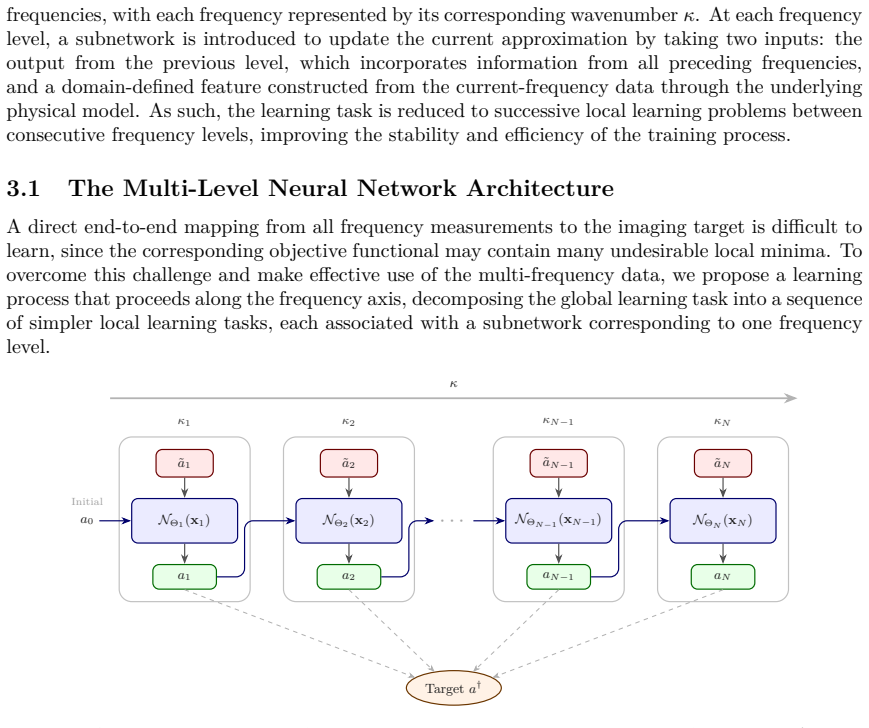
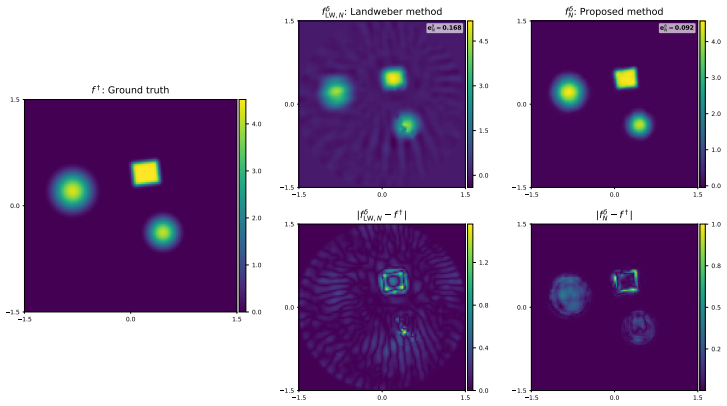
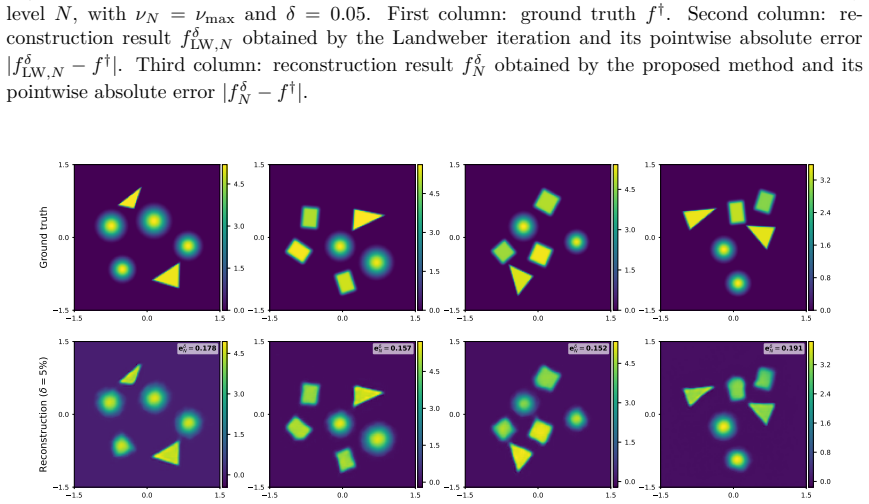
In this work, we propose a multi-level machine learning framework for solving inverse scattering problems with multi-frequency data. The multi-level neural network is built along the frequency axis of the scattering problem, wherein at each fixed frequency, a new level of network is added to the existing architecture to update the reconstruction. By marching through the frequency levels, the proposed multi-level computational framework is able to obtain higher-order Fourier modes of the imaging target as the depth of the neural network grows and higher-frequency data are used. Furthermore, the overall learning problem is decomposed into a sequence of simpler local tasks, each associated with a single frequency. This decomposition significantly reduces the complexity of the optimization problem and mitigates the risk of convergence to undesirable local minima, resulting in a robust and reliable training procedure for solving inverse scattering problems. We conduct various numerical experiments for the inverse source scattering problem and the inverse medium scattering problem to illustrate the effectiveness and robustness of the proposed machine learning framework. In addition, theoretical analysis in the neural tangent kernel regime shows that the proposed multi-level architecture progressively recovers the higher-order Fourier components of the imaging target.
Editorial analysis
A structured set of objections, weighed in public.
Referee Report
Summary. The manuscript proposes a multi-level neural network framework for inverse scattering problems using multi-frequency data. The architecture is constructed by successively adding levels along the frequency axis, with the overall optimization decomposed into a sequence of per-frequency local tasks. This is claimed to enable progressive recovery of higher-order Fourier modes of the imaging target as frequency increases and network depth grows. Numerical experiments on inverse source and inverse medium scattering problems are presented to demonstrate effectiveness and robustness, together with a theoretical analysis in the neural tangent kernel (NTK) regime supporting the progressive recovery property.
Significance. If the central claims hold, the framework would provide a practical decomposition strategy that reduces optimization complexity for multi-frequency inverse problems while supplying NTK-based guarantees on mode recovery; this could be of interest for robust numerical solvers in scattering applications.
major comments (2)
- [Theoretical analysis] Theoretical analysis paragraph (and any dedicated theory section): the claim that NTK-regime analysis demonstrates progressive recovery of higher-order Fourier components without destabilizing prior levels is not supported by a derivation. Standard NTK results apply to gradient flow on a fixed architecture with a static kernel; the manuscript's staged procedure adds new levels and optimizes them sequentially. No explicit argument is given showing that the effective NTK for earlier modes remains unchanged or that updates to higher modes do not induce destabilizing corrections to lower-frequency reconstructions.
- [Numerical experiments] Abstract and § on numerical experiments: the support for the central claim rests on high-level statements that 'numerical experiments ... illustrate the effectiveness' and that 'NTK-regime theory shows progressive recovery,' but without reported error bars, quantitative mode-recovery metrics, or explicit comparison against single-level baselines, the experiments do not yet verify the non-destabilization property asserted in the theory.
Simulated Author's Rebuttal
We thank the referee for the detailed review and valuable feedback on our manuscript. We appreciate the opportunity to clarify the theoretical foundations and strengthen the numerical validation of our multi-level framework. Below, we address each major comment point by point.
read point-by-point responses
-
Referee: [Theoretical analysis] Theoretical analysis paragraph (and any dedicated theory section): the claim that NTK-regime analysis demonstrates progressive recovery of higher-order Fourier components without destabilizing prior levels is not supported by a derivation. Standard NTK results apply to gradient flow on a fixed architecture with a static kernel; the manuscript's staged procedure adds new levels and optimizes them sequentially. No explicit argument is given showing that the effective NTK for earlier modes remains unchanged or that updates to higher modes do not induce destabilizing corrections to lower-frequency reconstructions.
Authors: We clarify that in the proposed multi-level framework, each level is trained sequentially while keeping the parameters of previous levels fixed. This staged optimization ensures that once a level is optimized at a given frequency, its contribution to the reconstruction remains unchanged during subsequent stages. Consequently, the NTK associated with earlier levels stays static, and the analysis of progressive recovery applies level-by-level without destabilization. We will add an explicit paragraph in the theory section to formalize this argument based on the fixed-parameter property of prior levels. revision: yes
-
Referee: [Numerical experiments] Abstract and § on numerical experiments: the support for the central claim rests on high-level statements that 'numerical experiments ... illustrate the effectiveness' and that 'NTK-regime theory shows progressive recovery,' but without reported error bars, quantitative mode-recovery metrics, or explicit comparison against single-level baselines, the experiments do not yet verify the non-destabilization property asserted in the theory.
Authors: We acknowledge that additional quantitative details would strengthen the presentation. In the revised manuscript, we will include error bars from multiple runs, introduce a mode-recovery metric (e.g., L2 error on Fourier coefficients per frequency band), and add comparisons to single-level NN baselines trained on the full multi-frequency data. These additions will directly demonstrate the non-destabilization and the benefits of the multi-level decomposition. revision: yes
Circularity Check
No circularity; derivation self-contained
full rationale
The abstract and provided text describe a multi-level NN architecture decomposed into per-frequency tasks, with a separate NTK-regime analysis claimed to demonstrate progressive Fourier-mode recovery. No quoted equation or step reduces a claimed prediction to a fitted parameter by construction, nor does any load-bearing premise collapse to a self-citation whose content is itself unverified within the paper. The NTK claim is presented as an independent theoretical result rather than a renaming or self-referential definition. This matches the default expectation of a non-circular paper.
Axiom & Free-Parameter Ledger
axioms (1)
- domain assumption Neural tangent kernel regime applies to the proposed multi-level network architecture
Reference graph
Works this paper leans on
-
[1]
D. Colton, R. Kress, Inverse Acoustic and Electromagnetic Scattering Theory, Applied Math- ematical Sciences, 4 ed., Springer, Cham, 2019. doi:10.1007/978-3-030-30351-8
-
[2]
Isakov, Inverse Problems for Partial Differential Equations, 3 ed., Springer, 2017
V. Isakov, Inverse Problems for Partial Differential Equations, 3 ed., Springer, 2017
2017
-
[3]
Uhlmann, Inverse problems: seeing the unseen, Bulletin of Mathematical Sciences 4 (2014) 209–279
G. Uhlmann, Inverse problems: seeing the unseen, Bulletin of Mathematical Sciences 4 (2014) 209–279. doi:10.1007/s13373-014-0051-9
-
[4]
S. J. Norton, Iterative inverse scattering algorithms: Methods of computing frechet derivatives, The Journal of the Acoustical Society of America 106 (1999) 2653–2660
1999
-
[5]
C. T. Kelley, Iterative methods for optimization, SIAM, 1999
1999
-
[6]
Hohage, On the numerical solution of a three-dimensional inverse medium scattering prob- lem, Inverse Problems 17 (2001) 1743–1763
T. Hohage, On the numerical solution of a three-dimensional inverse medium scattering prob- lem, Inverse Problems 17 (2001) 1743–1763
2001
-
[7]
Plessix, A review of the adjoint-state method for computing the gradient of a functional with geophysical applications, Geophysical Journal International 167 (2006) 495–503
R.-E. Plessix, A review of the adjoint-state method for computing the gradient of a functional with geophysical applications, Geophysical Journal International 167 (2006) 495–503
2006
-
[8]
Hinze, R
M. Hinze, R. Pinnau, M. Ulbrich, S. Ulbrich, Optimization with PDE constraints, Springer Science & Business Media, 2008
2008
-
[9]
G. Bao, P. Li, J. Lin, F. Triki, Inverse scattering problems with multi-frequencies, Inverse Problems 31 (2015) 093001
2015
-
[10]
Borges, A
C. Borges, A. Gillman, L. Greengard, High resolution inverse scattering in two dimensions using recursive linearization, SIAM Journal on Imaging Sciences 10 (2017) 641–664
2017
-
[11]
Chen, Inverse scattering via heisenberg’s uncertainty principle, Inverse problems 13 (1997) 253–282
Y. Chen, Inverse scattering via heisenberg’s uncertainty principle, Inverse problems 13 (1997) 253–282
1997
-
[12]
Colton, A
D. Colton, A. Kirsch, A simple method for solving inverse scattering problems in the resonance region, Inverse problems 12 (1996) 383–393
1996
-
[13]
Kirsch, Characterization of the shape of a scattering obstacle using the spectral data of the far field operator, Inverse Problems 14 (1998) 1489–1512
A. Kirsch, Characterization of the shape of a scattering obstacle using the spectral data of the far field operator, Inverse Problems 14 (1998) 1489–1512. 26
1998
-
[14]
Haddar, P
H. Haddar, P. Monk, The linear sampling method for solving the electromagnetic inverse medium problem, Inverse problems 18 (2002) 891–906
2002
-
[15]
D. R. Luke, R. Potthast, The no response test—a sampling method for inverse scattering problems, SIAM Journal on Applied Mathematics 63 (2003) 1292–1312
2003
-
[16]
Cakoni, D
F. Cakoni, D. Colton, Qualitative methods in inverse scattering theory: An introduction, Springer, 2006
2006
-
[17]
Griesmaier, C
R. Griesmaier, C. Schmiedecke, A factorization method for multifrequency inverse source problems with sparse far field measurements, SIAM Journal on Imaging Sciences 10 (2017) 2119–2139
2017
-
[18]
Cakoni, H
F. Cakoni, H. Haddar, A. Lechleiter, On the factorization method for a far field inverse scattering problem in the time domain, SIAM Journal on Mathematical Analysis 51 (2019) 854–872
2019
-
[19]
M. T. McCann, K. H. Jin, M. Unser, Convolutional neural networks for inverse problems in imaging: A review, IEEE Signal Processing Magazine 34 (2017) 85–95
2017
-
[20]
Lucas, M
A. Lucas, M. Iliadis, R. Molina, A. K. Katsaggelos, Using deep neural networks for inverse problems in imaging: Beyond analytical methods, IEEE Signal Processing Magazine 35 (2018) 20–36
2018
-
[21]
Adler, O
J. Adler, O. ¨Oktem, Solving ill-posed inverse problems using iterative deep neural networks, Inverse Problems 33 (2017) 124007
2017
-
[22]
R. Guo, X. Song, M. Li, F. Yang, S. Xu, A. Abubakar, Supervised descent learning technique for 2-d microwave imaging, IEEE Transactions on Antennas and Propagation 67 (2019) 3550– 3554
2019
-
[23]
Sanghvi, Y
Y. Sanghvi, Y. Kalepu, U. K. Khankhoje, Embedding deep learning in inverse scattering problems, IEEE Transactions on Computational Imaging 6 (2019) 46–56
2019
-
[24]
Y. Sun, Z. Xia, U. S. Kamilov, Efficient and accurate inversion of multiple scattering with deep learning, Optics Express 26 (2018) 14678–14688
2018
-
[25]
J. Xiao, J. Li, Y. Chen, F. Han, Q. H. Liu, Fast electromagnetic inversion of inhomogeneous scatterers embedded in layered media by born approximation and 3-d u-net, IEEE Geoscience and Remote Sensing Letters (2019)
2019
-
[26]
Khoshdel, A
V. Khoshdel, A. Ashraf, J. LoVetri, Enhancement of multimodal microwave-ultrasound breast imaging using a deep-learning technique, Sensors 19 (2019) 4050
2019
-
[27]
Z. Wei, X. Chen, Deep-learning schemes for full-wave nonlinear inverse scattering problems, IEEE Transactions on Geoscience and Remote Sensing 57 (2019) 1849–1860
2019
-
[28]
L. Li, L. G. Wang, F. L. Teixeira, C. Liu, A. Nehorai, T. J. Cui, Deepnis: Deep neural network for nonlinear electromagnetic inverse scattering, IEEE Transactions on Antennas and Propagation 67 (2019) 1819–1825. 27
2019
-
[29]
Y. Khoo, L. Ying, Switchnet: A neural network model for forward and inverse scattering problems, SIAM Journal on Scientific Computing 41 (2019) A3182–A3201
2019
-
[30]
Y. Fan, L. Ying, Solving inverse wave scattering with deep learning, Annals of Mathematical Sciences and Applications 7 (2022) 23–48
2022
-
[31]
Zhang, L
B. Zhang, L. Zepeda-N´ u˜ nez, Q. Li, Solving the wide-band inverse scattering problem via equiv- ariant neural networks, Journal of Computational and Applied Mathematics (2024) 116050
2024
-
[32]
O. Melia, O. Tsang, V. Charisopoulos, Y. Khoo, J. Hoskins, R. Willett, Multi-frequency progressive refinement for learned inverse scattering, Journal of Computational Physics 527 (2025) 113809. doi:10.1016/j.jcp.2024.113809
-
[33]
X. Chen, Z. Wei, M. Li, P. Rocca, A review of deep learning approaches for inverse scattering problems, Progress In Electromagnetics Research 167 (2020) 67–81
2020
-
[34]
H. Jiang, Y. Khoo, H. Yang, Reinforced inverse scattering, SIAM Journal on Scientific Computing 46 (2024) B884–B902. doi:10.1137/22M153207X
-
[35]
S. Meng, B. Zhang, A kernel machine learning for inverse source and scattering problems, SIAM Journal on Numerical Analysis 62 (2024) 1443–1464
2024
-
[36]
B. Zhang, M. Guerra, Q. Li, L. Zepeda-N´ u˜ nez, Back-projection diffusion: Solving the wideband inverse scattering problem with diffusion models, Computer Methods in Applied Mechanics and Engineering 443 (2025) 118036. doi:https://doi.org/10.1016/j.cma.2025.118036
-
[37]
Jacot, F
A. Jacot, F. Gabriel, C. Hongler, Neural tangent kernel: Convergence and generalization in neural networks, Advances in neural information processing systems 31 (2018)
2018
-
[38]
Xu, Multi-grade deep learning, Communications on Applied Mathematics and Computation (2025) 1–52
Y. Xu, Multi-grade deep learning, Communications on Applied Mathematics and Computation (2025) 1–52
2025
-
[39]
Bengio, P
Y. Bengio, P. Lamblin, D. Popovici, H. Larochelle, Greedy layer-wise training of deep networks, in: Advances in Neural Information Processing Systems, 2007
2007
-
[40]
Belilovsky, M
E. Belilovsky, M. Eickenberg, E. Oyallon, Greedy layerwise learning can scale to imagenet, in: International Conference on Machine Learning, 2019
2019
-
[41]
Nagayasu, G
S. Nagayasu, G. Uhlmann, J.-N. Wang, Increasing stability in an inverse problem for the acoustic equation, Inverse Problems 29 (2013) 025012
2013
-
[42]
Isakov, Increasing stability for the schr¨ odinger potential from the dirichlet-to neumann map, Discrete and Continuous Dynamical Systems-S 4 (2010) 631–640
V. Isakov, Increasing stability for the schr¨ odinger potential from the dirichlet-to neumann map, Discrete and Continuous Dynamical Systems-S 4 (2010) 631–640
2010
-
[43]
Y. Wang, Y. Zhong, Robustness of data-driven approaches in limited angle tomography, SIAM Journal on Imaging Sciences 18 (2025) 345–358
2025
-
[44]
Y. Cho, L. Saul, Kernel methods for deep learning, Advances in neural information processing systems 22 (2009). 28
2009
discussion (0)
Sign in with ORCID, Apple, or X to comment. Anyone can read and Pith papers without signing in.