REVIEW 4 major objections 8 minor 3 cited by
An Analysis for Reasoning Bias of Language Models with Small Initialization
T0 review · 4 major / 8 minor · reviewed 2026-08-09 · deepseek-v4-flash
Pith's one-line read The scale of a transformer's weight initialization decides, in one training run, whether it learns compositional rules and generalizes or memorizes its training pairs; early embedding updates are shaped by token label distributions.
desk verdict Useful mechanism story for a known empirical result; the theory is suggestive rather than proven in the tested regime, but the paper deserves a careful referee. read the letter →
The pith
A machine-rendered reading of the paper's core claim, the machinery that carries it, and where it could break.
The reading
What carries the argument
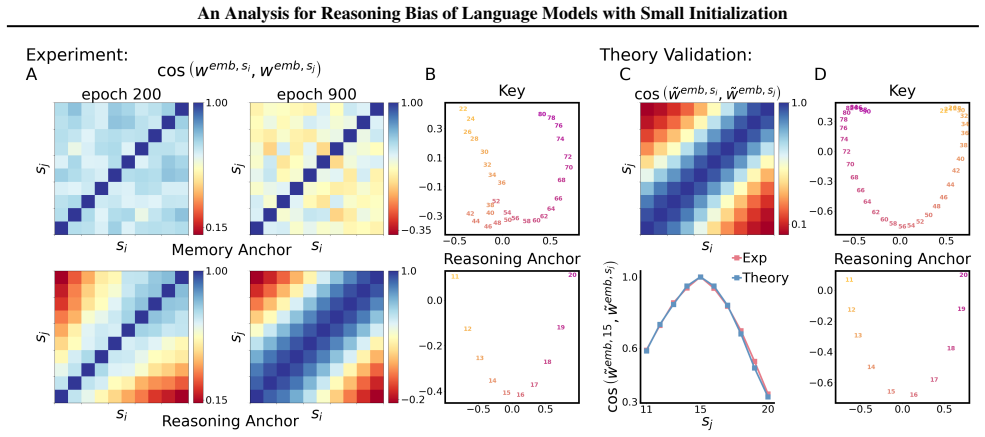
The load-bearing object is the early-time gradient flow of the embedding row $w_{\mathrm{emb},s}$, which under small initialization becomes $d w_{\mathrm{emb},s}/dt = r_s (P_s - \frac{1}{d}\mathbf{1})\tilde W$ (Propositions 1–3), where $P_s$ is the label distribution of the samples containing token $s$ and $\tilde W$ collects the effective value/output and feedforward paths. The argument hangs on the contrast between (7) and (8): every memory anchor has the same uniform label distribution, while each reasoning anchor has a shifted distribution, so the same gradient law differentiates reasoning embeddings and leaves memory embeddings similar. Theorem 1 then approximates the reasoning-anchor embedding by a Gaussian bump $e^{-(i-s)^2/(2\sigma_P)}$, and the first attention module is shown to act as a fixed average operator whose value projection is dominated by reasoning anchors, carrying the differentiated signal forward.
What would settle it
Track the norm of the attention-matrix derivative $\|dA/dt\|$ against the embedding-gradient norm $\|dw_{\mathrm{emb}}/dt\|$ during the first 200 epochs of the synthetic task at $\gamma = 0.8$; if attention gradients are not comparatively small, the frozen-attention premise fails. Alternatively, relabel the reasoning task so that every reasoning anchor has the same label distribution as every other anchor; if the reasoning bias persists under small initialization, the label-distribution mechanism is not the whole story.
Extended reading notes
Core claim
On the paper's own terms, the discovery is that smaller initialization scales bias language models toward reasoning tasks and larger scales bias them toward memorization, and that the bias is governed by how label distributions shape the embedding space during the earliest training steps. Formally, with small initialization ($\gamma > 0.5$ in the paper's scheme, where weights are drawn as $N(0, d^{-2\gamma})$), the attention matrix of the first layer acts like an averaging operator, and the gradient flow of a token's embedding $w_{\mathrm{emb},s}$ reduces to $d w_{\mathrm{emb},s}/dt = r_s (P_s - \frac{1}{d}\mathbf{1})\tilde{W}$, with $P_s$ the label distribution over samples containing $s$. Because $P_s$ is the same uniform distribution for every memory anchor but shifts with the anchor value for reasoning anchors, reasoning embeddings separate early and acquire a hierarchical, number-ordered structure, while memory embeddings remain undifferentiated. Theorem 1 approximates the resulting reasoning-anchor embeddings by $e^{-(i-s)^2/(2\sigma_P)}$ and bounds the inner-product error. The value projection $W^V$ of the first attention block develops a dominant singular direction aligned with reasoning anchors, so the reasoning signal propagates to all subsequent tokens, whereas memory anchors are not distinctly captured.
Load-bearing premise
Everything in the theoretical explanation depends on treating the attention matrix as a fixed averaging operator during early training and ignoring the gradients of the attention weights; if those gradients are not actually small in the window where the bias forms, the mechanism is incomplete.
Editorial extensions
If this is right
- Initialization scale becomes a practical control knob: with $\gamma > 0.5$ a small transformer on a mixed reasoning/memory dataset will preferentially learn and generalize the reasoning part, while $\gamma < 0.5$ makes it memorize the training pairs instead.
- The reasoning bias is not about the model's capacity or the data's complexity but about early embedding differentiation, so tasks whose per-token label distributions are structured inherit the bias automatically.
- Memory-style tasks can be made learnable even as arbitrary mappings if their label distributions vary with the anchor: the paper shows that an anchor-dependent memory task is learned faster than a fully uniform one.
- Real pretraining may inherit the same effect: in GPT-2 runs on PrOntoQA plus TinyStories, the loss advantage of the reasoning dataset grows as the initialization scale shrinks, and the reasoning-token embeddings become more distinguishable.
- Under small initialization, the first attention block's value projection aligns with reasoning anchors while the attention matrix stays near an average operator, giving a concrete internal signature that distinguishes a reasoning-biased run from a memorizing one.
Reading between the lines
- An untested implication is that the bias generalizes beyond arithmetic: any per-token label structure that encodes an ordering or a rule, such as dates, coordinates, or hierarchical codes, should benefit from small initialization, while flat, arbitrary fact associations should be chronically disfavored.
- As an extension not explored in the paper, one could deliberately engineer label-distribution diversity for key tokens through auxiliary objectives or embedding regularization to induce reasoning-like generalization without shrinking the initialization scale.
- The frozen-attention window may be a narrow early-training phase; at larger widths, deeper stacks, or with aggressive learning-rate schedules, attention gradients could become significant before the embedding geometry sets, which would make the bias a small-model, early-training phenomenon rather than a universal LLM property.
- A testable extension: after a small-initialization pretraining phase that has already differentiated reasoning embeddings, introducing a fresh memory-style task should proceed slowly; if correct, task order should interact with the bias.
Editorial analysis
A structured set of objections, weighed in public.
Referee Report
Summary. The paper studies how the parameter initialization scale of a Transformer affects whether the model learns compositional reasoning mappings or memorizes input–output pairs. In a synthetic anchor-function task and in a GPT-2 experiment mixing PrOntoQA and TinyStories, the authors report that a smaller initialization scale (γ=0.8) favors reasoning, while a larger scale (γ=0.3) favors memorization. They propose a mechanism in which early embedding gradients are driven by the label distribution of each token: memory anchors have uniform label distributions and thus undifferentiated embeddings, whereas reasoning anchors have anchor-dependent label distributions and thus develop a hierarchical embedding structure. The paper formalizes this with an Embedding-MLP analysis (Proposition 1), a one-layer Transformer gradient-flow analysis (Propositions 2–3, Theorem 1), and an analysis of the first and second attention modules, and it validates the qualitative embedding patterns against experiments.
Significance. If the empirical finding holds, initialization scale is an easily controllable training bias that determines whether a small Transformer learns a compositional rule and generalizes or simply memorizes training data. The synthetic task is carefully designed, the empirical direction is consistent across the Transformer, Emb-MLP, and GPT-2 settings, and the paper offers a concrete, testable mechanism based on label distributions. The theoretical framework, however, is not yet on solid ground: the Transformer gradient-flow derivation neglects derivatives through the attention weights, Lemma 1 holds provably only for initialization scales much larger than those tested, and the validation of Theorem 1 fixes Gaussian width and normalization by hand. The empirical contribution is valuable, but the claimed explanatory mechanism requires additional analysis.
major comments (4)
- [§3.3 / Appendix B.5, Lemma 3] The gradient-flow derivation for the one-layer Transformer differentiates fθ with respect to W_emb only through the value and residual paths, treating the attention matrix A as a fixed average operator. Since A = softmax(mask(QK^T)/√dk) depends on W_emb through Q and K, the omitted dA term is generically nonzero, and the paper does not bound it. Propositions 2 and 3 and Theorem 1 therefore do not yet establish that label distributions alone drive the early embedding differentiation in an actual Transformer. I recommend either deriving a bound on the dA contribution during the early-training window or adding a numerical comparison of the retained versus omitted gradient terms.
- [Lemma 1 / §3.3] The regime in which A is provably near the average operator is not the regime tested in the experiments. With d_m=200, d_k=64, ε=δ=0.1, the proof of Lemma 1 requires γ ≳ 2.8, while all experiments use γ=0.3, 0.5, and 0.8. Figure 6 shows the average-operator behavior for γ=0.8 only at epoch 200, which is after the early window in which the embedding differentiation is claimed to occur. The theoretical mechanism is therefore not verified for the experimental setting; please extend the lemma to the tested range, justify the extrapolation, or present experiments in the provable regime.
- [Theorem 1 / Eq. (14) / Appendix B.7] The validation of Theorem 1 fixes the Gaussian width and normalization in Eq. (14) by hand, and the stated error bound (13) yields O(d_m^{1-γ}(q^{-1/2}+d_m^{-γ})) ≈ O(2.4) for the experimental values (d_m=200, γ=0.8, q=2), which is too loose to certify the cosine-similarity match shown in Figure 5C. The visual agreement could therefore be sensitive to the hand-set constants; a principled estimate of C1, C2, and σP or a quantitative error metric is needed to substantiate the theoretical validation.
- [§3.1–§3.4, all figures] All reported experiments appear to be single runs without error bars or multiple seeds. Since the central empirical claim is a comparison of learning speeds and generalization behaviors across γ values, the observed differences could in principle be within run-to-run variability. Please report the number of seeds and the variance of the loss, accuracy, and cosine-similarity measures, or otherwise justify that the effects are stable.
minor comments (8)
- [§2.3, Eq. (2)] The masking operation mask(·) is used without definition; please specify the causal mask explicitly.
- [§3.1 / §2.2] The relationship between the 'last token prediction' described in §3.1 and the label construction defined in §2.2 should be stated explicitly, since the dataset definition refers to the label of the full sequence.
- [§3.5] The notation '{30, ..., 29 + 20 × i}' for the four label-range groups is confusing; the intended ranges (e.g., 30–49, 30–69, 30–89, 30–109) should be written out.
- [Appendix E, Assumption 4] The sign convention in cos(w_pos,i, w_pos,j) = cos(|i−j|π/L) should be checked against the increasing attention pattern in Figure 15C; if the cosine is negative for large |i−j|, the stated increasing behavior requires clarification.
- [Theorem 2] Theorem 2 assumes N_Z = d_m, which is not satisfied in the experiments (N_Z=100, d_m=200); the paper should state clearly that this result is not directly validated by the reported experiments.
- [§2.2 / §3.2] Equations (7) and (8) are immediate consequences of the dataset construction: memory labels are uniform by definition and reasoning labels are sums of keys and anchors by definition. The authors should state this explicitly so that the empirical content is understood to lie in the dynamical response of the embeddings to these distributions.
- [Throughout] The paper does not mention whether code and data will be released; an availability statement would improve reproducibility.
- [Figure 4 and Appendix B.5] There are several typesetting issues, such as 'P s − 1 dvob 1' in Figure 4B and the phrase 'as the initialization scales decrease to zero' in Appendix B.5, which conflicts with the γ→∞ limit used in Propositions 2–3; please proofread these passages.
Circularity Check
No significant circularity: the synthetic label distributions are definitions, the empirical loss and embedding results are measured, and the self-citations are background rather than load-bearing.
full rationale
The claimed derivation chain is: (i) the synthetic benchmark defines memory labels as uniform draws from Z and reasoning labels as sums of the key and anchors, which yields the label distributions in Eqs. (7)-(8); (ii) Proposition 1 and the small-initialization limit express the embedding gradient as proportional to P_s minus a uniform vector; (iii) Propositions 2-3 specialize this gradient flow to memory and reasoning anchors; and (iv) the predicted embedding differentiation is compared with measured cosine-similarity matrices, while the reasoning bias itself is read from independently measured loss curves on Dmem, Drsn,train, Drsn,test and on the external PrOntoQA and TinyStories corpora. Equations (7)-(8) are statements of the data-generation process, not fitted predictions, so the fact that reasoning anchors have s-dependent label distributions is a definitional input rather than a circular output. The empirical claims could have failed (for example, a larger initialization could have ignored the label structure), and Figures 3, 5, and 7 report measured quantities. The main theoretical weakness is the frozen-attention approximation in Lemma 3 and Appendix B.5, which omits derivatives of the attention matrix, together with the regime mismatch between Lemma 1's asymptotic guarantee and the tested gamma=0.8; these are rigor and correctness concerns, not circularity. The self-citations (Zhang et al. 2024a,b; Xu et al. 2025; Chen et al. 2024) motivate the anchor-function framework and condensation intuition, but they are not the load-bearing proof because the paper re-derives its gradient-flow results and validates them on external benchmarks. Therefore no load-bearing step reduces by construction to its own input.
Assumptions & free parameters
free parameters (1)
- Gaussian width and normalization in Theorem 1 =
sigma_P^2 = 6 (exponent (i-s)^2/12), C1*C2 = 1 in Eq. (14)
assumptions (7)
- standard math Assumption 1: activation sigma is C^2 with bounded first and second derivatives, sigma(0)=0, sigma'(0)=1.
- ad hoc to paper The attention matrix A is treated as constant when deriving the embedding gradient in the one-layer Transformer (Lemma 3).
- domain assumption The limits n -> infinity and gamma -> infinity are taken simultaneously with r_s constant.
- standard math The discrete sum of uniform random variables is approximated by a Gaussian via Berry-Esseen (Theorem 1).
- domain assumption Task construction: memory labels are uniform over Z independent of the anchor, reasoning labels are the sum of the key and anchors (Eqs. 7 and 8).
- ad hoc to paper Word embeddings and position embeddings are orthogonal and position-position cosine follows cos(|i-j| pi / L) (Assumptions 2-4, Appendix E).
- ad hoc to paper Theorem 2 assumes NZ = dm and a 1:1 ratio of memory to reasoning mappings.
Cite this review
Pith. "Pith review of An Analysis for Reasoning Bias of Language Models with Small Initialization." pith.science (2026). https://pith.science/paper/KLUVLCAP
@misc{pith2026250204375,
  author       = {Pith},
  title        = {Pith review of: An Analysis for Reasoning Bias of Language Models with Small Initialization},
  year         = {2026},
  howpublished = {\url{https://pith.science/paper/KLUVLCAP}},
  note         = {Machine review of arXiv:2502.04375}
}
read the original abstract
Transformer-based Large Language Models (LLMs) have revolutionized Natural Language Processing by demonstrating exceptional performance across diverse tasks. This study investigates the impact of the parameter initialization scale on the training behavior and task preferences of LLMs. We discover that smaller initialization scales encourage models to favor reasoning tasks, whereas larger initialization scales lead to a preference for memorization tasks. We validate this reasoning bias via real datasets and meticulously designed anchor functions. Further analysis of initial training dynamics suggests that specific model components, particularly the embedding space and self-attention mechanisms, play pivotal roles in shaping these learning biases. We provide a theoretical framework from the perspective of model training dynamics to explain these phenomena. Additionally, experiments on real-world language tasks corroborate our theoretical insights. This work enhances our understanding of how initialization strategies influence LLM performance on reasoning tasks and offers valuable guidelines for training models.
Figures


Figures from the paper (14 more)



Forward citations
Cited by 3 Pith papers
-
Understanding LoRA as Knowledge Memory: An Empirical Analysis
LoRA modules function as composable knowledge memories for LLMs with measurable storage capacity, internalization efficiency, and advantages in multi-module long-context reasoning.
-
Unveiling the Mechanisms of Multi-Hop Reasoning in Transformers via Identity Bridge
Adding identity supervision on bridge tokens enables out-of-distribution two-hop reasoning in simple transformers, with a nuclear-norm theory explaining the benefit.
-
Scalable Complexity Control Facilitates Reasoning Ability of LLMs
Controlling model complexity through smaller initialization rates and stronger weight decay improved LLM benchmark scores and made loss-versus-scale curves descend faster.
Reference graph
Works this paper leans on
-
[1]
J., Javaheripi, M., Kauffmann, P., Lee, J
Abdin, M., Aneja, J., Behl, H., Bubeck, S., Eldan, R., Gunasekar, S., Harrison, M., Hewett, R. J., Javaheripi, M., Kauffmann, P., Lee, J. R., Lee, Y. T., Li, Y., Liu, W., Mendes, C. C. T., Nguyen, A., Price, E., de Rosa, G., Saarikivi, O., Salim, A., Shah, S., Wang, X., Ward, R., Wu, Y., Yu, D., Zhang, C., and Zhang, Y. Phi-4 technical report, 2024. URL h...
arXiv 2024
-
[2]
L., Almeida, D., Altenschmidt, J., Altman, S., Anadkat, S., et al
Achiam, J., Adler, S., Agarwal, S., Ahmad, L., Akkaya, I., Aleman, F. L., Almeida, D., Altenschmidt, J., Altman, S., Anadkat, S., et al. Gpt-4 technical report. arXiv preprint arXiv:2303.08774, 2023
arXiv 2023
-
[3]
S., Hu, W., Li, Z., Salakhutdinov, R
Arora, S., Du, S. S., Hu, W., Li, Z., Salakhutdinov, R. R., and Wang, R. On exact computation with an infinitely wide neural net. In Advances in Neural Information Processing Systems, pp.\ 8141--8150, 2019
work page 2019
-
[4]
Reflections after refereeing papers for nips
Breiman, L. Reflections after refereeing papers for nips. The Mathematics of Generalization, XX: 0 11--15, 1995
work page 1995
-
[5]
Caiado, C. and Rathie, P. Polynomial coefficients and distribution of the sum of discrete uniform variables. 01 2007
work page 2007
-
[6]
Chen, Z.-A., Li, Y., Luo, T., Zhou, Z., and Xu, Z.-Q. J. Phase diagram of initial condensation for two-layer neural networks. CSIAM Transactions on Applied Mathematics, 5 0 (3): 0 448--514, 2024. ISSN 2708-0579. doi:https://doi.org/10.4208/csiam-am.SO-2023-0016. URL http://global-sci.org/intro/article_detail/csiam-am/23306.html
-
[7]
Chizat, L. and Bach, F. On the Global Convergence of Gradient Descent for Over -parameterized Models using Optimal Transport . In Advances in Neural Information Processing Systems 31 , pp.\ 3036--3046. 2018
work page 2018
-
[8]
Creswell, A. and Shanahan, M. Faithful reasoning using large language models. arXiv preprint arXiv:2208.14271, 2022
arXiv 2022
Show all 60 references
-
[9]
Selection-inference: Exploiting large language models for interpretable logical reasoning
Creswell, A., Shanahan, M., and Higgins, I. Selection-inference: Exploiting large language models for interpretable logical reasoning. arXiv preprint arXiv:2205.09712, 2022
2022 arXiv
-
[10]
The neural data router: Adaptive control flow in transformers improves systematic generalization
Csord \'a s, R., Irie, K., and Schmidhuber, J. The neural data router: Adaptive control flow in transformers improves systematic generalization. arXiv preprint arXiv:2110.07732, 2021
2021 arXiv
-
[11]
Ctl++: Evaluating generalization on never-seen compositional patterns of known functions, and compatibility of neural representations
Csord \'a s, R., Irie, K., and Schmidhuber, J. Ctl++: Evaluating generalization on never-seen compositional patterns of known functions, and compatibility of neural representations. arXiv preprint arXiv:2210.06350, 2022
2022 arXiv
-
[12]
L., Jiang, L., Lin, B
Dziri, N., Lu, X., Sclar, M., Li, X. L., Jiang, L., Lin, B. Y., Welleck, S., West, P., Bhagavatula, C., Le Bras, R., et al. Faith and fate: Limits of transformers on compositionality. Advances in Neural Information Processing Systems, 36, 2024
2024
-
[13]
A comparative analysis of optimization and generalization properties of two-layer neural network and random feature models under gradient descent dynamics
E, W., Ma, C., and Wu, L. A comparative analysis of optimization and generalization properties of two-layer neural network and random feature models under gradient descent dynamics. Sci. China Math., 63, 2020
2020
-
[14]
and Li, Y
Eldan, R. and Li, Y. Tinystories: How small can language models be and still speak coherent english?, 2023. URL https://arxiv.org/abs/2305.07759
2023 arXiv
-
[15]
How does gpt obtain its ability? tracing emergent abilities of language models to their sources
Fu, Y., Peng, H., and Khot, T. How does gpt obtain its ability? tracing emergent abilities of language models to their sources. Yao Fu’s Notion, 2022
2022
-
[16]
Delving deep into rectifiers: Surpassing human-level performance on imagenet classification
He, K., Zhang, X., Ren, S., and Sun, J. Delving deep into rectifiers: Surpassing human-level performance on imagenet classification. In Proceedings of the IEEE international conference on computer vision, pp.\ 1026--1034, 2015
2015
-
[17]
S., Perez, F., Ba, J., and Volkovs, M
Huang, X. S., Perez, F., Ba, J., and Volkovs, M. Improving transformer optimization through better initialization. In International Conference on Machine Learning, pp.\ 4475--4483. PMLR, 2020
2020
-
[18]
Learning compositionally through attentive guidance
Hupkes, D., Singh, A., Korrel, K., Kruszewski, G., and Bruni, E. Learning compositionally through attentive guidance. arXiv preprint arXiv:1805.09657, 2018
2018 arXiv
-
[19]
Neural Tangent Kernel : Convergence and Generalization in Neural Networks
Jacot, A., Gabriel, F., and Hongler, C. Neural Tangent Kernel : Convergence and Generalization in Neural Networks . In Advances in Neural Information Processing Systems 31 , pp.\ 8571--8580. 2018
2018
-
[20]
B., and M \"u ller, K
LeCun, Y., Bottou, L., Orr, G. B., and M \"u ller, K. R. Efficient BackProp, pp.\ 9--50. Springer Berlin Heidelberg, Berlin, Heidelberg, 1998. ISBN 978-3-540-49430-0. doi:10.1007/3-540-49430-8_2. URL https://doi.org/10.1007/3-540-49430-8_2
1998 doi
-
[21]
A., Serre, T., and Pavlick, E
Lepori, M. A., Serre, T., and Pavlick, E. Break it down: Evidence for structural compositionality in neural networks. arXiv preprint arXiv:2301.10884, 2023
2023 arXiv
-
[22]
Not all tokens are what you need for pretraining
Lin, Z., Gou, Z., Gong, Y., Liu, X., yelong shen, Xu, R., Lin, C., Yang, Y., Jiao, J., Duan, N., and Chen, W. Not all tokens are what you need for pretraining. In The Thirty-eighth Annual Conference on Neural Information Processing Systems, 2024. URL https://openreview.net/for...
2024
-
[23]
Deepseek-v3 technical report
Liu, A., Feng, B., Xue, B., Wang, B., Wu, B., Lu, C., Zhao, C., Deng, C., Zhang, C., Ruan, C., et al. Deepseek-v3 technical report. arXiv preprint arXiv:2412.19437, 2024
2024 arXiv
-
[24]
T., Goel, S., Krishnamurthy, A., and Zhang, C
Liu, B., Ash, J. T., Goel, S., Krishnamurthy, A., and Zhang, C. Transformers learn shortcuts to automata. arXiv preprint arXiv:2210.10749, 2022
2022 arXiv
-
[25]
Understanding the difficulty of training transformers
Liu, L., Liu, X., Gao, J., Chen, W., and Han, J. Understanding the difficulty of training transformers. arXiv preprint arXiv:2004.08249, 2020
2004 arXiv
-
[26]
J., Ma, Z., and Zhang, Y
Luo, T., Xu, Z.-Q. J., Ma, Z., and Zhang, Y. Phase diagram for two-layer relu neural networks at infinite-width limit. Journal of Machine Learning Research, 22 0 (71): 0 1--47, 2021
2021
-
[27]
Marcus, G. F. The algebraic mind: Integrating connectionism and cognitive science. MIT press, 2003
2003
-
[28]
A mean field view of the landscape of two-layer neural networks
Mei, S., Montanari, A., and Nguyen, P.-M. A mean field view of the landscape of two-layer neural networks. Proceedings of the National Academy of Sciences, 115 0 (33): 0 E7665--E7671, 2018. doi:10.1073/pnas.1806579115
2018 doi
-
[29]
S., Dick, R
Okawa, M., Lubana, E. S., Dick, R. P., and Tanaka, H. Compositional abilities emerge multiplicatively: Exploring diffusion models on a synthetic task. arXiv preprint arXiv:2310.09336, 2023
2023 arXiv
-
[30]
Language models are unsupervised multitask learners
Radford, A., Wu, J., Child, R., Luan, D., Amodei, D., and Sutskever, I. Language models are unsupervised multitask learners. 2019. URL https://api.semanticscholar.org/CorpusID:160025533
2019
-
[31]
P., Tanaka, H., and Lubana, E
Ramesh, R., Khona, M., Dick, R. P., Tanaka, H., and Lubana, E. S. How capable can a transformer become? a study on synthetic, interpretable tasks. arXiv preprint arXiv:2311.12997, 2023
2023 arXiv
-
[32]
and Vanden-Eijnden, E
Rotskoff, G. and Vanden-Eijnden, E. Parameters as interacting particles: long time convergence and asymptotic error scaling of neural networks. In Advances in Neural Information Processing Systems 31 , pp.\ 7146--7155. 2018
2018
-
[33]
and He, H
Saparov, A. and He, H. Language models are greedy reasoners: A systematic formal analysis of chain-of-thought. In The Eleventh International Conference on Learning Representations, 2023. URL https://openreview.net/forum?id=qFVVBzXxR2V
2023
-
[34]
and Spiliopoulos, K
Sirignano, J. and Spiliopoulos, K. Mean field analysis of neural networks: A central limit theorem. Stochastic Processes and their Applications, 130 0 (3): 0 1820--1852, 2020. doi:10.1016/j.spa.2019.06.003
2020 doi
-
[35]
Neurocompositional computing: From the central paradox of cognition to a new generation of ai systems
Smolensky, P., McCoy, R., Fernandez, R., Goldrick, M., and Gao, J. Neurocompositional computing: From the central paradox of cognition to a new generation of ai systems. AI Magazine, 43 0 (3): 0 308--322, 2022
2022
-
[36]
Srivastava, A., Rastogi, A., Rao, A., Shoeb, A. A. M., Abid, A., Fisch, A., Brown, A. R., Santoro, A., Gupta, A., Garriga-Alonso, A., et al. Beyond the imitation game: Quantifying and extrapolating the capabilities of language models. arXiv preprint arXiv:2206.04615, 2022
2022 arXiv
-
[37]
and Kolter, J
Trockman, A. and Kolter, J. Z. Mimetic initialization of self-attention layers. In International Conference on Machine Learning, pp.\ 34456--34468. PMLR, 2023
2023
-
[38]
Deepnet: Scaling transformers to 1,000 layers
Wang, H., Ma, S., Dong, L., Huang, S., Zhang, D., and Wei, F. Deepnet: Scaling transformers to 1,000 layers. IEEE Transactions on Pattern Analysis and Machine Intelligence, 2024 a
2024
-
[39]
Label words are anchors: An information flow perspective for understanding in-context learning
Wang, L., Li, L., Dai, D., Chen, D., Zhou, H., Meng, F., Zhou, J., and Sun, X. Label words are anchors: An information flow perspective for understanding in-context learning. arXiv preprint arXiv:2305.14160, 2023
2023 arXiv
-
[40]
Improving generalization and convergence by enhancing implicit regularization
Wang, M., He, H., Wang, J., Wang, Z., Huang, G., Xiong, F., Li, Z., Wu, L., et al. Improving generalization and convergence by enhancing implicit regularization. arXiv preprint arXiv:2405.20763, 2024 b
2024 arXiv
-
[41]
Wang, M. et al. Understanding the expressive power and mechanisms of transformer for sequence modeling. arXiv preprint arXiv:2402.00522, 2024 c
2024 arXiv
-
[42]
Wang, Z., Wang, Y., Zhang, Z., Zhou, Z., Jin, H., Hu, T., Sun, J., Li, Z., Zhang, Y., and Xu, Z.-Q. J. Towards understanding how transformer perform multi-step reasoning with matching operation. arXiv preprint arXiv:2405.15302, 2024 d
2024 arXiv
-
[43]
H., Hashimoto, T., Vinyals, O., Liang, P., Dean, J., and Fedus, W
Wei, J., Tay, Y., Bommasani, R., Raffel, C., Zoph, B., Borgeaud, S., Yogatama, D., Bosma, M., Zhou, D., Metzler, D., Chi, E. H., Hashimoto, T., Vinyals, O., Liang, P., Dean, J., and Fedus, W. Emergent abilities of large language models. Transactions on Machine Learning Researc...
2022
-
[44]
Chain of thought prompting elicits reasoning in large language models
Wei, J., Wang, X., Schuurmans, D., Bosma, M., Chi, E., Le, Q., and Zhou, D. Chain of thought prompting elicits reasoning in large language models. arXiv preprint arXiv:2201.11903, 2022 b
2022 arXiv
-
[45]
T., Panozzo, D., Zorin, D., and Bruna, J
Williams, F., Trager, M., Silva, C. T., Panozzo, D., Zorin, D., and Bruna, J. Gradient dynamics of shallow univariate relu networks. CoRR, abs/1906.07842, 2019. URL http://arxiv.org/abs/1906.07842
1906 arXiv
-
[46]
J., Zhang, Y., and Zhou, Z
Xu, Z.-Q. J., Zhang, Y., and Zhou, Z. An overview of condensation phenomenon in deep learning. arXiv preprint arXiv:2504.09484, 2025
2025 arXiv
-
[47]
Do vision-language pretrained models learn composable primitive concepts? arXiv preprint arXiv:2203.17271, 2022
Yun, T., Bhalla, U., Pavlick, E., and Sun, C. Do vision-language pretrained models learn composable primitive concepts? arXiv preprint arXiv:2203.17271, 2022
2022 arXiv
-
[48]
Improving deep transformer with depth-scaled initialization and merged attention
Zhang, B., Titov, I., and Sennrich, R. Improving deep transformer with depth-scaled initialization and merged attention. arXiv preprint arXiv:1908.11365, 2019 a
1908 arXiv
-
[49]
Understanding deep learning requires rethinking generalization
Zhang, C., Bengio, S., Hardt, M., Recht, B., and Vinyals, O. Understanding deep learning requires rethinking generalization. arXiv preprint arXiv:1611.03530, 2016
2016 arXiv
-
[50]
J., Luo, T., and Ma, Z
Zhang, Y., Xu, Z.-Q. J., Luo, T., and Ma, Z. A type of generalization error induced by initialization in deep neural networks. arXiv:1905.07777 [cs, stat], 2019 b
1905 arXiv
-
[51]
Zhang, Y., Zhang, Z., Zhang, L., Bai, Z., Luo, T., and Xu, Z.-Q. J. Linear stability hypothesis and rank stratification for nonlinear models. arXiv preprint arXiv:2211.11623, 2022
2022 arXiv
-
[52]
and Xu, Z.-Q
Zhang, Z. and Xu, Z.-Q. J. Loss spike in training neural networks. arXiv preprint arXiv:2305.12133, 2023
2023 arXiv
-
[53]
and Xu, Z.-Q
Zhang, Z. and Xu, Z.-Q. J. Implicit regularization of dropout. IEEE Transactions on Pattern Analysis and Machine Intelligence, 2024
2024
-
[54]
Zhang, Z., Li, Y., Luo, T., and Xu, Z.-Q. J. Stochastic modified equations and dynamics of dropout algorithm. arXiv preprint arXiv:2305.15850, 2023
2023 arXiv
-
[55]
Zhang, Z., Lin, P., Wang, Z., Zhang, Y., and Xu, Z.-Q. J. Initialization is critical to whether transformers fit composite functions by reasoning or memorizing. In The Thirty-eighth Annual Conference on Neural Information Processing Systems, 2024 a
2024
-
[56]
Zhang, Z., Wang, Z., Yao, J., Zhou, Z., Li, X., E , W., and Xu, Z.-Q. J. Anchor function: a type of benchmark functions for studying language models. arXiv preprint arXiv:2401.08309, 2024 b
2024 arXiv
-
[57]
Zhang, Z., Lin, P., Wang, Z., Zhang, Y., and Xu, Z.-Q. J. Complexity control facilitates reasoning-based compositional generalization in transformers. arXiv preprint arXiv:2501.08537, 2025
2025 arXiv
-
[58]
Zhou, H., Zhou, Q., Jin, Z., Luo, T., Zhang, Y., and Xu, Z.-Q. J. Empirical phase diagram for three-layer neural networks with infinite width. Advances in Neural Information Processing Systems, 2022
2022
-
[59]
R., and Goldstein, T
Zhu, C., Ni, R., Xu, Z., Kong, K., Huang, W. R., and Goldstein, T. Gradinit: Learning to initialize neural networks for stable and efficient training. Advances in Neural Information Processing Systems, 34: 0 16410--16422, 2021
2021
-
[60]
write newline
" write newline "" before.all 'output.state := FUNCTION n.dashify 't := "" t empty not t #1 #1 substring "-" = t #1 #2 substring "--" = not "--" * t #2 global.max substring 't := t #1 #1 substring "-" = "-" * t #2 global.max substring 't := while if t #1 #1 substring * t #2 gl...
Reviewed August 9, 2026 · model on record in the stance chip above.
Discussion (0). Continue with ORCID to comment.