Post-Earthquake Assessment of Buildings Using Deep Learning
Pith reviewed 2026-05-24 20:05 UTC · model grok-4.3
The pith
A VGG16 transfer learning model classifies post-earthquake building damage into four levels at 89.38 percent validation accuracy.
A machine-rendered reading of the paper's core claim, the machinery that carries it, and where it could break.
Core claim
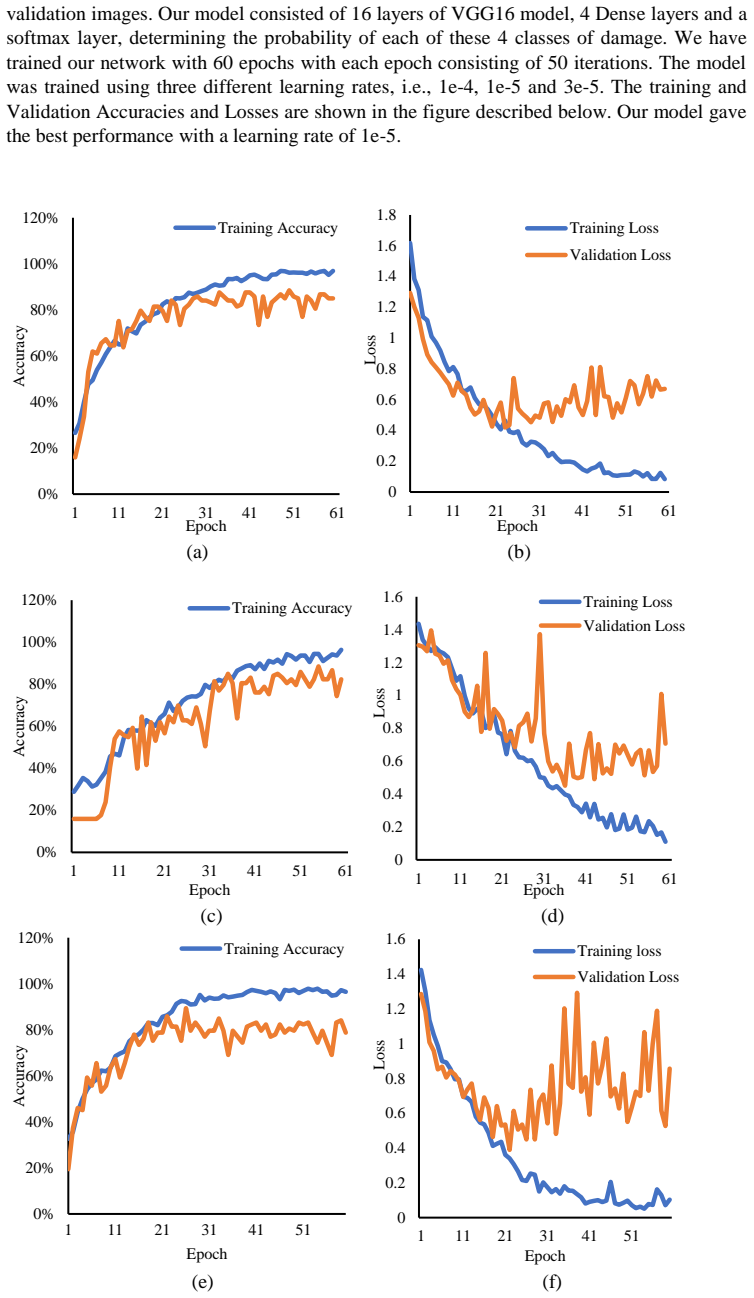
The VGG16 transfer learning model with a learning rate of 1e-5 gave a training accuracy of 97.85% and validation accuracy of up to 89.38% on a dataset of over 1200 images classified into four damage categories.
What carries the argument
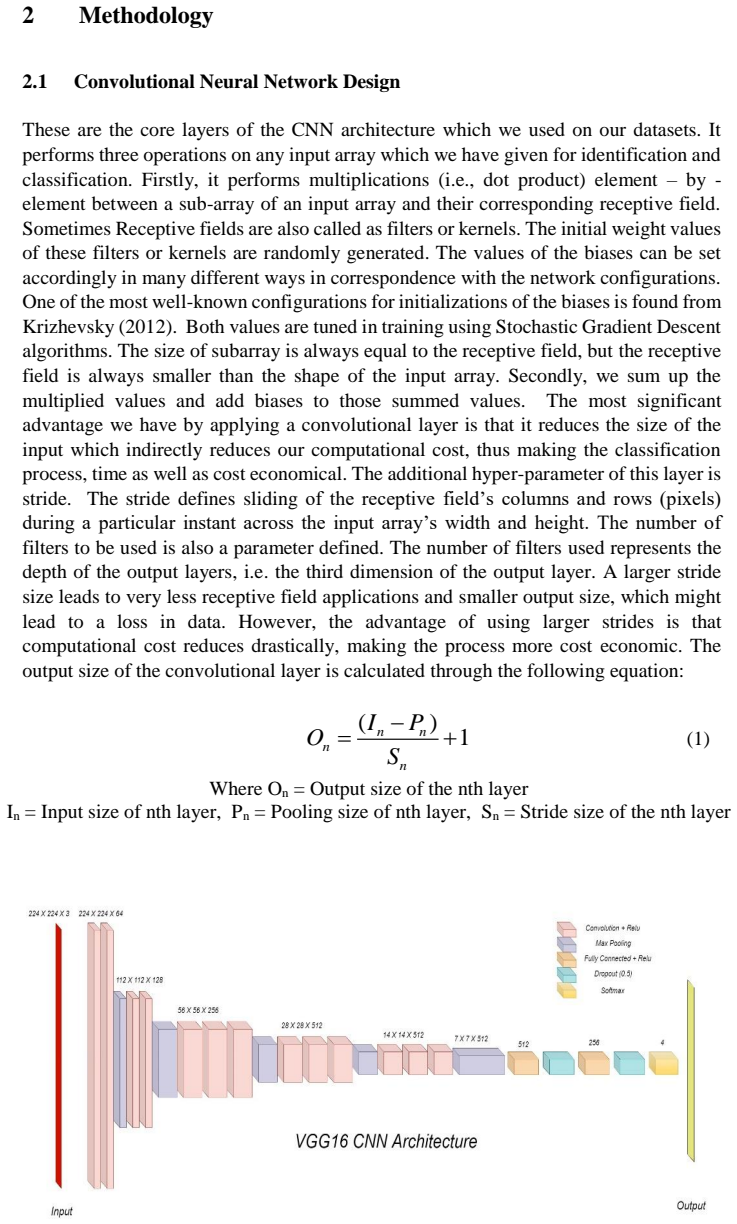
VGG16 transfer learning CNN for classifying building images into four categories of damage extent.
If this is right
- The model supports real-time application in the event of an earthquake for damage assessment.
- Automated classification reduces dependence on manual visual inspection for determining damage levels.
- Different algorithms and learning rates can be compared to identify the most suitable configuration for the task.
- The four-category output directly informs safety decisions and repair priorities after seismic events.
Where Pith is reading between the lines
- Pairing the model with drone or smartphone imagery could allow rapid surveys of inaccessible areas after a disaster.
- Retraining on images from additional building styles or lighting conditions would likely be needed before widespread deployment.
- Combining image-based predictions with structural sensor data could produce more reliable overall risk scores.
Load-bearing premise
The 1200 images and their four-category labels accurately represent the range of real post-earthquake conditions and were assigned without systematic bias.
What would settle it
Accuracy measured on a fresh collection of post-earthquake building images from an unseen event or region, collected and labeled independently of the original 1200-image set.
Figures
read the original abstract
Classification of the extent of damage suffered by a building in a seismic event is crucial from the safety perspective and repairing work. In this study, authors have proposed a CNN based autonomous damage detection model. Over 1200 images of different types of buildings-1000 for training and 200 for testing classified into 4 categories according to the extent of damage suffered. Categories are namely, no damage, minor damage, major damage, and collapse. Trained network tested by the application of various algorithms with different learning rates. The most optimum results were obtained on the application of VGG16 transfer learning model with a learning rate of 1e-5 as it gave a training accuracy of 97.85% and validation accuracy of up to 89.38%. The model developed has real-time application in the event of an earthquake.
Editorial analysis
A structured set of objections, weighed in public.
Referee Report
Summary. The paper proposes a CNN-based autonomous damage detection model for classifying post-earthquake building images into four categories (no damage, minor damage, major damage, collapse). A dataset of over 1200 images is split into 1000 for training and 200 for testing; the VGG16 transfer learning model with learning rate 1e-5 is reported to achieve 97.85% training accuracy and up to 89.38% validation accuracy, with claimed real-time applicability.
Significance. If supported by verifiable data protocols, the empirical result would demonstrate a practical application of transfer learning to post-disaster structural assessment in computer vision. The work applies a standard architecture to a relevant domain task but currently offers limited novelty beyond the reported numbers due to missing methodological details.
major comments (3)
- [Abstract] Abstract: the central performance claim (97.85% train / 89.38% validation accuracy) is presented without any description of image provenance, labeling protocol (e.g., by structural engineers or with inter-rater agreement metrics), class distribution, or whether the 1000/200 split was stratified.
- [Abstract] Abstract: no information is supplied on data augmentation timing (before or after split), handling of class imbalance, or comparison against baselines (other CNNs or non-DL methods), leaving the optimality of VGG16 at 1e-5 unsupported.
- [Abstract] Abstract: the claim of real-time application rests on the 89.38% validation figure, but without details on whether the test set represents multiple events or single-event conditions, generalization to real post-earthquake scenarios cannot be assessed.
minor comments (1)
- [Abstract] The abstract refers to testing 'various algorithms' but does not enumerate them or report their results.
Simulated Author's Rebuttal
We thank the referee for their thorough review and constructive comments. We address each of the major comments point-by-point below. We have made revisions to the manuscript to incorporate additional details where feasible.
read point-by-point responses
-
Referee: [Abstract] Abstract: the central performance claim (97.85% train / 89.38% validation accuracy) is presented without any description of image provenance, labeling protocol (e.g., by structural engineers or with inter-rater agreement metrics), class distribution, or whether the 1000/200 split was stratified.
Authors: We agree these details are essential. The revised manuscript includes an expanded description in the abstract and a new 'Dataset' section. Images were obtained from public post-earthquake image repositories. Labeling was conducted by the authors according to established damage classification standards. Class distribution is now reported, and the split was stratified by class. revision: yes
-
Referee: [Abstract] Abstract: no information is supplied on data augmentation timing (before or after split), handling of class imbalance, or comparison against baselines (other CNNs or non-DL methods), leaving the optimality of VGG16 at 1e-5 unsupported.
Authors: The original experiments involved testing various algorithms and learning rates, with VGG16 at 1e-5 performing best. We have revised the manuscript to specify that augmentation was applied post-split to the training set only, and that classes were sufficiently balanced. A comparison with additional models has been added to support the choice of VGG16. revision: partial
-
Referee: [Abstract] Abstract: the claim of real-time application rests on the 89.38% validation figure, but without details on whether the test set represents multiple events or single-event conditions, generalization to real post-earthquake scenarios cannot be assessed.
Authors: The images represent a range of building types from post-earthquake conditions. We have clarified in the revision that the model is intended for real-time use due to its computational efficiency, while noting the limitations in the discussion section. revision: partial
- Precise details on the number of distinct seismic events in the dataset, as event-specific metadata was not systematically recorded during image collection.
Circularity Check
No circularity: empirical accuracies on held-out split
full rationale
The paper reports training (97.85%) and validation (89.38%) accuracies obtained by running VGG16 transfer learning at LR=1e-5 on a 1000/200 split of 1200 labeled images. These numbers are direct empirical outputs of the training procedure; no equations, parameters, or self-citations reduce the reported figures to the inputs by construction. The derivation chain consists solely of standard supervised learning steps with no self-definitional, fitted-input-renamed-as-prediction, or uniqueness-imported patterns.
Axiom & Free-Parameter Ledger
free parameters (1)
- learning_rate =
1e-5
Reference graph
Works this paper leans on
-
[1]
Arnold, T., & Tilton, L. (2017). Automatic Building Damage Assessment Using Deep Learning and Ground -Level Image Data. Applied Sciences: School of Computing Science, 113 –129. Retrieved from http://link.springer.com.ezp- prod1.hul.harvard.edu/chapter/10.1007/978-3-319-20702-5_8
-
[2]
J., Choi, W., & Büyüköztürk, O
Cha, Y. J., Choi, W., & Büyüköztürk, O. (2017). Deep Learning-Based Crack Damage Detection Using Convolutional Neural Networks. Computer-Aided Civil and Infrastructure Engineering, 32(5), 361–378. https://doi.org/10.1111/mice.12263
-
[3]
J., Choi, W., Suh, G., Mahmoudkhani, S., & Büyüköztürk, O
Cha, Y. J., Choi, W., Suh, G., Mahmoudkhani, S., & Büyüköztürk, O. (2018). Autonomous Structural Visual Inspection Using Region -Based Deep Learning for Detecting Multiple Damage Types. Computer-Aided Civil and Infrastructure Engineering, 33(9), 731–747. https://doi.org/10.1111/mice.12334
-
[4]
Feng, C., Liu, M. -Y., Kao, C.-C., & Lee, T. -Y. (2017). Deep Active Learning for Civil Infrastructure Defect Detection and Cla ssification. Computing in Civil Engineering , 3, 298–306. https://doi.org/10.1061/9780784480823.036
-
[5]
Gao, Y., & Mosalam, K. M. (2018). Deep Transfer Learning for Image-Based Structural Damage Recognition. Computer-Aided Civil and Infrastructure Engineering, 33(9), 748–
work page 2018
-
[6]
https://doi.org/10.1111/mice.12363
-
[7]
Lin, Y. Z., Nie, Z. H., & Ma, H. W. (2017). Structural Damage Detection with Automatic Feature - Extraction through Deep Learning. Computer-Aided Civil and Infrastructure Engineering, 32(12), 1025–1046. https://doi.org/10.1111/mice.12313
-
[8]
Hashemi, H., & Abdelghany, K. (2018). End-to-End Deep Learning Methodology for Real -Time Traffic Network Management. Computer-Aided Civil and Infrastructure Engineering, 33(10), 849–
work page 2018
-
[9]
https://doi.org/10.1111/mice.12376
-
[10]
Nabian, M. A., & Meidani, H. (2018). Deep Learning for Accelerated Seismic Reliability Analysis of Transportation Networks. Computer-Aided Civil and Infrastructure Engineering , 33(6), 443–
work page 2018
-
[11]
https://doi.org/10.1111/mice.12359
-
[12]
Database on performance of low- rise reinforced concrete buildings in the 2015 Nepal earthquake
Yang, X., Li, H., Yu, Y., Luo, X., Huang, T., & Y ang, X. (2018). Automatic Pixel-Level Crack Detection and Measurement Using Fully Convolutional Network. Computer-Aided Civil and Infrastructure Engineering, 33(12), 1090–1109. https://doi.org/10.1111/mice.12412 10 . Zhang, A., Wang, K. C. P., Li, B., Yang, E., Dai, X., Peng, Y., … Chen, C. (2017). Automat...
-
[13]
Performance of reinforced concrete buildings in the 20 16 Taiwan (Meinong) earthquake
https://datacenterhub.org /resources/238 17 . NCREE (National Center for Research on Earthquake Engineering ) and Purdue University. 2016. “Performance of reinforced concrete buildings in the 20 16 Taiwan (Meinong) earthquake.” Accessed October 28, 2017. https://datacenterhub.org/resources/14098. 18 . Sim, C., E. Villalobos, J. P. Smith, P. Rojas, S. Pujo...
work page 2016
-
[14]
Performance of low -rise reinforced concrete buildings in the 2016 Ecuador earthquake
“Performance of low -rise reinforced concrete buildings in the 2016 Ecuador earthquake.” Accessed October 28, 2017. https:// datacenterhub.org/resources/14160. 19 . Sim, C., C. Song, N. Skok, A. Irfanoglu, S. Pujol, and M. Sozen. 2015. “Database of low- rise reinforced concrete buildings with earthquake damage.” Accessed October 28, 2017. .https://datacen...
discussion (0)
Sign in with ORCID, Apple, or X to comment. Anyone can read and Pith papers without signing in.