Robust applicability of continuous dynamical decoupling to decoherence reduction in longitudinal and transverse-noise settings: The role of anisotropy
Pith reviewed 2026-06-27 19:44 UTC · model grok-4.3
The pith
Continuous dynamical decoupling curbs decoherence from both longitudinal and transverse noise when control parameters reshape the effective noise spectrum.
A machine-rendered reading of the paper's core claim, the machinery that carries it, and where it could break.
Core claim
By applying a sequence of unitary transformations, the noise in the qubit system is recast into effective stochastic terms whose spectral properties depend on the parameters of the continuous driving field. This mapping permits the design of control strategies that mitigate decoherence by adjusting the effective noise characteristics. The method demonstrates that CDD remains effective against transverse noise and anisotropy in addition to longitudinal dephasing, including effects from fluctuations during the dressing of the qubit states via Landau-Zener transitions.
What carries the argument
The sequence of unitary transformations that converts the original noise into driving-parameter-dependent effective stochastic terms.
If this is right
- Decoherence reduction strategies can be designed by making controlled changes in the properties of the effective noise.
- CDD applies to generic qubit setups that contain both longitudinal and transverse noise sources.
- Significant robustness against the inclusion of transverse fluctuations and anisotropy is obtained through suitable choice of driving parameters.
- Fluctuations that occur while the driving field dresses the qubit states can be treated inside the same effective-noise description.
Where Pith is reading between the lines
- Device calibration could include direct characterization of noise anisotropy to select optimal drive parameters.
- The approach suggests that ramp times and amplitudes in real hardware can be tuned to suppress decoherence beyond what longitudinal-only models predict.
- Multi-qubit extensions might use similar unitary mappings to handle cross-talk noise whose spectrum is also reshaped by shared control fields.
Load-bearing premise
The noise can be represented as effective stochastic terms after a series of unitary transformations whose properties depend on the driving parameters.
What would settle it
A measurement of the qubit coherence time versus driving amplitude or ramp duration that shows no improvement for the parameter values predicted to optimize the effective noise spectrum would falsify the robustness claim.
Figures



read the original abstract
We analytically evaluate the efficiency of continuous dynamical decoupling (CDD) to curb decoherence in generic qubit setups where diverse sources of noise can be present. Previous theoretical approaches to CDD have mainly focused on its potential to cope with longitudinal fluctuations. Here, the basic scenario tackled with CDD is generalized. Apart from dealing with pure dephasing induced by diagonal noise, we consider the impact of transverse fluctuations, usually present in the practical arrangements. In particular, the implications of anisotropic noisy inputs are studied. Additionally, we analyze the role of the fluctuations in the dressing of the qubit by the CDD field of control: since the driving field is usually switched on through linear ramps of its characteristic parameters, the associated dressing of the original states can be described in terms of noisy Landau-Zener transitions. In our approach, based on a sequence of unitary transformations, the noise entering the system is cast into effective stochastic terms whose spectral characteristics are dependent on the driving parameters. This description allows the design of strategies to mitigate the impact of the fluctuations using controlled changes in the effective-noise properties. Significant robustness of CDD against the generalization of the basic scenario can be achieved through an appropriate choice of the parameters of control.
Editorial analysis
A structured set of objections, weighed in public.
Referee Report
Summary. The paper analytically evaluates the efficiency of continuous dynamical decoupling (CDD) to curb decoherence in generic qubit setups with longitudinal, transverse, and anisotropic noise, plus ramp-induced Landau-Zener dressing. It generalizes prior CDD work (focused on pure dephasing) by using a sequence of unitary transformations to recast the input noise into effective stochastic terms whose spectral properties depend on the driving parameters, thereby enabling mitigation strategies that achieve significant robustness via appropriate control-parameter choice.
Significance. If the unitary mapping is complete, the work extends CDD applicability to realistic multi-axis noise scenarios common in experiments and supplies a parameter-tuning design principle for decoherence suppression. The analytic framing could directly inform control protocols, provided the effective-model predictions are validated.
major comments (2)
- [Abstract / approach description] Abstract and approach paragraph on unitary transformations: the central claim that noise is recast into effective stochastic terms with tunable spectra rests on the completeness of the transformation sequence; non-commuting transverse/anisotropic components plus ramp dressing may generate surviving cross terms or higher-order commutators that are not eliminated, undermining the predicted robustness.
- [Generalized scenario / effective spectra] Section describing the generalized scenario and effective-noise spectra: no explicit derivation, error bounds, or comparison to full numerical integration of the original Hamiltonian is referenced, so it is unclear whether the effective model preserves all relevant dynamics for anisotropic inputs.
minor comments (1)
- The abstract states an analytic approach but does not mention any numerical validation or parameter ranges; adding a brief statement on the domain of validity would improve clarity.
Simulated Author's Rebuttal
We thank the referee for the careful reading and constructive feedback on our manuscript. The comments highlight important aspects of rigor in the unitary transformation approach and validation of the effective model. We address each point below and will incorporate revisions to strengthen the presentation.
read point-by-point responses
-
Referee: [Abstract / approach description] Abstract and approach paragraph on unitary transformations: the central claim that noise is recast into effective stochastic terms with tunable spectra rests on the completeness of the transformation sequence; non-commuting transverse/anisotropic components plus ramp dressing may generate surviving cross terms or higher-order commutators that are not eliminated, undermining the predicted robustness.
Authors: We agree that demonstrating the completeness of the transformation sequence is essential, particularly for non-commuting transverse and anisotropic noise components together with ramp-induced Landau-Zener effects. The manuscript constructs the sequence to eliminate leading noise terms and modulate the remainder via driving parameters, but we acknowledge that explicit verification of vanishing cross terms and higher-order commutators would benefit from additional detail. We will add an appendix providing the full step-by-step transformation, commutation relations, and suppression arguments to order relevant for the effective spectra. revision: yes
-
Referee: [Generalized scenario / effective spectra] Section describing the generalized scenario and effective-noise spectra: no explicit derivation, error bounds, or comparison to full numerical integration of the original Hamiltonian is referenced, so it is unclear whether the effective model preserves all relevant dynamics for anisotropic inputs.
Authors: The referee correctly notes the absence of explicit derivation details, error bounds, and numerical benchmarks in the current version. While the effective spectra follow directly from the unitary mappings, we will revise the manuscript to include the complete analytic derivation of the effective noise operators, quantitative error estimates for the approximation, and direct comparisons against numerical integration of the original time-dependent Hamiltonian for representative anisotropic noise strengths and ramp profiles. This will confirm preservation of the relevant dynamics. revision: yes
Circularity Check
No circularity: derivation uses standard unitary mapping to effective noise without self-referential reduction
full rationale
The paper's central approach is a sequence of unitary transformations that recast input noise (longitudinal, transverse, anisotropic, plus Landau-Zener effects) into parameter-dependent effective stochastic terms. This is a conventional technique in open quantum systems and dynamical decoupling literature; the abstract and described method do not define any quantity in terms of itself, fit parameters to a target and then relabel the fit as a prediction, or rely on load-bearing self-citations whose validity is internal to the present work. The robustness claim follows from the tunable spectra of the effective noise under control-parameter variation, which remains an independent calculation once the transformation sequence is accepted. No equations or steps in the provided text reduce the output to the input by construction.
Axiom & Free-Parameter Ledger
Reference graph
Works this paper leans on
-
[1]
[23] and [55], it is shown that, for t ≫ τc, the evolution of the coherences is given by ⟨ρm,m ′(t)⟩ ∝ e− (m− m′)2πS (χ a; ω =0)t
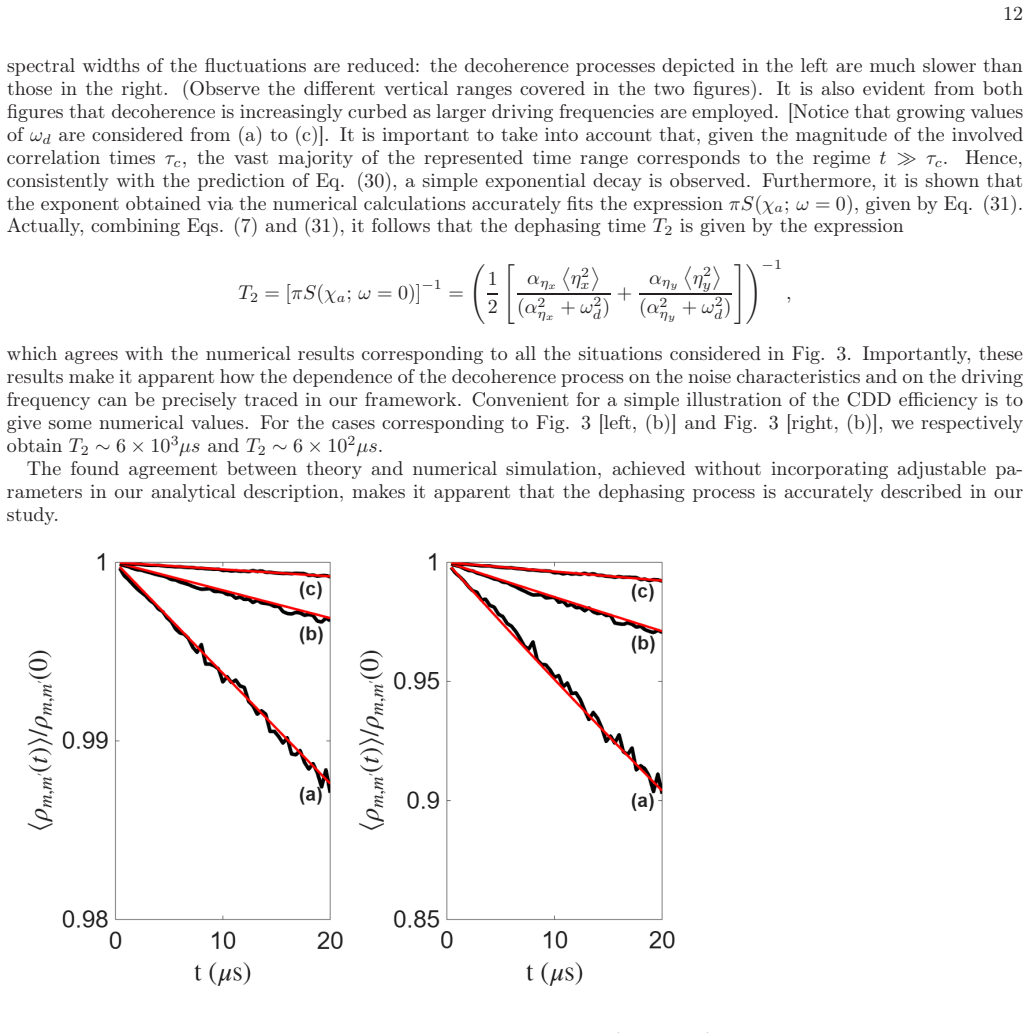
The limit of short correlation time Following Refs. [23] and [55], it is shown that, for t ≫ τc, the evolution of the coherences is given by ⟨ρm,m ′(t)⟩ ∝ e− (m− m′)2πS (χ a; ω =0)t. (30) Hence, this regime corresponds to exponential decay, the ra te being determined by the spectral density of χ a(t) at zero frequency, S(χ a;ω = 0). Note that these result...
-
[2]
Combining Eqs
The static-noise limit The term static noise refers to fluctuations with no time depe ndence: they take a fixed value in each particular realization, that value being randomly distributed for the different runs. Combining Eqs. (12) and (28), the stochastic variableζa(t) can be written in the static limit as ζa(t) = ∫ t 0 [ηx cos(ω dt′) +ηy sin(ω dt′)]dt′ (32...
-
[3]
The limit of short correlation time Following the procedure introduced in Ref. [23], one obtain s that, for t ≫ τc, the transfer probability averaged over noise realizations can be approximated as (see Appendix B) ⟨Pm,m ′(t)⟩ = 2 πt [ F (x) m,m ′S(δω 0; ˜Ω d) + F (y) m,m ′S(χ b; ˜Ω d) ] . (36) where ˜Ω d denotes the effective frequency corresponding to the...
-
[4]
The static-noise limit In the case of fluctuations with no time dependence, Eq. (34) i s developed to obtain ⟨Pm,m ′(t)⟩ = F (x) m,m ′ ⟨ δω 2 0 ⟩ sin2( ˜Ω dt 2 ) ( ˜Ω d/ 2)2 + 11 F (y) m,m ′ (⟨ η2 x ⟩ + ⟨ η2 y ⟩) [ sin2( Ω +t 2 ) Ω 2 + + sin2( Ω − t 2 ) Ω 2 − ] + (38) F (y) m,m ′ ( − ⟨ η2 x ⟩ + ⟨ η2 y ⟩) [ cos2(ω dt) + cos( ˜Ω dt) cos(ω dt) Ω +Ω − ] where ...
-
[5]
Preskill, Quantum Computing in the NISQ era and beyond , Quantum 2, 79 (2018)
J. Preskill, Quantum Computing in the NISQ era and beyond , Quantum 2, 79 (2018)
2018
-
[6]
C. L. Degen, F. Reinhard, and P. Cappellaro, Quantum sens ing, Rev. Mod. Phys. 89, 035002 (2017)
2017
-
[7]
Acín et al , The quantum technologies roadmap: a European community vi ew, New J
]A. Acín et al , The quantum technologies roadmap: a European community vi ew, New J. Phys. 20, 080201 (2018)
2018
-
[8]
Morong, K.S
W. Morong, K.S. Collins, A. De, E. Stavropoulos, T. You, a nd C. Monroe, Engineering Dynamically Decoupled Quantum Simulations with Trapped Ions, PRX Quantum 4, 010334 (2023)
2023
-
[9]
Suter and G
D. Suter and G. A. Álvarez, Colloquium: Protecting quant um information against environmental noise, Rev. Mod. Phys . 88, 041001 (2016)
2016
-
[10]
Baumgart, J.M
I. Baumgart, J.M. Cai, A. Retzker, M.B. Plenio, and Ch. Wu nderlich, Ultrasensitive Magnetometer using a Single Atom , Phys. Rev. Lett. 116, 240801 (2016)
2016
-
[11]
Giovannetti, S
V. Giovannetti, S. Lloyd, and L. Maccone , Advances in quantum metrology, Nature Photonics 5, 222 (2011)
2011
-
[12]
Y.-J. Lin, K. Jiménez-García, and I. B. Spielman, Spin-o rbit-coupled Bose-Einstein condensates, Nature 471, 83-86 (2011)
2011
-
[13]
Sugawa, F
S. Sugawa, F. Salces-Carcoba, A. R. Perry, Y. Yue, and I. B . Spielman, Second Chern number of a quantum-simulated non-Abelian Yang monopole, Science 360, 1429–1434 (2018)
2018
-
[14]
Bloch, Quantum coherence and entanglement with ultr acold atoms in optical lattices, Nature, 453, 1016 (2008)
I. Bloch, Quantum coherence and entanglement with ultr acold atoms in optical lattices, Nature, 453, 1016 (2008)
2008
-
[15]
Farolfi, D
] A. Farolfi, D. Trypogeorgos, G. Colzi, E. Fava, G. Lampo resi, and G. Ferrari, Design and characterization of a compa ct magnetic shield for ultracold atomic gas experiments, Rev. Sci. Instrum. 90, 115114 (2019)
2019
-
[16]
E. L. Hahn, Spin Echoes, Phys. Rev. 80, 580–94 (1950)
1950
-
[17]
Viola and S
L. Viola and S. Lloyd, Dynamical suppression of decoher ence in two-state quantum systems, Phys. Rev. A 58, 2733 (1998)
1998
-
[18]
Viola and E
L. Viola and E. Knill, Robust Dynamical Decoupling of Qu antum Systems with Bounded Controls, Phys. Rev. Lett. 90, 037901 (2003)
2003
-
[19]
G. S. Uhrig, Keeping a Quantum Bit Alive by Optimized π -Pulse Sequences, Phys. Rev. Lett. 98, 100504 (2007)
2007
-
[20]
G. A. Álvarez, A. Ajoy, X. Peng, and D. Suter, Performanc e comparison of dynamical decoupling sequences for a qubit i n a rapidly fluctuating spin bath, Phys. Rev. A 82, 042306 (2010)
2010
-
[21]
M. J. Biercuk, H. Uys, A. P. VanDevender, N. Shiga, W. M. I tano, and J. J. Bollinger, Optimized dynamical decoupling in a model quantum memory, Nature 458, 996 (2009)
2009
-
[22]
Khodjasteh, D
K. Khodjasteh, D. A. Lidar, Fault-Tolerant Quantum Dyn amical Decoupling, Phys. Rev. Lett. 95, 180501 (2005)
2005
-
[23]
F. F. Fanchini, J. E. M. Hornos, and R. d. J. Napolitano, C ontinuously decoupling single-qubit operations from a per turbing thermal bath of scalar bosons, Phys. Rev. A 75, 022329 (2007). 21
2007
-
[24]
J. M. Cai, B. Naydenov, R. Pfeiffer, L. P. McGuinness, K. D . Jahnke, F. Jelezko, M. B. Plenio, A. Retzker, Robust dynamical decoupling with concatenated continuous drivin g, New J. Phys. 14, 113023 (2012)
2012
-
[25]
K. C. Miao, J. P. Blanton, C. P. Anderson, A. Bourassa, A. L. Crook, G. Wolfowicz, H. Abe, T. Ohshima, and D. D. Awschalom, Universal coherence protection in a solid-stat e spin qubit, Science 369, 1493 (2020)
2020
-
[26]
Timoney, I
N. Timoney, I. Baumgart, M. Johanning, A. Varon, M. B. Pl enio, A. Retzker, and Ch. Wunderlich, Quantum gates and memory using microwave-dressed states, Nature 476, 185 (2011)
2011
-
[27]
Gomez Llorente, I
J.M. Gomez Llorente, I. Gomez-Ojeda, and J. Plata, Deco herence reduction via continuous dynamical decoupling: An a- lytical study of the role of the noise spectrum, Phys. Rev. A 108, 052412 (2023)
2023
-
[28]
Yu-bing Yao, Xiang-Fa Zhou, Zheng-Wei Zhou, and Xing-X iang Zhou, Continuous dynamical decoupling in non-Hermiti an two-level systems, Phys. Rev. A 111, 052622 (2025)
2025
-
[29]
Louzon, G.T
D. Louzon, G.T. Genov, N. Staudenmaier, F. Frank, J. Lan g, M.L. Markham, A. Retzker, and F. Jelezko, Robust Noise Suppression and Quantum Sensing by Continuous Phased Dynam ical Decoupling, Phys. Rev. Lett. 134, 120802 (2025)
2025
-
[30]
Farfurnik, N
D. Farfurnik, N. Aharon, I. Cohen, Y. Hovav, A. Retzker, and N. Bar-Gill, Experimental realization of time-depende nt phase-modulated continuous dynamical decoupling, Phys. R ev. A 96, 013850 (2017)
2017
-
[31]
Akerman and R
N. Akerman and R. Ozeri, Operating a Multi-Ion Clock wit h Dynamical Decoupling, Phys. Rev. Lett. 134, 013201 (2025)
2025
-
[32]
G. T. Genov, N. Aharon, F. Jelezko, and A. Retzker, Mixed dynamical decoupling, Quantum Sci. Technol. 4, 035010 (2019)
2019
-
[33]
Costa Morazotti, A.H
N.A. Costa Morazotti, A.H. Silva, G. Audi, F. Fernandes Fanchini, R.J. Napolitano, Optimized continuous dynamica l decoupling via differential geometry and machine learning, Phys. Rev. A 110, 042601 (2024)
2024
-
[34]
Miao Cai and Keyu Xia, Optimizing continuous dynamical decoupling with machine learning, Phys. Rev. A 106, 042434 (2022)
2022
-
[35]
Salhov, Q
] A. Salhov, Q. Cao, J. Cai, A. Retzker, F. Jelezko, and G. Genov, Protecting Quantum Information via Destructive Interference of Correlated Noise, Phys. Rev. Lett. 132, 223601 (2024)
2024
-
[36]
Pelzer et al , Multi-ion Frequency Reference Using Dynamical Decouplin g, Phys
L. Pelzer et al , Multi-ion Frequency Reference Using Dynamical Decouplin g, Phys. Rev. Lett. 133, 033203 (2024)
2024
-
[37]
Bermudez, P
A. Bermudez, P. O. Schmidt, M. B. Plenio, and A. Retzker, Robust trapped-ion quantum logic gates by continuous dynamical decoupling, Phys. Rev. A 85, 040302(R) (2012)
2012
-
[38]
V. J. Martínez-Lahuerta et al , Quadrupole transitions and quantum gates protected by con tinuous dynamic decoupling, Quantum Sci. Technol. 9, 015013 (2024)
2024
-
[39]
Andrew Golter, Thomas K
D. Andrew Golter, Thomas K. Baldwin, and Hailin Wang, Pr otecting a Solid-State Spin from Decoherence Using Dressed Spin States, Phys. Rev. Lett. 113, 237601 (2014)
2014
-
[40]
M. Senatore et al , Fast single-qubit gates for continuous dynamically decou pled systems, arXiv preprint arXiv:2412.11821 (2024)
arXiv 2024
-
[41]
X. Xu, Z. Wang, C. Duan, P. Huang, P. Wang, Y. Wang, N. Xu, X . Kong, F. Shi, X. Rong, and J. Du, Coherence-Protected Quantum Gate by Continuous Dynamical Decoupling in Diamond , Phys. Rev. Lett. 109, 070502 (2012)
2012
-
[42]
Trypogeorgos, A
D. Trypogeorgos, A. Valdés-Curiel, N. Lundblad, and I. B. Spielman, Synthetic clock transitions via continuous dy namical decoupling, Phys. Rev. A 97, 013407 (2018)
2018
-
[43]
Stark, N
A. Stark, N. Aharon, A. Huck, H.A.R. El-Ella, A. Retzker , F. Jelezko, and U.L. Andersen, Clock transition by continu ous dynamical decoupling of a three-level system, Sci Rep 8, 14807 (2018)
2018
-
[44]
C. J. Patrickson, V. Haemmerli, S. Guo, A. J. Ramsay, and I. J. Luxmoore, Microwave quantum heterodyne sensing using a continuous concatenated dynamical decoupling protocol, Nat Comm. 16, 4380 (2025)
2025
-
[45]
YY Xie, ZM Wang, LA Wu, Noise-resilient Universal Quant um Computing in the Presence of Anisotropic Noise, arXiv preprint arXiv:2508.04892 (2025)
arXiv 2025
-
[46]
Bosco, J
S. Bosco, J. Zou, and D. Loss, High-Fidelity Spin Qubit S huttling via Large Spin-Orbit Interactions, PRX 5,020353 (2024)
2024
-
[47]
Chen, Effects of symmetry breaking of the structur ally-disordered Hamiltonian ensembles on the anisotropic deco- herence of qubits, Sci
H.-B. Chen, Effects of symmetry breaking of the structur ally-disordered Hamiltonian ensembles on the anisotropic deco- herence of qubits, Sci. Rep. 12, 2869 (2022)
2022
-
[48]
Choi and R
Y. Choi and R. Joynt, Anisotropy with respect to the appl ied magnetic field of spin qubit decoherence times, npj Quant um Inf. 8, 70 (2022)
2022
-
[49]
Hajati, I
Y. Hajati, I. Heinz, and G. Burkard, Crosstalk analysis in single hole-spin qubits within highly anisotropic g-tensors, Phys. Rev. Res., 7, 023277 (2025)
2025
-
[50]
Hendrickx, L
N.W. Hendrickx, L. Massai, M. Mergenthaler, F. Schupp, S. Paredes, S.W. Bedell, G Salis, and A. Fuhrer, Sweet-spot operation of a germanium hole spin qubit with highly anisotr opic noise sensitivity, Nature Materials, 23, 920–927 (2024)
2024
-
[51]
Saez-Mollejo, D
J. Saez-Mollejo, D. Jirovec, Y. Schell, J. Kukucka, S. C alcaterra, D. Chrastina, G. Isella, M. Rimbach-Russ, S. Bos co, and G. Katsaros, Exchange anisotropies in microwave-driven si nglet-triplet qubits, Nature Communications, 16, 3862 (2025)
2025
-
[52]
D. A. Rower et al , Qubit-state purity oscillations from anisotropic transv erse noise, Phys. Rev. A 111, 032420 (2025)
2025
-
[53]
L. D. Landau, On the Theory of Transfer of Energy at Colli sions II, Phys. Z. Sowjetunion 2, 46 (1932)
1932
-
[54]
Zener, Non-Adiabatic Crossing of Energy Levels, Pro c
C. Zener, Non-Adiabatic Crossing of Energy Levels, Pro c. R. Soc. A 137, 696 (1932)
1932
-
[55]
Brouard and J
S. Brouard and J. Plata, Dissociation of ultracold mole cules via Feshbach resonances: The effect of magnetic-field fl uctu- ations, Phys. Rev. A 72, 023620 (2005)
2005
-
[56]
Gardiner
C.W. Gardiner. Handbook of Stochastic Methods. (Springer-Verlag, Berlin, 1985)
1985
-
[57]
Stratonovich
R.L. Stratonovich. Topics in the Theory of Random Noise. (Gordon and Breach, New York, 1963)
1963
-
[58]
Brouard and J
S. Brouard and J. Plata, Internal-state dephasing of tr apped ions, Phys. Rev. A 68, 012311 (2003)
2003
-
[59]
Paladino, Y
E. Paladino, Y. M. Galperin, G. Falci, and B. L. Altshule r, 1/f noise: Implications for solid-state quantum information, Rev. Mod. Phys. 86, 361 (2014)
2014
-
[60]
I. S. Gradshteyn and I. M. Ryshik, Table of Integrals, Series, and Products (Academic Press, New York, 1994). 22
1994
-
[61]
Y. Sung, F. Beaudoin, L. M. Norris, F. Yan, D. K. Kim, J. Y. Qiu, U. von Lüpke, J. L. Yoder, T. P. Orlando, L. Viola, S. Gustavsson, and W. D. Oliver, Non-Gaussian noise s pectroscopy with a superconducting qubit sensor, Nature Communications 10, 3715 (2019)
2019
-
[62]
Rogora, R
C. Rogora, R. Cominotti, C. Baroni, D. Andreoni, G. Lamp oresi, A. Zenesini, and G. Ferrari, Progress toward a zero- magnetic-field environment for ultracold-atom experiment s, Phys. Rev. A 110, 013319 (2024)
2024
-
[63]
C E Carroll and F T Hioe, Transition probabilities for th e three-level Landau-Zener model, J. Phys. A: Math. Gen. 19 2061 (1986)
2061
-
[64]
Y. B. Band and Y. A vishai, Three-level Landau-Zener dyn amics, Phys. Rev. A 99, 032112 (2019)
2019
-
[65]
Gomez Llorente and J
J.M. Gomez Llorente and J. Plata, Acceleration of spin- orbit coupled Bose-Einstein condensates: analytical desc ription of the emergence of Landau-Zener transitions, Phys. Rev. A 94, 053605 (2016)
2016
-
[66]
S. N. Shevchenko, S. Ashhab, and F. Nori, Landau-Zener- Stuckelberg interferometry, Phys. Rep. 492, 1 (2010)
2010
-
[67]
D. T. Gillespie, Exact numerical simulation of the Orns tein-Uhlenbeck process and its integral, Physical Review E 54, 2084 (1996)
2084
-
[68]
https://doi.org/10.5281/zenodo.17602005
discussion (0)
Sign in with ORCID, Apple, or X to comment. Anyone can read and Pith papers without signing in.