REVIEW 5 major objections 6 minor 50 references
Multi-Modality Transformer for E-Commerce: Inferring User Purchase Intention to Bridge the Query-Product Gap
T0 review · 5 major / 6 minor · reviewed 2026-08-10 · deepseek-v4-flash
Pith's one-line read This paper claims that sparse e-commerce queries can be transformed into pseudo-product embeddings, conditioned on crowd-level purchase-intention vectors and granular text and image product features, and that this transformation beats…
desk verdict A promising new combination of purchase-intent centroids and a pseudo-product decoder, but the training objective is under-specified in ways that block reproduction and the evaluation doesn't yet support the full superiority claim. read the letter →
The pith
A machine-rendered reading of the paper's core claim, the machinery that carries it, and where it could break.
The reading
What carries the argument
The load-bearing object is the purchase-intention vector set $S=\{s_1,\ldots,s_K\}$, a fixed number of learnable centroids in the shared query-product latent space. A reward-based competitive learning rule, adapted from Likas's reinforcement-learning clustering, assigns each query and its add-to-cart product to the nearest intent vector by Euclidean distance, rewards the pair when both choose the same centroid, and moves the centroid toward the pair; the selection probability in Equation (6) acts as a learning-rate modulator. The intention vector then becomes the conditioning signal for the stage-2 transformer decoder, which also cross-attends to query-aligned product text and image features retrieved from a faiss index, and is trained with a preference modeling loss that pulls the pseudo embedding toward the target product while a KL term preserves stage-1 recall.
What would settle it
Replace the hard argmin intent selection with a soft assignment (for instance, a Gumbel-softmax over intent distances) and retrain PINCER under identical settings; if SumR collapses or the intention centroids fail to move from initialization, the non-differentiable competitive update is doing essential work, not the transformer conditioning alone.
Extended reading notes
Core claim
PINCER's core claim is that sparse user queries can be transformed into pseudo-product embeddings that lie closer to the products users actually add to cart, by injecting two external signals: purchase intentions, defined as shared latent vectors that quantize query-ATC pairs through reward-based competitive learning, and query-aligned granular product text and image features stored in a vector database. Stage 1 trains the query and product encoders with a CLIP-style contrastive loss plus a reward-based competitive learning term that pushes each query and its ATC product to select the same intention vector. Stage 2 freezes those encoders and trains a causal transformer decoder, conditioned on the query, its nearest intention vector, and retrieved product features, to generate a pseudo-product embedding that is optimized by preference modeling against the true target product. The paper argues this two-stage design is what lets the model beat text-only and multi-modal baselines on both real-world and synthetic e-commerce retrieval.
Load-bearing premise
The whole pipeline relies on the hard nearest-intent selection in Equation (4) still providing reliable training gradients, and the paper does not describe how gradients flow through that non-differentiable step; if implemented naively, the intention centroids may never converge and the decoder's conditioning signal would be meaningless.
Editorial extensions
If this is right
- Queries can be retrieved as pseudo-products: at inference, the decoder produces an embedding compared to catalog product embeddings by cosine similarity, so no query reformulation or pseudo-relevance feedback loop is needed.
- Early-page recall is where the gain concentrates: PINCER improves Recall@10 and Recall@20 far more than Recall@100 on real-world data, which matters because users mostly buy from the first page.
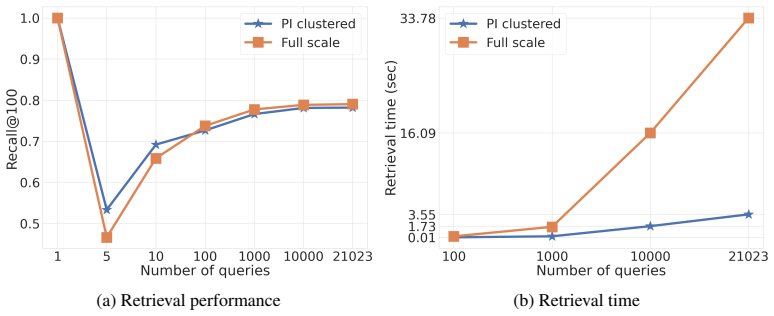
- Purchase intention vectors double as cluster centers: the same vectors used for conditioning pre-cluster the product catalog, cutting retrieval latency to 15ms per 1000 queries at a small recall cost.
- The method works with light encoders: PINCER's gains appear with distilBERT and ResNet-50, not just large pre-trained models, so it can run on modest GPU resources.
Reading between the lines
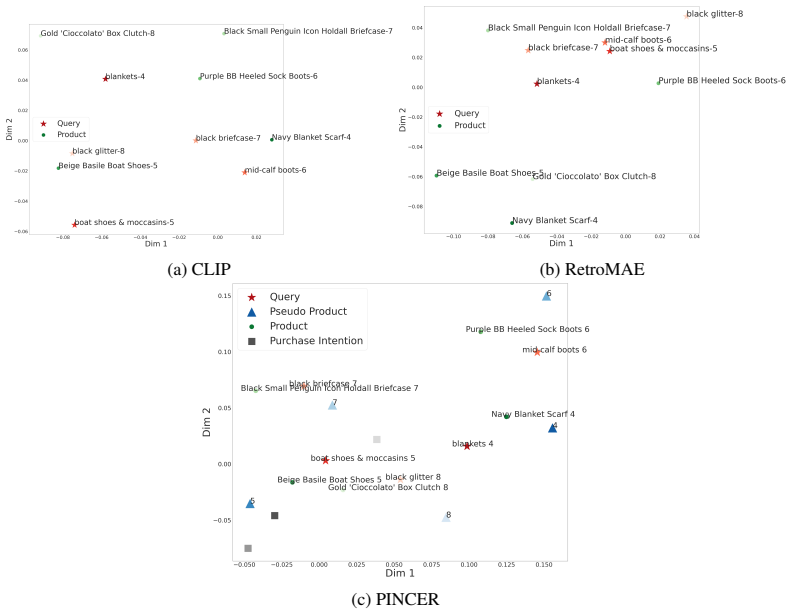
- If intention-vector conditioning is doing the work, the learned centroids should be interpretable as purchasing contexts (e.g., 'burning-incense gift' vs 'best-sellers incenses'), and the same vectors could explain recommendations or power diversified result sets, which the paper only hints at in its qualitative t-SNE plots.
- The formulation suggests a testable extension beyond e-commerce: any paired sparse-to-dense retrieval task where the two sides share latent intents could adopt the same two-stage pseudo-target generation.
- Because intention vectors are shared across users rather than per-user, PINCER sidesteps the cold-start problem of personalized search, but it also cannot adapt to a user whose intent is rare; a per-user refinement of the pseudo-embedding is a natural next step the paper leaves open.
- The paper does not examine sensitivity to K, the number of intention vectors; a controlled sweep of K on the real-world dataset would reveal whether the performance gain is robust or tuned to a particular quantization granularity.
Editorial analysis
A structured set of objections, weighed in public.
Referee Report
Summary. The paper proposes PINCER, a two-stage multi-modal transformer for e-commerce product retrieval. In Stage 1, contrastive learning aligns query and product text/image embeddings, while a reward-based competitive learning scheme with vector quantization estimates a set of purchase-intention vectors shared by queries and add-to-cart (ATC) products. In Stage 2, a transformer decoder conditioned on the query embedding, the selected purchase-intention vector, and retrieved granular product features generates a pseudo-product embedding; the decoder is trained with a preference-modeling loss and a KL term intended to preserve Stage 1 recall. The authors report experiments on a proprietary real-world home-decor click-stream dataset and on synthetic datasets derived from Amazon Cross-Market and FashionGen, comparing with RetroMAE, CLIP, and FashionCLIP. They claim consistent recall improvements, including a 10.81% relative SumR gain over RetroMAE on real data, and an ablation study on one synthetic dataset attributes the gains to combining purchase intention and product features.
Significance. If validated, the idea of transforming sparse queries into pseudo-product representations using crowd-derived purchase-intention vectors is a useful contribution to e-commerce retrieval, and the two-stage architecture with vector quantization is a plausible mechanism. The paper makes several strengths explicit: the synthetic datasets are released on OSF, the real-world evaluation uses authentic ATC transaction data, and the comparison includes a text-only strong baseline (RetroMAE). However, the mathematical formulation of both training stages has unresolved issues, the experimental protocol is underpowered (only three baselines, no error bars, no repeated runs, no public code), and the reported statistical significance test appears impossible with the stated sample size. These problems currently prevent the central claims from being accepted as established.
major comments (5)
- [§3.2, Eq. (3)–(7)] The reward-based competitive learning loss does not implement the stated negative reward for mismatched query/product intent assignments. For the first term of RCL in Eq. (3), the coefficient of ||xn - skx||^2 is rsk * rpxn,skx. When skx ≠ sky, Eq. (5) gives rsk = -1 and Eq. (7) gives rpxn,skx = -p, so the product is +p > 0. Thus the loss still attracts x to its selected intent vector even for mismatched pairs; there is no repulsive force that separates query and product intent choices. Only the weighting changes. Please correct the sign convention in Eq. (7) or Eq. (3), or state explicitly how the negative reward is realized.
- [§3.3, Eqs. (8)–(10)] The Stage 2 objective is not well defined. Eq. (10) defines SD@n,yn as the scalar log-softmax value for the positive pair, i.e., log(exp(@n·yn) / Σ_b exp(@n·yb)). Eq. (8) then takes a KL divergence between two such scalars, which is undefined; KL divergence requires probability distributions. If SD is intended to denote a vector of log-softmax values, the formula in Eq. (10) does not say so. In addition, Eq. (9) has no normalization term, so minimizing PML is equivalent to maximizing an unbounded difference of cosine similarities and is not a proper preference-modeling loss. Please specify the exact distributions and loss terms.
- [§3.2 and Algorithm 1, Eq. (4)] The gradient flow through the hard argmin assignment is not specified. In Algorithm 1 line 12, all encoders, projectors, and the intent vectors S are updated using Lstage1, but Lstage1 includes the argmin-selected indices from Eq. (4). The loss in Eq. (3) is differentiable with respect to the selected intent vector, so a detached-assignment / k-means-style update can work, but the paper never states whether assignments are detached, whether a straight-through estimator is used, or whether a soft relaxation is applied. These choices lead to very different training dynamics. The paper also does not report K (the number of intent vectors), the initialization of S, or how empty/dead intent vectors are handled, all of which are necessary for reproducibility.
- [§4.5, Wilcoxon test] The claimed Wilcoxon signed-rank test result is impossible with the reported data. The test is run on four synthetic dataset configurations (FashionGen with brightness, FashionGen with mean gradient, Amazon with brightness, Amazon with mean gradient), i.e., n = 4. For a two-sided exact Wilcoxon signed-rank test with n = 4, the minimum attainable p-value is 0.125 (0.0625 one-sided), so p = 0.043114 cannot occur. The statement that PINCER shows statistically significant gains at the 90% confidence level is therefore unsupported. Please provide the exact test statistic, a corrected exact test, or additional independent comparisons.
- [§4.1–§4.5] The experimental validation is underpowered for the paper's headline claim. Only three baselines are compared (RetroMAE, CLIP, FashionCLIP); modern e-commerce multi-modal baselines such as CommerceMM, e-CLIP, or EI-CLIP are not included, and the stated reason is that they are not openly available or trainable with the authors' resources. No error bars, multiple seeds, or repeated training runs are reported, so the point estimates in Tables 1 and 2 have no measure of variance. The real-world dataset is proprietary and no code is released, preventing independent replication. Please add at least a small number of repeated runs with variance, stronger baselines where feasible, and a more detailed reproducibility protocol.
minor comments (6)
- [Abstract] The abstract says 'This paper propose' but should be 'This paper proposes'.
- [Table 2 caption] The caption says 'Comparison of retrieval models on five datasets' but the table reports four synthetic configurations; the real-world results are in Table 1. Please correct the caption.
- [Eq. (1)] The outer sum runs to N while the denominator uses batch size B. Please clarify that the sum is over the batch elements and adjust the notation consistently.
- [§3, text before Eq. (1)] The notation 'd = 128|256' is unclear; please state the actual embedding dimension used for each dataset and each modality.
- [§4.2] The synthetic data generation uses ChatGPT 3.5 with unspecified prompts and an image-brightness/gradient filter for purchase-intention infusion. Please provide the exact prompt template, the number of LLM-generated queries per group, and dataset statistics so that the controlled experiments are reproducible.
- [§4.5] The phrase 'at 90% confidence level' should read 'at significance level α = 0.10' or similar, to avoid confusion with confidence intervals.
Circularity Check
No significant circularity: PINCER's central retrieval claim is trained and evaluated on held-out query-ATC pairs, so it is not derived from its own fitted parameters by construction.
full rationale
The paper's central claim is that PINCER transforms sparse queries into pseudo-product embeddings using learned purchase-intention vectors and granular product features, and that this improves retrieval over baselines. Nothing in the derivation chain reduces to its inputs by construction. The purchase-intention vectors S are learned from training query-ATC pairs via a reward-based competitive loss, and Stage 2 trains the decoder to map a query, its nearest intent vector, and retrieved product features toward the target product embedding; at inference, the same components produce a pseudo-product embedding that is matched against held-out product embeddings. This is a standard supervised training-and-evaluation loop, not a fitted parameter being renamed as a prediction. The synthetic evaluation is also not circular: the test ATC products are generated by filtering on image brightness/gradient, but the model never sees those filtering labels and must recover the resulting preference pattern from query-product pairs, so the controlled experiment measures learning rather than mere replication of the generative rule. The paper's main technical weakness, the underspecified gradient flow through the hard argmin in Eq. (4) and Algorithm 1 line 12, is a reproducibility and training-dynamics concern, not a circularity: it does not make the evaluation equivalent to the training objective. There are no load-bearing self-citations, no imported uniqueness theorem, and no ansatz smuggled in from prior work by the same authors. Accordingly, no circular step can be exhibited, and the honest finding is no significant circularity.
Assumptions & free parameters
free parameters (6)
- number of purchase intention vectors K (|S|) =
not specified
- temperature T in contrastive loss =
not specified
- loss weight lambda in Eq (2) =
0.5
- number of retrieved product features per query in stage 2 =
not specified
- negative sample y+ selection in preference modeling loss =
not specified
- embedding dimension d =
128
assumptions (5)
- domain assumption A single shared latent space of dimension d can represent queries, products, purchase-intention centroids, and product features such that Euclidean distance and dot-product similarity are meaningful.
- domain assumption Query to add-to-cart (ATC) pairs in click-stream data are a faithful observable proxy for underlying purchase intention.
- domain assumption Pre-trained distilBERT and ResNet-50, with linear projectors, provide sufficient semantic and visual features for e-commerce product matching in a 128-d space.
- ad hoc to paper Synthetic purchase intentions can be emulated by image brightness and mean gradient filters applied to product images.
- ad hoc to paper Hard argmin assignments in Eq (4) provide usable gradients for encoder and centroid updates.
invented entities (1)
-
Purchase intention vector s_k (crowd intent centroids)
Cite this review
Pith. "Pith review of Multi-Modality Transformer for E-Commerce: Inferring User Purchase Intention to Bridge the Query-Product Gap." pith.science (2026). https://pith.science/paper/KPZVT6JX
@misc{pith2026250114826,
  author       = {Pith},
  title        = {Pith review of: Multi-Modality Transformer for E-Commerce: Inferring User Purchase Intention to Bridge the Query-Product Gap},
  year         = {2026},
  howpublished = {\url{https://pith.science/paper/KPZVT6JX}},
  note         = {Machine review of arXiv:2501.14826}
}
read the original abstract
E-commerce click-stream data and product catalogs offer critical user behavior insights and product knowledge. This paper propose a multi-modal transformer termed as PINCER, that leverages the above data sources to transform initial user queries into pseudo-product representations. By tapping into these external data sources, our model can infer users' potential purchase intent from their limited queries and capture query relevant product features. We demonstrate our model's superior performance over state-of-the-art alternatives on e-commerce online retrieval in both controlled and real-world experiments. Our ablation studies confirm that the proposed transformer architecture and integrated learning strategies enable the mining of key data sources to infer purchase intent, extract product features, and enhance the transformation pipeline from queries to more accurate pseudo-product representations.
Figures


Figures from the paper (5 more)



Reference graph
Works this paper leans on
-
[1]
Learning a hierarchical embedding model for personalized product search
Qingyao Ai et al. “Learning a hierarchical embedding model for personalized product search”. In: Proceedings of the 40th International ACM SIGIR Conference on Research and Develop- ment in Information Retrieval . 2017, pp. 645–654
work page 2017
-
[2]
A general language assistant as a laboratory for alignment
Amanda Askell et al. “A general language assistant as a laboratory for alignment”. In: arXiv preprint arXiv:2112.00861 (2021)
arXiv 2021
-
[3]
Query expansion techniques for information retrieval: a survey
Hiteshwar Kumar Azad and Akshay Deepak. “Query expansion techniques for information retrieval: a survey”. In: Information Processing & Management 56.5 (2019), pp. 1698–1735
work page 2019
-
[4]
Modeling the impact of short-and long-term behavior on search person- alization
Paul N Bennett et al. “Modeling the impact of short-and long-term behavior on search person- alization”. In: Proceedings of the 35th international ACM SIGIR conference on Research and development in information retrieval. 2012, pp. 185–194
work page 2012
-
[5]
A transformer-based embedding model for personalized product search
Keping Bi, Qingyao Ai, and W Bruce Croft. “A transformer-based embedding model for personalized product search”. In:Proceedings of the 43rd International ACM SIGIR Conference on Research and Development in Information Retrieval . 2020, pp. 1521–1524. 12
work page 2020
-
[6]
Cross-Market Product Recommendation
Hamed Bonab et al. “Cross-Market Product Recommendation”. In: Proceedings of the 30th ACM International Conference on Information & Knowledge Management . ACM, 2021
work page 2021
-
[7]
Multi-objective ranking optimization for product search using stochastic label aggregation
David Carmel et al. “Multi-objective ranking optimization for product search using stochastic label aggregation”. In: Proceedings of The Web Conference 2020. 2020, pp. 373–383
work page 2020
-
[8]
Unsupervised learning of visual features by contrasting cluster as- signments
Mathilde Caron et al. “Unsupervised learning of visual features by contrasting cluster as- signments”. In: Advances in neural information processing systems 33 (2020), pp. 9912– 9924
work page 2020
Show all 50 references
-
[9]
Towards a better understanding of query reformulation behavior in web search
Jia Chen et al. “Towards a better understanding of query reformulation behavior in web search”. In: Proceedings of the web conference 2021 . 2021, pp. 743–755
2021
-
[10]
UNITER: UNiversal Image-TExt Representation Learning
Yen-Chun Chen et al. “UNITER: UNiversal Image-TExt Representation Learning”. In:Com- puter Vision – ECCV 2020 . Ed. by Andrea Vedaldi et al. Cham: Springer International Publish- ing, 2020, pp. 104–120. ISBN : 978-3-030-58577-8
2020
-
[11]
Detecting online commercial intention (OCI)
Honghua Dai et al. “Detecting online commercial intention (OCI)”. In: Proceedings of the 15th international conference on World Wide Web. 2006, pp. 829–837
2006
-
[12]
Contrastive Learning for User Sequence Representation in Personalized Product Search
Shitong Dai et al. “Contrastive Learning for User Sequence Representation in Personalized Product Search”. In: Proceedings of the 29th ACM SIGKDD Conference on Knowledge Discovery and Data Mining . 2023, pp. 380–389
2023
-
[13]
A large-scale evaluation and analysis of personalized search strategies
Zhicheng Dou, Ruihua Song, and Ji-Rong Wen. “A large-scale evaluation and analysis of personalized search strategies”. In: Proceedings of the 16th international conference on World Wide Web. 2007, pp. 581–590
2007
-
[14]
Semantic models for the first-stage retrieval: A comprehensive review
Jiafeng Guo et al. “Semantic models for the first-stage retrieval: A comprehensive review”. In: ACM Transactions on Information Systems (TOIS) 40.4 (2022), pp. 1–42
2022
-
[15]
Ready to buy or just browsing? Detecting web searcher goals from interaction data
Qi Guo and Eugene Agichtein. “Ready to buy or just browsing? Detecting web searcher goals from interaction data”. In: Proceedings of the 33rd international ACM SIGIR conference on Research and development in information retrieval . 2010, pp. 130–137
2010
-
[16]
Attentive long short-term preference modeling for personalized product search
Yangyang Guo et al. “Attentive long short-term preference modeling for personalized product search”. In: ACM Transactions on Information Systems (TOIS) 37.2 (2019), pp. 1–27
2019
-
[17]
Multi-modal preference modeling for product search
Yangyang Guo et al. “Multi-modal preference modeling for product search”. In: Proceedings of the 26th ACM international conference on Multimedia . 2018, pp. 1865–1873
2018
-
[18]
Momentum contrast for unsupervised visual representation learning
Kaiming He et al. “Momentum contrast for unsupervised visual representation learning”. In: Proceedings of the IEEE/CVF conference on computer vision and pattern recognition . 2020, pp. 9729–9738
2020
-
[19]
Analyzing and predicting purchase intent in e-commerce: anony- mous vs. identified customers
Mariya Hendriksen et al. “Analyzing and predicting purchase intent in e-commerce: anony- mous vs. identified customers”. In: arXiv preprint arXiv:2012.08777 (2020)
2020 arXiv
-
[20]
Extending CLIP for Category-to-image Retrieval in E-commerce
Mariya Hendriksen et al. “Extending CLIP for Category-to-image Retrieval in E-commerce”. In: European Conference on Information Retrieval. Springer. 2022, pp. 289–303
2022
-
[21]
Unsupervised dense information retrieval with contrastive learning
Gautier Izacard et al. “Unsupervised dense information retrieval with contrastive learning”. In: arXiv preprint arXiv:2112.09118 (2021)
2021 arXiv
-
[22]
Self-supervised product quantization for deep unsu- pervised image retrieval
Young Kyun Jang and Nam Ik Cho. “Self-supervised product quantization for deep unsu- pervised image retrieval”. In: Proceedings of the IEEE/CVF International Conference on Computer Vision. 2021, pp. 12085–12094
2021
-
[23]
Billion-scale similarity search with GPUs
Jeff Johnson, Matthijs Douze, and Hervé Jégou. “Billion-scale similarity search with GPUs”. In: IEEE Transactions on Big Data 7.3 (2019), pp. 535–547
2019
-
[24]
Vilt: Vision-and-language transformer without convolution or region supervision
Wonjae Kim, Bokyung Son, and Ildoo Kim. “Vilt: Vision-and-language transformer without convolution or region supervision”. In:International Conference on Machine Learning. PMLR. 2021, pp. 5583–5594
2021
-
[25]
Automatic identification of user goals in web search
Uichin Lee, Zhenyu Liu, and Junghoo Cho. “Automatic identification of user goals in web search”. In: Proceedings of the 14th international conference on World Wide Web . 2005, pp. 391–400
2005
-
[26]
Align before fuse: Vision and language representation learning with momen- tum distillation
Junnan Li et al. “Align before fuse: Vision and language representation learning with momen- tum distillation”. In: Advances in neural information processing systems 34 (2021), pp. 9694– 9705
2021
-
[27]
Blip: Bootstrapping language-image pre-training for unified vision-language understanding and generation
Junnan Li et al. “Blip: Bootstrapping language-image pre-training for unified vision-language understanding and generation”. In: International Conference on Machine Learning . PMLR. 2022, pp. 12888–12900. 13
2022
-
[28]
Embedding-based product retrieval in taobao search
Sen Li et al. “Embedding-based product retrieval in taobao search”. In:Proceedings of the 27th ACM SIGKDD Conference on Knowledge Discovery & Data Mining . 2021, pp. 3181–3189
2021
-
[29]
A reinforcement learning approach to online clustering
Aristidis Likas. “A reinforcement learning approach to online clustering”. In: Neural computa- tion 11.8 (1999), pp. 1915–1932
1999
-
[30]
Retromae: Pre-training retrieval-oriented transformers via masked auto-encoder
Zheng Liu and Yingxia Shao. “Retromae: Pre-training retrieval-oriented transformers via masked auto-encoder”. In: arXiv preprint arXiv:2205.12035 (2022)
2022 arXiv
-
[31]
Universal Vision-Language Dense Retrieval: Learning A Unified Rep- resentation Space for Multi-Modal Retrieval
Zhenghao Liu et al. “Universal Vision-Language Dense Retrieval: Learning A Unified Rep- resentation Space for Multi-Modal Retrieval”. In: The Eleventh International Conference on Learning Representations. 2022
2022
-
[32]
Understanding behaviors that lead to purchasing: A case study of pinterest
Caroline Lo, Dan Frankowski, and Jure Leskovec. “Understanding behaviors that lead to purchasing: A case study of pinterest”. In:Proceedings of the 22nd ACM SIGKDD international conference on knowledge discovery and data mining . 2016, pp. 531–540
2016
-
[33]
Vilbert: Pretraining task-agnostic visiolinguistic representations for vision- and-language tasks
Jiasen Lu et al. “Vilbert: Pretraining task-agnostic visiolinguistic representations for vision- and-language tasks”. In: Advances in neural information processing systems 32 (2019)
2019
-
[34]
EI-CLIP: Entity-Aware Interventional Contrastive Learning for E-Commerce Cross-Modal Retrieval
Haoyu Ma et al. “EI-CLIP: Entity-Aware Interventional Contrastive Learning for E-Commerce Cross-Modal Retrieval”. In: Proceedings of the IEEE/CVF Conference on Computer Vision and Pattern Recognition. 2022, pp. 18051–18061
2022
-
[35]
Semantic product search
Priyanka Nigam et al. “Semantic product search”. In: Proceedings of the 25th ACM SIGKDD International Conference on Knowledge Discovery & Data Mining . 2019, pp. 2876–2885
2019
-
[36]
Learning transferable visual models from natural language supervision
Alec Radford et al. “Learning transferable visual models from natural language supervision”. In: International Conference on Machine Learning . PMLR. 2021, pp. 8748–8763
2021
-
[37]
Fashion-gen: The generative fashion dataset and challenge
Negar Rostamzadeh et al. “Fashion-gen: The generative fashion dataset and challenge”. In: arXiv preprint arXiv:1806.08317 (2018)
2018 arXiv
-
[38]
e-clip: Large-scale vision-language representation learning in e- commerce
Wonyoung Shin et al. “e-clip: Large-scale vision-language representation learning in e- commerce”. In: Proceedings of the 31st ACM International Conference on Information & Knowledge Management. 2022, pp. 3484–3494
2022
-
[39]
Challenges and research opportunities in ecommerce search and recommendations
Manos Tsagkias et al. “Challenges and research opportunities in ecommerce search and recommendations”. In: ACM SIGIR F orum. V ol. 54. 1. ACM New York, NY , USA. 2021, pp. 1–23
2021
-
[40]
Learning latent vector spaces for product search
Christophe Van Gysel, Maarten de Rijke, and Evangelos Kanoulas. “Learning latent vector spaces for product search”. In: Proceedings of the 25th ACM international on conference on information and knowledge management. 2016, pp. 165–174
2016
-
[41]
ONE-PEACE: Exploring One General Representation Model Toward Unlimited Modalities
Peng Wang et al. “ONE-PEACE: Exploring One General Representation Model Toward Unlimited Modalities”. In: arXiv preprint arXiv:2305.11172 (2023)
2023 arXiv
-
[42]
Pseudo-relevance feedback for multiple representation dense retrieval
Xiao Wang et al. “Pseudo-relevance feedback for multiple representation dense retrieval”. In: Proceedings of the 2021 ACM SIGIR International Conference on Theory of Information Retrieval. 2021, pp. 297–306
2021
-
[43]
The influence of image search intents on user behavior and satisfaction
Zhijing Wu et al. “The influence of image search intents on user behavior and satisfaction”. In: Proceedings of the Twelfth ACM International Conference on Web Search and Data Mining . 2019, pp. 645–653
2019
-
[44]
Improving query representations for dense retrieval with pseudo relevance feedback
HongChien Yu, Chenyan Xiong, and Jamie Callan. “Improving query representations for dense retrieval with pseudo relevance feedback”. In: arXiv preprint arXiv:2108.13454 (2021)
2021 arXiv
-
[45]
Commercemm: Large-scale commerce multimodal representation learning with omni retrieval
Licheng Yu et al. “Commercemm: Large-scale commerce multimodal representation learning with omni retrieval”. In: Proceedings of the 28th ACM SIGKDD Conference on Knowledge Discovery and Data Mining . 2022, pp. 4433–4442
2022
-
[46]
Product quantization network for fast image retrieval
Tan Yu et al. “Product quantization network for fast image retrieval”. In:Proceedings of the European Conference on Computer Vision (ECCV). 2018, pp. 186–201
2018
-
[47]
Towards personalized and semantic retrieval: An end-to-end solution for e-commerce search via embedding learning
Han Zhang et al. “Towards personalized and semantic retrieval: An end-to-end solution for e-commerce search via embedding learning”. In: Proceedings of the 43rd International ACM SIGIR Conference on Research and Development in Information Retrieval . 2020, pp. 2407– 2416
2020
-
[48]
Collaborative quantization for cross-modal similarity search
Ting Zhang and Jingdong Wang. “Collaborative quantization for cross-modal similarity search”. In: Proceedings of the IEEE Conference on Computer Vision and Pattern Recognition . 2016, pp. 2036–2045
2016
-
[49]
Make: Vision-language pre-training based product retrieval in taobao search
Xiaoyang Zheng et al. “Make: Vision-language pre-training based product retrieval in taobao search”. In: Companion Proceedings of the ACM Web Conference 2023 . 2023, pp. 356–360. 14
2023
-
[50]
PSSL: self-supervised learning for personalized search with contrastive sampling
Yujia Zhou et al. “PSSL: self-supervised learning for personalized search with contrastive sampling”. In: Proceedings of the 30th ACM International Conference on Information & Knowledge Management. 2021, pp. 2749–2758. A Appendix / supplemental material A.1 Algorithm: The quer...
2021
Reviewed August 10, 2026 · model on record in the stance chip above.
Discussion (0). Continue with ORCID to comment.