Spatially resolved optical and mid-infrared spectroscopy of SDSS1335+0728: implications for the origin of the Ansky event
Pith reviewed 2026-07-02 08:54 UTC · model grok-4.3
The pith
Spatially resolved spectroscopy shows SDSS1335+0728 had ongoing low-level accretion before the 2019 Ansky event, consistent with a faint AGN or long-lived TDE remnant disc.
A machine-rendered reading of the paper's core claim, the machinery that carries it, and where it could break.
Core claim
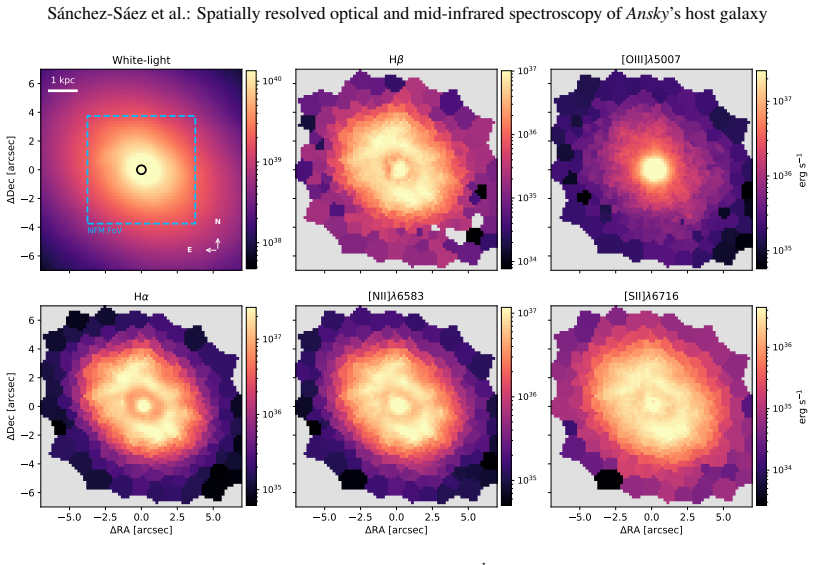
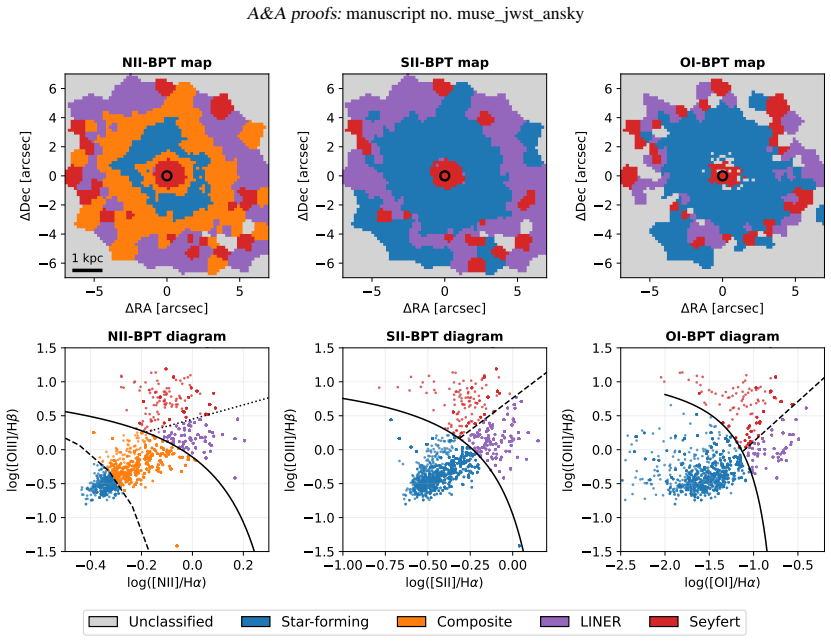
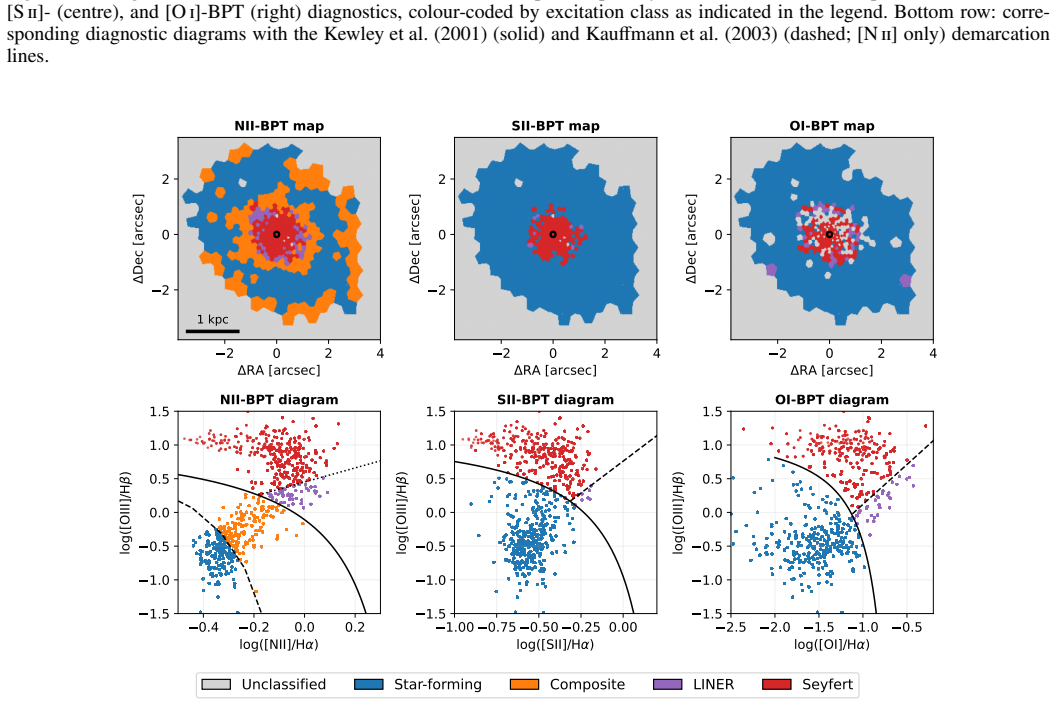
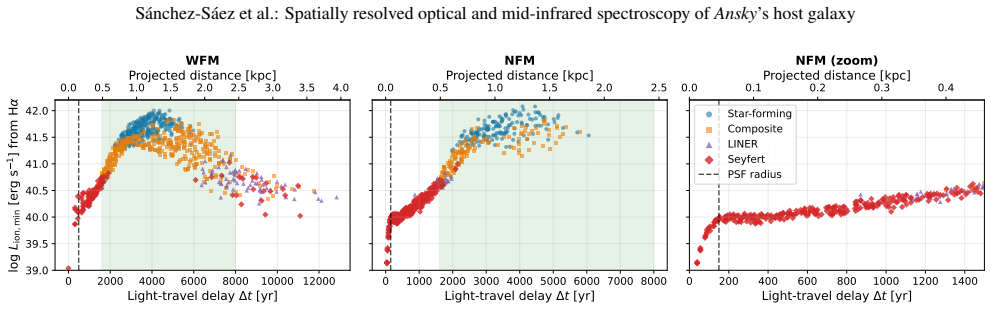
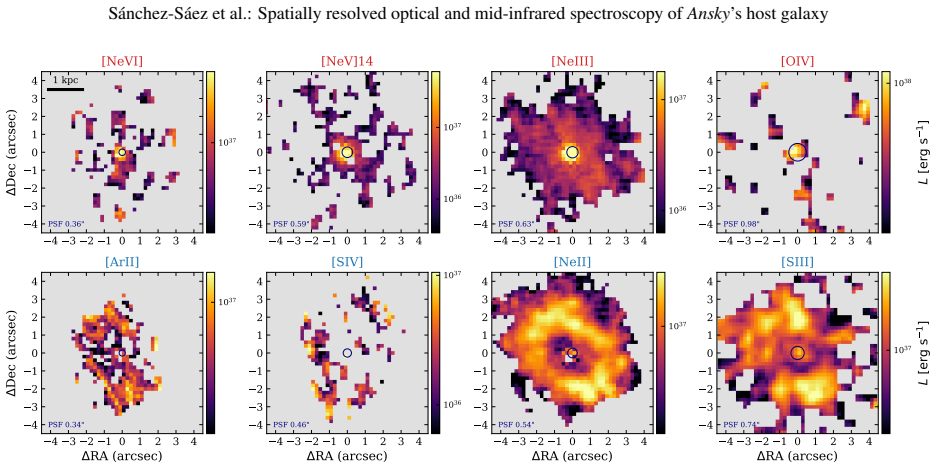
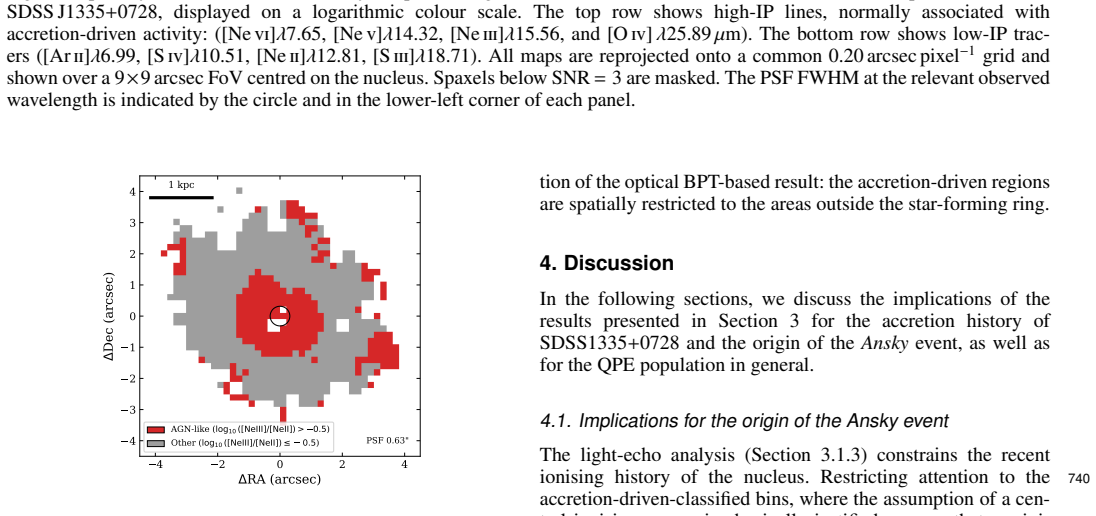
The data reveal a three-zone ionisation structure with central SMBH-powered high-ionisation lines, a star-forming ring, and outer LINER region, plus sustained past nuclear output at log L_ion,min ≈ 40.5 erg s^{-1} over ~1500 yr and optically thin dust. This is consistent with either a persisting or gradually fading low-luminosity AGN or a long-lived TDE remnant disc, positioning Ansky as a slow, faint transient in a ~10^6 M_⊙ SMBH that already hosted accretion and thereby challenging faded-AGN interpretations for some QPE hosts.
What carries the argument
The Balmer-line light-echo analysis that reconstructs the minimum sustained past ionising luminosity from emission-line fluxes, together with spatially resolved ionisation diagnostic maps that isolate the central coronal-line zone powered by SMBH accretion.
If this is right
- Ansky is a variation on pre-existing accretion rather than the start of new AGN activity.
- QPEs can occur around ~10^6 M_⊙ black holes that already host low-level accretion.
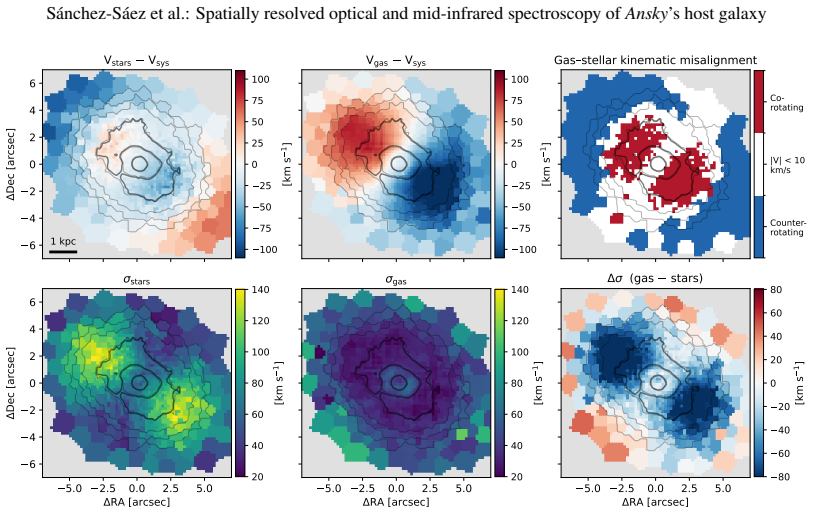
- The counter-rotating stellar components point to a minor merger that may have delivered or perturbed the nuclear gas supply.
- Star formation remains spatially separated from the nuclear ionisation zones.
Where Pith is reading between the lines
- If the pre-existing disc is a TDE remnant, such discs can survive and accrete for at least thousands of years around low-mass SMBHs.
- The same observations could be repeated on other QPE hosts to test whether ongoing accretion is common rather than exceptional.
- The minor-merger signature raises the question of whether external dynamical events commonly precede QPE activity.
Load-bearing premise
The Balmer-line light-echo analysis correctly reconstructs a minimum ionising luminosity of log L_ion,min ≈ 40.5 erg s^{-1} sustained over at least ~1500 yr without significant contamination from other ionisation sources or geometric effects.
What would settle it
Deeper spectroscopy showing Balmer line fluxes well below the light-echo prediction or revealing a classical AGN torus in the mid-infrared would falsify the sustained pre-2019 accretion scenario.
Figures
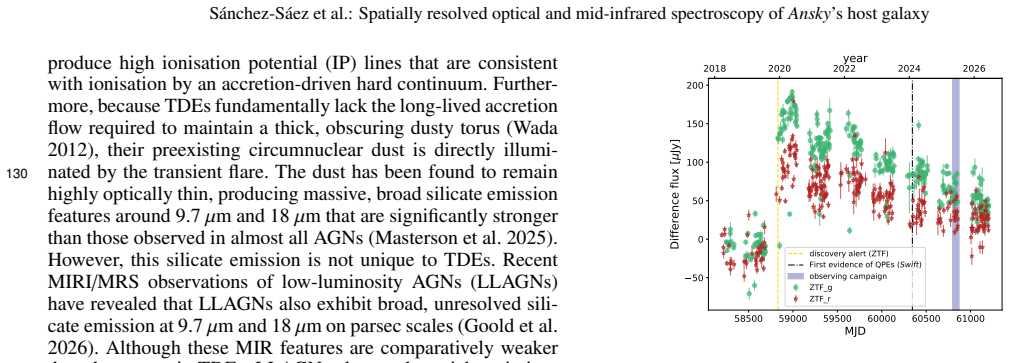
read the original abstract
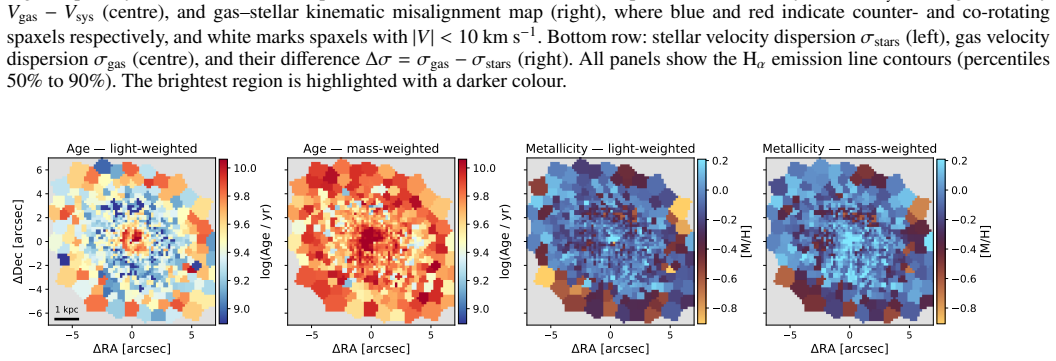
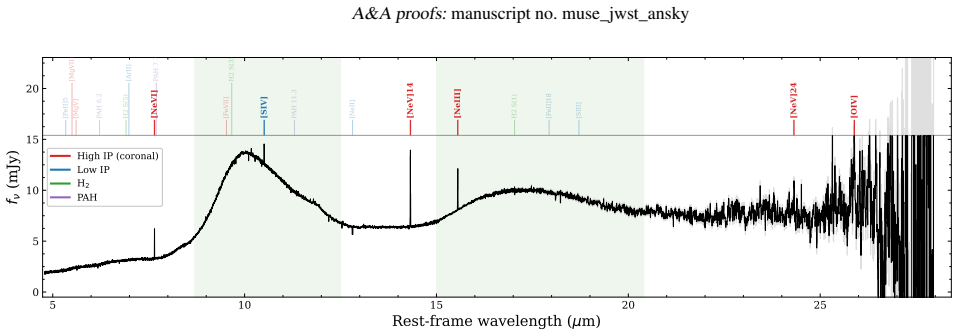
The galaxy SDSS1335+0728 brightened abruptly in December 2019 (the Ansky event) and has since been confirmed as the host of extreme X-ray quasi-periodic eruptions (QPEs) of debated origin. We constrain the origin of its transient activity by characterising the galaxy properties and nuclear accretion history with spatially resolved VLT/MUSE and JWST MIRI/MRS spectroscopy. We extract stellar and gas kinematics and emission-line fluxes, construct emission-line ionisation diagnostic maps, reconstruct the nuclear ionisation history via a Balmer-line light-echo analysis, and measure the mid-infrared silicate feature strength. The stellar kinematics reveal two counter-rotating stellar regions and kinematically cold gas ($\sigma_{\rm gas} \lesssim 60$ km s$^{-1}$), consistent with a past minor merger. Stellar populations show an old host with ongoing star formation confined to a ring at intermediate radii. Ionisation diagnostics reveal a three-zone structure: a central region powered by SMBH accretion, where high-ionisation coronal lines ([NeVI]$\lambda7.65\mu$m, [NeV]$\lambda14.32\mu$m, [OIV]$\lambda25.89\mu$m) are confined, a star-forming ring, and a LINER-like outer region. A Balmer-line light-echo analysis yields a minimum ionising luminosity $\log L_{\rm ion,min} \approx 40.5$ erg s$^{-1}$ sustained over at least $\sim 1\,500$ yr. Broad silicate emission at 9.7 and 18$\mu$m indicates optically thin dust, inconsistent with a classical active galactic nucleus (AGN) dusty torus. The data are consistent with two scenarios for the pre-2019 accretion: a persisting or gradually fading low-luminosity AGN, or a long-lived tidal disruption event (TDE) remnant disc. In both, Ansky corresponds to a slow, faint transient in a $\sim\!10^6\,M_{\odot}$ SMBH with already ongoing accretion, challenging the "faded AGN" interpretation proposed for some QPE hosts.
Editorial analysis
A structured set of objections, weighed in public.
Referee Report
Summary. The manuscript presents spatially resolved VLT/MUSE optical and JWST/MIRI mid-infrared spectroscopy of SDSS1335+0728, the host of the Ansky event and associated QPEs. It reports counter-rotating stellar components consistent with a minor merger, a star-forming ring at intermediate radii, a three-zone ionisation structure (nuclear coronal lines from SMBH accretion, star-forming ring, outer LINER-like region), a Balmer-line light-echo analysis yielding a minimum ionising luminosity log L_ion,min ≈ 40.5 erg s^{-1} sustained for at least ~1500 yr, and optically thin silicate emission at 9.7 and 18 μm inconsistent with a classical dusty torus. The authors conclude that these data are consistent with either a persisting or fading low-luminosity AGN or a long-lived TDE remnant disc around a ~10^6 M_⊙ SMBH with pre-existing accretion, thereby challenging the faded-AGN interpretation for some QPE hosts.
Significance. If the central measurements and light-echo reconstruction hold, the work supplies direct observational constraints on the pre-transient accretion state of a confirmed QPE host. The spatially resolved separation of nuclear, star-forming, and outer zones, combined with the mid-IR dust diagnostic, strengthens the case that Ansky occurred in a system already hosting low-level accretion. This has implications for distinguishing AGN versus TDE origins of QPEs and for the broader population of low-mass SMBH transients.
major comments (1)
- [Balmer-line light-echo analysis] Balmer-line light-echo analysis (abstract and associated section): the minimum luminosity log L_ion,min ≈ 40.5 erg s^{-1} sustained over ≳1500 yr is load-bearing for both proposed pre-2019 scenarios. The reconstruction assumes the observed line emission directly traces past nuclear output without significant contamination from other ionisation sources or geometric effects; a concrete test (e.g., comparison of multiple Balmer lines, assessment of covering-factor uncertainty, or limits on non-nuclear contributions) should be added to quantify the robustness of this assumption.
minor comments (2)
- [Abstract] The ~10^6 M_⊙ SMBH mass is stated without an accompanying method or reference; adding a brief statement of how this mass is derived (or cited) would improve traceability.
- [Ionisation diagnostics] The three-zone ionisation structure is described clearly in the abstract; ensure that the corresponding diagnostic maps in the main text include explicit spatial boundaries or masks for the nuclear, ring, and outer zones to aid reader interpretation.
Simulated Author's Rebuttal
We thank the referee for their constructive review and positive assessment of the significance of our spatially resolved spectroscopy of SDSS1335+0728. We address the major comment below.
read point-by-point responses
-
Referee: Balmer-line light-echo analysis (abstract and associated section): the minimum luminosity log L_ion,min ≈ 40.5 erg s^{-1} sustained over ≳1500 yr is load-bearing for both proposed pre-2019 scenarios. The reconstruction assumes the observed line emission directly traces past nuclear output without significant contamination from other ionisation sources or geometric effects; a concrete test (e.g., comparison of multiple Balmer lines, assessment of covering-factor uncertainty, or limits on non-nuclear contributions) should be added to quantify the robustness of this assumption.
Authors: We agree that additional quantitative tests would strengthen the light-echo analysis. In the revised manuscript we will add an explicit consistency check comparing the reconstructed ionising luminosity history derived independently from the Hα and Hβ light echoes. We will also incorporate a brief assessment of covering-factor uncertainty by propagating a plausible range of values (0.01–0.1) through the reconstruction and will use the spatially resolved ionisation maps to place limits on possible non-nuclear contributions to the Balmer emission in the nuclear aperture. These additions will be presented in the main text or an appendix as appropriate. revision: yes
Circularity Check
No significant circularity detected
full rationale
The paper derives its conclusions from direct observational measurements including spatially resolved emission-line fluxes, stellar and gas kinematics, ionization diagnostic maps, Balmer-line light-echo reconstruction of minimum ionizing luminosity, and mid-infrared silicate feature strength. These quantities are obtained via standard spectroscopic analysis techniques without any equations that reduce a claimed prediction back to a fitted input by construction, and without load-bearing self-citations that substitute for independent verification. The consistency statements with low-luminosity AGN or long-lived TDE remnant scenarios follow from the separation of nuclear, star-forming, and outer regions in the data, not from any self-definitional or renaming step.
Axiom & Free-Parameter Ledger
axioms (2)
- domain assumption Emission-line ratios reliably separate AGN, star-formation, and LINER ionisation without significant mixing or shock contributions
- domain assumption The observed Balmer lines directly trace the past nuclear ionising continuum via light travel time without substantial reprocessing or geometric dilution
Reference graph
Works this paper leans on
-
[1]
RCSED A Value-added Reference Catalog of Spectral Energy Distributions of 800,299 Galaxies in 11 Ultraviolet, Optical, and Near-infrared Bands: Morphologies, Colors, Ionized Gas, and Stellar Population Properties. , keywords =. doi:10.3847/1538-4365/228/2/14 , archivePrefix =. 1612.02047 , primaryClass =
work page internal anchor Pith review Pith/arXiv arXiv doi:10.3847/1538-4365/228/2/14
-
[2]
Evolutionary Processes in Binary and Multiple Stars
-
[3]
GSN 069 - A tidal disruption near miss. , keywords =. doi:10.1093/mnrasl/slaa020 , archivePrefix =. 2002.00970 , primaryClass =
-
[4]
The analysis of indexed astronomical time series - X. Significance testing of O-C data. , keywords =. doi:10.1111/j.1365-2966.2005.09719.x , adsurl =
-
[5]
, year = 1963, month = jan, volume =
Two-body problem with variable mass: A new approach. , year = 1963, month = jan, volume =. doi:10.1016/0019-1035(63)90072-1 , adsurl =
-
[6]
Interacting Binaries with Eccentric Orbits. II. Secular Orbital Evolution due to Non-conservative Mass Transfer. , keywords =. doi:10.1088/0004-637X/702/2/1387 , archivePrefix =. 0903.0621 , primaryClass =
work page internal anchor Pith review Pith/arXiv arXiv doi:10.1088/0004-637x/702/2/1387
-
[7]
Orbital Evolution of Mass-transferring Eccentric Binary Systems. I. Phase-dependent Evolution. , keywords =. doi:10.3847/0004-637X/825/1/70 , archivePrefix =. 1603.06592 , primaryClass =
work page internal anchor Pith review Pith/arXiv arXiv doi:10.3847/0004-637x/825/1/70
-
[8]
Orbital Evolution of Mass-transferring Eccentric Binary Systems. II. Secular Evolution. , keywords =. doi:10.3847/0004-637X/825/1/71 , archivePrefix =. 1603.06593 , primaryClass =
work page internal anchor Pith review Pith/arXiv arXiv doi:10.3847/0004-637x/825/1/71
-
[9]
Communications Physics , keywords =
The link between star formation and gas in nearby galaxies. Communications Physics , keywords =. doi:10.1038/s42005-020-00493-0 , archivePrefix =. 2012.05914 , primaryClass =
-
[10]
Extreme Coronal Line Emitters: Tidal Disruption of Stars by Massive Black Holes in Galactic Nuclei?
Extreme Coronal Line Emitters: Tidal Disruption of Stars by Massive Black Holes in Galactic Nuclei?. , keywords =. doi:10.1088/0004-637X/749/2/115 , archivePrefix =. 1202.1064 , primaryClass =
work page internal anchor Pith review Pith/arXiv arXiv doi:10.1088/0004-637x/749/2/115
-
[11]
The Tidal Disruption Event AT2021ehb: Evidence of Relativistic Disk Reflection, and Rapid Evolution of the Disk-Corona System. , keywords =. doi:10.3847/1538-4357/ac898a , archivePrefix =. 2206.12713 , primaryClass =
-
[12]
X-ray quasi-periodic eruptions from two previously quiescent galaxies. , keywords =. doi:10.1038/s41586-021-03394-6 , archivePrefix =. 2104.13388 , primaryClass =
-
[13]
The Orbital Structure and Selection Effects of the Galactic Center S-star Cluster. , keywords =. doi:10.3847/1538-4357/ad17bb , archivePrefix =. 2306.02076 , primaryClass =
-
[14]
Discovery of extreme quasi-periodic eruptions in a newly accreting massive black hole. Nature Astronomy , keywords =. doi:10.1038/s41550-025-02523-9 , archivePrefix =. 2504.07169 , primaryClass =
-
[15]
Discovery of Quasiperiodic Eruptions in the Tidal Disruption Event and Extreme Coronal Line Emitter AT2022upj: Implications for the QPE/TDE Fraction and a Connection to ECLEs. , keywords =. doi:10.3847/2041-8213/adc2f8 , archivePrefix =. 2503.19013 , primaryClass =
-
[16]
Rapidly Varying Ionization Features in a Quasi-periodic Eruption: A Homologous Expansion Model for the Spectroscopic Evolution. , keywords =. doi:10.3847/1538-4357/adb972 , archivePrefix =. 2504.07167 , primaryClass =
-
[17]
and Valli, Ruggero and Sari, Re’em and Justham, Stephen and Ryu, Taeho , title =
Olejak, Aleksandra and Stegmann, Jakob and de Mink, Selma E. and Valli, Ruggero and Sari, Re’em and Justham, Stephen and Ryu, Taeho , title =. The Astrophysical Journal Letters , abstract =. 2025 , month =. doi:10.3847/2041-8213/ade432 , url =
-
[18]
The Disk Accretion of a Tidally Disrupted Star onto a Massive Black Hole. , keywords =. doi:10.1086/168442 , adsurl =
-
[19]
The Astrophysical Journal , abstract =
Wada, Keiichi , title =. The Astrophysical Journal , abstract =. 2012 , month =. doi:10.1088/0004-637X/758/1/66 , url =
-
[20]
The Galaxy Activity, Torus, and Outflow Survey (GATOS). III. Revealing the inner icy structure in local active galactic nuclei. , keywords =. doi:10.1051/0004-6361/202348266 , archivePrefix =. 2310.09093 , primaryClass =
-
[21]
A complete census of silicate features in the mid-infrared spectra of active galaxies
A Complete Census of Silicate Features in the Mid-infrared Spectra of Active Galaxies. , keywords =. doi:10.1088/0004-637X/803/2/110 , archivePrefix =. 1502.05823 , primaryClass =
work page internal anchor Pith review Pith/arXiv arXiv doi:10.1088/0004-637x/803/2/110
-
[22]
Silicate emission in a type-2 quasar: JWST/MIRI constraints on torus geometry and radiative feedback. , keywords =. doi:10.1051/0004-6361/202557323 , archivePrefix =. 2512.02629 , primaryClass =
-
[23]
MUSE observations of the counter-rotating nuclear ring in NGC 7742
MUSE observations of the counter-rotating nuclear ring in NGC 7742. , keywords =. doi:10.1051/0004-6361/201730955 , archivePrefix =. 1711.08982 , primaryClass =
work page internal anchor Pith review Pith/arXiv arXiv doi:10.1051/0004-6361/201730955
-
[24]
Monthly Notices of the Royal Astronomical Society , volume =
McKernan, B and Ford, K E S and Cantiello, M and Graham, M and Jermyn, A S and Leigh, N W C and Ryu, T and Stern, D , title =. Monthly Notices of the Royal Astronomical Society , volume =. 2022 , month =. doi:10.1093/mnras/stac1310 , url =
-
[25]
Observational Constraints on the Feeding of Supermassive Black Holes
Observational constraints on the feeding of supermassive black holes. Nature Astronomy , keywords =. doi:10.1038/s41550-018-0611-0 , archivePrefix =. 1904.03338 , primaryClass =
work page internal anchor Pith review Pith/arXiv arXiv doi:10.1038/s41550-018-0611-0 1904
-
[26]
The Astrophysical Journal , abstract =
Zhang, Minghao and Zhang, Wenda and Deng, Hongping and Guo, Hengxiao and Sun, Jingbo , title =. The Astrophysical Journal , abstract =. 2025 , month =. doi:10.3847/1538-4357/ae0581 , url =
-
[27]
The Galaxy Zoo survey for giant AGN-ionized clouds: past and present black hole accretion events. , keywords =. doi:10.1111/j.1365-2966.2011.20101.x , archivePrefix =. 1110.6921 , primaryClass =
-
[28]
Fading AGN Candidates: AGN Histories and Outflow Signatures
Fading AGN Candidates: AGN Histories and Outflow Signatures. , keywords =. doi:10.3847/1538-4357/835/2/256 , archivePrefix =. 1612.06006 , primaryClass =
work page internal anchor Pith review Pith/arXiv arXiv doi:10.3847/1538-4357/835/2/256
-
[29]
The Astrophysical Journal , abstract =
Xiong, Yifei and Jiang, Ning and Pan, Zhen and Hao, Lei and Li, Zhenzhen , title =. The Astrophysical Journal , abstract =. 2025 , month =. doi:10.3847/1538-4357/ade2d7 , url =
-
[30]
Building gas rings and rejuvenating S0 galaxies through minor mergers
Building gas rings and rejuvenating S0 galaxies through minor mergers. , keywords =. doi:10.1051/0004-6361/201425315 , archivePrefix =. 1501.00016 , primaryClass =
work page internal anchor Pith review Pith/arXiv arXiv doi:10.1051/0004-6361/201425315
-
[31]
Spectral Signatures of Fast Shocks. II. Optical Diagnostic Diagrams. , keywords =. doi:10.1086/176596 , adsurl =
-
[32]
Mass Transfer in Tidally Heated Stars Orbiting Massive Black Holes and Implications for Repeating Nuclear Transients. arXiv e-prints , keywords =. doi:10.48550/arXiv.2505.10611 , archivePrefix =. 2505.10611 , primaryClass =
work page internal anchor Pith review Pith/arXiv arXiv doi:10.48550/arxiv.2505.10611
-
[33]
Bound orbits of a slowly evolving black hole. , keywords =. doi:10.1103/PhysRevD.100.064001 , archivePrefix =. 1806.09022 , primaryClass =
-
[34]
Prospects for EMRI/MBH Parameter Estimation Using Quasiperiodic Eruption Timings: Short-timescale Analysis. , keywords =. doi:10.3847/1538-4357/ae003b , archivePrefix =. 2508.20162 , primaryClass =
-
[35]
5: Discovery of Quasiperiodic Eruptions Every 3.7 days from a Galaxy at z > 0.1
SRG/eROSITA No. 5: Discovery of Quasiperiodic Eruptions Every 3.7 days from a Galaxy at z > 0.1. , keywords =. doi:10.3847/1538-4357/adec9b , archivePrefix =. 2506.17138 , primaryClass =
-
[36]
The complex time and energy evolution of quasi-periodic eruptions in eRO-QPE1. , keywords =. doi:10.1051/0004-6361/202243259 , archivePrefix =. 2203.11939 , primaryClass =
-
[37]
NICER observations reveal doubled timescales in Ansky's quasi-periodic eruptions. , keywords =. doi:10.1051/0004-6361/202555258 , archivePrefix =. 2509.16304 , primaryClass =
-
[38]
Astronomical Data Analysis Software and Systems V , year = 1996, editor =
XSPEC: The First Ten Years. Astronomical Data Analysis Software and Systems V , year = 1996, editor =
1996
-
[39]
The more the merrier: SRG/eROSITA discovers two further galaxies showing X-ray quasi-periodic eruptions. , keywords =. doi:10.1051/0004-6361/202348881 , archivePrefix =. 2401.17275 , primaryClass =
-
[40]
Cosmic hide and seek: The volumetric rate of X-ray quasi-periodic eruptions. , keywords =. doi:10.1051/0004-6361/202348949 , archivePrefix =. 2403.17059 , primaryClass =
-
[41]
Ticking away: The long-term X-ray timing and spectral evolution of eRO-QPE2. , keywords =. doi:10.1051/0004-6361/202451218 , adsurl =
-
[42]
Quasi-periodic X-ray eruptions years after a nearby tidal disruption event. , keywords =. doi:10.1038/s41586-024-08023-6 , archivePrefix =. 2409.02181 , primaryClass =
-
[43]
The Astropy Project: Sustaining and Growing a Community-oriented Open-source Project and the Latest Major Release (v5.0) of the Core Package. , keywords =. doi:10.3847/1538-4357/ac7c74 , archivePrefix =. 2206.14220 , primaryClass =
work page internal anchor Pith review Pith/arXiv arXiv doi:10.3847/1538-4357/ac7c74
-
[44]
A model-independent analysis of the variability of GRS 1915+105
A model-independent analysis of the variability of GRS 1915+105. , keywords =. doi:10.48550/arXiv.astro-ph/0001103 , archivePrefix =. astro-ph/0001103 , primaryClass =
work page internal anchor Pith review Pith/arXiv arXiv doi:10.48550/arxiv.astro-ph/0001103 1915
-
[45]
Possible X-Ray Quasi-periodic Eruptions in a Tidal Disruption Event Candidate. , keywords =. doi:10.3847/2041-8213/ac313b , archivePrefix =. 2110.10786 , primaryClass =
-
[46]
Milli-Hertz Gravitational-wave Background Produced by Quasiperiodic Eruptions. , keywords =. doi:10.3847/1538-4357/ac63bf , archivePrefix =. 2112.03408 , primaryClass =
-
[47]
Lense-Thirring precession around supermassive black holes during tidal disruption events
Lense-Thirring precession around supermassive black holes during tidal disruption events. , keywords =. doi:10.1093/mnras/stv2417 , archivePrefix =. 1510.04879 , primaryClass =
work page internal anchor Pith review Pith/arXiv arXiv doi:10.1093/mnras/stv2417
-
[48]
Tidal Disruption Events. , keywords =. doi:10.1146/annurev-astro-111720-030029 , archivePrefix =. 2104.14580 , primaryClass =
-
[49]
astroquery: An Astronomical Web-Querying Package in Python
astroquery: An Astronomical Web-querying Package in Python. , keywords =. doi:10.3847/1538-3881/aafc33 , archivePrefix =. 1901.04520 , primaryClass =
work page internal anchor Pith review Pith/arXiv arXiv doi:10.3847/1538-3881/aafc33 1901
-
[50]
Late-time UV observations of tidal disruption flares reveal unobscured, compact accretion disks
Late-time UV Observations of Tidal Disruption Flares Reveal Unobscured, Compact Accretion Disks. , keywords =. doi:10.3847/1538-4357/ab1844 , archivePrefix =. 1809.00003 , primaryClass =
work page internal anchor Pith review Pith/arXiv arXiv doi:10.3847/1538-4357/ab1844
-
[51]
Expanding the Ultracompacts: Gravitational-wave-driven Mass Transfer in the Shortest-period Binaries with Accretion Disks. , keywords =. doi:10.3847/1538-4357/ad9563 , archivePrefix =. 2411.12796 , primaryClass =
-
[52]
Orbital Period Increase in ES Ceti
Orbital Period Increase in ES Ceti. , keywords =. doi:10.3847/1538-4357/aa9ed6 , archivePrefix =. 1801.01049 , primaryClass =
work page internal anchor Pith review Pith/arXiv arXiv doi:10.3847/1538-4357/aa9ed6
-
[53]
Repeating Nuclear Transients from Repeating Partial Tidal Disruption Events: Reproducing ASASSN-14ko and AT2020vdq. , keywords =. doi:10.3847/1538-4357/ad6a5a , archivePrefix =. 2406.03675 , primaryClass =
-
[54]
Repeated Tidal Interactions Between Stars and Supermassive Black Holes: Mass Transfer, Stability, and Implications for Repeating Partial Tidal Disruption Events. , keywords =. doi:10.3847/1538-4357/add9a5 , archivePrefix =. 2504.18614 , primaryClass =
-
[55]
Extended Emission-line Regions in Poststarburst Galaxies Hosting Tidal Disruption Events. , keywords =. doi:10.3847/2041-8213/ad5725 , archivePrefix =. 2406.02674 , primaryClass =
-
[56]
Evidence for the Preferential Disruption of Moderately Massive Stars by Supermassive Black Holes. , keywords =. doi:10.3847/1538-4357/ac35d5 , archivePrefix =. 2110.03013 , primaryClass =
-
[57]
The Gaia mission. , keywords =. doi:10.1051/0004-6361/201629272 , archivePrefix =. 1609.04153 , primaryClass =
work page internal anchor Pith review Pith/arXiv arXiv doi:10.1051/0004-6361/201629272
-
[58]
The Palomar Transient Factory: System Overview, Performance and First Results
The Palomar Transient Factory: System Overview, Performance, and First Results. , keywords =. doi:10.1086/648598 , archivePrefix =. 0906.5350 , primaryClass =
work page internal anchor Pith review Pith/arXiv arXiv doi:10.1086/648598
-
[59]
Pan-STARRS: A Large Synoptic Survey Telescope Array. Survey and Other Telescope Technologies and Discoveries , year = 2002, editor =. doi:10.1117/12.457365 , adsurl =
-
[60]
ATLAS: A High-Cadence All-Sky Survey System
ATLAS: A High-cadence All-sky Survey System. , keywords =. doi:10.1088/1538-3873/aabadf , archivePrefix =. 1802.00879 , primaryClass =
work page internal anchor Pith review Pith/arXiv arXiv doi:10.1088/1538-3873/aabadf
-
[61]
Mapping the Inner 0.1 pc of a Supermassive Black Hole Environment with the Tidal Disruption Event and Extreme Coronal-line Emitter AT 2022upj. , keywords =. doi:10.3847/1538-4357/ad8a69 , archivePrefix =. 2406.11972 , primaryClass =
-
[62]
The Swift Gamma-Ray Burst Mission
The Swift Gamma-Ray Burst Mission. , keywords =. doi:10.1086/422091 , archivePrefix =. astro-ph/0405233 , primaryClass =
work page internal anchor Pith review Pith/arXiv arXiv doi:10.1086/422091
-
[63]
Quasi-periodic eruptions from impacts between the secondary and a rigidly precessing accretion disc in an extreme mass-ratio inspiral system. , keywords =. doi:10.1051/0004-6361/202346565 , archivePrefix =. 2304.00775 , primaryClass =
-
[64]
X-ray quasi-periodic eruptions from the galactic nucleus of RX J1301.9+2747. , keywords =. doi:10.1051/0004-6361/202037610 , archivePrefix =. 2002.08967 , primaryClass =
-
[65]
X-ray eruptions every 22 days from the nucleus of a nearby galaxy. Nature Astronomy , keywords =. doi:10.1038/s41550-023-02178-4 , archivePrefix =. 2309.03011 , primaryClass =
-
[66]
Impact of mass transfer on the orbital evolution of a white dwarf close to an intermediate-mass black hole. arXiv e-prints , keywords =. doi:10.48550/arXiv.2502.06160 , archivePrefix =. 2502.06160 , primaryClass =
-
[67]
Methods and results of an automatic analysis of a complete sample of Swift-XRT observations of GRBs. , keywords =. doi:10.1111/j.1365-2966.2009.14913.x , archivePrefix =. 0812.3662 , primaryClass =
-
[68]
A real-time transient detector and the living Swift-XRT point source catalogue. , keywords =. doi:10.1093/mnras/stac2937 , archivePrefix =. 2208.14478 , primaryClass =
-
[69]
Monthly quasi-periodic eruptions from repeated stellar disruption by a massive black hole. Nature Astronomy , keywords =. doi:10.1038/s41550-023-02073-y , archivePrefix =. 2309.02500 , primaryClass =
-
[70]
The Host Galaxies of Tidal Disruption Events. , keywords =. doi:10.1007/s11214-020-00657-y , archivePrefix =. 2003.02863 , primaryClass =
-
[71]
The Zwicky Transient Facility: System Overview, Performance, and First Results
The Zwicky Transient Facility: System Overview, Performance, and First Results. , keywords =. doi:10.1088/1538-3873/aaecbe , archivePrefix =. 1902.01932 , primaryClass =
work page internal anchor Pith review Pith/arXiv arXiv doi:10.1088/1538-3873/aaecbe 1902
-
[72]
The properties of GSN 069 accretion disk from a joint X-ray and UV spectral analysis: stress-testing quasi-periodic eruption models. arXiv e-prints , keywords =. doi:10.48550/arXiv.2501.03333 , archivePrefix =. 2501.03333 , primaryClass =
-
[73]
A physical model for the continuum variability and quasi-periodic oscillation in accreting black holes. , keywords =. doi:10.1111/j.1365-2966.2011.18860.x , archivePrefix =. 1101.2336 , primaryClass =
-
[74]
The rate of extreme coronal line emitting galaxies in the Sloan Digital Sky Survey and their relation to tidal disruption events. , keywords =. doi:10.1093/mnras/stae2384 , archivePrefix =. 2402.16951 , primaryClass =
-
[75]
The extreme coronal line emitter AT 2022fpx: varying optical polarization properties and late-time X-ray flare. , keywords =. doi:10.1093/mnras/stae1466 , archivePrefix =. 2403.04877 , primaryClass =
-
[76]
Research in Astronomy and Astrophysics , keywords =
AT2021acak: a Candidate Tidal Disruption Event Found in the Zwicky Transient Facility Survey. Research in Astronomy and Astrophysics , keywords =. doi:10.1088/1674-4527/acae6f , archivePrefix =. 2206.13148 , primaryClass =
-
[77]
VLASS tidal disruption events with optical flares II: discovery of two TDEs with intermediate width Balmer emission lines and connections to the ambiguous extreme coronal line emitters. arXiv e-prints , keywords =. doi:10.48550/arXiv.2310.03795 , archivePrefix =. 2310.03795 , primaryClass =
-
[78]
ASASSN-18ap: A Dusty Tidal Disruption Event Candidate with an Early Bump in the Light Curve. , keywords =. doi:10.3847/1538-4357/ad2ae4 , archivePrefix =. 2312.12015 , primaryClass =
-
[79]
To TDE or not to TDE: the luminous transient ASASSN-18jd with TDE-like and AGN-like qualities. , keywords =. doi:10.1093/mnras/staa859 , archivePrefix =. 1910.01142 , primaryClass =
-
[80]
The nuclear transient AT 2017gge: a tidal disruption event in a dusty and gas-rich environment and the awakening of a dormant SMBH. , keywords =. doi:10.1093/mnras/stac2673 , archivePrefix =. 2206.00049 , primaryClass =
discussion (0)
Sign in with ORCID, Apple, or X to comment. Anyone can read and Pith papers without signing in.