CORALIE radial-velocity search for companions around evolved stars (CASCADES) V. Three planetary companions and achievable precision
Pith reviewed 2026-06-27 15:08 UTC · model grok-4.3
The pith
Three planetary companions are identified around two low-luminosity red giant stars through long-term radial velocity observations.
A machine-rendered reading of the paper's core claim, the machinery that carries it, and where it could break.
Core claim
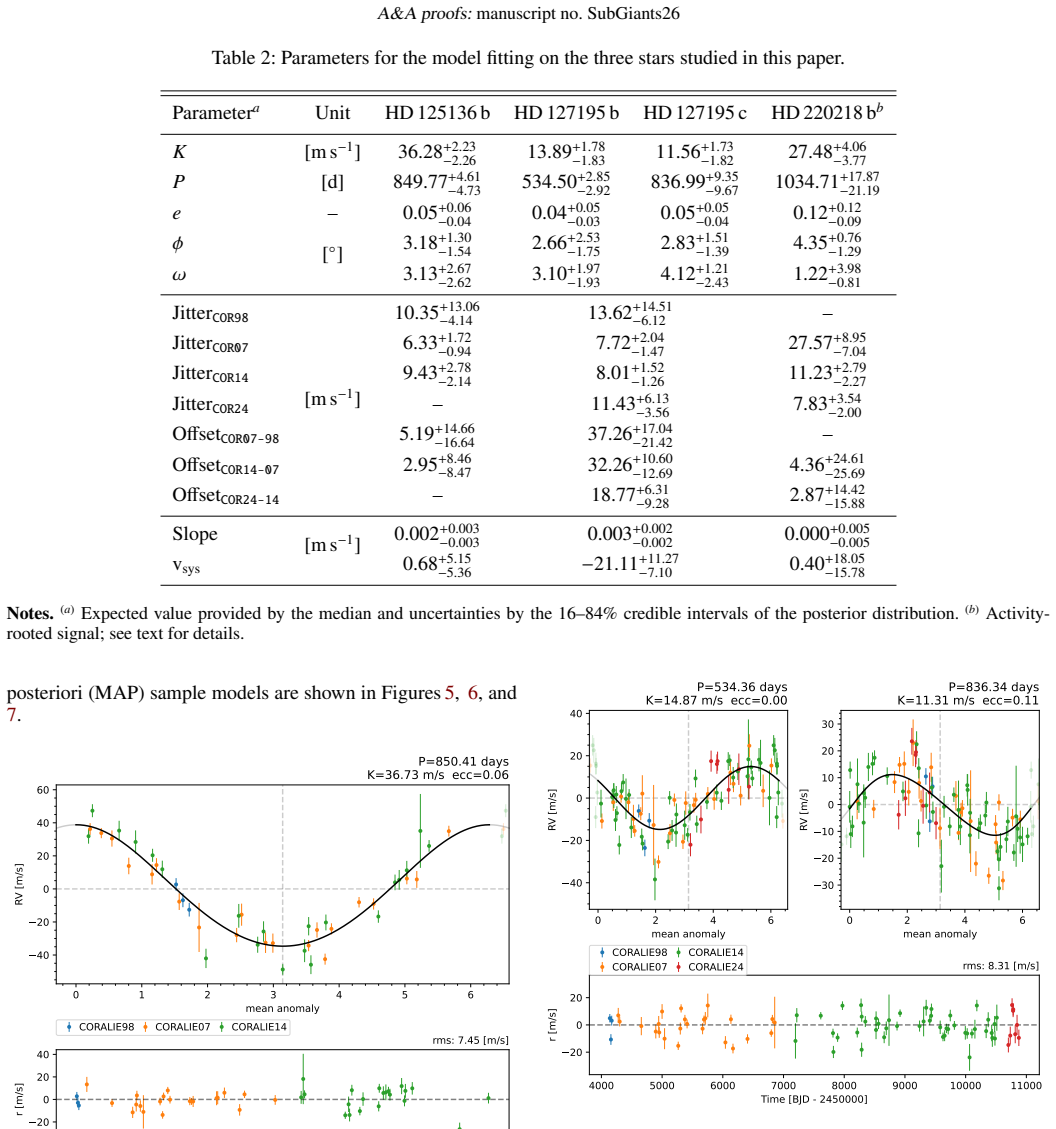
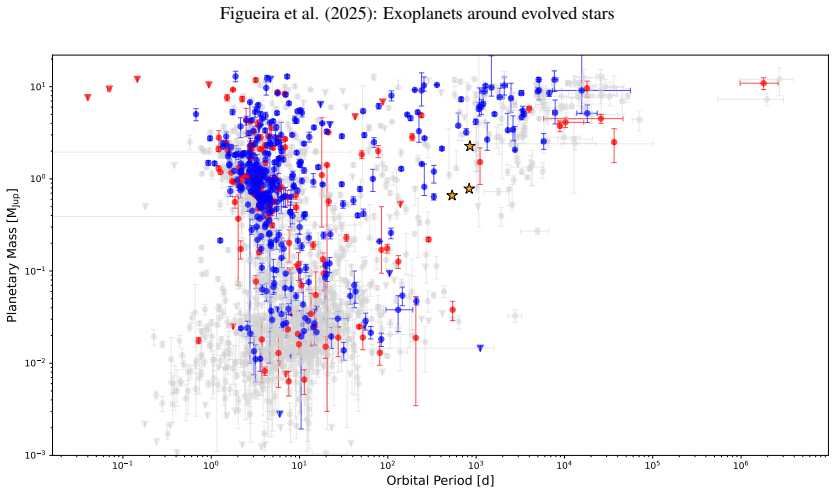
Signals accurately modelled by Keplerian curves are detected in the radial velocity data, leading to the identification of a 2.26 Jupiter-mass planet on an 850-day orbit around one star and a pair of 0.66 and 0.78 Jupiter-mass planets on 535-day and 834-day orbits around another, while the signal on the third star is attributed to stellar activity.
What carries the argument
Bayesian inference applied to radial velocity time series to fit Keplerian models, cross-checked with stellar activity indicators, along with a dedicated observing strategy to mitigate pulsation effects.
If this is right
- Planets with minimum masses from 0.66 to 2.26 Jupiter masses exist around low-luminosity red giants at orbital periods of several hundred days.
- The region of parameter space combining high stellar mass and moderate orbital periods gains additional entries.
- Stellar pulsations in low-luminosity giant stars can be reduced to below 5 m/s through appropriate observing cadence.
- Radial velocity searches can continue to yield planet detections around evolved stars when activity is properly accounted for.
Where Pith is reading between the lines
- This approach may be extended to additional evolved stars to further populate the census of their planetary systems.
- Confirmation of these signals with independent radial velocity instruments would provide stronger evidence for the planetary nature.
- The results suggest that planet formation or survival mechanisms around stars more massive than the Sun can produce companions at these separations.
Load-bearing premise
The fitted periodic signals in the radial velocity data originate from orbiting planets rather than from stellar activity or intrinsic pulsations.
What would settle it
A strong correlation between the radial velocity periods and any of the measured stellar activity indicators such as line bisector or chromospheric activity would indicate the signals are not planetary.
Figures
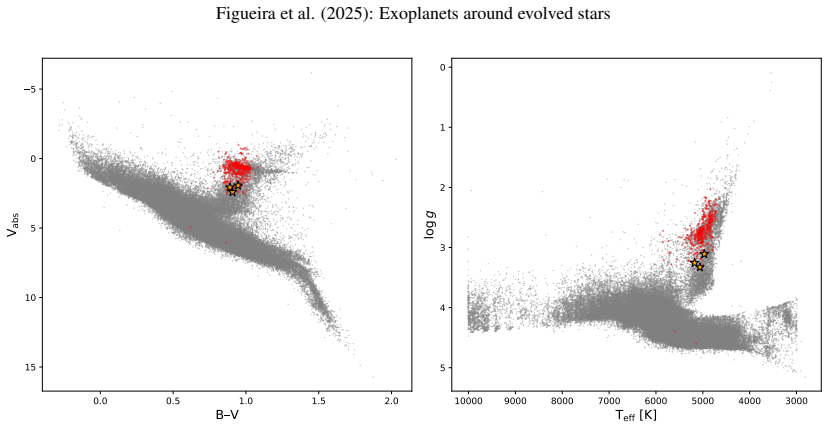
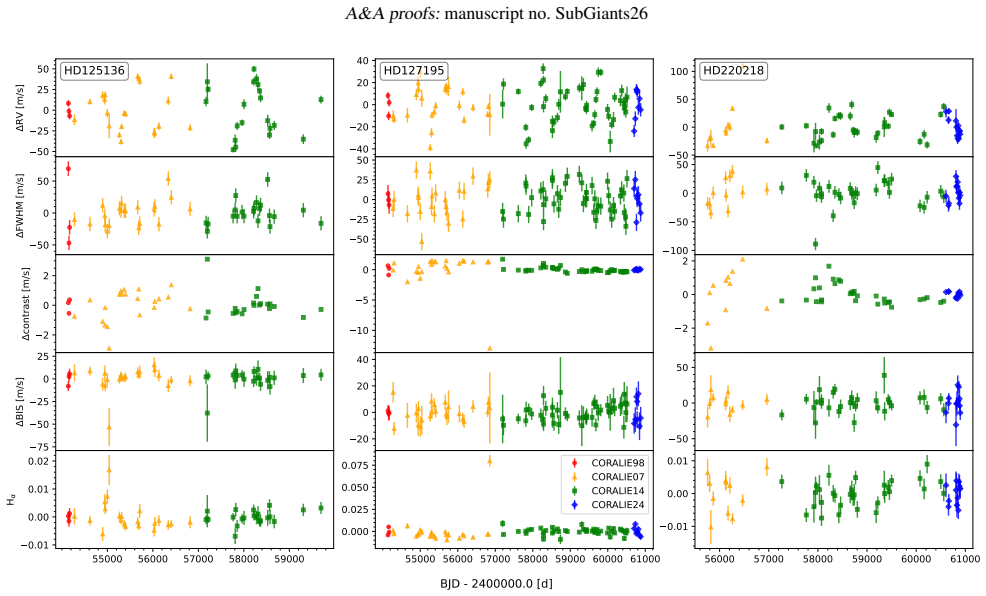
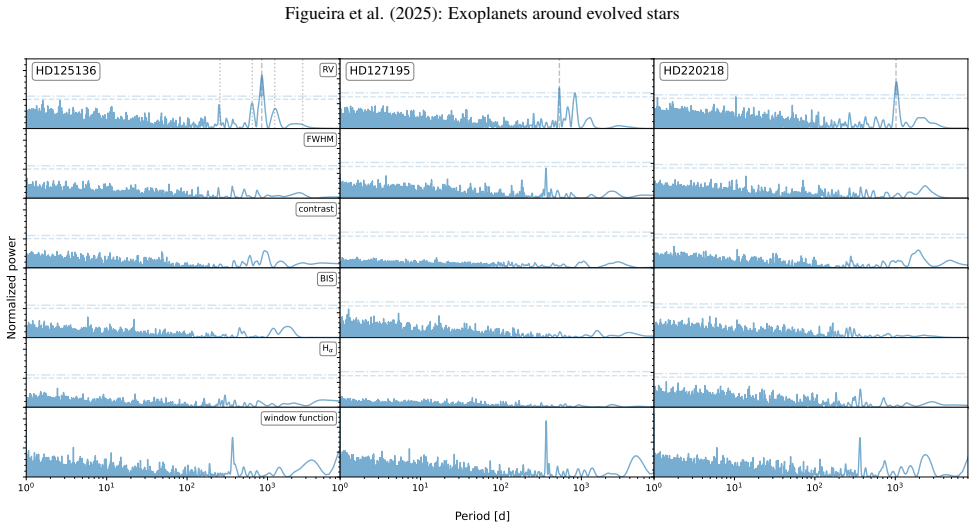
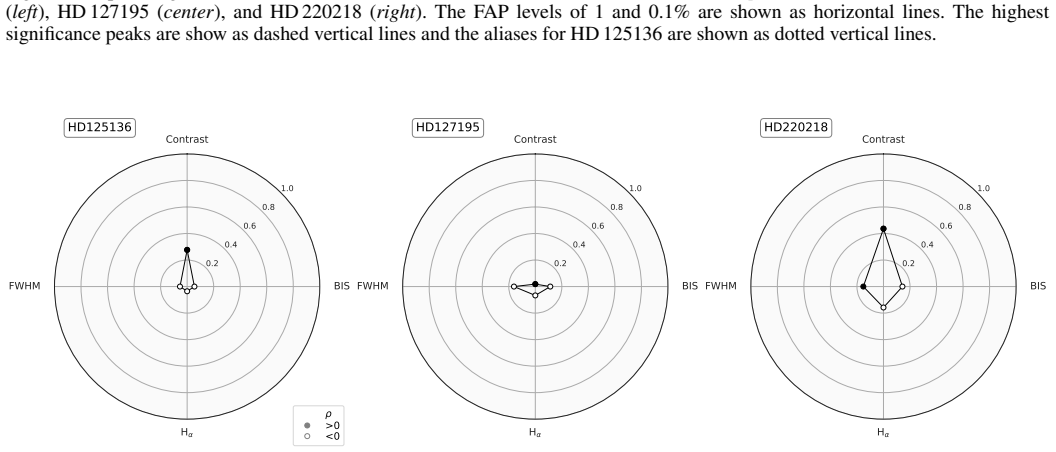
read the original abstract
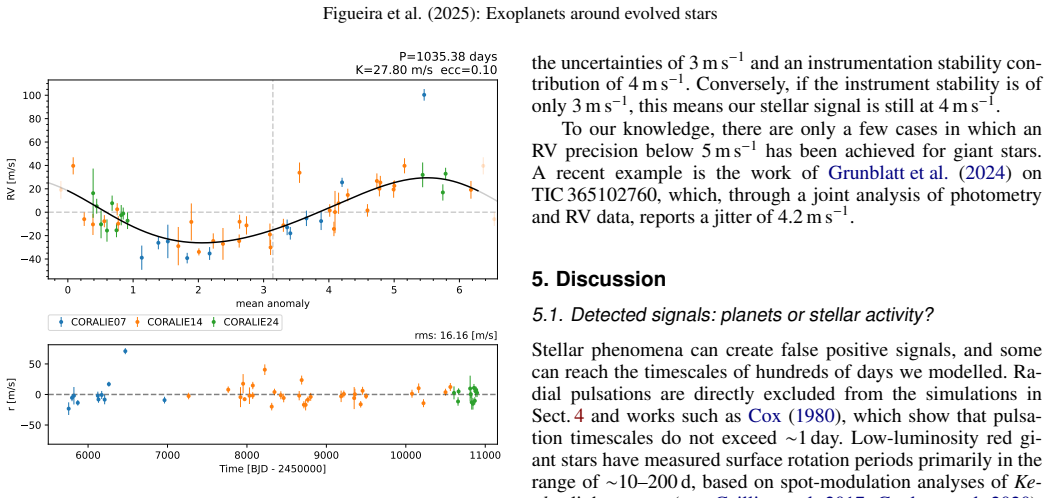
Aims. We expand the planetary census around massive stellar hosts through a long-term campaign of high-precision radial velocity (RV) measurements on evolved stars. Methods. We analyse data acquired with the CORALIE spectrograph covering 15-18 years on HD125136, HD127195, and HD220218. Stellar parameters are derived through different methods for a comprehensive characterization of each star. We then evaluate the presence of planetary signals in the RV time series using the Bayesian inference tool kima. Finally, we design an observing strategy aimed at mitigating the impact of pulsations on evolved stars and test its effectiveness on the low-luminosity red giant HD127195. Results. We detect signals that are accurately modelled by Keplerian curves in the RV data of the three stars: one on HD 125136, two on HD 127195, and one on HD 220218. While the signals on the first two stars seem to be of planetary origin, the signal on the third one shows several signs of stellar activity. We therefore identify a planetary companion around HD125136 with a minimum mass of 2.26 MJup on an 850 d orbit, and on HD127195 we identify a system composed of planets with 0.66 MJup and 0.78 MJup with orbital periods of 535 d and 834 d, respectively. Conclusions. We detect three massive planets around two low-luminosity red giant stars in a region of the parameter space that is poorly populated in both stellar mass and planetary orbital periods. The dedicated observing campaign on HD127195 showcases how stellar pulsations can be efficiently averaged out to below 5 m/s in low-luminosity giant stars.
Editorial analysis
A structured set of objections, weighed in public.
Referee Report
Summary. The manuscript reports long-term CORALIE radial-velocity observations (15-18 yr) of three evolved stars. Using the kima Bayesian tool, the authors identify one Keplerian signal around HD 125136 (P=850 d, m sin i = 2.26 M_Jup), two signals around HD 127195 (P=535 d and 834 d, m sin i = 0.66 and 0.78 M_Jup), and one signal around HD 220218 that they attribute to stellar activity. They also present and test an observing strategy to average out pulsations on the low-luminosity red giant HD 127195, claiming residual jitter below 5 m/s.
Significance. If the planetary assignments are robust, the detections populate a sparsely sampled region of parameter space (massive planets at long periods around evolved hosts). The demonstrated pulsation-averaging strategy offers a practical, low-cost method that could be adopted by other RV surveys of giants.
major comments (2)
- [kima analysis and activity-indicator section] The central claim that the 850 d, 535 d and 834 d signals are planetary rests on activity indicators (BIS, FWHM, log R'_HK) showing no matching periodicity. No joint multi-indicator model or Gaussian-process framework is described that would quantify the residual probability of a stellar origin once the pure-Keplerian model is subtracted; this step is load-bearing for evolved-star RV work.
- [Observing-strategy test on HD 127195] For HD 127195 the observing strategy is shown to suppress short-term pulsational jitter to <5 m/s, yet the text does not demonstrate that the same cadence and averaging also suppress longer-term convective or activity-induced signals at the 535 d and 834 d periods that are being claimed as planets.
minor comments (2)
- Add a table listing the exact number of epochs, time baseline, and median uncertainty for each star.
- Clarify which stellar-parameter derivation method (spectroscopic, photometric, or isochrone) is adopted for the final mass and radius values used in the minimum-mass calculation.
Simulated Author's Rebuttal
We thank the referee for their constructive report and the opportunity to clarify our analysis. We address each major comment below, proposing targeted revisions where they strengthen the manuscript without altering our core conclusions.
read point-by-point responses
-
Referee: [kima analysis and activity-indicator section] The central claim that the 850 d, 535 d and 834 d signals are planetary rests on activity indicators (BIS, FWHM, log R'_HK) showing no matching periodicity. No joint multi-indicator model or Gaussian-process framework is described that would quantify the residual probability of a stellar origin once the pure-Keplerian model is subtracted; this step is load-bearing for evolved-star RV work.
Authors: We agree that a joint multi-indicator model would provide a more quantitative bound on residual stellar activity. Our current analysis relies on kima's Bayesian model comparison (Keplerian vs. noise-only) plus the absence of matching periodicities or strong correlations in the activity indicators. While this is standard for many RV papers on giants, we acknowledge the referee's point on evolved-star work. In revision we will add a dedicated subsection with Spearman-rank correlations between RV and each indicator (after subtracting the best-fit Keplerians) and a brief discussion of why a full joint GP was not pursued; we will also note this as a limitation for future work. revision: partial
-
Referee: [Observing-strategy test on HD 127195] For HD 127195 the observing strategy is shown to suppress short-term pulsational jitter to <5 m/s, yet the text does not demonstrate that the same cadence and averaging also suppress longer-term convective or activity-induced signals at the 535 d and 834 d periods that are being claimed as planets.
Authors: The strategy was designed and tested exclusively to mitigate short-term pulsations (hours to days). The <5 m/s residual is measured on those short timescales; it is not claimed to suppress convective or activity signals at hundreds of days. The 535 d and 834 d signals are instead validated by the lack of matching periods or correlations in the activity indicators over the full 15–18 yr baseline. We will revise the relevant section to state this distinction explicitly and to clarify that long-term activity is addressed via the indicator analysis rather than the averaging cadence. revision: yes
Circularity Check
No circularity: planetary parameters obtained by direct Bayesian fitting of RV time series
full rationale
The paper reports observational results from applying the kima tool to CORALIE RV data on three stars, followed by activity-indicator checks to assign planetary origin. No equations, fitted parameters, or claims reduce by construction to self-defined quantities, prior self-citations, or renamed inputs. The central detections (periods, amplitudes, minimum masses) are outputs of the fitting procedure applied to the time series, not inputs redefined as predictions. Self-citations are absent from the load-bearing steps described. This is a standard direct-fitting analysis with an interpretive step on stellar vs. planetary origin that does not create circularity under the defined criteria.
Axiom & Free-Parameter Ledger
free parameters (1)
- Keplerian orbital elements (period, semi-amplitude, eccentricity, argument of periastron)
axioms (1)
- domain assumption RV time series can be decomposed into Keplerian signals plus noise and activity terms that kima can separate
Reference graph
Works this paper leans on
-
[1]
The Observatory , year = 1965, month = aug, volume =
The distribution of angular momentum among main sequence stars. The Observatory , year = 1965, month = aug, volume =
1965
-
[2]
Theory of Stellar Pulsation , series =
-
[3]
Journal of Hydrology , year = 1980, month = mar, volume =
A generalized probability density function for double-bounded random processes. Journal of Hydrology , year = 1980, month = mar, volume =. doi:10.1016/0022-1694(80)90036-0 , adsurl =
-
[4]
Studies in astronomical time series analysis. II. Statistical aspects of spectral analysis of unevenly spaced data. , keywords =. doi:10.1086/160554 , adsurl =
-
[5]
Rotation, convection, and magnetic activity in lower main-sequence stars. , keywords =. doi:10.1086/161945 , adsurl =
-
[6]
The relation between stellar rotation rate and activity cycle periods. , keywords =. doi:10.1086/162735 , adsurl =
-
[7]
Time-series measurements of chromospheric CA II H and K emission in cool stars and the search for differential rotation. , keywords =. doi:10.1086/163299 , adsurl =
-
[8]
Instrumentation in Astronomy VII , year = 1990, editor =
Final tests and commissioning of the UCL echelle spectrograph. Instrumentation in Astronomy VII , year = 1990, editor =. doi:10.1117/12.19119 , adsurl =
-
[9]
Solar flares, microflares, nanoflares, and coronal heating. , keywords =. doi:10.1007/BF00149894 , adsurl =
-
[10]
Avalanches and the Distribution of Solar Flares. , keywords =. doi:10.1086/186180 , adsurl =
-
[11]
IRAS Faint Source Survey, Explanatory supplement version 2
-
[12]
SYNTHE spectrum synthesis programs and line data
-
[13]
The Activity Cycle of tau Ceti. , keywords =. doi:10.1086/174210 , adsurl =
-
[14]
Robert E. Kass and Adrian E. Raftery , title =. Journal of the American Statistical Association , volume =. 1995 , publisher =. doi:10.1080/01621459.1995.10476572 , URL =
-
[15]
, year = 1995, month = nov, volume = 378, pages =
A Jupiter-mass companion to a solar-type star. , year = 1995, month = nov, volume =. doi:10.1038/378355a0 , adsurl =
-
[16]
, keywords =
ELODIE: A spectrograph for accurate radial velocity measurements. , keywords =
-
[17]
Magnetic Field and Rotation in Lower Main-Sequence Stars: an Empirical Time-dependent Magnetic Bode's Relation?. , keywords =. doi:10.1086/309891 , adsurl =
-
[18]
The General Catalogue of Photometric Data (GCPD). II. , keywords =. doi:10.1051/aas:1997197 , adsurl =
-
[19]
Line-profile variations of non-radial adiabatic pulsations of rotating stars. II. The diagnostic value of amplitude and phase diagrams derived from time series of spectra. , keywords =
-
[20]
, keywords =
Nearby stars of the Galactic disk and halo. , keywords =
-
[21]
Highlights of Astronomy , year = 1998, month = jan, volume =
The TYCHO Catalogue: Astrometric and Photometric Results. Highlights of Astronomy , year = 1998, month = jan, volume =
1998
-
[22]
The CORALIE survey for southern extra-solar planets. I. A planet orbiting the star Gliese 86. , keywords =
-
[23]
The acoustic spectrum of alpha Cen A
The acoustic spectrum of alpha Cen A. , keywords =. doi:10.1051/0004-6361:20020706 , archivePrefix =. astro-ph/0206051 , primaryClass =
work page internal anchor Pith review Pith/arXiv arXiv doi:10.1051/0004-6361:20020706
-
[24]
Intrinsic Colors of Stars in the Near-Infrared. , keywords =. doi:10.1086/322439 , adsurl =
-
[25]
No planet for HD 166435. , keywords =. doi:10.1051/0004-6361:20011308 , archivePrefix =. astro-ph/0109491 , primaryClass =
work page internal anchor Pith review Pith/arXiv arXiv doi:10.1051/0004-6361:20011308
-
[26]
The CORALIE survey for southern extra-solar planets VII. Two short-period Saturnian companions to <ASTROBJ>HD 108147</ASTROBJ> and <ASTROBJ>HD 168746</ASTROBJ>. , keywords =. doi:10.1051/0004-6361:20020433 , archivePrefix =. astro-ph/0202457 , primaryClass =
work page internal anchor Pith review Pith/arXiv arXiv doi:10.1051/0004-6361:20020433
-
[27]
The Messenger , year = 2003, month = dec, volume =
Setting New Standards with HARPS. The Messenger , year = 2003, month = dec, volume =
2003
-
[28]
New Grids of ATLAS9 Model Atmospheres
New Grids of ATLAS9 Model Atmospheres. Modelling of Stellar Atmospheres , year = 2003, editor =. doi:10.48550/arXiv.astro-ph/0405087 , archivePrefix =. astro-ph/0405087 , primaryClass =
work page internal anchor Pith review Pith/arXiv arXiv doi:10.48550/arxiv.astro-ph/0405087 2003
-
[29]
Do We Know of Any Maunder Minimum Stars?
Do We Know of Any Maunder Minimum Stars?. , keywords =. doi:10.1086/423221 , archivePrefix =. astro-ph/0406338 , primaryClass =
work page internal anchor Pith review Pith/arXiv arXiv doi:10.1086/423221
-
[30]
Models of Giant Planet formation with migration and disc evolution
Models of giant planet formation with migration and disc evolution. , keywords =. doi:10.1051/0004-6361:20042032 , archivePrefix =. astro-ph/0412444 , primaryClass =
work page internal anchor Pith review Pith/arXiv arXiv doi:10.1051/0004-6361:20042032
-
[31]
Asteroseismology of the planet-hosting star Arae. I. The acoustic spectrum. , keywords =. doi:10.1051/0004-6361:20052697 , archivePrefix =. astro-ph/0504043 , primaryClass =
work page internal anchor Pith review Pith/arXiv arXiv doi:10.1051/0004-6361:20052697
-
[32]
An Infrared Spectroscopic Sequence of M, L and T Dwarfs
An Infrared Spectroscopic Sequence of M, L, and T Dwarfs. , keywords =. doi:10.1086/428040 , archivePrefix =. astro-ph/0412313 , primaryClass =
work page internal anchor Pith review Pith/arXiv arXiv doi:10.1086/428040
-
[33]
A Bayesian Analysis of Extrasolar Planet Data for HD 73526. , keywords =. doi:10.1086/432594 , adsurl =
-
[34]
Spectroscopic Study on the Atmospheric Parameters of Nearby F--K Dwarfs and Subgiants. , keywords =. doi:10.1093/pasj/57.1.27 , adsurl =
-
[35]
Basic physical parameters of a selected sample of evolved stars
Basic physical parameters of a selected sample of evolved stars. , keywords =. doi:10.1051/0004-6361:20065105 , archivePrefix =. astro-ph/0608160 , primaryClass =
work page internal anchor Pith review Pith/arXiv arXiv doi:10.1051/0004-6361:20065105
-
[36]
Contributions to the Nearby Stars (NStars) Project: Spectroscopy of Stars Earlier than M0 within 40 pc-The Southern Sample. , keywords =. doi:10.1086/504637 , archivePrefix =. astro-ph/0603770 , primaryClass =
work page internal anchor Pith review Pith/arXiv arXiv doi:10.1086/504637
-
[37]
An extrasolar planetary system with three Neptune-mass planets
An extrasolar planetary system with three Neptune-mass planets. , keywords =. doi:10.1038/nature04828 , archivePrefix =. astro-ph/0703024 , primaryClass =
work page internal anchor Pith review Pith/arXiv arXiv doi:10.1038/nature04828
-
[38]
Gaussian Processes for Machine Learning
-
[39]
The Two Micron All Sky Survey (2MASS). , keywords =. doi:10.1086/498708 , adsurl =
-
[40]
Fluxes in H\alpha and Ca II H and K for a sample of Southern stars
H and the Ca II H and K lines as activity proxies for late-type stars. , keywords =. doi:10.1051/0004-6361:20066503 , archivePrefix =. astro-ph/0703511 , primaryClass =
work page internal anchor Pith review Pith/arXiv arXiv doi:10.1051/0004-6361:20066503
-
[41]
Retired A Stars and Their Companions: Exoplanets Orbiting Three Intermediate-Mass Subgiants
Retired A Stars and Their Companions: Exoplanets Orbiting Three Intermediate-Mass Subgiants. , keywords =. doi:10.1086/519677 , archivePrefix =. 0704.2455 , primaryClass =
work page internal anchor Pith review Pith/arXiv arXiv doi:10.1086/519677
-
[42]
Planets around evolved intermediate-mass stars. I. Two substellar companions in the open clusters NGC 2423 and NGC 4349. , keywords =. doi:10.1051/0004-6361:20077375 , archivePrefix =. 0706.2174 , primaryClass =
work page internal anchor Pith review Pith/arXiv arXiv doi:10.1051/0004-6361:20077375
-
[43]
Excitation of solar-like oscillations across the HR diagram
Excitation of solar-like oscillations across the HR diagram. , keywords =. doi:10.1051/0004-6361:20041953 , archivePrefix =. astro-ph/0611762 , primaryClass =
work page internal anchor Pith review Pith/arXiv arXiv doi:10.1051/0004-6361:20041953
-
[44]
A new code for automatic determination of equivalent widths: Automatic Routine for line Equivalent widths in stellar Spectra (ARES). , keywords =. doi:10.1051/0004-6361:20077288 , archivePrefix =. astro-ph/0703696 , primaryClass =
work page internal anchor Pith review Pith/arXiv arXiv doi:10.1051/0004-6361:20077288
-
[45]
, archivePrefix = "arXiv", eprint =
Assessing the statistical significance of periodogram peaks. , keywords =. doi:10.1111/j.1365-2966.2008.12689.x , archivePrefix =. 0711.0330 , primaryClass =
-
[46]
VOSA: Virtual Observatory SED Analyzer. An application to the Collinder 69 open cluster
VOSA: virtual observatory SED analyzer. An application to the Collinder 69 open cluster. , keywords =. doi:10.1051/0004-6361:200810395 , archivePrefix =. 0808.0270 , primaryClass =
work page internal anchor Pith review Pith/arXiv arXiv doi:10.1051/0004-6361:200810395
-
[47]
Advances in Space Research , year = 2008, month = jan, volume =
Helioseismology and the solar cycle. Advances in Space Research , year = 2008, month = jan, volume =. doi:10.1016/j.asr.2006.12.033 , adsurl =
-
[48]
Planet formation around stars of various masses: The snow line and the frequency of giant planets
Planet Formation around Stars of Various Masses: The Snow Line and the Frequency of Giant Planets. , keywords =. doi:10.1086/524130 , archivePrefix =. 0710.1065 , primaryClass =
work page internal anchor Pith review Pith/arXiv arXiv doi:10.1086/524130
-
[49]
Improved Age Estimation for Solar-Type Dwarfs Using Activity-Rotation Diagnostics
Improved Age Estimation for Solar-Type Dwarfs Using Activity-Rotation Diagnostics. , keywords =. doi:10.1086/591785 , archivePrefix =. 0807.1686 , primaryClass =
work page internal anchor Pith review Pith/arXiv arXiv doi:10.1086/591785
-
[50]
Stellar activity of planetary host star HD 189733
Stellar activity of planetary host star HD 189 733. , keywords =. doi:10.1051/0004-6361:200810648 , archivePrefix =. 0811.3923 , primaryClass =
work page internal anchor Pith review Pith/arXiv arXiv doi:10.1051/0004-6361:200810648
-
[51]
Diffusive Nested Sampling. arXiv e-prints , keywords =. doi:10.48550/arXiv.0912.2380 , archivePrefix =. 0912.2380 , primaryClass =
work page internal anchor Pith review Pith/arXiv arXiv doi:10.48550/arxiv.0912.2380
-
[52]
Long Secondary Periods in variable red giants. , keywords =. doi:10.1111/j.1365-2966.2009.15401.x , archivePrefix =. 0907.2975 , primaryClass =
-
[53]
Solar-like oscillations in the G8 V star tau Ceti
Solar-like oscillations in the G8 V star Ceti. , keywords =. doi:10.1051/0004-6361:200810746 , archivePrefix =. 0811.3989 , primaryClass =
work page internal anchor Pith review Pith/arXiv arXiv doi:10.1051/0004-6361:200810746
-
[54]
Evidence for mass ejection associated with long secondary periods in red giants
Evidence for Mass Ejection Associated with Long Secondary Periods in Red Giants. , keywords =. doi:10.1088/0004-637X/707/1/573 , archivePrefix =. 0910.4418 , primaryClass =
work page internal anchor Pith review Pith/arXiv arXiv doi:10.1088/0004-637x/707/1/573
-
[55]
The generalised Lomb-Scargle periodogram. A new formalism for the floating-mean and Keplerian periodograms. , keywords =. doi:10.1051/0004-6361:200811296 , archivePrefix =. 0901.2573 , primaryClass =
work page internal anchor Pith review Pith/arXiv arXiv doi:10.1051/0004-6361:200811296
-
[56]
CoRoT reveals a magnetic activity cycle in a Sun-like star
CoRoT Reveals a Magnetic Activity Cycle in a Sun-Like Star. Science , keywords =. doi:10.1126/science.1191064 , archivePrefix =. 1008.4399 , primaryClass =
work page internal anchor Pith review Pith/arXiv arXiv doi:10.1126/science.1191064
-
[57]
The AKARI/IRC Mid-Infrared All-Sky Survey
The AKARI/IRC mid-infrared all-sky survey. , keywords =. doi:10.1051/0004-6361/200913811 , archivePrefix =. 1003.0270 , primaryClass =
work page internal anchor Pith review Pith/arXiv arXiv doi:10.1051/0004-6361/200913811
-
[58]
Achieving better than 1 minute accuracy in the Heliocentric and Barycentric Julian Dates
Achieving Better Than 1 Minute Accuracy in the Heliocentric and Barycentric Julian Dates. , keywords =. doi:10.1086/655938 , archivePrefix =. 1005.4415 , primaryClass =
work page internal anchor Pith review Pith/arXiv arXiv doi:10.1086/655938
-
[59]
Retired A Stars and Their Companions. IV. Seven Jovian Exoplanets from Keck Observatory. , keywords =. doi:10.1086/653809 , archivePrefix =. 1003.3445 , primaryClass =
work page internal anchor Pith review Pith/arXiv arXiv doi:10.1086/653809
-
[60]
The Wide-field Infrared Survey Explorer (WISE): Mission Description and Initial On-orbit Performance. , keywords =. doi:10.1088/0004-6256/140/6/1868 , archivePrefix =. 1008.0031 , primaryClass =
work page internal anchor Pith review Pith/arXiv arXiv doi:10.1088/0004-6256/140/6/1868
-
[61]
Society of Photo-Optical Instrumentation Engineers (SPIE) Conference Series , year = 2010, series =
A Fabry-Perot calibrator of the HARPS radial velocity spectrograph: performance report. Ground-based and Airborne Instrumentation for Astronomy III , year = 2010, editor =. doi:10.1117/12.857951 , adsurl =
-
[62]
UBV(RI) _ C JHK observations of Hipparcos-selected nearby stars. , keywords =. doi:10.1111/j.1365-2966.2009.16182.x , adsurl =
-
[63]
The CORALIE survey for southern extrasolar planets. XVI. Discovery of a planetary system around HD 147018 and of two long period and massive planets orbiting HD 171238 and HD 204313. , keywords =. doi:10.1051/0004-6361/200912136 , archivePrefix =. 0908.1479 , primaryClass =
work page internal anchor Pith review Pith/arXiv arXiv doi:10.1051/0004-6361/200912136
-
[64]
New seismic analysis of the exoplanet-host star Mu Arae
New seismic analysis of the exoplanet-host star Arae. , keywords =. doi:10.1051/0004-6361/200911862 , archivePrefix =. 0903.5475 , primaryClass =
work page internal anchor Pith review Pith/arXiv arXiv doi:10.1051/0004-6361/200911862
-
[65]
Extrasolar planet population synthesis. III. Formation of planets around stars of different masses. , keywords =. doi:10.1051/0004-6361/201014760 , archivePrefix =. 1101.0513 , primaryClass =
work page internal anchor Pith review Pith/arXiv arXiv doi:10.1051/0004-6361/201014760
-
[66]
Disentangling between stellar activity and planetary signals. , keywords =. doi:10.1051/0004-6361/201014354 , adsurl =
-
[67]
Amplitudes of solar-like oscillations: a new scaling relation
Amplitudes of solar-like oscillations: a new scaling relation. , keywords =. doi:10.1051/0004-6361/201116789 , archivePrefix =. 1104.1659 , primaryClass =
work page internal anchor Pith review Pith/arXiv arXiv doi:10.1051/0004-6361/201116789
-
[68]
doi:10.1111/j.1365-2966.2011.18319.x , Eprint =
Detecting extrasolar planets from stellar radial velocities using Bayesian evidence. , keywords =. doi:10.1111/j.1365-2966.2011.18962.x , archivePrefix =. 1012.5129 , primaryClass =
-
[69]
Retired A Stars and Their Companions. VII. 18 New Jovian Planets. , keywords =. doi:10.1088/0067-0049/197/2/26 , archivePrefix =. 1108.4205 , primaryClass =
work page internal anchor Pith review Pith/arXiv arXiv doi:10.1088/0067-0049/197/2/26
-
[70]
Granulation in Red Giants: observations by the Kepler mission and 3D convection simulations
Granulation in Red Giants: Observations by the Kepler Mission and Three-dimensional Convection Simulations. , keywords =. doi:10.1088/0004-637X/741/2/119 , archivePrefix =. 1109.1194 , primaryClass =
work page internal anchor Pith review Pith/arXiv arXiv doi:10.1088/0004-637x/741/2/119
-
[71]
The HARPS search for Earth-like planets in the habitable zone. I. Very low-mass planets around <ASTROBJ>HD 20794</ASTROBJ>, <ASTROBJ>HD 85512</ASTROBJ>, and <ASTROBJ>HD 192310</ASTROBJ>. , keywords =. doi:10.1051/0004-6361/201117055 , archivePrefix =. 1108.3447 , primaryClass =
work page internal anchor Pith review Pith/arXiv arXiv doi:10.1051/0004-6361/201117055
-
[72]
Global p-mode oscillations throughout the complete solar cycle 23 and the beginning of cycle 24
Global p-mode oscillations throughout the complete solar cycle 23 and the beginning of cycle 24. GONG-SoHO 24: A New Era of Seismology of the Sun and Solar-Like Stars , year = 2011, series =. doi:10.1088/1742-6596/271/1/012030 , archivePrefix =. 1011.4966 , primaryClass =
work page internal anchor Pith review Pith/arXiv arXiv doi:10.1088/1742-6596/271/1/012030 2011
-
[73]
The Anglo-Australian Planet Search. XX. A Solitary Ice-giant Planet Orbiting HD 102365. , keywords =. doi:10.1088/0004-637X/727/2/103 , adsurl =
-
[74]
The Pan-Pacific Planet Search. I. A Giant Planet Orbiting 7 CMa. , keywords =. doi:10.1088/0004-637X/743/2/184 , archivePrefix =. 1111.1007 , primaryClass =
work page internal anchor Pith review Pith/arXiv arXiv doi:10.1088/0004-637x/743/2/184
-
[75]
, archivePrefix = "arXiv", eprint =
PARSEC: stellar tracks and isochrones with the PAdova and TRieste Stellar Evolution Code. , keywords =. doi:10.1111/j.1365-2966.2012.21948.x , archivePrefix =. 1208.4498 , primaryClass =
-
[76]
Planetary detection limits taking into account stellar noise. I. Observational strategies to reduce stellar oscillation and granulation effects. , keywords =. doi:10.1051/0004-6361/201014097 , archivePrefix =. 1010.2616 , primaryClass =
work page internal anchor Pith review Pith/arXiv arXiv doi:10.1051/0004-6361/201014097
-
[77]
The HARPS search for southern extra-solar planets. XXXI. Magnetic activity cycles in solar-type stars: statistics and impact on precise radial velocities. arXiv e-prints , keywords =. doi:10.48550/arXiv.1107.5325 , archivePrefix =. 1107.5325 , primaryClass =
work page internal anchor Pith review Pith/arXiv arXiv doi:10.48550/arxiv.1107.5325
-
[78]
Philosophical Transactions of the Royal Society of London Series A , keywords =
Models of very-low-mass stars, brown dwarfs and exoplanets. Philosophical Transactions of the Royal Society of London Series A , keywords =. doi:10.1098/rsta.2011.0269 , archivePrefix =. 1112.3591 , primaryClass =
-
[79]
Rotational periods and evolutionary models for subgiant stars observed by CoRoT
Rotational periods and evolutionary models for subgiant stars observed by CoRoT. , keywords =. doi:10.1051/0004-6361/201219791 , archivePrefix =. 1210.7268 , primaryClass =
work page internal anchor Pith review Pith/arXiv arXiv doi:10.1051/0004-6361/201219791
-
[80]
Intrinsic Colors, Temperatures, and Bolometric Corrections of Pre-Main Sequence Stars
Intrinsic Colors, Temperatures, and Bolometric Corrections of Pre-main-sequence Stars. , keywords =. doi:10.1088/0067-0049/208/1/9 , archivePrefix =. 1307.2657 , primaryClass =
work page internal anchor Pith review Pith/arXiv arXiv doi:10.1088/0067-0049/208/1/9
discussion (0)
Sign in with ORCID, Apple, or X to comment. Anyone can read and Pith papers without signing in.