REVIEW 3 major objections 5 minor 2 cited by
VisualPhishNet: Zero-Day Phishing Website Detection by Visual Similarity
T0 review · 3 major / 5 minor · reviewed 2026-08-14 · deepseek-v4-flash
Pith's one-line read A per-website visual profile, learned from screenshots, can catch phishing pages no detector has ever seen.
desk verdict Valuable dataset and a sensible metric-learning approach, but the zero-day claim needs a threshold-based evaluation on the temporally separated crawl. read the letter →
The pith
A machine-rendered reading of the paper's core claim, the machinery that carries it, and where it could break.
The reading
What carries the argument
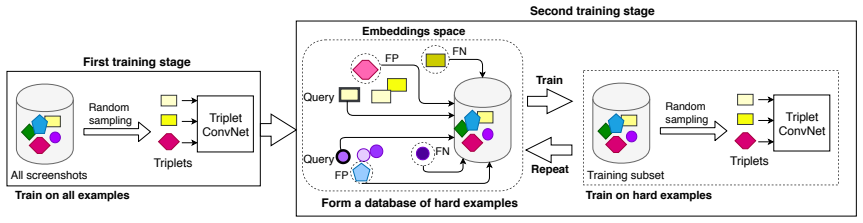
The load-bearing object is the embedding space produced by a triplet convolutional network. Three screenshots — an anchor, a positive from the same website, and a negative from a different website — pass through a shared VGG16 backbone extended with one $5\times5$ convolutional layer and a global max pooling layer, and the network is trained with the triplet loss to keep the anchor-positive distance smaller than the anchor-negative distance by a margin ($\alpha = 2.2$). Training proceeds in two stages: uniform random triplet sampling, then fine-tuning on hard examples (the farthest same-website and nearest different-website pages for each query) found with the latest checkpoint. At test time the $L_2$ distance from the query embedding to all stored trusted-list embeddings is computed; the nearest neighbour identifies the predicted target website, and a threshold on the minimum distance yields the phishing-versus-benign decision.
What would settle it
Retrain VisualPhishNet with the same architecture and protocol but leave all phishing pages out of the training data, then measure top-1 target matching on the held-out and newly crawled phishing sets; if accuracy collapses well below the reported 81% and 93.25%, the performance relies on similarity to phishing templates seen during training rather than on profiles of the trusted websites themselves.
Extended reading notes
Core claim
The paper's central claim is that phishing detection can be recast as metric learning: from screenshots alone, learn an embedding space in which any two pages of the same website are close and pages of different websites are far. A query page is then classified by nearest-neighbour distance to a pre-computed trusted-list of website profiles, and pages that fall within a threshold of some trusted profile but are served from a different domain are flagged as phishing. The claim is that these website-level profiles generalise across page designs, so a phishing page with no counterpart in the trusted list can still be matched to its target. The supporting evidence is an 81% top-1 target-matching rate and 0.9879 ROC AUC on the held-out phishing split, 93.25% matching on a later crawl of 955 fresh phishing pages tested without retraining, a gain of roughly 56 percentage points in matching accuracy over re-implemented prior visual approaches, and only small performance drops under hand-crafted perturbations and, after adversarial retraining, under FGSM noise.
Load-bearing premise
The evaluation treats the 60% of phishing pages held out from the same PhishTank crawl as genuinely unseen, but the paper only verifies that they differ visually from the trusted legitimate pages — not that they differ from the 40% of phishing pages used in training, so if same-period phishing pages share templates, the model could be recognising phishing styles rather than website identity.
Editorial extensions
If this is right
- A browser or mail provider could deploy VisualPhishNet as a proactive layer that flags a never-before-seen page the first time it appears, before any blocklist includes it; the 93.25% matching rate on a post-training PhishTank crawl is the offered evidence that this works.
- The VisualPhish dataset lets future visual-phishing detectors be trained and compared on 155 trusted websites rather than the handful used in earlier work, with supervision at the website level instead of page-to-page.
- Because attackers must stay visually close to a trusted brand to deceive users, the approach avoids the arms race that erodes URL- and HTML-heuristic detectors, whose features change as phishing kits evolve.
- The analysis that top-ranked website lists cover about 88% of collected phishing targets implies a defender could build a trusted-list for websites never yet attacked, giving the method a proactive rather than reactive role.
- Storing only 512-dimensional embeddings keeps deployment cheap: roughly 1.1 seconds per query on a CPU and 0.46 seconds on a GPU, so real-time checking against a large trusted-list is feasible.
Reading between the lines
- The temporally separated crawl (93.25% matching) is the stronger evidence for the zero-day claim; the same-period held-out split should be read with more caution, since the paper does not check that held-out phishing pages differ visually from training phishing pages.
- A direct test of the generalisation story is to withhold all phishing pages from the trusted-list during training; if matching accuracy drops sharply, part of the reported performance is phishing-template recognition rather than website-identity learning.
- The paper's own failure analysis points to an obvious extension: fusing the visual metric with OCR of on-page text or region-based logo detection would likely reduce false positives among form-heavy benign pages.
- The metric-learning framing transfers naturally to other impersonation settings where the attacker must imitate a visible brand, such as mobile app spoofing, fake storefronts, or homoglyph lookalike domains.
Signed reviews
Editorial analysis
A structured set of objections, weighed in public.
Referee Report
Summary. The paper proposes VisualPhishNet, a triplet-network embedding for webpage screenshots, and uses it for phishing detection by comparing a query screenshot against a trusted-list of legitimate website screenshots. The authors also introduce the VisualPhish dataset, which contains 155 trusted websites, 9,363 legitimate pages, 1,195 deduplicated phishing pages, and a benign test set chosen to match phishing-prone categories. On a 60% held-out split of the same PhishTank crawl, the model reports 81% top-1 target matching and a binary-classification ROC AUC of 0.9879; on 955 PhishTank pages crawled later, it reports 93.25% top-1 matching. Additional experiments cover ablations, comparisons with SURF/HOG/ORB and pretrained CNN baselines, hand-crafted perturbations, FGSM adversarial examples, browser differences, and deployment costs.
Significance. If the zero-day detection claim is supported, this is a substantial empirical contribution: it is the first deep metric-learning approach for pixel-based visual phishing detection, the VisualPhish dataset is considerably larger and more ecologically motivated than prior public sets, and the reported gains over re-implemented baselines are large. The paper also provides a careful ablation study and a useful analysis of failure modes, including a user study on whether dissimilar phishing pages are actually trusted. The dataset release is a concrete asset for future work. However, the headline claim about detecting unseen or zero-day phishing pages currently rests on matching accuracy rather than threshold-based detection on the temporally separated crawl, and the main same-crawl evaluation does not rule out learning phishing template styles.
major comments (3)
- [§6.8] The temporally separated zero-day evaluation reports only top-1 and top-5 matching accuracy (93.25% and 96%) on the 955 newly crawled PhishTank pages. The system described in §5.3 classifies a page as phishing only if its minimum distance to the trusted-list is below a threshold, so a page can be matched to the correct website and still be labeled legitimate if its distance exceeds the threshold from §6.6. The 93.25% figure is therefore compatible with a very low or even zero true-positive rate on those pages. Please report the threshold-based detection evaluation for this crawl: TPR at the chosen threshold, the full ROC curve, the FPR against a contemporaneous benign set, and a distance histogram analogous to Figure 7. In addition, state how duplicate or template-repeated screenshots were handled in the new crawl, because §4 treats deduplication as necessary for unbiased accuracy estimates.
- [§4, §6.1, Figure 2] The main held-out test set is drawn from the same PhishTank crawl as the 40% of phishing pages used in training (§4 and §6.1). Figure 2 only compares those test phishing pages with the trusted-list legitimate pages; it does not compare them with the training phishing pages. If phishing pages from the same crawl period share templates, the reported ROC AUC of 0.9879 on the same-crawl holdout may partly reflect recognition of phishing template style rather than website identity. To support the generalization claim, either measure the visual overlap between the 60% test phishing pages and the 40% training phishing pages in a fixed feature space (e.g., VGG16 nearest-neighbor distances) and show that the held-out pages are not near duplicates of training phishing pages, or base the central claim on the temporally separated experiment once it is evaluated with detection thresholds.
- [§6.8] The paper describes the newly crawled pages as harder than the dataset's phishing pages ('compared to 81% ... on the harder and more dissimilar dataset's phishing pages'), but no measure of difficulty or visual novelty is given for either set. If the new crawl happens to contain many near-duplicates of the legitimate trusted-list pages or of previously seen phishing templates, the higher matching accuracy would not demonstrate generalization to genuinely new visual appearances. Please provide the same VGG-distance analysis for the new pages, and clarify the crawl dates and the deduplication procedure so that the temporal-separation claim can be verified.
minor comments (5)
- [Figure 1 caption] The caption contains a duplicated word: 'pages that that are too similar' should be 'pages that are too similar.'
- [Table 1] The table uses blank cells to denote values identical to the final model, but the convention is easy to miss and the blank cells render inconsistently; please print the repeated values explicitly or use a clear placeholder such as '—'.
- [§6.1 and §6.8] Please state the crawl dates for both the original VisualPhish collection and the 955-page zero-day crawl; the temporal-separation argument currently rests on an unquantified 'after dataset collection' statement.
- [§5.1] The triplet loss is typeset as an inline formula and is difficult to read; please use display math with clear definitions of x_a, x_p, x_n, and the summation index.
- [§7.1] The three distance ranges used to describe successful matches (roughly 0–2, 2–4, and above 4) are stated without a formal rule for how the categories were derived; a short quantitative explanation would make the analysis reproducible.
Circularity Check
No circularity found: the learned metric is evaluated on held-out and temporally separated pages, so the central claim does not reduce to its training inputs.
full rationale
VisualPhishNet's derivation chain is not circular. The model is trained with a triplet loss to embed same-website screenshots closer than different-website screenshots; the website 'profile' is simply the learned embedding representation, and prediction is a nearest-neighbor L2-distance computation to the training embeddings. That is a standard metric-learning setup whose generalization is an empirical question, not a tautology. The headline performance is measured on phishing pages held out from training (60% of the crawled set are test-only, per Section 6.1), and the classification threshold is selected on a separate validation split before being applied to the test split (Section 6.6). The strongest independent evidence is Section 6.8: 955 PhishTank pages crawled after training are matched at 93.25% without retraining, and the Alexa top-10K benign set yields a ROC AUC of 0.974, so the zero-day claim does not reduce to a fitted input. The only circularity-adjacent concern is that the same-crawl 40/60 split may share phishing templates, and the Section 3 dissimilarity check compares test phishing pages only to legitimate trusted pages rather than to training phishing pages. This is a data-independence and evaluation-validity risk, not a by-construction equivalence between the prediction and its inputs, and the temporally separated experiment provides independent content. There are no load-bearing self-citations, no imported uniqueness theorems, and no fitted parameter renamed as a prediction.
Assumptions & free parameters
free parameters (4)
- Distance threshold (tau) =
approximately 8 (equal error rate on validation)
- Triplet loss margin (alpha) =
2.2
- Phishing training ratio =
40% of phishing pages
- Optimization hyperparameters =
learning rate 2e-5, batch size 32, 21000 + 18000 mini-batches, 75 query sets, 8 repeats
assumptions (5)
- domain assumption Phishing pages are visually similar to the legitimate pages they spoof, and attackers are motivated to keep this similarity high.
- domain assumption PhishTank reports provide accurate ground truth labels and target-website assignments.
- domain assumption Screenshots resized to 224x224 RGB and rendered in a desktop browser preserve enough visual identity for the task.
- standard math ImageNet-pretrained VGG16 features provide a useful initialization for website screenshot similarity.
- domain assumption The 683-page benign test set is representative of non-phishing pages users encounter.
Cite this review
Pith. "Pith review of VisualPhishNet: Zero-Day Phishing Website Detection by Visual Similarity." pith.science (2026). https://pith.science/paper/KRNXCX32
@misc{pith2026190900300,
  author       = {Pith},
  title        = {Pith review of: VisualPhishNet: Zero-Day Phishing Website Detection by Visual Similarity},
  year         = {2026},
  howpublished = {\url{https://pith.science/paper/KRNXCX32}},
  note         = {Machine review of arXiv:1909.00300}
}
read the original abstract
Phishing websites are still a major threat in today's Internet ecosystem. Despite numerous previous efforts, similarity-based detection methods do not offer sufficient protection for the trusted websites - in particular against unseen phishing pages. This paper contributes VisualPhishNet, a new similarity-based phishing detection framework, based on a triplet Convolutional Neural Network (CNN). VisualPhishNet learns profiles for websites in order to detect phishing websites by a similarity metric that can generalize to pages with new visual appearances. We furthermore present VisualPhish, the largest dataset to date that facilitates visual phishing detection in an ecologically valid manner. We show that our method outperforms previous visual similarity phishing detection approaches by a large margin while being robust against a range of evasion attacks.
Figures


Figures from the paper (19 more)


Forward citations
Cited by 2 Pith papers
-
PiMRef: Detecting and Explaining Ever-evolving Spear Phishing Emails with Knowledge Base Invariants
PiMRef flags spear phishing by verifying that an email's claimed sender identity matches its actual domain in a knowledge base, and that it contains a call to action.
-
A Login Page Transparency and Visual Similarity Based Zero Day Phishing Defense Protocol
A proposed login-page transparency log with visual similarity gating is undermined by the paper's own recall of 87.3%, which contradicts the claim that attackers cannot register look-alike pages.
Reference graph
Works this paper leans on
-
[1]
Sadia Afroz and Rachel Greenstadt. 2011. Phishzoo: Detecting phishing websites by looking at them. InProceedings of the IEEE International Conference on Semantic Computing
work page 2011
-
[2]
APWG. 2019. Anti Phishing Working Group report. (2019). https://www. antiphishing.org/resources/apwg-reports/
work page 2019
-
[3]
Battista Biggio and Fabio Roli. 2018. Wild patterns: Ten years after the rise of adversarial machine learning. Pattern Recognition 84 (2018), 317–331
work page 2018
-
[4]
Aaron Blum, Brad Wardman, Thamar Solorio, and Gary Warner. 2010. Lexical feature based phishing URL detection using online learning. In Proceedings of the ACM Workshop on Artificial Intelligence and Security
work page 2010
-
[5]
Ahmet Selman Bozkir and Ebru Akcapinar Sezer. 2016. Use of HOG descriptors in phishing detection. In Proceedings of the IEEE International Symposium on Digital Forensic and Security (ISDFS)
work page 2016
-
[6]
Ee Hung Chang, Kang Leng Chiew, Wei King Tiong, et al. 2013. Phishing detec- tion via identification of website identity. In Proceedings of the IEEE International Conference on IT Convergence and Security (ICITCS)
work page 2013
-
[7]
Kuan-Ta Chen, Jau-Yuan Chen, Chun-Rong Huang, and Chu-Song Chen. 2009. Fighting phishing with discriminative keypoint features.IEEE Internet Computing 13, 3 (2009), 56–63
work page 2009
-
[8]
Teh-Chung Chen, Scott Dick, and James Miller. 2010. Detecting visually similar web pages: Application to phishing detection. ACM Transactions on Internet Technology (TOIT) 10, 2 (2010), 5
work page 2010
Show all 57 references
-
[9]
Mitchell
Neil Chou, Robert Ledesma, Yuka Teraguchi, Dan Boneh, and John C. Mitchell
-
[10]
Igino Corona, Battista Biggio, Matteo Contini, Luca Piras, Roberto Corda, Mauro Mereu, Guido Mureddu, Davide Ariu, and Fabio Roli. 2017. Deltaphish: Detect- ing phishing webpages in compromised websites. In Proceedings of European Symposium on Research in Computer Security (ES...
2017
-
[11]
Firat Coskun Dalgic, Ahmet Selman Bozkir, and Murat Aydos. 2018. Phish-IRIS: A New Approach for Vision Based Brand Prediction of Phishing Web Pages via Compact Visual Descriptors. In Proceedings of the IEEE International Symposium on Multidisciplinary Studies and Innovative Te...
2018
-
[12]
Sounak Dey, Anjan Dutta, J Ignacio Toledo, Suman K Ghosh, Josep Lladós, and Umapada Pal. 2017. Signet: Convolutional siamese network for writer independent offline signature verification.arXiv preprint arXiv:1707.02131 (2017)
2017 arXiv
-
[13]
Matthew Dunlop, Stephen Groat, and David Shelly. 2010. Goldphish: Using im- ages for content-based phishing analysis. In Proceedings of the IEEE International Conference on Internet Monitoring and Protection
2010
-
[14]
Anthony Y Fu, Liu Wenyin, and Xiaotie Deng. 2006. Detecting phishing web pages with visual similarity assessment based on earth mover’s distance (EMD). IEEE Transactions on Dependable and Secure Computing 3, 4 (2006), 301–311
2006
-
[15]
Ian J Goodfellow, Jonathon Shlens, and Christian Szegedy. 2015. Explaining and harnessing adversarial examples. In International Conference on Learning Representations (ICLR)
2015
-
[16]
Kaiming He, Xiangyu Zhang, Shaoqing Ren, and Jian Sun. 2015. Delving deep into rectifiers: Surpassing human-level performance on imagenet classification. In Proceedings of the IEEE International Conference on Computer Vision (ICCV)
2015
-
[17]
Kaiming He, Xiangyu Zhang, Shaoqing Ren, and Jian Sun. 2016. Deep residual learning for image recognition. InProceedings of the IEEE Conference on Computer Vision and Pattern Recognition (CVPR)
2016
-
[18]
Chun-Ying Huang, Shang-Pin Ma, Wei-Lin Yeh, Chia-Yi Lin, and Chien-Tsung Liu. 2010. Mitigate web phishing using site signatures. In Proceedings of the IEEE Region 10 Conference (TENCON)
2010
-
[19]
Ankit Kumar Jain and B Brij Gupta. 2017. Phishing detection: analysis of visual similarity based approaches. Security and Communication Networks (2017)
2017
-
[20]
Mahmoud Khonji, Youssef Iraqi, and Andrew Jones. 2013. Phishing detection: a literature survey. IEEE Communications Surveys & Tutorials 15, 4 (2013), 2091– 2121
2013
-
[21]
Diederik P Kingma and Jimmy Ba. 2015. Adam: A method for stochastic opti- mization. In International Conference on Learning Representations (ICLR)
2015
-
[22]
Gregory Koch, Richard Zemel, and Ruslan Salakhutdinov. 2015. Siamese neural networks for one-shot image recognition. In International Conference on Machine Learning (ICML) Deep Learning Workshop
2015
-
[23]
Alex Krizhevsky, Ilya Sutskever, and Geoffrey E Hinton. 2012. Imagenet classifica- tion with deep convolutional neural networks. InAdvances in Neural Information Processing Systems
2012
-
[24]
Alexey Kurakin, Ian Goodfellow, and Samy Bengio. 2017. Adversarial machine learning at scale. In International Conference on Learning Representations (ICLR)
2017
-
[25]
Ieng-Fat Lam, Wei-Cheng Xiao, Szu-Chi Wang, and Kuan-Ta Chen. 2009. Coun- teracting phishing page polymorphism: An image layout analysis approach. In Proceedings of the International Conference and Workshops on Advances in Information Security and Assurance . Springer
2009
-
[26]
Yukun Li, Zhenguo Yang, Xu Chen, Huaping Yuan, and Wenyin Liu. 2019. A stacking model using URL and HTML features for phishing webpage detection. Future Generation Computer Systems 94 (2019), 27–39
2019
-
[27]
Min Lin, Qiang Chen, and Shuicheng Yan. 2014. Network in network. In Interna- tional Conference on Learning Representations (ICLR)
2014
-
[28]
Wenyin Liu, Xiaotie Deng, Guanglin Huang, and Anthony Y Fu. 2006. An antiphishing strategy based on visual similarity assessment. IEEE Internet Com- puting 10, 2 (2006), 58–65
2006
-
[29]
Jonathan L Long, Ning Zhang, and Trevor Darrell. 2014. Do convnets learn correspondence?. In Advances in Neural Information Processing Systems
2014
-
[30]
Laurens van der Maaten and Geoffrey Hinton. 2008. Visualizing data using t-SNE. Journal of Machine Learning Research 9, Nov (2008), 2579–2605
2008
-
[31]
Luka Malisa, Kari Kostiainen, and Srdjan Capkun. 2017. Detecting mobile ap- plication spoofing attacks by leveraging user visual similarity perception. In Proceedings of the ACM on Conference on Data and Application Security and Privacy
2017
-
[32]
Jian Mao, Pei Li, Kun Li, Tao Wei, and Zhenkai Liang. 2013. BaitAlarm: detecting phishing sites using similarity in fundamental visual features. In Proceedings of the IEEE International Conference on Intelligent Networking and Collaborative Systems
2013
-
[33]
Jian Mao, Wenqian Tian, Pei Li, Tao Wei, and Zhenkai Liang. 2017. Phishing- alarm: robust and efficient phishing detection via page component similarity. IEEE Access 5 (2017), 17020–17030
2017
-
[34]
Eric Medvet, Engin Kirda, and Christopher Kruegel. 2008. Visual-similarity-based phishing detection. In Proceedings of the 4th international conference on Security and privacy in communication netowrks
2008
-
[35]
Luong Anh Tuan Nguyen, Ba Lam To, Huu Khuong Nguyen, and Minh Hoang Nguyen. 2014. A novel approach for phishing detection using URL-based heuris- tic. In Proceedings of the IEEE International Conference on Computing, Management and Telecommunications (ComManTel)
2014
-
[36]
Adam Oest, Yeganeh Safaei, Adam Doupé, Gail-Joon Ahn, Brad Wardman, and Kevin Tyers. 2019. PhishFarm: A Scalable Framework for Measuring the Effective- ness of Evasion Techniques Against Browser Phishing Blacklists. In Proceedings of the IEEE Symposium on Security and Privacy (SP)
2019
-
[37]
Adam Oest, Yeganeh Safei, Adam Doupé, Gail-Joon Ahn, Brad Wardman, and Gary Warner. 2018. Inside a phisher’s mind: Understanding the anti-phishing ecosystem through phishing kit analysis. In APWG Symposium on Electronic Crime Research (eCrime)
2018
-
[38]
Ying Pan and Xuhua Ding. 2006. Anomaly based web phishing page detection. In Proceedings of the IEEE Annual Computer Security Applications Conference (ACSAC)
2006
-
[39]
Routhu Srinivasa Rao and Syed Taqi Ali. 2015. A computer vision technique to detect phishing attacks. In Proceedings of the IEEE International Conference on Communication Systems and Network Technologies
2015
-
[40]
Shaoqing Ren, Kaiming He, Ross Girshick, and Jian Sun. 2015. Faster r-cnn: Towards real-time object detection with region proposal networks. In Advances in Neural Information Processing Systems
2015
-
[41]
Angelo PE Rosiello, Engin Kirda, Fabrizio Ferrandi, et al. 2007. A layout-similarity- based approach for detecting phishing pages. In Proceedings of the IEEE Interna- tional Conference on Security and Privacy in Communications Networks and the Workshops (SecureComm)
2007
-
[42]
Florian Schroff, Dmitry Kalenichenko, and James Philbin. 2015. Facenet: A unified embedding for face recognition and clustering. In Proceedings of the IEEE Conference on Computer Vision and Pattern Recognition (CVPR)
2015
-
[43]
Ali Sharif Razavian, Hossein Azizpour, Josephine Sullivan, and Stefan Carlsson
-
[44]
Steve Sheng, Brad Wardman, Gary Warner, Lorrie Faith Cranor, Jason Hong, and Chengshan Zhang. 2009. An empirical analysis of phishing blacklists. In the Sixth Conference on Email and Anti-Spam (CEAS)
2009
-
[45]
Simonyan and A
K. Simonyan and A. Zisserman. 2015. Very Deep Convolutional Networks for Large-Scale Image Recognition. In International Conference on Learning Repre- sentations (ICLR)
2015
-
[46]
Yaniv Taigman, Ming Yang, Marc’Aurelio Ranzato, and Lior Wolf. 2014. Deepface: Closing the gap to human-level performance in face verification. In Proceedings of the IEEE Conference on Computer Vision and Pattern Recognition (CVPR)
2014
-
[47]
Kurt Thomas, Frank Li, Ali Zand, Jacob Barrett, Juri Ranieri, Luca Invernizzi, Yarik Markov, Oxana Comanescu, Vijay Eranti, Angelika Moscicki, et al. 2017. Data breaches, phishing, or malware?: Understanding the risks of stolen credentials. In Proceedings of the ACM SIGSAC Con...
2017
-
[48]
Liu Wenyin, Guanglin Huang, Liu Xiaoyue, Zhang Min, and Xiaotie Deng. 2005. Detection of phishing webpages based on visual similarity. In Special interest tracks and posters of the 14th international conference on World Wide Web
2005
-
[49]
Colin Whittaker, Brian Ryner, and Marria Nazif. 2010. Large-Scale Automatic Classification of Phishing Pages. In Proceedings of the Network and Distributed System Security Symposium (NDSS)
2010
-
[50]
Jonathan Woodbridge, Hyrum S Anderson, Anjum Ahuja, and Daniel Grant. 2018. Detecting Homoglyph Attacks with a Siamese Neural Network. In Proceedings 13 of the IEEE Security and Privacy Workshops
2018
-
[51]
Ning Yu, Larry Davis, and Mario Fritz. 2019. Attributing fake images to GANs: learning and analyzing GAN fingerprints. In Proceedings of the IEEE International Conference on Computer Vision (ICCV)
2019
-
[52]
Joe Yue-Hei Ng, Fan Yang, and Larry S Davis. 2015. Exploiting local features from deep networks for image retrieval. In Proceedings of the IEEE Conference on Computer Vision and Pattern Recognition (CVPR) workshops
2015
-
[53]
Haijun Zhang, Gang Liu, Tommy WS Chow, and Wenyin Liu. 2011. Textual and visual content-based anti-phishing: a Bayesian approach. IEEE Transactions on Neural Networks 22, 10 (2011), 1532–1546
2011
-
[54]
Yue Zhang, Jason I Hong, and Lorrie F Cranor. 2007. Cantina: a content-based approach to detecting phishing web sites. In Proceedings of the 16th international conference on World Wide Web
2007
-
[55]
Mouad Zouina and Benaceur Outtaj. 2017. A novel lightweight URL phishing detection system using SVM and similarity index. Human-centric Computing and Information Sciences 7, 1 (2017), 98. A EXTRA EV ALUATION AND QUALITATIVE RESULTS We here show supplementary results. In Figure...
2017
-
[2004]
In Proceedings of the Network and Distributed System Security Symposium (NDSS)
Client-side defense against web-based identity theft. In Proceedings of the Network and Distributed System Security Symposium (NDSS)
-
[2014]
In Proceedings of the IEEE Conference on Computer Vision and Pattern Recognition (CVPR) workshops
CNN features off-the-shelf: an astounding baseline for recognition. In Proceedings of the IEEE Conference on Computer Vision and Pattern Recognition (CVPR) workshops
Reviewed August 14, 2026 · model on record in the stance chip above.
Discussion (0). Continue with ORCID to comment.