Topological random alloy
Pith reviewed 2026-07-01 01:02 UTC · model grok-4.3
The pith
Doping a quantum anomalous Hall insulator produces dopant-centric chiral current loops that form topological domains even at dilute concentrations.
A machine-rendered reading of the paper's core claim, the machinery that carries it, and where it could break.
Core claim
In the topological random binary alloy model, doping a proximate quantum anomalous Hall insulator results in dopant-centric chiral current loops. Even at dilute dopant density, these can form topological domains in an otherwise trivial host and trigger a topological phase transition. Doping a topological host having chirality opposite to that of the dopants can stabilize a metallic phase in which bulk transport is mediated by inter-domain edge modes.
What carries the argument
Dopant-centric chiral current loops within the minimal model of the topological random binary alloy.
If this is right
- Topological phase transitions occur via domain formation even when dopant density is low in a trivial host.
- Opposite host-dopant chirality stabilizes a metallic phase with bulk transport through inter-domain edge modes.
- Impurity-band engineering takes the form of chiral loops whose properties depend on both host and dopant.
- The alloy realizes an exotic version of topological behavior driven by random binary doping.
Where Pith is reading between the lines
- The mechanism may extend to other classes of topological insulators when similar binary doping is applied.
- Inter-domain edge modes could produce measurable bulk conductance signatures in mesoscopic samples.
- Real-material tests would require checking whether lattice relaxation or interactions alter the loop formation.
- Controlled doping offers a design principle for engineering topological transitions in disordered systems.
Load-bearing premise
The minimal model of the topological random binary alloy captures the dominant physics of impurity effects and current loop formation without requiring additional terms for lattice relaxation, electron-electron interactions, or realistic disorder distributions beyond the binary alloy approximation.
What would settle it
Scanning tunneling microscopy images revealing localized chiral current loops around individual dopant sites, or electrical transport measurements showing a topological phase transition or metallic behavior at dilute doping levels in a quantum anomalous Hall host.
Figures


read the original abstract
Topological phases of matter are often realized in crystalline materials. To extend their understanding beyond perfect stoichiometry, we introduce a minimal model of a topological random binary alloy and show that the system realizes an exotic form of impurity-band engineering. We reveal that, in contrast to Wannier charge centers pinned by impurities in conventional semiconductors, doping a proximate quantum anomalous Hall insulator results in dopant-centric chiral current loops. The nature of such current loops is intrinsically tied to the properties of both the host and the dopant. We demonstrate that, even at dilute dopant density, these current loops can form topological domains in an otherwise trivial host and trigger a topological phase transition. On the other hand, doping a topological host having chirality opposite to that of the dopants can unexpectedly stabilize a metallic phase in which bulk transport is mediated by inter-domain edge modes.
Editorial analysis
A structured set of objections, weighed in public.
Referee Report
Summary. The manuscript introduces a minimal model of a topological random binary alloy. It claims that doping a proximate quantum anomalous Hall insulator produces dopant-centric chiral current loops whose properties depend on both host and dopant. Even at dilute concentrations these loops form topological domains in a trivial host and drive a topological phase transition. Doping a topological host whose chirality is opposite to that of the dopants stabilizes a metallic phase in which bulk transport occurs via inter-domain edge modes. The results are obtained within the explicitly minimal random-binary-alloy Hamiltonian.
Significance. If the numerical and analytic results inside the minimal model are robust, the work supplies a concrete mechanism for impurity-band engineering of topological phases and identifies a route to a disorder-stabilized metallic phase mediated by inter-domain modes. The explicit construction of dopant-centric loops and their domain formation at low density is a clear advance over conventional Wannier-center pinning pictures and provides falsifiable predictions for transport in doped topological materials.
minor comments (1)
- The abstract and introduction would benefit from a one-sentence statement of the model Hamiltonian (e.g., the form of the on-site and hopping terms) so that readers can immediately place the current-loop construction in context.
Simulated Author's Rebuttal
We thank the referee for their positive assessment of the manuscript and for recommending acceptance. The summary and significance statements accurately capture the central results on dopant-centric chiral loops and the resulting topological and metallic phases.
Circularity Check
No significant circularity
full rationale
The paper introduces a newly defined minimal model of a topological random binary alloy and demonstrates emergent phenomena (dopant-centric chiral loops, domain formation, inter-domain metallic transport) as direct consequences of calculations or simulations performed inside that explicit model. No load-bearing step reduces by construction to a fitted parameter, self-referential definition, or self-citation chain; the abstract and described claims treat the model as an independent starting point whose outputs are then inspected. This is a standard self-contained theoretical construction with no evidence of the enumerated circularity patterns.
Axiom & Free-Parameter Ledger
Reference graph
Works this paper leans on
-
[1]
local Chern marker
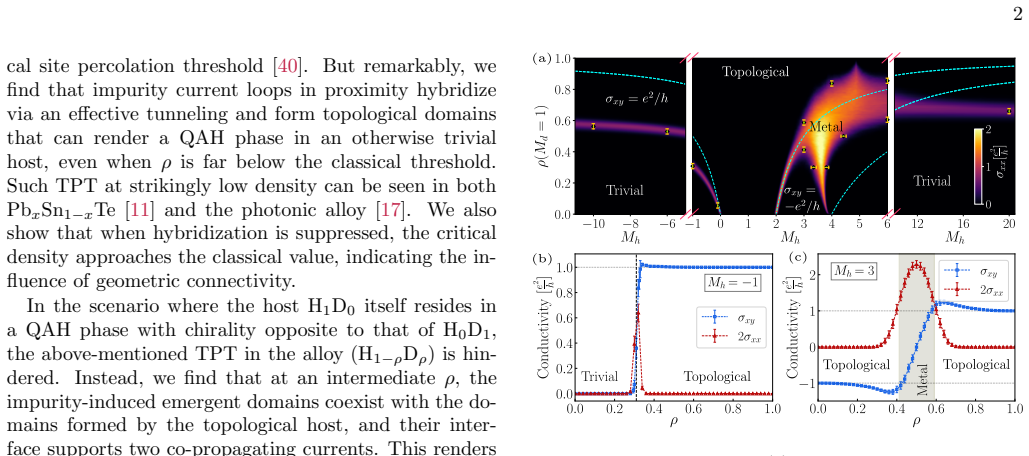
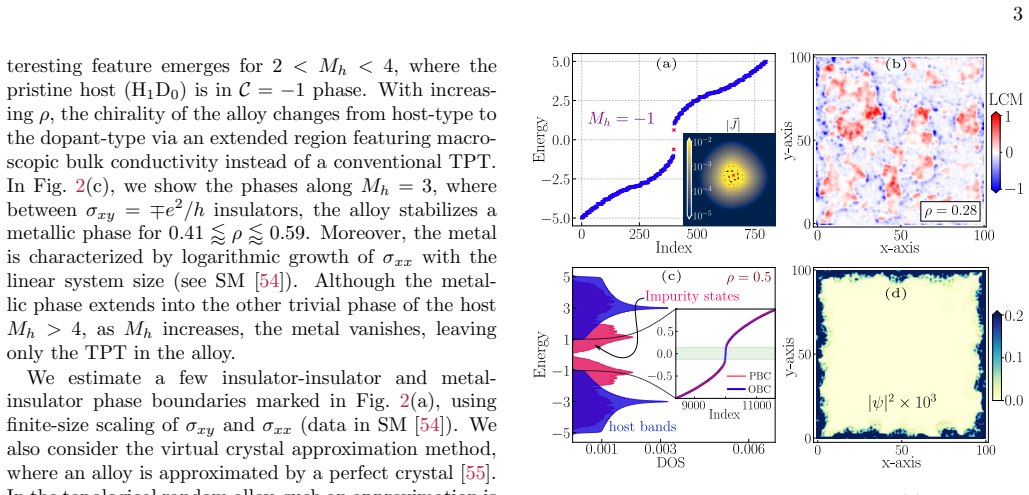
for σxy phase diagram). Moreover, we observe that when the host energy scale Mh is comparatively small, say Mh = −0.1, even a small amount of dopants, as low as ρ ∼ 0.05, can trigger the TPT in the alloy (see SM [54]). As Mh becomes further negative, ρc flows towards the classical site percolation threshold ∼ 0.6 [40]. When the host itself is topological ...
-
[2]
S. M. Sze, Y. Li, and K. K. Ng, Physics of semiconductor devices (John wiley & sons, 2021)
2021
-
[3]
Grundmann, The physics of semiconductors: an in- troduction including devices and nanophysics (Springer, 2006)
M. Grundmann, The physics of semiconductors: an in- troduction including devices and nanophysics (Springer, 2006)
2006
-
[4]
M. Z. Hasan and C. L. Kane, Colloquium : Topological insulators, Rev. Mod. Phys. 82, 3045 (2010)
2010
-
[5]
Qi and S.-C
X.-L. Qi and S.-C. Zhang, Topological insulators and su- perconductors, Rev. Mod. Phys. 83, 1057 (2011)
2011
-
[6]
Shen, Topological insulators: Dirac equation in con- densed matters , Vol
S.-Q. Shen, Topological insulators: Dirac equation in con- densed matters , Vol. 174 (Springer Science & Business Media, 2013)
2013
-
[7]
B. A. Bernevig and T. L. Hughes, Topological insula- tors and topological superconductors (Princeton Univer- sity Press, 2013)
2013
-
[8]
Bradlyn, L
B. Bradlyn, L. Elcoro, J. Cano, M. G. Vergniory, Z. Wang, C. Felser, M. I. Aroyo, and B. A. Bernevig, Topological quantum chemistry, Nature 547, 298–305 (2017)
2017
-
[9]
Topological materials database, https:// topologicalquantumchemistry.com
-
[10]
Hsieh, D
D. Hsieh, D. Qian, L. Wray, Y. Xia, Y. S. Hor, R. J. Cava, and M. Z. Hasan, A topological dirac insulator in a quantum spin hall phase, Nature 452, 970 (2008)
2008
-
[11]
S.-Y. Xu, C. Liu, N. Alidoust, M. Neupane, D. Qian, I. Belopolski, et al. , Observation of a topological crys- talline insulator phase and topological phase transition in Pb1−xSnxTe, Nature communications 3, 1192 (2012)
2012
-
[12]
C. Yan, J. Liu, Y. Zang, J. Wang, Z. Wang, et al. , Ex- perimental observation of dirac-like surface states and topological phase transition in Pb 1−xSnxTe(111) films, Phys. Rev. Lett. 112, 186801 (2014)
2014
-
[13]
Chang, J
C. Chang, J. Zhang, X. Feng, J. Shen, Z. Zhang, M. Guo, K. Li, Y. Ou, P. Wei, L. Wang, et al. , Experimental ob- servation of the quantum anomalous hall effect in a mag- netic topological insulator, Science 340, 167 (2013)
2013
-
[14]
M. Mogi, R. Yoshimi, A. Tsukazaki, et al. , Mag- netic modulation doping in topological insulators toward higher-temperature quantum anomalous hall effect, Ap- plied Physics Letters 107, 182401 (2015)
2015
-
[15]
X. Kou, L. Pan, J. Wang, Y. Fan, E. S. Choi, W. Lee, T. Nie, K. Murata, Q. Shao, S. Zhang, et al. , Metal- to-insulator switching in quantum anomalous hall states, Nature communications 6, 8474 (2015)
2015
-
[16]
K. He, Y. Wang, and Q.-K. Xue, Quantum anomalous hall effect, National Science Review 1, 38 (2013)
2013
-
[17]
Liu, S.-C
C.-X. Liu, S.-C. Zhang, and X.-L. Qi, The quantum anomalous hall effect: Theory and experiment, Annual Review of Condensed Matter Physics 7, 301 (2016)
2016
-
[18]
T. Qu, M. Wang, X. Cheng, X. Cui, R.-Y. Zhang, Z.-Q. Zhang, L. Zhang, J. Chen, and C. T. Chan, Topological photonic alloy, Phys. Rev. Lett. 132, 223802 (2024)
2024
-
[19]
X. Shi, T. Qu, M. Wang, L. Zhang, and J. Chen, Coex- istence of chiral edge and localized states in a high chern number topological photonic alloy, ACS Photonics 11, 5180 (2024)
2024
-
[20]
Z. Wang, X. Xi, and Z. Gao, Topological photonic quasicrystal alloy, Applied Physics Letters 125, 122201 (2024)
2024
-
[21]
Huang, Z
B. Huang, Z. Wang, and Z. Gao, Amorphous topological photonic alloys, Phys. Rev. B 112, 014204 (2025)
2025
-
[22]
X. Wu, T. Qu, X. Shi, L. Zhang, and J. Chen, Magnetic doping-induced second-order and first-order topological phase transition in the photonic alloy, Phys. Rev. B 113, 104205 (2026)
2026
-
[23]
Chadov, J
S. Chadov, J. Kiss, J. K¨ ubler, and C. Felser, Topological phase transition in bulk materials described by the co- herent potential approximation technique, Physica Sta- tus Solidi (RRL) 7, 82 (2013)
2013
-
[24]
Varjas, M
D. Varjas, M. Fruchart, A. R. Akhmerov, and P. M. Perez-Piskunow, Computation of topological phase dia- gram of disordered Pb1−xSnxTe using the kernel polyno- mial method, Phys. Rev. Res. 2, 013229 (2020)
2020
-
[25]
A. J. Ur´ ıa-´Alvarez and J. J. Palacios, Amorphization- induced topological and insulator-metal transitions in bidimensional BixSb1−x alloys, Phys. Rev. Res.7, 043263 (2025)
2025
-
[26]
Li, R.-L
J. Li, R.-L. Chu, J. K. Jain, and S.-Q. Shen, Topological anderson insulator, Phys. Rev. Lett. 102, 136806 (2009)
2009
-
[27]
C. W. Groth, M. Wimmer, A. R. Akhmerov, J. Tworzyd lo, and C. W. J. Beenakker, Theory of the topological anderson insulator, Phys. Rev. Lett. 103, 196805 (2009)
2009
-
[28]
Kobayashi, T
K. Kobayashi, T. Ohtsuki, and K.-I. Imura, Disordered weak and strong topological insulators, Phys. Rev. Lett. 110, 236803 (2013)
2013
-
[29]
Agarwala and V
A. Agarwala and V. B. Shenoy, Topological insulators in amorphous systems, Phys. Rev. Lett.118, 236402 (2017)
2017
-
[30]
M. N. Ivaki, I. Sahlberg, and T. Ojanen, Criticality in amorphous topological matter: Beyond the universal scaling paradigm, Phys. Rev. Res. 2, 043301 (2020)
2020
-
[31]
Mondal, S
S. Mondal, S. Pachhal, and A. Agarwala, Percolation transition in a topological phase, Phys. Rev. B 108, L220201 (2023)
2023
-
[32]
S. Mondal and A. Agarwala, Topological phase transi- tion under infinite randomness (2025), arXiv:2506.19913 [cond-mat.dis-nn]
-
[33]
Neehus, F
A. Neehus, F. Pollmann, and J. Knolle, Genuine topolog- ical anderson insulator from impurity induced chirality reversal, Phys. Rev. Lett. 135, 126604 (2025)
2025
-
[34]
Recent progress on disorder-induced topological phases
D.-W. Zhang and L.-Z. Tang, Recent progress on disorder-induced topological phases (2026), arXiv:2601.13619 [cond-mat.dis-nn]
work page internal anchor Pith review Pith/arXiv arXiv 2026
-
[35]
St¨ utzer, Y
S. St¨ utzer, Y. Plotnik, Y. Lumer, P. Titum, N. H. Lind- ner, M. Segev, M. C. Rechtsman, and A. Szameit, Pho- tonic topological anderson insulators, Nature 560, 461 (2018)
2018
-
[36]
G.-G. Liu, Y. Yang, X. Ren, H. Xue, X. Lin, Y.-H. Hu, H.-x. Sun, B. Peng, P. Zhou, Y. Chong, and B. Zhang, 6 Topological anderson insulator in disordered photonic crystals, Phys. Rev. Lett. 125, 133603 (2020)
2020
-
[37]
Li, J.-H
K. Li, J.-H. Wang, Y.-B. Yang, and Y. Xu, Symmetry- protected topological phases in a rydberg glass, Phys. Rev. Lett. 127, 263004 (2021)
2021
-
[38]
Zhou, G.-G
P. Zhou, G.-G. Liu, X. Ren, Y. Yang, H. Xue, L. Bi, L. Deng, Y. Chong, and B. Zhang, Photonic amorphous topological insulator, Light: Science & Applications 9, 133 (2020)
2020
-
[39]
Corbae, S
P. Corbae, S. Ciocys, D. Varjas, E. Kennedy, S. Zelt- mann, M. Molina-Ruiz, S. M. Griffin, C. Jozwiak, Z. Chen, L.-W. Wang, et al. , Observation of spin- momentum locked surface states in amorphous Bi 2Se3, Nature Materials 22, 200 (2023)
2023
-
[40]
Zhang, P
Z. Zhang, P. Delplace, and R. Fleury, Anomalous topo- logical waves in strongly amorphous scattering networks, Science Advances 9, 3186 (2023)
2023
-
[41]
Aharony and D
A. Aharony and D. Stauffer, Introduction To Percolation Theory (Taylor & Francis, 2003)
2003
-
[42]
Senthil and M
T. Senthil and M. P. A. Fisher, Quasiparticle localization in superconductors with spin-orbit scattering, Phys. Rev. B 61, 9690 (2000)
2000
-
[43]
J. T. Chalker, N. Read, V. Kagalovsky, B. Horovitz, Y. Avishai, and A. W. W. Ludwig, Thermal metal in network models of a disordered two-dimensional super- conductor, Phys. Rev. B 65, 012506 (2001)
2001
-
[44]
Mildenberger, F
A. Mildenberger, F. Evers, A. D. Mirlin, and J. T. Chalker, Density of quasiparticle states for a two- dimensional disordered system: Metallic, insulating, and critical behavior in the class-d thermal quantum hall ef- fect, Phys. Rev. B 75, 245321 (2007)
2007
-
[45]
M. V. Medvedyeva, J. Tworzyd lo, and C. W. J. Beenakker, Effective mass and tricritical point for lat- tice fermions localized by a random mass, Phys. Rev. B 81, 214203 (2010)
2010
-
[46]
C. R. Laumann, A. W. W. Ludwig, D. A. Huse, and S. Trebst, Disorder-induced majorana metal in interact- ing non-abelian anyon systems, Phys. Rev. B 85, 161301 (2012)
2012
-
[47]
T. Wang, Z. Pan, T. Ohtsuki, I. A. Gruzberg, and R. Shindou, Multicriticality of two-dimensional class-d disordered topological superconductors, Phys. Rev. B 104, 184201 (2021)
2021
-
[48]
S. Pachhal, N. P. Nayak, S. Bera, and A. Agarwala, Diffusive metal in a percolating chern insulator (2025), arXiv:2512.24050 [cond-mat.mes-hall]
-
[49]
Altland and M
A. Altland and M. R. Zirnbauer, Nonstandard symme- try classes in mesoscopic normal-superconducting hybrid structures, Phys. Rev. B 55, 1142 (1997)
1997
-
[50]
Kitaev, Periodic table for topological insulators and superconductors, AIP Conference Proceedings 1134, 22 (2009)
A. Kitaev, Periodic table for topological insulators and superconductors, AIP Conference Proceedings 1134, 22 (2009)
2009
-
[51]
A. W. W. Ludwig, Topological phases: classification of topological insulators and superconductors of non- interacting fermions, and beyond, Physica Scripta 2016, 014001 (2016)
2016
-
[52]
B. A. Bernevig, T. L. Hughes, and S.-C. Zhang, Quantum spin hall effect and topological phase transition in HgTe quantum wells, science 314, 1757 (2006)
2006
-
[53]
Qi, Y.-S
X.-L. Qi, Y.-S. Wu, and S.-C. Zhang, Topological quan- tization of the spin hall effect in two-dimensional param- agnetic semiconductors, Phys. Rev. B 74, 085308 (2006)
2006
-
[54]
C. W. Groth, M. Wimmer, A. R. Akhmerov, and X. Waintal, Kwant: a software package for quantum transport, New Journal of Physics 16, 063065 (2014)
2014
-
[55]
See supplemental material for details on conductivity cal- culation, metallic feature, phase boundaries, formation current loop, and other additional calculations
-
[56]
Soven, Coherent-potential model of substitutional dis- ordered alloys, Phys
P. Soven, Coherent-potential model of substitutional dis- ordered alloys, Phys. Rev. 156, 809 (1967)
1967
-
[57]
V. B. Jha, G. Rani, and R. Ganesh, Impurity-induced current in a chern insulator, Phys. Rev. B 95, 115434 (2017)
2017
-
[58]
R. Queiroz, R. Ilan, Z. Song, B. A. Bernevig, and A. Stern, Ring states in topological materials (2024), arXiv:2406.03529 [cond-mat.mes-hall]
-
[59]
Bianco and R
R. Bianco and R. Resta, Mapping topological order in coordinate space, Phys. Rev. B 84, 241106(R) (2011)
2011
-
[60]
J. T. Chalker and P. D. Coddington, Percolation, quan- tum tunnelling and the integer hall effect, Journal of Physics C: Solid State Physics 21, 2665 (1988)
1988
-
[61]
Oroszl´ any, P
L. Oroszl´ any, P. Rakyta, A. Korm´ anyos, C. J. Lambert, and J. Cserti, Theory of snake states in graphene, Phys. Rev. B 77, 081403(R) (2008)
2008
-
[62]
Evers and A
F. Evers and A. D. Mirlin, Anderson transitions, Rev. Mod. Phys. 80, 1355 (2008)
2008
-
[63]
Zhang, C
T. Zhang, C. Tian, and P. Sheng, Quantum diffusion of massive dirac fermions induced by symmetry breaking, Phys. Rev. B 104, 075427 (2021)
2021
-
[64]
P. M. Ostrovsky, I. V. Gornyi, and A. D. Mirlin, Quan- tum criticality and minimal conductivity in graphene with long-range disorder, Phys. Rev. Lett. 98, 256801 (2007)
2007
-
[65]
J. H. Bardarson, J. Tworzyd lo, P. W. Brouwer, and C. W. J. Beenakker, One-parameter scaling at the dirac point in graphene, Phys. Rev. Lett. 99, 106801 (2007)
2007
-
[66]
Nomura, M
K. Nomura, M. Koshino, and S. Ryu, Topological de- localization of two-dimensional massless dirac fermions, Phys. Rev. Lett. 99, 146806 (2007)
2007
-
[67]
P. W. Anderson, Localized magnetic states in metals, Phys. Rev. 124, 41 (1961)
1961
-
[68]
Datta, Electronic transport in mesoscopic systems (Cambridge university press, 1997)
S. Datta, Electronic transport in mesoscopic systems (Cambridge university press, 1997)
1997
-
[69]
Topological random alloy
H. Ji, P. Zhou, N. F. Yuan, H. Jiang, H. Liu, and X. Xie, Anomalous open orbits in hofstadter spectrum of chern insulator, Science China Physics, Mechanics & Astron- omy 68, 237211 (2025). 7 Supplemental Material to “Topological random alloy” Subrata Pachhal1, Aziz Hasan 2, Adhip Agarwala1 1Department of Physics, Indian Institute of Technology Kanpur, Kal...
2025
-
[70]
Given a host insulator, evaluate two in-gap states for a single impurity at position r1: |α1⟩ and |β1⟩
-
[71]
Independently solve for another impurity at r2 to get |α2⟩ and |β2⟩
-
[72]
This will give four in-gap modes, ϵn, with cor- responding wavefunctions, |ψn⟩
Now consider both the impurity together at r1 and r2. This will give four in-gap modes, ϵn, with cor- responding wavefunctions, |ψn⟩
-
[73]
The Hamiltonian of the two impurities in the diag- onal basis is: H(r1, r2) =P4 n=1 ϵn|ψn⟩⟨ψn|
-
[74]
local Chern marker
Project H(r1, r2) in the basis of the indepen- dent single impurity problem as: Heff.(r1, r2) = U †H(r1, r2)U, where U is the unitary matrix given by: |α1⟩ | β1⟩ | α2⟩ | β2⟩ . 11 FIG. S8. Effective hopping structure: (a) For Mh = −1 and Md = 1, hopping parameter tx/y/z (component of Pauli matrices σx/y/z in the effective Hamiltonian) between two impuritie...
discussion (0)
Sign in with ORCID, Apple, or X to comment. Anyone can read and Pith papers without signing in.