Seeing What Matters: Perceptual Wrapper with Common Randomness for 3D Gaussian Splatting
Pith reviewed 2026-06-27 10:07 UTC · model grok-4.3
The pith
A lightweight network conditioned on random noise enhances perceptual textures in 3D Gaussian Splatting outputs.
A machine-rendered reading of the paper's core claim, the machinery that carries it, and where it could break.
Core claim
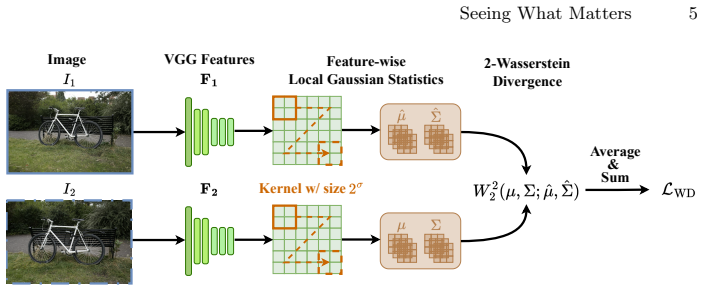
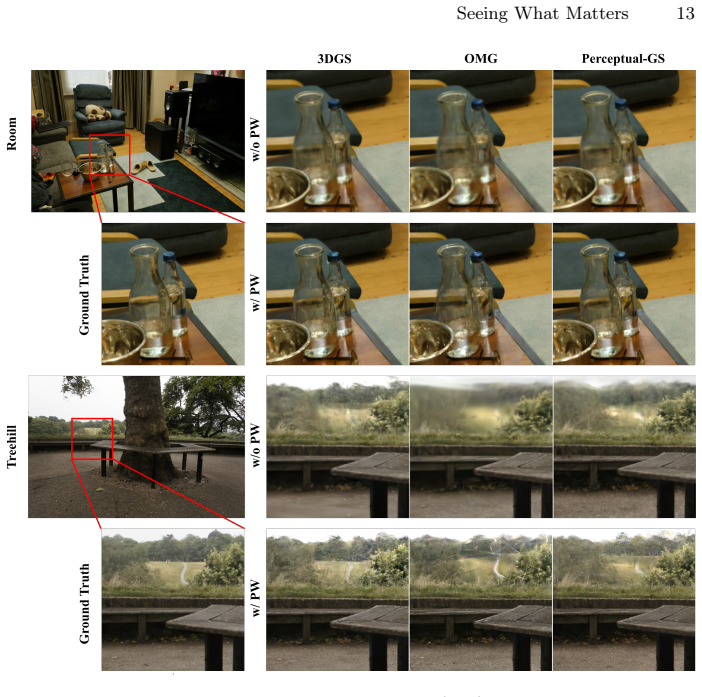
We propose a versatile 2D perceptual wrapper that enhances the rendered outputs of existing 3DGS representations in a content- and view-dependent manner. Our method leverages a lightweight synthesis network conditioned on pseudo-random Gaussian noise to synthesize perceptually plausible textures. Supervised by Wasserstein Distortion, the network learns to match local feature statistics rather than strictly enforcing pixel-wise reconstruction fidelity, effectively mitigating the blurriness inherent in standard frameworks.
What carries the argument
Lightweight synthesis network conditioned on pseudo-random Gaussian noise and supervised by Wasserstein Distortion to match local feature statistics.
If this is right
- The wrapper improves perceptual quality for vanilla 3DGS representations.
- It enables memory-constrained 3DGS to achieve higher quality at reduced model sizes.
- RDO-optimized 3DGS benefits from further size reductions with maintained or improved perceptual quality.
- The method mitigates blurriness without requiring changes to the underlying 3DGS pipeline.
Where Pith is reading between the lines
- This technique could extend to other view synthesis methods that suffer from texture loss.
- Using common randomness may help maintain consistency in other multi-view rendering tasks.
- Exploring alternative conditioning signals beyond Gaussian noise could further improve results.
Load-bearing premise
That conditioning a lightweight synthesis network on pseudo-random Gaussian noise will produce content- and view-dependent textures that remain consistent across views and do not introduce new artifacts when applied to existing 3DGS representations.
What would settle it
Observing view-inconsistent artifacts or new visual defects in rendered sequences after applying the wrapper would disprove the method's reliability.
Figures






read the original abstract
While 3D Gaussian Splatting (3DGS) achieves impressive real-time rendering, it frequently struggles to synthesize high-frequency textures, a limitation heavily exacerbated in memory-constrained and rate-distortion-optimized (RDO) pipelines. To address this, we propose a versatile 2D perceptual wrapper that enhances the rendered outputs of existing 3DGS representations in a content- and view-dependent manner. Our method leverages a lightweight synthesis network conditioned on pseudo-random Gaussian noise to synthesize perceptually plausible textures. Supervised by Wasserstein Distortion, the network learns to match local feature statistics rather than strictly enforcing pixel-wise reconstruction fidelity, effectively mitigating the blurriness inherent in standard frameworks. We demonstrate the broad applicability of our plug-and-play approach across vanilla, memory-constrained, and RDO 3DGS methods. Comprehensive subjective and objective experiments confirm that our method significantly improves over existing baselines, yielding superior perceptual quality at sharply reduced file or model sizes.
Editorial analysis
A structured set of objections, weighed in public.
Referee Report
Summary. The manuscript proposes a 2D perceptual wrapper for 3D Gaussian Splatting that applies a lightweight synthesis network conditioned on pseudo-random Gaussian noise (with common randomness) to rendered outputs. The network is supervised solely by Wasserstein Distortion on local feature statistics to synthesize high-frequency textures in a content- and view-dependent manner without enforcing pixel-wise fidelity. The approach is presented as a plug-and-play enhancement applicable to vanilla, memory-constrained, and RDO 3DGS pipelines, with the abstract asserting that comprehensive subjective and objective experiments demonstrate superior perceptual quality at sharply reduced file or model sizes.
Significance. If the shared pseudo-random noise successfully enforces view-consistent textures without introducing flickering or ghosting, the wrapper would provide a practical, low-overhead method for perceptual enhancement of existing 3DGS representations, particularly valuable in rate-distortion-optimized and memory-constrained regimes where increasing model size is undesirable.
major comments (2)
- [Abstract] Abstract: the central claim that 'comprehensive subjective and objective experiments confirm that our method significantly improves over existing baselines' is unsupported by any quantitative results, metrics, datasets, ablation studies, or error analysis, rendering the asserted superiority unverifiable from the manuscript.
- [Abstract] Abstract: the method's reliance on conditioning a synthesis network on pseudo-random Gaussian noise with common randomness to produce view-consistent textures lacks any described mechanism (e.g., 3D-position-dependent noise generation or explicit multi-view consistency loss) that would guarantee identical high-frequency output for the same surface point across camera angles, directly undermining the no-new-artifacts assumption required for the plug-and-play claim.
Simulated Author's Rebuttal
We thank the referee for the constructive feedback. We address the two major comments on the abstract point by point below.
read point-by-point responses
-
Referee: [Abstract] Abstract: the central claim that 'comprehensive subjective and objective experiments confirm that our method significantly improves over existing baselines' is unsupported by any quantitative results, metrics, datasets, ablation studies, or error analysis, rendering the asserted superiority unverifiable from the manuscript.
Authors: The full manuscript contains Section 4 with objective metrics (LPIPS, FID), subjective user studies, ablation studies, and results on standard datasets including Mip-NeRF 360 and Tanks & Temples. The abstract is a high-level summary of those findings. We will revise the abstract to explicitly name the key metrics, datasets, and improvement margins so the claim is directly verifiable. revision: yes
-
Referee: [Abstract] Abstract: the method's reliance on conditioning a synthesis network on pseudo-random Gaussian noise with common randomness to produce view-consistent textures lacks any described mechanism (e.g., 3D-position-dependent noise generation or explicit multi-view consistency loss) that would guarantee identical high-frequency output for the same surface point across camera angles, directly undermining the no-new-artifacts assumption required for the plug-and-play claim.
Authors: Section 3.2 explains that the pseudo-random Gaussian noise is generated deterministically from each 3D Gaussian's position and a fixed global seed, ensuring identical noise input (and thus identical high-frequency synthesis) for the same surface point regardless of viewpoint. No explicit multi-view loss is used because the 3D-position conditioning already enforces consistency. We will add a clarifying paragraph and pseudocode in the revised manuscript to make this mechanism more explicit. revision: partial
Circularity Check
No circularity: empirical plug-in method with external supervision
full rationale
The paper presents a lightweight synthesis network as a plug-and-play wrapper for 3DGS outputs, conditioned on pseudo-random noise and trained to match local feature statistics via Wasserstein Distortion. No equations, derivations, or predictions are claimed that reduce by construction to fitted parameters or self-citations. Improvements are asserted via comprehensive subjective/objective experiments on vanilla, memory-constrained, and RDO 3DGS baselines. The approach is self-contained against external benchmarks with no load-bearing self-citation chains or self-definitional steps visible in the abstract or described method.
Axiom & Free-Parameter Ledger
Reference graph
Works this paper leans on
-
[1]
compression.cc/(2025), last accessed 2026/03/04 Seeing What Matters 15
7th challenge on learned image compression (CLIC 2025).https://clic2025. compression.cc/(2025), last accessed 2026/03/04 Seeing What Matters 15
2025
-
[2]
arXiv preprint arXiv:2406.18214 (2024)
Ali, M.S., Qamar, M., Bae, S.H., Tartaglione, E.: Trimming the fat: Efficient com- pression of 3d gaussian splats through pruning. arXiv preprint arXiv:2406.18214 (2024)
arXiv 2024
-
[3]
IEEE Transactions on Image Processing32, 5046–5059 (2023).https://doi.org/10.1109/TIP.2023
Ameur, Z., Hamidouche, W., François, E., Radosavljević, M., Menard, D., De- marty, C.H.: Deep-based film grain removal and synthesis. IEEE Transactions on Image Processing32, 5046–5059 (2023).https://doi.org/10.1109/TIP.2023. 3308726
-
[4]
RLAIF-V: open-source AI feedback leads to super GPT-4V trustworthiness
Ballé, J., Versari, L., Dupont, E., Kim, H., Bauer, M.: Good, cheap, and fast: Overfitted image compression with wasserstein distortion. In: 2025 IEEE/CVF Conference on Computer Vision and Pattern Recognition (CVPR). pp. 23259– 23268 (2025).https://doi.org/10.1109/CVPR52734.2025.02166
-
[5]
Barron, J.T., Mildenhall, B., Verbin, D., Srinivasan, P.P., Hedman, P.: Mip-nerf 360: Unbounded anti-aliased neural radiance fields. In: 2022 IEEE/CVF Confer- ence on Computer Vision and Pattern Recognition (CVPR). pp. 5460–5469 (2022). https://doi.org/10.1109/CVPR52688.2022.00539
-
[6]
Journal of Computational and Graphical Statistics21(1), 174–196 (2010)
Caron, F., Doucet, A.: Efficient bayesian inference for generalized bradley–terry models. Journal of Computational and Graphical Statistics21(1), 174–196 (2010)
2010
-
[7]
In: European Conference on Computer Vision (2024)
Chen,Y.,Wu,Q.,Lin,W.,Harandi,M.,Cai,J.:Hac:Hash-gridassistedcontextfor 3d gaussian splatting compression. In: European Conference on Computer Vision (2024)
2024
-
[8]
Chen, Y., Wu, Q., Lin, W., Harandi, M., Cai, J.: Hac++: Towards 100x compres- sion of 3d gaussian splatting. IEEE Transactions on Pattern Analysis and Machine Intelligence47(11), 10210–10226 (2025).https://doi.org/10.1109/TPAMI.2025. 3594066
-
[9]
In: Proceedings of the IEEE/CVF Conference on Computer Vision and Pattern Recognition (CVPR)
Chen, Y., Jiang, J., Jiang, K., Tang, X., Li, Z., Liu, X., Nie, Y.: Dashgaussian: Optimizing 3d gaussian splatting in 200 seconds. In: Proceedings of the IEEE/CVF Conference on Computer Vision and Pattern Recognition (CVPR). pp. 11146– 11155 (June 2025)
2025
-
[10]
Ding, K., Ma, K., Wang, S., Simoncelli, E.P.: Image quality assessment: Unify- ing structure and texture similarity. IEEE Transactions on Pattern Analysis and Machine Intelligence44(5), 2567–2581 (2022).https://doi.org/10.1109/TPAMI. 2020.3045810
-
[11]
Advances in neural information processing systems37, 140138–140158 (2024)
Fan, Z., Wang, K., Wen, K., Zhu, Z., Xu, D., Wang, Z.: Lightgaussian: Unbounded 3d gaussian compression with 15x reduction and 200+ fps. Advances in neural information processing systems37, 140138–140158 (2024)
2024
-
[12]
In: European conference on computer vision
Fang,G.,Wang,B.:Mini-splatting:Representingsceneswithaconstrainednumber of gaussians. In: European conference on computer vision. pp. 165–181. Springer (2024)
2024
-
[13]
Proceedings of the ACM on Computer Graphics and Interactive Techniques8(1), 1–21 (2025)
Franke, L., Fink, L., Stamminger, M.: Vr-splatting: Foveated radiance field ren- dering via 3d gaussian splatting and neural points. Proceedings of the ACM on Computer Graphics and Interactive Techniques8(1), 1–21 (2025)
2025
-
[14]
In: European Conference on Computer Vision
Girish, S., Gupta, K., Shrivastava, A.: Eagles: Efficient accelerated 3d gaussians with lightweight encodings. In: European Conference on Computer Vision. pp. 54–71. Springer (2024)
2024
-
[15]
RLAIF-V: open-source AI feedback leads to super GPT-4V trustworthiness
Hanson, A., Tu, A., Lin, G., Singla, V., Zwicker, M., Goldstein, T.: Speedy- splat: Fast 3d gaussian splatting with sparse pixels and sparse primitives. In: 2025 IEEE/CVF Conference on Computer Vision and Pattern Recognition (CVPR). pp. 21537–21546 (2025).https://doi.org/10.1109/CVPR52734.2025.02006
-
[16]
In: Proceedings of the Computer Vision and Pattern Recognition Conference
Hanson, A., Tu, A., Singla, V., Jayawardhana, M., Zwicker, M., Goldstein, T.: Pup 3d-gs: Principled uncertainty pruning for 3d gaussian splatting. In: Proceedings of the Computer Vision and Pattern Recognition Conference. pp. 5949–5958 (2025) 16 H.-B. Yang et al
2025
-
[17]
ACM Trans
Hedman, P., Philip, J., Price, T., Frahm, J.M., Drettakis, G., Brostow, G.: Deep blending for free-viewpoint image-based rendering. ACM Trans. Graph.37(6) (Dec 2018)
2018
-
[18]
ACM Transactions on Graphics42(4) (July 2023),https://repo-sam.inria.fr/fungraph/3d-gaussian-splatting/
Kerbl, B., Kopanas, G., Leimkühler, T., Drettakis, G.: 3d gaussian splatting for real-time radiance field rendering. ACM Transactions on Graphics42(4) (July 2023),https://repo-sam.inria.fr/fungraph/3d-gaussian-splatting/
2023
-
[19]
Kim, H., Bauer, M., Theis, L., Schwarz, J.R., Dupont, E.: C3: High-performance and low-complexity neural compression from a single image or video. In: 2024 IEEE/CVF Conference on Computer Vision and Pattern Recognition (CVPR). pp. 9347–9358 (2024).https://doi.org/10.1109/CVPR52733.2024.00893
-
[20]
ACM Trans
Knapitsch, A., Park, J., Zhou, Q.Y., Koltun, V.: Tanks and temples: benchmarking large-scale scene reconstruction. ACM Trans. Graph.36(4) (Jul 2017)
2017
-
[21]
Ladune, T., Philippe, P., Henry, F., Clare, G., Leguay, T.: Cool-chic: Coordinate- based low complexity hierarchical image codec. In: 2023 IEEE/CVF International Conference on Computer Vision (ICCV). pp. 13469–13476 (2023).https://doi. org/10.1109/ICCV51070.2023.01243
-
[22]
In: The Thirty-ninth Annual Conference on Neural Information Processing Systems (2025), https://openreview.net/forum?id=GMiC4ccyHn
Lee, J.C., Ko, J.H., Park, E.: Optimized minimal 3d gaussian splatting. In: The Thirty-ninth Annual Conference on Neural Information Processing Systems (2025), https://openreview.net/forum?id=GMiC4ccyHn
2025
-
[23]
In: Proceedings of the IEEE/CVF Conference on Computer Vision and Pattern Recognition
Lee, J.C., Rho, D., Sun, X., Ko, J.H., Park, E.: Compact 3d gaussian representation for radiance field. In: Proceedings of the IEEE/CVF Conference on Computer Vision and Pattern Recognition. pp. 21719–21728 (2024)
2024
-
[24]
Lin,W.,Feng,Y.,Zhu,Y.:Metasapiens:Real-timeneuralrenderingwithefficiency- awarepruningandacceleratedfoveatedrendering.In:Proceedingsofthe30thACM International Conference on Architectural Support for Programming Languages and Operating Systems, Volume 1. pp. 669–682 (2025)
2025
-
[25]
arXiv preprint arXiv:2411.18473 (2024)
Liu, L., Chen, Z., Jiang, W., Wang, W., Xu, D.: Hemgs: A hybrid entropy model for 3d gaussian splatting data compression. arXiv preprint arXiv:2411.18473 (2024)
arXiv 2024
-
[26]
Liu, X., Wu, X., Zhang, P., Wang, S., Li, Z., Kwong, S.: Compgs: Efficient 3d scene representation viacompressedgaussiansplatting.In:Proceedingsofthe32ndACM International Conference on Multimedia. pp. 2936–2944 (2024)
2024
-
[27]
Lu, T., Yu, M., Xu, L., Xiangli, Y., Wang, L., Lin, D., Dai, B.: Scaffold-gs: Struc- tured 3d gaussians for view-adaptive rendering. In: 2024 IEEE/CVF Conference on Computer Vision and Pattern Recognition (CVPR). pp. 20654–20664 (2024). https://doi.org/10.1109/CVPR52733.2024.01952
-
[28]
mabyduck
Mabyduck: Mabyduck.https : / / www . mabyduck . com(2025), last accessed 2026/03/04
2025
-
[29]
In: SIGGRAPH Asia 2024 Conference Papers
Mallick, S.S., Goel, R., Kerbl, B., Steinberger, M., Carrasco, F.V., De La Torre, F.: Taming 3dgs: High-quality radiance fields with limited resources. In: SIGGRAPH Asia 2024 Conference Papers. pp. 1–11 (2024)
2024
-
[30]
In: 2018 Data Compression Conference
Norkin, A., Birkbeck, N.: Film grain synthesis for av1 video codec. In: 2018 Data Compression Conference. pp. 3–12 (2018).https://doi.org/10.1109/DCC.2018. 00008
-
[31]
Proceedings of the ACM on Computer Graphics and Interactive Techniques7(1), 1–17 (2024)
Papantonakis, P., Kopanas, G., Kerbl, B., Lanvin, A., Drettakis, G.: Reducing the memory footprint of 3d gaussian splatting. Proceedings of the ACM on Computer Graphics and Interactive Techniques7(1), 1–17 (2024)
2024
-
[32]
In: 2024 58th Annual Conference on Information Sciences and Systems (CISS)
Qiu, Y., Wagner, A.B., Ballé, J., Theis, L.: Wasserstein distortion: Unifying fidelity and realism. In: 2024 58th Annual Conference on Information Sciences and Systems (CISS). pp. 1–6 (2024).https://doi.org/10.1109/CISS59072.2024.10480168 Seeing What Matters 17
-
[33]
1–15 (2025).https://doi.org/ 10.1109/TPAMI.2025.3568201
Ren, K., Jiang, L., Lu, T., Yu, M., Xu, L., Ni, Z., Dai, B.: Octree-gs: Towards consistentreal-timerenderingwithlod-structured3dgaussians.IEEETransactions on Pattern Analysis and Machine Intelligence pp. 1–15 (2025).https://doi.org/ 10.1109/TPAMI.2025.3568201
-
[34]
arXiv preprint arXiv:2511.04283 (2025)
Ren, S., Wen, T., Fang, Y., Lu, B.: Fastgs: Training 3d gaussian splatting in 100 seconds. arXiv preprint arXiv:2511.04283 (2025)
arXiv 2025
-
[35]
Simonyan, K., Zisserman, A.: Very deep convolutional networks for large-scale image recognition. In: Bengio, Y., LeCun, Y. (eds.) 3rd International Conference on Learning Representations, ICLR 2015, San Diego, CA, USA, May 7-9, 2015, Conference Track Proceedings (2015),http://arxiv.org/abs/1409.1556
Pith/arXiv arXiv 2015
-
[36]
In: Ran- zato, M., Beygelzimer, A., Dauphin, Y., Liang, P., Vaughan, J.W
Sitzmann, V., Rezchikov, S., Freeman, B., Tenenbaum, J., Durand, F.: Light field networks: Neural scene representations with single-evaluation rendering. In: Ran- zato, M., Beygelzimer, A., Dauphin, Y., Liang, P., Vaughan, J.W. (eds.) Advances in Neural Information Processing Systems. vol. 34, pp. 19313–19325. Curran Asso- ciates,Inc.(2021),https://procee...
2021
-
[37]
In: Proceedings of the 32nd ACM International Conference on Multimedia
Sun, X., Lee, J.C., Rho, D., Ko, J.H., Ali, U., Park, E.: F-3dgs: Factorized coor- dinates and representations for 3d gaussian splatting. In: Proceedings of the 32nd ACM International Conference on Multimedia. pp. 7957–7965 (2024)
2024
-
[38]
In: Proceedings of the IEEE/CVF Winter Conference on Applications of Computer Vision (WACV)
Tseng,Y.J.,Kao,C.H.,Chen,J.Z.,Gnutti,A.,Lo,S.Y.,Lin,Y.Y.,Peng,W.H.:Cs- gaussian: Progressive rate-distortion compression and segmentation for 3d gaussian splatting. In: Proceedings of the IEEE/CVF Winter Conference on Applications of Computer Vision (WACV). pp. 6883–6892 (March 2026)
2026
-
[39]
In: European Conference on Computer Vision
Wang, H., Zhu, H., He, T., Feng, R., Deng, J., Bian, J., Chen, Z.: End-to-end rate-distortion optimized 3d gaussian representation. In: European Conference on Computer Vision. pp. 76–92. Springer (2024)
2024
-
[40]
In: The Thirty- eighth Annual Conference on Neural Information Processing Systems (2024), https://openreview.net/forum?id=W2qGSMl2Uu
Wang, Y., Li, Z., Guo, L., Yang, W., Kot, A., Wen, B.: ContextGS : Com- pact 3d gaussian splatting with anchor level context model. In: The Thirty- eighth Annual Conference on Neural Information Processing Systems (2024), https://openreview.net/forum?id=W2qGSMl2Uu
2024
-
[41]
IEEE Transactions on Image Processing 13(4), 600–612 (Apr 2004)
Wang, Z., Bovik, A., Sheikh, H., Simoncelli, E.: Image quality assessment: from error visibility to structural similarity. IEEE Transactions on Image Processing 13(4), 600–612 (2004).https://doi.org/10.1109/TIP.2003.819861
-
[42]
In: Proceedings of the Thirteenth International Conference on Learning Representations (ICLR) (2025)
Zhan, Y.T., Ho, C.Y., Yang, H., Chen, Y.H., Chiang, J.C., Liu, Y.L., Peng, W.H.: CAT-3DGS: A context-adaptive triplane approach to rate-distortion-optimized 3DGS compression. In: Proceedings of the Thirteenth International Conference on Learning Representations (ICLR) (2025)
2025
-
[43]
In: 2025 33rd European Signal Process- ing Conference (EUSIPCO)
Zhan, Y.T., Yang, H.b., Ho, C.Y., Chiang, J.C., Peng, W.H.: Cat-3dgs pro: A new benchmark for efficient 3dgs compression. In: 2025 33rd European Signal Process- ing Conference (EUSIPCO). pp. 1367–1371 (2025).https://doi.org/10.23919/ EUSIPCO63237.2025.11226320
arXiv 2025
-
[44]
Zhang, R., Isola, P., Efros, A.A., Shechtman, E., Wang, O.: The unreason- able effectiveness of deep features as a perceptual metric. In: 2018 IEEE/CVF Conference on Computer Vision and Pattern Recognition. pp. 586–595 (2018). https://doi.org/10.1109/CVPR.2018.00068
-
[45]
RLAIF-V: open-source AI feedback leads to super GPT-4V trustworthiness
Zhang, Y., Jia, W., Niu, W., Yin, M.: Gaussianspa: An "optimizing-sparsifying" simplification framework for compact and high-quality 3d gaussian splatting. In: 2025 IEEE/CVF Conference on Computer Vision and Pattern Recognition (CVPR). pp. 26673–26682 (2025).https://doi.org/10.1109/CVPR52734.2025. 02484 18 H.-B. Yang et al
-
[46]
In: Forty-second International Conference on Machine Learning (2025),https://openreview.net/forum?id=ij0vj0BC72
Zhou, H., Ni, Z.: Perceptual-GS: Scene-adaptive perceptual densification for gaus- sian splatting. In: Forty-second International Conference on Machine Learning (2025),https://openreview.net/forum?id=ij0vj0BC72
2025
discussion (0)
Sign in with ORCID, Apple, or X to comment. Anyone can read and Pith papers without signing in.