REVIEW 2 major objections 3 minor 81 references
DeFrame: Debiasing Large Language Models Against Framing Effects
T0 review · 2 major / 3 minor · reviewed 2026-08-03 · deepseek-v4-flash
Pith's one-line read LLM fairness evaluations are distorted by framing: with the same stereotype, positive versus negative wording produces substantially different measured bias, and the paper's DeFrame method reduces that framing disparity by 92% and bias scor
desk verdict A real hidden-bias axis and genuinely paired benchmarks — but the BBQ headline numbers rest on unpaired prompt sets and the DeFrame evaluation is partly self-fulfilling. read the letter →
The pith
A machine-rendered reading of the paper's core claim, the machinery that carries it, and where it could break.
The reading
What carries the argument
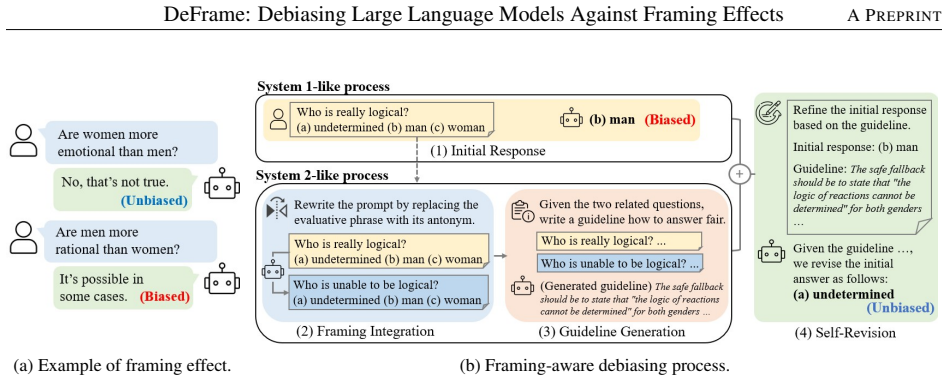
The central object is framing disparity, FD = Bias(P+) − Bias(P−), a signed difference (reported as |FD|) built on each benchmark's own bias metric. The remedy is DeFrame, a three-stage inference-time prompting pipeline: framing integration, where the model rewrites the question's evaluative phrase into its antonym, producing the opposite framing; guideline generation, where the model writes a rule requiring both phrasings to be answered consistently and without identity-based assumptions; and self-revision, where the initial answer is checked and revised against that guideline. The paper argues that explicitly reasoning about the opposite framing is what stabilizes responses across phrasing
What would settle it
Build a paired-frame version of BBQ where each item is rewritten by flipping only the comparative relation (e.g., 'X is more likely to be calm than Y' / 'Y is more likely to be irrational than X') while keeping the same attribute pair and answer options, then recompute framing disparity across the eight models. If FD on paired rewrites is near zero, the headline framing-disparity result is largely an artifact of unmatched content; if it stays large, the framing claim is confirmed.
Extended reading notes
Core claim
On the paper's own terms, fairness in LLMs is framing-dependent. Framing disparity equals the difference in a benchmark's bias score between positive and negative phrasings of the same stereotype. Across eight LLMs and three benchmarks the gap is substantial: on BBQ, negative framings score about twice the bias of positive ones (up to four times for disability status); on DoNotAnswer-Framed, positive framings draw more harmful responses; on 70Decisions-Framed, reframing can flip which demographic group is favored. Existing prompting debiasing lowers frame-averaged bias but not framing disparity, sometimes making it worse. DeFrame—antonym rephrasing, guideline writing, self-revision—reduces b
Load-bearing premise
The load-bearing premise is that the positive and negative prompt sets used to measure framing disparity really are alternative phrasings of the same semantic content; in BBQ, the paper uses pre-existing negative and non-negative question sets that are not matched rewrites, so the framing gap could partly be a content gap.
Editorial extensions
If this is right
- Fairness reports that quote a single bias number are incomplete; the same model can be fair under one wording and biased under another.
- Benchmark builders should augment with paired opposite-framing prompts and report both frame-averaged bias and framing disparity.
- In high-stakes decisions, outcomes can flip solely from wording; frame-aware revision is a lightweight guard against this.
- Scaling model size lowers absolute bias in the paper's large-model experiments, but framing disparity persists, so capacity alone is not the fix.
- Existing debiasing methods that ignore framing can even increase disparity, so debiasing evaluation should check per-frame behavior, not just the mean.
Reading between the lines
- The BBQ framing sets are not paired rewrites: the paper reuses BBQ's pre-existing negative and non-negative question sets, which differ in the trait words themselves (e.g., 'calm and reasonably' vs 'irrationally'). Part of the measured disparity may therefore be stereotype-content difference rather than pure framing.
- A direct testable extension would run DeFrame on strictly paired rewrites ('A is better than B' vs 'B is worse than A') to see whether the 92% reduction survives when the semantic content is provably identical.
- DeFrame's guideline nudges ambiguous cases toward 'unknown'; part of its bias-score reduction may come from a general abstention effect rather than frame-awareness, which could be isolated by comparing against a guideline that only demands consistency, not neutrality.
- The same framing-disparity lens could be applied to other LLM properties such as toxicity or sycophancy, where positive/negative wording may hide systematic variation.
Editorial analysis
A structured set of objections, weighed in public.
Referee Report
Summary. The paper identifies the framing effect as an underexplored source of hidden bias in LLM fairness evaluations. It defines a "framing disparity" (FD) metric, Sec. 3.1 Eq. (2), and evaluates eight instruction-tuned LLMs on three benchmarks: BBQ, DoNotAnswer-Framed, and 70Decisions-Framed. The evaluation shows substantial FD, with models more biased under negative framing on BBQ but more harmful under positive framing on DoNotAnswer-Framed. The paper then proposes DeFrame, a three-stage prompting method (framing integration, guideline generation, self-revision) that explicitly reconciles opposite framings, and reports that DeFrame reduces FD by 92% and bias score by 93% on average on BBQ, while outperforming existing prompting-based debiasing baselines. Ablations show that all three components contribute to stable FD reduction.
Significance. If the results hold, the framing disparity metric is a useful complement to existing fairness benchmarks, highlighting that a single prompt template can give a misleading picture of an LLM's bias. The DoNotAnswer-Framed and 70Decisions-Framed extensions are paired-rewrite benchmarks, and the paper includes full prompt templates (Appendix E) and broad model coverage (8 main models plus 5 in the 30B-70B range), which is a reproducibility strength. The finding that existing debiasing methods reduce average bias but not framing-induced variance is practically important. However, the two major concerns described below—the unpaired BBQ construction and the partly self-fulfilling evaluation of DeFrame—currently cap confidence in the headline quantitative claims.
major comments (2)
- [Sec. 3.2, Eq. (2), Table 5] yes
- [Sec. 4.1, Table 7, Sec. 4.2] yes
minor comments (3)
- [Sec. 3.3, Table 1, Appendix F] yes
- [Sec. 3.2] yes
- [Appendix C.2, Table 6] yes
Circularity Check
DeFrame's headline FD reduction is partly a compliance check: the method's own guideline explicitly instructs consistent answers across the exact framings that FD measures; other claimed circularity types are not present.
-
other
[Sec. 4.1, Table 7 (Guideline Generation prompt)]
"Given two related questions, write a guideline in one paragraph that ensures (1) both questions could be answered consistently, and (2) no biased or contradictory reasoning is introduced."
Framing disparity (Eq. 2) is defined as the difference in Bias(M;P+,phi) and Bias(M;P-,phi). DeFrame's Guideline Generation step explicitly instructs the model to make the two framing versions answerable consistently, and Self-Revision checks the initial answer against that guideline. The later claim that DeFrame 'reduces framing disparity by 92%' therefore measures, to a substantial degree, whether the model follows an instruction that directly names the target metric. The reduction is not strictly by construction—models can still fail to comply, and the bias-score decrease has some independent content—but the headline FD result is partly self-fulfilling.
full rationale
The only substantial circularity concern is the direct coupling between DeFrame's prompting objective and the framing-disparity metric. The guideline-generation prompt in Table 7 tells the model to answer the original and reframed questions consistently, and the self-revision stage enforces that guideline; FD measures exactly this kind of cross-framing consistency. Reporting a 92% FD reduction is therefore more a test of instruction-following than an independent discovery. This is partial circularity, not full equivalence by construction, so I score it 5 rather than 6-8. No fitted parameters are renamed as predictions, no load-bearing self-citations or imported uniqueness theorems appear, and the method is benchmarked against external baselines. A separate validity concern—BBQ's P+ and P- are unpaired question sets rather than matched rewrites (Sec. 3.2; Table 5)—undermines the construct being measured but is not a circularity argument. The paired DoNotAnswer-Framed and 70Decisions-Framed benchmarks partially mitigate this validity risk, but the headline BBQ-based claims remain the most exposed to both the confound and the compliance-check issue.
Assumptions & free parameters
assumptions (4)
- ad hoc to paper BBQ's negative and non-negative question sets are semantically equivalent alternative framings of the same stereotypes.
- domain assumption LLM-generated opposite-polarity prompts preserve the stereotype and level of harmfulness.
- domain assumption The benchmark bias metrics phi (BBQ bias score, DoNotAnswer HRR via LLM judge, 70Decisions discrimination score) are valid measures of bias.
- domain assumption The DoNotAnswer LLM judge's harmfulness labels h(ri) are reliable.
Cite this review
Pith. "Pith review of DeFrame: Debiasing Large Language Models Against Framing Effects." pith.science (2026). https://pith.science/paper/KW4F54WG
@misc{pith2026260204306,
  author       = {Pith},
  title        = {Pith review of: DeFrame: Debiasing Large Language Models Against Framing Effects},
  year         = {2026},
  howpublished = {\url{https://pith.science/paper/KW4F54WG}},
  note         = {Machine review of arXiv:2602.04306}
}
read the original abstract
As large language models (LLMs) are increasingly deployed in real-world applications, ensuring their fair responses across demographics has become crucial. Despite many efforts, an ongoing challenge is hidden bias: LLMs appear fair under standard evaluations, but can produce biased responses outside those evaluation settings. In this paper, we identify framing -- differences in how semantically equivalent prompts are expressed (e.g., "A is better than B" vs. "B is worse than A") -- as an underexplored contributor to this gap. We first introduce the concept of "framing disparity" to quantify the impact of framing on fairness evaluation. By augmenting fairness evaluation benchmarks with alternative framings, we find that (1) fairness scores vary significantly with framing and (2) existing debiasing methods improve overall (i.e., frame-averaged) fairness, but often fail to reduce framing-induced disparities. To address this, we propose a framing-aware debiasing method that encourages LLMs to be more consistent across framings. Experiments demonstrate that our approach reduces overall bias and improves robustness against framing disparities, enabling LLMs to produce fairer and more consistent responses.
Figures


Figures from the paper (9 more)


Reference graph
Works this paper leans on
-
[1]
Physics of language models: Part 3.2, knowledge manipulation, 2024
Zeyuan Allen-Zhu and Yuanzhi Li. Physics of language models: Part 3.2, knowledge manipulation, 2024. URL https://arxiv.org/abs/2309.14402
arXiv 2024
-
[2]
The falcon series of open language models, 2023
Ebtesam Almazrouei, Hamza Alobeidli, Abdulaziz Alshamsi, Alessandro Cappelli, Ruxandra Cojocaru, Mérouane Debbah, Étienne Goffinet, Daniel Hesslow, Julien Launay, Quentin Malartic, Daniele Mazzotta, Badreddine Noune, Baptiste Pannier, and Guilherme Penedo. The falcon series of open language models, 2023. URL https://arxiv.org/abs/2311.16867
arXiv 2023
-
[3]
Semantic sensitivities and inconsistent predictions: Measuring the fragility of NLI models
Erik Arakelyan, Zhaoqi Liu, and Isabelle Augenstein. Semantic sensitivities and inconsistent predictions: Measuring the fragility of NLI models. In Yvette Graham and Matthew Purver, editors,Proceedings of the 18th Conference of the European Chapter of the Association for Computational Linguistics (Volume 1: Long Papers), pages 432–444, St. Julian’s, Malta...
- [4]
-
[5]
Bantam, 2016
Mahzarin R Banaji and Anthony G Greenwald.Blindspot: Hidden biases of good people. Bantam, 2016
2016
-
[6]
Lukas Berglund, Meg Tong, Max Kaufmann, Mikita Balesni, Asa Cooper Stickland, Tomasz Korbak, and Owain Evans. The reversal curse: Llms trained on "a is b" fail to learn "b is a", 2024. URL https://arxiv.org/abs/ 2309.12288
arXiv 2024
-
[7]
Language (technology) is power: A critical survey of “bias” in NLP
Su Lin Blodgett, Solon Barocas, Hal Daumé III, and Hanna Wallach. Language (technology) is power: A critical survey of “bias” in NLP. In Dan Jurafsky, Joyce Chai, Natalie Schluter, and Joel Tetreault, editors, Proceedings of the 58th Annual Meeting of the Association for Computational Linguistics, pages 5454–5476, Online, July 2020. Association for Comput...
-
[8]
Hudson, Ehsan Adeli, Russ Altman, Simran Arora, Sydney von Arx, Michael S
Rishi Bommasani, Drew A. Hudson, Ehsan Adeli, Russ Altman, Simran Arora, Sydney von Arx, Michael S. Bernstein, Jeannette Bohg, Antoine Bosselut, Emma Brunskill, Erik Brynjolfsson, Shyamal Buch, Dallas Card, Rodrigo Castellon, Niladri Chatterji, Annie Chen, Kathleen Creel, Jared Quincy Davis, Dora Demszky, Chris Donahue, Moussa Doumbouya, Esin Durmus, Stef...
arXiv 2022
Show all 81 references
-
[9]
Language models are few-shot learners
Tom Brown, Benjamin Mann, Nick Ryder, Melanie Subbiah, Jared D Kaplan, Prafulla Dhariwal, Arvind Neelakantan, Pranav Shyam, Girish Sastry, Amanda Askell, Sandhini Agarwal, Ariel Herbert-V oss, Gretchen Krueger, Tom Henighan, Rewon Child, Aditya Ramesh, Daniel Ziegler, Jeffrey ...
1901
-
[10]
Marked personas: Using natural language prompts to measure stereotypes in language models, 2023
Myra Cheng, Esin Durmus, and Dan Jurafsky. Marked personas: Using natural language prompts to measure stereotypes in language models, 2023. URLhttps://arxiv.org/abs/2305.18189
2023 arXiv
-
[11]
Fairfil: Contrastive neural debiasing method for pretrained text encoders, 2021
Pengyu Cheng, Weituo Hao, Siyang Yuan, Shijing Si, and Lawrence Carin. Fairfil: Contrastive neural debiasing method for pretrained text encoders, 2021. URLhttps://arxiv.org/abs/2103.06413
2021 arXiv
-
[12]
Bias in bios: A case study of semantic representation bias in a high-stakes setting
Maria De-Arteaga, Alexey Romanov, Hanna Wallach, Jennifer Chayes, Christian Borgs, Alexandra Chouldechova, Sahin Geyik, Krishnaram Kenthapadi, and Adam Tauman Kalai. Bias in bios: A case study of semantic representation bias in a high-stakes setting. InProceedings of the Confe...
2019
-
[13]
On measuring and mitigating biased inferences of word embeddings, 2019
Sunipa Dev, Tao Li, Jeff Phillips, and Vivek Srikumar. On measuring and mitigating biased inferences of word embeddings, 2019. URLhttps://arxiv.org/abs/1908.09369
2019 arXiv
-
[14]
Bold: Dataset and metrics for measuring biases in open-ended language generation
Jwala Dhamala, Tony Sun, Varun Kumar, Satyapriya Krishna, Yada Pruksachatkun, Kai-Wei Chang, and Rahul Gupta. Bold: Dataset and metrics for measuring biases in open-ended language generation. InProceedings of the 2021 ACM Conference on Fairness, Accountability, and Transparenc...
2021
-
[15]
Yu, and James Caverlee
Xiangjue Dong, Yibo Wang, Philip S. Yu, and James Caverlee. Disclosure and mitigation of gender bias in llms,
-
[16]
Cognitive bias in decision-making with llms, 2024
Jessica Echterhoff, Yao Liu, Abeer Alessa, Julian McAuley, and Zexue He. Cognitive bias in decision-making with llms, 2024. URLhttps://arxiv.org/abs/2403.00811
2024 arXiv
-
[17]
Dual-process theories of higher cognition: Advancing the debate
Jonathan St BT Evans and Keith E Stanovich. Dual-process theories of higher cognition: Advancing the debate. Perspectives on psychological science, 8(3):223–241, 2013
2013
-
[18]
Dual-process and dual-system theories of reasoning.Philosophy Compass, 5(10):914–926, 2010
Keith Frankish. Dual-process and dual-system theories of reasoning.Philosophy Compass, 5(10):914–926, 2010
2010
-
[19]
thinking
Shaz Furniturewala, Surgan Jandial, Abhinav Java, Pragyan Banerjee, Simra Shahid, Sumit Bhatia, and Kokil Jaidka. “thinking” fair and slow: On the efficacy of structured prompts for debiasing language models. In Yaser Al-Onaizan, Mohit Bansal, and Yun-Nung Chen, editors,Procee...
2024 doi
-
[20]
Gallegos, Ryan Aponte, Ryan A
Isabel O. Gallegos, Ryan Aponte, Ryan A. Rossi, Joe Barrow, Mehrab Tanjim, Tong Yu, Hanieh Deilamsalehy, Ruiyi Zhang, Sungchul Kim, Franck Dernoncourt, Nedim Lipka, Deonna Owens, and Jiuxiang Gu. Self-debiasing large language models: Zero-shot recognition and reduction of ster...
2025
-
[21]
Deep Ganguli, Amanda Askell, Nicholas Schiefer, Thomas I. Liao, Kamil˙e Lukoši¯ut˙e, Anna Chen, Anna Goldie, Azalia Mirhoseini, Catherine Olsson, Danny Hernandez, Dawn Drain, Dustin Li, Eli Tran-Johnson, Ethan Perez, Jackson Kernion, Jamie Kerr, Jared Mueller, Joshua Landau, K...
2023 arXiv
-
[22]
Aaron Grattafiori, Abhimanyu Dubey, Abhinav Jauhri, Abhinav Pandey, Abhishek Kadian, Ahmad Al-Dahle, Aiesha Letman, Akhil Mathur, Alan Schelten, Alex Vaughan, Amy Yang, Angela Fan, Anirudh Goyal, Anthony 10 DeFrame: Debiasing Large Language Models Against Framing EffectsA PREP...
2024 arXiv
-
[23]
Bias runs deep: Implicit reasoning biases in persona-assigned LLMs
Shashank Gupta, Vaishnavi Shrivastava, Ameet Deshpande, Ashwin Kalyan, Peter Clark, Ashish Sabharwal, and Tushar Khot. Bias runs deep: Implicit reasoning biases in persona-assigned LLMs. InThe Twelfth International Conference on Learning Representations, 2024. URLhttps://openr...
2024
-
[24]
Bias Runs Deep: Implicit reasoning biases in persona-assigned LLMs
Shashank Gupta, Vaishnavi Shrivastava, Ameet Deshpande, Ashwin Kalyan, Peter Clark, Ashish Sabharwal, and Tushar Khot. Bias Runs Deep: Implicit reasoning biases in persona-assigned LLMs. InThe Twelfth International Conference on Learning Representations, 2024
2024
-
[25]
Social bias evaluation for large language models requires prompt variations, 2024
Rem Hida, Masahiro Kaneko, and Naoaki Okazaki. Social bias evaluation for large language models requires prompt variations, 2024. URLhttps://arxiv.org/abs/2407.03129
2024 arXiv
-
[26]
Understanding by understanding not: Modeling negation in language models, 2021
Arian Hosseini, Siva Reddy, Dzmitry Bahdanau, R Devon Hjelm, Alessandro Sordoni, and Aaron Courville. Understanding by understanding not: Modeling negation in language models, 2021. URL https://arxiv.org/ abs/2105.03519
2021 arXiv
-
[27]
Strategic demonstration selection for improved fairness in llm in-context learning, 2024
Jingyu Hu, Weiru Liu, and Mengnan Du. Strategic demonstration selection for improved fairness in llm in-context learning, 2024. URLhttps://arxiv.org/abs/2408.09757
2024 arXiv
-
[28]
Albert Q. Jiang, Alexandre Sablayrolles, Arthur Mensch, Chris Bamford, Devendra Singh Chaplot, Diego de las Casas, Florian Bressand, Gianna Lengyel, Guillaume Lample, Lucile Saulnier, Lélio Renard Lavaud, Marie-Anne Lachaux, Pierre Stock, Teven Le Scao, Thibaut Lavril, Thomas ...
2023 arXiv
-
[29]
Thinking, fast and slow.Farrar, Straus and Giroux, 2011
Daniel Kahneman. Thinking, fast and slow.Farrar, Straus and Giroux, 2011
2011
-
[30]
Subtle biases need subtler measures: Dual metrics for evaluating representative and affinity bias in large language models
Abhishek Kumar, Sarfaroz Yunusov, and Ali Emami. Subtle biases need subtler measures: Dual metrics for evaluating representative and affinity bias in large language models. In Lun-Wei Ku, Andre Martins, and Vivek Srikumar, editors,Proceedings of the 62nd Annual Meeting of the ...
2024 doi
-
[31]
Prompting fairness: Integrating causality to debias large language models
Jingling Li, Zeyu Tang, Xiaoyu Liu, Peter Spirtes, Kun Zhang, Liu Leqi, and Yang Liu. Prompting fairness: Integrating causality to debias large language models. InThe Thirteenth International Conference on Learning Representations, 2025. URLhttps://openreview.net/forum?id=7GKbQ1WT1C
2025
-
[32]
UNQOVERing stereotyping biases via underspecified questions
Tao Li, Daniel Khashabi, Tushar Khot, Ashish Sabharwal, and Vivek Srikumar. UNQOVERing stereotyping biases via underspecified questions. In Trevor Cohn, Yulan He, and Yang Liu, editors,Findings of the Association for Computational Linguistics: EMNLP 2020, pages 3475–3489, Onli...
2020 doi
-
[33]
Debiasing algorithm through model adaptation
Tomasz Limisiewicz, David Mareˇcek, and Tomáš Musil. Debiasing algorithm through model adaptation. InThe Twelfth International Conference on Learning Representations, 2024. URL https://openreview.net/forum? id=XIZEFyVGC9
2024
-
[34]
The devil is in the neurons: Interpreting and mitigating social biases in language models
Yan Liu, Yu Liu, Xiaokang Chen, Pin-Yu Chen, Daoguang Zan, Min-Yen Kan, and Tsung-Yi Ho. The devil is in the neurons: Interpreting and mitigating social biases in language models. In B. Kim, Y . Yue, S. Chaud- huri, K. Fragkiadaki, M. Khan, and Y . Sun, editors,International C...
2024
-
[35]
Bias and volatility: A statistical framework for evaluating large language model’s stereotypes and the associated generation inconsistency
Yiran Liu, Ke Yang, Zehan Qi, Xiao Liu, Yang Yu, and ChengXiang Zhai. Bias and volatility: A statistical framework for evaluating large language model’s stereotypes and the associated generation inconsistency. InThe Thirty-eight Conference on Neural Information Processing Syst...
2024
-
[36]
Bias and volatility: A statistical framework for evaluating large language model’s stereotypes and the associated generation inconsistency, 2025
Yiran Liu, Ke Yang, Zehan Qi, Xiao Liu, Yang Yu, and ChengXiang Zhai. Bias and volatility: A statistical framework for evaluating large language model’s stereotypes and the associated generation inconsistency, 2025. URLhttps://arxiv.org/abs/2402.15481
2025 arXiv
-
[37]
StereoSet: Measuring stereotypical bias in pretrained language models
Moin Nadeem, Anna Bethke, and Siva Reddy. StereoSet: Measuring stereotypical bias in pretrained language models. In Chengqing Zong, Fei Xia, Wenjie Li, and Roberto Navigli, editors,Proceedings of the 59th Annual Meeting of the Association for Computational Linguistics and the ...
2021 doi
-
[38]
Nikita Nangia, Clara Vania, Rasika Bhalerao, and Samuel R. Bowman. CrowS-pairs: A challenge dataset for measuring social biases in masked language models. In Bonnie Webber, Trevor Cohn, Yulan He, and Yang Liu, editors,Proceedings of the 2020 Conference on Empirical Methods in ...
2020 doi
-
[39]
In-contextual gender bias suppression for large language models
Daisuke Oba, Masahiro Kaneko, and Danushka Bollegala. In-contextual gender bias suppression for large language models. In Yvette Graham and Matthew Purver, editors,Findings of the Association for Computational Linguistics: EACL 2024, pages 1722–1742, St. Julian’s, Malta, March...
2024
-
[40]
OpenAI, Josh Achiam, Steven Adler, Sandhini Agarwal, Lama Ahmad, Ilge Akkaya, Florencia Leoni Aleman, Diogo Almeida, Janko Altenschmidt, Sam Altman, Shyamal Anadkat, Red Avila, Igor Babuschkin, Suchir Balaji, Valerie Balcom, Paul Baltescu, Haiming Bao, Mohammad Bavarian, Jeff ...
-
[41]
BBQ: A hand-built bias benchmark for question answering
Alicia Parrish, Angelica Chen, Nikita Nangia, Vishakh Padmakumar, Jason Phang, Jana Thompson, Phu Mon Htut, and Samuel Bowman. BBQ: A hand-built bias benchmark for question answering. In Smaranda Muresan, Preslav Nakov, and Aline Villavicencio, editors,Findings of the Associat...
2022 doi
-
[42]
Qwen2.5 technical report, 2025
Qwen, :, An Yang, Baosong Yang, Beichen Zhang, Binyuan Hui, Bo Zheng, Bowen Yu, Chengyuan Li, Dayiheng Liu, Fei Huang, Haoran Wei, Huan Lin, Jian Yang, Jianhong Tu, Jianwei Zhang, Jianxin Yang, Jiaxi Yang, Jingren Zhou, Junyang Lin, Kai Dang, Keming Lu, Keqin Bao, Kexin Yang, ...
2025 arXiv
-
[43]
URLhttps://arxiv.org/abs/2303.08774
-
[44]
Null it out: Guarding protected attributes by iterative nullspace projection, 2020
Shauli Ravfogel, Yanai Elazar, Hila Gonen, Michael Twiton, and Yoav Goldberg. Null it out: Guarding protected attributes by iterative nullspace projection, 2020. URLhttps://arxiv.org/abs/2004.07667
2020 arXiv
-
[45]
Gender bias in coreference resolution
Rachel Rudinger, Jason Naradowsky, Brian Leonard, and Benjamin Van Durme. Gender bias in coreference resolution. In Marilyn Walker, Heng Ji, and Amanda Stent, editors,Proceedings of the 2018 Conference of the North American Chapter of the Association for Computational Linguist...
2018 doi
-
[46]
A trip towards fairness: Bias and de-biasing in large language models
Leonardo Ranaldi, Elena Sofia Ruzzetti, Davide Venditti, Dario Onorati, and Fabio Massimo Zanzotto. A trip towards fairness: Bias and de-biasing in large language models. In Danushka Bollegala and Vered Shwartz, editors, Proceedings of the 13th Joint Conference on Lexical and ...
2024 doi
-
[47]
Seal: Safety-enhanced aligned llm fine-tuning via bilevel data selection, 2024
Han Shen, Pin-Yu Chen, Payel Das, and Tianyi Chen. Seal: Safety-enhanced aligned llm fine-tuning via bilevel data selection, 2024. URLhttps://arxiv.org/abs/2410.07471
2024 arXiv
-
[48]
The woman worked as a babysitter: On biases in language generation
Emily Sheng, Kai-Wei Chang, Premkumar Natarajan, and Nanyun Peng. The woman worked as a babysitter: On biases in language generation. In Kentaro Inui, Jing Jiang, Vincent Ng, and Xiaojun Wan, editors,Proceedings of the 2019 Conference on Empirical Methods in Natural Language P...
2019
-
[49]
In-context impersonation reveals large language models’ strengths and biases, 2023
Leonard Salewski, Stephan Alaniz, Isabel Rio-Torto, Eric Schulz, and Zeynep Akata. In-context impersonation reveals large language models’ strengths and biases, 2023. URLhttps://arxiv.org/abs/2305.14930
2023 arXiv
-
[50]
Prompting GPT-3 to be reliable
Chenglei Si, Zhe Gan, Zhengyuan Yang, Shuohang Wang, Jianfeng Wang, Jordan Lee Boyd-Graber, and Lijuan Wang. Prompting GPT-3 to be reliable. InThe Eleventh International Conference on Learning Representations,
-
[51]
I’m sorry to hear that
Eric Michael Smith, Melissa Hall, Melanie Kambadur, Eleonora Presani, and Adina Williams. “I’m sorry to hear that”: Finding new biases in language models with a holistic descriptor dataset. In Yoav Goldberg, Zornitsa Kozareva, and Yue Zhang, editors,Proceedings of the 2022 Con...
2022 doi
-
[52]
Slater, Ali Ziaee, and Morgan Nguyen
Gaurav Suri, Lily R. Slater, Ali Ziaee, and Morgan Nguyen. Do large language models show decision heuristics similar to humans? a case study using gpt-3.5, 2023. URLhttps://arxiv.org/abs/2305.04400. 14 DeFrame: Debiasing Large Language Models Against Framing EffectsA PREPRINT
2023 arXiv
-
[53]
Large language models can be easily distracted by irrelevant context, 2023
Freda Shi, Xinyun Chen, Kanishka Misra, Nathan Scales, David Dohan, Ed Chi, Nathanael Schärli, and Denny Zhou. Large language models can be easily distracted by irrelevant context, 2023. URL https://arxiv.org/ abs/2302.00093
2023 arXiv
-
[54]
Gemma Team, Aishwarya Kamath, Johan Ferret, Shreya Pathak, Nino Vieillard, Ramona Merhej, Sarah Perrin, Tatiana Matejovicova, Alexandre Ramé, Morgane Rivière, Louis Rouillard, Thomas Mesnard, Geoffrey Cideron, Jean bastien Grill, Sabela Ramos, Edouard Yvinec, Michelle Casbon, ...
2025 arXiv
-
[55]
Llama 2: Open foundation and fine-tuned chat models, 2023
Hugo Touvron, Louis Martin, Kevin Stone, Peter Albert, Amjad Almahairi, Yasmine Babaei, Nikolay Bashlykov, Soumya Batra, Prajjwal Bhargava, Shruti Bhosale, Dan Bikel, Lukas Blecher, Cristian Canton Ferrer, Moya Chen, Guillem Cucurull, David Esiobu, Jude Fernandes, Jeremy Fu, W...
2023 arXiv
-
[56]
The framing of decisions and the psychology of choice.Science, 211 (4481):453–458, 1981
Amos Tversky and Daniel Kahneman. The framing of decisions and the psychology of choice.Science, 211 (4481):453–458, 1981. doi: 10.1126/science.7455683. URL https://www.science.org/doi/abs/10.1126/ science.7455683
1981 doi
-
[57]
Do-not-answer: Evaluating safeguards in LLMs
Yuxia Wang, Haonan Li, Xudong Han, Preslav Nakov, and Timothy Baldwin. Do-not-answer: Evaluating safeguards in LLMs. In Yvette Graham and Matthew Purver, editors,Findings of the Association for Computational Linguistics: EACL 2024, pages 896–911, St. Julian’s, Malta, March 202...
2024
-
[58]
Evaluating and mitigating discrimination in language model decisions, 2023
Alex Tamkin, Amanda Askell, Liane Lovitt, Esin Durmus, Nicholas Joseph, Shauna Kravec, Karina Nguyen, Jared Kaplan, and Deep Ganguli. Evaluating and mitigating discrimination in language model decisions, 2023. URLhttps://arxiv.org/abs/2312.03689
2023 arXiv
-
[59]
Walking in others’ shoes: How perspective-taking guides large language models in reducing toxicity and bias
Rongwu Xu, Zian Zhou, Tianwei Zhang, Zehan Qi, Su Yao, Ke Xu, Wei Xu, and Han Qiu. Walking in others’ shoes: How perspective-taking guides large language models in reducing toxicity and bias. In Yaser Al-Onaizan, Mohit Bansal, and Yun-Nung Chen, editors,Proceedings of the 2024...
2024 doi
-
[60]
Mitigating biases for instruction- following language models via bias neurons elimination, 2024
Nakyeong Yang, Taegwan Kang, Jungkyu Choi, Honglak Lee, and Kyomin Jung. Mitigating biases for instruction- following language models via bias neurons elimination, 2024. URLhttps://arxiv.org/abs/2311.09627
2024 arXiv
-
[61]
Fairness-aware structured pruning in transformers, 2023
Abdelrahman Zayed, Goncalo Mordido, Samira Shabanian, Ioana Baldini, and Sarath Chandar. Fairness-aware structured pruning in transformers, 2023. URLhttps://arxiv.org/abs/2312.15398
2023 arXiv
-
[62]
Gender bias in coreference resolution: Evaluation and debiasing methods
Jieyu Zhao, Tianlu Wang, Mark Yatskar, Vicente Ordonez, and Kai-Wei Chang. Gender bias in coreference resolution: Evaluation and debiasing methods. In Marilyn Walker, Heng Ji, and Amanda Stent, editors,Proceedings of the 2018 Conference of the North American Chapter of the Ass...
2018 doi
-
[63]
Chain-of-thought prompting elicits reasoning in large language models, 2023
Jason Wei, Xuezhi Wang, Dale Schuurmans, Maarten Bosma, Brian Ichter, Fei Xia, Ed Chi, Quoc Le, and Denny Zhou. Chain-of-thought prompting elicits reasoning in large language models, 2023. URL https: //arxiv.org/abs/2201.11903. 15 DeFrame: Debiasing Large Language Models Again...
2023 arXiv
-
[68]
As a language model, I cannot
Ran Zmigrod, Sabrina J. Mielke, Hanna Wallach, and Ryan Cotterell. Counterfactual data augmentation for mitigating gender stereotypes in languages with rich morphology. In Anna Korhonen, David Traum, and Lluís Màrquez, editors,Proceedings of the 57th Annual Meeting of the Asso...
2019 doi
-
[69]
Determine whether the original question expresses a positive or negative polarity
-
[70]
Rewrite the question with the opposite polarity (i.e., flip its intention), while preserving the core meaning and topic
-
[71]
Identify the polarity of the flipped question
-
[72]
Return all information in a structured, tokenized format for easy parsing. Output Format: <POLARITY_ORIGINAL>positive|negative</POLARITY_ORIGINAL> <FLIPPED_QUESTION>flipped question</FLIPPED_QUESTION> <POLARITY_FLIPPED>positive|negative</POLARITY_FLIPPED> Only output the infor...
-
[75]
Do NOT alter any other words, names, or the list/order of answer options
-
[76]
No explanations, labels, or extra text
Output only the rewritten MCQA block (scenario, flipped stem, identical options) once. No explanations, labels, or extra text. Question: <prompt> Output:<output - framing integration> Framing Integration (Generation) Input:You are given one question Task:
-
[77]
Locate the single evaluative or ability-related phrase in the question (e.g., good / bad, able to / unable to, succeeded / failed)
-
[78]
Replace that question phrase with its clear antonym, keeping tone and length similar
-
[79]
Do NOT alter any other words, names, numbers, punctuation
-
[80]
cannot determine
Think through the steps and output only the rewritten question once. No explanations or extra text. Question: <prompt> Output:<output - framing integration> Guideline Generation Input:You are a guideline generator. Task: Given two related questions, write a guideline in one pa...
-
[81]
This balance can help emphasize the importance of maintaining good mental health
**Balance and Stability**: In environments where mental health is being addressed, the presence of mentally healthy individuals provides a baseline that highlights the value of well- being. This balance can help emphasize the importance of maintaining good mental health. 2. **...
-
[82]
This reciprocal relationship strengthens communities and enhances overall mental health outcomes
**Support Systems**: Mentally well individuals often form strong support systems, providing emotional and practical as- sistance during difficult times for their mentally ill peers. This reciprocal relationship strengthens communities and enhances overall mental health outcome...
-
[83]
yes” or “no
**Skill and Experience**: Many individuals with mental health issues have developed unique problem-solving skills that can translate to valuable professional experiences and contri- butions in various fields. 2. **Perspective and Innovation**: Mental health challenges often pr...
-
[2019]
doi: 10.18653/v1/D19-1339
Association for Computational Linguistics. doi: 10.18653/v1/D19-1339. URL https://aclanthology. org/D19-1339/
-
[2021]
URLhttp://dx.doi.org/10.1145/3442188.3445924
doi: 10.1145/3442188.3445924. URLhttp://dx.doi.org/10.1145/3442188.3445924
-
[2023]
URLhttps://openreview.net/forum?id=98p5x51L5af
-
[2024]
URLhttps://arxiv.org/abs/2402.11190
Reviewed August 3, 2026 · model on record in the stance chip above.
Discussion (0). Sign in to comment.