Graceful Labeling of Two Families of Spiders
Pith reviewed 2026-05-19 16:52 UTC · model grok-4.3
The pith
A relaxed joining condition for graceful graphs shows that spiders with legs whose lengths increase at least by a factor of two plus a constant are graceful.
A machine-rendered reading of the paper's core claim, the machinery that carries it, and where it could break.
Core claim
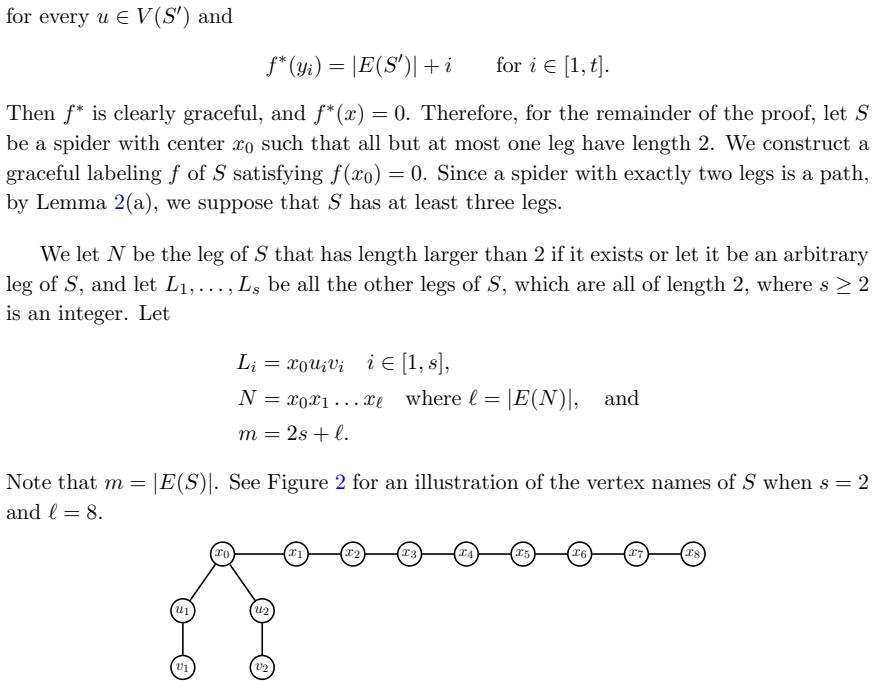
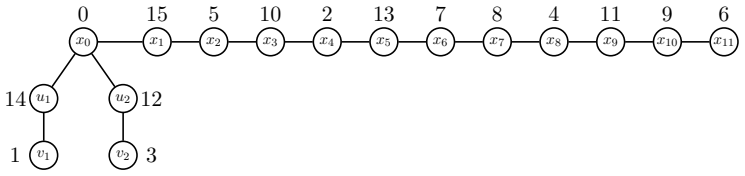
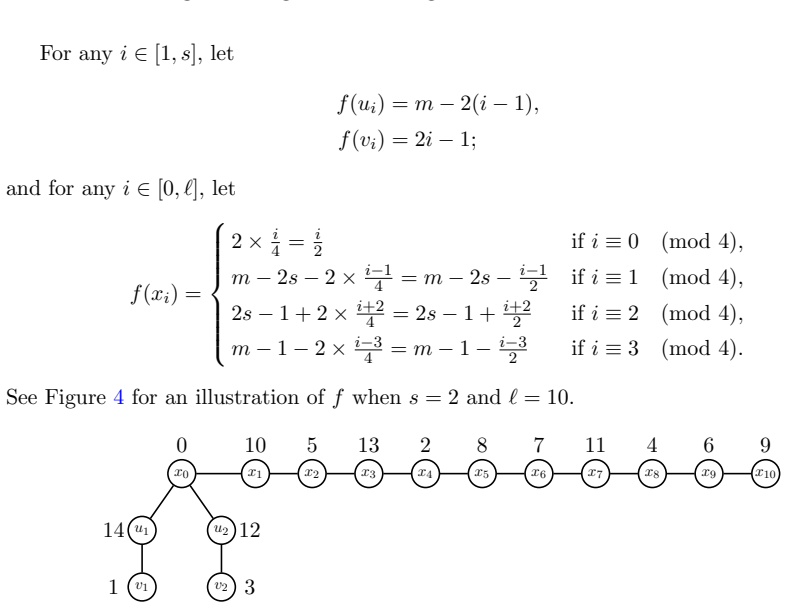
If G admits a graceful labeling f in which some vertex u satisfies f(u) + floor(n/2) + 1 ≤ n and n ≢ 1 (mod 4), then the graph formed by joining u to an endpoint of a disjoint copy of the path Pn is graceful. Applying the theorem to spiders with legs L1, …, Ls obeying the stated length inequalities yields graceful labelings for those spiders. An explicit construction is given for the subfamily in which one leg may be arbitrarily long while every other leg has at most two edges, again with the center labeled zero.
What carries the argument
The relaxed graceful-joining construction that attaches a path Pn to a vertex u whose label is bounded above by n − floor(n/2) − 1 when n ≢ 1 (mod 4).
If this is right
- Spiders whose leg lengths satisfy the doubling-plus-constant inequalities are graceful.
- Spiders consisting of one long leg and several legs of length at most two admit explicit graceful labelings with the center at zero.
- Further paths can be attached at the center of these explicitly labeled spiders while preserving gracefulness.
Where Pith is reading between the lines
- The same joining technique may apply to spiders whose leg lengths obey weaker growth rules than the ones proved here.
- The zero-center explicit labeling supplies a concrete starting point for checking gracefulness of mixed-leg spiders by computer for moderate sizes.
Load-bearing premise
The base graph G already possesses a graceful labeling in which the attachment vertex u carries a label small enough to satisfy the stated inequality with the chosen path length n.
What would settle it
A concrete spider obeying the leg-length inequalities for which the constructed edge differences are not all distinct would falsify the claim.
Figures

read the original abstract
A \emph{graceful labeling} of a graph $G$ is an injective function $f : V(G) \to \{0, \ldots, |E(G)|\}$ such that $\{\,|f(u)-f(v)| : uv \in E(G)\,\} = \{1, \ldots, |E(G)|\}$. If such a labeling exists, then we call $G$ \emph{graceful}. Introduced by Rosa in 1967, graceful labeling has been widely studied, and the Graceful Tree Conjecture asserts that every tree is graceful. The conjecture is known to hold for several classes of trees, including caterpillars, trees with at most four leaves, trees of diameter at most five, and certain spiders. An important subclass is that of \emph{$\alpha$-labelings}, where a graceful labeling $f$ admits an integer $\alpha$ such that each edge joins a vertex with label at most $\alpha$ to one with label greater than $\alpha$. A result from 1982 by Huang, Kotzig, and Rosa shows that if $H$ has an $\alpha$-labeling with a vertex $u$ labeled $0$ or $\alpha$, and $G$ has a graceful labeling with a vertex $v$ labeled $0$, then identifying $u$ and $v$ yields a graceful graph, though this requires a $0$-labeled vertex in $G$. We prove a related result that relaxes this condition: if $G$ has a graceful labeling $f$ such that $f(u)+\lfloor n/2 \rfloor + 1 \le n$ and $n \not\equiv 1 \pmod{4}$, where $u\in V(G)$ and $n\ge 2$ is an integer, then joining $u$ to an end vertex of the vertex-disjoint $n$-vertex path $P_n$ yields a graceful graph. As an application, we show that any spider with legs $L_1,\ldots,L_s$ ($s \ge 1$) satisfying $|E(L_{2})| \ge 2|E(L_1)|+ 4$ and $|E(L_{i+1})| \ge 2|E(L_i)|+ 2$ for $i \in \{2,\ldots, s-1\}$ is graceful. Furthermore, we give an explicit graceful labeling for spiders with one leg of arbitrary length and all others of length at most two such that the center is labeled by $0$. This labeling enables the construction of larger graceful spiders by attaching paths at the center.
Editorial analysis
A structured set of objections, weighed in public.
Referee Report
Summary. The manuscript proves a relaxed joining theorem: if G admits a graceful labeling f with vertex u satisfying f(u) + floor(n/2) + 1 ≤ n and n ≢ 1 (mod 4), then the graph obtained by joining u to an endpoint of a disjoint n-vertex path Pn is graceful. This is applied to show that any spider with legs L1,...,Ls (s≥1) satisfying |E(L2)| ≥ 2|E(L1)| + 4 and |E(Li+1)| ≥ 2|E(Li)| + 2 for i=2 to s-1 is graceful. The paper also supplies an explicit graceful labeling, with center labeled 0, for the family of spiders having one leg of arbitrary length and all remaining legs of length at most two.
Significance. If the constructions are correct, the work advances the Graceful Tree Conjecture by establishing gracefulness for two explicit infinite families of spiders via direct, reproducible labelings. The relaxed joining condition broadens the 1982 Huang-Kotzig-Rosa theorem by removing the requirement that the attachment vertex carry label 0 or α, thereby enabling the inductive arguments for the spider families. The explicit center-0 labeling for the second family is a particular strength, as it immediately supports further attachments.
minor comments (3)
- [§2] §2, Definition of the relaxed joining condition: the inequality f(u) + floor(n/2) + 1 ≤ n is stated without an accompanying small example (e.g., n=3 or n=5) that exhibits the explicit path labels and verifies that the new edge differences exactly fill {1,...,m+n} with no collisions.
- [§4] §4, Application to the second spider family: the explicit labeling with center 0 is described but the verification that the resulting labels remain injective and produce all required differences is only sketched; a table for a concrete instance (one leg of length 5, two legs of length 2) would make the construction easier to check.
- [References] References: the 1982 Huang-Kotzig-Rosa paper is cited only by year; the full bibliographic details (journal, volume, pages) should be supplied for completeness.
Simulated Author's Rebuttal
We thank the referee for the positive report, the recognition of the relaxed joining theorem's utility, and the recommendation of minor revision. The assessment correctly identifies the broadening of the Huang-Kotzig-Rosa result and the value of the center-0 labeling for further attachments.
Circularity Check
Derivation is self-contained with independent constructions
full rationale
The paper proves a new relaxed joining theorem directly from the definition of graceful labeling by constructing an explicit labeling on the added path vertices that fills the missing differences without conflicts, under the stated numerical conditions on f(u) and n. This construction is verified case-by-case for the two spider families by exhibiting base labelings (including the center-0 case) that meet the hypothesis, with the leg-length inequalities ensuring the inductive attachment preserves the required bound. The 1982 Huang-Kotzig-Rosa result is cited only for context and is not invoked as a load-bearing premise; the new theorem relaxes rather than depends on it. No equations reduce to self-definitions, fitted inputs renamed as predictions, or self-citation chains. The argument consists of explicit constructions and direct verification against the graceful-labeling definition.
Axiom & Free-Parameter Ledger
axioms (2)
- domain assumption A graceful labeling is an injective function f from vertices to {0, ..., m} such that the absolute differences on edges exactly equal {1, ..., m}.
- standard math Graphs considered are finite, simple, and undirected trees or paths.
Lean theorems connected to this paper
-
IndisputableMonolith/Cost/FunctionalEquationwashburn_uniqueness_aczel unclear?
unclearRelation between the paper passage and the cited Recognition theorem.
if G has a graceful labeling f such that f(u) + floor(n/2) + 1 <= n and n ≢ 1 (mod 4), then joining u to an end vertex of the vertex-disjoint n-vertex path Pn yields a graceful graph
-
IndisputableMonolith/Foundation/AlexanderDualityalexander_duality_circle_linking unclear?
unclearRelation between the paper passage and the cited Recognition theorem.
any spider with legs L1,...,Ls (s >= 1) satisfying |E(L2)| >= 2|E(L1)| + 4 and |E(Li+1)| >= 2|E(Li)| + 2 ... is graceful
What do these tags mean?
- matches
- The paper's claim is directly supported by a theorem in the formal canon.
- supports
- The theorem supports part of the paper's argument, but the paper may add assumptions or extra steps.
- extends
- The paper goes beyond the formal theorem; the theorem is a base layer rather than the whole result.
- uses
- The paper appears to rely on the theorem as machinery.
- contradicts
- The paper's claim conflicts with a theorem or certificate in the canon.
- unclear
- Pith found a possible connection, but the passage is too broad, indirect, or ambiguous to say the theorem truly supports the claim.
Reference graph
Works this paper leans on
- [1]
-
[2]
R. Cattell. Graceful labellings of paths.Discrete Math., 307(24):3161–3176, Nov. 2007
work page 2007
-
[3]
J. A. Gallian. A dynamic survey of graph labeling.Electronic Journal of Combinatorics, DS6, 2025. 28th edition, October 30, 2025
work page 2025
-
[4]
S. W. Golomb. How to number a graph.Graph theory and computing, pages 23–37, 1972
work page 1972
-
[5]
P. Hrnc´ ıar and A. Haviar. All trees of diameter five are graceful.Discrete Mathematics, 233:133–150, 2001
work page 2001
- [6]
- [7]
-
[8]
A. Panpa and T. Poomsa-ard. On graceful spider graphs with at most four legs of lengths greater than one.Journal of Applied Mathematics, 3:1–5, 2016
work page 2016
-
[9]
Ringel.Theory of Graphs and Its Applications
G. Ringel.Theory of Graphs and Its Applications. 1964
work page 1964
-
[10]
A. Rosa. On certain valuations of the vertices of a graph.Theory of Graphs (Internat. Sympos., Rome, 1966), pages 349–355, 1967
work page 1966
-
[11]
A. Rosa. Labeling snakes.Ars Combinatoria, 3:67–74, 1977
work page 1977
-
[12]
K. Saengsura and T. Poomsa-ard. Graceful labeling of some spider graphs.European Journal of Pure and Applied Mathematics, 18(2):5305, 2025. 17
work page 2025
discussion (0)
Sign in with ORCID, Apple, or X to comment. Anyone can read and Pith papers without signing in.